n e ws
4 The It hacan
Internship costs cause headaches internships from page 1
under the school’s insurance or the supervisor’s insurance,” Halperin said. “If the student is getting credit, then there is an assumption that the school will carry the insurance on the student.” Perlin said it has not been established who carries the PERLIN said intern liemployers usually ability, but require credits for schools are liability purposes. typically held responsible. “One motive that employers have is to push potential liability onto the schools,” Perlin said. “Academic credit would potentially lead a court to assume that the responsibility lies with the school, not with the employer.” However, paying for internship credits can pose a problem for some students when it is required by employers. Halperin said this creates additional costs for students who may not need the credits. “The employers may see it as value in that [students are] getting credit, but sometimes the students don’t technically need that credit,” Halperin said. Some departments at the college provide assistance in the internship search. Faculty and staff work with students to find internships that will give them valuable experience. Last week Career Services launched Career Shift, a comprehensive career management tool. Career Shift is a website used for job searches, networking and career management. Caryanne Keenan, assistant director for career development at Career Services, said the site will replace the department’s current job search tool, Career Search. Keenan said Career Shift provides more information than Career Search. “[Career Search] has ways that you can look up companies, but the people part of it is incredibly limited,” Keenan said. “Career Shift is loaded; every single time you do a search you come up with a lot of information.” According to Keenan, the site allows users to search for job listings and contacts and then organize them into specific folders. Career Shift combines elements of several other career search websites, she said. As students look for internships, some are frustrated about having to pay for credits. Junior Zach Woelfel interned with Cronin and company over the summer. Woelfel said he didn’t want to pay for unnecessary credits but said he understands why employers require credit. “Since we are doing work, we should be compensated for our work, and if it’s not going to be through a paycheck, it should be through credit,” Woelfel said. “I just wish there was a way to accomplish that without me having to personally pay for the credit.”
Th ursday, November 1 5 , 2 0 1 2
College increases local food options Food from page 1
"We’re planning on breaking ground in March, and it’ll be operational next summer, so by the time the fall semester of 2013 starts we’d be able to provide quite a bit more,” Holzbaur said. A small pilot project to bring more local products to campus began this year with Tim Leonard, the Towers Dining Hall manager who passed away earlier this semester. Holzbaur said Finger Lakes Fresh had provided several cases of produce, such as squash, tomatoes, corn and beans. Stephanie Piech, sustainability coordinator for Sodexo at the college, said dining services usually sources the cheapest food available. From what she is able to track, Piech said 14 to 15 percent of food costs were spent on local food. “With a better tracking system put into place this year and an increase of items, I believe we will be closer to 20 percent this year,” Piech said. Sodexo gets the majority of its products from Sysco, one of the largest wholesale food distributors in the U.S. “As far as I understand, places like Sysco will pretty much get it from the place that it’s cheapest to secure from,” Piech said. “My understanding is that if it can come locally or regionally, it will, just because a lot of times it’s cheaper as far as shipping and transportation.” Last year, the college’s chapter of the international Slow Food movement created a petition for more local and allergen- or diet-conscious options. Senior Danielle Prizzi, co-president and treasurer of the organization, said they received about 800 signatures. “[It stemmed from] how frustrating it was that it was our tuition money that was paying to have Sodexo supply our food, while there wasn’t a great deal of student input,” Prizzi said. Prizzi said there was an opportunity to source more food from local farmers that Sodexo was not taking advantage of. Slow Food shared the petition with Piech, and they began the feasibility of incorporating more localized food, Prizzi said. “We realized it would be easier to work within the infrastructure [of Sodexo],” Prizzi said. “I know a bunch of different schools have Sodexo and have dining halls that are completely locally sourced or as locally sourced as possible. I know [the University of Vermont] is a perfect example of students fighting for it.” UVM’s dining services are still provided by Sodexo, but because of the community’s vocalization
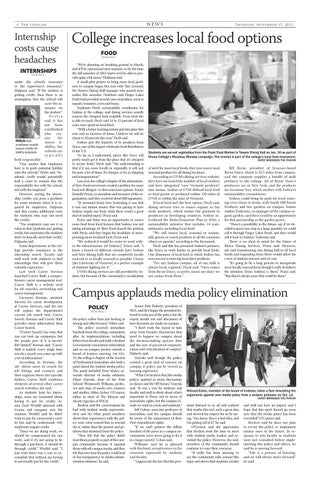
Students are served vegetables from the Fresh Food Market in Towers Dining Hall on Jan. 30 as part of Ithaca College's Meatless Monday campaign. The market is part of the college's local food movement.
Durst breneiser/The ithacan
of need for more local foods, they now source local seasonal produce for all dining locations. According to UVM’s dining services website, they have increased the number of local vendors and have integrated “core Vermont products” into menus. Sodexo at UVM defined local food as food grown or produced within 150 miles of UVM or within the state of Vermont. If local food isn’t the best option, Piech said, dining services tries to source organic or fair trade products, which ensure fair payment to producers in developing countries. Sodexo introduced the BetterTomorrow Plan in 2010, a sustainability initiative that includes 14 commitments, including local food. “We will source local, seasonal or sustainably grown or raised products in all the countries where we operate,” according to the document. Piech said this has pressured Sodexo’s partners, like Sysco, to work harder to provide local foods. One dimension of local food in which Sodexo has seen success is sourcing local dairy products. “For any Sodexo campus, all of our milk is always local, regional,” Piech said. “Ours comes from Byrne Dairy, so pretty much any dairy we use comes from them."
Bill Byrne, president of Syracuse-based Byrne Dairy, which is 55.5 miles from campus, said the company supplies a bundle of milk products to the college. All of Byrne Dairy’s producers are in New York, and the products are hormone free, which meshes with Sodexo’s sustainability commitment. Sodexo could bring its push for local sourcing even closer to home, with South Hill Forest Products and two gardens on campus. Senior Amber Zadrozny, co-manager of the campus organic garden, said there could be an opportunity for that partnership as the garden grows. “There’s a possibility in the future, say, if we decided to grow one crop in a large quantity, we could sell it through Finger Lakes Fresh, and they would sell it back to Sodexo,” Zadrozny said. There is no ideal in mind for the future of Ithaca Dining Services, Prizzi said. However, she said transitioning one dining hall to all local foods and expanding from there would allow for a test of student interest and of cost. “It’s going to be a long process to incorporate more locally sourced food, though I really do believe the intention [from Sodexo] is there,” Prizzi said. “But there’s always more that could be done.”
Campus applauds media policy elimination policy from page 1
the policy rather than just looking at timing and effectiveness,” Miles said. The policy received immediate backlash from the college community after its implementation, including letters from faculty and staff, a Student Government Association referendum and an on-campus protest outside a board of trustees meeting. On Oct. 15, the college’s chapter of the Society of Professional Journalists also held a panel about the student media policy. The panel included Dave Maley, associate director of media relations; Diane Gayeski, dean of the Park School; Wenmouth Williams, professor and chair of media arts, sciences and studies; Miles; Kelsey O’Connor, editor in chief of The Ithacan and Nicole Ogrysko of WICB. Rochon said the conversations he had with student media representatives and the other panel members about their experiences with the policy were what swayed him to rescind the it, rather than the protest and petitions that stemmed from the policy. “They felt that the policy didn’t treat them properly as part of the campus community because it equated them with off-campus media, and they felt that over time the policy could lead to less transparency to media-administration relations,” he said.
Senior Rob Flaherty, president of SGA, said he’s happy the president listened to criticism of the policy, but the repeal should not end discussion of how decisions are made on campus. “I don’t want the repeal to take away from broader discussions that need to happen on campus about the decision-making process here and the sort of perceived corporatization and centralization of campus,” Flaherty said. Gayeski said though the policy created a great deal of concern on campus, it policy can be viewed as learning experience. “What I’ve heard is that [the media policy] sparked so many discussions in classes and the SPJ forum,” Gayeski said. “It was a way for students and faculty and staff to think about what’s important to them, not in terms of journalistic rights, but the campus climate we want to create and maintain.” Jeff Cohen, associate professor of journalism, said the campus should be aware of the importance of their First Amendment rights. “If we can’t protect the fullest freedom of the press in a campus environment, we’re never going to do it in a larger society,” Cohen said. Williams said he is pleased with Rochon’s receptiveness to the concerns expressed by students and faculty. “I appreciate the fact that the pres-
Richard Eaton, member of the board of trustees, takes a flyer describing the arguments against new media policy from a student protester on Oct. 12.
Durst breneiser/the ithacan
ident listened to us all and realized that maybe this isn’t such a great idea and showed his respect for us by saying, ‘You know, this is a bad idea, and I’m getting rid of it,’” he said. O’Connor said she appreciates that Rochon took the time to meet with student media leaders and revisited the policy. However, she said, members of the community should continue to voice their concerns. “It really has been amazing to see the community rally around this topic and shows that students, faculty
and staff can have an impact, and I hope that this spirit doesn’t go away now that the media policy has been rescinded,” O’Connor said. Rochon said he does not plan to revisit the policy or implement similar ones in the future. In response to why faculty or students were not consulted before implementing this policy and others, he said he is moving forward. “Life is a process of learning, and we will always move forward,” he said.