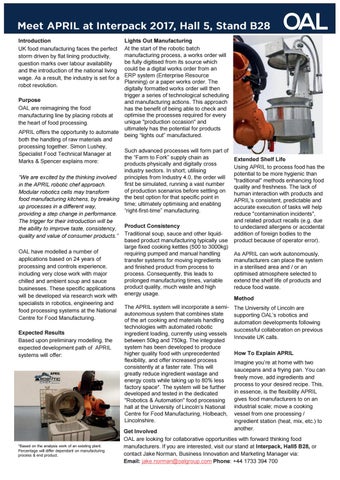
Introduction UK food manufacturing faces the perfect storm driven by flat lining productivity, question marks over labour availability and the introduction of the national living wage. As a result, the industry is set for a robot revolution. Purpose OAL are reimagining the food manufacturing line by placing robots at the heart of food processing. APRIL offers the opportunity to automate both the handling of raw materials and processing together. Simon Lushey, Specialist Food Technical Manager at Marks & Spencer explains more:
Lights Out Manufacturing At the start of the robotic batch manufacturing process, a works order will be fully digitised from its source which could be a digital works order from an ERP system (Enterprise Resource Planning) or a paper works order. The digitally formatted works order will then trigger a series of technological scheduling and manufacturing actions. This approach has the benefit of being able to check and optimise the processes required for every unique "production occasion" and ultimately has the potential for products being “lights out” manufactured.
Such advanced processes will form part of the “Farm to Fork” supply chain as products physically and digitally cross industry sectors. In short; utilising “We are excited by the thinking involved principles from Industry 4.0, the order will first be simulated, running a vast number in the APRIL robotic chef approach. of production scenarios before settling on Modular robotics cells may transform food manufacturing kitchens, by breaking the best option for that specific point in time; ultimately optimising and enabling up processes in a different way, “right-first-time” manufacturing. providing a step change in performance. The trigger for their introduction will be the ability to improve taste, consistency, Product Consistency quality and value of consumer products.” Traditional soup, sauce and other liquidbased product manufacturing typically use large fixed cooking kettles (500 to 3000kg) OAL have modelled a number of requiring pumped and manual handling applications based on 24 years of transfer systems for moving ingredients processing and controls experience, and finished product from process to process. Consequently, this leads to including very close work with major prolonged manufacturing times, variable chilled and ambient soup and sauce product quality, much waste and high businesses. These specific applications will be developed via research work with energy usage. specialists in robotics, engineering and The APRIL system will incorporate a semifood processing systems at the National autonomous system that combines state Centre for Food Manufacturing. of the art cooking and materials handling Expected Results Based upon preliminary modelling, the expected development path of APRIL systems will offer:
*Based on the analysis work of an existing plant. Percentage will differ dependant on manufacturing process & end product.
INGOMBRO ADV.indd 3
technologies with automated robotic ingredient loading, currently using vessels between 50kg and 750kg. The integrated system has been developed to produce higher quality food with unprecedented flexibility, and offer increased process consistently at a faster rate. This will greatly reduce ingredient wastage and energy costs while taking up to 80% less factory space*. The system will be further developed and tested in the dedicated "Robotics & Automation" food processing hall at the University of Lincoln’s National Centre for Food Manufacturing, Holbeach, Lincolnshire.
Extended Shelf Life Using APRIL to process food has the potential to be more hygienic than "traditional" methods enhancing food quality and freshness. The lack of human interaction with products and APRIL’s consistent, predictable and accurate execution of tasks will help reduce "contamination incidents", and related product recalls (e.g. due to undeclared allergens or accidental addition of foreign bodies to the product because of operator error). As APRIL can work autonomously, manufacturers can place the system in a sterilised area and / or an optimised atmosphere selected to extend the shelf life of products and reduce food waste. Method The University of Lincoln are supporting OAL’s robotics and automation developments following successful collaboration on previous Innovate UK calls.
How To Explain APRIL Imagine you’re at home with two saucepans and a frying pan. You can freely move, add ingredients and process to your desired recipe. This, in essence, is the flexibility APRIL gives food manufacturers to on an industrial scale; move a cooking vessel from one processing / ingredient station (heat, mix, etc.) to another.
Get Involved OAL are looking for collaborative opportunities with forward thinking food manufacturers. If you are interested, visit our stand at Interpack, Hall5 B28, or contact Jake Norman, Business Innovation and Marketing Manager via: Email: jake.norman@oalgroup.com Phone: +44 1733 394 700
07/04/17 11:01