NICOSIA
NICOSIA
The Heart of Cyprus
N
icosia has been the capital of Cyprus since the 11th century. Encircled by strong fortress walls built by the Venetians in the 16th century and renowned for its fabled and mysterious past, today’s Lefkoşa (Turkish name of the city) blends its historic past brilliantly with the bustle of a modern city.
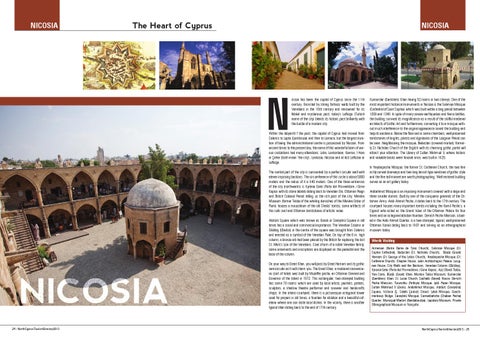
Within the labyrinth f the past, the capital of Cyprus had moved from Salamis to Lapta (Lambousa) and then to Larnaca; but the longest duration of being the administrational centre is possessed by Nicosia. From ancient times to the present day, the name of this wonderful loom of various civilizations had many alterations: Lidra, Levkonteon, Kermia, I Hora or Şeher (both mean ‘the city’), Levkosia, Nicosia and at last Lefkosia or Lefkoşa. The central part of the city is surrounded by a perfect circular wall with eleven imposing bastions. The circumference of this circle is about 5000 meters and the radius of it is 840 meters. One of the three entrances of the city (northwards) is Kyrenia Gate (Porta del Provveditore / Girne Kapısı) with its stone tablets dating back to Venetian Era, Ottoman Reign and British Colonial Period telling us the rich past of the city. Mevlevi Museum (former Tekke of the whirling dervishes of the Mevlevi Order of Rumi) houses a mausoleum of the old Sheiks’ tombs, some artifacts of this sufic sect and Ottoman tombstones of artistic value. Atatürk Square which was known as Konak or Sarayönü Square in old times has a social and commercial importance. The Venetian Column or Dikilitaş (Obelisk) in the centre of the square was brought from Salamis and erected as a symbol of the Venetian Rule. On top of the 6 m. high column, a bronze orb had been placed by the British for replacing the lost St. Mark’s Lion of the Venetians. Coat of arm of a noble Venetian family, some ornaments and inscriptions are displayed on the pedestal and the base of the column.
NICOSIA 24 - NorthCyprusTourismDirectory2013
On your way to Great Khan, you will pass by Great Hamam and its gothic semicircular arch will charm you. The Great Khan, a medieval caravenserai (sort of hotel) was built by Muzaffer pasha, an Ottoman General and Governor of the Island in 1572. This rectangular, two-storeyed building has some 70 rooms which are used by local artists, painters, potters, sculptors, a shadow theatre performer and souvenir and handicrafts shops. In the interio courtyard, there is a picturesque octagonal tower used for prayers in old times, a fountain for ablution and a beautiful cafeteria where one can taste local dishes. In the vicinity, there is another typical khan dating back to the end of 17th century,
Kumarcılar (Gamblers) Khan having 52 rooms in two storeys. One of the most important historical monuments in Nicosia is the Selimiye Mosque (Cathedral of Saint Sophia) which was built within a long period between 1209 and 1340. In spite of many severe earthquakes and fierce battles, the building survived its magnificence as a result of the skillful medieval architects of Gothic Art and furthermore, converting it to a mosque without much interference to the original appearance saved the building and help its existence. Below the floor and in some chambers, well preserved tombstones of knights, priests and dignitaries of the Lusignan Period can be seen. Neighbouring the mosque, Bedestan (covered market), formerly St. Nicholas Church of the English with its charming gothic portal will attract your attention. The Library of Sultan Mahmud II, where historic and valuable books were housed once, was built in 1829. In Haydarpasha Mosque, the former St. Catherine Church, the two fine richly carved doorways and two long lancet type windows of gothic style and the fine tall minaret are worth photographing. Well restored building serves as an art gallery today. Arabahmet Mosque is an imposing monument covered with a large and three smaller domes. Built by one of the conqueror generals of the Ottoman Army, Arab Ahmet Pasha, it dates back to the 17th century. The courtyard houses many important tombs including the Kamil Pasha’s, a Cypriot who acted as the Grand Vizier of the Ottoman Palace for four times and an octagonal ablution fountain. Dervish Pasha Mansion, situated in the Arab Ahmet Quarter, is a two-storeyed, typical, well preserved Ottoman Konak dating back to 1807 and serving as an ethnographical museum today. Worth Visiting Armenian (Notre Dame de Tyre) Church), Selimiye Mosque (St. Sophia Cathedral), Bedestan (St. Nicholas Church), Büyük (Great) Hamam (St. George of the Latins Church), Haydarpasha Mosque (St. Catherine Church), Chapter House, Latin Archbishopric Palace, Lusignan House, City Walls and the Bastions, Venetian Column (Dikilitaş), Kyrenia Gate (Porta del Provveditore / Girne Kapısı), Aziz Efendi Tekke, Yeni Cami, Büyük (Great) Khan, Mevlevi Tekke Museum, Kumarcılar (Gamblers) Khan, St. Lucas Church, Sachaklı (Eaved) House, Dervish Pasha Mansion, Turunchlu (Fethiye) Mosque, Iplik Pazari Mosque, Sultan Mahmud II Library, Arabahmet Mosque, Atatürk (Sarayönü) Square, Victoria (Ş. Salahi Şevket) Street, Laleli Mosque, Goechmenkeuy Bridge, Sarayönü Mosque, Samanbahche (Shaban Pasha) Quarter, Municipal Market (Bandabouliya), Lapidary Museum, Private Ethnographical Museum in Yenişehir.
NorthCyprusTourismDirectory2013 - 25