IST High School Graduation Guide



The International School of Texas (IST) is a Candidate School for the International Baccalaureate Diploma Programme. This school is pursuing authorization as an IB World School, having already received authorization for the Primary Years (PYP) and Middle Years (MYP) programmes. These are schools that share a common philosophy a commitment to high-quality, challenging, international education that IST believes is important for our students
*Only schools authorized by the IB Organisation can offer any of its four academic programmes: the Primary Years Programme (PYP), the Middle Years Programme (MYP), the Diploma Programme (DP), or the Career-related Programme (CP). Candidate status gives no guarantee that authorization will be granted. For further information about the IB and its programmes, visit www.ibo.org.


Table of Contents
Introduction ..... 4
Why IST DP? ..... 5
Diplomas ..... 7
DP Courses at IST: A Shared Learning Journey ..... 9
Assessment in IB Diploma ..... 20
Conditions for Awarding the IB Diploma ..... 21
Understanding DP Scores, Results, and the Diploma ..... 22
Grade Conversions ..... 23
Key Date Windows ..... 24
College Counseling & University Planning ..... 25
Contact List ..... 30
Introduction
The final two years of high school should do more than help students “finish requirements.” They should strengthen the habits that matter most after graduation: disciplined thinking, clear communication, intellectual honesty, and the confidence to learn independently.
The IB Diploma Programme (DP) at IST is built to develop those strengths. Students don’t just absorb content—they learn to make claims with evidence, weigh perspectives fairly, and communicate ideas with precision. They practice managing long-term deadlines, responding to feedback, and sustaining effort over time

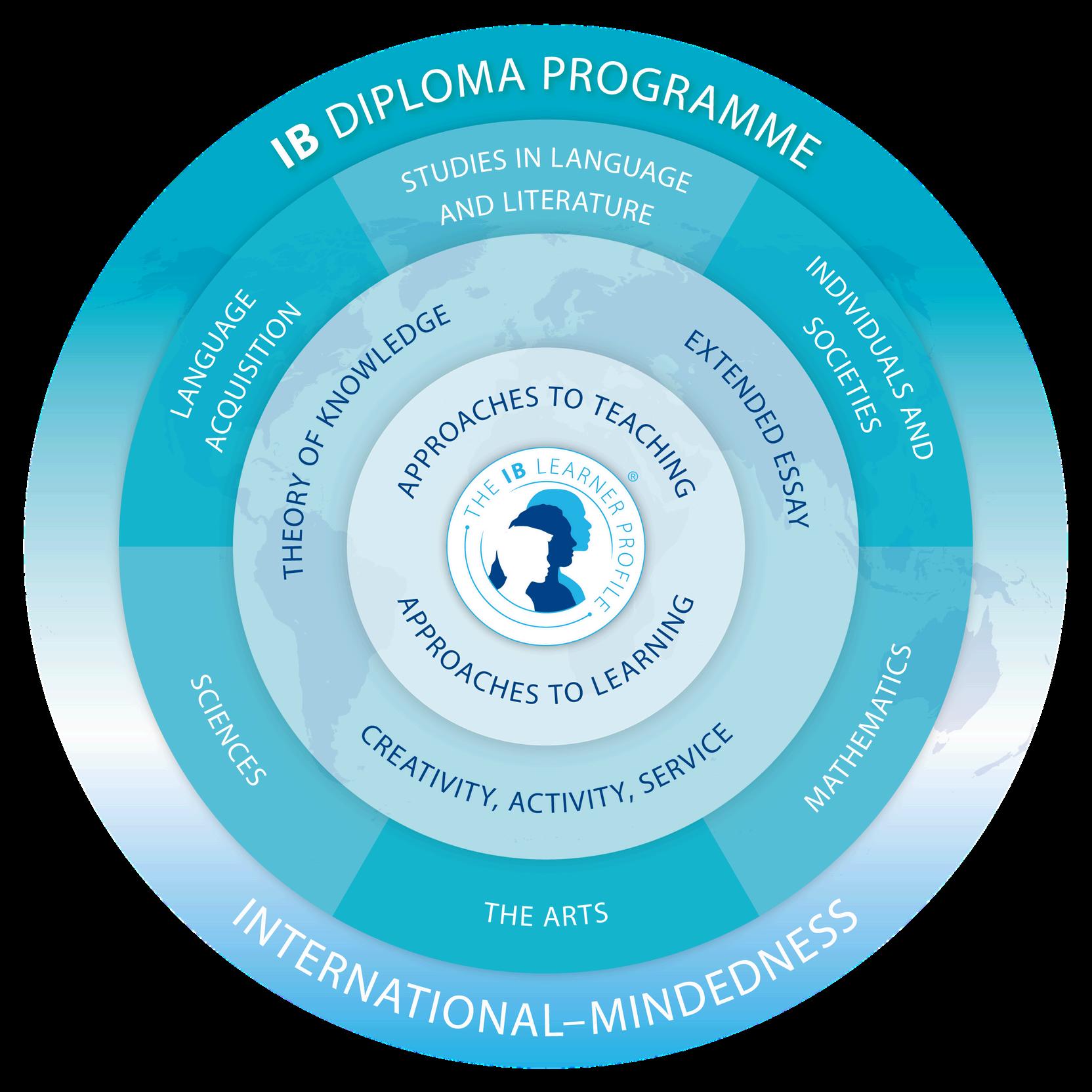
DP learning is intentionally both broad and deep. Students study across disciplines while also developing expertise in selected subjects through Higher Level coursework. At the same time, the DP Core—Creativity, Activity, Service (CAS), Theory of Knowledge (TOK), and the Extended Essay (EE)— develops research competence, reflection, ethical awareness, and real-world engagement.
This guide is designed to make the high school clear and manageable. It outlines diploma options at IST, what students will experience day to day, the headline milestones families should protect, and who to contact with questions. Read it as both a map for the journey ahead and an invitation to a kind of learning that changes students for the better.
Why IST DP?
At IST, the final two years are the capstone of a fully aligned IB journey Students enter DP fluent in inquiry, reflection, and international-mindedness and we raise the ceiling. DP at IST balances rigorous academics with whole-student development: students learn to think deeply, communicate with precision, analyze complex information, and defend ideas with evidence. They also build the habits that matter most for college success—time management, resilience, and the ability to connect learning to real-world contexts. Our promise is simple: whether a student pursues the full IB Diploma or earns course results through the same DP classes, the learning experience and expectations remain equally rigorous. The difference is how students complete the final credentialing components not the quality of the program or the outcomes it builds.
What kind of student thrives here?
Students thrive at IST DP when they’re curious, willing to wrestle with complexity, and open to feedback. They don’t need to be “the smartest kid in the room.” They need to be the kind of learner who can ask good questions, revise their thinking, and show up consistently. If a student enjoys discussion, debate, labs, problemsolving, creative work, or building arguments from evidence, DP will feel like a home.
IST is also a strong fit for students who want a school culture that values kindness, perspective-taking, and global awareness alongside achievement. DP rewards students who can think beyond “right answers” and learn to make strong, ethical, wellsupported decisions—especially when the world is messy.
What outcomes do we build (no matter the credential path)?
Evidence-based thinking. Students learn to analyze information, evaluate claims, interpret data, and justify conclusions skills that transfer to any university major or career.
Research and academic writing. Students learn to ask meaningful questions, locate and assess sources, and produce structured, credible writing.
Clear communication. Students develop confidence speaking and writing with precision explaining ideas, defending arguments, and collaborating effectively.
Time management and resilience. Students learn to plan, prioritize, and sustain highquality work over time one of the strongest predictors of college success.
Ethical, globally minded leadership. Students learn to weigh perspectives, consequences, and responsibility in an interconnected world.
IST is a strong fit for students who want a culture that values kindness, perspectivetaking, and global awareness alongside achievement. The DP rewards learners who can move beyond “right answers” to make thoughtful, ethical, evidence-based decisions especially when real-world issues are complex.
In the pages that follow, you will see what each DP course looks like at IST what students study, how learning runs week to week, and how IB results are earned in each subject.
To earn the IB Diploma, students study six DP subjects across languages, individuals and societies, sciences, mathematics, and the arts— selecting three at Higher Level and three at Standard Level. At IST, all students complete the same courses whether or not they ultimately pursue the full IB Diploma. The DP Core (CAS, TOK, and the Extended Essay) is completed in its full IB form by IB Diploma candidates.
All students also complete the DP Core:
Theory of Knowledge (TOK) encourages students to question how knowledge is constructed and to explore connections between disciplines and perspectives while building philosophical inquiry skills.
The Extended Essay (EE) is an independent research project developing academic writing, inquiry, and self-management skills for university life. (IB Diploma candidates complete the full 4,000-word EE.)
Creativity, Activity, Service (CAS) invites engagement in artistic pursuits, physical challenges, and community initiatives that promote balance, reflection, and purpose in and outside of school. (IB Diploma candidates complete CAS requirements and the full portfolio.)
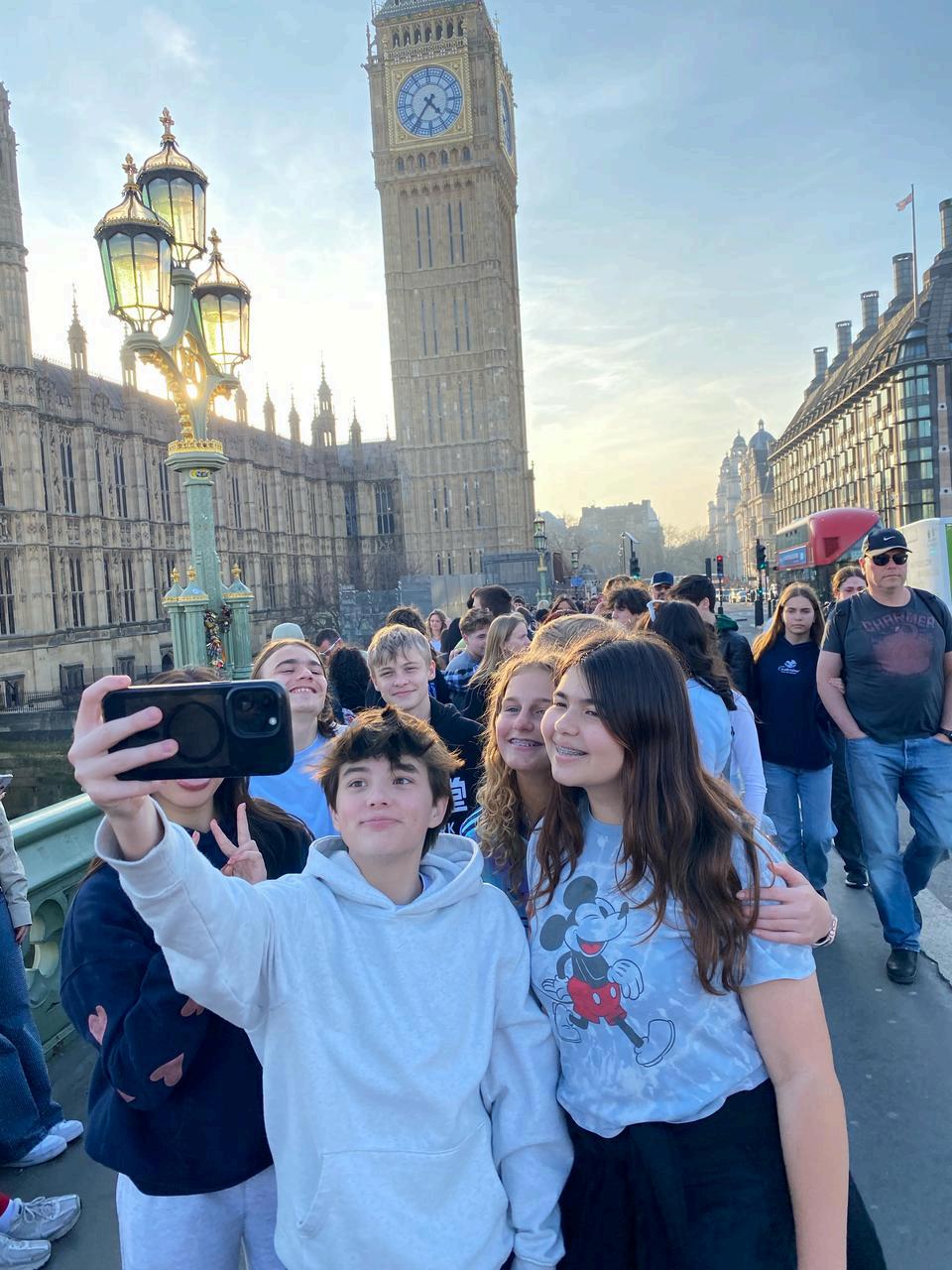
IST combines academic rigor with balance and structure with freedom to develop individual pursuits, encouraging students to explore interdisciplinary connections, develop leadership through service, and build the self-management and inquiry skills essential for university success.
Graduates of the IB Diploma Programme are recognized worldwide for their preparation and achievement, with universities across the globe granting advanced standing, course credit, or direct admission to successful Diploma candidates.

High School Faculty Spotlight
Average of 18+ years of teaching experience. 100% hold bachelor’s degrees; 72% hold graduate-level degrees; 18% hold PhDs.
Diploma Pathways
All IST students take the same courses. Families typically finalize the decision to pursue the full IB Diploma at the end of DP1 (Grade 11).
IST Pathway (Course Results / IST Diploma): Students remain in the same DP courses, but may take SL courses only in DP2, may opt out of IB external assessments and complete IST campus-based final assessments instead, and may complete an EE-style research project at a reduced length if not pursuing the full IB Diploma.
Accreditations and Authorizations
IB: International Baccalaureate Organization
TAAPS: Texas Alliance of Accredited Private Schools

Graduation Pathways

The IST Diploma
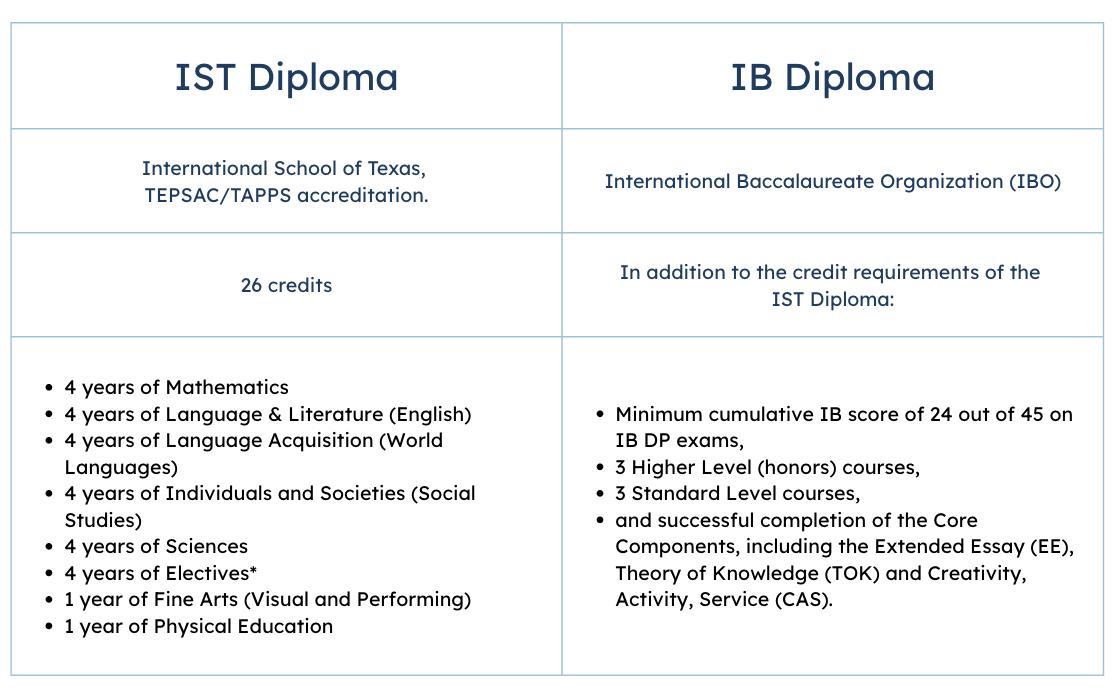
Upon successful completion of IST graduation requirements, students earn an IST High School Diploma (TEPSAC/TAPPS accredited). All 11 and 12 grade courses are college preparatory courses. th th
The IB Diploma
To earn the full IB Diploma, students complete six DP subjects (typically three at Higher Level and three at Standard Level) and successfully complete the DP Core: CAS, TOK, and the Extended Essay.
It’s important to distinguish between two types of results students earn during DP: Standard day to day course grades vs. the overall final IB score is determined from required Internal and External assessments. See individual course pages scoring sections for more details.
*Exams & Registrations (IBDP, SAT, ACT) not included in tuition fees.
The IB Diploma Programme at IST
The IB Diploma Programme (DP Grades 11-12) is designed to develop strong subject knowledge while also building the habits universities expect: independent learning, clear communication, research competence, and ethical decision-making.
What makes the DP distinct
Students do not just learn content they learn how to build and defend ideas with evidence, consider multiple perspectives, and communicate with precision. Across two years, students practice long-term planning, revision based on feedback, and sustained performance under deadlines.
DP structure
Students pursuing the full IB Diploma complete six subjects (typically three at Higher Level and three at Standard Level) plus the DP Core:
Creativity, Activity, Service (CAS)
Theory of Knowledge (TOK)
Extended Essay (EE)
University recognition (important, but individualized)
Universities worldwide recognize the strength of DP coursework. Admission and credit/placement policies vary by institution and programme. IST College Counseling will support students in researching recognition policies, building balanced plans, and aligning DP choices to postsecondary goals.
Planning note
This guide provides a clear overview of expectations and key programme windows. Cohort-specific deadlines and exact dates are provided in the Two Year Assessment Calendar finalized in August of each student’s DP1 (Grade 11) year.
DP Courses at IST: A Shared Learning Journey
The Diploma Programme is designed as a coherent two-year course of study, not a collection of disconnected classes. While each subject has its own content and assessment model, all DP courses at IST share a common purpose: to help students think deeply, communicate clearly, and apply learning in sophisticated, real-world ways. Across the programme, students build the habits that make advanced learning possible—strong reading and research skills, disciplined writing and problem-solving, effective time management, and the ability to reflect and improve through feedback.
You will notice a consistent rhythm across courses from DP1 to DP2. DP1 focuses on building the foundation: core concepts, key skills, and the academic routines students need to succeed. DP2 increases independence and performance: students refine their thinking, strengthen their ability to work under exam-style conditions where relevant, and complete major IB assessment components such as Internal Assessments and course-specific performance tasks. This gradual increase in sophistication is intentional; students are not expected to start at “IB or university level” on day one—they grow into it through structured practice.
At the heart of the DP is a shared emphasis on perspective, evidence, and responsible learning. Students learn to support claims with evidence, evaluate ideas fairly, and communicate with clarity and respect. They also learn to use academic integrity consistently and to manage long-term tasks with planning and resilience. Over two years, students develop more than subject knowledge—they develop the intellectual toolkit to succeed in university and beyond.
Each course page that follows explains what students study, how learning typically looks week to week, and how the final IB subject score (1–7) is calculated for that course.
Course lengths:
All courses run the full two years (Class of 2028: August 2026 through May 2028graduation).
Standard level courses have a minimum of 150 hours of instruction, and High level courses have a minimum of 240 hours of instruction.
Choosing HL vs SL (simple guidance)
Higher Level courses require deeper conceptual mastery and greater volume over two years. Students should choose HLs based on: sustained interest, demonstrated strength, and realistic workload balance alongside TOK, EE, CAS, and internal assessments.
Available courses each year/cohort dependent on student interests, staffing, and scheduling.
Group 1 Language A: English Language & Literature
Course overview
DP English Language & Literature at IST is a two-year course in disciplined reading, clear thinking, and powerful communication. Students study literary and non-literary works to understand how meaning is shaped by language, structure, voice, and context and how writers and speakers build credibility, persuade audiences, and express complex ideas with precision. Across DP1, students strengthen close reading and analytical writing; across DP2, they develop greater independence and control, refining interpretation, synthesis, and argumentation under timed conditions. The through-line is simple and rigorous: strong claims are built through evidence, reasoning, and craft. By the end, students can write with authority, speak with confidence, and engage thoughtfully with challenging texts and ideas.
How students learn in this course (what it looks like week to week)
Week to week, students move through a steady rhythm of close-reading workshops, guided discussion, and writing cycles built around feedback and revision Lessons regularly shift from noticing details to forming interpretations, then shaping those interpretations into coherent arguments with purposeful structure and style. Students practice comparative thinking deliberately connecting works by technique, purpose, audience, and choices rather than surface topic. Oral work develops in stages from low-stakes practice to polished delivery, building clarity, poise, and control over ideas in real time
How the final IB score (1–7) is calculated in this course: Your student’s IST course grade comes from ongoing coursework across the year. The final IB subject score (1–7) comes from the IB assessment components below. IB assessment component
Paper 1 (Guided textual analysis)
Paper 2 (Comparative essay)
Write a timed analysis of unseen/nonstudied text(s), focusing on authorial choices and meaning
Ongoing timed practice Sep 2027–Apr 2028
Write a timed comparative essay on two works studied in the course
Individual Oral (IO)
HL Essay (HL only)
Deliver an individual oral connecting two course texts (one literary, one non-literary) through a global issue
Write an academic essay based on a line of inquiry into a studied work/body of work
Sep 2027–Apr 2028
Final IO recording window Jan/Feb 2028
Topic Aug–Sep 2027; draft Nov 2027; final Jan 2028 — 20%
When this happens in our IST timeline (Cohort 2028)
Group 2 Language Acquisition: Spanish B
For students with existing proficiency in the target language
Course Overview
DP Spanish B at IST is a two-year course designed to build real, usable communication confident listening, reading, speaking, and writing in meaningful contexts The curriculum is organized around five prescribed themes with which the students engage through written, audio, visual and audiovisual texts. Students learn Spanish through authentic language use: stories, articles, audio, conversations, and practical writing tasks with clear purposes and audiences. Across DP1, students build fluency and accuracy with strong scaffolds. Across DP2, they sharpen precision, tone, and complexity as they handle more demanding texts and sustained speaking. The through-line is purposeful communication: students learn to choose language that fits the situation. By the end, the course is designed to provide students with the necessary skills and intercultural understanding to enable them to communicate successfully in an environment where the Spanish is spoken. Students will develop into successful, effective communicators evidenced through receptive, productive and interactive skills
How students learn in this course (what it looks like week to week)
Week to week, students engage in predictable, confidence-building cycles: input (listening/reading), guided practice (vocabulary and structures in context), and output (speaking/writing for specific purposes). Classes include frequent short conversations, partner tasks, and structured discussions that grow into longer exchanges. Writing is taught as craft—planning, drafting, and refining for clarity and tone—while listening and reading build stamina through repeated exposure to authentic materials. Students regularly practice the kinds of tasks they will be asked to do in assessments, but always through real communication, not rote drills.
How the final IB score (1–7) is calculated in this course:
Your student’s IST course grade comes from ongoing coursework across the year. The final IB subject score (1–7) comes from the IB assessment components below.
Paper 1 (Writing)
Paper 2 (Listening & Reading)
Individual Oral (IO)
a Spanish text type for a specific purpose and audience, using appropriate register, organization, and language control
Demonstrate comprehension and interpretation of authentic Spanish audio and written texts, responding accurately with evidence from the texts
Complete an individual oral assessment that demonstrates sustained spoken communication and thoughtful engagement with a course theme/global issue
IO introduction April 2027; mock week of Jan 18, 2028; final recorded IO window Jan/Feb 2028
accordingly.
IB assessment component
What students do
When this happens in our IST timeline (Cohort 2028) Weight (SL)
Weight (HL)
Group 2 Language Acquisition: Spanish ab initio
For students with no/low existing proficiency in the target language
Course Overview
DP Spanish ab initio at IST is a two-year beginner language course designed for students with little to no prior experience in Spanish There is a strong emphasis on encouraging students to develop intercultural understanding, open-mindedness, and the attitudes necessary for them to respect and evaluate a range of points of view. Students learn to communicate in practical, real-life situations understanding spoken and written Spanish, expressing ideas clearly in speech and writing, and building confidence through steady, supported practice. Across DP1, students develop the essential foundations: high-frequency vocabulary, core grammar in context, accurate pronunciation, and the habits that make language learning stick Across DP2, students move from supported production to more independent communication, expanding range, improving accuracy, and sustaining conversations with greater ease and flexibility. The course has a consistent throughline: communication with purpose choosing language that fits the situation, the audience, and what you want to accomplish. Students regularly connect language to everyday life and cultural perspectives (media, routines, communities, and shared human experiences) while practicing respectful interpretation and appropriate expression By the end of the course, students will have the necessary skills and intercultural understanding to enable them to communicate successfully in an environment where the language studied is spoken.
How students learn in this course (what it looks like week to week)
Week to week, learning follows a predictable, confidence-building cycle: input (listening/reading), guided practice (vocabulary and structures in context), and output (speaking/writing for a clear purpose) Language ab initio students develop their receptive, productive and interactive skills while learning to communicate in the target language in familiar and unfamiliar contexts. Classes include frequent short speaking routines partner talk, role-play, and structured discussion so students build fluency through repetition without feeling put on the spot. Students work with authentic, level-appropriate audio and texts, then practice responding with increasing accuracy and independence Writing is taught as a skill: students plan, draft, and revise short text types (such as emails, messages, blog-style posts, or short articles) with feedback that targets clarity organization, and language control.
How the final IB score (1–7) is calculated in this course:
Your student’s IST course grade comes from ongoing coursework across the year. The final IB subject score (1–7) comes from the IB assessment components below. Language ab initio is not offered as an HL course in the IB.
Paper 2 (Listening & Reading)
Individual Oral (IO)
Demonstrate comprehension of authentic Spanish audio and written texts, responding accurately using evidence from the texts Ongoing
IO preparation and rehearsal cycles
Complete an Individual Oral: a brief presentation from a visual stimulus, followed by discussion and conversation connected to course themes
DP1–DP2; mock week of Jan 18, 2028; final recorded IO window Jan/Feb 2028 25%
IB assessment component
What students do
When this happens in our IST timeline (Cohort 2028)
Weight (SL)
Paper 1 (Writing)
Group 3 Individuals & Societies: Psychology
Course overview
DP Psychology at IST is a two-year course that teaches students to think like researchers: to ask careful questions about human behavior, evaluate evidence, and draw well-supported conclusions. Students explore how biological, cognitive, and sociocultural factors influence thinking and behavior, and they learn how psychologists design studies, interpret data, and weigh the strengths and limits of claims. Across DP1, students build foundational knowledge and learn how to write clear, structured responses using research appropriately; across DP2, they refine evaluation and synthesis, comparing studies and applying concepts to unfamiliar scenarios. The through-line is evidence over assumption students learn how to think clearly about complex human questions without oversimplifying them.
How students learn in this course (what it looks like week to week)
Week to week, students analyze studies, practice research-based writing, and build fluency with command terms through targeted practice. Lessons often begin with a question or scenario, then move into the evidence: what counts as good research, what conclusions are justified, and what limitations must be acknowledged. Students practice planning responses, integrating research accurately, and evaluating arguments with balance and clarity. Practical work emphasizes research skills and ethical study design, with frequent feedback cycles to improve precision and reasoning.
How the IB score (1–7) is calculated in this course
Your student’s IST course grade comes from ongoing coursework across the year. The final IB subject score (1–7) comes from the IB assessment components below.
Paper 1 (external)
Integration of concepts, content, and contexts through structured shortanswer and extended-response writing
May 2028 IB exam window; major timedwriting prep throughout DP1–DP2; DP2 Mock Exams (Round 1) in late February 2028
Paper 2 (external)
Apply concepts and content to research contexts, including class practicals and evaluation of an unseen study
Paper 3 (HL only, external)
Data analysis and interpretation using source-based research material tied to HL extensions
Internal Assessmen t (IA): Research proposal
Write a research proposal (question + rationale + method + ethics + data considerations) demonstrating disciplined psychological inquiry
May 2028 IB exam window; practicals and research-methods practice across DP1–DP2; DP2 Mock Exams (Round 1) in late February 2028
May 2028 IB exam window; HL-style data interpretation practice concentrated in DP2; DP2 Mock Exams (Round 1) in late February 2028
IA launch Aug–Sep 2027; Draft 1 window Nov–Dec 2027; Final IA submission (IST deadline) February 7, 2028
When
happens in our IST timeline (Cohort 2028)
(SL)
(HL)
Group 3 Individuals & Societies: History
Course overview
DP History at IST is a two-year course in rigorous analysis learning how to make sense of complex events using evidence, context, and disciplined reasoning. Students examine significant historical developments and the decisions, ideas, and conditions that shaped them, learning to distinguish between narrative and argument, and between opinion and evidence. Across DP1, students build a strong foundation in source analysis, historical thinking, and structured writing; across DP2, they sharpen synthesis and evaluation, comparing interpretations and constructing well-supported essays under timed conditions. The through-line is historical literacy: students learn to investigate claims carefully, weigh perspectives fairly, and write with clarity and authority.
How students learn in this course (what it looks like week to week)
Week to week, students work with primary and secondary sources, practice document analysis, and build essay skills through structured planning and revision. Classes include short, frequent writing tasks that develop into longer timed responses, with explicit teaching of argument structure, evidence selection, and contextualization. Students learn to evaluate reliability and bias in sources without dismissing complexity, and they practice comparing interpretations across historians and evidence sets Regular retrieval practice and exam-style tasks build confidence and stamina over time.
How the IB score (1–7) is calculated in this course
Your student’s IST course grade comes from ongoing coursework across the year. The final IB subject score (1–7) comes from the IB assessment components below.
component
Paper1 (external)
Source-basedassessmentlinkedtoa focusedstudyandaninquiryquestion
Paper2 (external)
Paper3(HL only, external)
Internal Assessment (IA): Historical investigation
Conceptualandthematicwriting:short response+essayresponseusingstudied examples
Regionalin-depthessaypaperrequiring evaluative,evidence-basedargument
May2028IBexamwindow;source analysisandPaper1skill-buildingacross DP1–DP2;DP2MockExams(Round1)in lateFebruary2028
May2028IBexamwindow;majoressay practiceacrossDP1–DP2;DP2Mock Exams(Round1)inlateFebruary2028
May2028IBexamwindow;HLtimedwritingpracticeconcentratedinDP2;DP2 MockExams(Round1)inlateFebruary 2028
Independentinvestigation:formulatean inquiryquestion,selectandevaluate sources,synthesizeevidenceintoa reasonedresponse
IAlaunchAug–Sep2027;Draft1window Nov–Dec2027;FinalIAsubmission(IST deadline)February20,2028
Group 4 Sciences: Biology
Course
overview
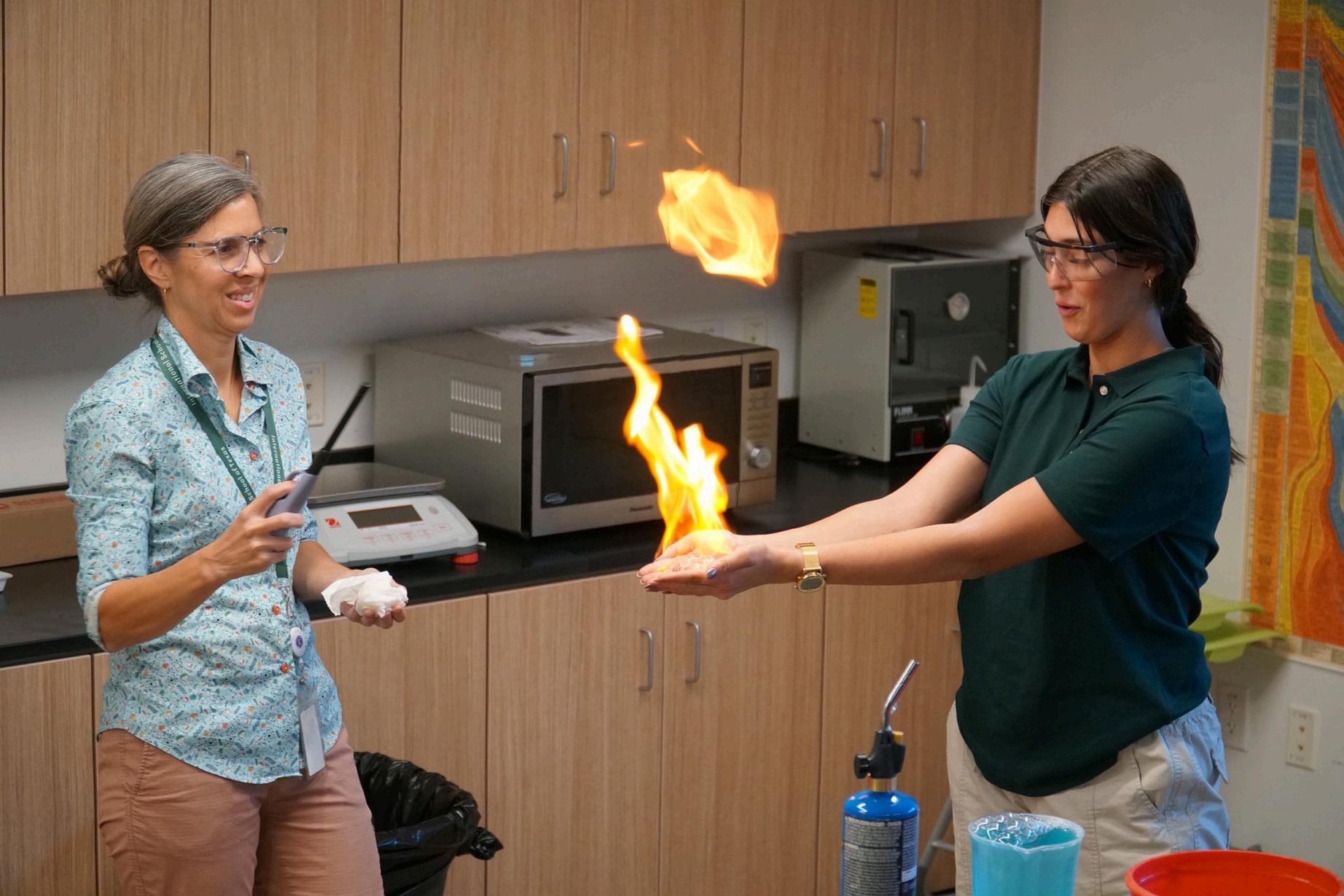
DP Biology at IST is a two-year course that invites students to explore life as an ordered and dynamic interconnected system. Students explore biological organization from molecules to ecosystems, learning how form supports function, how systems maintain balance, and how life evolves over time. Across DP1, students build core understanding and strong lab habits; across DP2, they deepen sophistication by integrating concepts across units, interpreting unfamiliar data, and designing investigations with increasing independence. The through-line is scientific reasoning: students learn to move from inquiry to observation to analysis, using data, models, inference, and careful argumentation. By the end of DP Biology, students will analyze biological problems with confidence and communicate scientific thinking clearly.
How students learn in this course (what it looks like week to week)
Week to week, learning blends concept building, data interpretation, and practical work. Students regularly work with graphs and datasets, explain patterns, and justify conclusions with evidence Lab experiences are used to build both technique and thinking planning methods, controlling variables, evaluating error and uncertainty, and communicating results with clarity. Students practice examstyle questions throughout the course to build fluency with IB command terms and expectations while maintaining an inquiry-first classroom culture.
How the IB score (1–7) is calculated in this course
Your student’s IST course grade comes from ongoing coursework across the year. The final IB subject score (1–7) comes from the IB assessment components below.
Group 4 Sciences: Chemistry
Course overview
DP Chemistry at IST is a two-year course that empowers students to explore and explain how matter behaves - both predictably and often paradoxically. Students investigate the 3D structure and properties of matter, bonding types, energetics, kinetics, and the mechanisms that drive chemical change. Across DP1, students develop strong foundations in the scientific method, using the chemical lexicon, quantitative reasoning, and lab techniques. Across DP2, they will integrate ideas across topics, interpret more complex data, and solve unfamiliar problems with expertise and confidence. The through-line is model-based thinking: students learn to connect what they observe to what is happening at the molecular level, and to support explanations with evidence and calculation. By the end, students can analyze chemical systems, reason through multi-step problems, and communicate scientific conclusions clearly.
How students learn in this course (what it looks like week to week)
Week to week, classes move between concept development, structured problem-solving, and handson practical work. Students learn to translate between representations (words, equations, graphs, the periodic table, molecular models), then apply those representations to real chemical questions. Labs are purposeful: students plan, observe, measure, analyze, evaluate error and uncertainty, and improve methods, they don't just “follow the procedure. Frequent practice with IB-style questions builds speed and accuracy, while teacher feedback focuses on precision, reasoning, and clear scientific communication.
How the IB score (1–7) is calculated in this course
Your student’s IST course grade comes from ongoing coursework across the year. The final IB subject score (1–7) comes from the IB assessment components below.
assessment component
Paper 1 (external)
Paper 2 (external)
Internal Assessment (IA): Scientific investigation
students do
Multiple-choice + databased / experimental questions (Paper 1A + 1B)
Short-answer + extended-response questions
May 2028 IB exam window; timed practice throughout DP1–DP2; DP2 Mock Exams in late Feb 2028
Design and carry out an investigation; write the final report for IB moderation
IA launch in DP2; drafting + conferencing through Term 1–2; final submission before IB upload window
Group 4 Sciences: Environmental Systems & Societies (ESS)
Course overview
Environmental Systems and Societies (ESS) at IST is a two-year interdisciplinary course that trains students to think in systems connecting environmental science with the human decisions that shape outcomes. Students study how natural systems function, how societies use resources, and how evidence is used to evaluate trade-offs in policy, technology, and daily life. Across DP1, students build foundations in ESS concepts, data interpretation, and case-study analysis; across DP2, they strengthen synthesis and evaluation, weighing competing priorities and explaining conclusions clearly. The through-line is responsible reasoning: students learn to analyze complex questions using evidence, recognize uncertainty, and communicate balanced judgments.
How students learn in this course (what it looks like week to week)
Week to week, students work through case studies, real datasets (graphs, maps, reports), and structured writing tasks that build from short responses to longer evaluations. Classes emphasize interpreting evidence accurately, identifying cause-and-effect relationships, and explaining systems interactions without oversimplifying. Discussion is academic and evidence-centered: students learn to articulate reasoning clearly and respond thoughtfully to alternative interpretations. Investigations (including local contexts where feasible) help students practice inquiry, method, and evaluation in a grounded way.
How the IB score (1–7) is calculated in this course
Your student’s IST course grade comes from ongoing coursework across the year. The final IB subject score (1–7) comes from the IB assessment components below
Paper1 (external)
Paper2 (external)
Internal Assessment (IA): Individual investigation
Analyzeandevaluatea previouslyunseencase studyusingprovideddata
SectionA:short-answer+ data-based;SectionB: structuredessay(s)froma choice
Planandcompletean individualinvestigation; writethefinalreport formoderation
May2028IBexamwindow;casestudy/datapracticethroughoutDP1–DP2; DP2MockExamsinlateFeb2028
May2028IBexamwindow;timed writingandessaypracticethroughout DP1–DP2;DP2MockExamsinlateFeb 2028
IAplanning+checkpointsacrossDP2; finalsubmissionbeforeIBupload window
IB assessment component
What students do
When this happens in our IST timeline (Cohort 2028) Weight (SL) Weight (HL)
Group 5 Math: Applications and Interpretations (AI)
Course
overview
DP Mathematics at IST is a two-year course that builds both mathematical fluency and mathematical judgment. Students strengthen core skills in algebra and functions, equations and inequalities, trigonometry, geometry, and sequences and series, while also developing confidence with probability, statistics, and data analysis. As the course progresses, students use these tools to model real situations, interpret graphs and results, and communicate solutions with clarity and precision. Across DP1, the focus is on building strong foundations and flexible problem-solving habits; across DP2, students tackle more complex, multi-step problems and deepen their ability to reason, justify, and verify. Whether students are headed toward calculus-heavy university pathways or fields that rely on quantitative literacy, the through-line is the same: students learn to think mathematically accurately, logically, and with purpose.
How students learn in this course (what it looks like week to week)
Week to week, students practice through a blend of direct instruction, worked examples, independent problem sets, and collaborative problem-solving Lessons emphasize reasoning steps and clarity of method, not just final answers. Students regularly interpret graphs and data, explain decisions, and revise solutions after feedback. Investigation work supports deeper understanding by asking students to explore patterns, test models, and communicate findings in a clear mathematical style.
How the IB score (1–7) is calculated in this course
Your student’s IST course grade comes from ongoing coursework across the year. The final IB subject score (1–7) comes from the IB assessment components below.
Assessment (Exploration)
unfamiliarcontexts
exploration (modeling/analysis/interpretati on) IAlaunchAug2027;topic+ data/modelplanlocked Nov/Dec2027;fulldraftJan 2028;finalIAlateFeb2028
Group 6 The Arts: Visual Arts Studio
Course overview
DP Visual Arts Studio at IST is a two-year course for students who want to think and work like artists —developing technique, building a personal voice, and learning to make intentional choices. Students explore materials and processes, study artists and art contexts, and practice turning ideas into strong visual outcomes through experimentation and reflection. Across DP1, students build foundational skills, creative habits, and artistic risk-taking; across DP2, they refine craftsmanship, deepen conceptual focus, and curate a coherent body of work that shows growth and intention. The throughline is purposeful creation: students learn to plan, test, revise, and communicate the “why” behind what they make.
How students learn in this course (what it looks like week to week)
Week to week, students are actively making sketching, experimenting, producing work, and documenting decisions. Studio time is structured around cycles: concept → exploration → critique → revision → refinement Students regularly analyze artworks to learn strategies and vocabulary, then apply those insights to their own practice. Feedback is frequent and specific, helping students strengthen composition, technique, and conceptual clarity while maintaining individual style. Students build strong documentation habits so their process and thinking are as visible and compelling as their final pieces.
How the IB score (1–7) is calculated in this course
Your student’s IST course grade comes from ongoing coursework across the year. The final IB subject score (1–7) comes from the IB assessment components below.
Task1:ArtMaking Inquiries Portfolio
Task2: Connections Study(SL)/ ArtistProject (HL)
Task3:Resolved Artworks& Curatorial Rationale
(portfolioof inquiry/process evidence)
ongoingdocumentationcheckpointsevery 2–3weeks;portfoliocheckpointJan–Feb 2028
(contextual investigation+ analysis)
(resolvedwork+ curatorialwriting)
selectionplanOct–Dec2027;mock exhibition/portfolioreviewJan2028
IB assessment component
What students do
When this happens in our IST timeline (Cohort 2028) Weight (SL) Weight (HL)
Assessment in the IBDP
In every DP course, assessment is ongoing and supports learning over time. Students receive frequent formative feedback and complete summative assessments that reflect IB expectations for skills, thinking, and communication.
Two important assessment layers:
Course assessment at IST (for regular grades and transcripts).
Students complete regular tasks throughout the two years—writing, labs, presentations, problem sets, performances, projects, and exams. Teachers assess learning using IB-aligned criteria, provide feedback, and report progress.
IB assessment (for official IB scores)
IB subject results are determined by required IB assessment components that vary by course, including:
1. Internal Assessments (IAs): major coursework tasks graded by the teacher and externally moderated by the IB
2. External Assessments: IB examinations and/or externally graded components set and marked by IB examiners
Academic integrity matters:
Because internal assessments and core components contribute to official IB results, students must produce authentic work and document sources appropriately. IST teaches and reinforces academic integrity expectations and provides guidance about what support is allowed. Failure to uphold IB Academic Integrity requirements may disqualify students from the IB Diploma. Expectations are explicitly taught and reinforced across all DP courses.
Scoring
snapshot
Each DP subject is scored by the IB on a 1–7 scale (7 is highest). Students can earn up to 3 additional points from combined TOK/EE results, for a maximum diploma total of 45 points. Weight of individual elements varies by course - see the breakdown on the individual course pages and the Grade Conversions section. .

Conditions for Awarding the IB Diploma
The IB Diploma is awarded to students whose total score (including up to 3 points from TOK/EE) reaches or exceeds 24 points, and who also meet additional IB requirements.
In addition to earning sufficient points, diploma award depends on meeting IB requirements, including:
Completion of CAS requirements and full portfolio
Successful completion of TOK and EE components.
Satisfactory completion of all required assessment components (no missing components)
Meeting minimum performance thresholds across subjects and levels (including Higher Level and Standard Level expectations)
No academic misconduct penalty that affects the final award decision
IB Course Results
Students who take DP courses may still receive official IB course results in individual subjects even if they do not earn the full IB Diploma—provided they are registered for IB assessments and complete the required assessment components for those subjects. Students who opt out of IB external assessments complete IST campus-based final assessments and earn IST course credit and transcript grades.

Grades vs Scores
Understanding DP Scores Vs. Grades, Results, and the Diploma
There are two types of results (scores and grades) - It is important to not confuse them:
1) IST course grades (for typical transcripts and report cards)
Students complete regular coursework all year (assignments, labs/studio work, tests, essays, projects, presentations, etc.). These are assessed by teachers using IB-aligned expectations and appear on report cards and transcripts.
2) IB Diploma results (final IB scores)
At the end of DP2, the IB awards official scores in each DP subject based on required IB assessments (which vary by course). These official IB scores are separate from IST course grades.
HOW IB SUBJECT SCORES WORK (1–7)
Each IB subject is awarded a score from 1 to 7 (7 is highest).
A subject’s final IB score is based on a combination of:
External assessments (IB exams and/or externally marked components), and
Internal assessments (IAs) completed during the course (assessed by teachers using IB rubrics and moderated by the IB).
Important: the exact Weight differs by subject.
WHAT TOK + EE ADD (UP TO 3 POINTS)
TOK and the Extended Essay are assessed by the IB and can contribute up to 3 additional points to the overall diploma total (according to the IB’s TOK/EE matrix).
CAS is required for the diploma but does not earn points.
THE DIPLOMA TOTAL (OUT OF 45)
The IB Diploma total is a maximum of 45 points:
Up to 42 points from six subjects (each out of 7)
Plus up to 3 points from TOK + EE
“PASSING”
THE IB DIPLOMA (WHAT IT REALLY MEANS)
Earning the IB Diploma is not just about reaching a point total. In general, students must:
Meet the IB’s minimum point requirement (commonly 24 points)
Complete CAS requirements
Submit all required assessment components (no missing pieces)
Meet IB’s minimum expectations across HL/SL courses (specific conditions apply)
Avoid academic misconduct penalties that can affect the final award decision
(A full list of conditions is published by the IB and is applied to each cohort.)
RESULTS TIMING (WHAT FAMILIES CAN EXPECT)
Most IB subject assessments are completed during DP2 (with internal assessments submitted during the year and examinations at the end of the programme).
Official IB results are released after the examination session.
Students may request that results be sent to universities through the IB’s results service process.
Grade Conversions
IST reports DP achievement using the IB 1–7 scale and provides an approximate U.S. letter and GPA equivalency for transcript readability.
The percentage ranges above are IST transcript approximations used for reporting course grades. They are not IB grade boundaries and should not be interpreted as the way the IB assigns 1–7 scores. IB grade boundaries vary by subject and examination session. Universities evaluate IB scores using their own admission, placement, and credit policies and assign the point value based on those policies.
How
IB subject results are determined (quick clarification)
Final IB subject results are based on a combination of external assessments (IB exams and/or externally marked components) and internal assessments (IAs) completed during the course (assessed by the teacher using IB criteria and moderated by the IB). The exact balance of internal vs. external assessment varies by subject. (See individual course syllabi for details and percentages.)
Key Date Windows
Non-negotiable deadlines
Major milestones happen in predictable windows across DP1 and DP2. Internal assessments and core deadlines build steadily through DP2, mock exams occur mid-year of DP2, and final IB examinations take place in May of DP2. Because these are sent to the IB to be scored or moderated by IB teachers worldwide, the deadlines and exam dates are fixed. No extensions or make-ups are possible for IB examinations. Final internal assessment submission deadlines are fixed once work is finalized for IB upload; late work risks missing IB submission requirements and the ability to earn the IB diploma.
Milestone
Semester Final Exams - All courses
TOK Exhibition (event & final essay)
End-of-Year exams
Extended Essay (EE) draft due
Window (Cohort 2028 - estimated)
Mid December 2026
early January 2027
Late April–early May 2027
August 2027 (1 day of school) st
Extended Essay (EE) final due December 6, 2027
CAS final portfolio due January 10, 2028
Language orals (English A + Spanish B) final recording windows
Internal Assessments (IAs) final submissions
DP2 Mock Exams
Final IB Exam Session
January–February 2028
November 2027-March 2028
Last two weeks of February 2028
May 2028
College Counseling & University Planning
Counselor: T.B.A.
University planning begins early in DP1 and becomes increasingly individualized through DP2. Students build a balanced academic plan, develop a strong record of learning, and practice presenting themselves clearly through writing, reflection, activities, and evidence of growth.
Families can expect support in these areas:
Course planning for best-fit pathways and HL/SL balance
Understanding IB results and university recognition (credit/placement policies vary by institution)
Building a healthy application timeline and decision-making process
Guidance on written materials (essays and short responses) and application organization
Planning for deadlines while protecting student wellbeing and sustainable routines
Timeline at a glance (high level)
DP1: exploration, academic direction, early planning habits, and building a coherent student story through learning and activities
DP2: execution finalizing lists, completing applications, meeting deadlines, and transitioning confidently to post-secondary life
Testing note
Mr. Hyatt & college counselor to confirm and report ASAP
About IB credit/placement:
Credit and advanced placement policies vary by university and sometimes by department. Students and families should rely on the university’s published recognition policy and confirm details for intended majors. IST counseling supports students in documenting and planning for these policies—without assuming that any single policy applies universally.
How families can help (realistically):
Protect key programme windows (major IA deadlines, TOK/EE deadlines, mock exam periods, and exam windows). Encourage steady habits over last-minute surges. When travel conflicts arise, communicate early—IB deadlines have limited to no flexibility.

Universities with Generous Credit*
An IB Diploma means Time & Tuition Savings
These schools often grant a semester or more of credit for strong IB scores:
UT Austin, Texas A&M, University of Houston – State law: up to 24 credits
UCLA, UC schools – HL 5–7 = up to 30 credits
University of Michigan, University of Virginia – HL scores may earn 24–28 credits
University of Colorado Boulder & Colorado State – Full IB Diploma = 24 credits
Iowa State, BYU, BYU–Hawaii, Utah Valley University – Generous credit for HL 5–7.
Western Oregon University: IB Diploma with a score of 30+ grants guaranteed admission, sophomore standing, honors program entry, priority housing, and studyabroad opportunities.
College of Idaho: IB diploma (with a score of 28+) earns preferred admissions status, 30 credits, and merit scholarships up to $11,000/year.
*ALL examples are provided for general awareness (based on information available 2025). Universities change recognition policies; families should confirm credit and placement directly through each university’s published policy.
Universities with Strong Recognition

IB Diploma = Time & Tuition Savings
These schools grant meaningful credit (often a semester), though with subject caps:
USC – Up to 20 credits for a strong Diploma.
Boston University, NYU – Up to 32 credits for HL scores.
Pepperdine, University of San Diego, University of Illinois, University of Houston – HL 5–7 count toward major/minor requirements
IB DP students often shorten their degree path while strengthening their admissions profile.
Universities with Placement Emphasis

An IB Diploma means Recognition and Advanced Placement
At these highly selective universities, IB carries enormous admissions weight. Credit is limited, but strong IB results often allow students to skip introductory courses and move directly into advanced study.
Brown University – HL scores may allow placement; credit is rare. Still, IB achievement is highly valued in admissions.
University of Chicago – Very limited credit, but IB Diploma strengthens admissions profile.
Duke University – Some HL 6–7 scores recognized for “International Placement Credit,” though not always toward graduation.
Stanford University – Limited credit; HL 7s sometimes earn placement into advanced courses.
Princeton University – No degree credit; departmental placement possible. IB is highly respected in admissions.
Massachusetts Institute of Technology (MIT) – HL 7s in Math or Physics may allow advanced placement, but not formal credit.
Harvard University – No credit, but strong IB performance allows placement out of certain introductory courses. IB is a major plus in admissions.
Columbia University – No official credit, but IB Diploma is considered one of the strongest possible academic programs for admissions.
Johns Hopkins University – Limited IB credit, but used widely for placement into advanced courses.
Auburn University – HL 5–7 may earn some course credit; policy varies by department.
Even without additional college credits, the IB diploma makes a student stand out in admissions. It signals readiness for elite academic environments.
University recognition and credit/placement for IB results vary by institution and programme and policies change over time. What is consistent is what the DP builds: deep content mastery, strong academic writing, high-level problem solving, research competence, and the ability to perform under sustained deadlines.
IST College Counseling supports every family in researching current policies for the universities students are considering and planning course choices accordingly.
More Universities That Actively Favor DP Grads
An IB Diploma often means access to exclusive scholarships and higher admissions rates
Ivy League and Elite Institutions
Admission rates for IB Diploma students at Ivy League schools can be as much as 18% higher compared to the general applicant pool. The effect is even stronger—around 22% higher—for other top-tier universities outside the Ivy League.
Universities with scholarships specifically designated for IB DP graduates:
Southern Methodist University (SMU)
Florida State University (FSU)
University of Oregon (UO)
Oregon State University (OSU)
College of Idaho
University of Arizona (UA)
University of Rochester
Illinois State University
Mississippi State University
Drury University
University of Calgary (Canada)
University of Alberta (Canada)
These examples show universities that actively recruit and offer structured advantages to IB students beyond credit alone.
Admissions officers value the IB DP because of its rigor as one source puts it, “IB students tend to have higher GPAs and are admitted at notably higher rates.”
Tracking Success
College Success Outcomes for IB DP Graduates vs. National Averages
Graduation Rate
(DP programme participants)
(DP diploma recipients)
Insights
IB DP graduates enroll and persist in college at stronger rates compared to the national average.
They’re more likely to graduate within 4 or 6 years even more so if they completed the full diploma.
Nearly half attend highly selective colleges.
IB students demonstrate higher preparedness, managing college-level rigor and independent learning more effectively than peers.
Academic Preparedness & GPA
A University of California study found IB students earned higher college GPAs and graduated at higher rates than peers.
Data from the University of Oregon Honors shows IB students strongly outperform in persistence and adaptation especially in time management, workload resilience, and taking ownership of learning.