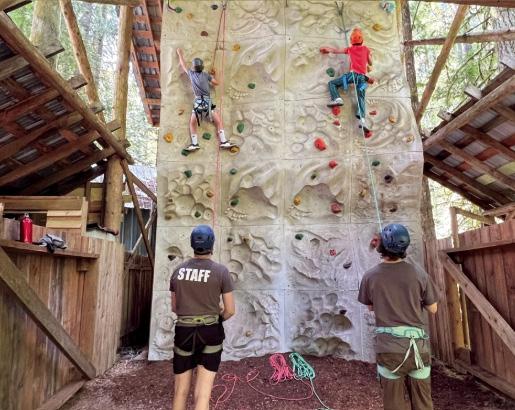
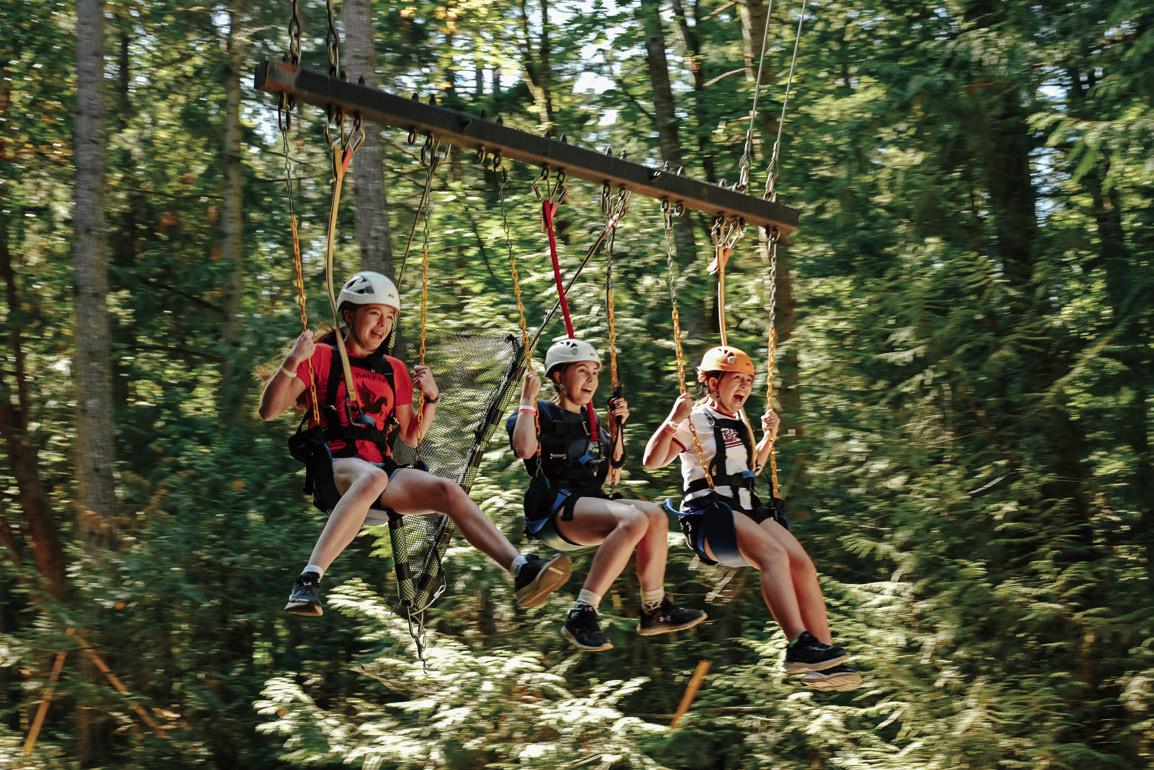
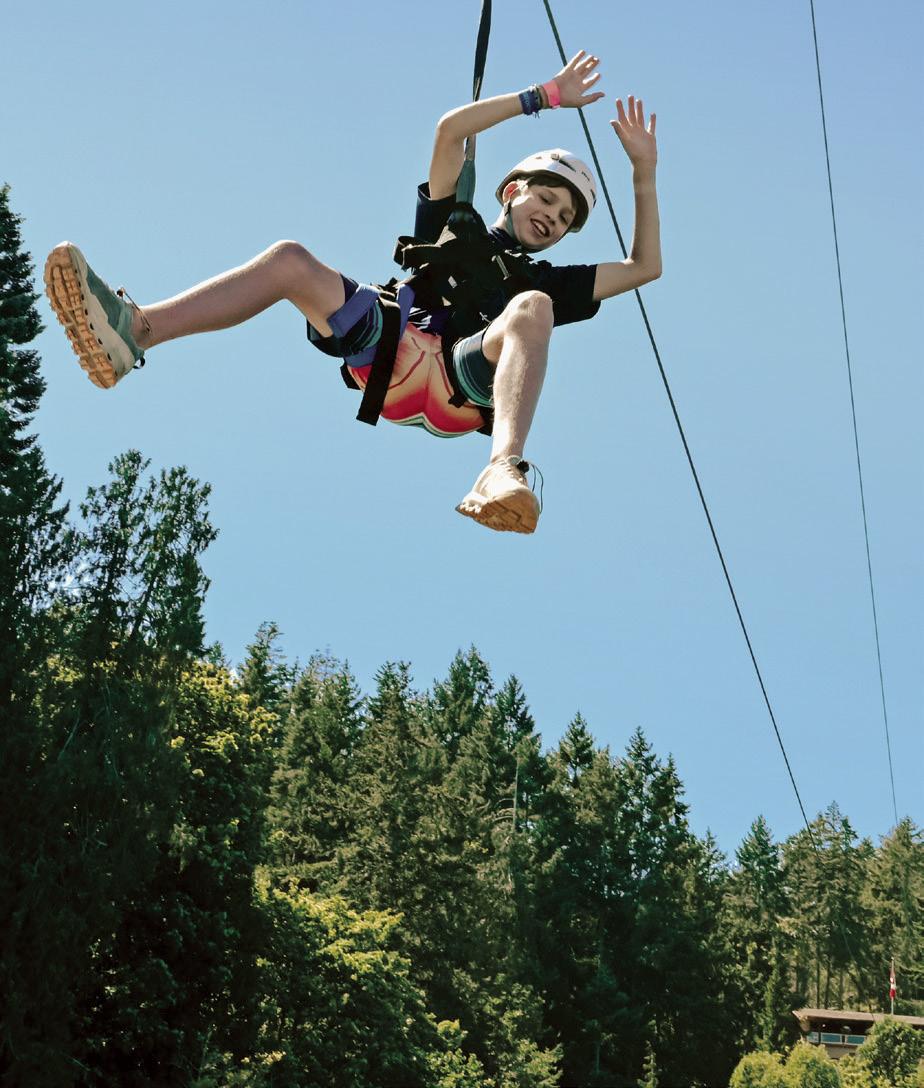
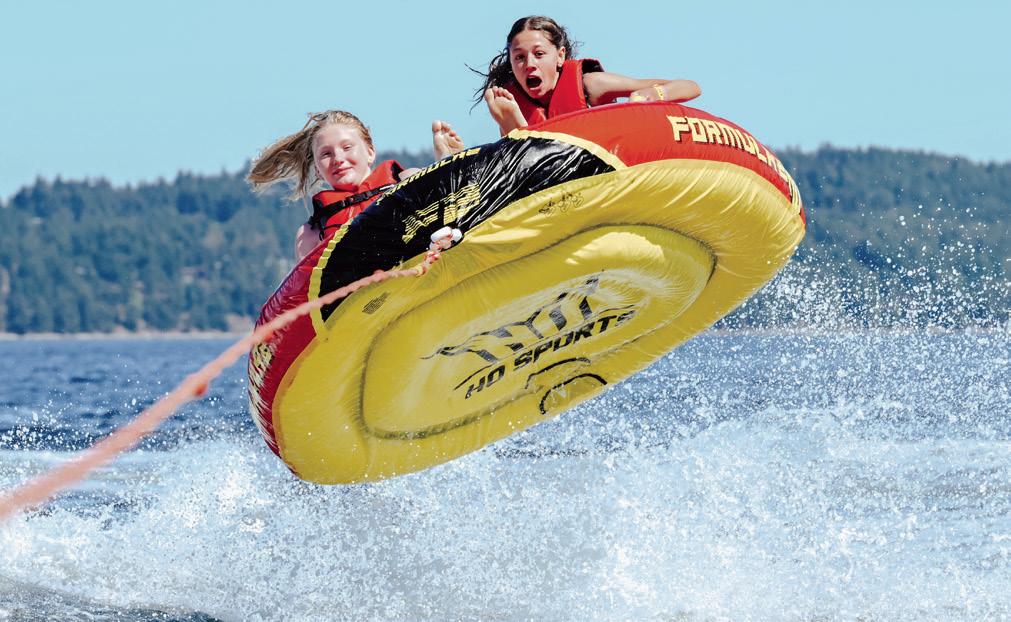
“We were looking for a local school that combined academic excellence with well-rounded development, including a strong global perspective, for our three children. Brentwood offers all of this in a stunning setting, where the staff truly feel like an extension of our family.” — Liliana and Juan
admissions@brentwood.ca | 250 743 8770 WHERE STUDENTS CHOOSE TO BE
Island Parent Magazine, published by Island Parent Group Enterprises Ltd., is a bimonthly publication that honours and supports parents by providing information on resources and businesses for Vancouver Island families. Views expressed are not necessarily those of the publisher. No material herein may be reproduced without the permission of the publisher. Island Parent is distributed free in selected areas. Annual mail subscriptions (7 issues) are available for $21 (GST included). Canadian Publication Mail Product Sales Agreement 40051398. ISSN 0838-5505
distribution inquiries, please email publisher@islandparent.ca
Adopting Good Enough Parenting
As a primary parent, we are programmed to feel like we must do it all.
We have to work (and love what we do), keep a clean house (and not complain), make healthy meals (that are met with, “I don’t want that!”), play with our kids (with no distractions), organize and keep track (of all of the things, for everyone), have close friends (in our “spare” time) and practice self-care (are you kidding?!).
How do we do it all? At the expense of our mental, physical and emotional well-being.
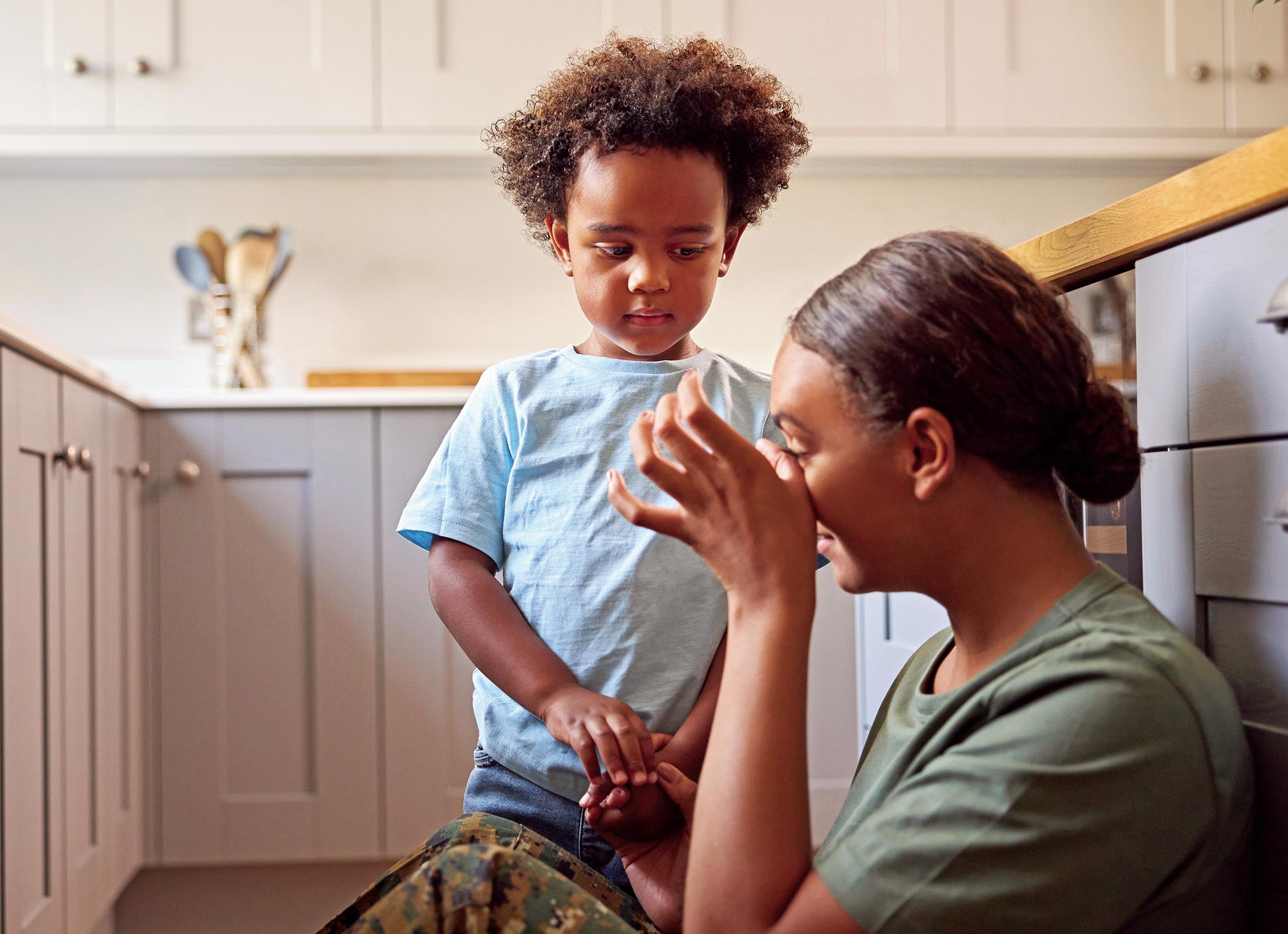
In 2026, many parents are realizing this way of thinking has gone on too long. It is impossible to do all these things simultaneously and trying to do so is putting our health in jeopardy. The irony here is that we are doing all of this to be “better parents,” but it is actually detrimental to our children.
We are starting to understand what registered clinical counsellor Darcy Harbour shares in her story “The Perfectionism Trap”: Escaping perfectionism isn’t about trying harder; it’s about the adoption of Good Enough Parenting.
As a recovering perfectionist, this is a concept that took me a long time to grasp. My kids are 11 and eight and I am only now coming to the realization that it benefits them way more to have a real-life human mom who makes mistakes than it
does for them to have a perfect robot who sends them to school with a three-course lunch and a smile on her face.
I don’t expect them to be perfect and by (trying to) model perfectionism, I am showing them that they should be. This sets them up for anxiety, disappointment and failure—the opposite of what I want for my kids.
They need to see that life is hard, messy and painful. They must learn how to get through it by watching my example. I need to apologize to them when I yell. I need to admit that I make mistakes. They need to see me stop and take deep breaths when I get frustrated. They need to witness my tears when something sad or awful happens.
They will feel stress, they will mess up, they will get mad, they will cry. How can they know how to deal with these everyday instances if I don’t model appropriate reactions for them?
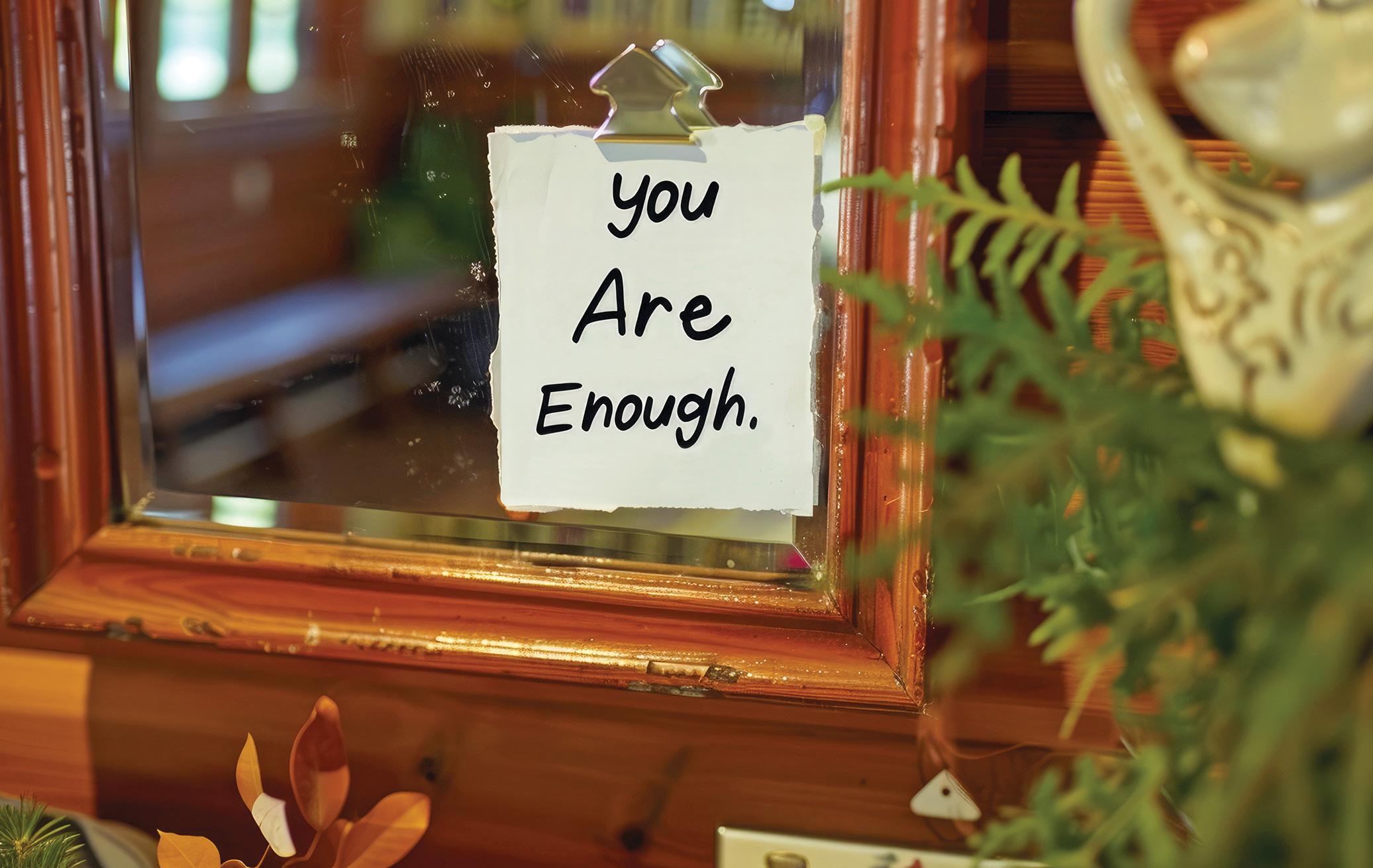
This mindset shift has helped me more than anything else I have learned during my parenting journey. Letting go of the concept of being a “perfect parent” and realizing I am enough has helped me be a better mom, wife, friend and person (flaws and all).
– Stacie Gaetz
@ 10 Momfluencers
YOU NEED TO KNOW
@exploringwiththeasmas
Angela Asma: Alongside her husband and littles, Angela shares all things family in Victoria. From pregnancy and parenting to food and travel, follow along for a real-life glimpse into a local family’s cozy life here on the West Coast.
@marikoleebenson
Mariko Benson: This Victoriabased mama shares wellness tips, relatable moments and family-friendly things to do with a real yet uplifting point of view. Mariko shares candidly about her journey with Hashimoto’s disease, supporting other women to feel confident and empowered with their own wellness.
Natasha Mills: Natasha shares her relatable perspective on motherhood, wellness, travel and lifestyle right here on the West Coast. This candid mama of three has built a community of support to celebrate the beautiful (and sometimes messy!) journey of parenthood.
@theneurodiversitymom
Katherine L’Etang: As a latediagnosed neurodivergent mom with neurodivergent littles, Katherine shares a unique lens that many mamas can relate to. Follow along with this Vancouver Island mom and watch for the upcoming launch of Katherine’s first book Actually, I’m Autistic.
@sassandsmalls
Deb Balino: Deb, aka Sass & Smalls, shares her perspective on being a neurodivergent mama and parent caregiver. She is passionate about inspiring other parents to break the burnout cycle and keep their spark after kids. Follow along and check out her podcast, Sass & Small Talk, on Telus StoryHive.
@more.thanjustamother
Natausha Johnson: Natausha shares unfiltered motherhood with relatable reels, mom moments and a whole lot of heart. Check out her page for fashion, family lifestyle, food, travel and all things mom life on Vancouver Island.
@play.grow.adventure
Katie Thompson: Momfluencer and professional photographer Katie is passionate about inspiring families to explore the outdoors. Based in the Cowichan Valley, Katie shares playgrounds, parks, trails and all kinds of things to do for families throughout the southern Island.
@wellness.with.anna
Anna Keevil: Anna is a nutritionist and mom of two, sharing tips on wellness while managing a busy working-mom life. She shares simple nutrition, nervous system support, motherhood and the behind the scenes of building a life that feels aligned—not perfect.
@alyssaknight.bc
Alyssa Knight: Focused on inspiring yet relatable home and family lifestyle content, Alyssa shares recipes and travel as well as cozy and relatable moments. Alyssa believes in making everyday life feel lighter, sharing support and tips for busy moms.
@thepurposefulyou
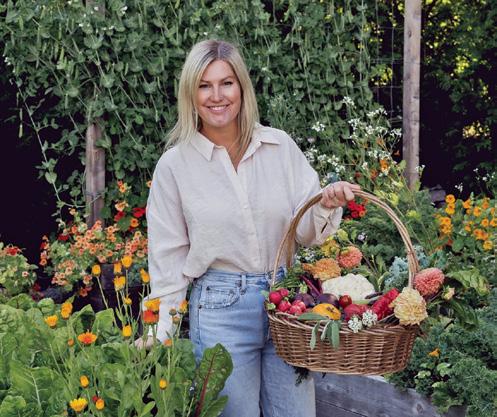
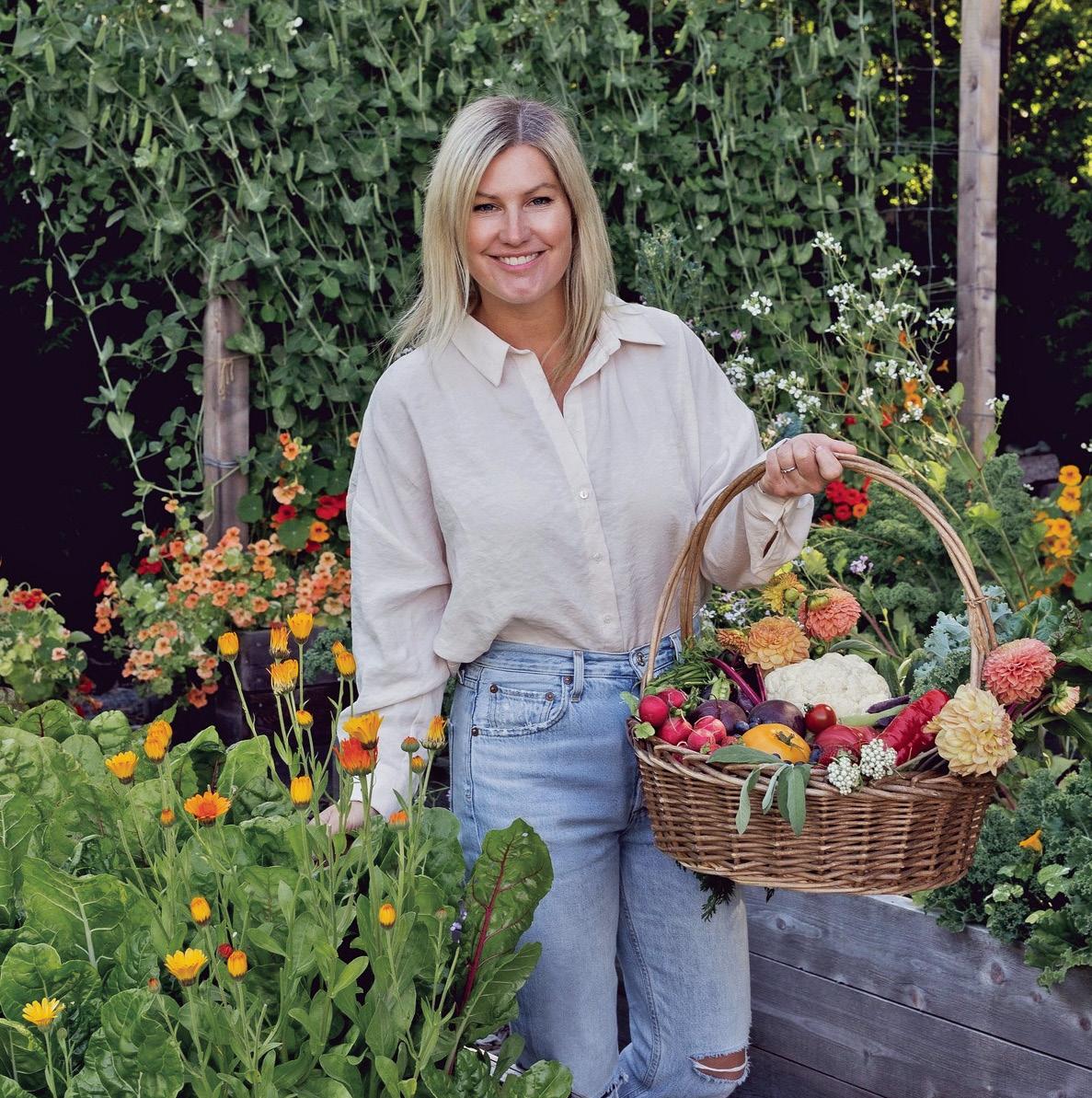
Tasha Medve: Tasha is your backyard veggie gardening bestie! This mom of two shares intentional living and gardening inspiration. She is passionate about making gardening and growing your own food accessible to more families. Don’t forget to check out her new book, The Purposeful Gardener.
The Perfectionism Trap
Why ‘Good Enough’ Is the Secret to a Sane
Spring is traditionally the season of the fresh start. We’re told to scrub our baseboards, renew our gym memberships and miraculously transform into the calm, organized parents we’ve been promising ourselves we’d be. But for those of us who are primary caregivers, we’ve just spent the whole winter holding the mental, emotional and logistical load of an entire family. In this context, the spring fever pressure for self-improvement can feel less like a fresh start and more like a heavy weight.
As both a counsellor and a mom, I see it every day: the Perfectionism Trap. It’s the invisible, high-stakes performance where we feel we must be the patient, gentle, organic-snackproviding Pinterest Mom just to be considered adequate. We think that if we just try a little harder, read one more par-
Spring
enting book or stay a little calmer, we will finally achieve a peaceful home.
But here is a truth that might surprise you: Perfectionism is a stress response. When we strive for 100 percent “perfect” parenting, our nervous system is stuck in a state of high alert. We are scanning for mistakes, bracing for tantrums and judging our own reactions with a microscopic lens. In this state of fight-or-flight, we aren’t present; we are performing.
And because our children regulate their nervous systems by mirroring ours, our internal pressure for perfection often creates the very chaos we are trying to avoid.
The Solution: The ‘Good Enough’ Parent
Escaping the perfectionism trap isn’t about trying harder. It’s about a concept that has been a cornerstone of child
psychology for decades: The Good Enough Parent. The late pediatrician Donald Winnicott famously proposed that children don’t benefit from a perfect parent.
They need a parent who is consistently safe and loving, but who also fails, gets tired and makes mistakes. Why? Because when we are “good enough,” we show our children how to handle the inevitable ruptures of life. We move the focus away from avoiding the mess and toward the magic of the repair.
The Loneliness of the Pedestal
Perfectionism is inherently isolating because it requires us to maintain a pedestal. Moms who secretly feel this pressure to be perfect need solidarity in the reminder that it’s okay to be human, and that this authenticity is exactly where we find our connection.
The tragedy of the “perfect” parent is that it blocks true intimacy. Connection requires vulnerability; if you never show your struggle, no one can ever truly support you. We end up in a comparison loop, where we assume everyone else is living at 100 percent while we hide our messy 30 per cent moments. This mask of perfection is exhausting. By the time we have a chance to connect with a friend, we are often too depleted to do anything but retreat.
How to Break the Isolation: The ‘Ugly Coffee’ Strategy
If perfectionism is the lock, vulnerability is the key. You can start small with micro-disclosures:
The “First Move” Rule: Don’t wait for someone else to admit they’re struggling. Be the one to say, “It was a really hard morning over here.” Watch how quickly the other parent’s shoulders drop in relief.
Lower the Bar for Hosting: Invite a friend over for “Ugly Coffee.” Tell them, “The laundry is on the couch and the kids are loud, but I’d love to see you for 20 minutes.” This signals that your friendship is about support, not presentation.
Find a Safe Container: Look for spaces like a dedicated parent support community where the goal is to be real rather than right.
Your New Bar: The 70 Percent Rule
The 70 Percent Rule is the ultimate sigh of relief. It suggests that if we are attuned to our children about 70 percent of the time, they will develop a secure attachment. Believe it or not, the other 30 percent = the moments we lose our cool or feel touched out, is developmentally necessary. It teaches our children that relationships can handle friction and that breaks can be fixed.
What 70 Percent looks like = The ‘Glows’:
• Stopping for 10 seconds to look at a drawing.
• Validating that it’s okay to be sad over a broken banana.
• Being the safe person they come to when they are hurt.
What the other 30% looks like = The ‘Grows’:
• Snapping after a long day at work.
• Being distracted by an email while your child is talking.
• Moving away because your sensory system is at its limit.
The Magic Is in the Repair
The most important part of this rule is the repair. When you miss the mark, use this script: “I’m sorry I raised my voice. I was feeling overwhelmed, but it wasn’t your fault. I love you, and I’m back now. Can we start over?”
When we are human rather than perfect, we give our kids a safe foundation and the skills to handle conflict and reconnect.
From Island to Village
We’ve been told that a healthy mother is one who does it all. But clinically speaking, a healthy mother is one who is connected. When we trade the loneliness of perfection for the messy reality of community, our nervous systems finally get the message that it’s safe to relax. We stop being managers of a household and start being members of a village. In that shift, we don’t just become better parents, we become more ourselves.
Darcy Harbour, MA, RCC is a Registered Clinical Counsellor (RCC) and the founder of Harbour Family Counselling. Through her signature program Chaos to Calm, she helps parents trade the perfectionism trap for authentic connection. harbourfamilycounselling.ca
Homegrown Tales
Island Parents are Writing the Stories Children Need
One of the most transformational gifts we can give our children is a lasting love of reading. When children enjoy books, research consistently links it to stronger academic success, critical thinking and empathy.
Across Vancouver Island, parents are quietly creating picture books for young readers. When stories come from familiar faces and local names, literacy becomes personal and meaningful.
In speaking with other Island parent-authors, common threads emerged. Many began writing, not because they planned to publish, but because children invited them to see the world differently.
“Writing for children is like turning your shirt inside out,” says Sylvia Thomson, author of Ernie the Big Blue Beagle.
Sometimes families are unable to find the gentler or more inclusive stories, or those that better reflect the world they want their children to grow up in. Parents begin creating them themselves, shaped by care, intention and lived experience.
Often, stories start close to home. A grandparent’s tales of coastal wildlife inspire series like Marlet Ashley’s Revelry on the Estuary. Others reimagine complex ideas for young readers. Haley Healey, known for her non-fiction work on trailblazing women, such as Elizabeth Quocksister: Keeper of History, has spoken about the challenge and joy of making stories accessible to children while still engaging adults.
For many families, parenthood is deeply transformative. Writing a children’s book becomes a way to slow down, reflect and create something meaningful during the early years. What begins as a bedtime story can grow into a book that captures imagination, growth and belonging within Island communities.
Vancouver Island has always been rich in storytelling. When communities choose local titles for their shelves, that support comes full circle, and we strengthen early literacy in our neighbourhoods.
There is quiet pride in knowing something once scribbled on a notepad is now being read at bedtime in local homes. When a child laughs at a line or asks how a book is made, creative work becomes something more. It becomes a connection. A lifelong love of reading does not grow in isolation; it grows in community.
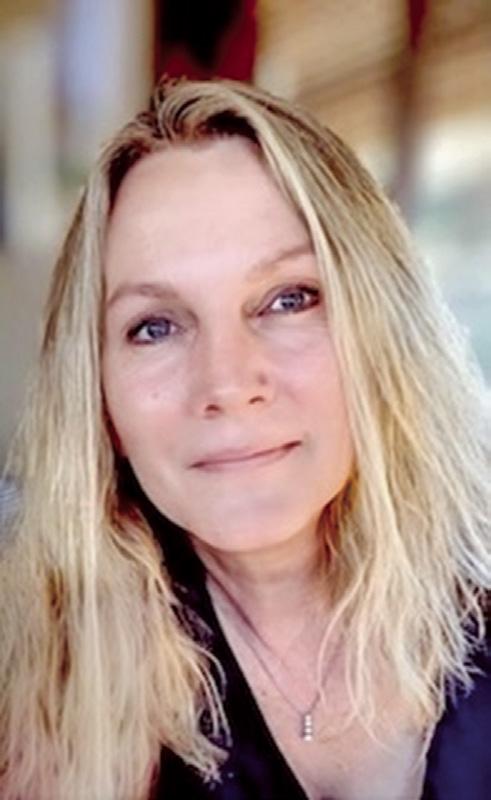
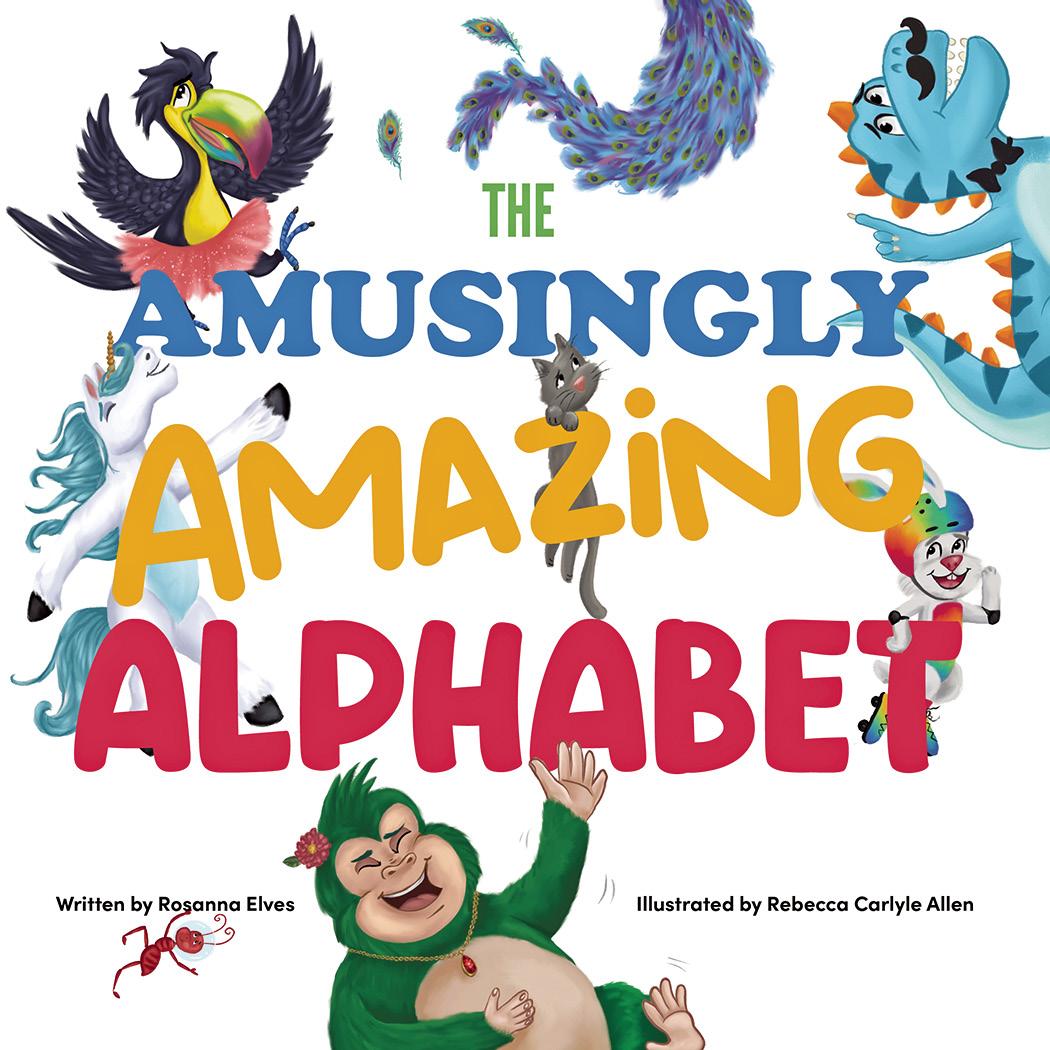
Rosanna Elves is a Canadian-Mexican author living in Victoria. A mother, identical twin and traveller, Rosanna has lived in Japan, Peru and Mexico, all experiences that inform her writing. Her book, The Amusingly Amazing Alphabet, is in the GVPL Emerging Local Authors Collection. Find her online at linktr.ee/rosannaelves
Teresa Schapansky, North Cowichan
Along the Way series (self-published, 2021, 12 books)
Illustrated by Elly Mossman
What inspired this book series?
I wrote them because I found a serious lack of entertaining books about Canada for young readers.
What was your path to publishing?
The biggest challenge was finding the perfect illustrator whose vision aligned with mine, and oddly enough, I finally found her living right down the road from me. I chose to selfpublish to maintain control of my vision.
. How has your book impacted your community?
The public response has been nothing short of phenomenal—they’ve been featured in an article in the Times Colonist and received an amazing review from The Canadian Homeschooler.
Rosanna Elves, Victoria
The Amusingly Amazing Alphabet (self-published, 2024)
Illustrated by Rebecca Carlyle Allen
What inspired this book?
While teaching my daughter the alphabet, we read countless books, but none felt imaginative or funny enough. With her as my muse, I began creating three-word alliteration stories for each letter.
What was your path to publishing?
On a whim, I messaged an illustrator via social media whose work I admired, because—why not? We ended up collaborating for a year-and-a-half to self-publish a high-quality book.
How has your book impacted your community?
My daughter’s kindergarten teacher invited me to read to her class. A year later, one student asked, “How did you even write all that?” Moments like these remind me why I create tools that encourage early literacy.
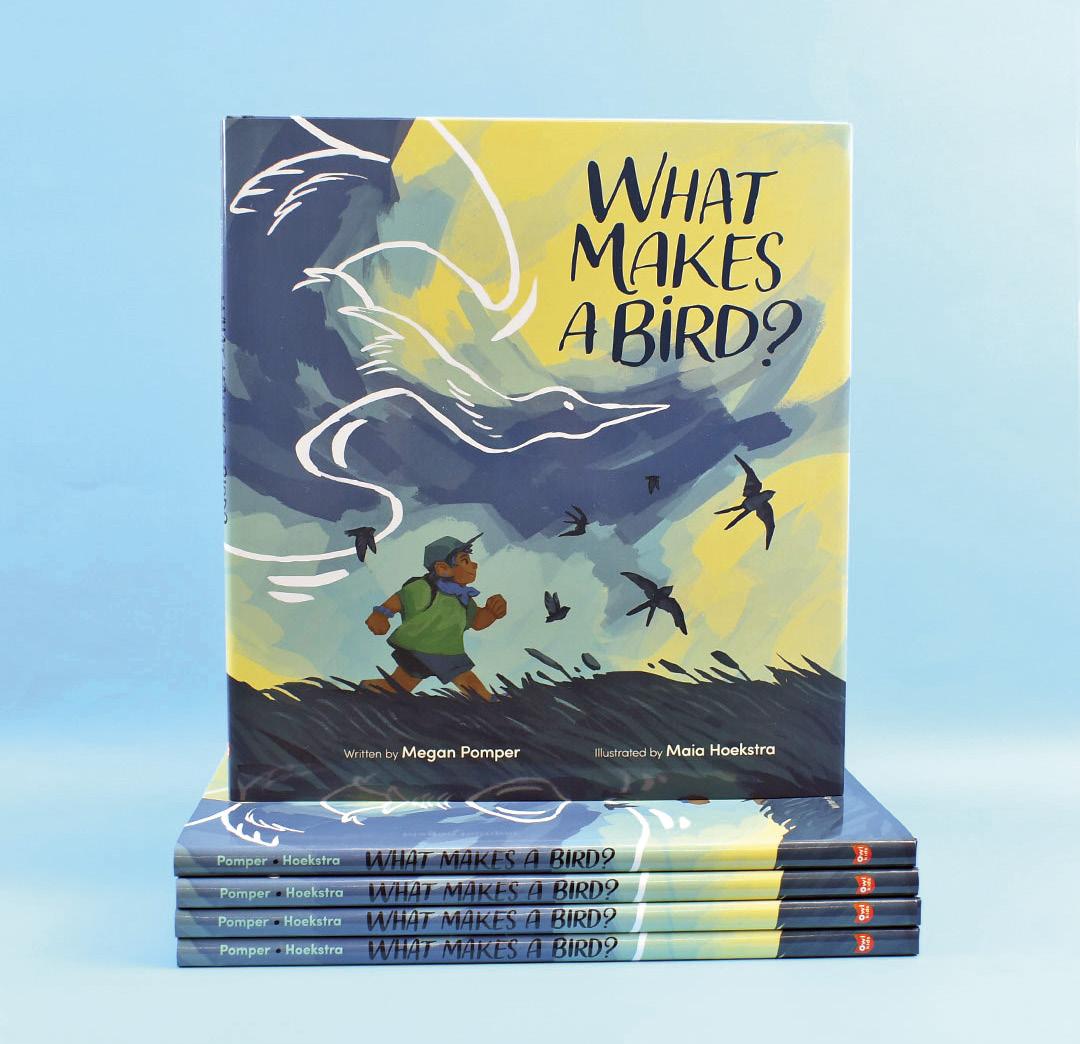
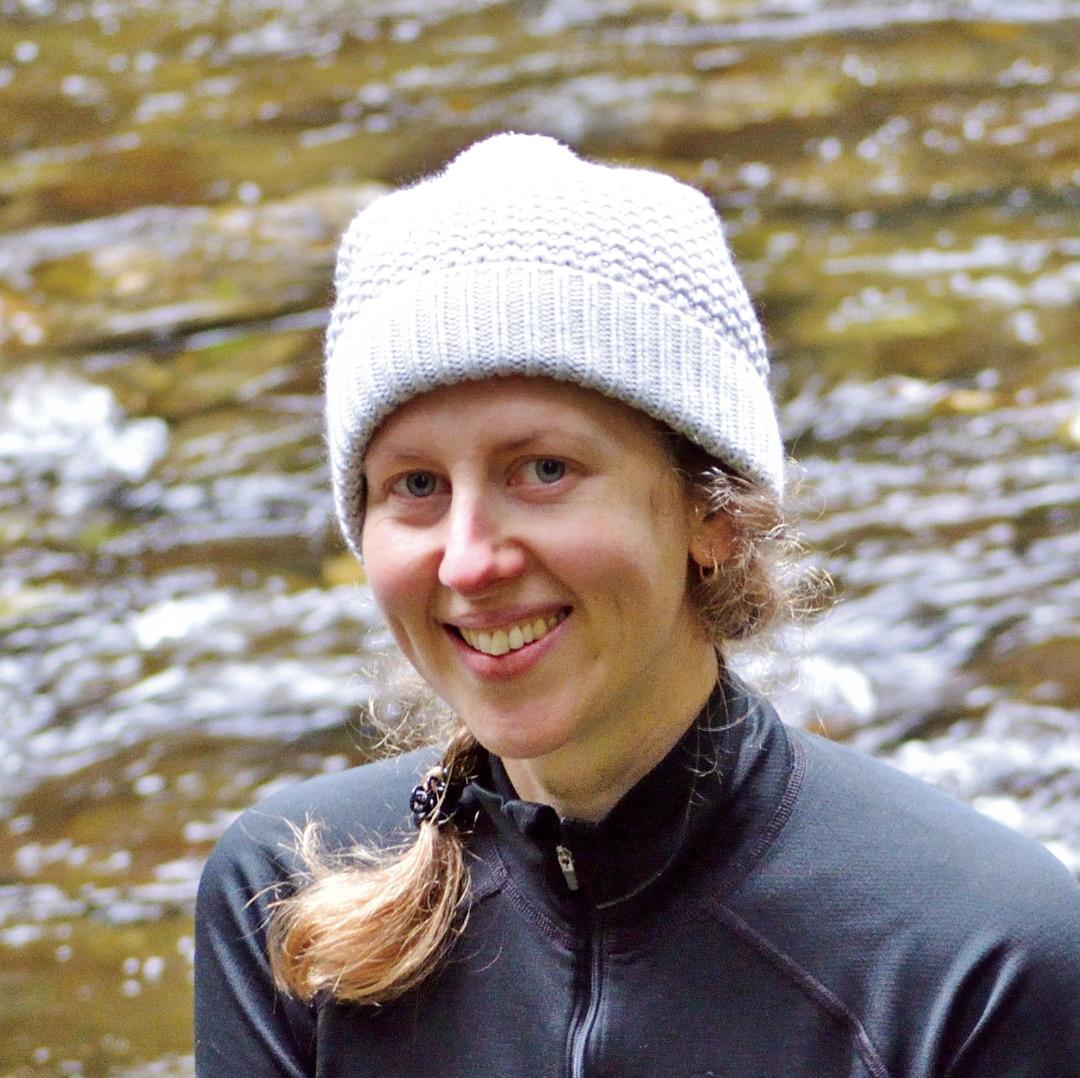
Megan Pomper, Brentwood Bay What Makes a Bird? (Owlkids, 2025)
Illustrated by Maia Hoekstra
What inspired this book?
This book was inspired by watching my kids grow up unencumbered by others' ideas of who they should be. I wanted to inspire children to question the world and recognize the power they have in defining themselves.
What was your path to publishing?
I pursued traditional publishing as I didn't know anything about self-publishing, and it felt incredibly daunting. Querying is hard—often feeling like you are throwing ideas into the abyss. But once I began working with Owlkids, the entire process was dream-like.
How has your book impacted your community?
I have been so touched by the positive response to this book. I loved participating in some school visits in 2025, and I hope to be able to continue these visits this year!
Learning How to Lose MoreThan a Game
Igrew up playing team soccer from the age of eight to 16, and I loved every minute of it. At the time, I didn’t fully understand how instrumental those years would be in shaping who I was becoming. What I remember most were the friendships, the practices after supper and the quiet lessons about perseverance that only sport seems to teach.
Now, years later, I’m seeing those same lessons unfold through my own children.
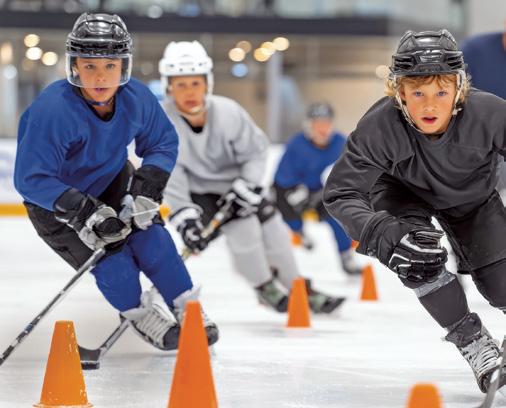
As we wrap up Hudson’s fourth year of hockey—his first full season of rep hockey—I find myself reflecting on the journey
far deeper than wins or losses. They offer growth—sometimes in ways we don’t even notice until we pause long enough to look back.
Early in the season, Hudson’s rep hockey team faced more than their fair share of humbling losses. For young athletes, those early defeats can feel heavy. But somewhere along the way, something began to shift. The team started to gel. Practices became more focused, confidence began to build and the boys began leaning into the kind of grit that sports often demand.
that brought us here. When I first stepped into the role of “hockey mom,” I had no idea what I was signing up for: the early mornings, the emotional highs and lows, the physical commitment of constant practices and games, and the very real financial investment that comes with it.
But every ounce of that effort has been surpassed by something far greater: the pride of watching your child develop skills in an activity they truly love.
Hudson’s passion for hockey is entirely his own. And along the way, I’ve realized that youth sports offer children something
Recently, they won gold in a tournament hosted right here at home, and that comeback from losses to undefeated wins left us all awestruck in amazement. Watching that journey unfold has been a powerful reminder that one of the most valuable lessons sports can teach our children is how to lose—and keep showing up anyway.
Team sports offer something uniquely powerful: a sense of belonging. Children learn that their role matters, whether they score the winning goal or simply support their teammates from
the bench. They learn how to celebrate each other’s victories and push through disappointment together.
Sports also introduce children to friendships that exist outside the structure of school. Teammates come from different classrooms, neighbourhoods and backgrounds, often creating bonds that might never have formed otherwise. Over time, those locker room friendships and shared victories—and losses—can become some of the most meaningful connections kids carry with them.
Watching my children grow into their own interests has also reminded me that not every child thrives in the same environment.
Mila, my girl twin, now in her third year of dance, has fully embraced the world of ballet and jazz. She hasn’t shown much interest in team sports just yet, she’s my most independent child, content to spend hours colouring quietly, slipping into imaginative role play or practicing dance moves in front of the mirror. Dance has become her space to express herself creatively, and along the way she’s formed a few sweet friendships within her class.
For children like Mila, individual activities can offer a different kind of confidence. Without the added pressure of a team dynamic, kids are free to focus inward, refining their movements, expressing themselves creatively and building confidence at their own pace.
Her twin brother Liam, on the other hand, is still discovering where his passions might land. He’s in his second year of little league baseball and will be trying hockey for the first time this fall as well. Like many kids his age, we’re still not entirely sure which direction he’ll go or what will truly spark that deeper love for sport. For now, we’re simply following his lead and giving him the opportunity to explore.
And perhaps that’s one of the most important roles we have as parents: to create opportunities for our children to try new things while allowing them the freedom to discover what truly lights them up.
As parents, we sometimes focus on the scoreboard, the schedule or the commitment required to keep up with practices and games. But when we step back, the true value of youth sports becomes clear.
Whether on the ice, the baseball field or a dance floor, our children aren’t just learning how to play. They’re learning who they are becoming.
Natasha Mills is a twin mom of three living and raised in Victoria for over 30 years. She is a published author in the parenthood space and a full-time digital creator on social media. Find more of her content at @mommamillsblog.
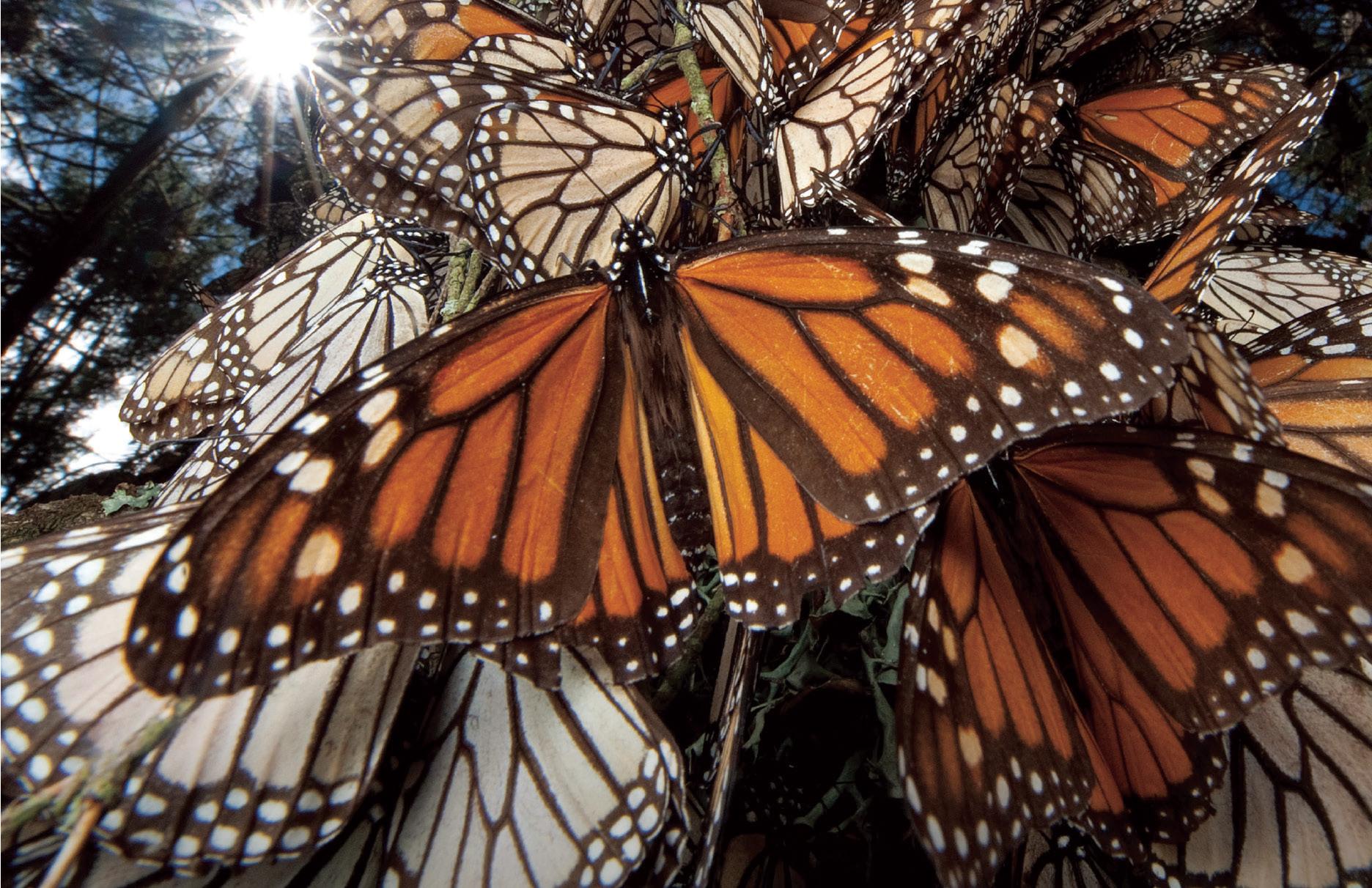
Butterfly Journey
The Messy, Honest Work of Making ‘Parent Friends’
When I moved to Vancouver Island from the UK, I carried hope that making friends would feel kind of easy. Coming from a big city and a large company, I was used to brushing shoulders with strangers and striking up conversations. Putting myself out there had always felt natural.
I imagined making friends in a new country and city would be similar, perhaps even more organic. Conversations at the playground would naturally turn into coffee dates, coffee dates would slowly grow into friendships, and I would feel connected and at home. Some of that did happen, but it also felt surprisingly hard. What I learned is that, in any context, building friendships, organizing events or sharing who you are with a new community takes courage. As adults, we often forget how much bravery it takes simply to try. As parents, that courage is layered on top of exhaustion, limited time and the oddly emotional stakes of wanting connection for yourself and your family.
Hosting—whether it’s a casual coffee, a walk or an evening at home—can be a powerful way of turning acquaintances into connections. Inviting people into your space, however small or imperfect, is often where relationships begin to move from polite to personal. When you imagine hosting, it’s easy to picture something calm, effortless and nourishing. But in reality, it rarely unfolds that neatly. People cancel or arrive at unexpected times, plans shift, logistics fall through and little mishaps like spilled food, disagreements and forgotten details are part of the process. By the end, you might feel unsettled, wobbly or deflated, and it’s completely natural to wonder whether all the effort was worth it.
But here’s the quiet secret: these meetups probably didn’t go wrong. They just went differently to what was pictured.
And in many ways, they may have been going right all along…
Mishap is information, not failure
When something doesn’t go to plan, it’s easy to turn the experience into a verdict. But often, what we’re being given is information—about timing, capacity, expectations and what people need. When we step back from the emotional charge, these moments become data points rather than judgments. They help us understand ourselves and others with more nuance and kindness.
Make sure it fills your cup too
There’s something important about creating experiences that nourish you, regardless of how others respond. Whether it’s hosting, organizing or simply reaching out, the effort feels different when it aligns with something you enjoy. When it matters to you, it’s never entirely wasted; there is always something gained, even if the outcome looks different.
Small, reliable connections matter
We often imagine community as something large and visible, but in reality, it’s built on a few steady relationships. A small circle of people who show up, respond honestly and offer continuity make a huge difference. Those consistent connections carry us far more than a wide network.
Bravery builds trust
Putting yourself out there is visible, and people notice. Even when plans wobble, the act of trying sends a signal that connection matters. Over time, that willingness tends to invite openness and trust in others.
Look for the quiet signs of connection
Connection is not always loud or immediate. Sometimes it shows up as a message later, a thoughtful comment or someone quietly following along. These subtle signals can be easy to miss, but they often indicate that something meaningful is taking root beneath the surface.
You are growing through this
Moments of discomfort—navigating cancellations, miscommunication or personal tension—are often moments of growth. They stretch patience, empathy and self-awareness. Over time, they shape how we relate to others and to ourselves.
Imperfect moments still create memories
So much of connection happens in imperfect moments. Conversations that meander, plans that change, laughter that happens despite things not going smoothly. These experiences become part of the story of how relationships form—messy, human and real. Belonging isn’t built
in polished highlights, but in ordinary attempts.
If you’re reading this and recognizing yourself, you’re not alone. Making friends as an adult is hard. Making friends as a parent can feel even harder. It asks for vulnerability at a time when many of us are already stretched thin. Plans will fall through. Cakes will fall on the floor. People will cancel. And yet, often, those messy moments are exactly where connection begins through shared reality rather than curated perfection. So, if it all goes wrong, take a breath. Look for what went right. And keep showing up, imperfectly. Because that, quietly, is how belonging grows.
Charlotte Curtis is a senior regulatory scientist within the pharmaceutical industry but wears many hats. She writes about belonging, identity and village-building on Substack and can also be found on @char_andthevillage.
RecoveringAwe in the Ordinary
Parenthood has a subtle way of reshaping how we see the world. Before becoming a parent, I thought awe lived in big moments: breathtaking views, milestone achievements, once-in-a-lifetime experiences. Then, through my son, I discovered that awe often lives much closer to home, hidden inside ordinary days.
Some of our happiest moments were simple and low key. Sitting on the floor together or following his imagination instead of leading it, I found myself laughing more freely and feeling fully present in ways I had never experienced before.
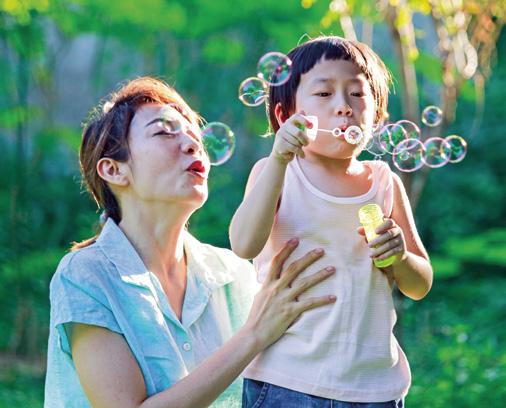
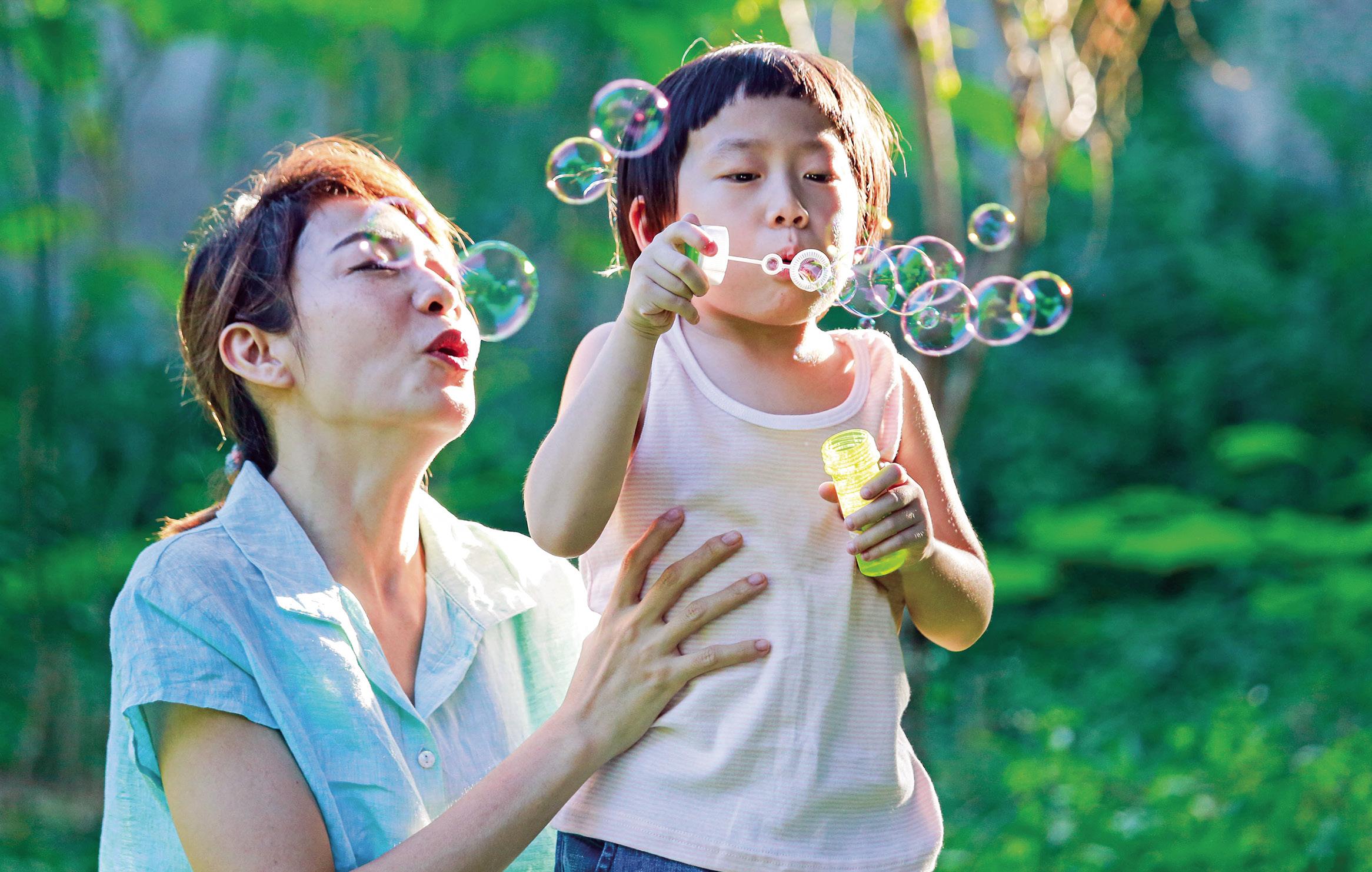
Even blowing bubbles became magical. For a few minutes, everything else faded. All we cared about were floating orbs, giggles and the delight of trying to catch something so fleeting and light. That’s when I realized joy doesn’t require grandeur. It requires attention and presence.
We also sang a lot. Sometimes we sang real songs; other times, we made up silly tunes about getting dressed, cleaning up his room or helping him memorize things for school. Singing eased routines and tasks that might have felt stressful and
turned them into moments of connection and warmth. It reminded me that joy isn’t only something we feel; it’s something we create.
Even toilet training, a stage many parents associate with stress, became surprisingly joyful for us. When he was successful, we sometimes called the grandparents, and occasionally an aunt, to proudly share the news. What could have been an ordinary milestone became a shared celebration across generations.
Sometimes, the celebration was simply a small dance, like the one some football players do after a touchdown. We would clap, laugh and dance around the room in our own victory ritual. It wasn’t about exaggerating small achievements. It was about showing him that effort mattered and progress was worth celebrating.
I also learned how important transitions were. When it was time to leave the playground or the beach, he would start to fuss. Instead of rushing him, I began giving him time to say goodbye to the playground, the fountain, the beach or his favourite park. Those simple goodbyes changed everything. They
honoured his experience and they respected his feelings. They taught me something; leaving well is just as important as arriving well.
In those moments, I began to understand that children experience time differently than adults do. What felt like “just another step” to me was, for him, a meaningful chapter in his day. By slowing down and allowing space for goodbyes, I was teaching him that his feelings mattered. It was safe for him to notice, feel and express emotions without being rushed.
Over time, I noticed how this small practice made other parts of our lives flow more smoothly. Mornings became easier. Bedtimes felt more peaceful. Even difficult moments seemed easier to navigate when we approached them with patience and presence.
Through these small moments with bubbles, songs, dances and gentle goodbyes, my son taught me that awe isn’t reserved for mountaintops or special occasions. It lives in daily life. I slowly began to understand something simple yet profound: most challenges in parenting don’t need complicated solutions. They need empathy, patience and love. When I paused long enough to see the world through my son’s eyes, I understood his excitement, his frustration and his attachment to a moment or to certain things, so my response naturally softened. Instead of reacting and rushing to fix things, I learned to listen and connect first.
Empathy didn’t mean giving in to every request. It meant honouring his feelings while still offering gentle guidance. Love meant showing up with patience, curiosity and kindness, even on difficult days.
Over time, I realized that this approach didn’t just ease small conflicts, it strengthened our relationship, and that sense of safety and connection became the foundation for everything else.
He’s all grown up now, and I’m deeply grateful that we laughed, sang and celebrated so freely. Those moments shaped more than his childhood. They reshaped me by teaching me to slow down, focus, enjoy and truly appreciate our time together. Perhaps the greatest gift my son gave me is a joyful way of seeing the world: lighter, brighter and filled with quiet wonder.
Spring & Summer Swimming Programs
For Kids who LOVE to Swim
Laura Guarin is a Vancouver Island parent and joyful living and resilient aging coach. Through reflective writing, supportive coaching and well-being practices, she helps women navigate significant life changes with greater joy, vitality, purpose and resilience.
Island Swim Skills Team
• Runs to end of June
• Weekday afternoons at JDF & Commonwealth pools
• New swimmers book an assessment online
Summer Skills
• Runs August 4 September 4 at Commonwealth pool
• daily afternoons, registered by the week.
Swimmers must be able to complete 25 metres unassisted
www.islandswimming.com/program-info
Books to Get Your Family Moving
Discover a world of healthy habits with this month’s selection of books that celebrate movement and mindfulness for every age. Featuring standout titles from local BC authors, these reads will inspire your family to get active and embrace the joy of play together.
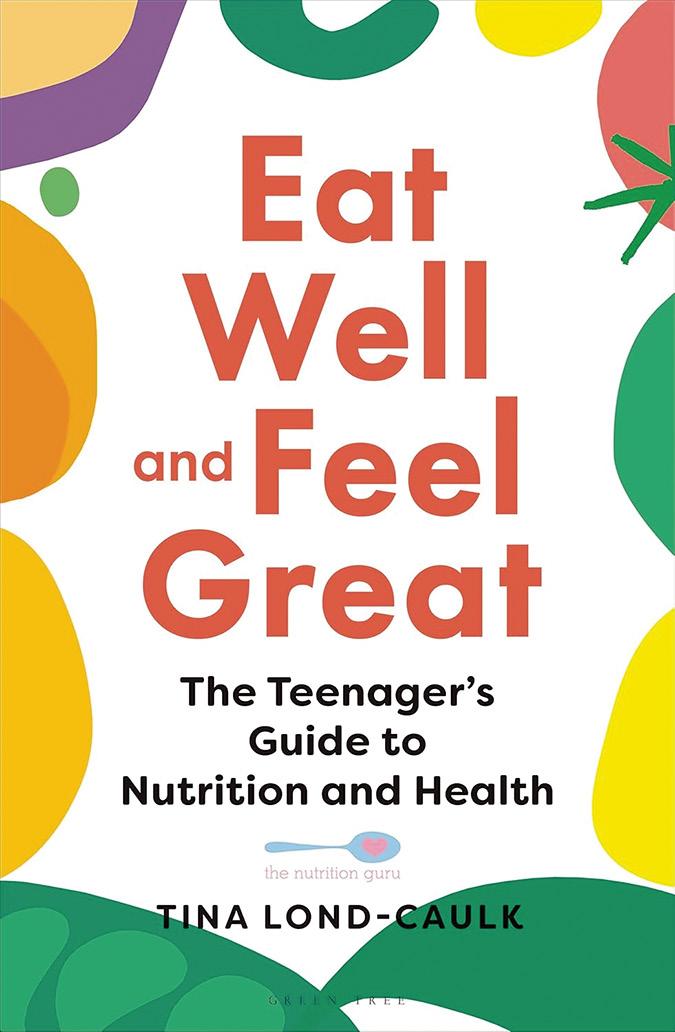
Eat Well and Feel Great
Written by Tina Lond-Caulk
This is a practical nonfiction guide designed to help teens understand how nutrition and healthy habits affect their bodies, energy and overall well-being. It encourages developing minds to create a positive relationship with food while learning how smart nutrition choices can support mental health, physical performance and long-term wellness. The book aims to empower teens with reliable information so they can make confident, healthy decisions in their everyday lives.
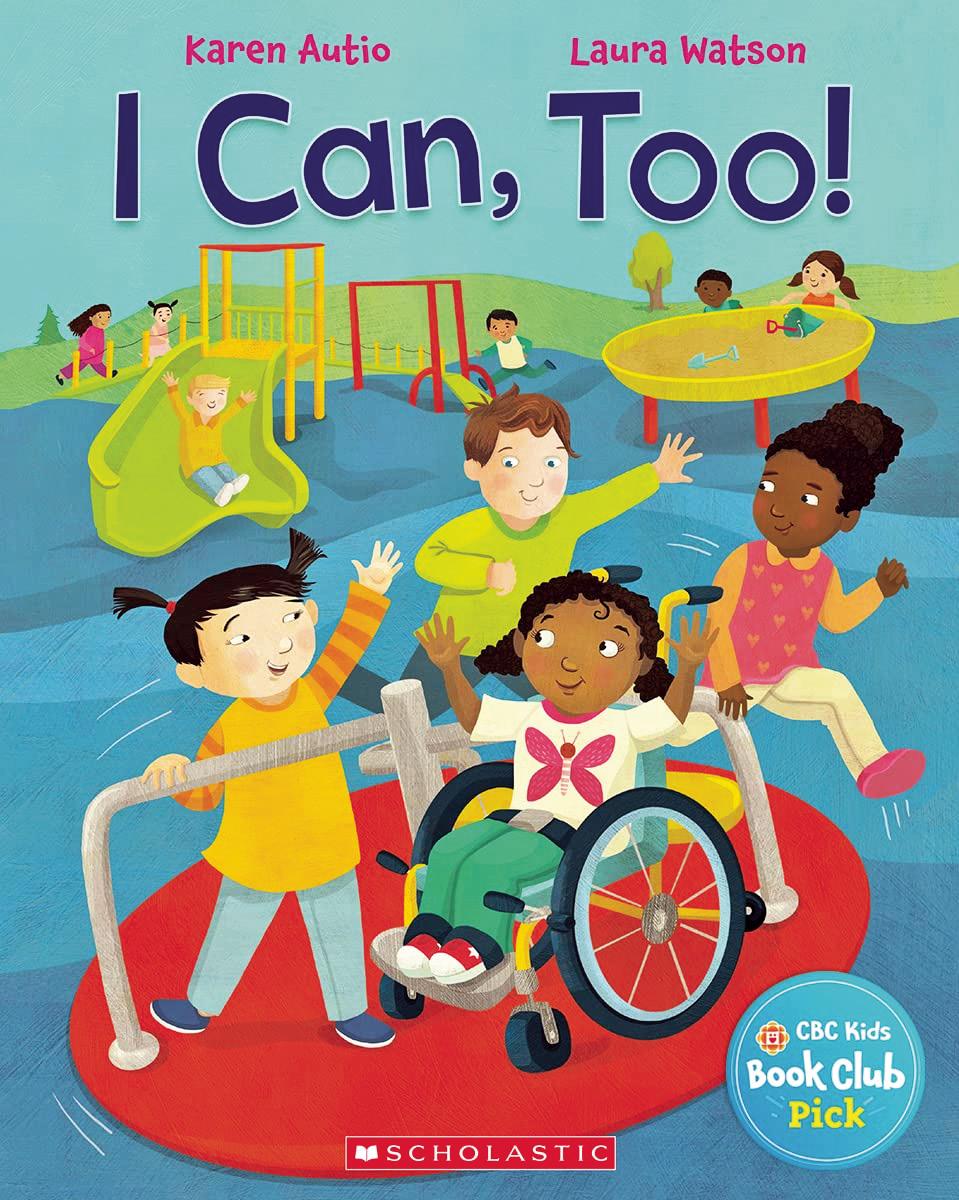
I Can, Too!
Written by Karen Autio,
Illustrated by Laura Watson
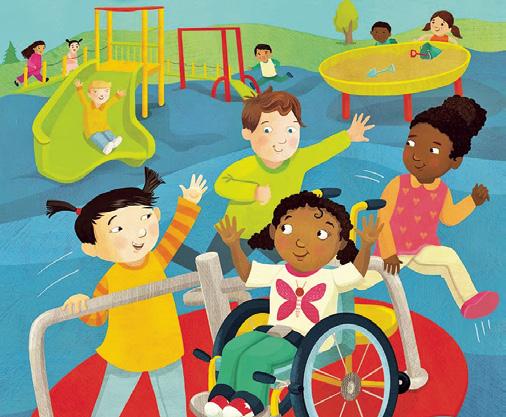
A joyful picture book from Kelownabased author Karen Autio, celebrating movement and play for all kids—no matter if they walk, pedal, glide or roll! Through simple, energetic text and vibrant illustrations, this story shows how adaptive equipment and creativity help all children enjoy being active and playing outside. This book is great for toddlers to start thinking about active play and inclusive fun.
Fighting for Gold
Written
by
Lorna Schultz Nicholson
This inspiring nonfiction book tells the story of Canada’s Paralympic sledge hockey team. It shows how athletes with disabilities train, compete and overcome obstacles to reach the highest level of sport. The book, best suited for tweens and teens, celebrates perseverance, determination and the power of sport to inspire.
Erika Palmer is a writer living in Victoria with her husband and daughter. She believes most problems can be solved with a good cup of tea and a huge piece of chocolate.
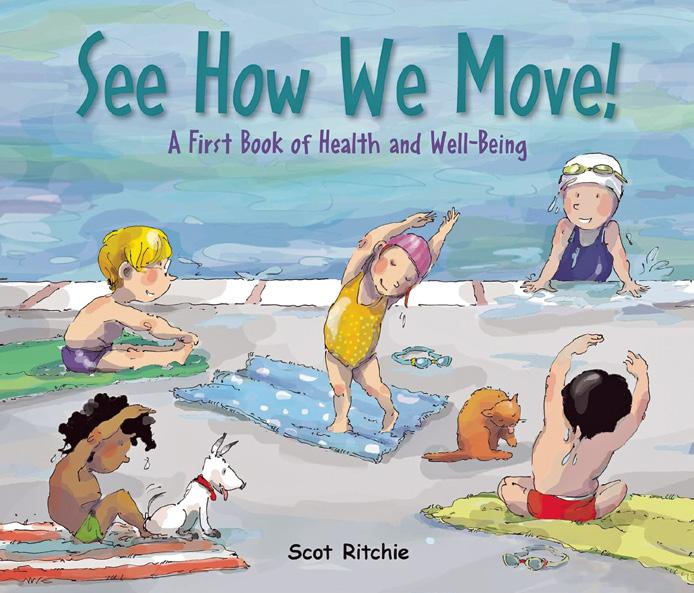
See How We Move!: A First Book of Health and Well-Being
Written and Illustrated by Scot Ritchie
This engaging nonfiction picture book introduces children to the building blocks of healthy living. Through the story of kids preparing for a swim meet, readers learn about exercise, nutrition, teamwork and rest in an accessible, encouraging way. Vancouver-based author and illustrator, Scot Ritchie’s detailed illustrations help young readers understand how healthy habits fit into everyday life, making this a strong pick for early elementary-aged kids.
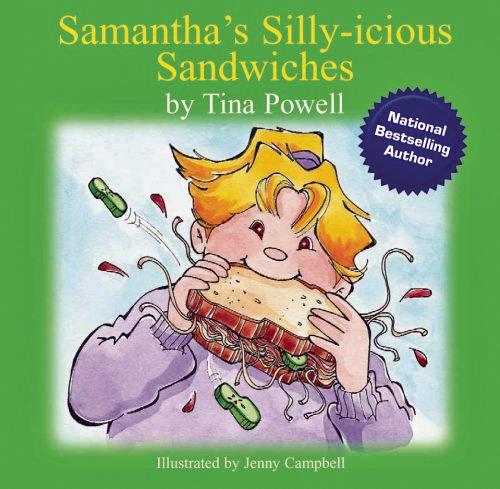
Samantha’s Silly-icious Sandwiches
Written by Tina Powell and Illustrated by Jenny Campbell
Using humour, Vancouver author Tina Powell introduces themes of nutrition, trying new foods and taking responsibility for making healthy choices. Aimed at young school-aged kids, the story follows Samantha, who becomes tired of the same old sandwiches in her lunchbox and decides to start making her own imaginative creations.
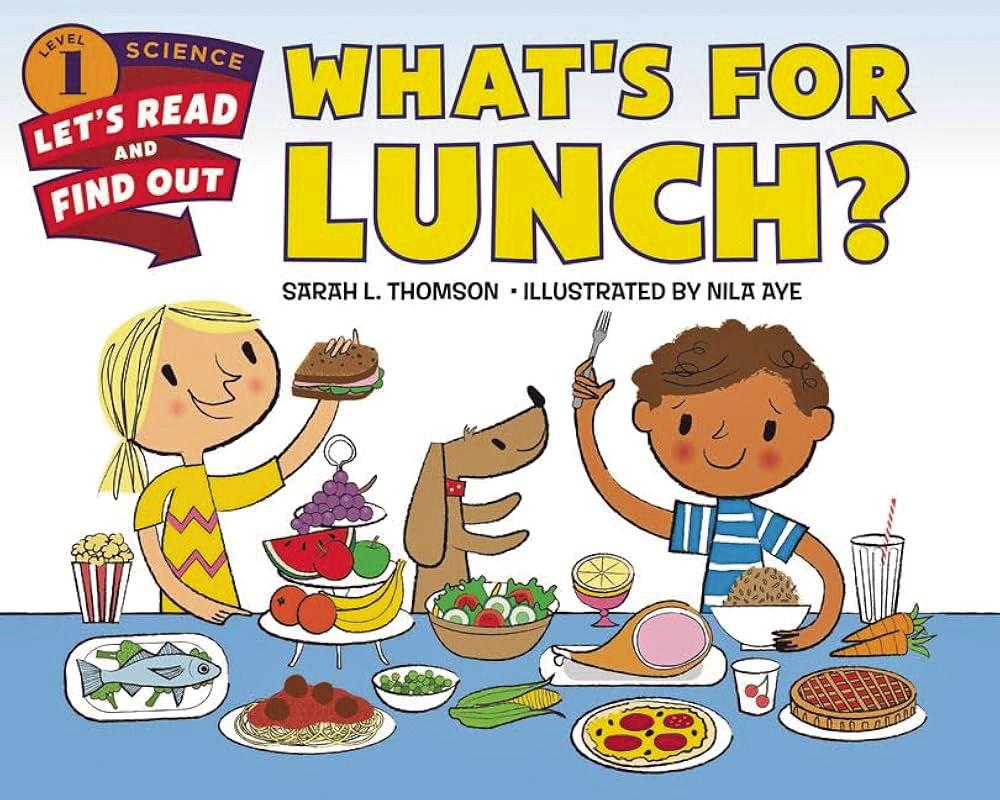
What’s for Lunch?
Written by Sarah L Thomson and Illustrated by Nila
Aye
This is a colourful nonfiction picture book that introduces young readers to the basics of healthy eating and nutrition. Written for young elementary children, it explains how different foods help the body grow strong and stay healthy. Kids will learn that foods like fruits, vegetables, grains and proteins each have their own role in helping the body function and work to strengthen bones, build muscles or give energy for play and learning.
Celebrate the World with Food
Want to make dinner exciting? Try throwing an Around the World dinner party! It’s a great way to explore new flavours and learn more about other countries. Here are six ideas to help you start exploring the world through food.
1. Celebrate the whole world by cooking a dish from each of the continents.
cultures have bread, noodles, dumplings and salads. How are they different and how are they the same?
5. Visit ethnic grocery stores to find new foods to add to your meal.
6. Get your kids involved. Let them help plan and cook the menu!
Here are four easy snacks and
Use a globe or map to teach your children about the five continents.
2. Deep dive into a single country. Create a three-course meal featuring an appetizer, main dish and dessert. Play music from that country, find it on a map and learn a few fun facts.
3. Why not celebrate a different country every month? It’s a great way to build family connections through a fun and delicious routine.
4. Discuss the similarities and differences between various cuisines. Many
appetizers from around the world. They are simple enough that even young children can help prepare them. Older children can likely make them on their own!
BRAZIL: Tapioca Cheese Puff (Pão De Queijo)
Prep Time: 10 minutes,
Bake Time: 25 minutes
These Brazilian cheese puffs are a favourite with pretty much everyone. They are best eaten hot and fresh from the
oven. However, the dough can be made in advance. Simply stick it in the fridge until you’re ready to bake.
1⁄2 cup milk
1⁄4 cup oil
1⁄2 tsp salt
1 cup tapioca starch
1 egg
1 cup grated cheese
Preheat the oven to 375°F.
Heat the milk, salt and oil on the stove. Make sure it’s hot but not scalding.
Remove from heat. Stir in the tapioca starch. Mix until a dough forms. Allow it to cool slightly before mixing in the egg. Make sure it is well mixed. Fold in the cheese.
Grease a rimmed baking sheet. Using two spoons, form balls with about 2 Tbsp of dough.
Bake for 20 to 25 minutes, until the puffs are cooked through and starting to brown.
AFRICA: Oven-Baked Plantain Chips
Prep Time: 15 minutes
Plantain chips are typically deep fried. But oven baked chips are a whole lot easier and just as tasty.
1 green plantain
1 Tbsp of oil
1⁄4 tsp salt
Preheat the oven to 375°F. Remove plantain peel with a knife. Slice as thinly as possible. If you have a box grater, you can use the slicing side to make nice even slices.
Toss the plantain slices with oil. Lay them out in a single layer on a rimmed baking sheet. Sprinkle it with the salt. Bake for 8 minutes. Turn the slices then bake for another 2 to 8 minutes. The baking time will depend on how thick the plantain slices are. They are ready as soon as they start to crisp. Plantain chips taste best when fresh and hot, so serve immediately.
JAPAN: Miso Soup
Prep Time: 5 minutes, Cook Time: 10 minutes
8 cups water or kombu dashi
1 block of tofu
2 tsp dried wakame
6 Tbsp miso paste
4 spring onions
Cut the tofu into small cubes. Dice the spring onions.
Bring the water (or dashi) to a boil. Add in the tofu, spring onions and dried wakame and turn off the heat.
Remove 1 cup of liquid from the pot. Mix the miso paste into the liquid until it’s fully dissolved.
Stir the miso into the cooling soup and serve.
INDIA: Mango Lassi
Prep Time: 5 minutes
Feel free to skip the sugar in this mango lassi. It’s only necessary for tart mangos. Most mangos have plenty of natural sweetness.
1 large ripe mango, or 2 small mangoes (about 1 lbs worth)
2 cups of yogurt
2 tsp sugar
Peel the mango and cut the flesh off the pit.
Place the mango flesh and yogurt in a blender. Blend until smooth. Taste and add sugar if it needs a bit more sweetness. Serve right away.
Viewmont Dental Centre
Emillie Parrish loves having adventures with her two busy children. You can find more of her recipes in her cookbook Fermenting Made Simple. fermentingforfoodies.com
How Boundaries Became My Gateway to Freedom
My journey to discovering boundaries started right after the birth of my first child. It was the day after I returned home from the hospital following a C-section. I was cracked open physically, emotionally and spiritually. I was also navigating the raw terrain of breastfeeding, healing and stepping into the vast unknown of motherhood. And yet, despite the exhaustion and pain, I was euphoric. My son had arrived and I was floating in the magic of it all.
But that magic was fragile.
It was this time, this sacred fleeting window, that became the impetus for my interest in boundaries. Though I didn’t have the language for it then, I felt it in my gut. I planned to protect this new family space; to honour the postpartum cocoon I always suggested as a doula and prenatal massage therapist. I knew the importance of the “postpartum babymoon.” I knew how vital it was to slow down, to nest, to bond and to heal. I spent years talking to women about the importance of claiming that space. Now it was my turn. I wrote a gentle note for the outside door:
“I’m so glad you came over, but we would love a few weeks to have family time and to heal.”
It was a whisper of self-advocacy, a quiet plea for reverence. But my mother tore it down.
It was a foreign concept to her and hit a chord with her people-pleasing ways of putting others before herself. She told me I couldn’t do that. That it was rude. And in that moment, something inside of me collapsed. My heart sank. I felt erased. Like my needs, my healing, my desire to bond with my baby were inconvenient; like asking for space was selfish. I had just brought life into the world, and yet I was being told to shrink.
Becoming a new mother, for me, felt incredible. What I was not prepared for was having all the answers for everyone; the expectations of family that I never even thought would come up. At times, I felt like I was in the spotlight and I had to do things the way they were always done.
All the questions about feeding, sleeping and vaccinations can feel overwhelming. You don’t need all the answers. You
need breath, grace and room to become…. The questions that feel overwhelming now are invitations to slow down, to listen inward, honour the messy magic of birthing yourself into motherhood.
You are not failing, you are unfolding.
Your gateway to freedom is boundaries.
Motherhood is not a time to shrink. It is a time to expand and become the new person parenthood brings. Each family is unique with different needs. This is where boundaries come into play. Implementing the following gave me the freedom I was looking for.
• “No” is a full sentence and I don’t need to explain my position.
• Boundaries are a puzzle piece to how I live in the world.
• I now know where I stop and someone else begins.
• A boundary is between me and me, even if someone else is involved.
• My boundaries are fluid and may change over time.
• No one can cross my boundaries but me.
This information typically resonates with people pleasers, peacekeepers or empaths. It is indicative of living an “other referenced” life; waiting to see how others feel, over how you feel. When we do this, we abandon ourselves.
You deserve to take space and to have your needs met. You are worthy of having the life you want.
Janis Elliott is a certified life coach who resides in the Comox Valley with her husband and three sweet, sharp-witted boys. She specializes in helping people stay accountable to their goals and values with clarity and purpose.
Register For Music Lessons Today.
Expecting When Meets Education
Becoming a Parent While Pursuing a Master’s Degree
Iwas 25 and I had just found out I was pregnant. We were on a ferry, going to tell my parents when I opened the email that said I was accepted into the master’s program that I had applied for. My head was spinning! What should I do?
My parents were excited and worried for me, as having a baby and going to school are both expensive and life-changing events. My dad’s advice was not to try to do both at the same time. I was torn. I had never had such a big decision to make. I kept thinking, “but I want them both!”
My husband was the one who encouraged me to go for it. He strategized how we would pay for it, and he could see the other side. It would be better for me in the long run to do this schooling now. We wanted multiple children. The opportunity felt precious.
So, I did it. I had two children while doing my Master of Science and this is what I learned:
1. People change the way they treat you while you are pregnant. Not only was I a woman pursuing STEM, but I was also pregnant. Really pregnant. I would say I was treated very differently by my professors and my fellow students. I can’t say if it changed the outcome of my schooling but it definitely included a certain stigma.
2. My brain was not all there. The first thing my doctor said to me when I found out I was pregnant was that I was going to lose 25 percent of my brain power. He was not wrong. I felt somewhat in a daze during the courses, and I leaned on my cohort when we had group assignments. Every thought was slower to materialize. It can create a sense of isolation, since there are very few other pregnant women at university.
3. I needed my family. My mom was the one who watched my infant daughter while I had class. My husband worked as the sole earner for those three years. My father helped me with complicated assignments. It was a team effort. I heard similar stories from other parents in my university. When I graduated, I was surrounded by those who had held me up and we all cel ebrated together.
4. I needed to modify my expectations. I knew what I was not willing to compromise on. I knew my goals were the same as before I became pregnant, but I did have to lower my expec tations. I could not do a complex field experiment with mul tiple data sets in remote geographical locations. I listened to my thesis supervisor, and we found a good solution that made me feel like I was still in control of my project.
5. Don’t be shy to ask your school to modify the program or schedule for you. It is vitally important for women to pursue higher education. Check with the school’s policies on taking leave. Don’t be afraid to ask your school to adjust for you. Think of how your daughters will benefit if you champion change.
6. I was gentle with myself. I knew that I had chosen this path, and that I wasn’t going to be going into a fancy new job like some of my colleagues. It didn’t matter though, to me, starting a family was equally important.
7. Be prepared to play catchup. While I was parenting, my career was on hold. It was okay, and I did catch up from those years I took off to parent. It took a little longer than I wanted, and I was nervous that I had waited too long, but everything turned out just fine. I have a career now, and I love my job that my degree qualified me for.
It takes a lot of bravery to start a family, and the compounding pressures on young families make these decisions feel insurmountable at times. Women deserve access to higher education, and we can demand society makes space for us. The world needs your creativity and problem-solving innovation. Plus, you are modelling positive change for society, when you put your education forward as a priority in your life. Never give up on your goals!
Rachel Bevington is a member of the Lower Nicola band who lives and works on Salt Spring Island as a restoration biologist and mom. When not working or playing outside, she likes to be knitting and weaving in her studio in the forest.
Learn more by scanning the QR code or visiting mygns.ca/community/camps
We’re offering a variety of fun summer camps for students age 3 to 16. Arts, coding, writing, field hockey, volleyball, kayaking and more — our summer camps offer something for everyone!
Vancouver Island’s Best Family Camps All Together Now
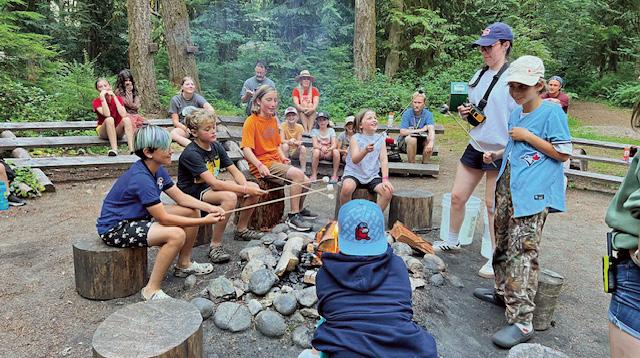
Family camps offer a unique kind of vacation. Instead of dropping kids off for the week, everyone participates together—parents, kids and sometimes even grandparents. Days are often filled with outdoor activities like kayaking, hiking, crafts and games, while evenings bring shared meals and campfire activities.
Across Vancouver Island, several camps offer programs specifically designed for families to attend together. Some are weekend retreats, while others are week-long immersive experiences. Here are some of the best family camps on Vancouver Island.
Camp Homewood, Quadra Island
Located on a beautiful 200-acre oceanfront property on Quadra Island, Camp Homewood has been welcoming families for decades. Their dedicated family camp sessions allow parents and children to stay on site together in cabins, lodge rooms or tents. Families can take part in activities like kayaking, swimming, hiking, archery and crafts. Evenings include group meals and campfires overlooking the ocean, creating a relaxed environment where families can connect and unwind. And their parents-only dinners are always a hit to get some needed connection while the kids are safely entertained.
O.U.R. Ecovillage ReVILLAGEing Family Camp, Shawnigan Lake
The ReVILLAGEing Family Camp at O.U.R. Ecovillage on Shawnigan Lake is a multi-day learning experience focused on sustainable living and community. Families camp together while learning hands-on skills such as permaculture gardening, natural building and regenerative agriculture. The workshops, storytelling and collaborative activities are designed for all ages, making it a unique educational retreat where families learn practical sustainability skills while spending time in nature.
Camp Bob Family Camp, Black Creek
Located north of Courtenay near Roberts Lake, Camp Bob offers family camp sessions where parents and kids stay together for several days of outdoor adventure. Activities often include canoeing, hiking, field games and campfire gatherings. The camp focuses on building community and encouraging families to enjoy outdoor experiences together in a supportive environment.
Pioneer Pacific Family Camp, Thetis Island
Pioneer Pacific Camp on Thetis Island is a week-long camp that allows families to stay in tents, trailers or cabins while enjoying a wide variety of activities. Programs include outdoor
recreation, arts activities, group games and evening events like talent shows and campfire programs. The structure typically includes both family time and age-group activities so kids can make friends while parents relax.
BC Family French Camp, Nanaimo
BC Family French Camp in Nanaimo is a popular French language immersion program in a fun camp setting. Held in August, the camp offers activities such as games, sports, crafts and evening campfires—with opportunities to practice French in a relaxed environment. Parents do not need to be fluent to attend, but kids should have at least basic communication skills in French.
Strathcona Park Lodge Family Adventure Programs, Strathcona Provincial Park
Although a little less “summer camp structured” than the other options, Strathcona Park Lodge hosts outdoor adventure programs that families can attend together. Activities you can add to your stay include canoeing, kayaking, hiking, climbing and wilderness skills workshops. The lodge’s lakeside setting provides easy access to Vancouver Island’s largest provincial park, making it an excellent choice for families who enjoy outdoor exploration and guided adventures.
oTENTik Camping, Fort Rodd Hill National Historic Site (Colwood/Victoria)
Families looking for a unique camping experience for a night or two without a summer camp structure can stay in oTENTik tents at Fort Rodd Hill National Historic Site. These Parks Canada accommodations combine the comfort of a small cabin with the feel of camping, featuring raised floors, wooden furniture, electricity and bunk beds that can sleep up to six people.
Many summer family camps combine structured programming with free time, giving families the chance to paddle a lake, explore forest trails or simply relax in nature. On Vancouver Island, these camps take advantage of some of the province’s most beautiful natural landscapes—from coastal shorelines and forested lakes to mountain parks. For many families, attending camp becomes a beloved tradition and one of the highlights of the year.
Erika Palmer is a writer living in Victoria with her husband and daughter. She believes most problems can be solved with a good cup of tea and a huge piece of chocolate.
CAMPS
Earth Day Recycling Projects
Earth Day is an important reminder to celebrate the natural beauty that surrounds us and learn more about how we can protect it. This day, celebrated on April 22, highlights the importance of reducing, reusing and recycling and respecting the natural world. You can make
waste. Below are some fun and easy projects to make from household items this Earth Day.
Dinner Napkins
Say goodbye to disposable paper napkins and hello to stylish reusable fabric
embroidery in one corner such as your initials or a flower design. If you have patterned or floral sheets, your new cloth napkins will give an endearing touch to every meal. You can also make table runners and shelf liners for your kitchen cupboards from bed sheets.
a difference by reusing and recycling your unwanted textiles and clothes. Old clothes, curtains, drapes, bed sheets, and pillowcases can be given a second life. When fabrics and clothing are re-used rather than trashed, it reduces landfill
dinner napkins. Wash and tumble dry an old bedsheet, then cut it into 16-inch squares. Next, finish around the edges by turning the edges over quarter-inch and then finish by hand stitching or a sewing machine. Personalize each napkin with
Braided Friendship Bracelets
These bracelets are constructed from pre-loved t-shirts; they make lovely gifts for your friends and are very easy to make. Cut long half-inch wide strips from t-shirts. The more colourful the
better. Then, tie three lengths of the strips into a knot at one end and begin tightly braiding together until you achieve the desired length to go around your wrist. Add beads for extra pizzazz. Knot around your wrist or ankle when finished.
Decorative Denim Coasters
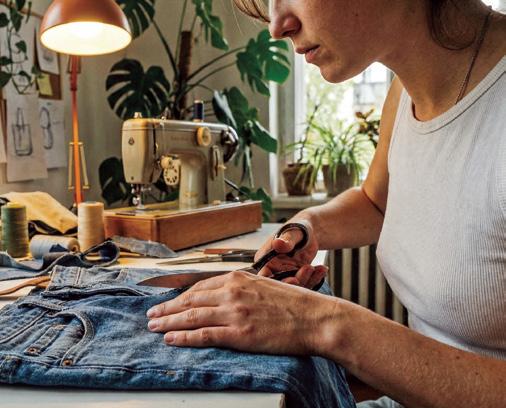
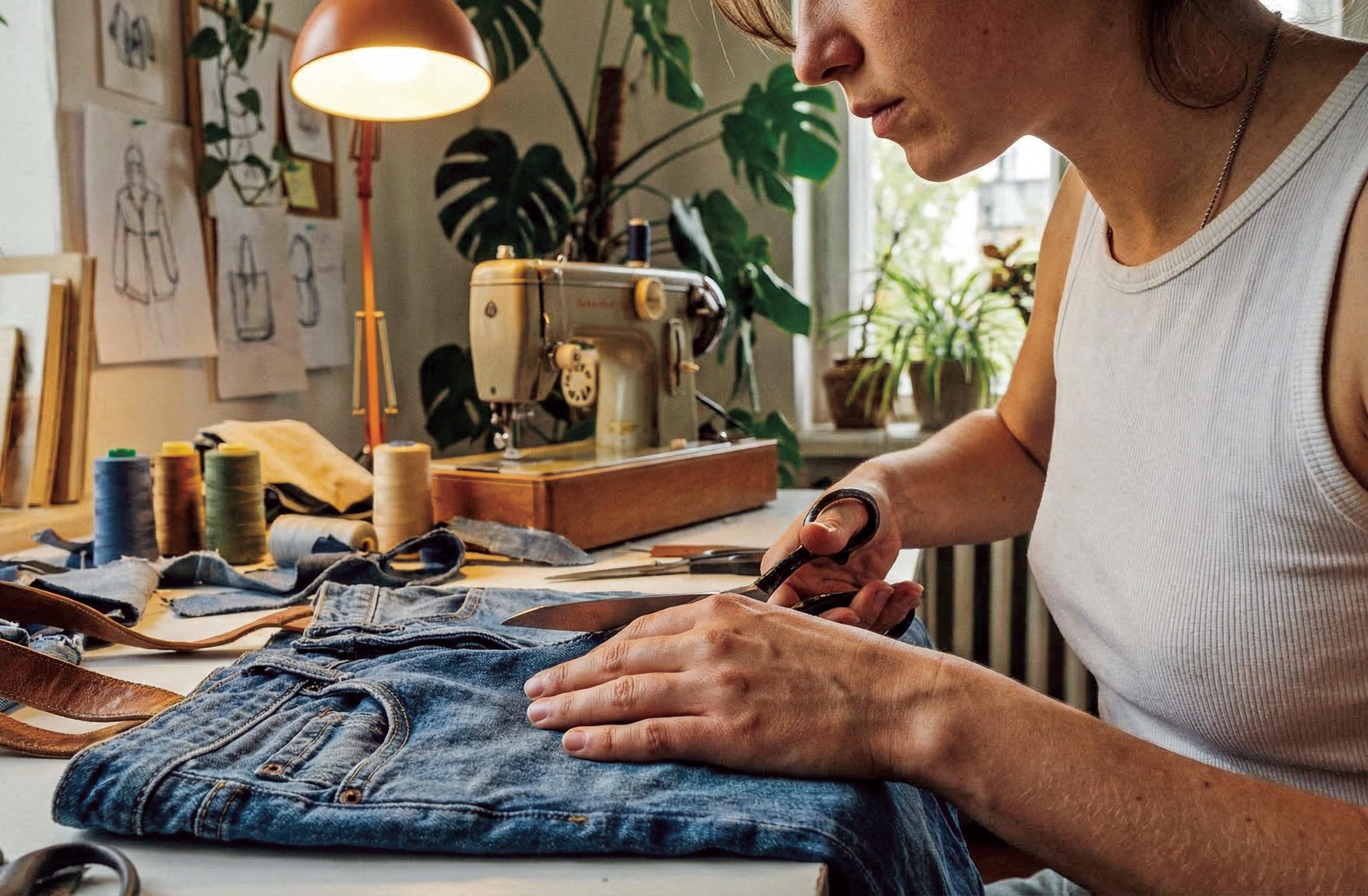
Don’t throw away your old denim jeans or denim skirts. Instead, make these coasters which are ideal for placing hot cups of cocoa or tea. Cut out five-inch diametre circles or squares from the denim fabric for the front and back of each coaster. Then, insert a piece of flannel or interfacing as padding for the middle section. Stack the three coasters together with the flannel in the middle. Sew a quarter-inch seam around the edge of the coaster. Make as many coasters as you want. If you would like, you can fray the edges of each coaster. This is done by using a hairbrush or a piece of sandpaper to distress the raw edges and create a small fringe. Embroider each circle or sew on small beads along the edges. Make several for your friends too.
Cowl Neck Scarf
Create new life out of a pre-loved pullover and make a fashionable neck warmer. Find a wool or wool blend pullover sweater and wash and tumble dry. Next, cut the sweater with scissors in a straight line from armpit to armpit to form the cowl. Finish the cut edge with a whip stitch or a zig-zag stitch on the sewing machine. Slip over your head and around your neck to keep warm on a cold day.
Jerri Carson is is a retired SD61 primary school teacher as well as teaching music and choir. She volunteers on the VOS Musical Theatre costume crew, sewing costumes and working back- stage during costume changes.
At Little Ears, Registered Audiologist Dr. MacAskill is the only Audiologist in Canada who is Board Certified in Pediatric Audiology. Little Ears provides care for Children (and adults) from 8 months onwards.
• Child centred hearing assessments
• Evidence‑based recommendations you can trust
• Clear, supportive communication for parents and educators
• Kid‑approved spaces and playful touches that make appointments feel easy
• Locally owned and operated
Whether you’re seeking answers, ongoing support, or a second opinion, Little Ears provides expert audiol ogy care that meets children where they are — with patience, empathy, and a smile.
Why Predictability Is a Superpower
I’ve never thought of myself as particularly methodical or predictable. Most days I’m juggling full-time work, three kids and a small side business, barely holding it together. Predictability wasn’t something I offered consistently. But over time, I started noticing just how much my kids depended on it.
The realization showed up slowly, in small, everyday interactions where consistency made things smoother. I noticed how predictability helped me prevent toddler meltdowns and, years later, steady my tweens and teens. It became clear that predictability is a quiet superpower in our home.
Morning Cartoons: The First Lesson
When my oldest was a toddler, she’d wander into my room each morning asking for cartoons. Some mornings I’d say yes and we’d extend our morning peacefully with the TV on. Other mornings, when we had to rush to preschool or had already pushed our luck with screen time, I’d say no.
But I never seemed to know which reaction I’d get. Sometimes acceptance, sometimes an immediate meltdown. Her responses seemed unpredictable.
Then one morning I realized the meltdowns were much worse on days when I’d said yes several days in a row and then suddenly said no. She wasn’t melting down just because she couldn’t watch TV. She was melting down because she expected to watch TV. In her mind, we had created a routine.
I was making logical decisions in the moment. I was thinking about how much we’d watched TV yesterday, or if we might be forming bad habits. But none of that matters when you’re four years old. To her, mornings meant cartoons… until they didn’t.
So, we created a simple rule: cartoons on weekends only. Mornings became smoother almost instantly.
Seeing the Pattern Everywhere
Once I noticed it with cartoons, I started noticing it everywhere.
Dessert after dinner: The kids had no clue which answer was coming.
Video games after school: If they got to play yesterday, they should get to play today.
The issue wasn’t sugar, screens or even the requests. The issue was unpredictability. I was making decisions based on nutrition, schedules, mood and routines—adult reasoning. But my kids operated on expectations. When my answers didn’t match those expectations, emotions rose quickly.
Predictability didn’t magically eliminate meltdowns (nothing does), but it dramatically reduced the intensity and frequency of them. It also helped me see that emotional reactions aren’t always about anger. Often, they’re about disappointment.
I later learned that research backs this up: routines reduce uncertainty, help kids feel safe and free up the mental energy they need for everything else. And honestly, it helped me too. I didn’t have to renegotiate the same decisions every day or rely on tired snap judgments.
Bringing Predictability into Hard Conversations
Interestingly, predictability has helped us with communication, too.
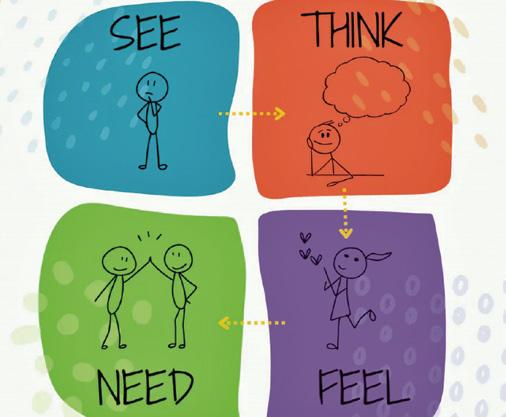
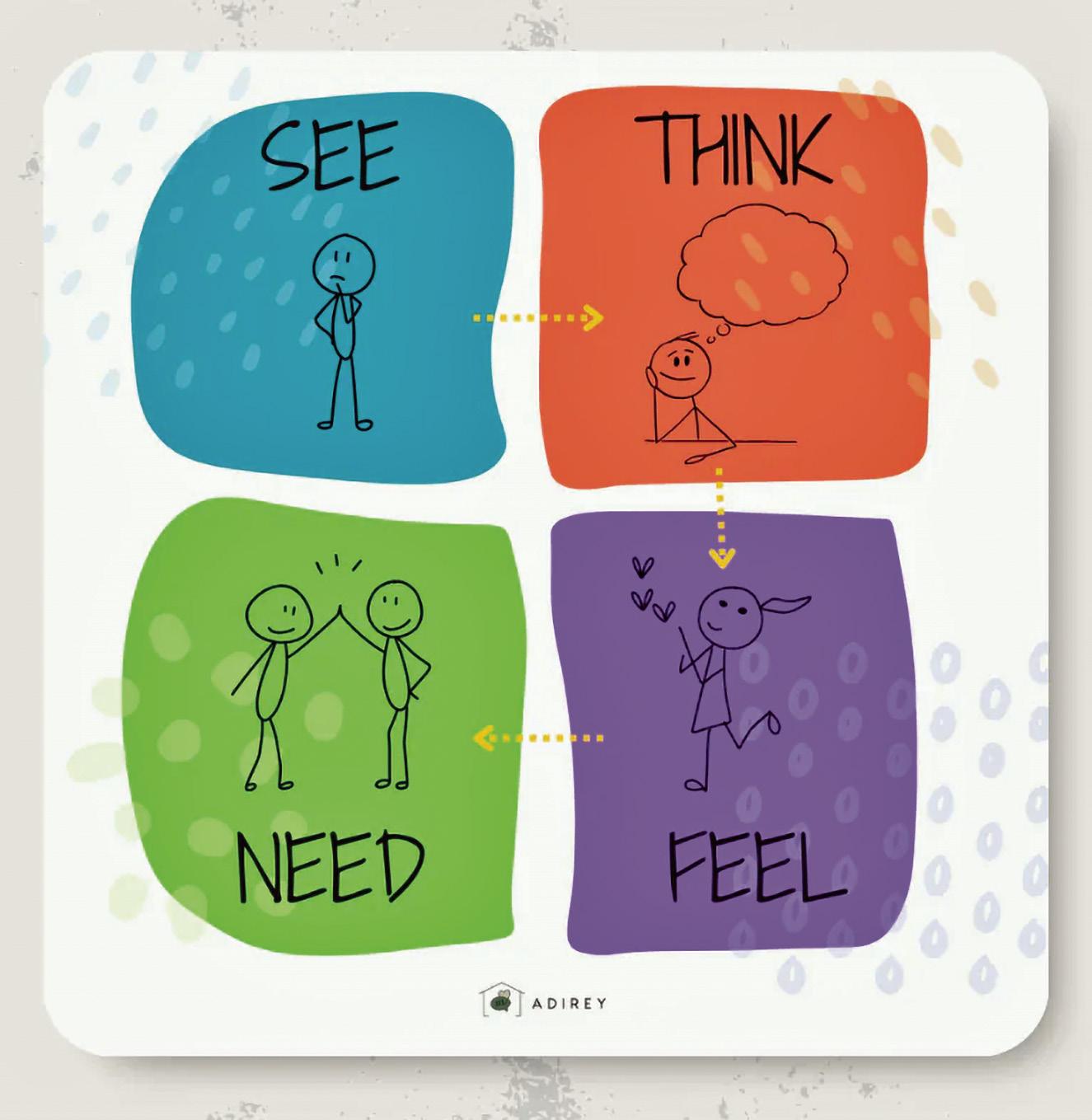
I learned about a communication framework called the “experience cube,” designed to teach adults how to have
tough conversations. But when my oldest was seven, I tried it at home. I laid four sheets of paper on the floor, on which were written four simple words—See, Think, Feel, Need— and we practiced stepping through each one. It gave my kids a way to talk about emotions without feeling overwhelmed.
One of the first times we used it on-the-go was during the drive to school. The girls were fighting over a hairbrush, and I needed a way to help them talk about it calmly. I asked my 10-year-old to remember the squares, and we talked through it:
• What are you seeing? “My sister won’t give me the brush!”
• What are you thinking about? “I think she’s taking a long time, but I need it too.”
• What are you feeling? “I’m worried I won’t get to brush my hair before we leave for school.”
• What do you need? “I need her to finish quickly so I will have time to use it.”
It transformed the conversation from shouting into clarity. And it gave us a predictable structure to fall back on whenever emotions ran high.
Watching the Impact Over Time
I’ve used this framework to help my kids debrief meltdowns, resolve conflicts and even apologize more meaningfully. We practice it often.
My now 13-year-old recently reminded me how powerful this can be. After a hard moment (and a door slam), she came upstairs and quietly slid a folded paper to me. Inside were four little boxes: what happened, what she thought, how she felt and what she needed.
It was one of the shortest, most meaningful conversations we’ve had.
Predictability isn’t about rigid rules. It’s about helping our kids feel secure in a world that often feels unpredictable. And when life gets messy, having a predictable way to come back together makes all the difference.
Estevan Optometry Clinic
2544B Dunlevy Street, Victoria 778 430 2020 estevanoptometry.ca estevanoptometry@gmail.ca
Samantha Christianson is a healthcare leader and mom of three who knows how important emotional skills are for a child’s ability to thrive. Through her passion project, adirey.com, she designs simple, practical tools to help parents teach emotional skills through everyday moments.
BYTE CAMP BYTE CAMP
Healing Over Haste
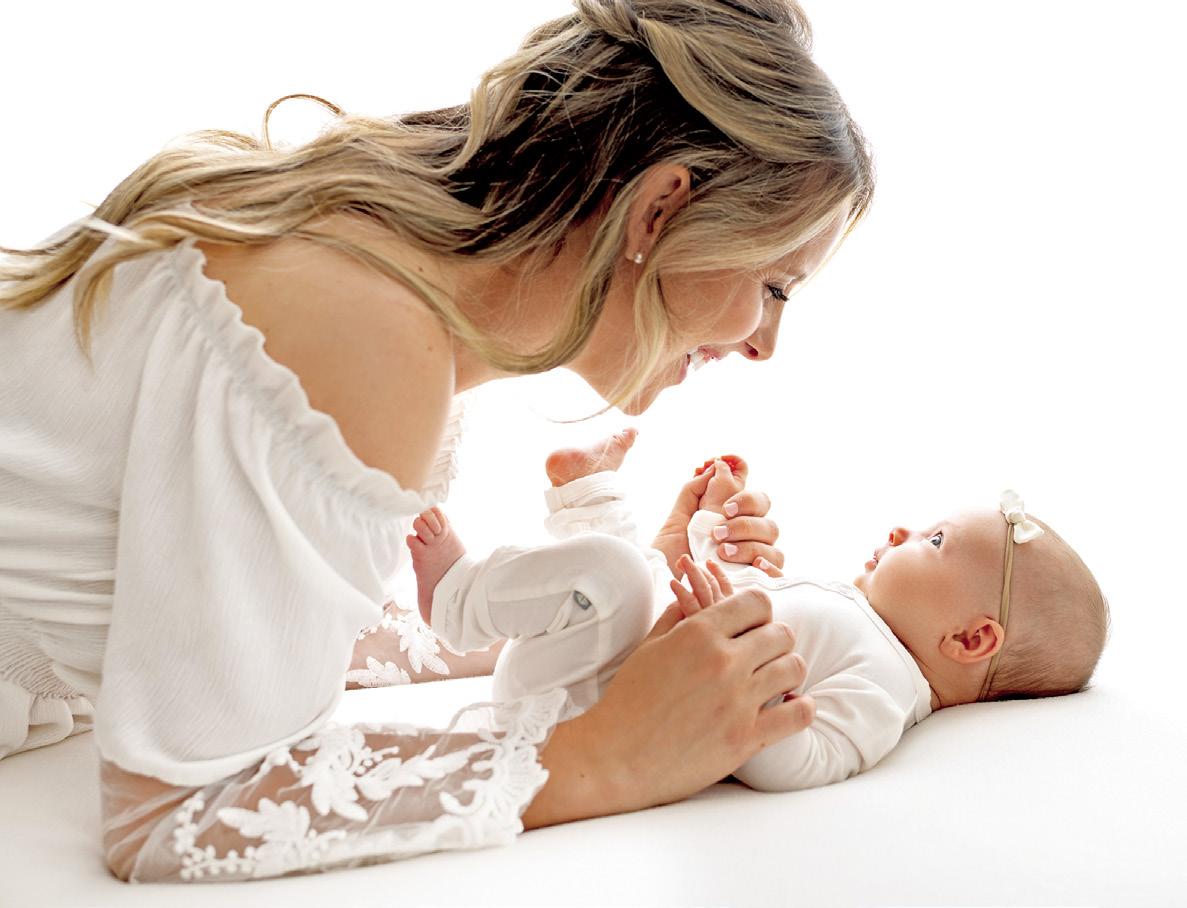
Reimagining the Timeline for Newborn Portraits
Who doesn’t love the thought of beautifully lit photos of their brand-new baby swaddled perfectly in a muslin blanket with a tranquil look of peace on their sweet face? Chances are at some point during the preparation for baby’s arrival, you have looked through (and maybe even planned) newborn photos that you will cherish for years to come.
However, the reality of the first few weeks of life with a new baby may look different than you think. Exhaustion, the need to heal physically and mentally, a steep learning curve and other challenges can mean a photoshoot is the last thing on your mind when baby arrives.
We sat down with Chris Higginbottom, a Victoria newborn photographer, to get the real story behind newborn photos and learn why there is no rush to capture these memories.
Q: Why do moms feel pressure to book newborn photos so early after birth?
A: For years, the photography industry has centered around the two-week window. That timing became popular because babies are sleepier and curl easily into posed positions. But somewhere along the way, that industry standard became a rule and many moms internalized the message that if they didn’t do photos immediately, they missed their chance.
If a mom feels excited and ready at two weeks—wonderful. But if she feels exhausted, emotional, swollen or simply not herself yet, that’s normal too.
Photographs should preserve a moment—not add pressure to it.
Many families are surprised to learn that beautiful newborn portraits can happen at five to 10 weeks. For some moms, that timing feels much more manageable physically and emotionally. You haven’t failed if you’re not ready early. You’re listening to your body and your family’s needs.
Q: How are babies different at five to 10 weeks compared to the traditional newborn window?
A: At this stage, babies are still tiny, but they’re much more expressive.
They:
• Make eye contact
• Offer early smiles
• Stay awake for parts of the session
• React to their family—smiling at mom or a sibling, holding their gaze and recognizing familiar faces
At this stage, babies aren’t just being posed, they’re interacting. The portraits begin to capture real moments of connection between baby and family.
The problem is that the first two weeks postpartum are often physically painful, hormonally intense, exhausting and emotionally overwhelming. You’re healing. You’re learning your baby. You may be recovering from surgery. You may be navigating baby blues or postpartum depression. And yet the messaging has often been: “Book now or you’ll miss it.” Moms simply don’t know there is an alternative.
Q: What is the “right” time for newborn photos?
A: There is no single “right” time. There is only the right time for you.
Q: What should moms know if they feel they’ve already “missed” the newborn photo window?
A: You have not missed it. There is no magical expiration date on documenting your baby.
Babies at six weeks, eight weeks, even 12 weeks are still very much newborns. What you may have missed in curled poses, you gain in connection and expression.
Q: How can moms give themselves permission to prioritize recovery and mental wellbeing without guilt?
A: By remembering this: a supported and healthy mother is more important than any photograph. We talk a lot about
documenting babies. We don’t talk nearly enough about protecting mothers.
After my first baby was born, I experienced postpartum depression. When I think back to those early weeks, I remember tears, exhaustion, physical pain and the feeling that I was simply trying to get through the day. Nursing hurt, I couldn’t sit comfortably and life felt chaotic and overwhelming. I loved my baby deeply, but emotionally and physically, I was far from okay.
I had booked newborn portraits for two weeks, I was not ready and I had to cancel. At the time, there were no other options. If you missed that narrow window, it was simply gone.
That experience shaped how I approach newborn photography today.
Q: What should parents look for when choosing a photographer if they want a more relaxed, connection-focused experience?
Look for a photographer whose work centres on connection, not just poses. In their images, you should see parents holding their baby naturally, siblings leaning in, eye contact and moments that feel genuine.
Most importantly, trust your emotional response. When you look at a photographer’s work, do you feel calm, tenderness and connection? The right photographer should make you exhale.
The most meaningful newborn portraits aren’t about perfect posing or rushing to meet a narrow window—they’re about giving families the space to be together and capturing that connection in a way that will feel timeless for years to come.
Chris Higginbottom is a Victoria newborn photographer specializing in older newborn sessions. Known for her calm, white studio and family-focused approach, she helps mothers feel emotionally and physically ready before stepping in front of the camera—capturing connection, early expressions and the quiet beauty of new motherhood.
Adventure at Camp Pringle
POV: You came to camp not knowing anyone…and left with your favourite people
At Camp Pringle, it’s not about being the “outdoorsy type.” It’s about showing up exactly as you are—and finding where you belong.
Late night laughs
Real connection (no screens needed)
A place to breathe, be yourself and just be
Whether it’s your first time or your fifth, there’s a space here for you. Bring a friend…or come make one. Either way, you won’t leave the same.
Spots for this summer are filling up—come be part of something real.
250-743-2189 Shawnigan Lake
Socks for a Cause
Victoria boy raises money for Island Kids Cancer Association
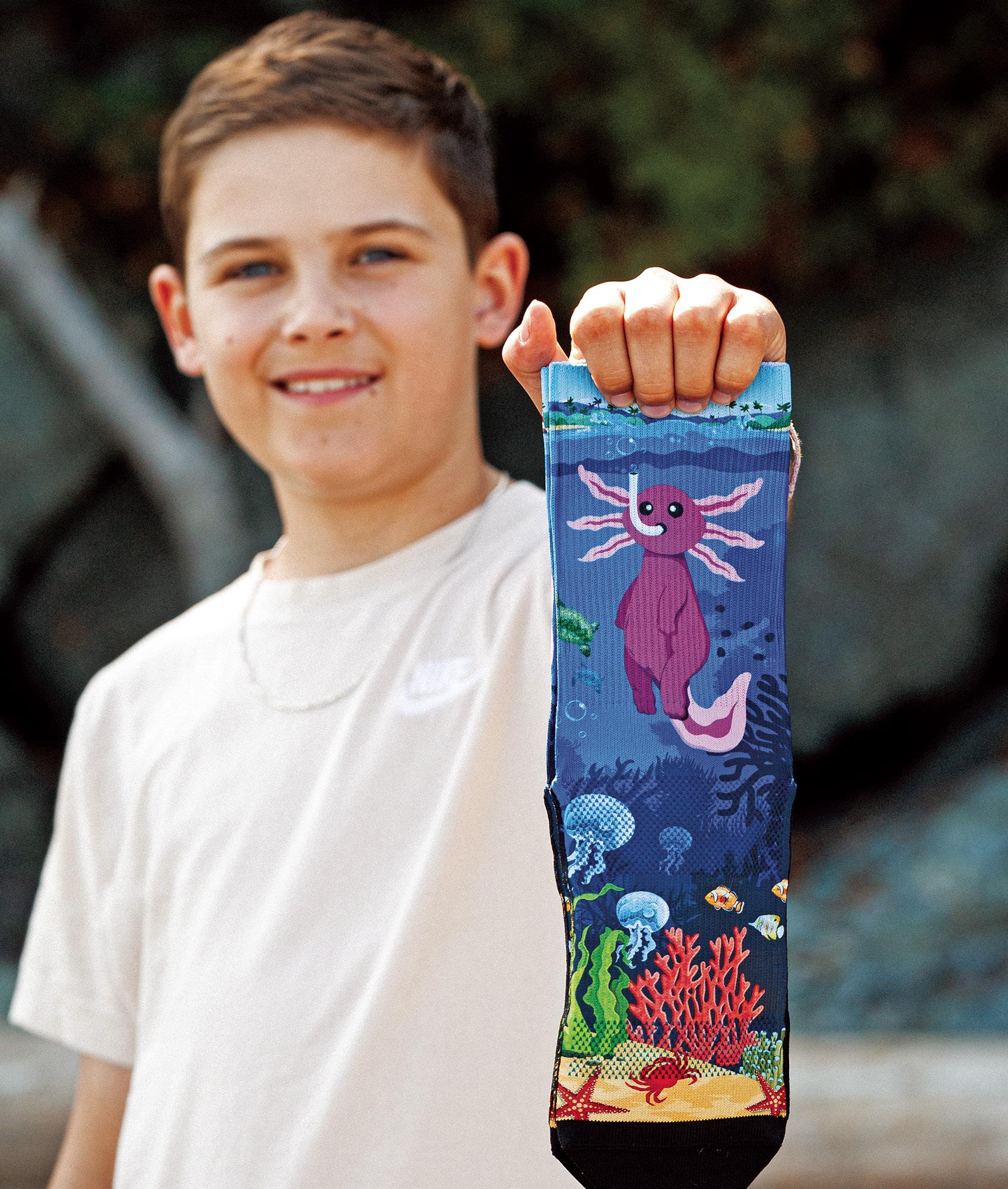
Alocal sock company has once again teamed up with an 11-year-old Victoria resident to launch a sock design in support of the Island Kids Cancer Association (IKCA).
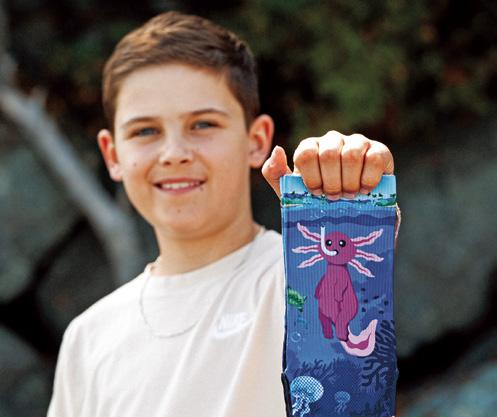
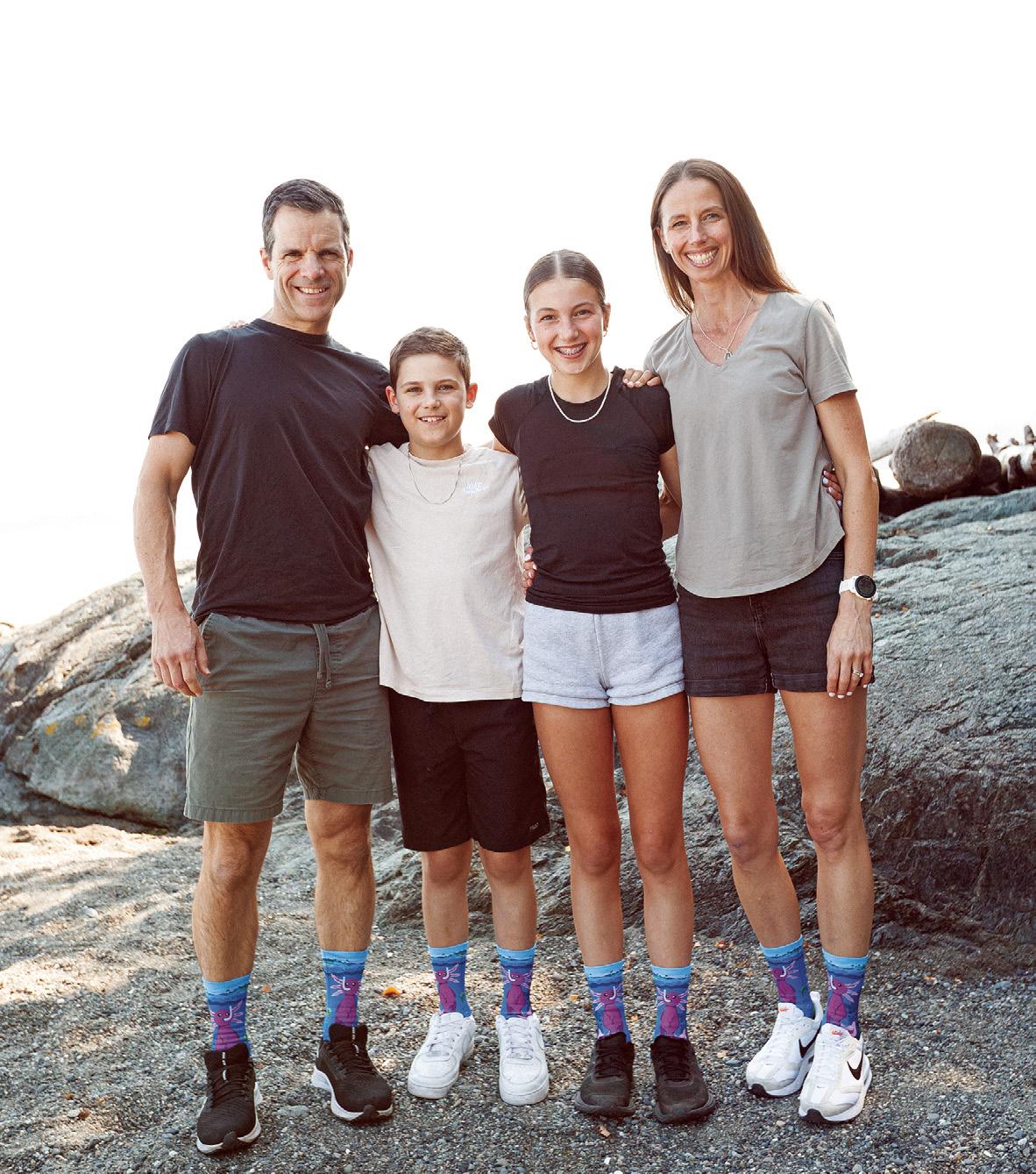
Diagnosed with leukemia in April 2024, Eamonn Millar has turned his creativity into a force for good. While in hospital, he designed his first vibrant sock pattern, “Dreams Gone Wild,” which quickly became a symbol of awareness and connection. Now, his latest design, “Enchanted Deep,” builds on that success, showing how powerful partnerships can be in uplifting families when they need it most.
“People tell me, ‘Dreams Gone Wild’ have become their lucky socks,” says Millar.
“My Victoria oncology team wears them every time I go in for treatment, and other kids wear them on their chemo days. That makes me really proud because the socks give people strength and something good to hold onto. I designed this new axolotl sock on a snorkeling adventure to do the same—to make people feel happy when they wear it.”
By purchasing a pair through Outway, supporters not only wear a bold, creative design but also help raise awareness and funds for families navigating childhood cancer. Founded in 2016 in Victoria, Outway is a sock brand built by athletes, for active lifestyles.
“It’s a privilege to collaborate with Eamonn,” says Rob Fraser, founder and CEO of Outway.
“His creativity and resilience embody the spirit of Outway, and bringing his second design to life in support of such an important cause is an honour.”
All net proceeds from the sale of Millar’s sock designs go directly to the IKCA, a local non-profit organization that supports families on Vancouver Island and the Gulf Islands navigating a childhood cancer diagnosis. IKCA provides practical help, health and wellness resources, financial assistance and community programs tailored to meet the needs of each family. Numbers are not yet in for the axolotl design, but Millar’s first design raised an impressive $19,331.71 for the cause.
“Eamonn is an inspiration,” says Jenna Remedios, programs and partnerships lead at IKCA.
“The success of his original design for Outway demonstrated the impact one child’s creativity can have. It’s more than a sock, it’s a symbol of resilience, creativity and the power of community. We’re so grateful to Eamonn for sharing his talent and to Outway for their generosity and helping amplify his story.”
Both designs are available for purchase at outway.com.
Stacie Gaetz is the managing editor of Island Parent Magazine and the proud mama of a delightful daughter and silly son who fill her days with love and chaos. She thoroughly enjoys supporting, connecting with and informing parents through interesting articles like this one. Reach her at editor@islandparent.ca.
Before the Beginning: Trying to Conceive
The story of a pregnancy does not begin with conception. It often starts months or even years before, when the parent or parents decide they would like to start a family. Let’s go back to the beginning to talk about the time before you become pregnant.
Becoming pregnant comes easily for some people. They talk about it casually, idly speculating about how it would feel to have a baby and the next thing they know, they’re pregnant! For others, it is a long and difficult journey, fraught with disappointment and hope, waiting and hurrying, decisions and hesitations.
If you are having trouble getting pregnant, make sure you access all the resources available. Talk to your health-care provider, of course, but also reach out to folks who have been down the trying-to-conceive road before you. You are not the only one in this situation. The Elements of Health Centre in Victoria offers a great online course.
If you are planning a pregnancy sometime in the next year, consider the actions below. Remember that no one can do all
these things. Choose the ones that make sense to you and that you think will make the most difference for your family.
Note that all the tasks below are just as important for the non-childbearing parent to undertake. The health of a child is affected by the health of the whole family, not just the childbearing parent.
• Learn about your menstrual cycle and become aware of when you ovulate.
• See your doctor or midwife for a pre-conception check-up.
• Discuss any prescription medications you are taking and consider replacing them with ones that are safe for pregnancy, if possible.
• Discuss any concerns you may have about genetic conditions in your family. Consider genetic testing or counselling.
• Talk about taking folic acid, vitamin D and calcium.
• Have your iron levels checked.
• Update your vaccinations—Mumps, measles and Rubella (MMR) and Tetanus, if you’re due for a booster.
• See your dentist for a cleaning and a check-up. Make sure your teeth are healthy, it affects your general health.
• Stop smoking, drinking alcohol or taking recreational drugs if you do.
• Evaluate your exposure to environmental toxins in your workplace or your home and reduce it as much as possible.
• Improve your nutrition by eating nutrient-dense foods, emphasizing whole grains, vegetables and fruit, lean protein and high-quality fats.
• Limit your intake of salt and caffeine.
• Be physically active on a regular basis. Start or continue a physical activity you can pursue during your pregnancy (yoga, swimming, hiking).
It is also important to take part in things that will keep your mind busy as you wait to get pregnant.
• Talk, talk, talk with your partner about your plans as coparents. This is a good time to work on your relationship and make it as strong and harmonious as possible.
• Do some reading or online research about babies, breast/ chestfeeding, child development.
• Find out about parental leave and what your employer provides for.
• Think about your finances. Talk to a financial advisor.
• Make a will.
• If you are planning any renovations, or a move, try to do them now. They are easier to do when you are not pregnant or hauling a baby around!
• Have some spontaneous fun! Go on a short (or a long) trip. Dash out to a movie or a night out with friends and enjoy each other.
Eva Bild is a childbirth and lactation educator and grandmother. She is the founder of Mothering Touch, where she facilitates Baby Groups on Tuesday and Thursday mornings. Learn more at motheringtouch.ca
I ❤ ISLAND PRODUCTS
Sweet Spots
Visit one of these amazing bakeries to pick up some yummy items for your springtime picnic or tea party—or just as a treat for yourself!
Honey Grove Bakery
Honey Grove Bakery is a small artisan bakery located in Courtenay. This locally owned bakery focuses on small-batch baking using organic flour and traditional sourdough techniques. Despite its tucked-away location, it has built a loyal following in the Comox Valley. Don’t miss out on the infamous sourdough loaves, croissants, Welsh cakes and seasonal pastries. honeygrovebakery.ca
Royal Bay Bakery
Located on Metchosin Road in Colwood, Royal Bay Bakery has been a West Shore favourite since 1974. Locally owned for decades, the bakery is known for using organic flour and quality ingredients while serving the community with fresh breads, pastries, and café items. Must-try items include doughnuts, fresh breads, breakfast pastries and savoury baked goods. royalbaybakery.com
Old Town Bakery
Located in historic downtown Ladysmith in a building that has housed a bakery since 1932, Old Town Bakery was formed in 2002. It has become one of Vancouver Island’s most famous from-scratch bakeries and a popular stop for travellers and locals alike. The bakery is best known for its legendary cinnamon buns, along with pies, breads and classic pastries. oldtownbakery.ca
BURNABY ONLINE
LEARNING SCHOOL
Ministry approved BC curriculum Kindergarten to Grade 12 program
Contemporary Indigenous Studies 12 available for enrollment
Full time or part time available Grade 10 to 12
Adult learning options
Grade 8 to 12: over 50 course options
Innovative learning management system
Experienced online learning teachers
Opportunities for self-paced, flexible, convenient learning
Direct teacher support available
Develop communication and technical online skills registering full-time or for a single course