Antimicrobial Resistance: The Role of Animals and the Environment
Antimicrobial Resistance: The Role of Animals and the Environment
Series | Antimicrobial resistance
[ This document is one of a series of discussion notes addressing fundamental questions about global health. Its purpose is to transfer scientific knowledge into the public conversation and decision-making process. The papers are based on the best information available and may be updated as new information comes to light. ]
13 June 2024
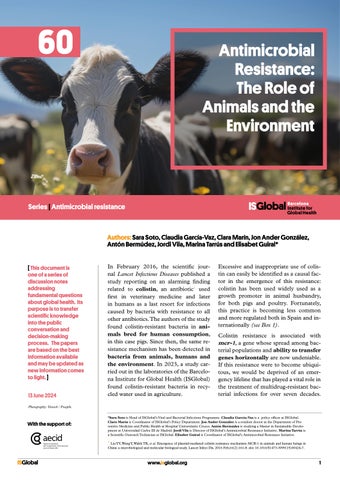
Photography: Vestock / Freepik.
In February 2016, the scientific journal Lancet Infectious Diseases published a study reporting on an alarming finding related to colistin, an antibiotic1 used first in veterinary medicine and later in humans as a last resort for infections caused by bacteria with resistance to all other antibiotics. The authors of the study found colistin-resistant bacteria in animals bred for human consumption, in this case pigs. Since then, the same resistance mechanism has been detected in bacteria from animals, humans and the environment. In 2023, a study carried out in the laboratories of the Barcelona Institute for Global Health (ISGlobal) found colistin-resistant bacteria in recycled water used in agriculture.
Excessive and inappropriate use of colistin can easily be identified as a causal factor in the emergence of this resistance: colistin has been used widely used as a growth promoter in animal husbandry, for both pigs and poultry. Fortunately, this practice is becoming less common and more regulated both in Spain and internationally (see Box 1)
Colistin resistance is associated with mcr-1, a gene whose spread among bacterial populations and ability to transfer genes horizontally are now undeniable. If this resistance were to become ubiquitous, we would be deprived of an emergency lifeline that has played a vital role in the treatment of multidrug-resistant bacterial infections for over seven decades.
*Sara Soto is Head of ISGlobal’s Viral and Bacterial Infections Programme. Claudia García-Vaz is a policy officer at ISGlobal. Clara Marín is Coordinator of ISGlobal’s Policy Department. Jon Ander González is a resident doctor in the Department of Preventive Medicine and Public Health at Hospital Universitario Cruces. Antón Bermúdez is studying a Master in Sustainable Development at Universidad Carlos III de Madrid. Jordi Vila is Director of ISGlobal’s Antimicrobial Resistance Initiative. Marina Tarrús is a Scientific Outreach Technician at ISGlobal. Elisabet Guiral is Coordinator of ISGlobal’s Antimicrobial Resistance Initiative.
1 Liu YY, Wang Y, Walsh TR, et al. Emergence of plasmid-mediated colistin resistance mechanism MCR-1 in animals and human beings in China: a microbiological and molecular biological study. Lancet Infect Dis. 2016 Feb;16(2):161-8. doi: 10.1016/S1473-3099(15)00424-7.
Authors: Sara Soto, Claudia García-Vaz, Clara Marín, Jon Ander González, Antón Bermúdez, Jordi Vila, Marina Tarrús and Elisabet Guiral*
Unless new antimicrobials are developed, the spread of colistin resistance would leave us defenceless against drug-resistant bacterial infections in a post-antibiotic era.
Antibiotic resistance is a problem that affects human health but also the health
of animals and the environment. The purpose of this paper is to explain the impact of antimicrobial resistance (AMR) on animals and the environment, and the implications of AMR for human health.
Box 1. The use (and abuse) of antibiotics in animals
For decades, antibiotics have been used inappropriately, not only for therapeutic ends but also to promote growth in livestock and indiscriminately as a prophylactic measure. Veterinary use represents 70% of the total global consumption of antibiotics, with human consumption accounting for the remaining 30%. The European Union (EU) banned the use of growth-promoting antibiotics in January 2006 2 and the use of antibiotic prophylaxis in January 2022 3. Regulation (EU) 2019/6 on veterinary medicinal products, which came into force in January 2022, states that antibiotics can only be used for prophylaxis in “exceptional cases” and that prescription of antimicrobial drugs is only permitted after a proper diagnosis of the infection and when there are no available alternatives. The same regulation reserves certain antibiotics exclusively for human use to prevent the emergence of resistant strains and their transmission to the general population. With this objective, the ESVAC project monitors antibiotic consumption in animals in Europe, compiling data on sales of veterinary antimicrobials. According to a recent ESVAC report issued by the European Medicines Agency (EMA) with data from 31 European countries, 4500 tonnes of active substance with antibiotic activity destined for use in food-producing animals were sold in 2022 4. This represents a reduction in sales of 31% compared to 2017 and 53% compared to 2011, indicating a clear downward trend. However, the volume of sales is still worrying. Penicillins, which are also used extensively in humans, were the highest-selling antibiotic class for veterinary use in 2022.
2 Regulation (EC) No 1831/2003 of the European Parliament and of the Council of 22 September 2003 on additives for use in animal nutrition (Text with EEA relevance). OJ L vol. 268 (2003).
3 Regulation (EU) 2019/6 of the European Parliament and of the Council of 11 December 2018 on veterinary medicinal products and repealing Directive 2001/82/EC (Text with EEA relevance). OJ L vol. 004 (2019).
4 European Medicines Agency, European Surveillance of Veterinary Antimicrobial Consumption, 2022. ‘Sales of veterinary antimicrobial agents in 31 European countries in 2022’ (EMA/299538/2023). https://www.ema.europa.eu/en/documents/report/sales-veterinary-antimicrobial-agents-31-european-countries-2022-trends-2010-2022-thirteenth-esvac-report_en.pdf
“Human and animal health are interdependent and also closely linked to the ecosystems in which they coexist.”
“One Health”: A Conceptual Framework for Tackling Antimicrobial Resistance in Animals and the Environment
The term One Health was introduced at the beginning of the 21st century to give a name to a reality that has been clearly understood for over a century: human and animal health are interdependent and also closely linked to the ecosystems in which they coexist. The One Health approach has been defined as a “collaborative effort involving multiple disciplines (medical, veterinary and research professionals, among others) working locally, nationally and globally to achieve optimal health for people, animals and the environment”.
The concept has gained in importance in recent years due to changes in the interactions between humans, animals, plants and the environment. The growth in the world population and its geographical spread into previously uninhabited areas has increased contact between humans and animals and in turn increased the risk of the transmission of zoonotic diseases. Today, 60% of known infectious diseases in humans are of animal origin according to the World Organisation for Animal Health. At the same time, climate change, deforestation and intensive livestock farming are modifying habitats and environmental conditions, favouring the spread of diseases from animals to humans. Intensive livestock farming also contributes to deforestation and soil contamination, increasing the risk of zoonoses transmission when certain species lose their habitats and are forced to seek new niches close to human habitation or when soil biodiversity is reduced, thereby weakening an ecological barrier to the transmission of clinically important resistant bacteria. In addition, the increased global mobility of people, animals and food has accelerated the spread of diseases and their vectors, further increasing the risk of disease transmission.
In light of all of these factors, there is an urgent need for a holistic approach in the fight against AMR. In addition to One Health, there are other approaches focused on the interconnection between human health and ecosystems, each with its own particularities (see Box 2).
One Health Emphasis
Disciplines Involved
Core values
Planetary Health Emphasis
Interconnection between human, animal and environmental health, recognising that all three are intrinsically linked and that addressing health challenges requires collaboration between many different disciplines and sectors.
Public health | Human medicine
Veterinary medicine | Microbiology
Promoting human and animal health
Multidisciplinary collaboration in research
Human health viewed in the context of broader political, economic and environmental systems, recognising the impact of global environmental changes on human health and the need to address these challenges from the standpoint of sustainability and equity.
Disciplines involved
Core values
EcoHealth
Emphasis
EcoHealth Emphasis
Core values
Public health | Human medicine
Economy | Energy and natural resources
Agricultural sciences | Ecology and environmental sciences
Importance of equity in health
Sustainable balance between human needs and planetary limits
Mitigation of health risks caused by environmental and ecological changes
Relationship between the health of humans, animals and ecosystems, recognising the importance of promoting health through sustainable ecosystem management and socioeconomic equity.
Public health | Human medicine
Urban and rural development and planning
Veterinary medicine | Ecology
Social sciences and anthropology
Importance of equity in health
Participation of different social sectors
Action based on consensus and cooperation
Source: Lerner H, Berg C. A comparison of three holistic approaches to health: One Health, EcoHealth, and Planetary Health. Front Vet Sci. 2017 Sep 29;4:163. doi: 10.3389/fvets.2017.00163. PMID: 29085825; PMCID: PMC5649127.
“Once
they emerge, resistant bacteria are transmitted from animals to humans by various routes.”
Antimicrobial Resistance in Animals: From Farm to Fork
The veterinary use of antibiotics can lead to the development of antibiotic-resistant strains in the intestinal microbiota of treated animals. The prophylactic use of antibiotics to prevent infections usually
involves doses lower than those used to eliminate bacterial infections completely, which favours the development of mutations that confer resistance to the antibiotics being used.
Figure 1. The relationship between antimicrobial consumption and resistance in animals and humans
Antimicrobial consumption in food-producing animals
Antimicrobial consumption in humans
Antimicrobial resistance in foodproducing animals
Antimicrobial resistance in humans
Source: European Centre for Disease Prevention and Control (ECDC), European Food Safety Authority (EFSA), European Medicines Agency (EMA). Third joint inter‐agency report on integrated analysis of consumption of antimicrobial agents and occurrence of antimicrobial resistance in bacteria from humans and food‐producing animals in the EU/EEA: JIACRA III 2016-2018. EFSA J. 2021;19(6). http://dx.doi. org/10.2903/j.efsa.2021.6712
a. What are the transmission routes? Once they emerge, resistant bacteria are transmitted from animals to humans by various routes.
Food safety. Animals, like humans, are carriers of intestinal bacteria and these can get into food in several ways:
• When animals are slaughtered and processed, meat or meat products can be contaminated through contact with processing equipment or storage containers infected with resistant bacteria.
• Fruit and vegetables can be contaminated through contact with soil, water or
fertilisers containing faeces or animal excrement that carry multidrug-resistant bacteria.
Direct contact. Resistant bacteria can be transferred directly from person to person, from animals to humans, from humans to animals, from the environment to humans, and from humans to the environment. Animal-to-human transmission via contact with an animal, its faeces or its surroundings is a particular risk for people working in certain professions—veterinary medicine, animal husbandry and butchery—and for people who have pets.
Indirect contact. One example of indirect transmission is the risk for people working in wastewater treatment plants (WWTP) posed by airborne aerosols generated during certain phases of the treatment process.
b. Antimicrobial resistance in the environment: soil, water and air
Antibiotics used in human and veterinary medicine can enter the environment through urine and faeces. Depending on the type of antibiotic used, between 40% and 90% of the dose administered is excreted as the original compound in faeces and urine, that is, in its active form, which then contaminates the environment, entering into water, soil and plants. The use of large quantities of antibiotics in animal husbandry leads to contamination of the agricultural ecosystem when crops are irrigated with water treated in WWTPs (reclaimed water) or animal manure is used to fertilise the land. Antimicrobials are now also being used as pesticides to control plant diseases. This practice could accelerate the development and spread of resistant bacteria when they contaminate the surrounding soil and water, and subsequently nearby lakes and rivers as a result of rainwater runoff and irrigation.
The improper disposal of unused drugs in wastewater systems is also a concern. Antibiotic-contaminated wastewater is treated in WWTP but total removal of the antibiotics is impossible in a conventional plant. The presence of residual concentrations of antibiotics not only causes mutations in the bacterial population that may confer resistance, it also kills bacterial cells, releasing their genetic material into the surrounding environment. This free DNA may then be taken up by other bacteria through a mechanism called transformation. If the genetic material carries resistance genes, the recipient bacterium will become resistant. The problem is further exacerbated by the use of reclaimed water to irrigate agricultural land, parks, streets and gardens.
As well as favouring the development and transmission of AMR, antibiotic residues can be absorbed by plants, interfere with physiological processes and have ecotoxicological effects. The high levels of antibiotics found in agricultural land fertilised with contaminated manure can delay germination or reduce biomass, thereby negatively affecting crop yields. Moreover, the consumption of vegetables contaminated with antibiotic residues can affect human health and cause allergic reactions and alterations in the digestive system due to alterations in the microbiota. Prolonged exposure may result in chronic toxic effects.5
5 Polianciuc SI, Gurz u AE, Kiss B, et al. Antibiotics in the environment: causes and consequences. Med Pharm Rep. 2020; https://pdfs.semanticscholar.org/425c/3b463de577adef46d49b65da31d31035917b.pdf
“In Spain, the main initiative aimed at reducing the misuse of antibiotics in both humans and animals is the national plan on AMR (Plan Nacional Frente a la Resistencia a los Antibióticos [PRAN]).”
What is the Current Legislation? Analysis of Policy and Best Practices
Many countries—particularly those belonging to the EU—have been waging a battle against AMR for decades. In Spain and other European countries, numerous policies are aimed at reducing the risk factors that favour the spread of AMR to humans have been developed and implemented.
a. In Spain
In Spain, the main initiative aimed at reducing the misuse of antibiotics in both humans and animals is the national plan on AMR (Plan Nacional Frente a la Resistencia a los Antibióticos [PRAN]). The first phase of this plan was implemented in 2014 and the principal objectives of the current phase (2022-2024) are as follows: to strengthen antimicrobial use surveillance systems; to monitor the emergence of AMR; to promote the judicious use of antibiotics; and to enhance the prevention and control of infections in animals and humans.
In 2021, PRAN launched the Small Animal Pilot Project to analyse current consumption of antibiotics in small animal veterinary clinics and to optimise antimicrobial use. Another PRAN project monitors clinically pathogenic bacteria and has created a network of laboratories committed to collecting data on these microorganisms (Proyecto de Vigilancia de Bacterias Patógenas Clínicas). The aim in this case is to map epidemiological resistance and enable the real-time identification of patterns and trends in order to inform the development of new strategies and facilitate the evaluation of interventions.
In another initiative, PRAN has created a number of programmes aimed at reducing the use of antibiotics in species destined for human consumption (the REDUCE programmes). These programmes are supported by the Spanish Agency of Medicines and Medical Devices (AEMPS). Of these, the programme targeting the swine industry has been
particularly successful in achieving a significant decrease in colistin consumption, which has been reduced by 92% since the start of the programme in 2016.
In 2021, AEMPS launched an informative website to provide Therapeutic Guidelines for Veterinary Antimicrobials to provide guidance for veterinary professionals in the therapeutic use of antimicrobials, their categorisation, and patterns of resistance.
The importance of the threat posed by AMR in animals in Spain is undeniable and the authorities are becoming increasingly aware of the magnitude of this problem throughout the environment. An Environmental Working Group was created in 2019 to address the problem. This body was set up through a collaboration between AEMPS and the Ministry for Ecological Transition and the Demographic Challenge (MITECO). The aim of this working group is to monitor and deal with the environmental problems associated with the use of drugs, including soil and water contamination and its relationship with the spread of AMR.
b. In Europe
The European Union (EU) has been the main driver promoting anti-AMR practices in Europe. This has been achieved through the firm adoption of the One Health approach, by raising awareness and increasing understanding of AMR, and by improving cooperation and coordination between Member States in the fight against AMR.
In 2017, The European Commission (EC) approved an AMR action plan entitled A European One Health Action Plan against Antimicrobial Resistance. The principal objectives of this plan were as follows: to strengthen the surveillance, control and prevention of AMR; to raise awareness about the problem; to promote a better understanding of the role of the environment; to enhance coordination among
EU member countries; and to improve compliance with EU rules aimed at combatting AMR. With the approval of the Council Recommendation on stepping up EU actions to combat antimicrobial resistance in a One Health approach by the EC in April 2023, the EU committed to expanding the 2017 One Health plan and taking additional action, maximising synergies and fostering joint action.
The EU initiatives with the greatest impact come under the Common Agricultural Policy (CAP), which includes a set of agricultural and environmental practices that professionals can apply voluntarily on their farms to contribute to biodiversity,
natural resources and the protection of the environment. These practices are summarised in a set of nine standards called the Good Agricultural and Environmental Conditions (GAEC). Professionals who comply with CAP requirements can access certain subsidies and direct payments. There are also many European regulations and directives governing all stages of animal food production and limiting drug residues in both water and soil.
The efforts of the EU in this area have, however, been hampered by the political response from certain sectors, especially in rural areas (see Box 3).
Royal Decree 109/1995 on veterinary medicines
This Spanish act regulates the authorisation, sale and use of veterinary medicines in Spain, including specific rules governing antibiotics and resistance.
Regulation (EC) No. 882/2004
Establishes controls to ensure compliance with feed and food law, animal health and animal welfare rules.
Law 22/2011 on waste and contaminated soil Legislative framework for the prevention and control of drug residues in soil and water.
Royal Decree 177/2014, governing Spain’s national plan (Plan Nacional frente a la Resistencia a los Antibióticos [PRAN]).
PAC 1962
Amended in 1992, 2003, 2013 and 2020. Establishes measures to reduce the use of veterinary antibiotics. Nine standards of Good Agricultural and Environmental Conditions (GAEC) to protect the environment.
Regulation (EC) no. 1831/2003
Regulates feed additives and includes restrictions on the use of antibiotics.
Directive 2008/105/EC on environmental quality standards in the field of water policy
Establishes maximum levels for drug residues in water.
��Decision No. 1082/2013/EU on serious cross-border threats to health
Considers AMR to be a crossborder threat and makes notification mandatory.
Regulation (EU) 2019/4
Regulates the manufacture, sale and use of medicated feed, amending previous regulations.
��Regulation (EU) 2019/6
Regulates the authorisation, sale, and safe use of veterinary medicinal products. Allows Member States to restrict the use of certain antibiotics exclusively for human use and mandates the collection of data on antibiotic sales and use.
Figure 2. Timeline of Spanish and EU legislation dealing with AMR in animals and the environment
Box
Despite the progress made in both European and Spanish legislation, the problems persist and the risk of proliferation increases as the authorities fail to take decisions needed to effectively combat resistance.
Following protests this year in the primary sector throughout Europe, the European Parliament has lowered the environmental requirements imposed on farmers and the livestock industry, an unjustifiable step backwards.
As mentioned above, the CAP obliges farmers to comply with an enhanced set of environmental standards known as the GAEC to qualify for direct payments and subsidies. The EC has proposed a revision of GAEC standards 6, 7 and 8 to provide more flexibility for Member States. In addition, it proposes that certain crops, soil types and farming systems be exempted from complying with requirements on tillage, soil cover and crop rotation. Exemptions may also be established to allow ploughing to restore permanent grassland in in Natura 2000 areas damaged by predators or invasive species.
These exemptions weaken the protection of biodiversity and foment abusive use of chemical fertilisers and pesticides, which are used in an attempt to continuously boost crop production but which also pose risks for local flora and fauna. The economic interests of people working in the agricultural sector clash with the collective environmental interests of European citizens. These legitimate interests of European farmers are the main obstacle to the progress of environmental policies.
The solution must be to compensate these stakeholders in order to increase the acceptability of the regulations in rural areas and to ensure that the primary sector is not adversely affected by the implementation of progressive environmental policies.
Recommendations
While great strides have been made in the fight against AMR in recent decades, we face tough challenges in the decades to come. The EU and its Member States must remain firm in their stance regarding a threat that could be exacerbated by the impact of climate change on agriculture, livestock farming and the epidemiology of infectious diseases. It is essential to continue ongoing efforts, but we also need to propose new measures if we are to avoid the risk of our world spiralling into
a post-antibiotic era. Government bodies and public agencies in Spain and Europe must work closely with all the relevant actors to implement the necessary measures. The scientific community must be involved in the design and implementation of evidence-based interventions, and these must also take into account the interests of all affected stakeholders in the agricultural, livestock rearing and veterinary sectors to ensure acceptability and compliance. The following are our recommendations:
• The EU and its Member States must continue in their effort to reduce the generalised use of antibiotics in animals and seek alternatives, such as probiotics, among others. Examples of these kinds of interventions include the REDUCE programmes mentioned above and other initiatives, such as Healthy Livestock, a project whose main objective is to improve the health and welfare of livestock in order to reduce the need for antimicrobial treatment.
• It is vital to continue working to minimise the use of antibiotic prophylaxis to control the spread of infectious diseases in livestock.
• It is essential to raise awareness about alternative measures, such as the isolation of sick animals, a practice that has been shown to be effective (even though it is sometimes not possible due to the size of the farm or the animal population)6 National and regional governments must be made responsible for encouraging the use of such alternative measures within their jurisdiction.
• Encouraging farmers to vaccinate their livestock could greatly reduce the use of antibiotics in the treatment of vaccine-preventable diseases.
• Food safety and public health authorities must conduct strict controls of food processing chains to ensure that these operations are not providing an environment conducive to the spread of resistant bacteria.
• In addition to the above, improving current methods for detecting antibiotic resistant bacteria in the food production chain could increase food biosecurity, an area that is the responsibility of the Spanish Agency for Food Safety and Nutrition.
• Integrated disease surveillance would provide more information on the links between AMR in food-producing animals and in the food chain. The surveillance systems could include a centralised data repository to facilitate the collection and sharing of information across sectors and would require collaboration between actors from different sectors and the public authorities. Data collected through routine monitoring of AMRs in the veterinary sector could, for example, be compared with data on trends in human AMRs and inform joint interventions.
• To prevent the spread of resistance, the competent authorities should review and enforce, where appropriate, environmental surveillance and MITECO’s public health standards for the handling and disposal of waste and manure.
• Scientists should develop clear standards that set maximum values for antibiotic resistance genes (ARG) and antibiotic resistant bacteria (ARB) in raw sewage and wastewater effluents.
• Civil society involvement is vital to educate and raise awareness in the general public through educational programs and awareness campaigns designed to promote rational use of antibiotics in all contexts.
6 Imam T., Gibson J.S., Gupta S.D., et al. Association between farm biosecurity practices and antimicrobial usage on commercial chicken farms in Chattogram, Bangladesh. Prev. Vet. Med. 2021;196:105500. doi: 10.1016/j.prevetmed.2021.105500.
TO LEARN MORE
• Vila J, Marín C, Diago E, et al. Antimicrobial Resistance: The silent pandemic? Barcelona Institute for Global Health (ISGlobal). Series: Antimicrobial resistance , nº 59. April 2024. Available from: https://www.isglobal.org/en/-/resistencias-bacterianas-antibioticos-pandemia-silenciosa
• Plan Nacional Frente a la Resistencia a los Antibióticos (PRAN) 20222024. https://www.resistenciaantibioticos.es/sites/default/files/2024-04/ Plan%20Nacional%20frente%20a%20la%20Resistencia%20a%20los%20 Antibi%C3%B3ticos%202022-2024.pdf
• Council of the European Union Infographic: Five reasons to care about antimicrobial resistance (AMR). (2024). https://www.consilium.europa.eu/en/infographics/antimicrobial-resistance/
How to cite this document:
Soto S, García-Vaz C, Marín C, et al. Antimicrobial resistance: The role of animals and the environment Barcelona Institute for Global Health (ISGlobal). Series: Antimicrobial resistance, n.º 60. June 2024.