IMG_4888
59
Antimicrobial Resistance: The Silent Pandemic?
Series | Antimicrobial resistance
Authors: Jordi Vila, Clara Marín, Elizabet Diago, Claudia García-Vaz, Laura Agúndez, Sara Soto, Clara Ballesté-Delpierre, Marina Tarrús and Elisabet Guiral* [ This document is one of a series of discussion notes addressing fundamental questions about global health. Its purpose is to transfer scientific knowledge into the public conversation and decision-making process. The papers are based on the best information available and may be updated as new information comes to light. ]
Antimicrobial resistance, which refers to the ability of microorganisms to withstand the effects of antibiotics and other antimicrobial agents, is a growing threat. Labelled by some as a silent pandemic, it has increased at an alarming rate in recent decades. Organisations such as the European Centre for Disease Prevention and Control and the World Health Organization (WHO) consider that infections caused by multidrug-resistant bacteria, colloquially known as superbugs, are a significant public health concern.1 In 2016, a comprehensive review entitled “Tackling Drug-Resistant Infections Globally, chaired by British economist Jim O’Neill,
12 April, 2024
*Jordi Vila, Director of ISGlobal’s Antimicrobial Resistance Initiative; Clara Marín, Coordinator of ISGlobal’s Global Analysis and Development Department; Elizabet Diago, Ccoordinator of ISGlobal’s Preparedness, Response, Recovery and Resilience working group; Claudia García-Vaz, ISGlobal’s Policy Officer; Laura Agúndez, resident physician in preventive medicine and public health at Hospital Universitario La Paz; Sara Soto, Head of ISGlobal’s Viral and Bacterial Infections Programme; Clara BallestéDelpierre, Associated Research Professor at ISGlobal, she is part of the CIBERINFEC group and works at the Biomedical Diagnostics Centre of the Hospital Clínic in Barcelona. Marina Tarrús, Scientific Outreach Technician at ISGlobal; Elisabet Guiral, Coordinator of ISGlobal’s Antimicrobial Resistance Initiative.
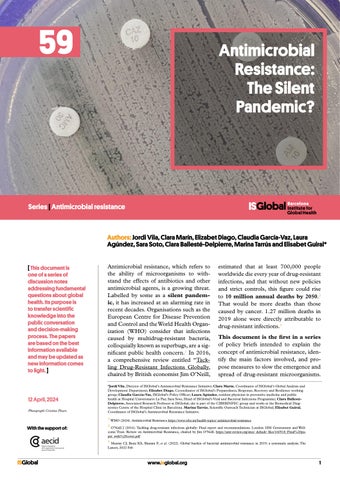
Photograph: Cristina Pitart.
1
estimated that at least 700,000 people worldwide die every year of drug-resistant infections, and that without new policies and strict controls, this figure could rise to 10 million annual deaths by 2050.2 That would be more deaths than those caused by cancer. 1.27 million deaths in 2019 alone were directly attributable to drug-resistant infections.3 This document is the first in a series of policy briefs intended to explain the concept of antimicrobial resistance, identify the main factors involved, and propose measures to slow the emergence and spread of drug-resistant microorganisms.
WHO (2024). Antimicrobial Resistance https://www.who.int/health-topics/ antimicrobial-resistance
2
O’Neill J (2016). Tackling drug-resistant infections globally: Final report and recommendations. London: HM Government and Wellcome Trust. Review on Antimicrobial Resistance, chaired by Jim O’Neill. https://amr-review.org/sites/ default/ files/160518_Final%20paper_with%20cover.pdf
3
Murray CJ, Ikuta KS, Sharara F, et al. (2022). Global burden of bacterial antimicrobial resistance in 2019: a systematic analysis. The Lancet, 2022 Feb
www.isglobal.org
1