This publication is available digitally at https://isass.org/category/news/ vertebral-columns/
Cover image generated by ChatGPT
From the ¹Department of Orthopaedic Surgery at Rush Uni‑versity Medical Center in Chicago, Illinois, and ²Drexel University College of Medicine in Philadelphia, Pennsylvania.
Clinical Burden of Spinal Implants
The prevalence of degenerative spinal conditions within the field of orthopedics has created a need for precise and functional technology for the treatment of disease. Traditional treatments serve to offer mechanical stability using spinal implants, such as rods, cages, and vertebral body replacements.1 Implant placement does not mark the end of patient treatment; postoperative monitoring is required to ensure the prevention of adverse events. For example, surgical site infections occur in about 3.1% of spine surgeries. 2 While relatively uncommon, their consequences are severe, lengthening hospital stays and potentially costing up to $26,000 per case. 3 Infections involving spinal hardware are difficult to treat due to biofilm formation, often necessitating prolonged intravenous antibiotics, repeated debridement, or hardware removal. These in turn increase the risk of adverse patient outcomes such as pseudarthrosis, instability, or neurological decline. 3 Deep infections elevate reoperation risk and diminish long-term function underscoring the need for close postoperative monitoring.
Monitoring Spinal Implants
Clearly, monitoring implants is crucial
in preventing adverse patient outcomes. Two common methods include imaging, which assesses implant position and surrounding tissue, and laboratory analyses, which measure systemic inflammatory markers.4 These methods require specialist expertise and invasive sampling, involve late symptom recognition, and often lack generalizable quantitative indicators. A promising alternative to these traditional methods is SMART implants, which are orthopedic implants that combine intelligent telemetry with traditional biomechanical safety and efficacy. These SMART implants offer continuous patient monitoring and care while also providing quantitative data. 5 They mark a shift in implantable sensor technology that is reshaping the field.
Conventional SMART Implants
Early SMART implants relied on integrating batteries, telemetry units, and wired systems into the hardware. These devices offered a proof of concept that implants could serve as diagnostic and monitoring tools rather than passive stabilizers. For example, early load-sensing spinal rods incorporated strain gauges powered by small batteries that measured axial load in real time.5 However, the reliance on batteries
Aryan Patel, BS1
Aimen A. Khan, BS1
Jimin Yeom, BA1
Noah A. Pogonitz, BS1
Puranjay Gupta, BS1
Sehajvir Singh, BS2
Kern Singh, MD1
created a finite lifespan requiring eventual device replacement, which was invasive and risked leakage or corrosion.6 Similarly, percutaneous leads found within the wired systems allowed for increased infection risk and wire breakage. 4 These shortcomings hindered the long-term clinical translation despite the clear benefits of continuous in vivo monitoring. The advent of battery-free implantable sensors bypasses these limitations and presents a more miniaturized, efficient solution. Battery-free systems generally depend on passive resonant circuits, inductive coils, or capacitive interfaces that facilitate real-time wireless telemetry. 6,7 These advances have been demonstrated to reduce the device’s footprint and permit integration directly within orthopedic constructs, such as pedicle screws or interbody cages. A primary advantage of wireless operation is the elimination of long leads or bulky batteries, which can act as a nidus for mechanical failure or bacterial colonization.6 The development of sensors for orthopedic use is predominantly characterized by three primary modalities: temperature, pH, and load monitoring. Each of these provides a
unique physiologic or biomechanical parameter with clinical relevance.
Infection Detection
The primary application of SMART orthopedic implants is the early identification of infection. Conventional diagnostic methodologies frequently exhibit inadequate specificity and sensitivity, particularly during the early postoperative phase. 3 Implantable pH and temperature sensors have been developed to address this limitation by detecting localized changes at the bone–implant interface. Early infection frequently manifests with minimal temperature elevations that are localized to the surgical site. The utilization of implantable temperature sensors provides direct surveillance prior to the onset of systemic fever or elevated inflammatory markers. 8 The incorporation of pH sensors serves to enhance the scope of infection monitoring. The sensors’ functionality is predicated on the detection of localized acidification that accompanies bacterial metabolism and biofilm formation.9 This acidification serves as a highly specific infection biomarker, distinguishing it from systemic inflammation. Collectively, these methodologies yield real-time, site-specific biomarkers that can direct timely interventions and mitigate the morbidity associated with delayed diagnoses.
Load Monitoring and Fusion Assessment
The efficacy of spinal fusion procedures is contingent upon the gradual transfer of load from hardware to bone during the consolidation phase of the fusion process.
Inadequate fusion results in pseudarthrosis, which is associated with pain, implant failure, and reoperation. Load-sensing implants have been shown to directly quantify these mechanical dynamics. Decreasing rod loads correspond to progressive fusion, while persistently elevated loads indicate delayed healing.10 This method empowers clinicians to assess fusion risk and customize rehabilitation protocols using objective, quantifiable load data. The integration of such systems into clinical practice holds the potential for earlier detection of nonunion, more precise assessment of recovery trajectories, and a reduction in the number of unnecessary reoperations.11
Personalized and Remote Patient Monitoring
The advent of SMART implants has heralded a paradigm shift in healthcare, marked by the ability to transmit sensor data wirelessly, thereby facilitating remote patient monitoring. This development stands to significantly reduce the reliance on in-person hospital visits and imaging studies, improving patient autonomy and convenience. Wireless interfaces can integrate with digital health, thus enabling real-time data sharing between patients and healthcare providers.7 Such integration is conducive to the implementation of telemedicine models and chronic disease management, particularly in settings characterized by limited resources or a high proportion of rural residents. This personalized monitoring may serve as a guide for the development of customized rehabilitation protocols, including the adjustment of activity levels in accordance
with implant strain or clinician notification of subclinical infections. 5 Consequently, the implementation of SMART implants has the potential to transform postoperative care from an episodic and reactive model to a continuous and proactive approach.
Implant Obstacles
Notwithstanding the evident advantages, battery-free implants confront challenges in technical design, biological integration, and regulatory oversight. Signal attenuation, calibration drift, and encapsulation durability remain significant limitations. 6,12 Cyclic loading may accelerate wear or calibration drift, creating a need for maintenance or routine follow-up. Fibrous encapsulation can reduce sensor sensitivity, and the sterilization of pH- or enzyme-sensitive coatings poses considerable practical challenges.9 The successful integration of these technologies into clinical practice necessitates seamless surgical procedures without increasing operative times or introducing additional risks. 5 Finally, regulatory and ethical challenges persist, particularly in the domains of cybersecurity and equitable access, as outlined by the US Food and Drug Administration.14 Surgeons and developing companies must remain vigilant about these limitations to safeguard patient welfare.
Future Directions
The future of SMART implants includes the development of multi-modal platforms that integrate infection and load monitoring.13 The integration of artificial intelligence and machine learning into the interpretation of
References
sensor data has the potential to facilitate the development of predictive models, thereby providing early warnings of pseudarthrosis or infection weeks before the manifestation of clinical symptoms. 4 This integration is particularly promising in the context of joint arthroplasty and fracture fixation, where infection and loosening remain significant challenges.7 The commercial platforms, such as OrthoSENS, exemplify the translational trajectory of this technology, with remote data sharing capabilities that enable clinician oversight and patient engagement.
Conclusion
Battery-free wireless implants represent the most significant advancement in this
1. Nouh MR. Spinal fusion-hardware construct: Basic concepts and imaging review. World J Radiol. 2012;4(5):193-207.
2. Zhou J, Wang R, Huo X, Xiong W, Kang L, Xue Y. Incidence of Surgical Site Infection After Spine Surgery: A Systematic Review and Meta-analysis. Spine . 2020;45(3):208.
3. Kasliwal MK, Tan LA, Traynelis VC. Infection with spinal instrumentation: Review of pathogenesis, diagnosis, prevention, and management. Surg Neurol Int . 2013;4(Suppl 5):S392-S403.
4 Wang J, Chu J, Song J, Li Z. The application of impantable sensors in the musculoskeletal system: a review. Front Bioeng Biotechnol. 2024;12.
5. Kim SJ, Wang T, Pelletier MH, Walsh WR. ‘SMART’ implantable devices for spinal implants: a systematic review on current and future trends. J Spine Surg. 2022;8(1):117-131.
6. Kim H, Rigo B, Wong G, Lee YJ, Yeo WH. Advances in wireless, batteryless, implantable electronics for real-time,
field. The elimination of batteries and wires has resulted in the development of smaller, safer, and longer-lasting systems in comparison to previous generations. The transformation of orthopedic implants from passive stabilizers to dynamic diagnostic platforms capable of detecting infection and tracking fusion progression in real time is a significant development in the field. 8,9,10 The current research trajectory indicates that SMART implants are poised to transform postoperative care in orthopedics. With further refinement, these systems may evolve toward closed-loop systems capable of both monitoring and therapeutic response, thereby marking a new era of patient-centered surgical care. l
continuous physiological monitoring. Nano-Micro Lett . 2023;16:52.
7. Bhatia A, Hanna J, Stuart T, Kasper KA, Clausen DM, Gutruf P. Wireless battery-free and fully implantable organ interfaces. Chem Rev. 2024;124(5):2205-2280.
8. Glassman SD, Carreon LY, Aruwajoye O, Benson NM, Li P, Kurian AS. Local temperature elevation as a marker of spinal implant infection in an animal model. North Am Spine Soc J. 2021;7:100077.
9. Fiore L, Mazzaracchio V, Gosti C, et al. Functionalized orthopaedic implant as pH electrochemical sensing tool for smart diagnosis of hardware infection. The Analyst . 2024;149(11):3085-3096.
10. Windolf M, Heumann M, Varjas V, et al. Continuous rod load monitoring to assess spinal fusion status–pilot in vivo data in sheep. Medicina (Mex). 2022;58(7):899.
11. Ramakrishna VAS, Chamoli U, Rajan G, Mukhopadhyay SC, Prusty BG, Diwan AD. Smart orthopaedic implants: a targeted approach for continuous
postoperative evaluation in the spine. J Biomech. 2020;104:109690.
12. Xu B, Yu C. Wireless, battery‐free, implantable inductor‐capacitor based sensors. Advanced Electronic Materials . 2025;11(10):2500184.
13. Rich AM, Rubin W, Rickli S, et al. Development of an implantable sensor system for in vivo strain, temperature, and pH monitoring: comparative evaluation of titanium and resorbable magnesium plates. Bioact Mater. 2025;43:603-618. doi:10.1016/j.bioactmat.2024.09.015
14. Center for Devices and Radiological Health. Cybersecurity in Medical Devices: Quality System Considerations and Content of Premarket Submissions. June 26, 2025. Accessed September 30, 2025. https://www.fda.gov/regulatory-information/search-fda-guidance-documents/ cybersecurity-medical-devices-quality-system-considerations-and-content-premarket-submissions
From the Department of Orthopaedic Surgery, Rush University Surgery, at Rush University Medical Center in Chicago, Illinois.
Anatomical Considerations in Pre-psoas and Transpsoas Interbody Fusion
Lumbar spinal fusion techniques have evolved over the past few decades, encompassing traditional, open surgical techniques and, more recently, minimally invasive surgical (MIS) approaches. MIS techniques offer potential benefits, including reduced blood loss, avoiding paraspinal muscle disruption, decreased postsurgical pain, and shorter hospital stays.
Lateral lumbar interbody fusion (LLIF) and oblique lumbar interbody fusion (OLIF) are 2 such techniques. They have emerged as 2 similar yet distinct solutions for achieving interbody fusion in both degenerative and deformity settings. The fundamental objective of both LLIF and OLIF is to achieve indirect neural decompression by restoring disc height and correcting coronal and sagittal alignment. In both techniques, the patient is placed in the lateral decubitus position, and a retroperitoneal corridor is exploited to access the disc space. However, each relies on different anatomical planes, leading to unique risk profiles and preoperative considerations.
The Transpsoas Corridor (LLIF)
In the LLIF technique, a flank incision is made, and the abdominal musculature is divided to access the retroperitoneal space.
Sequential dilators are then used to create a working channel through the psoas, followed by placement of a tubular retractor. The primary anatomical challenge is safely avoiding the lumbar plexus. The lumbar plexus consists of the ventral rami of L1–L4, with frequent contribution from T12. These rami unite within the psoas muscle belly, where the plexus gives rise to various nerve branches. At the upper lumbar levels, the plexus is situated relatively posterior in the muscle belly, providing a relatively safe window to access the disc space. However, as the approach moves caudally, the lumbar plexus migrates ventrally within the muscle, and the margin of safety diminishes. Anatomical studies have shown that the plexus is often at the center of the disc space at the L4-L5 level, requiring direct retraction.1
The most common approach-related neurological complication of LLIF is transient hip flexor weakness and thigh sensory changes, which may occur in up to 36% of patients according to a large systematic review. 2 These symptoms generally improve over time, often resolving by 3 to 6 months
Jonathan Gabor, MD
Malik Scott, BS
Arash J. Sayari, MD
LUMBAR SPINE
after the operation. Persistent neurologic complications were reported at a much lower rate of 4%. 2
Intraoperative neuromonitoring (IONM), mainly triggered by electromyography (EMG), is essential for mitigating risk of neurologic injury. During dissection, a stimulating probe is used on dilators/retractor blades and the psoas muscle belly. If the tip is near a motor nerve, a muscle contraction (in quadriceps, adductors, etc) occurs at low stimulation thresholds. A high stimulation threshold (>10–15 mA) suggests the dilator is safely away from a major motor nerve. The addition of other IONM modalities to monitor the lumbar plexus, such as motor evoked potentials and saphenous somatosensory evoked potentials, may be superior to relying on EMG alone. 3
There are other considerations besides the lumbar plexus when performing LLIF. The
L5-S1 level is generally considered inaccessible due to the iliac crest, which prohibits a straight lateral approach. At the upper lumbar levels—namely L1-L2—the twelfth rib presents another physical obstacle; in this case, a subcostal approach is commonly used. The diaphragm, its attachments to the spine via the crura, and the pleura are carefully preserved during dissection, and the retractor is angled upward toward the disc space. A rib resection or an intercostal approach between the eleventh and twelfth ribs are also options at this level. Although the direct lateral approach is designed to avoid major blood vessels, their location relative to the psoas must be accounted for during preoperative planning, as anatomic variations exist.
There has been recent interest in the prone transpsoas (PTP) LLIF, which eliminates the need for an interoperative flip from the lateral decubitus (LD) to the prone position when adding posterior pedicle screw fixation. One distinct advantage of the PTP LLIF over the traditional LD LLIF is the improved ability to restore lumbar lordosis—a finding that has been reproduced across several studies.4 In the prone position, gravity pulls down the weight of the abdomen, which helps to naturally increase lordosis as it hangs freely from the table. However, there are anatomic concerns unique to prone positioning that must be considered. While it may seem intuitive for gravity to pull the retroperitoneal organs away from the spine, this has not been shown to be the case. Paradoxically, the colon migrates posteriorly relative to the disc space and psoas by >50% compared to the
LD position. 5 Moreover, prone positioning results in a longer surgical corridor, with the distance from the skin to the lateral disc surface being 134.9 mm in prone positioning compared with 118.7 mm in LD positioning. 5 These factors may combine to result in a more technically demanding procedure with a higher potential for visceral injury.
The Pre-psoas Corridor (OLIF)
Like the LLIF approach, the OLIF approach uses a retroperitoneal corridor. It exploits the anatomic plane between the psoas muscle and the great vessels—the aorta, inferior vena cava, and common iliac vein. In doing so, the psoas muscle is preserved, and the lumbar plexus is avoided entirely. However, this approach is not without its own inherent risks, with vascular injury being the most obvious. Major vascular injury, though uncommon, occurs at a higher rate in OLIF than LLIF, with a meta-analysis comparing the rates between both procedures and finding rates of 1.8% and 0.4%, respectively.6 Vascular injury is not limited to the major vessels—the iliolumbar vein is also at risk during dissection, particularly just below the L4-5 disc or at the L5 vertebral body.7 It can also be avulsed during retraction of the common iliac vein from which it branches, and so excessive retraction of the common iliac vein should be avoided. 8
Preoperative planning and careful imaging evaluation are essential to identifying a safe corridor. One imaging study found that 11% of patients had no measurable oblique corridor at the L4-5 level on magnetic resonance imaging where the corridor is naturally at its
“Preoperative planning and careful imaging evaluation are essential to identifying a safe corridor. One imaging study found that 11% of patients had no measurable oblique corridor at the L4-5 level where the corridor is naturally at its narrowest.”
narrowest, either due to vascular obstruction or a bulky psoas. 9 Variations in psoas morphology such as the “teardrop” psoas—also termed a “high-rising” or “Mickey Mouse” psoas—has also been described as precluding a safe corridor. A teardrop psoas is typically longer in longitudinal length and shorter in transverse length compared to a non-teardrop psoas and is associated with lateral and posterior migration of the iliac vasculature to the anterior third of the L4-L5 disc.10 It is also associated with more anterior migration of the lumbar plexus.
While OLIF has traditionally been performed using true AP and lateral fluoroscopic x-ray images to localize the disc space and aid in retractor placement, navigation may potentially increase accuracy and safety. Use of an intraoperative computed tomographic image allows the surgeon to be aware of the location of great vessels in real-time, allowing
LUMBAR SPINE
for a safer and more precise trajectory. In a large retrospective review of 214 patients who underwent navigated OLIF, there was a 0% rate of vascular injury.11
Another risk of the OLIF approach is injury to the lumbar sympathetic chain, located ventrally to the psoas muscle. Such an injury can manifest as symptoms such as unequal skin temperature in the lower extremities and, in male patients, retrograde ejaculation. A significant risk factor for this type of injury is prolonged retractor time, with one study identifying a time exceeding 31.5 minutes as a crucial threshold.12
Conclusion
While LLIF and OLIF may seem similar on the surface, they make use of very different anatomic corridors that carry unique risk profiles. LLIF requires a transpsoas approach, which carries a risk of injury to the lumbar plexus. OLIF makes use of a pre-psoas approach, which avoids the plexus but increases the chance of complications involving the great vessels or sympathetic chain. Thorough imaging analysis and careful patient selection based on individual anatomy are essential to reducing complications and achieving a successful outcome. Surgery at the L5-S1 level, obstruction from the ribs or iliac crest, a teardrop psoas, or the lack of a safe oblique corridor may make one approach preferable to the other—or necessitate a different interbody technique entirely. Emerging technology, such as navigation, will continue to improve surgical safety by offering real-time anatomic detail. l
References
1. Park DK, Lee MJ, Lin EL, Singh K, An HS, Phillips FM. The relationship of intrapsoas nerves during a transpsoas approach to the lumbar spine: anatomic study. J Spinal Disord Tech. 2010;23(4):223-228.
2. Hijji FY, Narain AS, Bohl DD, et al. Lateral lumbar interbody fusion: a systematic review of complication rates. Spine J. 2017;17(10):1412-1419.
3. Alluri R, Mok JK, Vaishnav A, et al. Intraoperative neuromonitoring during lateral lumbar interbody fusion. Neurospine . 2021;18(3):430-436.
4. Rohde M, Echevarria A, Carrier R, Zinner M, Ngan A, Verma R. Prone single position approach to lateral lumbar interbody fusion: systematic review and meta-analysis. Int J Spine Surg. 2024;18(4):408-417.
5. Menezes CM, Andrade LM, Lacerda GC, Salomão MM, Freeborn MT, Thomas JA. Intra-abdominal content movement in prone versus lateral decubitus position lateral lumbar interbody fusion (LLIF). Spine (Phila Pa 1976). 2024;49(6):426-431.
6. Walker CT, Farber SH, Cole TS, et al. Complications for minimally invasive lateral interbody arthrodesis: a systematic review and meta-analysis comparing prepsoas and transpsoas approaches. J Neurosurg Spine . 2019;30(4):446-460.
7. Davis M, Jenkins S, Bordes S, et al. Iliolumbar vein: anatomy and surgical importance during lateral transpsoas and oblique approaches to lumbar spine. World Neurosurg. 2019;128:e768-e772.
8. Soh TLT, Lee HJ, Choi J, Oh JYL. Iliolumbar vein injuries in prepsoas lateral lumbar interbody fusion: strategies for prevention and management. Illustrative case. J Neurosurg Case Lessons . 2025;9(12).
9. Ng JPH, Kaliya-Perumal AK, Tandon AA, Oh JYL. The oblique corridor at L4-L5: a radiographic-anatomical study into the feasibility for lateral interbody fusion. Spine (Phila Pa 1976). 2020;45(10):E552-E559.
10. Louie PK, Narain AS, Hijji FY, et al. Radiographic analysis of psoas morphology and its association with neurovascular structures at L4-5 with reference to lateral approaches. Spine (Phila Pa 1976). 2017;42(24):E1386-E1392.
11. Xi Z, Chou D, Mummaneni PV, Burch S. The navigated oblique lumbar interbody fusion: accuracy rate, effect on surgical time, and complications. Neurospine . 2020;17(1):260-267.
12. Singhatanadgige W, Tangdamrongtham T, Limthongkul W, et al. Incidence and risk factors for lumbar sympathetic chain injury after oblique lumbar interbody fusion. Neurospine . 2024;21(3):820-832.
From DISC Sports and Spine Centers in Newport Beach, California.
Advances in Atraumatic Bone Removal in Spine Surgery
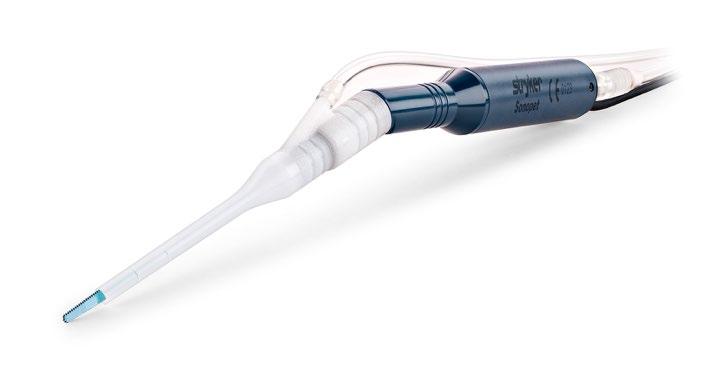
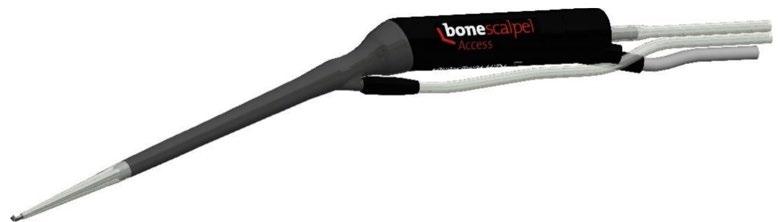
Bone removal remains an important part of nearly all spine operations. Whether done for the purposes of decompression, osteotomy, or instrumentation, resection of bone within the spine is technically demanding given the immediate proximity of neural structures, hollow organs, and blood vessels. Bone removal must be carried out precisely to achieve the goals of surgery while avoiding iatrogenic instability. Despite improvements in visualization, navigation, and neuromonitoring, the inherent risks of neurological, vascular and visceral injury remain a challenge for spine surgeons. Rotary burrs may chatter, skip, or wrap delicate structures, while Kerrison and pituitary rongeurs can tear dura during ligamentum flavum resection. These limitations have driven the development of devices designed to make bony work more precise and less traumatic. Ultrasonic bone scalpels and oscillatory burrs are 2 of the most recent options now commercially available. Ultrasonic bone removal (UBR) tools (Stryker’s Sonopet and Misonix’s BoneScalpel; Figure 1) use high-frequency vibration to preferentially cut mineralized tissue while spar-
ing adjacent soft tissue. Rigid bone microscopically fractures in response to high frequency vibration, whereas elastic structures such as dura and nerve roots deform without shearing. This selectivity makes ultrasonic devices increasingly attractive in spine surgery, allowing bone removal without risk of durotomy or nerve injury. Both devices are coupled with continuous irrigation to mitigate thermal injury.
The technology is built on piezoelectric transduction, which converts electrical energy into oscillatory motion at ultrasonic
Figure 1. Ultrasonic bone removal tools in spine surgery: (a) Sonopet (b) BoneScalpel.
Brandon P. Hirsch, MD
frequencies (typically 20–35 kHz). At these frequencies, mineralized bone cannot absorb and dissipate the vibrational energy, leading to microfracture and fragmentation. In contrast, soft tissues deflect under the same load, dispersing energy without permanent deformation. The constant irrigation serves a dual purpose: cooling the cutting edge to prevent thermal necrosis and flushing away bone slurry to preserve visualization. Unlike a rotary burr, which generates constant frictional heat, the intermittent contact of ultrasonic vibration tends to produce lower peak temperatures at the cutting surface. This physical selectivity allows ultrasonic scalpels to be placed confidently at the bone–dura interface.
A review by Renjith et al summarized the application of UBR in decompression, laminoplasty, anterior cervical discectomy and fusion (ACDF), and osteotomies, concluding that the instruments are both safe and effective, with the primary barriers being cost and the learning curve.1 Steinle et al compared lumbar laminectomies performed with UBR to conventional instruments and reported a durotomy rate of 0% with UBR compared to 12.5% with traditional tools. 2 Matthes et al evaluated thermal effects, showing that ultrasonic devices generated significantly less heat than high-speed drills, reducing the risk of thermal injury. 3
Several randomized studies have demonstrated the safety and efficacy of ultrasonic bone removal tools when compared with traditional burrs. Rittipoldech et al found that thoracolumbar decompressions performed with UBR resulted in shorter laminectomy
times and reduced intraoperative blood loss without increasing complications.4 In ACDF, Yao et al demonstrated that UBR reduced operative time and blood loss compared with high-speed drills, with no dural or neurological injuries in the ultrasonic group. 5 Endoscopic applications have also been described. Tsai et al reported that UBR facilitated precise decompression in unilateral biportal endoscopic spine surgery with minimal blood loss and no durotomies. 6 Most recently, Segerlind et al found that high-frequency ultrasonic osteotomy shortened operative time and hospital stay while maintaining safety during spinal tumor removal.7
Oscillating burrs represent another newer option for atraumatic bone removal during spine surgery. Rather than rotating a continuous 360 degrees, these burrs utilize a back-and-forth motion, rotating 180 degrees prior to reversing direction. Similar to ultrasonic tools, oscillating drills offer a potentially safer means of bone removal near critical structures due to the distinct mechanical responses of bone and soft tissue to oscillatory motion. Oscillation produces rapid back-and-forth displacement over a limited arc, which efficiently fractures the mineralized matrix of bone while leaving compliant tissues such as dura and nerves more likely to deform and displace rather than shear. Because the tip does not rotate continuously, there is less opportunity for tissue wrapping or entanglement, and the intermittent contact reduces the buildup of thermal energy that can occur with highspeed rotary drilling. The restricted motion
path also limits skiving across cortical bone, improving control in confined anatomical spaces. These devices are new to the US device market, with DuraPro (Globus Medical) being the only widely distributed device currently available.
Oscillating drills blend the precision of hand instruments with the efficiency of powered devices. The oscillatory action does not transmit the same torsional force back into the surgeon’s hand as a high-speed burr, which may reduce fatigue during long decompressions or multilevel procedures. In addition, the motion produces a distinctive tactile and auditory feedback that differs from rotary instruments, which can be helpful in gauging the depth and density of bone being removed. Because oscillating motion tends to follow a stable trajectory, these tools are useful adjuncts to navigation. When preparing pedicle entry points or working through narrow minimally invasive retractors, the reduced tendency to “walk” across cortical bone may improve accuracy. In revision cases where scar tissue or prior instrumentation complicates the use of conventional
burrs, oscillating drills may provide a wider margin of safety.
Ultrasonic bone scalpels and oscillating drill systems are promising alternatives for atraumatic bone removal during spine surgery. Ultrasonic instruments already have substantial clinical evidence demonstrating reductions in durotomy rates, blood loss, and operative time in both open and minimally invasive contexts. Oscillating systems offer a mechanical solution that may reduce soft tissue wrapping and provide improved trajectory control, potentially at lower cost. As newer generations of these devices evolve, additional studies will be needed to define optimal indications as well as quantify their impact on complication rates, operative efficiency, and overall cost-effectiveness. Currently, ultrasonic scalpels are supported by a significant body of evidence demonstrating their utility. Oscillating drills are at an earlier stage of adoption but show theoretical advantages grounded in tissue biomechanics. Together, these technologies reflect ongoing efforts to improve safety and efficiency of bone removal during spine surgery. l
References
1. Renjith KR, Eamani NK, Raja DC, et al. Ultrasonic bone scalpel in spine surgery. J Orthop. 2023;41:1–7.
2. Steinle AM, Chen JW, O’Brien A, et al. Efficacy and safety of the ultrasonic bone scalpel in lumbar laminectomies. Spine Surg Relat Res . 2022;7:242–248.
3. Matthes M, Pillich DT, El Refaee E, et al. Heat generation during bony decompression of lumbar spinal stenosis using a high-speed diamond drill with or without automated irrigation and an ultrasonic bone-cutting knife: a single-blinded
prospective randomized controlled study. World Neurosurg. 2018;111:e72–e81.
4. Rittipoldech CA, Limsomwong P, Thamrongskulsiri N. Ultrasonic bone scalpel versus conventional technique for thoracolumbar spinal decompression: a prospective randomized controlled trial. Rev Bras Ortop (Sao Paulo). 2023;58:706–711.
5. Yao Z, Zhang S, Liu W, et al. The efficacy and safety of ultrasonic bone scalpel for removing retrovertebral osteophytes in anterior cervical discectomy and fusion: a retrospective study. Sci Rep. 2024;14(1):80.
6. Tsai SHL, Chang CW, Lin TY, et al. The use of ultrasonic gone scalpel (UBS) in unilateral biportal endoscopic spine surgery (UBESS): technical notes and outcomes. J Clin Med. 2023;12(3):1180.
7. Segerlind JP, Staartjes VE, El-Hajj VG, et al. High-frequency ultrasonic osteotomy in the treatment of intradural spinal tumors: matched cohort study. Eur Spine J. 2025;34(8):3570-3577.
SPINE TRAUMA
Spine Trauma in DISH/AS Patients
Management Principles
Ankylosing spondylitis (AS) and diffuse idiopathic skeletal hyperostosis (DISH) are distinct conditions that both lead to reduced spinal mobility, abnormal biomechanics, and a rigid, fracture-prone spine.1–3 Despite differing etiologies (Table 1), advanced stages of both conditions confer a 4-fold higher risk of vertebral fracture compared to unaffected individuals, often after low-energy trauma, with significantly greater complication and mortality rates.4
Biomechanical alterations drive the distinct fracture patterns observed in these patients. Spinal fusion creates a long lever arm that is unable to dissipate impact, producing high stress concentrations even after minor trauma.4 In AS, paravertebral ossification spanning zygapophyseal and costotransverse joints frequently leads to kyphosis and unstable fractures involving posterior elements, strongly linked to neurological deterioration. In contrast, DISH patients more frequently sustain isolated vertebral body fractures. These injuries still carry similar risks of delayed diagnosis and neurologic decline. 5,6 In addition, osteoporosis and decreased bone min-
From the Department of Orthopaedic Surgery at the University of California, Davis, in Sacramento, California.
eral density are prevalent in AS, likely driven by systemic inflammation and reduced activity.7,8 Although DISH is not directly linked to osteoporosis, its older patient population often exhibits compromised bone quality. Moreover, ligamentous ossification can artifactually elevate bone mineral density readings, masking underlying fragility.9 Thus, impaired bone quality further compounds fracture risk in both conditions. With the rising prevalence of DISH in aging, obese, and diabetic populations, and with a steady incidence of AS, it is critical to understand the unique fracture mechanisms, instability patterns, and bone quality considerations in these patients. These factors underscore the importance of tailored management strategies for trauma in patients with an ankylosed spine.
Radiographic Evaluation
Patients with suspected fractures should be managed with advanced complete spinal imaging and full spine precautions until definitive treatment. Studies demonstrate high rates of missed or incorrect initial fracture diagnosis in patients with AS and DISH, which may result in progres -
Audrey Zhao, BS
Hania Shahzad, MD
Safdar Khan, MD
Yashar Javidan, MD
Wyatt Vander Voort, MD
Hai Le, MD
sive neurologic injury. 5 Advanced imaging such as computed tomography (CT) should be used in fracture identification for any patient with AS or DISH, as nondisplaced fractures are easily missed using only x-ray imaging. Magnetic resonance imaging (MRI) is mandatory in cases with neurologic involvement, but literature suggests CT alone may be sufficient in DISH patients without suspicion for neurologic involvement.10 Shah et al found that additional MRI findings did not change management of isolated vertebral body fractures in DISH patients, but all AS
patients with the same fracture pattern on CT had additional MRI findings that were clinically significant and warranted conversion to operative management.10
Management and Outcomes
Operative treatment is recommended in vertebral fractures in patients with AS and DISH owing to the severity and incidence of complications, namely pseudarthrosis and progression of neurologic deficits.11 Westerfeld et al found that overall complications and mortality rates were lower in patients
Pathophysiology Autoimmune inflammatory disorder of the axial skeleton associated with the HLA-B27 antigen; typically involves sacroiliac, costovertebral, and costotransverse joints
Age of onset Second and third decades of life, not usually after age 40 y
Calcification and ossification of soft tissues; thoracic spine is the most commonly affected region
Typically older patients, aged around 50 y
Symptoms Spinal pain and stiffness with decreasing range of motion; advanced disease can result in postural abnormalities Asymptomatic or associated with mild dorsolumbar pain, with mild spinal mobility restriction
Diagnostic criteria
• Bilateral sacroiliitis grade ≥ 2 or unilateral sacroiliitis grade 3 or 4, and 2 of the following:
• Low back pain and stiffness for at least 3 mo improved by exercise and not relieved by rest
• Limitation of motion of the lumbar spine in both the sagittal and the frontal planes
• Limitation of chest expansion relative to values normal for age and sex
• Presence of flowing ossifications that involve a minimum of 4 contiguous vertebrae
• Preservation of disc height with minimal degenerative changes in the affected vertebral segments
• Absence of ankylosis at the facet-joint interface and no sacroiliac joint erosion, sclerosis, or fusion
Radiographic characteristics
Nonsurgical management
• Sacroiliitis (Figure 1)
• “Squaring” of the vertebral bodies caused by osteitis
• “Bamboo spine” caused by ossification of spinal ligaments bridging intervertebral discs
Table 1. Comparison of Ankylosing Spondylitis and Diffuse Idiopathic Skeletal Hyperostosis
SPINE TRAUMA
managed operatively.5 Medical comorbidities are the most common reason for nonoperative treatment.1
Nonoperative Management
Nonoperative management typically consists of rigid external immobilization with orthoses such as cervical collars and thoracolumbosacral orthoses, depending on the level of injury. Patients with advanced disease may have postural deformities that require additional molding or adjustment for external bracing. Taher et al demonstrated successful outcomes using bracing without surgical intervention in 3 patients with extension-type injuries, no significant dislocation, and normal facet orientation.12 Several case series suggest that nonoperative management can achieve good outcomes in well-selected patients, but further investigation into patient selection is needed.13 However, nonoperative management is not without risk of complications. Besides the risks inherent to fracture instability, healing fractures without fixation requires extended bed rest, which can lead to deconditioning, skin ulceration, and pulmonary complications.14
Operative Management
Positioning
The ligaments and paraspinal muscles are crucial mechanical supports for the ankylosed spine. Surgeons must be careful when positioning patients for surgery to prevent additional fractures or displacement, especially after the loss of muscular tone with general anesthesia. For patients with cer-
vical injuries, fiberoptic intubation is recommended to reduce the risk of worsening neurological deficits.11
Approach
In AS and DISH patients, fusion can be performed through an anterior, posterior, or combined approach using allograft, autograft, or other synthetic graft materials. The posterior approach is preferred in trauma patients, as it allows for multiple points of fixation and provides good exposure to the spinal cord if decompression is needed. Current recommendations for thoracolumbar spine fracture in DISH utilize an open posterior fixation with instrumentation at 3 levels above and below the site of the fracture. Caron et al found that of 58 patients (77% of the surgical treatment group) who received posterior segmental fixation with instrumentation 3 levels above and below the injury, no patients required reoperation for fixation failure.15 However, multilevel fixation may not be necessary in the cervical spine. Cervical fractures are more frequently encountered than thoracolumbar fractures in AS patients.16 Although posterior fixation is preferred in the thoracic spine, cervical fracture management is not standardized and varies with patient factors. Evidence suggests there is no significant difference in neurological improvement between the posterior and combined approaches.17 While the combined approach leads to longer operation times, greater stability can be achieved than with the posterior approach alone.18 Patients with unstable B- and C-type cervical fractures may benefit from this increased
stabilization. Generally, standalone anterior fixation is at a higher risk of failure without posterior fixation due to a lack of structural support.16 Studies show the anterior approach has been associated with fewer degrees of neurological improvement, but it may also result in fewer complications and may be a suitable option for patients who cannot tolerate prone positioning due to cardiac comorbidities or fracture instability.19,20
Surgical Techniques
The standard for operative management uses pedicle screw and rod constructs. Monoaxial pedicle screw systems are preferred because they are inherently more stable than polyaxial screw systems and are better able to counteract mechanical stresses that are increased with the ankylosed spine. 21 Besides percutaneous pedicle screw (PPS) fixation, there is also emerging evidence that interdiscal penetrating endplate screws may provide stronger fixation with significantly decreased screw loosening. 22
Poor bone quality is highly associated with AS and DISH, and increased screw quantity or augmentation with polymethylmethacrylate can be effective. Surgeons should be aware of possible pulmonary cement embolization in patients with long instrumentation.10
Minimally Invasive Surgery
Minimally invasive surgery (MIS) approaches are increasingly utilized in spinal fixation for traumatic fractures in patients with ankylosing spinal diseases. 23 Lower complication rates, decreased blood loss, and decreased hospital stay when compared to open surgery
are highly desired benefits for AS and DISH patients given their high rates of medical comorbidities.11 Furthermore, many studies have demonstrated the efficacy of PPS in DISH and AS patients. 24,25 Okada et al found similar fusion length and neurological improvement and lower complication rates in PPS fixation compared to traditional open posterior fixation. 25
The decision to use MIS depends on various factors, including surgeon experience, fracture type, and stability. Current studies indicate that good outcomes can be achieved in AS and DISH patients using a minimally invasive approach for hyperextension fractures and minimally displaced neurologically intact injuries.18
Complications
Complication rates for patients with AS and DISH are known to be higher than those of control populations. 5,26 Westerveld et al found that complications occurred more frequently in patients with ankylosing disorders regardless of treatment strategy, and respiratory failure and pneumonia were most frequently reported. 5 Patients with DISH have been shown to have decreased pulmonary function compared to control patients, contributing to their susceptibility to pulmonary complications. 27 Deconditioning due to stiffness and pain, as well as high rates of medical comorbidities, are other factors that affect postoperative recovery. The systemic inflammatory nature of AS also predisposes patients to complications such as increased intraoperative bleeding and surgical site infections. 28 Epidural he -
SPINE TRAUMA
matoma and cardiac abnormalities have also been documented in the AS population postoperatively. 26,29
Patient Cases
Case 1
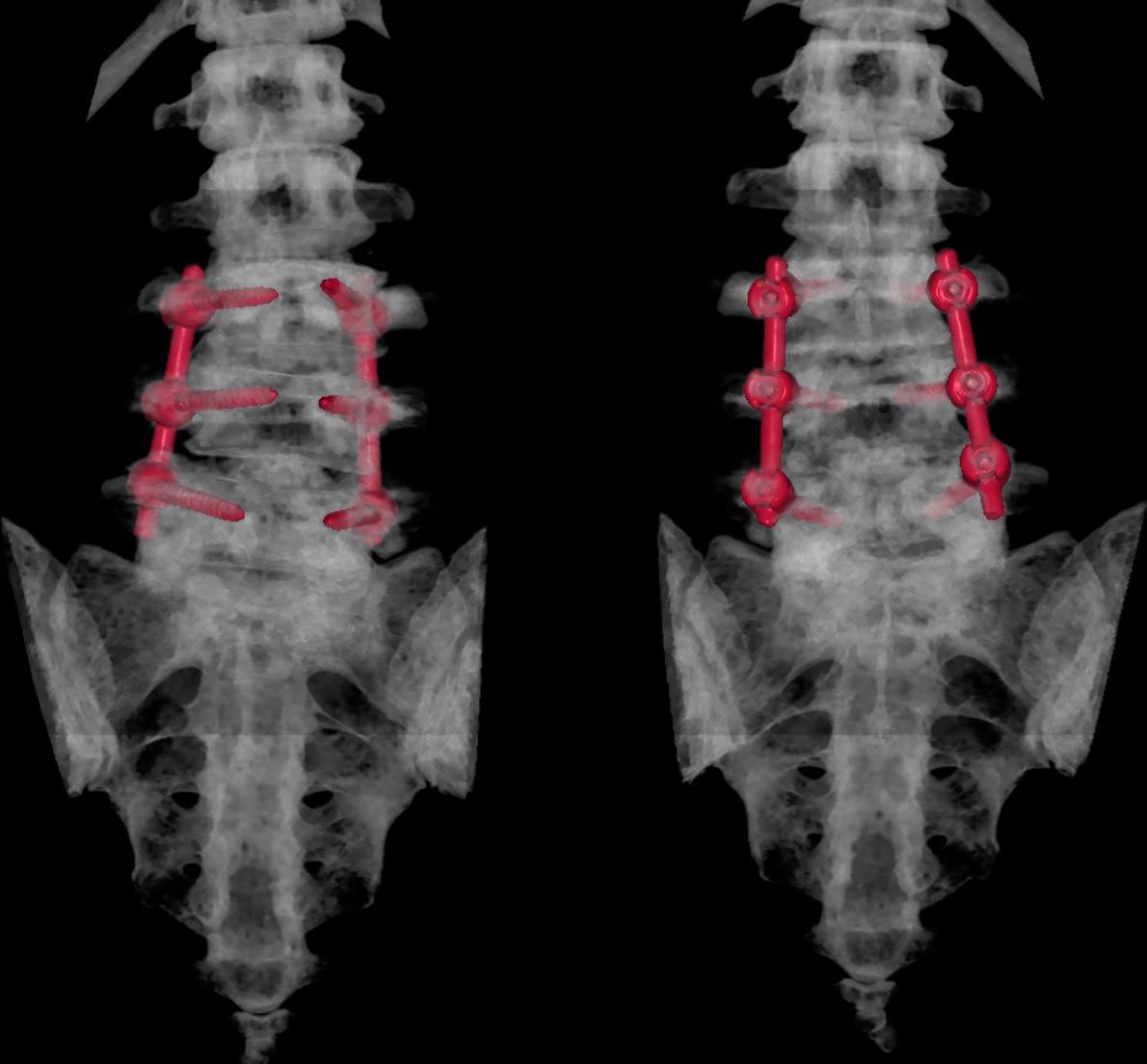
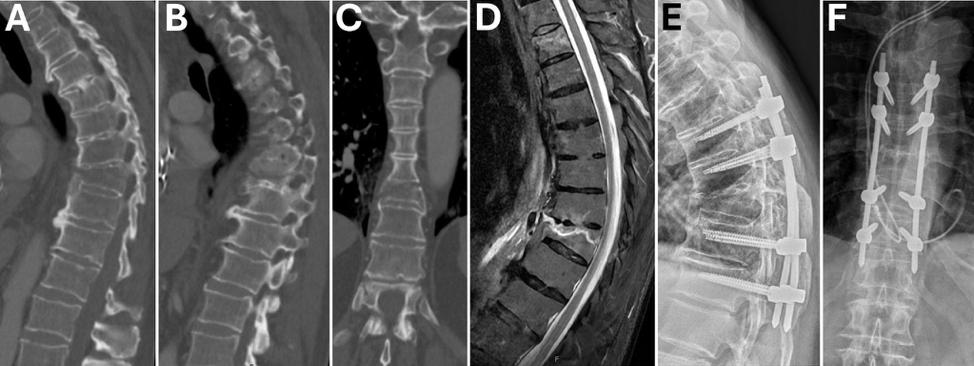
A 71-year-old man with ankylosing spondylitis sustained a mechanical ground-level fall that resulting in an extension injury involving the anterior and middle columns of T9, as seen on CT and MRI (Figure 1AD). He underwent percutaneous T7-T11 instrumentation to stabilize the injury (Figure 1E and F).
Case 2
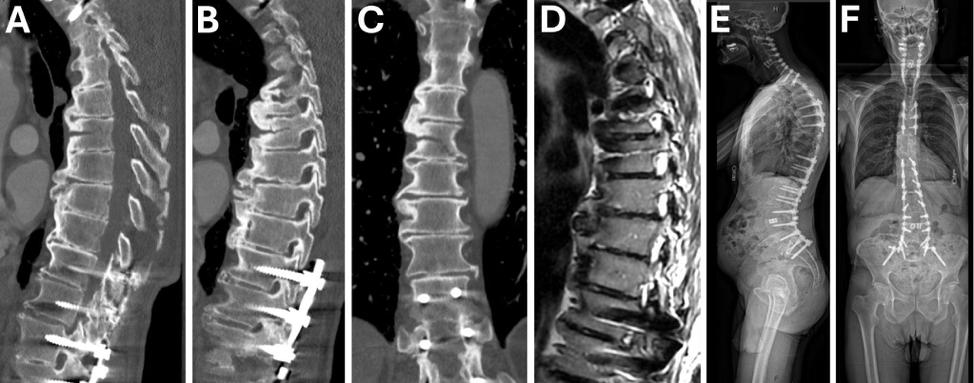
An 85-year-old man with DISH and a remote history of C1-T2 and T10-pelvis fusion sustained a syncopal ground-level fall, resulting in an extension injury involving the anterior and middle columns of T6, as seen on CT (Figure 2A-C) and MRI (Figure 2D). He underwent percutaneous T5-7 instrumentation to stabilize the injury (Figure 2E and F).
Conclusion
Management of spinal fractures in patients with AS and DISH presents unique challenges due to altered spinal biomechanics, difficulty of radiographic evaluation, and risk of neurologic deficit progression. Treatment can be operative or nonoperative, but nonoperative management is typically only used for patients with factors that preclude them from surgery. A posterior approach is typically preferred for traumatic thoracic fractures in cases where spinal decompression is also indicated. Surgical approaches for cervical fractures can vary based on fracture stability and patient comorbidities. Patients with AS and DISH require special consideration during management, from fracture identification to patient transport and positioning to surgical technique. In understanding the factors that affect management of vertebral fractures in this patient population, surgeons will be equipped to provide the care that patients need and improve long-term outcomes. l
Figure 1. Thoracic spine injury in a patient with ankylosing spondylitis. Computed tomography (A-C) and MRI (D) show extension injury involving the anterior and middle columns of T9. Percutaneous T7-T11 instrumentation (E and F) was provided to stabilize the injury.
Figure 2. Thoracic spine injury in patient with diffuse idiopathic skeletal hyperostosis (DISH). Computed tomography (A-C) and MRI (D) show extension injury involving the anterior and middle columns of T6. Percutaneous T5-T7 instrumentation (E and F) was provided to stabilize the injury.
References
1. Westerveld LA, Verlaan JJ, Oner FC. Spinal fractures in patients with ankylosing spinal disorders: a systematic review of the literature on treatment, neurological status and complications. Eur Spine J. 2009;18(2):145-156.
2. Kim SH, Lee SH. Updates on ankylosing spondylitis: pathogenesis and therapeutic agents. J Rheum Dis . 2023;30(4):220-233.
4. Harlianto NI, Ezzafzafi S, Foppen W, et al. The prevalence of vertebral fractures in diffuse idiopathic skeletal hyperostosis and ankylosing spondylitis: a systematic review and meta-analysis. North Am Spine Soc J. 2024;17:100312.
5. Westerveld LA, van Bemmel JC, Dhert WJA, Oner FC, Verlaan JJ. Clinical outcome after traumatic spinal fractures in patients with ankylosing spinal disorders compared with control patients. Spine J. 2014;14(5):729-740.
6. Kobayashi K, Okada E, Yoshii T, et al. Risk factors for delayed diagnosis of spinal fracture associated with diffuse idiopathic skeletal hyperostosis: a nationwide multiinstitution survey. J Orthop Sci. 2021;26(6):968-973.
7. Briot K, Roux C. Inflammation, bone loss and fracture risk in spondyloarthritis. RMD Open. 2015;1(1).
8. Ramírez J, Nieto-González JC, Curbelo Rodríguez R, Castañeda S, Carmona L. Prevalence and risk factors for osteoporosis and fractures in axial spondyloarthritis: a systematic review and meta-analysis. Semin Arthritis Rheum. 2018;48(1):44-52.
9. Donnelly S, Doyle DV, Denton A, Rolfe I, McCloskey EV, Spector TD. Bone mineral density and vertebral compression fracture rates in ankylosing spondylitis. Ann Rheum Dis . 1994;53(2):117-121.
10. Shah NG, Keraliya A, Harris MB, Bono CM, Khurana B. Spinal trauma in DISH and AS: is MRI essential following the detection of vertebral fractures on CT? Spine J. 2021;21(4):618-626.
11. Daher M, Rezk A, Baroudi M, et al. Management of thoracolumbar vertebral fractures and dislocations in
patients with ankylosing conditions of the spine. Orthop Rev. 2024;16:94279.
12. Taher AW, Page PS, Greeneway GP, et al. Spinal fractures in the setting of diffuse idiopathic skeletal hyperostosis conservatively treated via orthosis: illustrative cases. J Neurosurg Case Lessons . 2022;3(20):CASE21689.
13. Barkay G, Fernandes J, Strong D, Suttor S, Hartin N, Gray R. Non-operative management for patients with spinal ankylosing disorders presenting with extension type (AOSpine B3) fractures—our experience with a cohort of 40 patients. Global Spine J. 2025;15(7):3323-3331.
14. Werner BC, Samartzis D, Shen FH. Spinal fractures in patients with ankylosing spondylitis: etiology, diagnosis, and management. J Am Acad Orthop Surg. 2016;24(4):241-249.
15. Caron T, Bransford R, Nguyen Q, Agel J, Chapman J, Bellabarba C. Spine fractures in patients with ankylosing spinal disorders. Spine . 2010;35(11):E458-E464.
16. Kurucan E, Bernstein DN, Mesfin A. Surgical management of spinal fractures in ankylosing spondylitis. J Spine Surg. 2018;4(3):501-508.
17. Peng C, Luan H, Liu K, Song X. Comparison of posterior approach and combined anterior-posterior approach in the treatment of ankylosing spondylitis combined with cervical spine fracture: a systematic review and meta-analysis. Global Spine J. 2024;14(5):1650-1663.
18. Harlianto NI, Kuperus JS, Verlaan JJ. Perioperative management, operative techniques, and pitfalls in the surgical treatment of patients with diffuse idiopathic skeletal hyperostosis: a narrative review. Explor Musculoskelet Dis . 2023;1(4):84-96.
19. Shetty AP, Murugan C, Karuppannan Sukumaran SVA, et al. Surgical approach to cervical fractures in ankylosing spondylitis patients: rationale and surgical strategy. World Neurosurg. 2023;173:e321-e328.
20. Chen HJ, Chen DY, Zhou SZ, Sang LL, Wu JZ, Huang FL. Combined anterior and posterior approach in treatment of ankylosing spondylitis-associated cervical fractures: a systematic review and meta-analysis. Eur Spine J. 2023;32(1):27-37.
21. Reinhold M, Knop C, Kneitz C, Disch A. Spine fractures in ankylosing dis -
eases: recommendations of the spine section of the German Society for Orthopaedics and Trauma (DGOU). Global Spine J. 2018;8(2S):56S-68S.
22. Ishikawa T, Ota M, Umimura T, et al. Penetrating endplate screw fixation for thoracolumbar pathological fracture of diffuse idiopathic skeletal hyperostosis. Case Rep Orthop. 2022;2022:5584397.
23. Nayak NR, Pisapia JM, Abdullah KG, Schuster JM. Minimally invasive surgery for traumatic fractures in ankylosing spinal diseases. Global Spine J. 2015;5(4):266-273.
24. Ye J, Jiang P, Guan H, et al. Surgical treatment of thoracolumbar fracture in ankylosing spondylitis: a comparison of percutaneous and open techniques. J Orthop Surg Res . 2022;17(1):504.
25. Okada E, Shiono Y, Nishida M, et al. Spinal fractures in diffuse idiopathic skeletal hyperostosis: advantages of percutaneous pedicle screw fixation. J Orthop Surg. 2019;27(2):2309499019843407.
26. Schwendner M, Seule M, Meyer B, Krieg SM. Management of spine fractures in ankylosing spondylitis and diffuse idiopathic skeletal hyperostosis: a challenge. Neurosurg Focus . 2021;51(4):E2.
27. Shimizu T, Suda K, Harmon SM, et al. The impact of diffuse idiopathic skeletal hyperostosis on nutritional status, neurological outcome, and perioperative complications in patients with cervical spinal cord injury. J Clin Med. 2023;12(17):5714.
28. Chehrassan M, Shakeri M, Nikouei F, et al. Understanding the pros and cons of spine surgery for ankylosing spondylitis: experience from a single institution study. BMC Rheumatol. 2025;9(1):11.
29. Hanna G, Uddin SA, Trontis A, et al. Epidural hematoma in patients with ankylosing spondylitis requiring surgical stabilization: a single-institution retrospective review with literature analysis. Neurosurg Focus . 2021;51(4):E5.
From the Department of Orthopedic Surgery at Midwest Orthopedics at Rush in Chicago, Illinois.
Venous Thromboembolism Prophylaxis After Elective Spine Surgery
A Narrative Review
Venous thromboembolism (VTE), which includes deep venous thrombosis and pulmonary embolism, is an uncommon but serious and preventable complication following spine surgery.1,2 Reported incidence varies markedly, from 0.3% to 31%, reflecting heterogeneity in patient populations, surgical indications, and prophylactic strategies.1,3-5 With an aging population and a growing prevalence of comorbidities, increasing numbers of patients are undergoing elective spine surgery while already receiving anticoagulant or antiplatelet (AC/AP) therapy. 6 Although the overall incidence of VTE in elective spine procedures is relatively low (1.1–3.2%) compared with trauma or oncology cases, associated morbidity and mortality remain clinically significant. 2,7-11 Conversely, postoperative bleeding, particularly epidural hematoma (EDH), is reported in only 0–0.7% of cases, and it poses a major concern given its potential for irreversible neurological inju -
ry.2,12-15 The balance between preventing VTE and avoiding hemorrhagic complications therefore remains a central perioperative challenge in spine surgery.
In contrast to joint replacement, where well-defined guidelines for VTE prophylaxis exist and are widely implemented,16 spine surgery lacks universally accepted protocols. Current recommendations are inconsistent, and no consensus has been firmly established. In 2009, the North American Spine Society concluded that evidence was insufficient to support routine chemoprophylaxis in elective spine surgery.7 Later, in 2012, the American College of Chest Physicians recommended mechanical prophylaxis over chemoprophylaxis or no prophylaxis, with pharmacologic prophylaxis reserved for moderate- to high-risk patients (eg, combined anterior–posterior surgery, paralysis, multiple traumas, malignancy, spinal cord injury, or hypercoagulable states), unless there was high bleeding risk.17
Over the past 2 decades, mechanical and pharmacologic strategies have been extensively evaluated. Nonpharmacologic measures such as early mobilization, thromboembolic deterrent stockings, and
Kuan-Po Chen, MD
Po-Hsin Chou, MD, PhD
Yuan-Kun Tu, MD, PhD
Nathan J. Lee, MD
sequential compression devices are consistently recommended due to their noninvasiveness, efficacy, and low complication rates. 2,7,12,13,15,18,19 These devices enhance venous return by compressing the superficial venous system, thereby increasing venous flow and promoting fibrinolysis. 20 In contrast, pharmacologic prophylaxis— including low-molecular-weight heparin (LMWH), unfractionated heparin, direct oral anticoagulants (DOACs), and aspirin—remains debated because of variable efficacy and the risk of wound complications or EDH.1,14,21,22
Practice patterns differ considerably among institutions and regions. Retrospective series, randomized trials, and consensus statements all demonstrate variation in the timing, choice, and stratification of prophylaxis.1,8,13 Recent reviews and meta-analyses further suggest no significant difference in thromboembolic or hemorrhagic events among low-risk patients with or without chemoprophylaxis 2,9,13 while also pointing to potential benefits of earlier initiation in carefully selected high-risk groups, highlighting the importance of individualized assessment.10,23
Given these persistent uncertainties, a synthesis of current evidence is needed. This narrative review consolidates recommendations from major guidelines and consensus statements—including the 2023 Delphi guideline, 8 the 2020 AO Spine global survey,1 and the 2009 North American Spine Society guideline 7—together with recent literature on elective spine surgery and proposes an evidence-informed framework
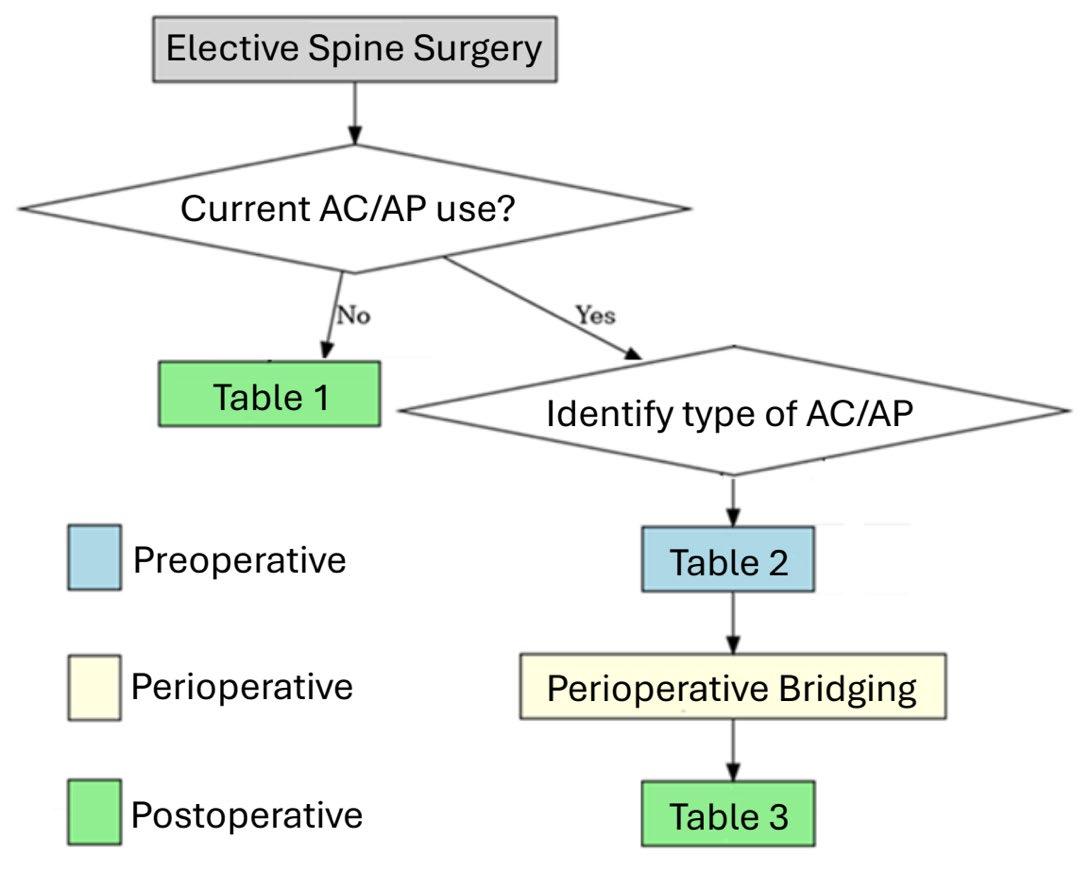
1. Algorithm for perioperative management of venous thromboembolism prophylaxis and anticoagulation/antiplatelet (AC/AP) therapy in elective spine surgery. The flowchart incorporates three decision tables: postoperative initiation (Table 1), preoperative cessation (Table 2), and postoperative resumption (Table 3), together with perioperative bridging considerations.
to guide spine surgeons toward safer, more standardized perioperative practice.
Algorithm
For patients undergoing elective spine surgery, the first step is to establish whether there is current or prior use of AC/AP therapy, as well as to evaluate risk factors for VTE. This assessment forms the basis of perioperative planning. The proposed algorithm ( Figure 1) guides clinicians through subsequent decision-making by linking to the relevant risk stratification tables (Table 1–3). These tables provide a structured framework for assigning risk scores based on patient-specific characteristics, thereby categorizing individuals into low-, medium-, or high-risk groups for both thromboembolic and bleeding
Figure
Patientspecific factors
PATIENT OUTCOMES
complications. A stepwise application of this approach allows AC/AP management and VTE prophylaxis to be individualized according to each patient’s clinical profile.
Postoperative Initiation of AC/AP in Patients Not on Baseline AC/AP Therapy
In 2 institutional protocols, anticoagulation was initiated 24 hours after surgery with either enoxaparin or rivaroxaban.12,24
In an international cross-sectional survey,
most surgeons reported mobilization and mechanical prophylaxis beginning on postoperative day (POD) 0–1, while LMWH was either not used or was started within the same timeframe.1 Consensus recommendations emphasized the use of risk stratification tools, such as the guideline proposed by Zuckerman et al, which introduced a structured scoring system. 8
On the basis of these data and consensus statements, the evidence was consolidated into Table 1, which stratifies patients ac -
Ambulation status Normal With assistance Wheelchair/bedridden Prior VTE No history
Cancer status No history In remission Active cancer
AC/AP medication preferred Enoxaparin: 40 mg once per day (standard rather than weight-based)
Mechanical prophylaxis All patients start routinely just before/at the beginning of surgery until full ambulation
Abbreviations: A+P, Anterior and posterior; AC/AP, anticoagulant/antiplatelet; ALIF, anterior lumbar interbody fusion; BMI, body mass index; OCP, oral contraceptive; POD, postoperative day; VTE, venous thromboembolism.
Source: Modified from Zuckerman et al, 2023.8
Table 1. Postoperative Scoring for Initiation of AC/AP in Patients Not on Baseline AC/AP Therapy
cording to risk factors such as prior VTE, cardiac intervention, malignancy, oral contraceptive or hormone use, 8 and surgical complexity or approach.7 Importantly, the guideline distinguishes a true anterior abdominal approach—where iliac vessels are mobilized—from prepsoas or transpsoas approaches, in which vascular manipulation is minimal or absent. For clarity, POD 1 is defined as the morning following surgery, regardless of the finishing time. Accordingly, the timing of postoperative initiation of AC/ AP therapy is determined by the cumulative risk score, and careful neurological monitoring is advised once chemoprophylaxis is introduced. A standardized regimen of enoxaparin, 40 mg once daily, is preferred over weight-based dosing. 8
Preoperative Cessation of AC/AP in Patients on Chronic AC/AP Therapy
Compared with VTE prophylaxis, perioperative AC/AP management remains relatively underexplored. 25,26 Based on drug half-life and reversibility, current guidance suggests discontinuing DOACs 2 days before surgery, warfarin 5 days prior, and all other AC/AP
“A stepwise application of the risk stratification approach allows AC/ AP management and VTE prophylaxis to be individualized according to each patient’s clinical profile.”
agents, including aspirin, 7 days prior.7,8 These recommendations are summarized in Table 2, which also includes available reversal agents for each AC/AP drug, to serve as a practical reference for perioperative decision-making. 27
Perioperative Bridging Method in Patients on Chronic AC/AP Therapy
To our knowledge, no clear consensus has been established on the optimal strategy for perioperative bridging. In patients dis -
AC/AP Medication Cessation, days before surgery Specific Antidote for AC/AP
Table 2. Preoperative Cessation of AC/AP in Patients on Chronic AC/AP Therapy
specific factors
PATIENT OUTCOMES
continuing warfarin, intravenous heparin may be considered as a bridging option and should ideally be guided by specialist consultation, given its greater controllability and predictability compared with LMWH. Nevertheless, LMWH, most commonly enoxaparin, is also regarded as a reasonable alternative.7,8
Postoperative Resumption of AC/AP After Elective Spine Surgery
In the 2020 international survey, the timing of AC/AP resumption in patients on chronic therapy showed a bimodal pattern worldwide, with most providers restarting on either POD 0–1 or POD 5–6.1 Subsequent consensus recommended resumption at POD 7 for low-risk, POD 5 for medium-risk, and POD 2 for high-risk patients (Table 3). 8 It should be emphasized that recommendations from internists, hematologists, or cardiologists should be prioritized when
available, as these supersede general consensus guidance. This recommendation is particularly relevant in nonacademic or community settings, where spine surgeons may lack timely access to specialist consultation.
Prophylaxis for High-Risk Thromboembolism Patients
Beyond the elective risk categories outlined in Table 1, certain patient groups are recognized as having an intrinsically higher risk of postoperative VTE. These include individuals with polytrauma and associated spinal fractures, patients with spinal cord injury, and those with spinal tumors. 8,23,28,29
Unlike routine elective cases where risk stratification determines timing, these populations are generally recommended to start chemical prophylaxis as early as POD 1–2 in conjunction with mechanical methods. Evidence indicates that such
related factors
Abbreviations:
Table 3. Postoperative Resumption of AC/AP Following Elective Spine Surgery
early intervention reduces VTE incidence without increasing major bleeding or overall mortality, and this benefit extends to nonoperative spinal trauma or spinal cord injury patients.13,23,31,32
Complication Balance
While VTE incidence after spine surgery varies widely, elective cases generally fall within a lower range (1.1%–3.2%), 2,7,8,10 whereas rates are higher in patients with elevated baseline risk. 5,12 In contrast, EDH occurs in less than 1% of cases, with pooled analyses estimating an incidence of approximately 0.4% (range 0%–0.7%) and showing no significant difference between patients who did and those who did not receive chemoprophylaxis.12,13,23
Regional and Practice Variation
International surveys have demonstrated marked regional variability in perioperative VTE prophylaxis, particularly in the timing of AC/AP initiation, cessation, and resumption.1 In general, 70.3% of surgeons reported routinely performing anticoagulation risk stratification, regardless of location. Moreover, most providers implemented early mobilization, LMWH, and mechanical prophylaxis irrespective of patient history. By contrast, one area of relative uniformity has been the management of acute spinal cord injury, where global practice has consistently adhered to established prophylactic protocols, reflecting both the exceptionally high VTE risk in this population and the availability of well-validated guidelines. 33-35
Conclusion and Future Directions
VTE remains an uncommon but serious complication after spine surgery, with incidence influenced by patient risk profile, surgical complexity, and perioperative management. Mechanical prophylaxis is consistently supported as safe and effective, whereas the role of chemoprophylaxis remains debated due to the competing risk of EDH. Recent consensus statements, international surveys, and systematic reviews highlight the need for individualized, risk-stratified approaches—summarized in this narrative review—to guide perioperative management of AC/AP initiation, cessation, resumption, and bridging. These findings emphasize the persistent challenge of balancing thromboembolic prevention against bleeding risk and reinforce the importance of developing evidence-informed, standardized protocols for spine surgery. The absence of statistical significance in current studies should be interpreted with caution, and future large-scale, multicenter prospective trials with consistent inclusion criteria, standardized surgical classifications, and uniform outcome measures are warranted. Such investigations, specifically designed to assess both thromboembolic and hemorrhagic endpoints, will be essential to validate risk-stratification tools and to establish standardized management of preoperative AC/AP therapy and VTE chemoprophylaxis in adult elective spine surgery. l
PATIENT OUTCOMES
References
1. Louie P, Harada G, Harrop J, et.al. Perioperative anticoagulation management in spine surgery: initial findings from the AO Spine anticoagulation global survey. Global Spine J. 2020;10(5):512-527.
2. Muralidharan A, Gong DC, Baumann AN, et al. Venous thromboembolism chemoprophylaxis is not supported following elective spine surgery: a systematic review and meta-analysis of randomized controlled trials. J Spine Surg. 2025;11(2):242-255.
3. Glotzbecker MP, Bono CM, Wood KB, Harris MB. Thromboembolic disease in spinal surgery: a systematic review. Spine (Phila Pa 1976). 2009;34(3):291-303.
4. Rockson HB, DiPaola CP, Connolly PJ, Stauff MP. Venous thromboembolism prophylaxis for patients having elective spine surgery: when, why, and how much. J Bone Joint Surg Am. 2019;101(13):1220-1229.
5. Schulte LM, O’Brien JR, Bean MC, Pierce TP, Yu WD, Meals C. Deep vein thrombosis and pulmonary embolism after spine surgery: incidence and patient risk factors. Am J Orthop (Belle Mead NJ). 2013;42(6):267-270.
6. O’Lynnger TM, Zuckerman SL, Morone PJ, Dewan MC, Vasquez-Castellanos RA, Cheng JS. Trends for spine surgery for the elderly: implications for access to healthcare in North America. Neurosurgery. 2015;77(suppl 4):S136-S141.
7. Bono CM, Watters WC 3rd, Heggeness MH, et al. An evidence-based clinical guideline for the use of antithrombotic therapies in spine surgery. Spine J. 2009;9(12):1046-51.
8. Zuckerman SL, Berven S, Streiff MB, et al. Management of anticoagulation/antiplatelet medication and venous thromboembolism prophylaxis in elective spine surgery: concise clinical recommendations based on a modified Delphi process. Spine (Phila Pa 1976). 2023;48(5):301-309.
9. Ellenbogen Y, Power RG, Martyniuk A, Engels PT, Sharma SV, Kasper EM. Pharmacoprophylaxis for venous thromboembolism in spinal surgery: a systematic review and meta-analysis. World Neurosurg. 2021;150:e144-e154.
10. Sansone JM, del Rio AM, Anderson PA. The prevalence of and specific risk factors for venous thromboembolic disease following elective spine surgery. J Bone Joint Surg Am. 2010;92(2):304-13.
11. Piper K, Algattas H, DeAndrea-Lazarus IA, et al. Risk factors associated with venous thromboembolism in patients undergoing spine surgery. J Neurosurg Spine. 2017;26(1):90-96.
12. Aljohani H, Alashkar AH, Alkafarnah GK, Almeshigeh MM, Alsadoon AA, Alfakhouri A. A protocol for venous thromboembolism prophylaxis in elective spine surgery: a
retrospective evaluation of a single-center experience. Cureus. 2025;17(6):e85297.
13. Rahmani R, Eaddy S, Stegelmann SD, Skrobot G, Andreshak T. Chemical prophylaxis and venous thromboembolism following elective spinal surgery: a systematic review and meta-analysis. N Am Spine Soc J. 2023;17:100295.
14. Glotzbecker MP, Bono CM, Wood KB, Harris MB. Postoperative spinal epidural hematoma: a systematic review. Spine (Phila Pa 1976). 2010;35(10):E413-20.
15. Kepler CK, McKenzie J, Kreitz T, Vaccaro A. Venous thromboembolism prophylaxis in spine surgery. J Am Acad Orthop Surg. 2018;26(14):489-500.
16. Lieberman JR, Heckmann N. Venous thromboembolism prophylaxis in total hip arthroplasty and total knee arthroplasty patients: from guidelines to practice. J Am Acad Orthop Surg. 2017;25(12):789-798.
17. Gould MK, Garcia DA, Wren SM, et al. Prevention of VTE in nonorthopedic surgical patients: antithrombotic therapy and prevention of thrombosis, 9th ed: American College of Chest Physicians evidence-based clinical practice guidelines. Chest. 2012;141(2 suppl):e227S-e277S.
18. Epstein NE. Intermittent pneumatic compression stocking prophylaxis against deep venous thrombosis in anterior cervical spinal surgery: a prospective efficacy study in 200 patients and literature review. Spine (Phila Pa 1976). 2005;30(22):2538-2543.
19. Sachdeva A, Dalton M, Lees T. Graduated compression stockings for prevention of deep vein thrombosis. Cochrane Database Syst Rev. 2018;11(11):CD001484.
20. Comerota AJ, Chouhan V, Harada RN, et al. The fibrinolytic effects of intermittent pneumatic compression: mechanism of enhanced fibrinolysis. Ann Surg 1997;226(3):306-313; discussion 313-4.
21. Schroeder GD, Hilibrand AS, Arnold PM, et al. Epidural hematoma following cervical spine surgery. Global Spine J. 2017;7(1 suppl):120S-126S.
22. Kou J, Fischgrund J, Biddinger A, Herkowitz H. Risk factors for spinal epidural hematoma after spinal surgery. Spine (Phila Pa 1976). 2002;27(15):1670-1673.
23. Mohanty S, von Riegen H, Akodu M, et al. Timing of chemical anticoagulant administration in spine trauma and its impact on VTE, bleeding, and mortality: a systematic review and meta-analysis. Global Spine J. Published online July 6, 2025. https:// doi.org/10.1177/21925682251353138
24. Shafiei M, Sabouri M, Aminmansour B, et al. Comparison between rivaroxaban versus enoxaparin for venous thrombo -
embolism prophylaxis following spine surgeries, a randomized clinical trial. J Clin Neurosci. 2022;105:51-57.
25. Epstein NE. When to stop anticoagulation, anti-platelet aggregates, and non-steroidal anti-inflammatories (NSAIDs) prior to spine surgery. Surg Neurol Int. 2019;10:45.
26. Cuellar JM, Petrizzo A, Vaswani R, Goldstein JA, Bendo JA. Does aspirin administration increase perioperative morbidity in patients with cardiac stents undergoing spinal surgery? Spine (Phila Pa 1976). 2015;40(9):629-635.
27. Yee J, Kaide CG. Emergency reversal of anticoagulation. West J Emerg Med. 2019;20(5):770-783.
28. Geerts WH, Pineo GF, Heit JA, et al. Prevention of venous thromboembolism: the Seventh ACCP Conference on Antithrombotic and Thrombolytic Therapy. Chest. 2004;126(3 suppl):338S-400S.
29. Ghobrial GM, Maulucci CM, Maltenfort M, et al. Operative and nonoperative adverse events in the management of traumatic fractures of the thoracolumbar spine: a systematic review. Neurosurg Focus. 2014;37(1):E8.
30. Guyatt GH, Akl EA, Crowther M, Gutterman DD, Schuünemann HJ; American College of Chest Physicians Antithrombotic Therapy and Prevention of Thrombosis Panel. Executive summary: Antithrombotic Therapy and Prevention of Thrombosis, 9th ed: American College of Chest Physicians evidence-based clinical practice guidelines. Chest. 2012;141(2 suppl):7S-47S.
31. Dornbush C, Maly C, Bartschat N, et al. Chemoprophylaxis timing is not associated with postoperative bleeding after spinal trauma surgery. Clin Neurol Neurosurg. 2023;225:107590.
32. Lambrechts MJ, Toci GR, Issa TZ, et al. Immediate vs delayed venous thromboembolism prophylaxis following spine surgery: increased rate of unplanned reoperation for postoperative hematoma with immediate prophylaxis. Spine J. 2024;24(11):2019-2025.
33. Eichinger S, Eischer L, Sinkovec H, et al. Risk of venous thromboembolism during rehabilitation of patients with spinal cord injury. PLoS One. 2018;13(3):e0193735.
34. Matsumoto S, Suda K, Iimoto S, et al. Prospective study of deep vein thrombosis in patients with spinal cord injury not receiving anticoagulant therapy. Spinal Cord. 2015;53(4):306-9.
35. Teasell RW, Hsieh JT, Aubut JA, Eng JJ, Krassioukov A, Tu L; Spinal Cord Injury Rehabilitation Evidence Review Research Team. Venous thromboembolism after spinal cord injury. Arch Phys Med Rehabil. 2009;90(2):232-45.
From the 1Department of Orthopaedics at the Hospital for Special Surgery in New York City, New York; 2Weill Cornell Medical College in New York City, New York; and 3Department of Orthopedics at the University of Tsukuba Hospital in Tsukuba, Japan.
Benefits of GLP-1 Use in Spine Surgery
With the increasing popularity of drugs such as Ozempic and Mounjaro, glucagon-like peptide-1 (GLP-1) receptor agonists (RAs) have come to the forefront of research and development in the pharmaceutical field. To understand the mechanism of action of these drugs, it is important to understand the natural compounds they mimic. GLP-1 and gastric inhibitory peptide (GIP) are postprandial incretins that are released from the gastrointestinal tract that, among other things, induce insulin secretion and inhibit glucagon secretion. The insulin release concurrently (1) lowers blood sugars by translocating GLUT-4 receptors to adipocyte and myocyte membranes for glucose uptake and (2) acts as an anorexigenic hormone by activating the proopiomelanocortin nucleus in the hypothalamus. Therefore, incretin mimetics such as GLP-1 RAs have quickly become first-line treatment options in type 2 diabetes mellitus and obesity because of their effects in lowering blood sugar and regulating appetite.1 While these are the main indications for GLP-1 RAs, there are additional effects of GLP-1 RAs on peripheral tissues.
PATIENT OUTCOMES
Effects of GLP-1 RAs on Peripheral Tissues
Globally, GLP-1s have been shown to have antioxidant effects by decreasing oxidative stress and inflammatory cytokines.2,3 GLP-1 RAs increase myocyte synthesis, decrease muscle breakdown, increase microvascular blood flow, and slow gastric, gallbladder, and intestinal emptying.4,2 Furthermore, GLP-1 RAs exert multiple beneficial effects on cardiovascular health, including reductions in nonfatal myocardial infarction, nonfatal stroke, and death. 5 They can also indirectly impact cardiovascular health because of their effects on blood glucose, obesity, and inflammation. 6 Finally, with regards to osteogenic health, GLP-1 RAs can promote osteogenesis through enhancing osteoblast differentiation, inhibiting osteoclast activity, and reducing fracture risk.7,3 Specifically, GLP-1 RAs have been shown to enhance lumbar spine and femoral head bone mineral density. 8
Pathophysiology of Obesity in Spine Pathologies
Obesity is strongly associated with poor bone quality and multiple spine pathologies, including herniated intervertebral discs, spinal stenosis,
Raul F. Montes, BS1,2
Zora C. Hahn, BA1
Anthony R. Lewis, BA1
Tomoyuki Asada, MD, PhD1,3
Sravisht Iyer, MD1,2
PATIENT OUTCOMES
reduced disc height, and altered spinal alignment. 9-13 Takeuchi et al showed that increased BMI is significantly associated with disc degeneration and Modic changes, as well as the deterioration of paraspinal muscle mass and back extensor strength.12 Pandya et al found a significant association between increased BMI and decreased spinal canal width. 9 Regarding the biomechanics of the spine, obesity is associated with decreased spinal mobility and increased thoracic kyphosis.14 Overall, the pathologies associated with obesity can present clinically as low back pain, radicular leg pain, myelopathy, neurogenic claudication, and general functional impairment.15 Shahi et al found that patients with BMI ≥35 had worse patient-reported outcome measures, lower rates of achieving minimally clinically important difference or patient-acceptable symptom state, and longer postoperative stays and return to driving after minimally
invasive transforaminal lumbar interbody fusions.10 These findings collectively support the consensus that obesity is a modifiable risk factor for the development and progression of degenerative spine pathologies and spinal surgery, and that weight management should be considered as a preventive strategy.
GLP-1 RAs in Spine Surgery
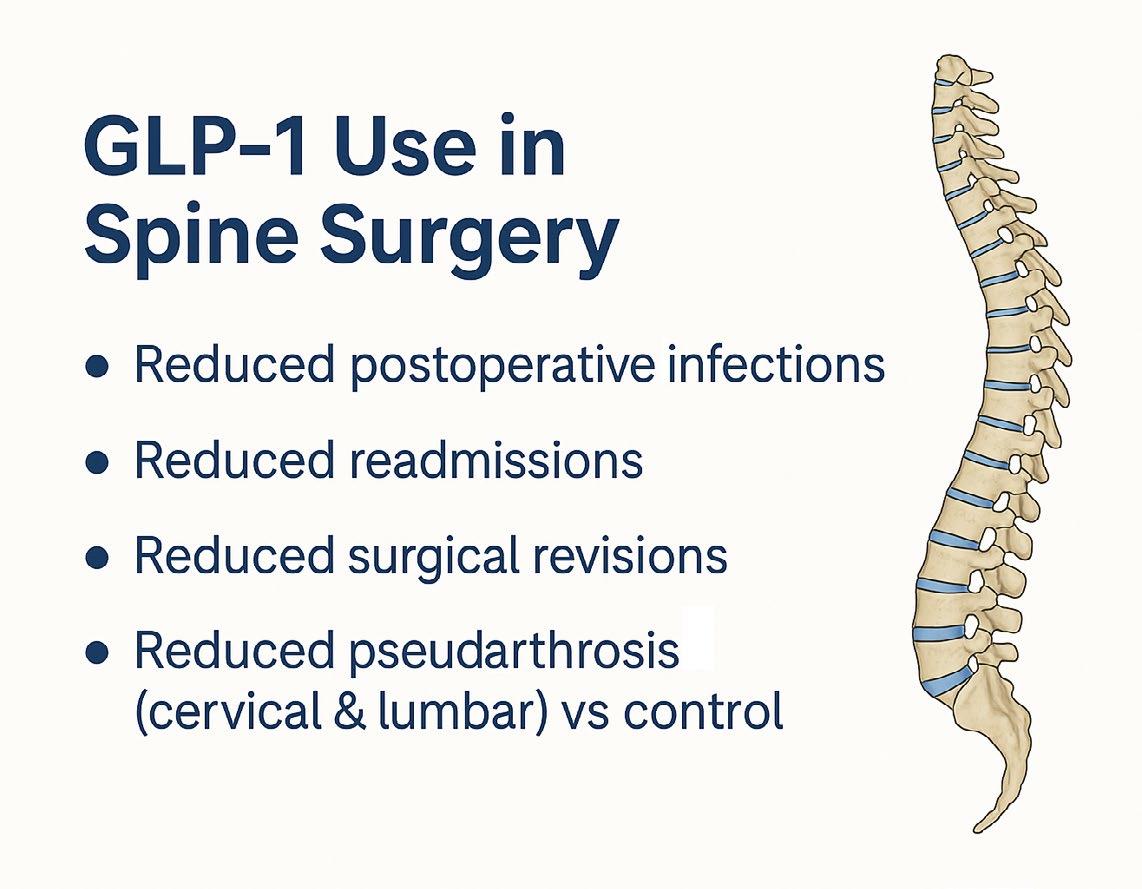
GLP-1 RAs have several reported benefits in spine surgery ( Figure 1). They have been reported to decrease perioperative and preoperative complications in spine surgery, specifically among obese and diabetic patients.16 In a retrospective multicenter study of patients undergoing spine fusion surgery, the use of GLP-1 RAs was shown to be linked to reduced postoperative infection rates, readmission rates, and revisions in both obese and nonobese patient cohorts. In the obese cohort, GLP-1 RAs were linked to markers of improved quality of life such as decreased rates of generalized muscle weakness and mobility abnormalities. In the nonobese cohort, patients using GLP-1 RAs had reduced rates of back pain and mobility abnormalities when compared to nonobese peers who were not taking GLP-1 RAs.16
Cervical Spine Surgery
The current literature mostly suggests that GLP-1 RAs are beneficial in procedures concerning the cervical spine. In a large retrospective analysis in patients undergoing anterior cervical discectomy and fusion (ACDF), the incidence of nonfusion was significantly lower in GLP-1 RA users compared
Figure 1. Benefits of the use of glucagon-like peptide-1 (GLP-1) in spine surgery.
to the control cohort at all postoperative timepoints (39% reduction in odds at the 2-year postoperative timepoint). A subgroup comparison of GLP-1 RA users and insulin users showed consistent results with the whole cohort analysis.17
Similarly, another retrospective analysis on multilevel cervical fusion demonstrated that patients who used GLP-1 RAs had significantly lower rates of pseudarthrosis in both multilevel ACDF and posterior cervical fusion (PCF). The analysis reported no statistically significant difference in the onset of postoperative infection in either the ACDF or PCF group.18
In contrast, the short-term results from a different database study of patients with type 2 diabetes mellitus undergoing cervical spine decompression and fusion suggests that the usage of GLP-1 RAs have no significant difference in the rates of postoperative surgical complications and 30- and 90-day hospital readmission rates when compared to the control cohort.19
Another retrospective study focusing on semaglutide, a class of GLP-1 RAs, showed that postoperative complication rates were generally similar. The rate of cerebrovascular accidents was lower in patients taking semaglutide in comparison to the control (0.88% vs 1.36%). In contrast to other studies including all GLP-1 RAs, the usage of semaglutide was linked to significantly higher rates of pseudarthrosis (13.53% vs 3.31%, p < 0.001) and dysphagia (14.41 vs 7.40%, p < 0.001) 2 years after the operation. 20 Overall, patients undergoing cervical spine surgery received benefit from having been on GLP-1 RAs
“In an obese cohort, GLP-1 RAs were linked to improved quality of life, including decreased rates of generalized muscle weakness and mobility abnormalities.”
compared to propensity-matched controls in regard to postoperative complications such as pseudarthrosis and readmission rates.
Lumbar Spine Surgery
More studies have investigated the effect of GLP-1 RAs in lumbar spine surgery on surgical and medical complications. A separate retrospective on the incidence of pseudarthrosis in single-level lumbar fusion procedures found that patients using GLP-1 RAs had significantly reduced rates of pseudarthrosis at all postoperative time points in comparison to nonusers (12.6% vs 17.5%). 21 This finding was further corroborated by an additional retrospective study in a wider range of lumbar spine surgery procedures, including decompression. It was shown that patients using any form of GLP-1 RAs had significantly reduced rates of pseudarthrosis at the 1-year and 3-year postoperative period (8.88% vs 10.77%). There were no significant differences in medical complications in the 90-day postoperative period, including myocardial infarction, deep vein
thrombosis (DVT), hospital readmission, and wound dehiscence. 22 Additional retrospective studies focused on thoracic and lumbar fusion surgery for degenerative spine disease showed reduced medical day complications (infection, pneumonia, thromboembolism) in patients taking GLP-1 RAs compared to controls. The 10-year risk of revision surgery, pseudarthrosis, and mechanical failure was reduced in groups using GLP-1 RAs. 23 The data show patients’ benefit from using GLP-1 RAs in comparison to patients who do not. There are lower rates of pseudarthrosis at multiple postoperative timepoints and revision surgery.
Research Opportunities
Current information regarding GLP-1 RA use in spine surgery remains limited by methodology. To date, no prospective studies have examined their perioperative use, and most available data are restricted to obese and diabetic cohorts. Expanding the investigation to nonobese, nondiabetic populations will be critical for understanding whether the observed benefits extend more broadly.
Another unanswered question concerns formulation-specific effects. Agents such as semaglutide, liraglutide, and tirzepatide differ in pharmacokinetics, yet comparative studies evaluating their influence on pseudarthrosis rates, complications, and recovery are lacking. Clarifying whether outcomes vary across drug classes would help guide perioperative decision-making.
Surgical approach also warrants closer study. The relationship between GLP-1 RA use and pseudarthrosis following PCF re -
mains unresolved, with inconsistent findings across current reports. 20,19,18 Focused studies stratified by approach and fusion level could better delineate these risks.
Finally, given their substantial weightloss effects, GLP-1 RAs may play a role in modifying spinal epidural lipomatosis. 24 Evaluating their potential as a nonsurgical alternative to decompression represents another promising avenue for research.
Conclusion
While the data surrounding GLP-1 RAs remains relatively nascent, emerging evidence suggests these agents may offer meaningful benefits in the management of spine pathologies among obese and diabetic patients. Their demonstrated potential to reduce postoperative complications, infection rates, and pseudarthrosis positions GLP-1 RAs as a promising adjunct in perioperative optimization.
Importantly, most existing literature focuses on diabetic and obese cohorts, leaving significant gaps regarding the safety, efficacy, and dosing strategies of GLP-1 RAs in nondiabetic, nonobese patients undergoing spine surgery.
GLP-1 RAs may serve as a valuable tool not only for medical weight management but also as a means of reducing surgical risk and enhancing recovery in spine surgery patients. Integrating these therapies into spine care pathways demands continued clinical investigation, but the potential for GLP-1 RAs to reshape perioperative optimization and postsurgical outcomes is both timely and compelling. l
PATIENT OUTCOMES
References
1. American Diabetes Association Professional Practice Committee. 8. Obesity and weight management for the prevention and treatment of type 2 diabetes: standards of care in diabetes—2025. Diabetes Care . 2025;48(1 suppl 1):S167–S180.
2. Szekeres Z, Nagy A, Jahner K, Szabados E. Impact of selected glucagon-like peptide-1 receptor agonists on serum lipids, adipose tissue, and muscle metabolism. Int J Mol Sci. 2024;25(15):8214.
3. Zhu S, Hu Y, Wang Z, et al. The mechanism of liraglutide on promoting osteogenesis via macrophage polarization under inflammatory and oxidative stress in osteoporosis. Life Sci. 2025;377:123717.
4. Jalleh RJ, Marathe CS, Rayner CK, et al. Physiology and pharmacology of effects of GLP-1-based therapies on gastric, biliary and intestinal motility. Endocrinology. 2024;166(1):bqae155.
5. Madsbad S, Holst JJ. Cardiovascular effects of incretins: focus on glucagon-like peptide-1 receptor agonists. Cardiovasc Res . 2023;119(4):886–904.
6. Ussher JR, Drucker DJ. Glucagon-like peptide 1 receptor agonists: cardiovascular benefits and mechanisms of action. Nat Rev Cardiol. 2023;20(7):463–474.
7. Zheng M, Zhao J, Wang Y, et al. Exploring new therapeutic drugs for osteoarthritis and osteoporosis: glucagon-like peptide-1 receptor agonists. Medicine (Baltimore). 2025;104(29):e43239.
8. Li X, Li Y, Lei C. Effects of glucagon-like peptide-1 receptor agonists on bone metabolism in type 2 diabetes mellitus: A systematic review and meta-analysis. Int J Endocrinol. 2024;2024:1785321.
9. Pandya R, Monas A, Chatad D, Bou Monsef J, Razi AE, Ng MK. High body mass index is a predictor of lumbar stenosis: A retrospective MRI study. J Am Acad Orthop Surg. 2025.
10. Shahi P, Subramanian T, Araghi K, et al. Class 2/3 obesity leads to worse outcomes following minimally invasive transforaminal lumbar interbody fusion. Spine J. 2025;25(9):1985–1996.
11. Segar AH, Baroncini A, Urban JPG, Fairbank J, Judge A, McCall I. Obesity increases the odds of intervertebral disc herniation and spinal stenosis; an MRI study of 1634 patients. Eur Spine J. 2024;33(3):915–923.
12. Takeuchi Y, Takahashi S, Ohyama S, et al. Relationship between body mass index and spinal pathology in community-dwelling older adults. Eur Spine J. 2023;32(2):428–435.
13. Urquhart DM, Kurniadi I, Triangto K, et al. Obesity is associated with reduced disc height in the lumbar spine but not at the lumbosacral junction. Spine . 2014;39(16):E962–E966.
14. Bayartai ME, Luomajoki H, Tringali G, De Micheli R, Abbruzzese L, Sartorio A. Differences in spinal posture and mobility between adults with obesity and normal weight individuals. Sci Rep. 2023;13(1):13409.
15. Hasvik E, Haugen AJ, Grøvle L. Symptom descriptors and patterns in lumbar radicular pain caused by disc herniation: a 1-year longitudinal cohort study. BMJ Open. 2022;12(12):e065500.
16. Wiener JM, Sanghvi PA, Vlastaris K, et al. Glucagon-like peptide-1 receptor agonist medications alter outcomes of spine surgery: A study among over 15,000 patients. Spine . 2025;50(13):871–880.
17. Chang Y, Chi KY, Song J, Lin HM. Association between GLP-1 receptor agonists and non-fusion risk after single-level ACDF. Spine J. 2025.
18. Vatsia SK, Levidy MF, Rowe ND, Meister AS, Bible JE. Fusion outcomes of GLP-1 agonist therapy in multilevel cervical spinal fusion: A propensity-matched analysis. Clin Spine Surg. 2025;38(4):213–216.
19. Tao X, Ranganathan S, Van Halm-Lutterodt N, et al. No difference in short-term surgical outcomes from semaglutide treatment after cervical decompression and fusion: a propensity score-matched analysis. Spine . 2025;50(8):515–521.
20. Ng MK, Mastrokostas PG, Mastrokostas LE, et al. Semaglutide use is associated with higher rates of pseudarthrosis and dysphagia in posterior cervical fusion. Spine J. 2025;25(9):1974–1980.
21. Agrawal V, Amasa S, Karabacak M, Margetis K. Perioperative GLP-1 agonist use and rates of pseudarthrosis after single-level lumbar fusion: a retrospective cohort study. Neurosurgery. 2024;97(1):91–97.
22. Tummala S, Gibbs DC, Chavarria J, Alder J, Avramis I, Rizkalla JM. GLP1 receptor agonist use in elective lumbar spine surgery: reduced pseudarthrosis rates and favorable safety profile. J Orthop. 2025;65:227–232.
23. Kishan A, Khela HS, Carayannopoulos NL, Singh M, Cohen L, Chisango Z, et al. Association of glucagon-like peptide-1 receptor agonist use with complications following thoracic and/ or lumbar spinal fusion: a BMI-stratified retrospective study. Spine . Published online September 4, 2025. https://doi. org/10.1097/brs.0000000000005494
24. Barkyoumb D, Muhammad F, Smith ZA, Shakir HJ. Preoperative optimization of obese spine patients with GLP-1 receptor agonists: enhancing surgery and improving outcomes. J Spine Surg. 2025;11(2):339–346.
CLINICAL PRACTICE
From the 1Department of Orthopaedics at the Hospital for Special Surgery in New York City, New York; 2 Department of Orthopedics at the University of Tsukuba Hospital in Tsukuba, Japan; and 3Weill Cornell Medical College in New York City, New York
Economics of Minimally Invasive Spine Surgery
Minimally invasive surgery (MIS) in spine care encompasses techniques that achieve the goals of traditional open surgery while reducing soft tissue disruption and preserving stabilizing structures.1,2 Utilization of MIS techniques has accelerated in recent years, supported by evidence of reduced perioperative morbidity, shorter hospitalizations, and faster recovery. 3,4 While these clinical advantages are important, the broader impact of MIS lies in its potential to reshape the economics of spine care. Spine care is facing increasing pressures around value-based care, cost containment, and resource allocation. 5–7 Thus, beyond clinical effectiveness, it is essential to understand how MIS influences cost drivers, short- and long-term economic outcomes, and the overall value to patients, providers, and society. This review aims to examine the contemporary economic implications of MIS utilization in spine surgery.
Cost Drivers and Savings in MIS
The costs of spine surgery can be highly variable, ranging from $8,286 to $120,394. 8,9
The major drivers of cost include medical devices/implants, facility and operating room expenses, hospitalization, and surgeon compensation. 8–10 In more complex cases, which often involve a greater number of levels, longer operating times and more intensive postoperative care further increase costs. Complications, such as infection or hardware-related sequelae, can compound these costs by requiring further treatments, readmission, or even reoperations.11 Additionally, indirect costs, such as those relating to extended postoperative care needs, rehabilitation, and loss of productivity, should be considered to comprehensively evaluate the economic costs of undergoing spine surgery.
MIS has the potential to alter the cost profile of spine procedures substantially and in several important ways. By reducing the procedural invasiveness, MIS can decrease surgical morbidity and speed up recovery in the immediate postoperative period, which may translate into lower hospital care costs.12,13 Reduced length of stay (LOS) is consistently cited as one of the most significant cost savings associated with MIS, in addition to lowered use of narcotics and inpatient rehabilitation needs.14–16 Furthermore, smaller incisions decrease the risk of surgical site infections, while earlier and improved patient mobilization can reduce medical complications
Adrian T.H. Lui, MBBS1
Nicholas J. Giattino, BA1
Tomoyuki Asada, MD, PhD1,2
Sheeraz A. Qureshi, MD, MBA1,3
such as deep vein thrombosis (DVT). 17,18 Moreover, the utilization of robotic technologies in MIS can enhance the accuracy of instrumentation and thus potentially reduce hardware-related complications.19,20 Reduced medical and hardware complications and fewer readmissions further lower downstream direct expenditures for both hospitals and patients. 17,21 As a result of the above, MIS techniques can also facilitate outpatient procedures, enabling a shift to specialized ambulatory surgical centers, which are generally more efficient and can further enhance overall economic value. 22–24 Indirect costs, such as patient productivity loss and caregiver burden, may also be improved, as MIS has been associated with lower perioperative care dependency and faster return to work. 25,26 However, it is important to recognize that savings and added costs are not universal and vary by procedure type: simple decompression, single-level fusion, multilevel fusion, and deformity corrections have distinct cost structures and likely different MIS value propositions. For example, the latter two procedure types tend to have longer operative times and greater implant or instrumentation requirements, which may erode theoretical cost savings offered by MIS. 27 Although MIS may reduce downstream costs, high upfront investments may offset
early savings. There are high upfront capital investments for surgeon education and training, as well as expensive infrastructure such as microscopes, endoscopic equipment, intraoperative imaging systems, and navigation or robotic platforms. 28 An individual set of endoscopic equipment, for instance, can cost up to $300,000 29 ( Figure 1). In addition to one-time capital expenditures, MIS is associated with higher variable per-case costs, including specialized implants, devices, and other consumables, compared with traditional open techniques. 30,31 Additionally, the steep learning curve for surgeons adopting MIS techniques often necessitates longer operative times early in the adoption process, potentially diminishing initial cost-effectiveness. However, the learning curve for
Figure 1. A case of lumbar disc herniation treated with a minimally invasive approach, with the use of specialized endoscopic equipment.
MIS is typically short, with proficiency achieved after 20–40 cases for nondeformity cases, suggesting that any early increases in operative time or costs are temporary and can be quickly offset. 32–34 Importantly, while upfront costs are substantial, higher procedural volumes help dilute these expenses on a per-case basis, reinforcing the role of surgical volume and the potential for higher economic efficiency by implementing MIS in high-volume settings.
Economic Evaluation Methods in MIS
Because the conclusions of economic studies in MIS are largely determined by their methodological approach, a clear understanding of the analytic frameworks used is essential for accurate interpretation. Several analytic methods are used to evaluate the economics of MIS, considering both clinical outcomes and economic impacts across the healthcare system. One such method is cost-effectiveness analysis (CEA), which compares the relative costs and outcomes between interventions. Costs are measured in monetary units, while effectiveness is measured in nonmonetary outcomes, such as LOS, complication rates, and readmissions. 35 A cost-effectiveness ratio is then established to compare different interventions. Cost-utility analysis (CUA) is a subtype of CEA that focuses on a composite measure of both quantity and quality of life outcome, in quality-adjusted life years (QALYs), instead of a specific health outcome. 36 QALYs are calculated by multiplying the number of life-years gained by a chosen utility value, reflecting prefer-
ences for specific health outcomes. 37 CEA and CUA present results based on impact on patients and enables clear comparisons between diverse interventions that aim for similar outcomes. They highlight the opportunity costs implicit in resource allocation, helping providers and patients choose between treatments, and guiding policymakers on whether investing in MIS delivers greater health gains per dollar. 38,39
However, significant limitations exist for both CEA and CUA. Their outcomes depend heavily on methodologies used, involve confounding cross-study comparisons, and often conflict with societal values and other perspectives when used as the primary foundation for decision-making. 40,41 For all methodologies, the choice of economic evaluation method reflects decisions about what constitutes “success” and how it should be valued. They typically evaluate average costs and outcomes across general populations, yet MIS may be highly cost-effective for certain patient subgroups, such as younger patients or high-risk patients, and not for others, causing interpretation to be inherently subjective even when underlying data are objective. 41 The quality and comparability of CUAs remain problematic, with many studies in spine care exhibiting substantial heterogeneity in interventions compared, cost components measured, and methodological approaches, with mixed reporting quality that fails to provide sufficient concluding evidence.42,43 Although conceptually simple, CEA/CUA can be difficult to apply and does not capture all value judgments, so results
should be interpreted alongside budgetary, feasibility, and stakeholder considerations in transparent, context-specific decision-making.
In contrast to CEA and CUA, CBA differs by expressing both costs and benefits in monetary terms. Net benefit is measured in monetary terms as the total benefits minus total costs. This can be expressed as a cost-benefit ratio: the dollar value of benefit received for every dollar spent.44 The main advantage of CBA over CEA/CUA is in its interpretability by framing the entire conversation in strictly monetary terms. This is particularly valuable in the context of MIS, where the benefits are real but often subtle, and trade-offs are significant. By converting benefits to monetary terms, CBA makes opportunity costs explicit and helps identify which groups stand to gain or lose from an intervention, supporting transparent and socially accountable resource allocation. However, among the methods mentioned, CBA faces the most significant methodological and ethical limitations, as human life and health are assigned arbitrary monetary values and calculations may be structured to favor industry interests over public health. 45 From an ethical perspective, Kelman et al contend that many health and safety decisions may be morally correct even when benefits don’t outweigh costs, and they oppose monetizing nonmarketed benefits and costs. 46 As is with the other methods, CBA is best used in tandem with other types of analysis, not as a standalone tool in clinical decision-making.
Stakeholder Perspectives in Economic Evaluation
The chosen stakeholder perspectives determine which costs and outcomes are included, as well as which factors are prioritized in the analysis. Patient-focused analyses tend to emphasize health-related quality of life, complications costs, and out-of-pocket expenses. Narain et al found that long-term outcomes, the surgeon’s recommendation, and complication risk are most important for patients choosing between open and MIS; thus, patient-centered studies should prioritize long-term quality-of-life measures and preference-based outcomes, for which CEA and CUA are most applicable.47 Another perspective to consider would be the health care provider. The provider’s perspective includes all costs incurred by a provider in delivering care to patients, including procedure, device/implant, staffing, facility and capital costs. While it may sometimes overlap with the patient perspective, it is typically broader and better suited for evaluating the financial implications of hospital policies.48 This perspective is often applied in CBA and commonly adopted by hospital administrators and policymakers to guide resource allocation. The societal perspective is the most comprehensive, accounting for all potential costs and benefits to society such as productivity, caregiver burden, and non-medical costs, regardless of who incurs the costs or receives the benefits. However, its breadth requires longer time horizons, includes additional assumptions, and often sacrifices precision for comprehensiveness.
CLINICAL PRACTICE
“MIS offers meaningful opportunities to improve value in spine care by reducing morbidity, length of stay, complications, and indirect costs.”
Short-Term Economic Impacts
As MIS’ primary advantage is to reduce surgical morbidity in the immediate postoperative period and accelerate recovery, its economic impact is also expected to be greatest in the short term. Currently, studies suggest that acute care costs for MIS spine surgery are lower than those of traditional open surgeries. 49,50 Safaee
et al found that open decompression was associated with higher total cost than MIS ($21,280 vs $14,407), which was driven by care pathway and length of stay. 51 For lumbar fusions, studies showed that while single-level lumbar fusions yield no significant cost difference between MIS and open approaches, MIS demonstrates substantial savings in two-level fusions (up to $2825 per operation in savings), attributed to lower LOS and facility costs, suggesting MIS’s benefits may be more pronounced in procedures with greater surgical morbidity.13,52 When comparing MIS and open procedures for adult degenerative scoliosis (ADS), Uddin et al demonstrated that the inpatient charge for MIS, including complications and revision surgeries, was on average $122,081 less expensive for MIS
References
1. Thongtrangan I, Le H, Park J, Kim DH. Minimally invasive spinal surgery: a historical perspective. Neurosurg Focus. 2004;16(1):1–10.
2. Smith ZA, Fessler RG. Paradigm changes in spine surgery—evolution of minimally invasive techniques. Nat Rev Neurol. 2012;8(8):443–450.
3. Pokorny G, Amaral R, Marcelino F, et al. Minimally invasive versus open surgery for degenerative lumbar pathologies: a systematic review and meta-analysis. Eur Spine J. 2022;31(10):2502–2526.
4. Fried TB, Schroeder GD, Anderson DG, Donnally CJ. Minimally invasive surgery (MIS) versus traditional open approach: transforaminal interbody lumbar fusion. Clin Spine Surg. 2022;35(2):59–62.
5. McGirt MJ, Resnick D, Edwards N, Angevine P, Mroz T, Fehlings M. Background to understanding value-based surgical spine care. Spine. 2014;39:S51–S52.
6. Haglin JM, Richter KR, Patel NP. Trends in Medicare reimbursement for neurosurgical procedures: 2000 to 2018. J Neurosurg. 2020;132(2):649–655.
7. Haglin JM, Zabat MA, Richter KR, et al. Over 20 years of declining Medicare reimbursement for spine surgeons: a temporal and geographic analysis from 2000 to 2021. J Neurosurg Spine. 2022;37(3):452–459.
8. Beckerman D, Esparza M, Lee SI, et al. Cost analysis of single-level lumbar fusions. Global Spine J. 2020;10(1):39–46.
9. McCarthy IM, Hostin RA, Ames CP, et al. Total hospital costs of surgical treatment for adult spinal deformity: an extended follow-up study. Spine J. 2014;14(10):2326–2333.
10. Sivaganesan A, Chotai S, Parker SL, McGirt MJ, Devin CJ. Drivers of variability in 90-day cost for elective laminectomy and fusion for lumbar degenerative disease. Neurosurgery. 2019;84(5):1043–1049.
11. Salas-Vega S, Chakravarthy VB, Winkelman RD, et al. Late-week surgery and discharge to specialty care associated with higher costs and longer lengths of stay after elective lumbar laminectomy. J Neurosurg Spine. 2021;34(6):864–870.
12. Goldstein CL, Macwan K, Sundararajan K, Rampersaud YR. Perioperative outcomes and adverse events of minimally invasive versus open posterior lumbar fusion: meta-analysis and systematic review. J Neurosurg Spine. 2016;24(3):416–427.
13. Lucio JC, Vanconia RB, DeLuzio KJ, Lehmen JA, Rodgers JA, Rodgers W. Economics of less invasive spinal surgery: an analysis of hospital cost differences between open and minimally invasive instrumented spinal fusion procedures during the perioperative period. Risk Manag Healthc Policy. 2012;65.
14. Skovrlj B. Perioperative outcomes in minimally invasive lumbar spine surgery: a systematic review. World J Orthop. 2015;6(11):996.
than for the open cohort. 53 The quoted savings (~$120,000) are strikingly higher than savings reported in other studies (~$3000-$7000), likely reflecting in part the prolonged length of stay associated with deformity surgeries. While this may point to a genuine economic advantage of MIS in such cases, the analysis emphasized the provider perspective, extensively including pre-insurance hospital costs rather than reimbursement/patient charges, which may have inflated the reported savings, and the methodological limitations noted above decrease the strength of this conclusion. MIS appears to generate substantial immediate postoperative savings, and with increasing surgical volume, these savings are expected to offset the initial investment and eventually yield net cost
benefits. However, short-term impacts cannot be directly extrapolated, and the long-term economic effects of MIS warrant separate consideration, particularly given its potential to preserve spinal stability and reduce complications and reoperations in the long run.
Long-Term Economic Impacts
Current evidence regarding long-term economic impacts of various procedures utilizing MIS presents mixed findings when compared with traditional open surgery. Many studies find long-term clinical outcome differences are often small or inconsistent. 17,54 Studies differ in perspective (hospital charges vs costs vs societal), time horizon, inclusion of capital or implant costs, and whether they perform formal
15. Wang MY, Cummock MD, Yu Y, Trivedi RA. An analysis of the differences in the acute hospitalization charges following minimally invasive versus open posterior lumbar interbody fusion. SPI. 2010;12(6):694–699.
16. Hockley A, Ge D, Vasquez-Montes D, et al. Minimally invasive versus open transforaminal lumbar interbody fusion surgery: an analysis of opioids, nonopioid analgesics, and perioperative characteristics. Global Spine J. 2019;9(6):624–629.
17. Altshuler M, Mueller K, MacConnell A, Wirth P, Sandhu F, Voyadzis JM. Does minimally invasive spine surgery reduce the rate of perioperative medical complications? A retrospective single-center experience of 1435 degenerative lumbar spine surgeries. Eur Spine J. 2021;30(1):122–127.
18. O’Toole JE, Eichholz KM, Fessler RG. Surgical site infection rates after minimally invasive spinal surgery: clinical article. SPI. 2009;11(4):471–476.
19. Matur AV, Palmisciano P, Duah HO, Chi -
lakapati SS, Cheng JS, Adogwa O. Robotic and navigated pedicle screws are safer and more accurate than fluoroscopic freehand screws: a systematic review and meta-analysis. Spine J. 2023;23(2):197–208.
20. Stull JD, Mangan JJ, Vaccaro AR, Schroeder GD. Robotic guidance in minimally invasive spine surgery: a review of recent literature and commentary on a developing technology. Curr Rev Musculoskelet Med. 2019;12(2):245–251.
21. Nayar G, Wang T, Sankey EW, et al. Minimally invasive lateral access surgery and reoperation rates: a multi-institution retrospective review of 2060 patients. World Neurosurg. 2018;116:e744–e749.
22. Eckman WW, Hester L, McMillen M. Same-day discharge after minimally invasive transforaminal lumbar interbody fusion: a series of 808 cases. Clin Orthop Related Res. 2014;472(6):1806–1812.
fusion using multimodal analgesic management in the ambulatory surgery setting. Int J Spine Surg. 2020;14(6):970–981.
24. Patel DV, Yoo JS, Singh K. Ethics of minimally invasive spine surgery in an ambulatory surgery center setting. J Spine Surg. 2019;5(S2):S204–S205.
25. Wang X, Borgman B, Vertuani S, Nilsson J. A systematic literature review of time to return to work and narcotic use after lumbar spinal fusion using minimal invasive and open surgery techniques. BMC Health Serv Res. 2017;17(1):446.
26. Shinn D, Mok JK, Vaishnav AS, et al. Recovery kinetics after commonly performed minimally invasive spine surgery procedures. Spine. 2022;47(21):1489–1496.
27. Alvarado AM, Schatmeyer BA, Arnold PM. Cost-effectiveness of adult spinal deformity surgery. Global Spine J. 2021;11(1_suppl):73S-78S.
CEA/CUA or simple cost comparisons, and therefore caution should be exercised when interpreting these results.
A systematic review that included 3 studies assessed outcomes of MIS vs open discectomy, where each reported statistically significant lower total costs in MIS compared with the open group, with similar reported gains in QALYs. 30 In a 2-year CEA, Parker et al found that MIS multilevel hemilaminectomy incurred costs comparable to the open approach for lumbar stenosis, with both groups achieving the same cumulative gain of 0.72 QALYs at 2 years postoperatively. 55
For fusion surgeries, Vertuani et al. evaluated the cost-effectiveness of MIS and open one- to two-level lumbar fusions in the United Kingdom and Italy, reporting a more
28. Menger RP, Savardekar AR, Farokhi F, Sin A. A cost-effectiveness analysis of the integration of robotic spine technology in spine surgery. Neurospine. 2018;15(3):216–224.
29. Findlay MC, Hamrick FA, Kim RB, Twitchell S, Mahan MA. Hospital cost differences between open and endoscopic lumbar spine decompression surgery. J Neurosurg Spine. 2024;40(1):77–83.
30. Eseonu K, Oduoza U, Monem M, Tahir M. Systematic review of cost-effectiveness analyses comparing open and minimally invasive lumbar spinal surgery. Int J Spine Surg. 2022;16(4):612–624.
31. Chung AS, Ballatori A, Ortega B, et al. Is less really more? Economic evaluation of minimally invasive surgery. Global Spine J. 2021;11(1_suppl):30S-36S.
32. Shahi P, Subramanian T, Maayan O, et al. Surgeon experience influences robotics learning curve for minimally invasive lumbar fusion: a cumulative sum analysis. Spine. 2023;48(21):1517–1525.
modest total cost saving per procedure in favor of MIS ($1080 for Italy and $1849 for the United Kingdom, 2015 USD), with only an improvement of 0.04 QALYs over 2 years. 56 Another study found that mean total costs (accounting for complications, revisions, and operating fees) were similar for open and MIS lumbar fusions ($42,500 vs $41,500), with its subanalysis suggesting lower cost-per-QALY for MIS ($115,912 vs $296,624 at 1 year; $5,825 vs $14,906 extrapolated to lifetime), though results should be interpreted cautiously given sample size and assumptions. 49 For more specific fusion approaches, a pooled summary by Chung et al of five CEAs suggested MIS TLIF produced greater savings over open TLIF, ranging from $3,569 to $9,295, with direct hospital cost savings between $1,758 and
33. Sharif S, Afsar A. Learning curve and minimally invasive spine surgery. World Neurosurg. 2018;119:472–478.
34. Epstein N. Learning curves for minimally invasive spine surgeries: are they worth it? Surg Neurol Int. 2017;8(1):61.
35. Michelly Gonçalves Brandão S, Brunner-La Rocca HP, Pedroso de Lima AC, Alcides Bocchi E. A review of cost-effectiveness analysis: from theory to clinical practice. Medicine (Baltimore). 2023;102(42):e35614.
36. de la Torre-Díez I, López-Coronado M, Vaca C, Aguado JS, de Castro C. Cost-utility and cost-effectiveness studies of telemedicine, electronic, and mobile health systems in the literature: a systematic review. Telemed J E Health. 2015;21(2):81–85.
37. Higgins AM, Harris AH. Health economic methods: cost-minimization, cost-effectiveness, cost-utility, and cost-benefit evaluations. Crit Care Clin. 2012;28(1):11–24, v.
38. Moayyedi P, Mason J. Cost-utility and cost-benefit analyses: how did we get here and where are we going? Eur J Gastroenterol Hepatol. 2004;16(6):527–534.
39. Warner KE. Issues in cost effectiveness in health care. J Public Health Dent. 1989;49(5):272–278.
40. Bertram MY, Lauer JA, De Joncheere K, Edejer T, Hutubessy R, Kieny MP, et al. Cost-effectiveness thresholds: pros and cons. Bull World Health Organ. 2016;94(12):925–930.
41. Hoch JS, Dewa CS. An introduction to economic evaluation: what’s in a name? Can J Psychiatry. 2005;50(3):159–66.
42. Neumann PJ, Greenberg D, Olchanski NV, Stone PW, Rosen AB. Growth and quality of the cost-utility literature, 19762001. Value Health. 2005;8(1):3–9.
43. Dagenais S, Roffey DM, Wai EK, Haldeman S, Caro J. Can cost utility evaluations inform decision making about interventions for low back pain? Spine J. 2009;9(11):944–957.
$2,820, though not all differences reached statistical significance. 31 Transpsoas approaches (LLIF) have been associated with better outcomes in terms of postoperative health-related quality of life and lower costs over 1-year follow-up compared with the more invasive open technique, though the study is of limited size. 57 For longer segment fusions, Passias et al found that while patients receiving T11-Pelvis fusions had similar baseline EQ-5D (health-related quality of life) scores, MIS patients had a significantly better improvement at 1-year postoperative follow-up. 49 Overall, despite consistent evidence of immediate postoperative cost savings and value, longer-term economic evidence remains uncertain because of methodological heterogeneity across studies.
Conclusion and Future Directions
Minimally invasive spine surgery offers meaningful opportunities to improve value in spine care by reducing morbidity, length of stay, complications, and indirect costs, though these gains must be weighed against substantial upfront investment, higher per-case expenditures, and procedure-specific variability in benefits. While short-term evidence consistently supports cost savings and faster recovery, long-term data remain limited and heterogeneous. Future standardized economic evaluations should adopt rigorous methodologies that integrate multiple stakeholder perspectives, as well as capture long-term differences in economic value between MIS and open surgery across procedure types with distinct cost-benefit profiles. l
44. Robinson R. Cost-benefit analysis. BMJ. 1993;307(6909):924–926.
45. Baram MS. The use of cost-benefit analysis in regulatory decision-making is proving harmful to public health. Ann N Y Acad Sci. 1981;363:123–128.
46. Kelman S. Cost-benefit analysis: an ethical critique. Regulation. 1981;5(1):33–40.
47. Narain AS, Hijji FY, Duhancioglu G, et al. Patient perceptions of minimally invasive versus open spine surgery. Clin Spine Surg. 2018 Apr;31(3):E184–92.
48. Sittimart M, Rattanavipapong W, Mirelman AJ, et al. An overview of the perspectives used in health economic evaluations. Cost Eff Resour Alloc. 2024;22(1):41.
49. Passias PG, Brown AE, Alas H, Bortz CA, Pierce KE, Hassanzadeh H, et al. A cost benefit analysis of increasing surgical technology in lumbar spine fusion. Spine J. 2021;21(2):193–201.
50. Allen RT, Garfin SR. The economics of minimally invasive spine surgery: the value perspective. Spine (Phila Pa 1976). 2010;35(26 Suppl):S375-S382.
51. Safaee MM, Chang D, Hillman JM, Shah SS, Garcia J, Wadhwa H, et al. Implementation of outpatient minimally invasive lumbar decompression at an academic medical center without ambulatory surgery centers: a cost analysis and systematic review. World Neurosurg. 2021;146:e961–e971.
52. Wang MY, Lerner J, Lesko J, McGirt MJ. Acute hospital costs after minimally invasive versus open lumbar interbody fusion: data from a US national database with 6106 patients. J Spinal Disord Techn. 2012;25(6):324–328.
53. Uddin OM, Haque R, Sugrue PA, et al. Cost minimization in treatment of adult degenerative scoliosis. J Neurosurg Spine. 2015;23(6):798–806.
54. Heemskerk JL, Oluwadara Akinduro O, Clifton W, Quiñones-Hinojosa A, Abode-Iya -
mah KO. Long-term clinical outcome of minimally invasive versus open single-level transforaminal lumbar interbody fusion for degenerative lumbar diseases: a meta-analysis. Spine J. 2021;21(12):2049–2065.
55. Parker SL, Adogwa O, Davis BJ, et al. Cost-utility analysis of minimally invasive versus open multilevel hemilaminectomy for lumbar stenosis. J Spinal Disord Tech. 2013;26(1):42–47.
56. Vertuani S, Nilsson J, Borgman B, et al. A cost-effectiveness analysis of minimally invasive versus open surgery techniques for lumbar spinal fusion in Italy and the United Kingdom. Value in Health. 2015;18(6):810–816.
57. Swamy G, Lopatina E, Thomas KC, Marshall DA, Johal HS. The cost effectiveness of minimally invasive spine surgery in the treatment of adult degenerative scoliosis: a comparison of transpsoas and open techniques. Spine J. 2019;19(2):339–348.