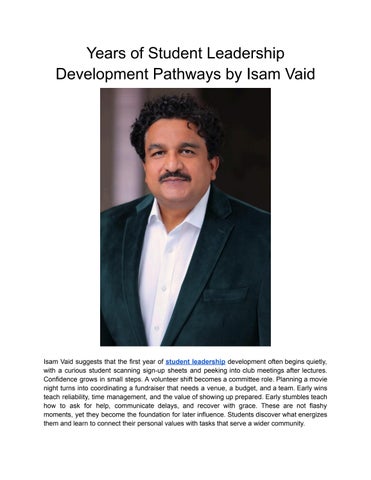
Years of Student Leadership Development Pathways by Isam Vaid

Isam Vaid suggests that the first year of student leadership development often begins quietly, with a curious student scanning sign-up sheets and peeking into club meetings after lectures. Confidence grows in small steps A volunteer shift becomes a committee role Planning a movie night turns into coordinating a fundraiser that needs a venue, a budget, and a team. Early wins teach reliability, time management, and the value of showing up prepared Early stumbles teach how to ask for help, communicate delays, and recover with grace These are not flashy moments, yet they become the foundation for later influence. Students discover what energizes them and learn to connect their personal values with tasks that serve a wider community
By the second year, involvement deepens into responsibility Students chair subcommittees, run orientation booths, or lead service days that pair campus enthusiasm with local needs. Planning shifts from a checklist to a calendar that balances classes, jobs, and meetings Budgets become real numbers, not guesses. Project debriefs introduce the habit of reflection. What worked, what strained the team, and what needs a new approach. Mentors begin to matter more. An advisor’s quick question can prompt strategic thinking, like why a program exists and how it supports the mission. This is where student leadership development becomes deliberate, guided by feedback and measured by outcomes that reach beyond a single event
The third year often invites students to build systems rather than execute plans. They design onboarding for new volunteers so knowledge does not vanish every spring They draft role descriptions for successors and create shared folders that capture timelines, vendor contacts, and marketing templates. Campus partnerships expand their view of influence. A collaboration with residence life, athletics, or multicultural affairs shows how different groups define impact Communication skills sharpen as leaders tailor messages for first-year students, skeptical peers, and busy deans They learn audience, tone, and timing They also learn to handle conflict with empathy, turning disagreements into workshops, restorative conversations, or explicit norms that keep teams inclusive and focused.
Senior leaders often face sustainability challenges They can run a significant event, but a lasting impact requires training others to run it better next year. This shift from star performer to coach is the pivotal growth point in student leadership development Seniors build pipelines, not pedestals. They hold open office hours for officers, pair new leaders with mentors, and create low-stakes practice spaces where people can try presenting, budgeting, or moderating a meeting Decision-making becomes both strategic and humane Leaders weigh equity, accessibility, and cost. They navigate approvals, risk assessments, and marketing plans. They celebrate milestones to keep morale high and set aside time for rest so teams can endure busy seasons without burning out
Throughout these years, learning has been reinforced by evidence Portfolios collect flyers, agendas, and attendance-tracking data Reflection journals capture lessons that numbers miss, like how it felt to mediate a tense conversation or to give credit publicly. These artifacts become valuable during internships and interviews Employers care about impact, and students who can explain a challenge, their actions, and the measurable result tend to stand out Keywords such as student leadership development, campus leadership, and leadership training come to life through stories A grant was secured for a food pantry A peer education series that doubled attendance. A voting registration drive that reached commuter students through targeted outreach

After graduation, the habits built across years of student leadership development continue to pay off. Alumni report that they are comfortable facilitating meetings, drafting timelines, and giving constructive feedback They know how to build coalitions across departments because they practiced across student organizations They recognize burnout signs and promote healthy work rhythms because they learned to pace themselves during midterms and event weeks. The best measure of success is not a title but a pattern Inclusive decisions Clear communication Courage during uncertainty. Students who grow this way carry campus lessons into neighborhoods, nonprofits, and companies, proving that careful, human-centered leadership scales from a table of volunteers to a team that shapes the future