
International Research Journal of Engineering and Technology (IRJET) e-ISSN: 2395-0056
Volume: 12 Issue: 11 | Nov 2025 www.irjet.net p-ISSN: 2395-0072
International Research Journal of Engineering and Technology (IRJET) e-ISSN: 2395-0056
Volume: 12 Issue: 11 | Nov 2025 www.irjet.net p-ISSN: 2395-0072
Ajit.V.Pawar , Yashraj.S.Tayde , Vaibhav.R.Thaware
1Student , Dept , of E&TC Engineering, KK Wagh collage of engineering Nashik, India
2Student , Dept , of E&TC Engineering, KK Wagh collage of engineering Nashik, India
3Student , Dept , of E&TC Engineering, KK Wagh collage of engineering Nashik, india Under the guidance of Prof. S.S. Dongare Sir ***
Abstract - With the increasing number of wildlife tourism activities, there is a growing need for technologies that enhance tourist safety while also supporting animal conservation. This project introduces a wildlife tracker using GPS & BLE technology that uses (BLE) and GPS to monitor wild animals and alert tourists in real time. The system involves compact tags attached to animals, integrating a GPS module for location tracking and a BLE chip for short-range communication. When a tagged animal approaches within a predefined range, nearby smartphones (with the app) detect the BLE signal and generate alert notifications, including warningsounds and animal information. The GPS data is also logged for use by forest departments to study animal movement patterns. This solution operates with BLE & GPS technologies , making it suitable for remote forest areas. It increases tourist awareness, reduces human animal conflicts, andanimal monitoring.The proposedsystemcombines safety, technology, and conservation into a practical solution .
Key Words: Alerts, Location Tracking, GPS, BLE, Animals
Wildlifeplaysavitalroleinmaintainingthebalanceofour ecosystem. However, with increasing human interference andhabitat loss,many wild animalsareat risk,leading to frequent human animal conflicts and difficulties in monitoringtheirmovements.Traditionaltrackingmethods areoftenlimitedbyrange,highcost,andpoorconnectivity inremoteforestregions.Toaddressthesechallenges,this projectproposesa Wildlife Tracker & Alert System using GPS and Bluetooth Low Energy (BLE) technologies. The GPS module continuously provides the animal’s location coordinates, while the BLE module enables short-range communication with nearby smartphones or monitoring devices,eveninareaswithoutinternetaccess.Thesystem also integrates health monitoring sensors such as temperature and heart rate sensors to track the animal’s condition.Ifanyabnormalreadingsorriskyproximityare detected, the system sends alerts to forest officials and nearby tourists for quick action. This solution enhances wildlife safety, supports behavioral study through stored data on an SD card, and helps reduce human–animal conflicts. By combining GPS precision with BLE efficiency, theprojectoffersa cost-effective, low-power, and scalable approachtomodernwildlifemonitoring.
It focuses on developing a low-cost and efficient tracking systemforfarmanimalsusinganArduinomicrocontroller integrated with a GPS and GSM module. The GPS module continuously records the animal’s position, while GSM transmits this data to the farmer’s mobile phone through SMS. The proposed system helps farmers locate missing animals, monitor grazing boundaries, and detect unusual movements. The system also ensures better animal safety and management. The hardware is lightweight, easy to mount, andpowered bya rechargeable battery. Overall,it demonstrateshowIoTtechnologycanreducelivestockloss andimprovefarmautomation.[1]
Itpresentsareal-timetrackingsystemthatusesBluetooth LowEnergy(BLE) beacons tomonitor assetlocation.BLE tagsperiodicallysendlocationdatatoamobileapplication or gateway device within a defined range. Compared to traditionalBluetoothorWi-Fisystems,BLEconsumesvery little power and supports longer battery life. The paper explains data transfer mechanisms, signal strength-based localization, and the use of smartphones as receivers. The proposedtechniqueensuresreal-timedatavisualizationona dashboardandsupportsmultiplenodessimultaneously.It’s adaptablenotonlyforindustrialassetmanagementbutalso fortrackinganimalsorequipmentinforestzones.[2]
Introduces a BLE-based wireless sensor node designed to monitor animal health and location efficiently. The node includes sensors for temperature, motion, and heart rate, enabling health diagnostics in addition to tracking. It communicatesdata toa basestationorsmartphoneusing Bluetooth Low Energy technology, which significantly reducesenergyconsumption.Thedeviceisbuiltforremote field operation and optimized for compactness and long battery life. The authors discuss the firmware structure, energyoptimization,anddatatransmissionprotocols.The solution demonstrates how BLE can replace costly longrangesystemsforshort-rangeanimalmanagementtasks.[3]
Thepepperfocusesondetectingandtrackingwildanimals nearforestboundariesusingsensorsandimageprocessing techniques. It integrates GPS for location tracking and wireless communication to send alerts when an animal crossesageofencedarea.Thesystemusesinfrared(IR)and motionsensorstodetectmovementevenatnight.Alertsare
International
Volume: 12 Issue: 11 | Nov 2025 www.irjet.net p-ISSN: 2395-0072
automaticallysenttoforestrangersornearbyresidentsto preventhuman–animalconflict.Theauthorsalsoproposea mobile alert interface for real-time updates. This system helpsinimprovingwildlifemonitoring,preventingpoaching, andensuringbothhumanandanimalsafety[4]
It proposes a multi-object tracking framework for simultaneouslymonitoringseveralanimalsinagivenarea. Usingcomputervisionandmachinelearningalgorithms,the system identifies individual animals from video feeds and trackstheirpaths.Thetechniqueappliesfeatureextraction and motion prediction to maintain unique IDs for each animal. It helps researchers analyze animal behavior, migration patterns, and herd movement. The paper also highlights the use of IoT-enabled cameras and wireless networksforreal-timetransmission.Theproposedmethod can be used for wildlife studies, ecological research, and smartforestmanagementsystems.[5]
ThepaperpresentsaGPSandGSM-basedsystemthathelps forestdepartmentsmonitorwildanimals’movementinreal time.EachanimalisequippedwithaGPScollarthatsendsits coordinatestoacontrolunitthroughGSMcommunication. When animals enter danger zones or approach human settlements, automatic alerts are generated. The system helpspreventanimalpoachingandreducehuman–wildlife conflict.Itincludesa webinterfacefor displayinglocation maps and movement history. The authors emphasize the reliabilityandcoveragerangeofGSMnetworksforeffective data transfer. The model is scalable and suitable for large forestreserves.[6]
This paper combines GNSS (Global Navigation Satellite System)andLoRa(LongRange)communicationtodevelopa low-power, long-range wildlife tracking solution. LoRa enables data transmission over several kilometers with minimalenergyconsumption,makingitidealforforest or mountainenvironments.Thepaperdiscussesoptimization algorithmstoreduceGNSSpowerdrawandextendbattery life. The tracking unit sends periodic updates to a base station for analysis. The system design balances accuracy, powerefficiency,andcommunicationcost.Itdemonstrates how hybrid GNSS–LoRa networks can overcome the limitations of GPS-only or GSM-based systems in wildlife research.[7]
Thisreviewpaperexplorestheevolutionandapplicationsof miniatureradiotagsusedforanimaltracking.Itcompares technologieslikeGPS,LoRa,BLE,ZigBee,andRFIDbasedon energy use, range, weight, and data capacity. The authors analyze their suitability for tracking different species from large mammals to small birds or reptiles. It also discusses design trade-offs between tag size, antenna performance,andbatterylife.Thepaperhighlightsthetrend toward integrating multi-sensor capabilities (like temperature,acceleration,andheartrate)inmoderntags.It concludeswithrecommendationsforfutureenergy-efficient andminiaturizedwildlifetrackingdevices.[8]
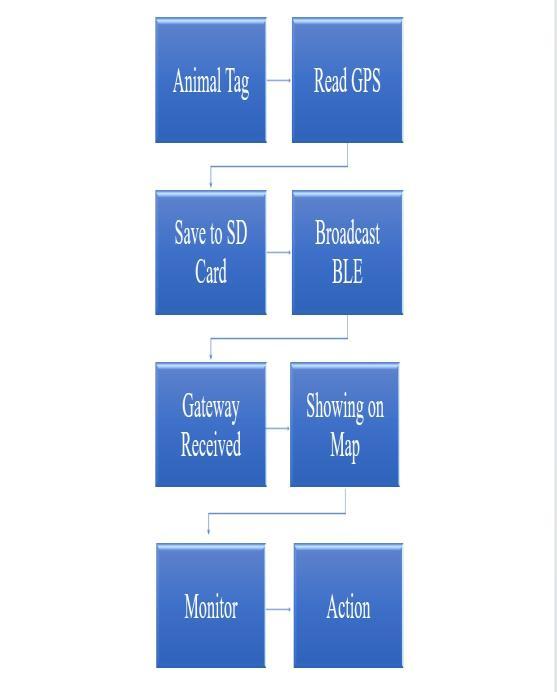
Thewildlifetrackingandsafetysystembeginswithtagging each animal using a compact device equipped with GPS, ESP32microcontroller,BLE,andanSDcard.Onceactivated, the tag acquires precise GPS coordinates and timestamps, which are saved locally for data integrity. The device periodicallybroadcaststhistrackingdataviaBluetoothLow Energy(BLE).Rangers’mobilephonesorstrategicallyplaced gateways receive these BLE transmissions, ensuring data capture even in areas with limited connectivity. The collected data is then visualized on a mobile application utilizingGoogleMaps,allowingreal-timetrackingofanimal movements.Rangerscanmonitortheselocations,setcustom alerts for boundary crossings or unusual activity, and respondproactivelyto enhancewildlifesafetyandreduce human-animal conflict. This integrated approach enables efficientfieldmonitoring,data-drivenpatrolplanning,and improved conservation outcomes through the seamless applicationofIoTtechnology.
Data collection summery: Most of the studies used GPS modulesforanimallocationtrackingbecauseoftheirhigh accuracy, but they often faced signal loss in dense forest areas. To overcome this, some papers integrated IoT and GSM-basedsystems,allowingdatatobetransferredtocloud platforms for monitoring through mobile apps or dashboards.
Afewrecentstudies(especiallyafter2022)focusedonBLE (BluetoothLowEnergy)andLoRacommunicationtoreduce power consumption and improve range in remote zones. Thesesystemswerefoundmoresuitableforlong-termuse sincetheyrequiredlessbatterypowercomparedtoWi-Fior GSM-based trackers.Many papers also emphasized solar energy and low-power circuit design to make the devices sustainableinwildlifeconditions.However,onlya limited
International Research Journal of Engineering and Technology (IRJET) e-ISSN: 2395-0056
Volume: 12 Issue: 11 | Nov 2025 www.irjet.net p-ISSN: 2395-0072
numberofworksincludedreal-timealertsystemsfornearby humansorAI-basedanimalbehaviorprediction,whichare still emerging areas of research.In summary, the overall analysis shows a clear shift from traditional GPS-only systemstowardhybridIoT-basedandBLE-poweredmodels. The combination of GPS + BLE + IoT cloud dashboard appearstobethemostpromisingsetupforaccurate,energyefficient,andcontinuouswildlifetrackingdirectlyaligning withtheobjectivesofourproposedproject.
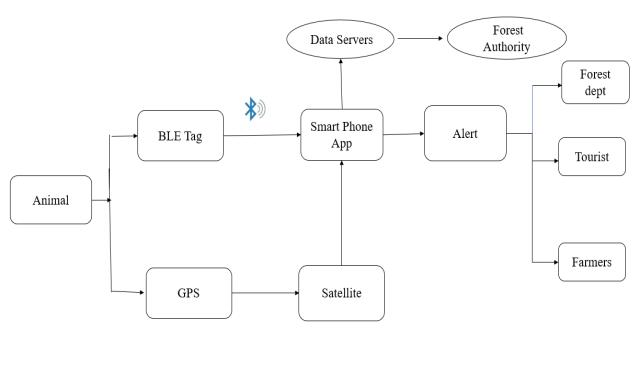
Fig. 2 BlockDiagram 2. Results
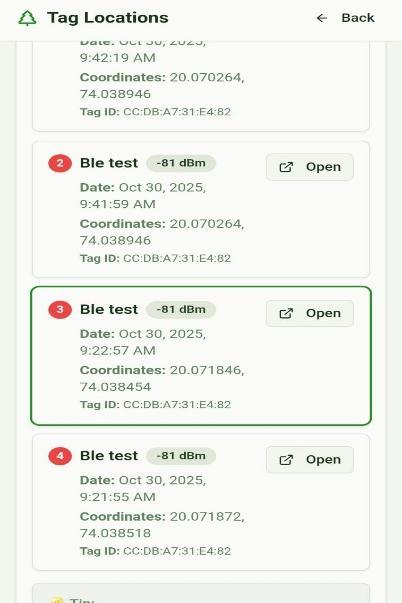
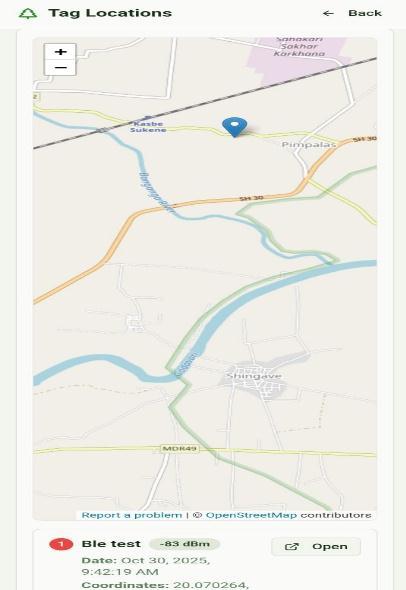
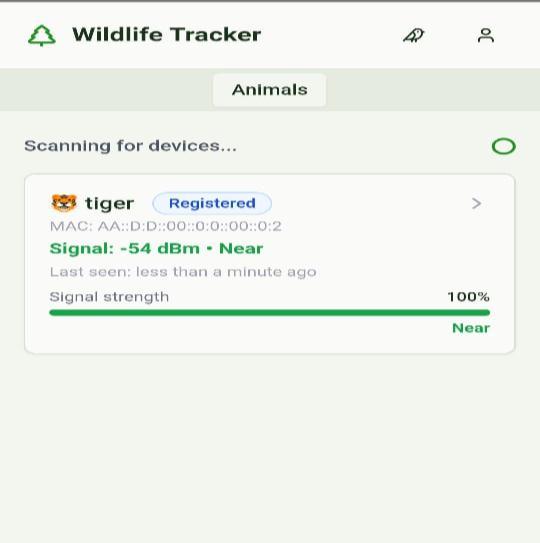
ThisFig.showstheHowthetagisregisterandgetrealtime locationofanimalinmobileappwithusingtheBLEandGPS, so we can track the animal , and we also get some basic information of that that animal like temperature, signal strengthofBLEtag,Batterypercentageoftaganddistanceof thatanimalwecanseethealltheinformationofthatanimal inAdvanceinfo.Tabinmobileapplicationsection.
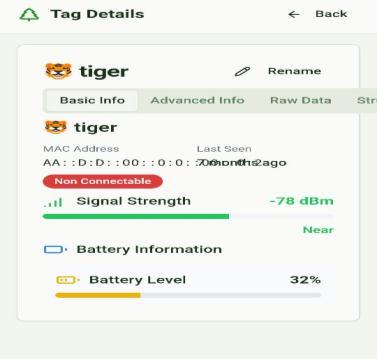
Fig.3-6showstheresult
Volume: 12 Issue: 11 | Nov 2025 www.irjet.net p-ISSN: 2395-0072
The implementation of the proposed Wildlife Tracker & AlertSystemdemonstrateshowGPSandBLEtechnologies can be effectively combined to provide real-time location trackingandalertinginwildlifeareas.Comparedtoprevious approachesthatreliedonlyonGPSandGSM,theintegration ofBLEsignificantlyreducespowerconsumptionandallows communicationeveninremoteregionswithlimitednetwork connectivity.
The results indicate that BLE-based alerts are reliable for short-range detection between the tagged animal and the mobile device, while GPS provides continuous positional dataforlong-rangemonitoring.Thishybridmodelensures both safety and efficiency, allowing tourists and forest officerstoreceiveimmediatenotificationswhenananimal approachesarestrictedortouristzone.
The addition of health monitoring parameters such as temperatureandbatterylevelenhancesthepracticalityof thesystem.Thisfeaturesupportsforestofficialsintracking animalwell-beinganddetectingunusualbehaviorpatterns. Furthermore,storingdataonanSDcardprovidesavaluable resource for long-term studies on animal movement and habitatusage.
However, some limitations were identified, including possibleGPSsignallossindenseforestareasandreduced BLE range depending on terrain or environmental interference.Futureimprovementscouldinvolveintegrating LoRaormeshnetworksupporttoextendrange,andadding solar-basedchargingtoincreasedevicelifetime.Overall,the discussion confirms that the proposed system offers a balanced, low-cost, and sustainable approach for both wildlifeconservationand touristsafety.It bridgesthegap between traditional GPS tracking and modern IoT-based smart monitoring systems, supporting both ecological researchandreal-timeprotectionefforts
Wildlife monitoring is important for effective protection, sustainable use and scientific management of wildlife resources. Although there is currently a lot of work on buildingrealsensorsystems,veryfewattemptshavebeen made to deploy them in the field and then maintain and developthem.Thestudyoftheanimalsthroughthissystem ortheirconservation.Proposedsystemisthebestpossible waytokeeptrackoftheanimal’slocationandtheirhealth24 hours-a-day.Proposednewsystemcanfindtheanimalover large,denseforestareaswiththehelpofaNodeMCU.Italso givesaliveupdateoftheirhealththroughthetemperature andpulsesensors.
The app in the mobile phones of forest officers will allow themtokeeptrackofthewildlifefromanywhereandatall times.Thenotificationsystemwillalertthemimmediately.if
anythingiswrongwiththespecies,thecaretakercanreach theexactlocationimmediately.Proposedsystemdoesnot require any human attention as this is a completely selfindependent and automated system. Proposed project willhelpussavewildlifeatamuchbetterrate
Wewouldliketoexpressoursinceregratitudetoallthose who have supported and guided us throughout the successfulcompletionofourprojecttitled“WildlifeTracker using GPS and BLE Technology.”First and foremost, we extend our deepest thanks to our project guide, Prof. S. S. Dongare,fortheirconstantguidance,valuablefeedback,and technical support. Their encouragement and expertise greatlyhelpedusinshapingourprojectandunderstanding everystageofitsdevelopment.
WearealsoprofoundlythankfultoDr.K.N.Nandurkar,our respected Principal, for his continuous support and motivation, which provided us with the resources and environment needed for successful project execution. Our sincerethankstoDr.S.A.Patil,HeadoftheDepartmentof Electronics and Telecommunication, for his constant inspiration, insightful suggestions, and encouragement throughoutthisjourney.
We also wish to extend our appreciation to all faculty membersofourdepartmentfortheirassistanceandmoral supportwheneverrequired.Aheartfeltthankstoourteam members for their dedication, teamwork, and consistent efforts in research, design, and implementation of this project.
Wearegratefultoourcollegemanagementforprovidingthe necessaryinfrastructureandtechnicalfacilitiesthatenabled ustocompletethisworksuccessfully.Wewouldalsoliketo express our deepest gratitude to our parents, whose constantencouragement,patience,andblessingshavebeen ourgreatestsourceofstrength.
Lastly, we are inspired by the efforts of forest officers, farmers, and wildlife researchers, whose real-world challenges motivated us to design a system that enhances both human and animal safety. We hope our work will contributeinasmallwaytotheconservationofwildlifeand thepreventionofhuman-animalconflicts.
[1] G.Rameshetal.,'FarmAnimalLocationTrackingSystem UsingArduinoandGPSModule,’IEEE,2021.
[2] D.Thamizhselvietal.,'Real-TimeAssetTrackingUsing BLETechnology,’IEEE2025.
[3] K.S.Burmanetal.,'LowEnergyBluetoothSensorNode forAnimalMonitoring,’ResearchGate,2021.
International Research Journal of Engineering and Technology (IRJET) e-ISSN: 2395-0056
Volume: 12 Issue: 11 | Nov 2025 www.irjet.net p-ISSN: 2395-0072
[4] V.R.Vijietal.,'DetectionandTrackingofWildAnimal,’ IEEE,2023.
[5] M.P.Banavathetal.,'Multi-ObjectTrackingforAnimals,’ IEEE, 2023.
[6] K.Dhivyaetal.,'GPSbasedTrackingSystemforWildlife Safety,’IEEE,2022
[7]Kerle-Malchareketal.,“GNSSandLoRa-BasedWildlife TrackingwithEnergyOptimization,”IEEE,2025.
[8]Toledoetal.,“ReviewofMiniatureRadioTagsfor WildlifeTracking,”IEEE,2025.



1.YashrajS.Tayde
FinalYearStudentofE&TC
AtKKWaghInstituteof EngineeringEducationand researchNashik
2.AjitV.Pawar
FinalYearStudentofE&TC
AtKKWaghInstituteof EngineeringEducationand researchNashik
3.VaibhavR.Thaware
FinalYearStudentofE&TC
AtKKWaghInstituteof EngineeringEducationand researchNashik