
International Research Journal of Engineering and Technology (IRJET) e-ISSN: 2395-0056
Volume: 12 Issue: 04 | Apr 2025 www.irjet.net p-ISSN: 2395-0072
International Research Journal of Engineering and Technology (IRJET) e-ISSN: 2395-0056
Volume: 12 Issue: 04 | Apr 2025 www.irjet.net p-ISSN: 2395-0072
Darshan Bhavesh Mehta1 ,
1Independent AI Researcher, Mumbai, Maharashtra, India
Abstract - Wildfire annihilate thousands of hectares of global forestland annually. Predicting fire behavior is pivotal for coordinating mitigation resources and managing response efforts during such disasters. Fire spread forecasting systems require diverse data inputs plagued by uncertainties, such as meteorological forecasts and vegetation maps. The dynamic nature of wildfires demands adaptable prediction tools. This study applies two fire spread prediction systems based on the Dynamic Data-Driven Application System (DDDAS) framework and introduces a hybrid method that merges both approaches. The solution leverages high-performance computing to deliver rapid, real-time predictions.
Keywords: Dynamic data-driven systems, parallel computation, uncertain data integration, predictive modeling,wildfiresimulation.
1.INTRODUCTION
Ensuringreliableelectricalpowerhasbecomeincreasingly critical for utilities and consumers [1][2][3]. Voltage fluctuations,transients,andwaveformdistortionscausedby grid or equipment disturbances can compromise power quality(PQ) definedasmaintainingstablevoltage/current waveforms at specified frequencies and magnitudes with minimaldistortion.Theproliferationofpowerelectronicsin deviceslikeindustrialdrives,renewableenergysystems,and smart appliances has heightened grid vulnerability to PQ disruptions. Non-linear loads, including rectifiers and variable-speedmotors,distortsinusoidalwaveforms,leading toissuessuchasharmonics,voltagesags/swells,imbalances, and flicker. These disturbances threaten equipment reliability, operational efficiency, and system safety. For instance, voltage sags can trip sensitive machinery, while harmonicsoverheattransformers.AddressingPQchallenges is now essential to safeguarding modern power infrastructureandensuringuninterruptedserviceinanera dominatedbyelectronics-dependenttechnologies.
Innovations in power electronics have spurred transformativedevelopments,particularlyinpowerquality managementthroughtechnologieslikeFACTS(FlexibleAC TransmissionSystems)andtailoredpowersolutions.These advancements enable enhanced grid control, improving stability and efficiency. Modern power systems operate under deregulated frameworks, where generation, transmission,anddistributionaredecoupledtoreducecosts.
Withescalatingenergydemands,optimizingexistingpower plantsandoperatingtransmissionlinesnearthermallimits is essential for stability[7]. Reducing transmission losses
remains a critical priority, necessitating tools like FACTS devices.Thesesystemsregulatepowerflow,maximizeline capacity, and enhance operational resilience, ensuring reliableelectricitydeliveryinevolvinggrids.
TheintegrationofpowerelectroniccomponentsinFACTS devices boosts control precision and increases power transfer capacity. By embedding FACTS into transmission networks, these systems can evolve into smarter, more adaptableinfrastructures.ControllerslikeSTATCOM,TCSC, SSSC, and SVC enable real-time adjustments to grid conditions, improving voltage stability and power quality. Reactivepowerdeficits oftencausedbyfaults,heavyloads, or voltage swings are mitigated through FACTS devices, which dynamically inject or absorb reactive power to maintain equilibrium. FACTS devices enhance power flow management,suppressoscillations,reduce environmental footprint,andoffercost-effectivealternativestotraditional grid upgrades. Among these, the Unified Power Flow Controller (UPFC) stands out. Its primary function is to adjusttransmissionlinepowerdistributionbymodulating voltage magnitude and phase angle via a series voltage input[6][2]. This control over real and reactive power optimizeslineusage,enablingoperationclosertothermal limitswhilebolsteringtransientandsmall-signalstability. The UPFC combines impedance, voltage, and phase-angle compensationforcomprehensivegridsupport(Figure2).It employstwovoltagesourceconverters:ashuntconverter (STATCOM) and a series converter (SSSC). The STATCOM supplies reactivepower to thegridand maintains DClink voltage, while the SSSC injects a controlled series voltage intothetransmissionline.Bothconvertersarelinkedviaa shared DC capacitor, which acts as an energy buffer. The UPFC’s shunt and series converters must balanceactive power exchange to ensure stability. The shunt converter drawsactivepowertosustaintheDClink,whiletheseries converterinjectsitintotheline[12][14].Thiscoordination, coupledwithindependentreactivepowerregulationinboth converters,enablesprecisepowerflowcontrol.Acoupling transformer integrates the UPFC with the grid, ensuring seamlessinteraction.
The2005CardonaFireinCatalonia,Spain(41°54'N,1°40' E),whichburned1,439hectaresoverfivehoursonJuly8, underscores the challenges of predicting dynamic environmental events. The fire, ignited at 14:45 and containedby19:45,exhibitedarapidaccelerationfrom~10 m/min to ~100 m/min two hours post-ignition, despite
International Research Journal of Engineering and Technology (IRJET) e-ISSN: 2395-0056
Volume: 12 Issue: 04 | Apr 2025 www.irjet.net p-ISSN: 2395-0072
recordedwindconditionsremainingrelativelystable(4.8–2.2 m/s, 185°–190°). This acceleration highlights the critical influence of topography and fire-induced microclimates, particularlyalongsouth-facingslopesandvalleyswheresolar exposureintensifiedfuelaridity(Fig.1a).Traditionalmodels, designedtoaccountforwindandslope,oftenfailtocapture thesecomplex,fire-drivenatmosphericinteractions.
Toaddressthesemodellimitations,DynamicData-Driven Application Systems (DDDAS) offer enhanced predictive accuracybyintegratingreal-timedatastreams.Techniques suchasKalmanFilteringandEnsembleKalmanFilteringcan dynamicallyadjustsimulationsbasedonsensordata,refining accuracy by up to 35%. Ensemble Forecasting, which combinesoutputsfrommultiplemodels,improvesprediction reliability by accounting for parameter uncertainty. Highperformancecomputing(HPC)facilitatesparallelsimulations, enablingrapidscenariotestingduringdynamicfireevents. Theseadaptivestrategies,whichincorporatereal-timedata assimilationandhybridmodelingtechniques,arecrucialfor managingcomplexandevolvingsystemseffectively.
Unified Power Flow Controllers (UPFCs) in power grids mirror this adaptive approach. UPFCs, integrating Static Synchronous Compensators(STATCOMs)and Series Static SynchronousCompensators(SSSCs),enhancegridstability andefficiencythroughavarietyofcorefunctions:powerflow control,harmonicsuppression,anddynamicstability[16][5]. In power systems, as in wildfire management, there is an increasingneedforreal-timedataintegrationandadaptive control. By leveraging real-time sensor measurements to refinepredictivemodelsandcontrolactions,powergridscan better respond todisturbancesand maintain stability.The success of adaptive methodologies in these disparate domains underscores their potential to enhance resilience andefficiencyincomplexsystemsworldwide.
Asnoted,predictioninaccuraciesarisefromtheinabilityof simulators to fully account for fire-induced effects on environmentalconditions.Themicroclimatecreatedbythe fire directly influences the local meteorological state, affectingdatainputs.Toaddressthis,twoDDDASapproaches areanalyzedusingtheFARSITEandWildFireAnalyst(WFA) simulators[4][10][1].
WhilebothsimulatorsimplementRothermel'sequation,their methods for obtaining global prediction evolution differ, resulting in distinct predicted perimeters, as illustrated in Figure 2. In this example, both simulators provide a fire spread prediction using the initial recorded perimeter at 14:38asthestartingpointandasimulationtimeof5hours. Themeteorological conditionsaresettothosegatheredat the ignition time and kept constant throughout the simulation[11].
Neither basic prediction method accurately mirrors the observed fire progression. FARSITE (Fig. 2(a)) underestimates the actual fire spread, as does WFA (Fig. 2(b)). Therefore, Dynamic Data Driven strategies were employedtomitigatetheselimitations[3].Themethodology extractsrelevantinformationabouttheobservedfirespread toadjustparametersofthesimulationprocessdynamically. These calibrated values are then fed into the simulation systemtodrivenear-termevolutionforecasts.
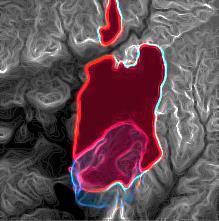
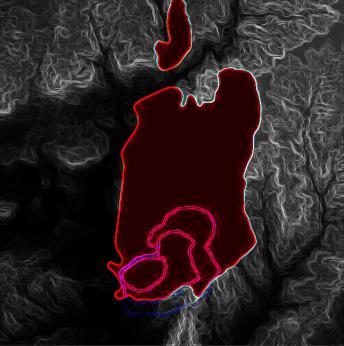
Thewayofextractingknowledgefromobservedfirebehavior fortheDDDASstrategyvaries.However,thegeneralscheme isillustratedinFigure3.Anadjustmentstagerequiresaccess to two consecutive real fire perimeters or georeferenced points from the fire spread perimeter. The calibration processcanbere-initiatedeachtimethesystemisfedwith newobservedfirebehavior.Thegoaliscontinuoussystem operation,providingfireevolutionforecastsonpresettime horizons.Theinputdatasetusedforpredictioniscalibrated inthecorrespondingadjustmentstage.Thismethodologyis simulator-independent,allowingplug-and-playreplacement.
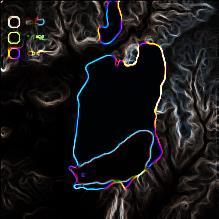
Inthenextsection,twoDDDASapproachesforforecasting fire spread will be described: DDDAS-GAand DDDAS-ROS. Bothuse data from the firepropagation interval (14:38to 17:13)toadjustinputdata.Thisdataisthenusedtodrivethe fire evolution forecast dynamically until 19:40. Figure 4 showsinitial,intermediate,andfinalperimetersusedinthe DDDASforecast.
International Research Journal of Engineering and Technology (IRJET) e-ISSN: 2395-0056
Volume: 12 Issue: 04 | Apr 2025 www.irjet.net p-ISSN: 2395-0072
DDDAS-GAisadynamicdata-drivenpredictionschemehat employs a Genetic Algorithm (GA) for calibration. This strategyintegratesfielddatatorefinewildfiresimulationsby adjusting parameters like fuel moisture and wind speed. Although the fire simulator is FARSITE, the system is designedtobesimulator-independent,allowingforflexibility inthechoiceoftheunderlyingmodel.
TheGAstartswitharandompopulationofindividuals,each representing a simulation scenario. A scenario/individual comprisesgenesrepresentinginputvariables(e.g.,deadfuel moisture, live fuel moisture, wind speed, wind direction). Eachindividualissimulated,andthepredictionresultsare compared to the most recently observed fire propagation. Firespreadisexpressedusingacellmapdescription,which showswhetheracellhasbeenburnedatagiventime.This comparison assesses the symmetric difference between predictedandactualburnedareasusingequation:
Difference = (UnionCells - IntersectionCells) / (RealCellsInitCells)
Intheaboveequation,UnionCellsdenotesthenumberofcells burnedbyeitherthepredictedorrealfire.IntersectionCells indicatesthenumberofcellsburnedinboththepredicted andrealmaps.RealCellsrepresentsthetotalnumberofcells burnedintherealfire,andInitCellssignifiesthenumberof cellsburnedatthestartingtime.Thisdifferenceaccountsfor bothfalselyburnedanderroneouslyunburnedcells.Based onthisfitnessfunction,theentirepopulationisranked,and geneticoperators(selection,elitism,mutation,crossover)are applied,producinganevolvedpopulationretainingatleast thebestindividualfromthepreviousgeneration.
Thenewpopulationisevaluated,andthisiterativeprocess identifies a suitable input parameter set. However, the substantialcomputationalcostduetonumeroussimulations
necessitates speeding up execution while maintaining predictionaccuracy[5].Therefore,aparallelimplementation of this methodology has been developed using the Master/Worker paradigm with MPI, enabling efficient distribution of simulations across nodes. The master node generates a random initial population and distributes it amongworkers.Workerssimulateeachindividual,evaluate thefitnessfunction,andsenderrorsbacktothemaster.The master sorts individuals by their error, applies genetic operators, and generates a new population. This iterative process repeats a fixed number of times, with the final iteration providing a population from which the best individualisselectedasthesolution.
Wildfire Analyst (WFA), part of the Tecnosylva Incident Management suite, provides real-time analysis of wildfire spread, evacuation planning, and impact assessment for multi-agencyincidentmanagement.WFAincorporatesadata assimilation technique that tunes simulations based on observed fire behavior, seeking the best ROS adjustment factorstominimizetheerrorbetweenthesimulatedandreal firedata.Thesefactorsarefuelmodel-specificandadjustthe fire'srateofspreadaccordingly.
The method's strengths lie in its non-recursive nature, enabling near-instantaneous solutions, easy-to-interpret adjustments for fire managers, and minimal input data requirements.Unlikeothermethods,itdoesn'tanalyzethe rootcauseofobservederrors(weather,fuelproperties)but focusesonestimatingfuturefirebehaviorregardlessofthe errorsource.Whileadjustmentsmaybeusedforcalibration, they can also guide recursive optimization or data assimilation schemes to determine the causes of observed errors.
The algorithm currently functions as an operational adjustment module, lacking automated data feeding for a fullyoperationaldata-drivenapplication.Itprovidesthebest ROSfactorsfittingafireandallowsuserstomanuallyadjust them to instantly visualize the expected behavior without redoing the simulation. Users can also adjust the tuning strengthtobalanceerror minimizationand theseverityof adjustments.Mathematically,themethodassumessimulated firepathsreachingtheknownfirelocationdon'tsignificantly change before and after adjustment, which typically holds unless adjustments are too drastic; a small recursive algorithmmaybeusedotherwise
Two Dynamic Data-Driven Application Systems applied to forecastwildfirespreadweredescribedabove.Bothschemes adjust/calibrateunknownenvironmentaldataneededforfire spread simulations based on observed real fire evolution[6][12].Figures3(a)and3(b)showthepredicted
International Research Journal of Engineering and Technology (IRJET) e-ISSN: 2395-0056
Volume: 12 Issue: 04 | Apr 2025 www.irjet.net p-ISSN: 2395-0072
spread for the Cardona Fireusing DDDAS-GAand DDDASROS, respectively. As expected, both approaches yielded slight differences compared to the actual final fire spread, though both predictions clearly match the main fire run directiondespitenotperfectlymatchingtheshape.DDDASGA underestimates the real fire spread, while DDDAS-ROS overestimates the final burnt area. Therefore, overlapping DDDAS forecasts could take both prediction results into account.Figure3ashowsthepredictionfirespreadareasof bothschemesandthefinalrealburntarea.Analysisreveals that using data to drive the simulation system directly impacts fire spread direction. The overlapped DDDAS forecast can find the maximum rate of spread path, which dependsonunderlyingtopographyandfuel.
Using the overlapped DDDAS forecast as a prediction approach, the area predicted to burn in all cases was destroyed by the fire, except the left flank where the overlapped DDDAS forecast overestimated the area. However,usingtheoverlappedschemereducesfalsealarms due to the compensating effect of using two DDDAS approaches,ascouldbeobservedinthebackpropagation.
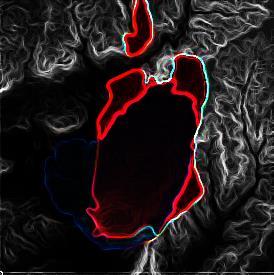

comparedtotherealfireburntarea(redshape).
Wildfires,arecurrentnaturalhazard,devastatevastforest areasworldwideannually.Computersimulationhasbecome crucial in providing enhanced propagation information to decision support systems, aiding mitigation efforts. However, current forest fire simulators often lack the capacity to modify model behavior based on changing environmental conditions caused by the fire itself. To address this limitation, dynamic data-driven approaches have been developed, enabling model behavior updates basedonobservedrealfirespread[2].
ThispaperdescribestwodistinctDDDASapproaches:one basedonGeneticAlgorithmsandtheotheronthemaximum ROS path. Both approaches have demonstrated a strong ability to adapt to rapid changes in fire rate of spread resultingfrommicro-climatesgeneratedbythefireunder
specific topographic conditions. This adaptability was provenusingtheCardonaFire,whichoccurredin2005in northeasternSpain,asatestcase.

Fig- 4: Mapoverlapincludingthefinalfirepredictions applyingbothDDDASschemesandtherealfirespread
Giventhecomplementarystrengthsofbothapproaches,an overlapping DDDAS forecast is proposed to provide highfidelityforestfirespreadprediction(Figure4),leveraging the advantages of both methods to improve accuracy and reliability.
Disclosure of conflict of interest Noconflictofinteresttobedisclosed.
[1] MarkArnoldFinneyetal.Farsite,fireareasimulator–modeldevelopmentandevaluation.2004.
[2] Collin D Bevins. Firelib user manual and technical reference.1996.
[3] D.BuckleyJ.Ramirez,S.Monedero.Newapproachesin fire simulations analysis with wildfire analyst. In 7th InternationalConferenceonForestFireResearch.The 5th International Wildland Fire Conference. Sun City, SouthAfrica,2011.
[4] GemmaSanjuan,CarlosBrun,Tom`asMargalef,andAna Cort´ es. Wind field uncertainty in forest fire propagation prediction. In Proceedings of the International Conference on Computational Science, ICCS 2014, Cairns, Queensland, Australia, 10-12 June, 2014,pages1535–1545,2014.
[5] Jason M. Forthofer, Bret W. Butler, and Natalie S. Wagenbrenner.Acomparisonofthreeapproachesfor simulating fine-scale surface winds in support of wildland fire management. part i. model formulation
International Research Journal of Engineering and Technology (IRJET) e-ISSN: 2395-0056
and comparison against measurements. International JournalofWildlandFire,23:969–981,2014.
[6] J.D.BeezleyJ.MandelandAdamK.Kochanski.Coupled atmosphere-wildland fire modeling with wrf 3.3 and sfire.GeoscientificModelDevelopment,4(3):591–610, 2011.
[7] M.Vejmelka J.D.BeezleyJ. Mandel,A.Kochanski.Data assimilation of active fire detection in coupled atmosphere-fire simulations by wrf-sfire. In 7th International Conference on Forest Fire Research. CopernicusPublications,2014.
[8] Carlos Brun, Tom`as Margalef, Ana Cort´es, and Anna Sikora. Enhancing multi-model forest fire spread prediction by exploiting multi-core parallelism. The JournalofSupercomputing,70(2):721–732,2014.
[9] J.L.CoenM.KimMandel,J.D.Beezley.Dataassimilation forwildlandfires:EnsembleKalmanfiltersincoupled atmosphere-surface models. IEEE Control Systems Magazine,29(3):47–65,2009.
[10] Frederica Darema. Dynamic data driven applications systems: A new paradigm for application simulations and measurements. In Computational Science - ICCS 2004,4thInternationalConfer-ence,Krak´ow,Poland, June 6-9, 2004, Proceedings, Part III, pages 662–669, 2004.
[11] Darshan Bhavesh Mehta and Harsha Kosta (2016), Image Compression Using Discrete Cosine Transform, International Journal of Innovative Research in ComputerandCommunicationEngineeringVol.4,Issue 4,2016
[12] M´ onica Denham, Kerstin Wendt, Germ´an Bianchini, AnaCort´es,andTom`asMargalef.Dynamicdata-driven genetic algorithm for forest fire spread prediction. J. Comput.Science,3(5):398–404,2012.
[13] Tom`asArt´es, Andr´esCencerrado,Ana Cort´ es,and Tom`as Margalef. Relieving the effects of uncertaintyinforestfirespreadpredictionbyhybridmpiopenmpparallelstrategies. InProceedings of the International Conference on Computational Science, ICCS 2013, Barcelona, Spain, 5-7 June, 2013, pages 2278–2287,2013.
[14] George C Rothermel, Richard C.; Rinehart. Field procedures for verification and adjustment of fire behaviorpredictions.1983
Volume: 12 Issue: 04 | Apr 2025 www.irjet.net p-ISSN: 2395-0072 © 2025, IRJET | Impact Factor value: 8.315 | ISO 9001:2008
| Page