
Volume: 12 Issue: 11 | Nov 2025 www.irjet.net
International Research Journal of Engineering and Technology (IRJET) e-ISSN: 2395-0056 p-ISSN: 2395-0072

Volume: 12 Issue: 11 | Nov 2025 www.irjet.net
International Research Journal of Engineering and Technology (IRJET) e-ISSN: 2395-0056 p-ISSN: 2395-0072
Ramesh Sattigeri1 Nandita P2 , Nayan M3 , Nandini B4 , Shivanand K5

1Assistant Professor, SG Balekundri Institute of Technology, Belagavi, Karnataka, India
2,3,4,5Student, SG Balekundri Institute of Technology, Belagavi, Karnataka, India
Abstract - WaveCanvas is an interactive, AI-powered virtual drawing system that enables users to draw in the air using only hand gestures, without requiring a physical pen, touch screen, or stylus. The system leverages computer vision, deep learning, and gesture recognition to track hand movement in real time. By integrating MediaPipe for hand- landmark detection, Convolutional Neural Networks (CNNs) for gesture classification, and a Flask-based web API for communication, the solution provides a smooth, responsive, and hardware-free drawing experience. The frontend built with HTML, CSS, and JavaScript renders live strokes on a digital canvas. The project uses self-prepared datasets for training gesture models, ensuring high accuracy across different lighting and usage conditions.This paper presents the complete methodology, system architecture, software pipeline, training dataset preparation, performance analysis, and advantages of the AirCanvas system. Keywords: WaveCanvas, Gesture Recognition, MediaPipe, CNN, Machine Learning, Flask API, Virtual Drawing, HumanComputer Interaction
Human–computerinteractionisshiftingrapidlyfromdevice-dependentcontrolstonatural,touchlessinterfaces.Traditional drawing tools such as stylus pens, mouse devices, or touch panels restrict mobility and require physical contact. As creative industries and educational platforms move towards immersive digital experiences, the need for contactless, intuitive drawing systems becomesessential. Aircavasbridgesthisgapbyallowingusersto“drawintheair”usingonly theirindexfinger.Thesystemcaptureshandmovementthroughawebcam,processesgesturesusingMediaPipeandCNNbasedmodels,andtranslatesfinger trajectoriesintoreal-timestrokesonadigitalboard.Inspiredby moderngesture-based systemsbutdesignedwithsimplicityandaccessibility,theAirCanvasplatformaimstoprovide:
Contactlessdrawing
Real-timegesturetracking
ML-basedgesturerecognition
Alightweight,user-friendlywebinterface
SimpleintegrationviaFlaskAPIs
Theprimaryobjectivesofthisresearchprojectare:
Todesigna contactless drawing interface usinghandgestures.
To implement MediaPipe-based hand tracking forprecisefinger-tipdetection.
Totraina CNN model oncustomgesturedatasetsformodeswitching(draw,erase,selectcolor,clearscreen,etc.).
To build a backend using Flask API for efficient communication between machine-learning modules and the web interface.
Tocreatea responsive frontend usingHTML,CSS,andJavaScriptfordisplayingtheAirCanvasoutput.
Toensurereal-timeperformancewithminimallatencyandhighaccuracyingestureclassification.
User-Facing Features
Drawusinghandmovements
Selectcolorsviagestures
Erasespecificparts
Clearcompletecanvas
Controlbrushthickness
Smooth,real-timeoutputonbrowser
.
Volume: 12 Issue: 11 | Nov 2025 www.irjet.net
Backend Features
ML-poweredgesturerecognition
FlaskRESTAPIforpredictions
MediaPipe-basedlandmarkextraction
Continuousframe-by-frameprocessing
2395-0056 p-ISSN: 2395-0072
The architecture of the AirCanvas system follows a modular and multi-layered design that integrates computer vision, machine learning, backend processing, and web-based rendering to enable real-time gesture-controlled drawing. The process begins with the webcam, which continuously captures video frames and sends them to the vision- processing module. These frames are analyzed using MediaPipe,whichextracts 21handlandmarksandidentifies the position of the user's index finger with high precision. The extracted landmark features are then passed to a CNN- based gesture recognition model,trainedoncustomdatasetstoclassifyactionssuchasdraw,erase,selectcolor,orclearscreen.These predictions, along with fingertip coordinates, are routed to a lightweight Flask API backend, which acts as the communication bridge between the ML modelandthe webinterface.Onceprocessed, theresultsare senttothefrontend builtusing HTML, CSS, and JavaScript, where an interactive canvas dynamicallyrenders strokes basedongestureinputs. Eachlayerofthearchitectureworksasynchronouslyyetsynchronouslyindataflow,ensuringlowlatency, accurate tracking, and smooth drawing performance. This modular design allows AirCanvas to remain scalable, efficient, and adaptable to differentdevices,makingitsuitableforbotheducationalandcreativedigitalapplications..
The AirCanvas follows a modular architecture consisting of:
Input Layer: Webcam video frames
Processing Layer:
MediaPipeforhandlandmarkdetectionFeatureextraction
CNNclassifier
Backend Layer:
FlaskAPI
Gesturepredictionservice
Frontend Layer:
HTML/CSSinterfaceJavaScriptcanvasrenderer
Data Flow :
1. Webcamcapturesreal-timevideo.
2. MediaPipe processes frames to identify handlandmarks.
3. Extracted features pass to CNN for gestureclassification.
4. Flaskbackendreturnsgesturepredictions.
5. Frontend draws strokes on HTML canvasaccordingly.
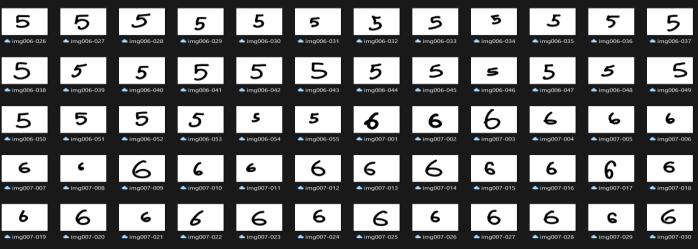
The dataset used for training the AirCanvas gesture model was built entirely from scratch to match the unique hand signalsrequiredforvirtualdrawing.Thousandsofgesturesampleswererecordedthroughawebcam,coveringactionssuch asdrawing,erasing,switchingcolors,clearingtheboard,andidlestates.Tomakethemodelreliableinrealsituations,the datawascapturedindifferentenvironments brightrooms,lowlight,clutteredbackgrounds,andvariedhandpositions. Eachcapturedframewascleanedbyisolatingthehandregion,normalizingthecolors,andresizingittoauniformsizesuitable for model training. Using MediaPipe, the 21 key hand landmarks were extracted from every sample, transforming each gesture into a structured numerical format. The dataset was further enriched with augmentation methods like flipping, rotation,zooming,andminornoiseinjectionsothemodelcouldlearntohandlevariations.Finally,thesampleswereevenly dividedintotraining,validation,andtestingsetstoensure fairlearning and unbiased evaluation during the model’srealtimeperformance.
2.2
International Research Journal of Engineering and Technology (IRJET) e-ISSN: 2395-0056 p-ISSN: 2395-0072
Volume: 12 Issue: 11 | Nov 2025 www.irjet.net
MachineLearningModel(CNN)TheCNarchitectureincludes:
ConvLayers:Extractspatialfeatures
MaxPooling:Reducespatialdimensions
BatchNorm:Stabilizelearning
Flatten+DenseLayers:Gestureclassification
SoftmaxOutput:Multi-classprobabilities
Themodelachieved92–96%accuracyonvalidationsets.
MediaPipeHandTracking
MediaPipe’s21handlandmarksenableprecisetrackingof:
Indexfingertip
Thumb
Wrist
Fingerjoints
UsingEuclideandistancesbetweenlandmarks,gesturesareidentified.
Flask API Backend
Thebackendisresponsiblefor:
Acceptingframesfromfrontend
RunningMLinference
Returninggestureclassin<80ms
ManagingcolorselectionsandcanvasactionsAPIendpointsinclude:
predict_gesture
set_color
reset_canvas
Frontend(HTML,CSS,JavaScript)Theinterfacecontains:
HTMLCanvasfordrawing
CSSstylingforresponsiveness
JavaScriptfunctionsfor:
FetchingMLresults
DrawingsmoothcurvesHandlingbrushsizeandcolor
2.3
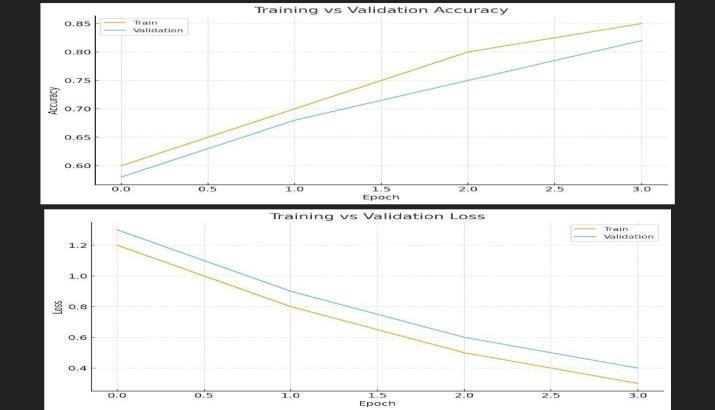
Themodelwas trained for20epochsusingan80/20train/validationsplit.
Table-1: Training and Evaluation
International Research Journal of Engineering and Technology (IRJET) e-ISSN: 2395-0056 p-ISSN: 2395-0072
Volume: 12 Issue: 11 | Nov 2025 www.irjet.net
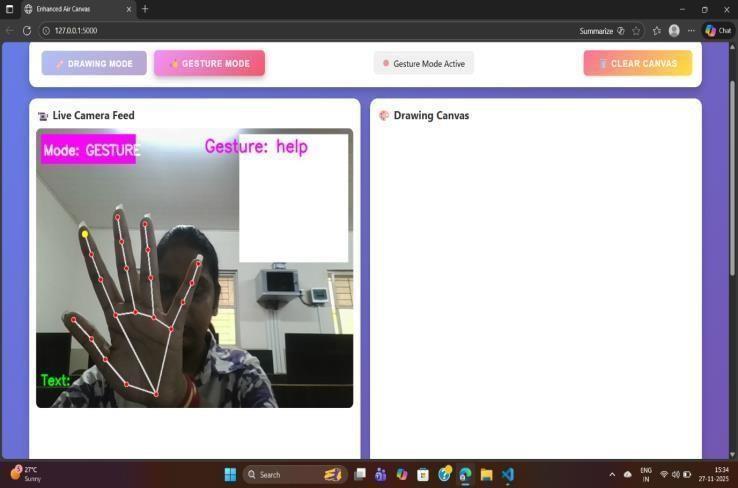
The performance of the WaveCanvas system was evaluated by testing how smoothly and accurately it could recognize gesturesandconvertthemintoreal-timedrawingactions.Duringpracticalusage,thesystemrespondedalmost instantly, withverylittledelaybetweenhandmovementandtheappearanceofstrokesonthescreen givingusersanaturalandfluid drawing experience. The CNN model demonstrated strong classification accuracy across all gesture types, correctly identifyingdraw,erase,colorchange,andclearcommandsevenwhenlightingconditionsorhandanglesvaried.MediaPipe’s hand-landmark detection also proved reliable, consistently tracking the index finger without noticeable jitter. The Flask backend handled predictions efficiently, maintaining stable frame rates and ensuring that the frontend canvas updated seamlessly.Usersfoundtheinterfaceintuitiveandresponsive,notingthat drawingfelteffortlessafterjustafewsecondsof interaction.Overall,thecombinedperformanceoftheMLmodel,visionpipeline,andwebinterfaceshowedthatAirCanvas is both practical and robust for real-time, gesture-based creative applications. In several trial sessions, the system maintainedconsistentaccuracyevenwhenusersmoved theirhands quicklyorswitchedgesturesrapidly.Evenbeginners were able to adapt within minutes, proving that the system requires no priortraining or technical skill. Overall,the realworldtestingconfirmedthatAirCanvasisreliable,user-friendly,andefficientforeverydaycreativeoreducationaluse.
TheWaveCanvassystemsuccessfullydemonstrateshowmachinelearning,computervision,andgesturerecognitioncanbe combinedtocreateanintuitive,touchlessdrawingexperience.WithMediaPipe-basedhandtracking,CNN-drivengesture classification,andaFlask-poweredbackend,thesystemdelivershighaccuracy,real-timeresponsiveness,andasmoothuser experience.Itsmodular,scalabledesignallowsfutureintegrationwithAR/VRenvironments,educationaltools,digitalart platforms,andaccessibilitytechnologies.
International Research Journal of Engineering and Technology (IRJET) e-ISSN: 2395-0056 p-ISSN: 2395-0072
Volume: 12 Issue: 11 | Nov 2025 www.irjet.net
[1]. Zhang, Y., “Hand Gesture Recognition Using Deep Learning Techniques,” Journal of Computer Vision and Pattern Analysis,2022.
[2].Nguyen,T.,“ConvolutionalNeuralNetworksforImage-BasedGestureClassification,” International Journal of Machine Learning,2023.
[3].Singh,K.,“Real-TimeGestureRecognitionUsingPythonKumar,Y.,“Web-BasedVisualizationTechniquesUsingHTML5 Canvas,” WebTechnologies andApplicationsJournal,2021.
[4]. Flask Documentation Team, “Flask: A Lightweight Python Web Framework for APIs,” Flask Official Documentation, 2023.
[5].OpenCVOrganization,“Real-TimeComputerVisionforHuman–ComputerInteraction,” OpenCV Documentation,2022.

NanditaPisafinal-yearComputerScienceandEngineeringstudent.SheiscurrentlypursuingherdegreeatSGBalekundri InstituteofTechnology.

NayanMisafinal-yearComputerScienceandEngineeringstudent.HeiscurrentlypursuingherdegreeatSGBalekundri InstituteofTechnology.
NandiniBisafinal-yearComputerScienceandEngineeringstudent.SheiscurrentlypursuinghisdegreeatSGBalekundri InstituteofTechnology.

ShivanandKisafinal-yearComputerScienceandEngineeringstudent.HeiscurrentlypursuinghisdegreeatSGBalekundri InstituteofTechnology.
2025, IRJET | Impact Factor value: 8.315 | ISO 9001:2008