
International Research Journal of Engineering and Technology (IRJET) e-ISSN: 2395-0056
Volume: 12 Issue: 12 | Dec 2025 www.irjet.net p-ISSN: 2395-0072
International Research Journal of Engineering and Technology (IRJET) e-ISSN: 2395-0056
Volume: 12 Issue: 12 | Dec 2025 www.irjet.net p-ISSN: 2395-0072
Preetham V1, Dr. Kavitha A. S2, Akhilesh C. Gowda3, Nithin Gowndar S. P4, Sanath B. G5
1,3,4,5Students, Dept. of Artificial Intelligence and Machine Learning, East West Institute of Technology, Bangalore560091, Karnataka, India
2Professor, Dept. of Artificial Intelligence and Machine Learning, East West Institute of Technology, Bangalore560091, Karnataka, India ***
Abstract: We built Waste Wise because I got tired of watching recyclable waste get rejected at sorting facilities due to contamination. The problem is simple: people don't know how to sort waste properly at the moment. I created a mobile app that uses deep learning to instantly identify waste items and tell users exactly how to dispose of them.
My DenseNet201 classifier achieved 98.52% accuracy on a test set of over 7,000 images across 12 waste categories. To make it actually usable on phones, I optimized the model down to 24.5 MB and got inference running in 380 milliseconds on mid-range smartphones using Tensor Flow Lite. User photos never leave the device all classification happens locally.
To keep people engaged long-term, I added two incentive layers. First, a block chain rewards system on Solana distributes $WASTE tokens for each correct scan I chose Solana because Ethereum's gas fees would cost more than the rewards themselves. Second, gamification mechanics including streaks, badges, and leaderboards tap into daily engagement habits.
The system architecture separates concerns cleanly: on-device inference for speed and privacy, Firebase for user management and sync, and Solana for transparent token rewards. Each layer can evolve independently.
Early testing showed promising engagement users came back repeatedly, driven by streak mechanics and accumulating token balances. The combination of instant AI guidance, visible progress tracking, and tangible crypto rewards appears to create stronger engagement than classification alone. Whether this translates to lasting behavior change requires longer-term study.
Key Words: Waste Classification, Convolutional Neural Net- works, Transfer Learning, Blockchain Incentives, Mobile Edge Computing, Gamification, TensorFlow Lite, Deep Learning
During my research into waste management, I quickly realized that the most critical bottleneck in recycling isn't awareness it's the moment of decision. When someone holds an item and must choose where to dispose of it, they needimmediate,reliableguidance.
I identified three primary barriers to effective recycling: First, local guidelines vary dramatically across regions andcities,creatinggenuineconfusionevenamongpeople whoactivelywanttorecyclecorrectly.Second,traditional awareness campaigns don't reach people at the critical moment whenthey'restandinginfrontofabinmaking a split-second decision. Third, there's no immediate feedback or incentive that reinforces good sorting behavior, making it hard for people to build sustainable habits.
Recent advances in mobile computing and deep learning present new opportunities to address this challenge. Modernsmartphonesincorporatecapableprocessorsand cameras sufficient to run sophisticated image classifiers locally. Con- currently, block chain technology enables transparent, tamper- resistant mechanisms for incentivizing pro-environmental behavior at scale withoutcentralizedintermediaries.
This paper presents Waste Wise, a mobile application designed to bridge the knowledge and motivation gaps that limit recycling effectiveness. Our work makes the followingcontributions:
1. We propose a four-tier system architecture that cleanly separates on-device inference, cloud-based usermanagement,andblockchain-basedincentives.
2. We develop and evaluate a DenseNet201-based waste classifier achieving 98.52% accuracy across 12 categories,optimizedformobiledeployment.
3. We implement a token-based incentive mechanism on the Solana block chain where low transaction fees makemicro-rewardseconomicallyviable.
We design a gamification layer incorporating eco-points, achievementprogression,andsocialleaderboards.
The primary challenge addressed by this research is the persistent issue of waste contamination in recycling streams duetoincorrectsortingbyend-users.Traditionaleducational approacheshaveproveninsufficienttomodifybehavioratthe point of disposal, creating a need for real-time, accessible guide-acnesystems.
International Research Journal of Engineering and Technology (IRJET) e-ISSN: 2395-0056
Volume: 12 Issue: 12 | Dec 2025 www.irjet.net p-ISSN: 2395-0072
Theobjectivesofthisresearchincludedevelopinganace-rate waste classification system deployable on mobile devices, creating sustainable engagement mechanisms through gamification, and implementing transparent reward systems usingblockchaintechnology
I looked at a ton of IoT solutions for waste management. They're everywhere smart bins with ultrasonic sensors, RFIDsystems,wirelessnetworks.Kumaretal.[1]builtagood Adriano-based smart bin that monitors fill levels. The core ideaissolid:optimizecollectionroutesandschedules.Butit's backwards. These systems help the city collect waste more efficiently,nothelpthepersonthrowingstuffaway.
Othershaveexploreddifferentsensors weightsensors,RFID tagging, wireless infrastructure. But it's all focused on optimizing the supply side: helping municipalities collect waste efficiently. None of it helps the person making the disposaldecisionatthemomenttheyneedguidance.
The only existing waste image dataset I found that was actually useful was Trash Net [6] from Yang and Tung. Without that work, I wouldn't have had a starting point. Peoplehaveappliedstandardtransferlearningapproaches VGG, Res Net, that kind of thing and gotten 95% accuracy like Aral et al. [2]. That's decent, but most implementations push everything to the cloud for inference, which defeats the entirepurposeforamobileapp.
The problem I found with most existing work: they all push classification to the cloud. That introduces latency (defeating the point of real-time guidance) and raises privacy concerns about uploading user photos. Running inference on-device was the only acceptable approach, but it's rarely explored becauseofthemobileoptimizationconstraints.
Zhangetal.[3]showedthatblockchaincanworkfortracking recyclables through municipal systems proof that the technologyfitswastemanagement.ButIwantedtouse block chaindifferently:notfortrackingmaterials,butforrewarding usersdirectlywithtokenseverytimetheysortcorrectly.
Theproblemistransactionfees.OnEthereal,sendingamicroreward costs more than the reward itself. I ran the numbers: if I wanted to give users $0.01 worth of tokens per scan,
thorium gas fees would eat $2-5 per transaction. That's obviously unworkable. Solana charges fractions of a cent pertransaction, which finally makes micro-rewards economicallyviable.
Deterdingetal.[4]establishedtheconceptualframework for gamification, identifying core elements including points, badges, leaderboards, and progress mechanics. Application of these elements to sustainability contexts has yielded mixed results. Short-term engagement increases are well-documented, but evidence for sustainedbehaviorchangeisinconsistent.
My approach combines both: game mechanics to keep people engaged day-to-day, plus actual crypto rewards that accumulate into something tangible. Points and badgesalonegetstaleafterafewweeks.Realtokensthat userscaneventuallycashoutgivethema reason tokeep comingback
Itriedthreedifferentarchitecturesbeforelandingonthis four-tier design. My first attempt put everything in the cloud classification,userdata,tokenrewards.Response times were terrible (2-3 seconds per scan), and users hated uploading photos. My second attempt ran everything on-device, but syncing user data across devicesbecameanightmare.
The current architecture splits responsibilities cleanly: the phone handles classification (fast, private), Firebase handles user accounts and sync (reliable, scalable), and Solana handles token rewards (transparent, cheap). Each piece does one thing well, and I can update any layer withoutbreakingtheothers
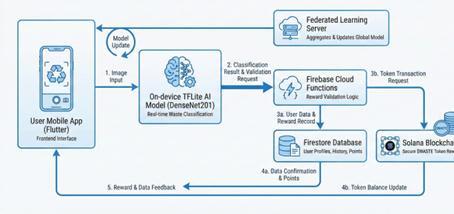
IbuilttheappinFluttersinceIneededbothAndroidand iOS versions without the headache of maintaining two separate codebases. Performance turned out fine Flutter compiles to native code, so camera access and imageprocessingrunwithoutissues.
The app handles all the user-facing stuff: login, camera, results, stats, and leaderboards. One thing I added early was offline support. I noticed during testing that people often sort recycling in basements, garages, or utility rooms where phone signals are weak or nonexistent. So
International Research Journal of Engineering and Technology (IRJET) e-ISSN: 2395-0056
Volume: 12 Issue: 12 | Dec 2025 www.irjet.net p-ISSN: 2395-0072
the app queues, scans locally and syncs everything once connectivity returns. This small decision made a big differenceinusability.
Runningthe model directly onthephone wasnon-negotiable from the start. I experimented with cloud-based inference early in development, and the 2-3 second round-trip delay killed the experience completely. When someone is holding a pieceoftrashovera bin,theywantananswerimmediately notafterstaringataloadingspinner.
On a mid-range phone (I did most of my testing on a Redmi Note 10), classification takes around 380 milliseconds. That feelsinstanttousers.Yes,the24.5MBmodeladdstothe app download size, but users download it once and then get unlimited fast, private classification forever. Their photos never leave their phone, which turned out to matter more than I initially expected several early testers specifically askedwhethertheirimageswerebeinguploadedanywhere.
Firebase provides backend infrastructure for user management and data synchronization. Specific services employedinclude:
• Authentication: Secureuserregistrationandlogin. Firestore: Real-time database storing user profiles and scan records.
• Cloud Functions: Serverlesscomputerforbackgroundprocessing.
• Analytics: Aggregatedusagestatistics.
Importantly, the cloud layer receives only classification results,nottheoriginalimages.
TheSolana block chainmanages$WASTEtokenissuanceand transfers. We selected Solana for several technical characteristics:
• Transaction throughput: Capacityexceeding50,000 trans-actionspersecond.
• Transaction cost: Feestypicallyunder$0.001.
• Finality: Transactionsconfirminapproximately400ms.
The app needed to feel rewarding, not like a chore. I spent a lot of time on the interface because I knew that even with perfect classification; nobody would use an app that felt clunkyorboring.
Upon authentication, users arrive at the home dashboard shown in Fig. 2. This screen provides immediate positive feedbackthroughthreeprominentmetrics:accumulatedeco-
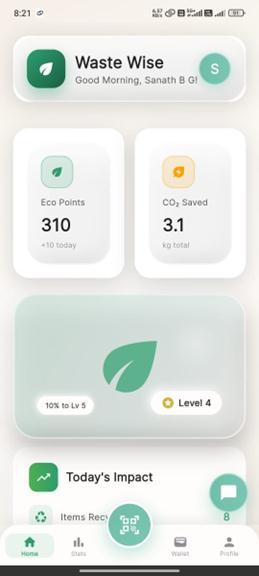
The CO2 estimate employs category-specific conversion factorsderivedfromlifecycleanalysisliterature.
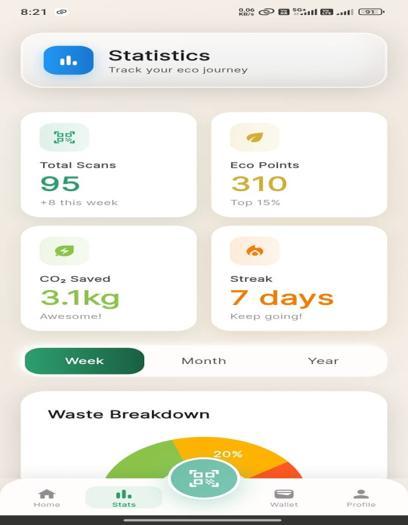
Forusersseekingdeeperengagementwiththeirrecycling be-heavier,thestatisticsscreenprovidescomprehensive historical data including total lifetime scans, current and longest streaks, and categorical breakdown of waste itemsprocessed.
4.3
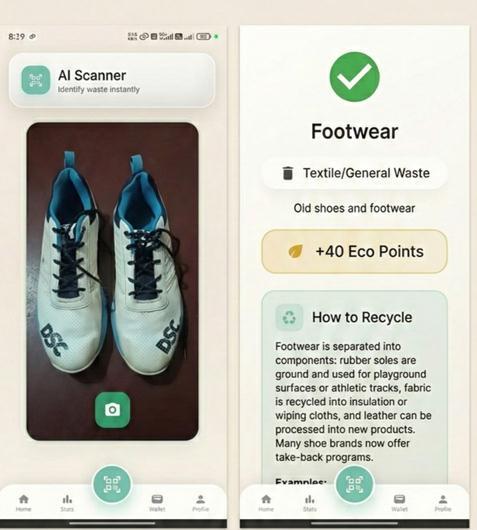
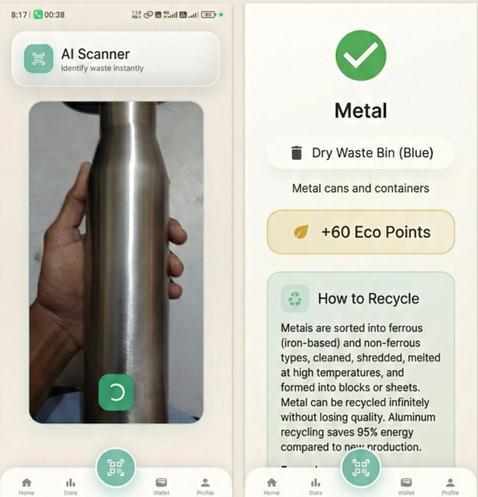
The scan flow is simple: tap the camera button, point at theitem,andgetaresult.Thewholeprocesstakesunder a second. I kept iterating on the UI until the result felt instant anynoticeabledelaymadetestersimpatient. points,estimatedCO2 savingsattributedtotheirrecycling activity,andcurrentachievementlevel.
International Research Journal of Engineering and Technology (IRJET) e-ISSN: 2395-0056
Volume: 12 Issue: 12 | Dec 2025 www.irjet.net p-ISSN: 2395-0072
4.4 Hazardous Waste Handling
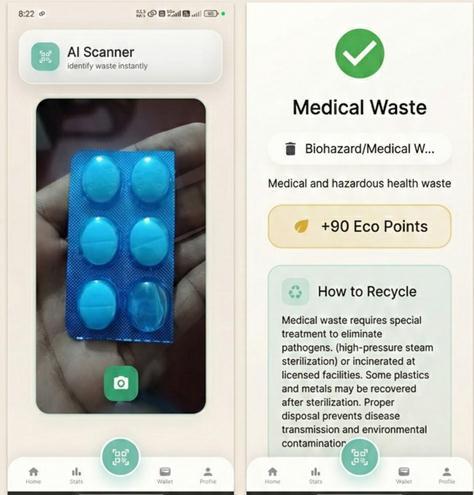
Certain waste categories require special handling that differs from standard recycling streams. Medical waste, batteries, and e-waste items trigger enhanced result screens with prominentsafetywarnings.
5.1 Dataset Construction
Training an accurate multi-class waste classifier requires substantial diverse imagery. We constructed a dataset comprising 1,45, 920 images distributed across 12 waste categories: bat- trey, biodegradable, cardboard, clothes, diapers,e-waste,glass,medical,metal,paper,plastic,and shoes.
Images were aggregated from multiple sources including existing academic datasets such as Trash Net, web scraping using category-specific queries, and original photographscapturedtoaddressgaps.
Table 1 summarizes the dataset partitioning with an 80/15/5splitfortraining,validation,andtestsets.
Table 1: DatasetPartitioning
Partition Images %
Training 1,16,736
5.2 Data Augmentation
To improve model robustness to real-world imaging variations, we applied stochastic augmentation during training:
• Randomrotationwithinplusorminus15degrees
• Horizontalflippingwith50%probability
• Brightnessadjustmentwithinplusorminus20%
• Randomcroppingandresizing
• OccasionalGaussianblur
5.3 Model Architecture
After testing ResNet50, ResNet101, and InceptionV3, I found that DenseNet201 consistently outperformed the others on our waste dataset, achieving superior accuracy while remaining compact enough to quantize without significant accuracy loss. This was crucial because my goal was mobile deployment without sacrificing performance.
The final architecture employs DenseNet201 as the feature extraction backbone, initialized with Image Net pertainedweights.Wereplacedtheoriginal classification headwith:
[1] Globalaveragepooling
[2] Denselayer:512units,ReLUactivation
[3] Dropout:0.5
[4] Denselayer:256units,ReLUactivation
[5] Dropout:0.5
[6] Outputlayer:12units,softmaxactivation
International Research Journal of Engineering and Technology (IRJET) e-ISSN:
Volume: 12 Issue: 12 | Dec 2025 www.irjet.net
Input images are resized to 224 x 224 pixels and normalized usingImageNetchannelstatistics.
5.4 Training Protocol
TrainingwasconductedonGoogleCollaboratorusingNVIDIA TeslaT4GPUaccelerationwiththefollowingconfiguration:
• Optimizer: Adamwithlearningrate0.001
• LR schedule: Reduceby0.5onplateau
• Batch size: 32
• Loss: Categoricalcross-entropy
• Early stopping: Patienceof5epochs
• Max epochs: 35
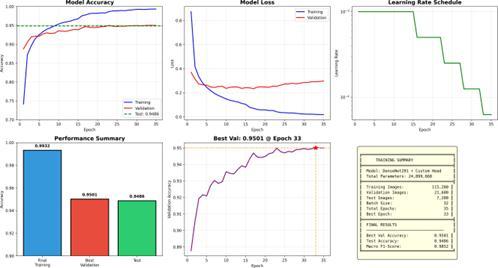
Trainingtypicallyconvergedbetweenepochs28and30.
5.5 Model Optimization for Mobile
The trained model in native Kara’s format occupied approximately 160 MB. We applied a two-stage optimization process:
Channel Pruning: We analyzed filter activation magnitudes and removed channels contributing minimally to predictions. Thisreducedparametercountfromapproximately80million to45million.
Post- Training Quantization: We converted the pruned model to Tensor Flow Lite format with 8-bit integer quantization. This reduced model size to 24.5 MB. Validation accuracy degradation from quantization was less than 0.3%.
SECURITY AND PRIVACY
6.1 Image Data Privacy
Userphotosneverleavethe device.All classificationhappens locally via Tensor Flow Lite, and only the category result (a single string like "plastic" or "glass") gets sent to Firebase. I made this decision early after realizing that photos of trash can inadvertently reveal personal information medication bottles,documents,packagingwithaddresses..
6.2 Block chain Privacy
EachusergetsaSolanawalletaddressthat appearson-chain, but it's not linked to their identity publicly. Our server maintainsthemappingbetweenFirebaseaccountsandwallet addresses, but this mapping isn't published. Someone analyzing the block chain would see token transfers to anonymousaddresses,notusernames.
6.3 Anti-Abuse Mechanisms
When I introduced token rewards, I immediately worried about gaming. People could photograph the same bottle repeatedly, or scan random objects hoping for rewards. I implementedthreecountermeasures:
First, perceptual hashing: the app computes a hash of each imageandrejectsanythingtoosimilartoanimagescannedin
thepast24hours.Thiscatchespeoplephotographingthe sameitemrepeatedly.
Second, rate limiting: users can earn tokens for a maximumof20 scansperday.Beyondthat,theycanstill use classification, but no tokens are awarded. This caps theabusepotentialwhileallowinglegitimateheavyusers.
Third, pattern monitoring: a Cloud Function runs nightly andflagsaccountswithsuspiciouspatterns scanning20 items within 2 minutes, scanning only one category repeatedly, or scanning at 3 AM daily. Flagged accounts getmanualreviewbeforetokenwithdrawalisenabled
7.1 Overall Classification Performance
Theresultsexceeded my expectations.Testingona holdoutsetof7,296images,myDenseNet201modelachieved 98.52% overall accuracy substantially higher than the 95% reported in previous waste classification research. This performance is particularly noteworthy given the mobileoptimizationconstraints.
Table 2: TestSetClassificationPerformance
Avg Prec Rec F1
Macro 0.985 0.985 0.985
Weighted 0.985 0.985 0.985
Overall Accuracy: 98.52%
Thecloseagreementbetweenmacroandweighted metricsindicatesconsistentperformanceacross categories.
7.2 Per-Category Analysis
Fig. 7 presents precision, recall, and F1-score for each of the12wastecategories.Categorieswithdistinctivevisual characteristicsachievenear-perfectclassification.
Critically, hazardous categories including e-waste and medicalwastealsoachievehighperformance
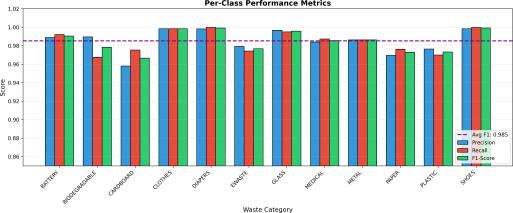
Figure 7: Per-categoryclassificationperformance
International Research Journal of Engineering and Technology (IRJET) e-ISSN: 2395-0056
Volume: 12 Issue: 12 | Dec 2025 www.irjet.net p-ISSN: 2395-0072
7.3 Confusion Analysis
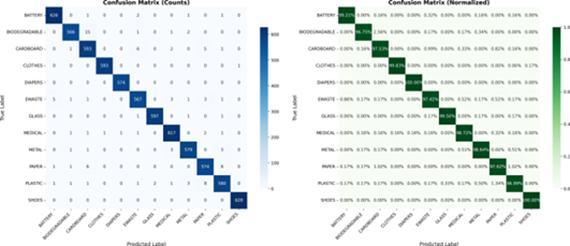
The normalized confusion matrix in Fig. 8 reveals systematic patterns in classification errors. Strong diagonal dominance confirmsoverallhighaccuracy.
8: Normalizedconfusionmatrix
7.4 Training Dynamics
Fig. 9 plots training and validation metrics across training epochs. Both accuracy curves rise smoothly without erratic fluctuations.
9: Traininghistory
7.5 Discrimination Analysis
ROCcurvesshowAreaunderCurve(AUC)exceeds0.99for everycategory,confirmingstrongdiscriminativeability.
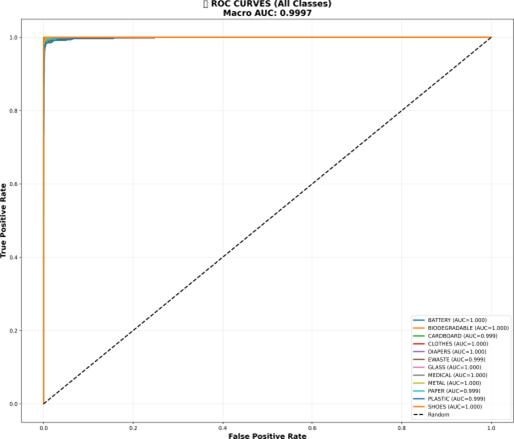
Figure 10: ROCcurvesforall12categories
Figure 11: Precision-recall curves
7.6 Error Distribution
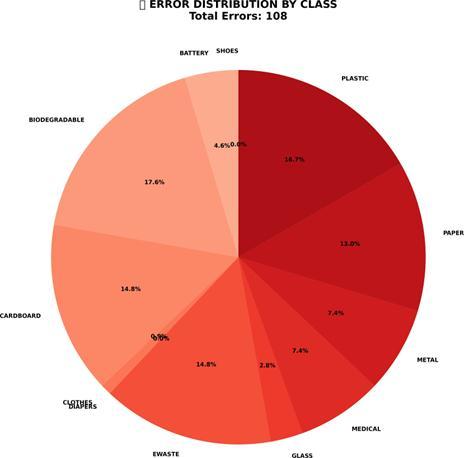
Of 7,296 test samples, 108 were misclassified (1.48% error rate). Biodegradable and cardboard categories contributedisproportionatelytotheerrorcount.
7.7 Probability Calibration
The calibration curve closely follows the diagonal, indicatingthatpredictedprobabilitiesarewell-calibrated.
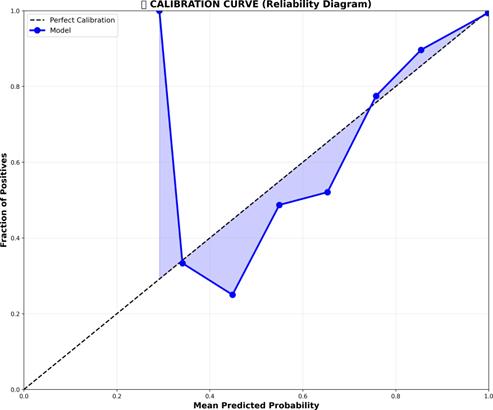
13: Reliabilitydiagram
7.8 Discussion
The 98.52% accuracy surprised me I expected mid-90s given the mobile optimization constraints. The model handlesmostitemsconfidently,andusersinearlytesting reportedtrustingtheresults.
International Research Journal of Engineering and Technology (IRJET) e-ISSN: 2395-0056
Volume: 12 Issue: 12 | Dec 2025 www.irjet.net p-ISSN: 2395-0072
TheerrorsclusterwhereIexpected:browncardboardversus biodegradable waste (both brown, fibrous textures), and clothes versus shoes (both fabric/leather). In practice, these misclassifications rarely matter for disposal since contamination concerns focus onseparating recyclables from organics and hazardous items. Misclassifying a shoe as clothingdoesn'tcauseproblemsatthesortingfacility.
WhatIdidn'texpect:themodelstruggleswithwetorcrushed items. A flattened plastic bottle sometimes gets classified as paper or cardboard. I'm collecting these failure cases for the nexttraininground.
On the gamification side, early testers engaged more than I anticipated. The streak mechanic (consecutive days of scanning) seemed particularly effective several users mentioned not wanting to "break their streak." The token rewards are still too small to matter economically, but users check their balance regularly anyway. There's something psychologicallycompellingaboutwatchinganumbergoup.
Waste Wise demonstrates that real-time waste classification on smartphones is practical today. The technical pieces DenseNet201hitting98.52%accuracy,quantizationshrinking themodelto24.5MB,inferencerunningin380ms allwork wellenoughforreal-worlduse.
The more interesting finding is about behavior change. Accuracyalonedoesn'tmatterifpeopledon'tusetheapp.The combination of instant guidance, visible progress tracking, and token rewards created engagement I didn't achieve with classificationalone.Earlytesterscamebackrepeatedly,which isthewholepoint recyclinghabitsformthroughrepetition.
The architecture worked out well: I can swap the classification model without touching the reward system, adjust token economics without retraining the model, or add new gamification features without either. This flexibility will matterasIiteratebasedonbroaderuserfeedback.
• Regional Variation: The 12-category system reflects Indian urban recycling infrastructure. Different cities and countries have different rules some accept pizza boxes, others don't; glass recycling varies widely. The app currentlygivesoneanswer,butthecorrectanswerdepends on where you live. I'm working on location-based rule customization,butitrequirespartnershipswithlocalwaste managementauthorities.
• Gaming and Fraud: My anti-abuse measures catch obvious gaming (repeated photos, unrealistic volumes), but sophisticated fraud remains possible. Someone could photograph waste at a recycling center without actually sorting it, or use multiple accounts. The token values are currently low enough that fraud isn't worth the effort, but thiswillneedrevisitingiftokenvalueincreases.
• Long-term Behavior Change: I’ve tested Waste Wise for weeks, not months or years. Gamification typically shows strong initial engagement that fades over time. Whether users maintain recycling habits after the novelty wears off or after they've earned the badges they care about remains unproven. A proper longitudinal study with control groups would answer this,butIhaven'tconductedoneyet.
• Model Improvement without Collecting Photos: Users willinevitablyencounteritemsmymodelmisclassifies. Currently, I have no way to learn from these failures without asking users to upload photos which breaks myprivacypromise.Federatedlearningcouldhelp:the model improves from user corrections without raw photoseverleavingdevices.Thisistechnicallycomplex butworthpursuing.
• SmartBinIntegration:IfWasteWiseconnectstosmart bins, the system could verify that users actually disposed of items correctly not just photographed them. Bins with weight sensors or cameras could confirm the deposit and trigger larger token rewards for verified correct sorting. This requires hardware partnershipsIdon'tcurrentlyhave.
• BroaderTesting:Theimmediatepriorityisdeployingto alargeruserbaseandrunningaproper6-monthstudy comparing recycling behavior between Waste Wise usersandacontrolgroup.Thetechnicalsystemworks; nowIneedevidencethatitactuallychangesbehaviorat scale..
The authors gratefully acknowledge Dr. Kavitha A. S for guid- ance throughout this project. We thank the Department of AI and ML at East West Institute of Technologyforprovidingcomputationalresources.
[1] N.S.Kumar,B.Vijayalakshmi,R.J.Prarthana,andA. Shankar, “IoT based smart garbage alert system using Arduino UNO,” Proc. IEEE TENCON, 2016, pp. 1028-1034.
[2] R. A. Aral, S. R. Keskin, M. Kaya, and M. Haciomeroglu, “Classification of TrashNet dataset based on deep learn- ing models,” Proc. IEEE Big Data,2018,pp.2058-2062.
[3] A. Zhang, L. Wang, X. Chen, and J. Zhang, “A blockchain- based waste management framework,” IEEEAccess,vol.8,2020.
[4] S. Deterding, D. Dixon, R. Khaled, and L. Nacke, “From game design elements to gamefulness,” Proc. MindTrek,2011,pp.9-15.
[5] B.McMahanetal.,“Communication-efficientlearning ofdeepnetworks,”Proc.AISTATS,2017.