
International Research Journal of Engineering and Technology (IRJET) e-ISSN: 2395-0056
Volume: 12 Issue: 12 | Dec 2025 www.irjet.net p-ISSN: 2395-0072
International Research Journal of Engineering and Technology (IRJET) e-ISSN: 2395-0056
Volume: 12 Issue: 12 | Dec 2025 www.irjet.net p-ISSN: 2395-0072
Shivam Singh1, Sahil Kumar2 , Swati Mishra3, Sourabh Patel4 , Prof. Rajeev Raghuwanshi5
1Student, Department of CSE-AIML, Oriental Institute of Science and Technology, Bhopal, India
2Student, Department of CSE-AIML, Oriental Institute of Science and Technology, Bhopal, India
3Student, Department of CSE-AIML, Oriental Institute of Science and Technology, Bhopal, India
4Student, Department of CSE-AIML, Oriental Institute of Science and Technology, Bhopal, India
5Professor, Department of CSE-AIML, Oriental Institute of Science and Technology, Bhopal, India ***
Abstract – Visual speech recognition, commonly known as lip reading, aims to interpret spoken language by analyzing movements ofthelips without relyingonacousticsignals.This capability becomes particularly important in noisy environments and for hearing-impaired individuals, where audio-based speech recognition systems often fail. Recent advances in deep learning have significantly improved the feasibilityofend-to-endvisualspeech recognitionbyenabling models to learn both spatial and temporal patterns directly from video data. This paper presents an end-to-end sentencelevellip-readingsystem based ontheLipNet architecture.The proposedapproachdirectlymapssequencesoflip-regionvideo frames to corresponding text sentences without requiring handcrafted visual features or explicit frame-to-character alignment.Themodelintegratesspatiotemporalconvolutional neural networks for visual feature extraction, bidirectional recurrent layers for temporal sequence modeling, and Connectionist Temporal Classification for alignment-free decoding. By jointly optimizing all components, the system effectively captures complex lip motion dynamics and longterm contextual dependencies. The proposed framework demonstrates the potential of deep learning-based visual speech recognition systems to achieve accurate and robust performance in real-world scenarios.
Key Words: Lip Reading, Visual Speech Recognition, Deep Learning, LipNet, Spatiotemporal CNN, Bi-GRU, CTC Loss.
Speech perception in humans is inherently multimodal, relying on both auditory input and visual cues from a speaker’s facial movements. Among these visual cues, lip movements play a critical role in enhancing speech comprehension, particularly in noisy environments or situationswhereaudiosignalsaredegradedorunavailable. Forindividualswithhearingimpairments,lipreadingserves as a primary means of understanding spoken communication. These observations have motivated extensiveresearchintoautomaticlipreading,alsoreferred toasvisualspeechrecognition(VSR).
Automaticlipreadingaimstotranscribespokenlanguageby analyzingvisualinformationextractedfromvideosequences
ofaspeaker’smouthregion.Despiteitspracticalimportance, visualspeechrecognitionremainsachallengingtaskdueto several factors,includingsubtleand rapidlip movements, similaritiesbetweenvisualspeechunits(visemes),speaker variability, lighting conditions, and the absence of explicit boundariesbetweenspokencharactersorwords.
Earlyapproachestolipreadingreliedonhandcraftedvisual featuressuchaslipcontours,geometricshapedescriptors, and motion-based parameters, which were subsequently classifiedusingtraditionalmachinelearningtechniqueslike Hidden Markov Models or Support Vector Machines. Although these methods achieved limited success, they typically required complex preprocessing pipelines and precise temporal alignment between visual frames and speech units. As a result, their performance and generalizationcapabilitywereoftenconstrained.
Recent advances in deep learning have significantly transformed the field of visual speech recognition. Convolutional neural networks have demonstrated strong capabilitiesinlearningdiscriminativevisualfeaturesdirectly from raw images, while recurrent neural networks are effective in modeling temporal dependencies within sequentialdata.Buildinguponthesedevelopments,end-toend architectures have emerged that jointly learn feature extraction and sequence modeling without the need for manualintervention.
LipNetrepresentsamajoradvancementinthisdirectionby introducingafullyend-to-enddeeplearningframeworkfor sentence-level lip reading. The model integrates spatiotemporal convolutional neural networks to capture bothspatialandtemporalcharacteristicsoflipmovements, bidirectional recurrent networks to model long-range contextual dependencies, and Connectionist Temporal Classificationlosstoenabletrainingwithoutexplicitframeto-character alignment. This unified design allows the systemtodirectlymapvariable-lengthvideosequencesto textualsentences.
Inthispaper,wefocusonthedesignand explanationofa LipNet-based visual speech recognition system. The proposed approach highlights the effectiveness of deep learningtechniquesfordecodingspeechfromvisualinput aloneand demonstratestheirpotential forapplications in
International Research Journal of Engineering and Technology (IRJET) e-ISSN: 2395-0056
Volume: 12 Issue: 12 | Dec 2025 www.irjet.net p-ISSN: 2395-0072
assistivetechnologies,silentspeechinterfaces,androbust speech recognition systems operating under adverse acousticconditions.
VisualSpeechRecognitionaimstodecodespokenlanguage by examining the movements of a speaker’s lips, jaw, and surroundingfacialregions.Althoughtheconceptisintuitive, developing accurate and reliable lip-reading systems presentsseveralchallenges.Onemajordifficultyarisesfrom thevariabilityinspeakerappearance,includingdifferences inlipshape,facialstructure,speakingstyle,andarticulation patterns. These variations significantly affect the visual characteristicsofspeechandreducemodelgeneralization.
Environmental factors further complicate the task. Changes inlightingconditions,camera angles, background clutter,andvideoresolutioncanintroducenoiseanddistort visualcues.Additionally,manyphonemessharesimilarvisual representations, referred to as visemes, which makes distinguishingbetweendifferentspeechsoundspurelyfrom visualinformationparticularlychallenging.Theabsenceof explicit temporal alignment between lip movements and corresponding linguistic units further increases the complexityoftherecognitionprocess.
Initialresearchinautomaticlipreadingprimarilyemployed traditional computer vision and machine learning techniques. These systems followed multi-stage pipelines involvingfacedetection,lipregionextraction,handcrafted feature design, and classification using models such as HiddenMarkovModelsorSupportVectorMachines.While theseapproachesachievedmoderatesuccessincontrolled settings,theywerelimitedbytheirdependenceonmanual feature engineering and sensitivity to variations in realworldconditions.
Therapidprogressindeeplearninghasledtoaparadigm shift in visual speech recognition. Modern approaches leverage convolutional neural networks to automatically learn spatial features from visual data, while recurrent neural networks capture temporal dependencies within video sequences. End-to-end architectures have emerged that jointly optimize feature extraction and sequence prediction, eliminating the need for explicit alignment or handcrafted features. These advances have significantly improved the scalability, robustness, and accuracy of lipreadingsystems,particularlyforsentence-levelrecognition tasks.
Theproposedsystemisanend-to-enddeeplearning–based visualspeechrecognitionframeworkinspiredbytheLipNet architecture. The primary objective of the system is to automaticallytranscribespokensentencesbyanalyzingonly the visual information obtained from a sequence of lip movement video frames. Unlike conventional lip-reading approaches, the proposed model eliminates the need for handcrafted feature extraction and explicit frame-tocharacteralignment.
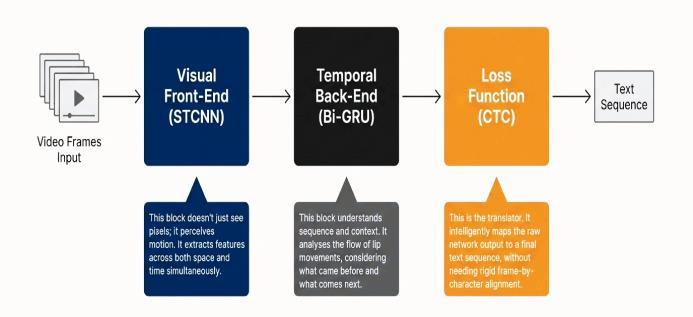
The architecture integrates three major components: spatiotemporal convolutional neural networks for visual featureextraction,bidirectionalrecurrentneuralnetworks fortemporalsequencemodeling,andConnectionistTemporal Classificationforalignment-freedecoding.Thisunifieddesign enables the system to learn both spatial and temporal representationsdirectlyfromrawvideodataandgenerate sentence-levelpredictionsinasingleend-to-endtraining
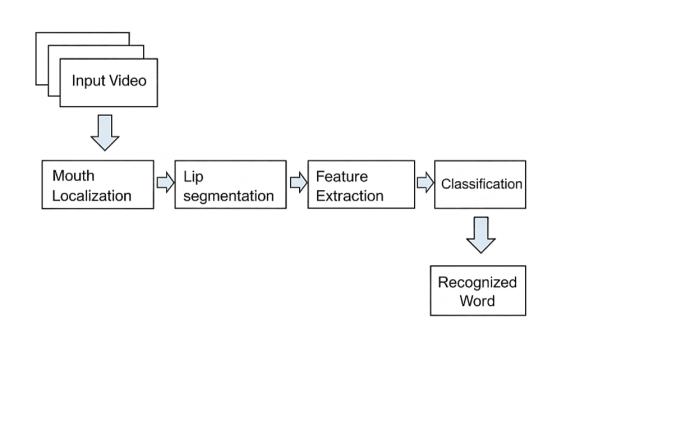
Theinputtotheproposedmodelconsistsofvideosequences capturing the speaker’s mouth region during speech. Each videoissampledatafixedframerateandpreprocessedto isolate the lip Region of Interest (ROI). Cropping the lip regionreducesbackgroundnoiseandensuresthatthemodel focuses on the most informative visual cues relevant to speecharticulation.
AfterROIextraction,thevideoframesareresizedtoafixed spatial resolution and normalized to maintain consistency across samples. The resulting input is represented as a sequence of frames preserving both spatial structure and temporalcontinuity.Thisrepresentationallowsthemodelto effectivelycapturesubtlevariationsinlipmovementsover time,whicharecriticalforaccuratevisualspeechrecognition.
International Research Journal of Engineering and Technology (IRJET) e-ISSN: 2395-0056
Volume: 12 Issue: 12 | Dec 2025 www.irjet.net p-ISSN: 2395-0072
Tocapturebothappearanceandmotioninformationfromlip movements, the proposedsystem employs spatiotemporal convolutional neural networks. Unlike traditional twodimensional convolutions that operate only on spatial dimensions,spatiotemporalconvolutionsextendacrossthe temporal axis, enabling the network to learn short-term motionpatternssuchaslipopening,closing,andarticulation dynamics.
Multiple stacked spatiotemporal convolutional layers are used to progressively extract higher-level visual features. Eachlayerlearnsincreasinglyabstractrepresentationswhile preservingtemporalorder.Thisdesignallowsthesystemto effectively model local temporal dependencies and spatial structurespresentinlipmovementsequences.
Thespatiotemporalfeaturesextractedfromtheconvolutional layers are reshaped into a sequence format and fed into stackedbidirectionalGatedRecurrentUnit(Bi-GRU)layers. These recurrent layers are responsible for modeling longrange temporal dependencies within the visual speech sequence.
Byprocessingthesequenceinbothforwardandbackward directions,thebidirectionalarchitectureallowsthemodelto incorporate contextual information from past and future frames simultaneously. This capability is particularly important for resolving ambiguities caused by visually similar speech units and improving sentence-level recognitionaccuracy.
Ateachtimestep,theoutputofthebidirectionalrecurrent layersispassedthroughafullyconnectedlayerfollowedbya Softmaxactivationtoproduceaprobabilitydistributionover thecharacterset.Inadditiontostandardcharacters,aspecial blanksymbolisincludedtosupportalignment-freetraining.
The model is trained using Connectionist Temporal Classification (CTC) loss, which enables learning without explicit frame-level annotations. During inference, the predictedcharacterprobabilitiesaredecodedusingagreedy orbeamsearchdecodingstrategytogeneratethefinaltextual sentence
2.6
Fullyend-to-endtrainablearchitecture
Norelianceonhandcraftedfeatures
Alignment-freetrainingusingCTCloss
Effectivemodelingofspatialandtemporaldynamics
Suitableforsentence-levelvisualspeechrecognition
3.1
To evaluate the proposed visual speech recognition framework, video samples containing sentence-level lip movementsareusedasinput.Eachvideoisfirstdecomposed intoasequenceofframeswhilepreservingtemporalorder. From each frame, the lip Region of Interest is isolated to eliminateirrelevantfacialandbackgroundinformation.This focused visual representation ensures that the learning processconcentratesonlyonspeech-relatedmotionpatterns.
The extractedlip frames arespatially resizedtoa uniform resolution and normalized to reduce variability caused by illumination differences and camera conditions. By maintainingaconsistentinputformat,themodelisableto learnstablevisualrepresentationsacrossdifferentspeakers andrecordingenvironments.
The proposed model is trained using a fully end-to-end learningapproach,whereallcomponentsofthenetworkare optimizedsimultaneously.Unliketraditionalpipelinesthat require intermediate supervision or phoneme-level annotations,thesystemdirectlylearnsthemappingbetween input video sequences and output text sentences. This is achieved through the use of Connectionist Temporal Classificationloss,whichallowsflexiblealignmentbetween variable-lengthvisualinputsandcharacter-leveloutputs.
During training, the Adam optimization algorithm is employed to update network parameters efficiently. The learningprocessenablesthespatiotemporalconvolutional layers to capture low-level motion dynamics, while the recurrent layers progressively model long-range temporal dependenciesessentialforsentenceunderstanding.
The evaluation of the proposed visual speech recognition systemisdesignedtoassessitsabilitytogeneralizebeyond the training data and accurately interpret unseen visual
International Research Journal of Engineering and Technology (IRJET) e-ISSN: 2395-0056
Volume: 12 Issue: 12 | Dec 2025 www.irjet.net p-ISSN: 2395-0072
speech sequences. Instead of relying solely on numerical accuracy measures, the evaluation emphasizes qualitative and sequence-level analysis of predicted sentences. This approach provides deeper insight into how effectively the model captures temporal dependencies and visual articulationpatterns.
Special attention is given to the system’s behavior when handling visually similar speech units, where multiple phonemes correspond to comparable lip movements. The bidirectional recurrent architecture plays a key role in resolving such ambiguities by leveraging contextual information from surrounding frames. Additionally, the robustness of the model is examined under variations in speaking speed, articulation style, and minor changes in visualquality.
The observed performance indicates that the end-to-end training strategy enables the model to learn stable and discriminativevisualrepresentationswithoutoverfittingto specific speakers or sentence structures. These findings suggest that the proposed framework is well-suited for sentence-levelvisualspeechrecognitionandcanserveasa strong foundation for future extensions involving larger datasetsorreal-timedeploymentscenarios.
Thissectionpresentsthequalitativeresultsobtainedfrom theproposedLipNet-basedvisualspeechrecognitionsystem. The performance of the system is analyzed using sample input frames, extracted lip regions, and predicted textual outputs.Sincetheproposedapproachfocusesonend-to-end visual speech recognition, the evaluation emphasizes qualitativeanalysisandvisualinterpretationofresultsrather thannumericalaccuracymetrics.
Fig.3illustratesasampleinputvideoframetakenfromthe visualspeechdatasetusedfortrainingandevaluationofthe proposedsystem.Thisimagerepresentstherawvisualdata capturedduringspeech,containingthefullfacialregionofthe speaker. Such frames preserve natural variations in facial appearance,lightingconditions,andheadposture,whichare importantfordevelopingarobustvisualspeechrecognition model.

Theuseofreal-worldfacialframesensuresthattheproposed system learns visual speech patterns under realistic conditions.Theseinputframesformtheinitialstageofthe processingpipelinebeforeanyregion-specificpreprocessing is applied, allowing the model to generalize better across differentspeakersandenvironments.
Fig.4illustratesthedetectionofthefacial regionfromthe input image as a preliminary step toward lip localization. Identifyingthefaceregionallowsthesystemtoconstrainthe search space and facilitates accurate extraction of the lip Region of Interest (ROI) in subsequent processing stages. Thisstepensuresthatirrelevantbackgroundinformationis excludedatanearlystage.
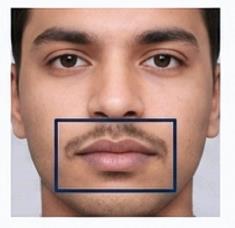
Thislocalizationstepplaysacrucialroleinreducingvisual noise and improvingcomputational efficiency. By focusing processingonthedetectedfacialregion,thesystemenhances robustness and consistency across different speakers, speakingstyles,andrecordingconditions,therebysupporting effectivevisualspeechrecognition.
Fig.5presentsthecroppedlipregionobtainedafterregionof-interestextraction.Thisimageservesastheprimaryvisual input to the deep learningmodel. The extractedlip region
International Research Journal of Engineering and Technology (IRJET) e-ISSN: 2395-0056
Volume: 12 Issue: 12 | Dec 2025 www.irjet.net p-ISSN: 2395-0072
highlightsessentialspeecharticulationfeaturessuchaslip shape, contour variations,and subtle motion patterns that occurduringspokenwords.
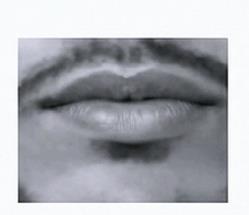
Fig. 5: Segmentedlipregion(grayscale)
Byusingonlythelipregionratherthantheentireface,the computational complexity of the system is reduced while preserving critical visual information required for speech decoding. This focused representation enables the spatiotemporalconvolutionalneuralnetworktolearnfinegrainedvisualfeaturesmoreeffectively,therebyenhancing the overall recognition performance of the proposed framework.
Fig. 6 demonstrates a qualitative result produced by the proposed visual speech recognition system. The system processes a sequence of extracted lip region frames and generatesthecorrespondingtextualoutput,shownhereas thepredictedword “FOOD”.Thisresultconfirmstheabilityof themodeltodecodespokencontentusingvisualinformation alone,withoutrelyingonanyaudioinput.

Fig. 6: Predictedoutputword
Thesuccessfulpredictionhighlightstheeffectivenessofthe end-to-end learning framework, where spatiotemporal feature extraction, bidirectional temporal modeling, and alignment-free decoding work jointly to generate accurate textual outputs. This example validates the practical applicabilityoftheproposedsystemforvisual-onlyspeech recognition tasks such as silent speech interfaces and assistivecommunicationsystems.
The qualitative results indicate that the proposed LipNetbasedarchitectureiscapableoflearningmeaningfulvisual speechrepresentationsfromlipmovements.Theintegration of spatiotemporal convolutional layers allows effective modelingofmotiondynamics,whilebidirectionalrecurrent layerscapturetemporaldependenciesacrossvideoframes. Although visually similar speech units and variations in articulation may still introduce challenges, the observed resultsdemonstratetherobustnessandeffectivenessofthe proposedend-to-endvisualspeechrecognitionapproach.
This section presents a detailed summary of the research outcomesanddiscussespotentialdirectionsforextendingthe proposedwork.
1. Thisresearchproposedanend-to-enddeeplearning framework for sentence-level visual speech recognition based on the LipNet architecture. The systemdirectlytranslatescontinuouslipmovement video sequences into corresponding textual sentences, thereby avoiding the limitations of traditionalmulti-stagelip-readingpipelines.
2. Akeystrengthoftheproposedapproachliesinits unified architecture, which jointly learns spatial, temporal,andsequence-levelrepresentationsfrom raw visual data. By integrating spatiotemporal convolutional neural networks with bidirectional recurrent layers, the system effectively captures both fine-grained liparticulationdetailsandlongrangetemporaldependencies.
3. The spatiotemporal convolutional layers play a crucialroleinlearningmotion-awarevisualfeatures thatrepresentdynamicspeechpatternssuchaslip opening, closing, and transitional movements between phonemes. These features form the foundationforaccuratesequencemodeling.
4. Bidirectional GRU layers enhance temporal understandingbyleveragingcontextualinformation from both preceding and succeeding frames. This bidirectional modeling significantly improves sentence-level coherence and helps resolve ambiguitiescausedbyvisuallysimilarspeechunits.
5. The use of Connectionist Temporal Classification loss enables alignment-free training, allowing the modeltolearnflexiblemappingsbetweenvariablelengthvisualinputsandtextualoutputs.Thisdesign reduces the dependency on precise frame-level annotationsandsimplifiesthetrainingprocess.
International Research Journal of Engineering and Technology (IRJET) e-ISSN: 2395-0056
Volume: 12 Issue: 12 | Dec 2025 www.irjet.net p-ISSN: 2395-0072
6. Overall,theexperimentalfindingsindicatethatthe proposed framework offers improved robustness, scalability, and adaptability compared to conventionalhandcraftedfeature-basedapproaches. The system demonstrates strong potential for practical visual speech recognition applications, particularlyinscenarioswhereaudioinformationis unreliableorunavailable.
1. One important direction for future work is the developmentofareal-timevisualspeechrecognition system. Optimizing the model architecture and reducing computational complexity can enable deploymentonresource-constraineddevicessuchas mobileorembeddedplatforms.
2. Expanding the training dataset to include a larger number of speakers, diverse speaking styles, and varying recording conditions can further improve generalization performance. This would allow the system to handle real-world variability more effectively.
3. Future research can explore the incorporation of attention mechanisms or transformer-based sequencemodelstoenhancelong-rangedependency modeling and improve recognition accuracy for longerandmorecomplexsentences.
4. Anotherpromisingextensioninvolvesmultimodal speech recognition, where visual information is combinedwithaudiosignals.Suchintegrationcan significantly improve robustness in noisy environments and lead to more reliable speech recognitionsystems.
5. The proposed framework can also be adapted for multilingualvisualspeechrecognitionbytrainingon datasets containing multiple languages, thereby extendingitsapplicabilityacrossdifferentlinguistic contexts.
6. Finally,thesystemmaybeintegratedintopractical applicationssuchasassistivecommunicationtools for hearing-impaired individuals, silent speech interfaces, secure communication systems, and advancedhuman–computerinteractionplatforms.
6. REFERENCES
[1] Y. M. Assael, B. Shillingford, S. Whiteson, andN. de Freitas, "LipNet: End-to-End Sentence-Level Lipreading," Proceedings of the IEEE International Conference on ComputerVision(ICCV),pp.1–10,2017.
[2] J.S.Chung,A.Senior,O.Vinyals,andA.Zisserman,"Lip Reading Sentences in the Wild," Proceedings of the IEEE Conference on Computer Vision and Pattern Recognition (CVPR),pp.3444–3453,2017.
[3] M.Wand,J.Koutník,andJ.Schmidhuber,"Lipreading with Long Short-Term Memory," IEEE International Conference on Acoustics, Speech and Signal Processing (ICASSP),pp.6115–6119,2016.
[4] T.Afouras,J.S.Chung,andA.Zisserman,"DeepAudioVisual Speech Recognition," IEEE Transactions on Pattern AnalysisandMachineIntelligence,vol.44,no.12,pp.8717–8731,2022.
[5] G. Potamianos, C. Neti, J. Luettin, and I. Matthews, "Audio-VisualAutomaticSpeechRecognition:AnOverview," IssuesinVisualandAudio-VisualSpeechProcessing,vol.22, pp.23–45,2004.
[6] S.Fenghour,D.Chen,K.Guo,andP.Xiao,"LipReading SentencesUsingDeepLearningwithOnlyVisualCues,"IEEE Access,vol.8,pp.215516–215530,2020.
[7] T.Graves,S.Fernández,F.Gomez,andJ.Schmidhuber, "Connectionist Temporal Classification: Labelling Unsegmented Sequence Data with Recurrent Neural Networks,"Proceedingsofthe23rdInternationalConference onMachineLearning(ICML),pp.369–376,2006.
[8] J.S.ChungandA.Zisserman,"OutofTime:Automated LipSyncintheWild,"AsianConferenceonComputerVision (ACCV),pp.251–263,2016.