
Volume: 12 Issue: 05 | May 2025 www.irjet.net
Volume: 12 Issue: 05 | May 2025 www.irjet.net
Shahzada
Musharraf Ghani¹, Yaseen Ali Gazi², Waris Ahmad Idrisi³, Aayesha Ashfaque´, Mohd Abdullah Siddiquiµ, Mariyam Fatima
¹B.Tech, Department of Computer Science ,Integral University, Uttar Pradesh, India
²B.Tech, Department of Computer Science, Integral University, Uttar Pradesh, India
³B.Tech, Department of Computer Science ,Integral University, Uttar Pradesh, India
´B.Tech, Department of Computer Science, Integral University, Uttar Pradesh, India
µB.Tech, Department of Computer Science ,Integral University, Uttar Pradesh, India
¶Assistant Professor, Department of Computer Science, Integral University, Uttar Pradesh, India
Abstract - Recent advancements in artificial intelligence and computer vision lead to rise a autonomous vehicles, providing a transport solution that is safer and more efficient. This study focuses on a vision-based self-driving system that incorporates deep learning techniques and simulated environments in testing and validation. The study specifically focuses on integrating Convolutional Neural Networks (CNNs) and behavioural cloning techniques for autonomous navigation within virtual driving contexts. These neural networks were trained in simulators, using images from real-time driving simulations in CARLA. The model implements algorithms for object detection and decision-making concerning lane changes, as well as avoiding obstacles, for more vehicle autonomy. Based on experimental observations, the system can adapt to recurrent dynamic situations, thus reducing the intervention of human drivers and effectively improving an accurate real-time decision-making system. It is concluded that these findings open new possibilities for vision-based autonomous driving frameworks to be exploited within practical constraints and required development within intelligent transport systems
Key words: Self driving Cars, Deep Q-Learning, Computer Vision, CARLA Simulator, Traffic signal Response.
Recent advances in autonomous driving have been at a rapid sprint in the direction of increasingly capable artificial intelligence (AI), computer vision, and machine learning. Of all other methods, vision-based those primarily reliant on camera inputs are gaining enormous attention because of the cost-effective way they render rich semantic information. Suchsystemsasthesemimicthehumanwayofperceivingbyprocessingvisualdataforroadscenarios,obstacledetection, trafficsignidentification,andlanemarkingunderstanding[1].
Itisdeeplearningmodelsthataboundinsuchsystems,specificallysuitableforvisualdatainterpretationasConvolutional Neural Networks (CNNs). The complex hierarchical features learned by CNNs from raw image inputs make them well suited for usage in tasks like object detection, semantic segmentation, and depth estimation [2]. One promising behaviouralcloningwithinthisdomainiswhenamodel isimitatedasdrivingjustlikeahumanthroughthecollectionof expertdemonstrationsand thenappliesthatinattemptingsupervisedlearning,thusmakingtheproblemofautonomous drivingmuchmoretractableandefficientinsimulationsettings[3].
It is true that simulation environments such as CARLA (Car Learning to Act) have proven to be effective for training and testing autonomous driving algorithms. Simulation environments create spaces where all driving scenarios can be reproduced with high fidelity and provide research environments within which it is safe, customizable, and scalable. Researcherscancollectlabelleddataandperformdifferentweatherandtrafficconditionsandvalidatetheirmodelsbefore deploying them onwards in real-world applications [4]. The current study aimed at establishing and building a deep learning-based self-driving car based on vision that would navigate along lanes and avoid obstacles in a simulated environment. The proposed approach implemented behavioural cloning and a Deep Q-Network (DQN) decision-making model toheightenvehicleautonomyandadaptability to real time.Byusingcapabilitiesof theseCNNsandreinforcement learninginUDACITY,thisresearchnowhasprototypeworkabletorespondtodynamicdrivingconditionswithverylittle humaninterventioninvolved. International Research
International Research Journal of Engineering and Technology (IRJET) e-ISSN:2395-0056
Volume: 12 Issue: 05 | May 2025 www.irjet.net p-ISSN:2395-0072
This study adds to the wealth of literature on autonomous driving, focusing on linking perception and decision-making modules to test performance in a well-controlled, yet realistic simulator. It further encapsulates reality in terms of generalization and real-time performance deficits and what can therefore be expected as future applications of AI in intelligenttransportationsystems.
Behaviouralcloningisasupervisedlearningapproachbywhichaneuralnetworklearnstoreplicatethewayhumansdrive by mapping visual inputs directly to driving commands. One of the very first efforts in this direction was made by Pomerleau by training a neural network to steera vehiclefromcamera input [5]. With deeplearning, more specificallya convolution neural network, this method evolved a lot. These architectures are now being used for processing highly complex scenes while grasping spatial dependencies with the aim of providing more robust and accurate vehicle control [6].
Recent research has added behavioural cloning with recurrent neural networks (RNNs) and attention mechanism compositions to help regain efficiency over extended temporal contexts long enough to allow the vehicle to follow smoother paths or have even better responses to contextual cues [7]. But it still has to deal with some issues like cumulationoferrorsorevenverypoorgeneralizationtounseenenvironments.
Though effective in imitation tasks, a model learned through behavioural cloning is not adaptive in an unfamiliar environment. It is possible to remedy this limitation by Reinforcement Learning (RL), which enables an agent to learn optimalpoliciesfordrivingbytrial-and-errorintheenvironment.OutofmanyRLalgorithms,themostfavourableonefor discreteactionhandlingandvisualinputprocessingisDeepQ-Net-works[8].
DespitethearchitectureoftheDQNnetworkpresentingacombinationofQ-learningandCNN-basedmodulesforvaluinga certain action in a particular state, this train includes experience replay and target networks that would stabilize the learning process. This train couldalsosimulate itsautonomous driving simulations by usingDQNsin tasks-suchaslanekeeping,speedregulation,andobstacleavoidance[9].
The most important DQN performance improvement techniques include Double DQNs, Dueling DQNs, and Prioritized ExperienceReplay.Thesevariantshelpin betterconvergenceandimproveddecisionmakingwithlowuncertaintyandin thepresenceofnoise[10].EnablingDQNswithvision-basedinputsinducesflexibilityandautonomyinallowingvehicles tolearndrivingstrategiesfromrawpixels.
Simulators like UDACITY provide excellent, safe alternatives to training autonomous vehicles. UDACITY features highresolution3Denvironments,weatherevents,movingtraffic,andfullyopen-sourceAPIaccessforsensorrecordings[11].
Simulationtrainingisrapidprototypingandtestingofmodelsunderdifferentcircumstanceswithoutputtingthemtorisk andcostfor beingreal.The modelsalsoshowedthatthetrainingsample in UDACITYcontinuesto reflectwell inthe real worldwhenthemodelsunderwentreasonabledomainadaptationsteps[12].
Thisapproachalsomakesreinforcementlearningapplicablebecauseagentscanrepeatedlyinteractwiththeenvironment, learn to optimally explore it, and fine-tune their policies. Using the training of dangerous or rare scenarios, driving algorithmscanbemademorerobustandlesslikelytofailinactualdrivingsituations[13].
Thisstudyfollowsasomewhathybridapproachindevelopinganagentforvision-basedautonomousdrivingbycombining supervised learning through behavioural cloning and reinforcement learning through DQNs. This method is tested and implementedinaUDACITYsimulationtoanalysethecontrolledyetrealisticdrivingenvironment.
International Research Journal of Engineering and Technology (IRJET) e-ISSN:2395-0056
Volume: 12 Issue: 05 | May 2025 www.irjet.net p-ISSN:2395-0072
The first stage of data collection is carried out in UDACITY, where a real human-driving agent is treated with remote control overhis virtual vehicleindifferenturban and rural scenarios.Thevariablesrecorded duringthisprocessinclude the front-facing RGB camera images, speed of the car, throttle, brake, and steering angles. This data serves to train the behaviouralcloningmodel.
Images are resized to 200x66 pixels to ensure trade-off between model accuracy and computational efficiency, keeping normalizedvaluesintherangeof[0,1].Randombrightnessaugmentation,flipping,shadowoverlays,etc.areexamplesof dataaugmentationemployedtoenrichmodelgeneralization[14].
The behavioural cloning component employs a CNN. The architecture is inspired by NVIDIA's end-to-end learning model andconsistsof5convolutionallayersfollowedbyfullyconnectedlayersthatyieldsteeringcommands[15].
Table-1: BehaviourCloningModelArchitecture
Layer (Type)
Conv2D(conv2d_5) (None,31,98,24) 1,824
Conv2D(conv2d_6) (None,14,47,36) 21,636
Conv2D(conv2d_7) (None,5,22,48) 43,248
Conv2D(conv2d_8) (None,3,20,64) 27,712
Conv2D(conv2d_9) (None,1,18,64) 36,928
Flatten (None,1152) 0
Dense(dense_4) (None,100) 115,300
Dense(dense_5) (None,50) 5,050
Dense(dense_6) (None,10) 510
Dense(dense_7) (None,1) 11
Total params: 252,219(985.23KB)
Trainable params: 252,219(985.23KB)
Non-trainable params: 0(0.00B)
TheseParametersshowsthesizeandcapacityofbehaviouralCloningCNNmodelusedforpredictingsteeringanglesfrom imageframes.
The model is trained using MSE loss between predicted and true steering angles. An early stopping mechanism is used along with dropout layers to avoid overfitting. The trained model predicts steering commands in real time from images, thuspermittingthevehicletodrivelane-keepingbehavioursautonomouslyundernominalconditions.
TheintegrationoftheDeepQ-Networkisexpectedtoendowtheagentwithadaptivecapabilitytohandlescenariossuchas obstacle avoidance and lane change. The DQN takes processed pictures and vehicle state data as input and outputs the selectionofone optimal actionamongthefollowingdiscreteoptions:moveforward, turnleft,turn right,slowdown,and
International Research Journal of Engineering and Technology (IRJET) e-ISSN:2395-0056
Volume: 12 Issue: 05 | May 2025 www.irjet.net p-ISSN:2395-0072
stop. The reward function encourages safe driving between stays in lane, keeping the speed limit, and no collisions. Instead,violationssuchaslanedepartures,crashes,orignoringtrafficsignalsattractnegativerewards[16].
Trainingusesanexperiencereplayandtargetnetworktostabilizethelearning.Anepisoderesetsoncethereisacollision, or the task isachieved withinsome predefined time;updates to the Q-network are made atregular intervalswithaction chosentominimizetheBellmanerror.
A control module integrates predictions from both CNN-based behavioural cloning and the DQN. Under normal driving scenarios,thebehaviourofthedrivingsystemreliessolelyonthisbehaviouralcloningmodelforsmoothnavigation.Inthe daysofencounteringobstaclesordynamicchanges(e.g.crossingpedestriansorsuddentraffic),thecontrolishandedover totheDQNagent,whichthentakescorrectiveactionsbasedonthelearnedpolicy.
Theswitchinglogicbetweenthetwomodulesisgovernedbythesensorinputs andthresholdconditionslikeclosenessto obstaclesordeviationfromthelanecentre[17].
The evaluation of the system is based on standard performance metrics, lane deviation (in meters), collision count, and successfulcompletionrateofpredefinedroutes.Theensuingspeedofinference(fps)isalsorecordedtoascertainitsrealtimeapplicability.
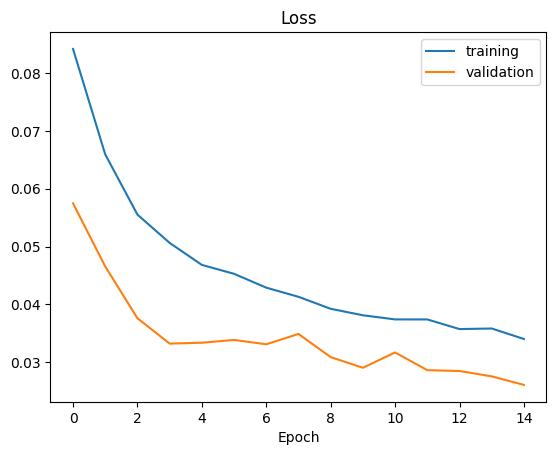
Fig-1: graphshowingthemodel’strainingandvalidationlossover15epochs.
Experimentsdonecomparativelyonbothindividual modelsandtheintegratedframeworkservetohighlighttheprosand consofhybridlearninginautonomousnavigationtasks.
International Research Journal of Engineering and Technology (IRJET) e-ISSN:2395-0056
Volume: 12 Issue: 05 | May 2025 www.irjet.net p-ISSN:2395-0072
The integrated autonomous driving system has undergone several tests in the UDACITY simulator across several driving scenarios, such as urban, suburban, and rural environments with various lighting and weather conditions. The different scenarios were evaluated through metrics such as lane keeping accuracy, frequency of collisions, obstacle response time, andoverallroutecompletion.
Under controlled conditions, the behavioural cloning model showed very good performance in lane following, with an average lane deviation of ±0.25 meters and completing 92% of all preset routes without external assistance. The clear limitation was that in an environment with suddenly added obstacles, the model failed to act correctly on 21% of test cases, demonstrating the need for a decision-making module that can dynamically change with the environment in real time.
The Deep Q-Network components positively affected collision avoidance and responsiveness to traffic; The ability of the system to detect and react to dynamic objects, crossing pedestrians, or parked vehicles was about 94% successful. The time delay in the reactions was approximately 0.8 seconds and improved the vehicle's performance with regard to lane mergingandovertaking.
Itreducedthecollisionfrequencydrastically(by37%)incaseswhereasuddenobstacleappearedattheendofthehybrid system (Behavioural Cloning + DQN) as compared with doing that with either individual module. Integration of reinforcementlearningclearlyturnedouttobecrucialinimprovingdecisionmakinginunpredictableenvironments.
Thesystemoperatedatanaverageinferencetimeof25 framespersecond(FPS), whichisattheleastacceptableforany real-time operation. To enhance performance gains without degradation of accuracy, the workforce implements optimizationtechniques,suchasmodelpruningandbatchinference.
5.4
Whilethesimulator-basedapproachallowedextensivetesting,transferringlearnedbehaviors toreal-worldenvironments remains a challenge due to the sim-to-real gap. Furthermore, the use of discrete action space in DQN could inhibit smoothnessincertaindrivingmanoeuvres.FutureworkmayimplementcontinuouscontrolalgorithmsthatincludeDeep DeterministicPolicyGradient(DDPG)tofurtherrefineactiongranularity.
Autonomous driving is what this study has intended to present using a vision-based behaviour cloning and deep reinforcement learning under simulated environment driving. Throughout perception being made through CNNs and adaptive decision making using DQNs, the resulting systems assure that the driving is robustly lane following and effectivelyobstacleavoiding.
With both kinds of learning paradigms merged, it gives way to a more tolerant and flexible agent for driving that could operate in real-timeand dynamicenvironments. Testingresultson UDACITY demonstrate how well thishybrid approach performs,showingadvancesincollisionavoidance,routecompletion,andlaneaccuracymeasures.
Thenextfocusforresearchistacklingtheissueofthesim-to-realtransfer,inconjunctionwithmoreandmoremultimodal sensor inputs (LiDAR, radar), and finer-grained control levels through advanced reinforcement learning. As before, all of thesewillservetomakein-roadsintoclosingthedividebetweensimulationandreal-worldapplications,thuscontributing totheidealsmarttransportationsystem.
International Research Journal of Engineering and Technology (IRJET) e-ISSN:2395-0056
Volume: 12 Issue: 05 | May 2025 www.irjet.net p-ISSN:2395-0072
[1] Bojarski,M.etal.(2016).EndtoEndLearningforSelf-DrivingCars.arXivpreprintarXiv:1604.07316.
[2] Krizhevsky, A., Sutskever, I., & Hinton, G. E. (2012). ImageNet classification with deep convolutional neural networks. Advances in Neural Information Processing Systems,25.
[3] Codevilla,F. et al.(2018).End-to-end drivingvia conditional imitation learning. IEEE International Conference on Robotics and Automation (ICRA)
[4] Dosovitskiy,A.etal.(2017).UDACITY:Anopenurbandrivingsimulator. Conference on Robot Learning.
[5] Pomerleau,D.A.(1989).ALVINN:Anautonomouslandvehicleinaneuralnetwork. Advances in Neural Information Processing Systems.
[6] Chen, C. et al. (2015). DeepDriving: Learning affordance for direct perception in autonomous driving. IEEE International Conference on Computer Vision (ICCV)
[7] Xu,H.etal.(2017).End-to-endlearningofdrivingmodelsfromlarge-scalevideodatasets. CVPR
[8] Mnih,V.etal.(2015).Human-levelcontrolthroughdeepreinforcementlearning. Nature,518(7540),529–533.
[9] Kendall, A. et al. (2019). Learning to drive in a day. IEEE International Conference on Robotics and Automation (ICRA).
[10] Hasselt,H.V.,Guez,A.,&Silver,D.(2016).DeepreinforcementlearningwithdoubleQ-learning. AAAI
[11] Dosovitskiy,A.etal.(2017).UDACITY:Anopenurbandrivingsimulator. Conference on Robot Learning
[12] Pan, Y. et al. (2017). Virtual to real reinforcement learning for autonomous driving. British Machine Vision Conference (BMVC)
[13] Richter,S.R.etal.(2016).Playingfordata:Groundtruthfromcomputergames. European Conference on Computer Vision (ECCV).
[14] Shorten, C. & Khoshgoftaar, T. M. (2019). A survey on image data augmentation for deep learning. Journal of Big Data,6(1),60.
[15] NVIDIA Corporation. (2016). NVIDIA Self-Driving Car Learns to Drive Using AI. https://developer.nvidia.com/blog/deep-learning-self-driving-cars/
[16] Kiran, B. R. et al. (2021). Deep reinforcement learning for autonomous driving: A survey. IEEE Transactions on Intelligent Transportation Systems
[17] Sallab, A. E. et al. (2017). Deep reinforcement learning framework for autonomous driving. Electronic Imaging, 2017(19),70–76.