
International Research Journal of Engineering and Technology (IRJET) e-ISSN: 2395-0056
Volume: 12 Issue: 05 | May 2025 www.irjet.net p-ISSN: 2395-0072
International Research Journal of Engineering and Technology (IRJET) e-ISSN: 2395-0056
Volume: 12 Issue: 05 | May 2025 www.irjet.net p-ISSN: 2395-0072
Sushant Gupta1, Shashank Mehta2 , Tarun Kumar3 , Shreyas L4
1 B.E. Final Year, Dept. of ISE, Global Academy of Technology, Bangalore, Karnataka, India
2 B.E Final Year, Dept. of ISE, Global Academy of Technology, Bangalore, Karnataka, India
3 B.E. Final Year, Dept. of ISE, Global Academy of Technology, Bangalore, Karnataka, India
4 Asst. Professor, Dept. of ISE, Global Academy of Technology, Bangalore, Karnataka, India
Abstract - Planning group travel involves coordinating various tasks such as organizing destinations, managing expenses, andensuringcollaborationamongparticipants.This paper introduces a cross-platform mobile application developed using React Native that simplifies the travel planning experience, especially for group trips. The app integrates secure user authentication through Google OAuth, with session management handled via JSON Web Tokens (JWT), ensuring data security and user privacy.
Once authenticated, users can create personalized trips that are stored ina MongoDBdatabase.Eachtripfeaturesmultiple tabs, includingOverview, Itinerary, Explore, and Budget, each designedto streamlinedifferentaspectsoftravelorganization. In the Overview tab, users can add points of interest using Google Places Autocomplete. The application also utilizes geolocation services to display recommended places within a 5-kilometer radius using Google Places and Geocoding APIs (Application Programming Interface).
The Itinerary tab allows users to schedule visits to selected locations by assigning them to specific dates, helping users construct a day-by-day travel plan.TheExploretabintroduces nearby restaurantsandattractions,enhancinguserexperience through contextual recommendations. The Budget section enables users to plan expenses by selecting activities and tracking who paid for what individually or in a group setting.
To facilitate collaboration, the app includes a sharing feature that sends trip invites via email, allowing others to join and contribute. By integratingreal-time cloudAPIs andproviding modular functionality, the application enhances user coordination and brings efficiency to group travel planning.
Key Words: React Native, Travel Planner App Itinerary Management, Budget Tracking, Group Collaboration, Cross-platform Mobile Application.
Trip planning is often a complex task, particularly when coordinating with multiple people. From choosing destinations to organizing daily activities and managing expenses, travellers face challenges that require efficient
toolstostreamlinetheprocess.Withthegrowthofmobile technologyandAPIsofferingreal-timedata,moderntravel applications are evolving to become more intelligent, collaborative,anduser-centric.
Thispaperintroducesacross-platformmobileapplication developed using React Native, designed to simplify the processofplanningtrips.Theapp,developedasafinalyear project by a team of three students, integrates various modern technologies including Google OAuth for secure login,JSONWebTokens(JWT)forsessionmanagement,and MongoDBforpersistentdatastorage.Theapplicationallows users to create, manage, and share travel plans in a collaborativeenvironment.
A notable feature of the application is its ability to recommendnearbyattractionsusingtheGooglePlacesAPI and geolocation services, enhancing the trip planning experiencewithdynamicsuggestions.Theitinerarymodule enables users to organize destinations date-wise, while a dedicatedbudgetmanagementtabfacilitatesgroupexpense tracking, categorizing spending based on individuals or groups. A trip sharing feature also allows users to invite othersviaemail,enhancingthecollaborativenatureofthe platform.
This paper presents the motivation, architecture, developmentprocess,implementationdetails,andpotential future enhancements of the application. It also discusses howintegratingvariousAPIsandbackendsystemscreatesa scalable and user-friendly travel solution aligned with moderndevelopmentpractices.
Before beginning the development of the travel planner application,theteamclearlydefinedthefunctionalgoalsand systemrequirements.Corefeaturessuchasauthentication, tripcreation,itineraryplanning,andexpensetrackingwere conceptualizedanddocumentedinastructuredformat.This initialplanningphasewasessentialtoensureasmoothand organizeddevelopmentprocess.
Theapplicationwasdesignedusingamodularapproach,with separate components for each feature to maintain code
International Research Journal of Engineering and Technology (IRJET) e-ISSN: 2395-0056
Volume: 12 Issue: 05 | May 2025 www.irjet.net p-ISSN: 2395-0072
clarityandscalability.Frontendcomponentsweredeveloped usingReactNative,whilethebackendAPIswerestructured usingNode.jsandExpress.Allbusinesslogicanddatamodels weremanagedindependentlybeforeintegratingthemintoa cohesivefull-stacksolution.
Justasformattingiscriticalindocumentation,maintaining cleanandconsistentcodethroughouttheprojectwasakey priority.Propernamingconventions,avoidanceofhardcoded values, and adherence to RESTful API standards helped streamline collaboration among team members. Version control was managed using Git to avoid conflicts and maintaincodeintegrity.
Furthermore, testing and debugging were performed iteratively, and care was taken to avoid redundancy and ensure high code readability. As emphasized in technical documentationpractices,attentionwaspaidtodetail,suchas removing unused code blocks, handling exceptions, and following indentation standards practices that enhanced both code quality and long-term maintainability of the application.
The entire application was developed using modern fullstack development technologies to ensure scalability, responsiveness, and a seamless user experience across mobile platforms. The frontend was built using React Native, which allowed for efficient cross-platform development and a native-like interface. On the backend, Node.js and Express.js wereusedtohandleAPIrequests, authentication,anddataoperations.
Fordatastorage, MongoDB waschosenduetoitsflexibility in managing semi-structured trip data, including itinerary items, budgets, and user collaboration records. To ensure secureandscalableauthentication, Google OAuth 2.0 was integratedandenhancedusing JWT (JSON Web Tokens) for sessionmanagement.
The user interface was designed to be minimalistic yet functional, adhering to responsive design principles. The GooglePlacesAPIandGeocodingAPIwereutilizedtoenable location-basedrecommendations,suchasnearbyattractions withina5kmradius,basedonuser-selecteddestinations.
Special attention was given to consistency in codebase design and UI layout. All screens were styled using standardizedcomponentstoensurevisualharmony.Justas consistent fonts are vital in documentation, consistent component styling and layout grids were maintained throughouttheapp.
This technological stack not only supports the current project requirements but also provides a foundation for futureenhancementssuchasmulti-usertripcollaboration,
expense visualization, and integration with travel service providers.
TheproposedTravelPlannerApplicationisamobilesolution developed using React Native, aimed at simplifying trip planning and enhancing group travel experiences. This systemintegratesseveralmoderntechnologiesandAPIsto offerastreamlinedandinteractiveinterfaceforusers.The first layer of the application includes secure user authenticationusingGoogleOAuth2.0,combinedwithJSON Web Tokens (JWT) for session management and data protection.
Uponsuccessfullogin,userscancreateatrip,whichisstored in a MongoDB database and immediately reflected on the home screen. The app interface is divided into several functionaltabs: Overview, Itinerary, Explore,and Budget. In the Overview section, users can search for places using GooglePlacesAutocompleteandaddthemtotheirtrip.This is further enhanced by showing ten nearby recommended locations within a 5-kilometer radius, derived using geolocationdata(latitudeandlongitude)throughtheGoogle PlacesAPI.
TheItinerarytaballowsuserstoassigntheseselectedplaces to specific dates, enabling a day-wise plan. The Budget sectionenablesuserstotrackexpensesandcategorizethem by individual or group contributions. The Explore tab is intendedtolistrestaurantsandsociallinksrelatedtothetrip destination,whichisstillunderdevelopment.Theapplication alsosupportsgrouptravelfeatures,suchastripsharingvia emailinvitations,allowingotherstojoincollaboratively.
Thissectionoutlinesthefundamentalstructureandmodular architecture that supports the application’s core functionality.
Table -1: ProjectOverview
Features of application
Authenticati on GoogleOAuth Trip creation Create,view andmange trips
Overviewtab Usercanadd places Recommen dation places Usinggoogle geocodingand placesApi
Itinerarytab Datewise planning Explore tab Restaurantand social places(future plans)
BudgetTab Trackexpense andassign payers Trip sharing Sharetripvia emails
2395-0056
Volume: 12 Issue: 05 | May 2025 www.irjet.net p-ISSN: 2395-0072
Theabovetableoutlinesthecorefunctionalitiesintegrated into the travel planner application developed using React Native. The platform provides a seamless experience for users to create, organize, and share trips. Each module addressesaspecificaspectoftravelplanning rangingfrom tripcreationanditinerarymanagementtoexpensetracking and collaborative trip sharing. By incorporating Google’s Places and Geocoding APIs, the system also enables smart location-based recommendations, enhancing user engagement. Future enhancements, such as expanding the Exploretabtoincludedynamiclistingsofnearbyrestaurants andsocialvenues,aimtomaketheapplicationamoreholistic travelcompanion.
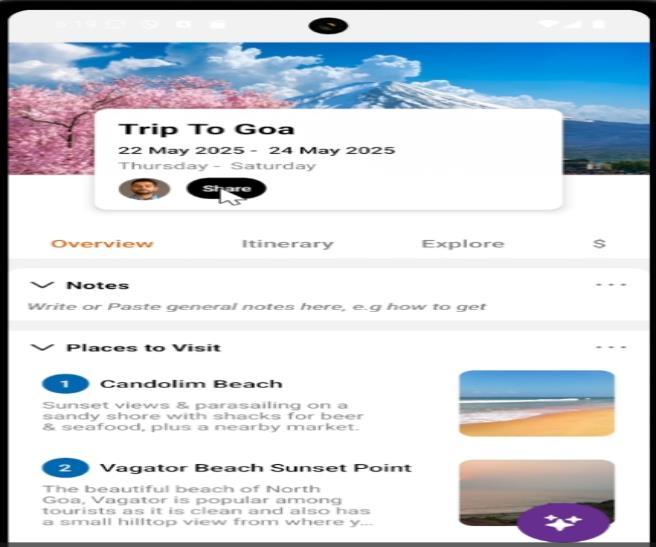
ThefiguredisplaystheOverviewsectionofthetravelplanner mobile application, where users can view trip details, add notes,andmanagealistofplacestovisit.Locationsareadded usingtheGooglePlacesAutocompletefeature,andtheapp offersnearbyrecommendationswithina5kmradiususing Google’sGeocodingandPlacesAPIs.Thisscreenisdesigned to provide a centralized view of the trip and serves as the foundationforbuildingapersonalizeditinerary.
ThetravelplannerapplicationdevelopedusingReactNative successfully addresses the complexities of group travel planningbyintegratingfeaturessuchasitinerarycreation, budgettracking,andcollaborativetripsharing.Withtheuse ofmoderntechnologieslikeGoogleOAuthforauthentication, JWTforsecuresessions,andMongoDBfordatastorage,the system ensures both functionality and scalability. The incorporationofGooglePlacesandGeocodingAPIsenhances the planning experience by offering intelligent locationbased recommendations. Through a modular design and user-friendly interface, the application simplifies the organizationoftripswhileenablingreal-timecollaboration among users. This project demonstrates the potential of cross-platform mobile development in creating practical solutions for real-world problems and lays a strong foundation for future enhancements such as dynamic restaurantlistings,expensevisualization,andmulti-userrole management.
Theauthorswouldliketoexpresstheirsinceregratitudeto the Department of Information Science and Engineering, GlobalAcademyofTechnology,Bangalore,forprovidingthe necessaryguidanceandresourcestocarryoutthisproject. We are especially thankful to our mentor, Mr. Shreyas L, Assistant Professor, for his constant support, valuable feedback,andencouragementthroughoutthedevelopment ofthisapplication.Wealsoacknowledgethecontributionsof ourteammatesfortheircollaborativeeffortsinsuccessfully completingthisfinalyearproject
[1] Gautham Vijayan, “Implementing React Native Map Routes with Google’s Routes API,” Medium, Nov. 24, 2024.[Online].Available:
[2]M.Young,TheTechnicalWriter’sHandbook,MillValley, CA:UniversityScience,1989.
[3] D. Kornack and P. Rakic, “Cell Proliferation without NeurogenesisinAdultPrimateNeocortex,”Science,vol. 294, Dec. 2001, pp. 2127–2130, doi:10.1126/science.1065467.
[4]K.Elissa,“Titleofpaperifknown,”unpublished.
[5]R.Nicole,“Titleofpaperwithonlyfirstwordcapitalized,” J.NameStand.Abbrev.,inpress.
[6] React Native Documentation, “React Native – A framework for building native apps using React,” [Online].Available:https://reactnative.dev/
International Research Journal of Engineering and Technology (IRJET) e-ISSN: 2395-0056
Volume: 12 Issue: 05 | May 2025 www.irjet.net p-ISSN: 2395-0072
[7] Google Developers, “Google Places API,” [Online]. Available: https://developers.google.com/maps/documentation/p laces/web-service/overview
[8]MongoDBInc.,“MongoDB:TheDeveloperDataPlatform,” [Online].Available:https://www.mongodb.com/
[9] Auth0, “What is JSON Web Token (JWT),” [Online]. Available:https://auth0.com/learn/json-web-tokens/
[10] Express.js, “Express - Node.js web application framework,”[Online].Available:https://expressjs.com/
2025, IRJET | Impact Factor value: 8.315 | ISO 9001:2008