
International Research Journal of Engineering and Technology (IRJET) e-ISSN: 2395-0056
Volume: 13 Issue: 03 | Mar 2026 www.irjet.net p-ISSN: 2395-0072
International Research Journal of Engineering and Technology (IRJET) e-ISSN: 2395-0056
Volume: 13 Issue: 03 | Mar 2026 www.irjet.net p-ISSN: 2395-0072
Dr.K.Raghavendar¹, K.Sai Sruthi², G.Shirisha³, K.Nikhil´
1 Associate Professor, Department of Computer Science and Engineering
2,3,4 B.Tech Students, Department of Computer Science and Engineering
Teegala Krishna Reddy Engineering College , Telangana, India
Abstract - Financial fraud has become a major challenge for financial institutions due to the rapid growth of digital transactions and online banking systems. Traditional fraud detection techniques often rely on complex deep learning models such as Deep Neural Networks (DNN) and Recurrent Neural Networks (RNN). Although these models provide high prediction accuracy, they typically operate as black-box systems, making it difficult to understand how decisions are made. Additionally, centralized data processing in traditional systems raises significant concernsrelatedtodataprivacyand security. To address these challenges, this research proposesa financial fraud detection framework that integrates Explainable Artificial Intelligence (XAI) and Federated Learning (FL). The system utilizes the PaySim dataset to analyze transactionpatternsandidentifyfraudulentactivities. Interpretable machine learning algorithms such as Decision Trees, Random Forests, Gradient Boosting Machines, and XGBoost are employed to improve model transparency and predictionaccuracy.Furthermore,FederatedLearningenables decentralized model training across multiple devices without sharing raw financial data, thereby preserving user privacy. Explainability techniques such as SHAP values are used to interpret model predictions and highlight feature importance in fraud detection. Experimental results demonstrate that the proposed approach improves transparency, privacy preservation, and fraud detection performance compared to traditional methods. The integration of Explainable AI and Federated Learning provides a robust and secure framework for developing trustworthy financial fraud detection systems.
Key Words: Financial Fraud Detection, Explainable Artificial Intelligence (XAI), Federated Learning (FL), Decision Tree, Random Forest, Gradient Boosting, XGBoost, Machine Learning, Privacy-Preserving Learning, SHAP Explainability.
Financial fraud has emerged as a significant challenge in modern financial systems due to the rapid expansion of digital payment platforms, online banking, and mobile financialservices.Asdigitalfinancialtransactionscontinue toincreaseglobally,financialinstitutionsprocessenormous volumes of transaction data every day. While these technologies improve accessibility, efficiency, and convenience, they also create new opportunities for
fraudulentactivities.Fraudulentpracticessuchasidentity theft,unauthorizedtransactions,andpaymentmanipulation canleadtosubstantialfinanciallossesforbothindividuals andorganizations.
Traditionally,frauddetectionsystemsreliedonrule-based mechanismsandmanualverificationtechniques.Although theseapproacheswereeffectiveforsmall-scaletransaction monitoring, they struggle to handle large-scale financial datasets and evolving fraud patterns. In recent years, machinelearningandartificialintelligencetechniqueshave beenincreasinglyadoptedtoautomatefrauddetectionand improvepredictionaccuracy.ModelssuchasDeepNeural Networks (DNN) and Recurrent Neural Networks (RNN) have shown strong performance in identifying complex fraudpatterns.However,thesedeeplearningmodelsoften function as “black-box” systems, making it difficult to interpret their decision-making processes. Additionally, many existing fraud detection frameworks rely on centralized data storage, which raises serious concerns regarding data privacy and security.To address these challenges, this research proposes an advanced fraud detection framework that integrates Explainable Artificial Intelligence(XAI)andFederatedLearning(FL).Explainable AI improves transparency by providing interpretable insightsinto model predictions,whileFederatedLearning enablesdecentralizedmodeltrainingwithouttransferring sensitive financial data to a central server. By combining thesetwoapproaches,theproposedsystemaimstoenhance both the transparency and privacy of fraud detection systemswhilemaintaininghighpredictiveperformance.
Theincreasingvolumeofdigitalfinancialtransactionshas significantly increased the risk of fraudulent activities. Financial institutions must analyze massive datasets to identifysuspicioustransactionpatternsandpreventfraud effectively. However, many traditional machine learning modelslacktransparency,makingitdifficultforanalyststo understand how predictions are generated. This lack of interpretabilityreducestrustinautomatedfrauddetection systemsandcreateschallengesforregulatorycompliance.
Furthermore, financial transaction data contains highly sensitive information, including personal and financial details of users. Centralized data processing exposes such
International Research Journal of Engineering and Technology (IRJET) e-ISSN: 2395-0056
Volume: 13 Issue: 03 | Mar 2026 www.irjet.net p-ISSN: 2395-0072
data to potential security breaches and privacy risks. Therefore,thereisastrongneedforfrauddetectionsystems thatnotonlyprovideaccuratepredictionsbutalsoensure data privacy and model interpretability.The motivation behindthisresearchistodevelopatransparentandprivacypreserving fraud detection framework by integrating ExplainableAItechniqueswithFederatedLearning.
Despitetheprogressmadeinmachinelearning-basedfraud detection, several challenges remain unresolved. Deep learning models such as DNN and RNN can achieve high accuracybutoftenlackinterpretability,makingitdifficultfor financial institutions to understand and justify automated decisions.Moreover,manyexistingfrauddetectionsystems relyoncentralizeddatacollectionformodeltraining.Storing large volumes of sensitive financial data in centralized systems increases the risk of data breaches and privacy violations.Therefore,thereisaneedforanadvancedfraud detection system that not only achieves high detection accuracybutalsoensurestransparency,interpretability,and strongdataprivacyprotection.
The primary objective of this research is to develop a financialfrauddetectionsystemthatintegratesExplainable Artificial Intelligence and Federated Learning to enhance transparency, interpretability, and data privacy.The study aims to develop machine learning models capable of accuratelydetectingfraudulentfinancialtransactionsusing the PaySim dataset. It also focuses on implementing interpretable algorithms such as Decision Trees, Random Forests,GradientBoosting,andXGBoosttoimprovemodel explainability.Additionally,FederatedLearningisappliedto enable decentralized model training without sharing sensitive financial data. By achieving these objectives, the proposed system aims to provide a reliable, efficient, and privacy-preservingfrauddetectionframeworksuitablefor real-worldfinancialapplications.
Theproposedsystemintroducesatransparentandprivacypreserving framework for financial fraud detection by integrating Explainable Artificial Intelligence (XAI) and Federated Learning (FL) with interpretable machine learning algorithms. The system is designed to detect fraudulent financial transactions while ensuring that the decision-making process is understandable and that sensitivefinancialdataremainsprotected.
Traditional fraud detection systems rely heavily on deep learningmodelssuchasDeepNeuralNetworks(DNN)and RecurrentNeuralNetworks(RNN).Althoughthesemodels
can achieve high accuracy, they often lack interpretability andrequirecentralizeddata collectionformodel training. This raises concerns related to data privacy, regulatory compliance, and trust in automated decision systems.To address these challenges, the proposed approach utilizes interpretable machine learning algorithms including Decision Trees, Random Forests, Gradient Boosting Machines, and XGBoost. These algorithms provide better transparencyinmodeldecisionswhilemaintainingstrong predictive performance. Additionally, the integration of Federated Learningallowsthemodel to betrainedacross decentralizeddeviceswithouttransferringrawtransaction data to a central server.Explainable AI techniques such as SHAP(ShapleyAdditiveExplanations)areusedtointerpret modelpredictionsbyidentifyingtheimportanceofdifferent transaction features. This helps financial analysts understandthereasoningbehindfrauddetectiondecisions.
The system processes transaction data from the PaySim dataset, which simulates real-world mobile financial transactions.Thedatasetundergoespreprocessing,feature extraction, and model training before generating fraud predictions.
TheproposedsystemutilizesthePaySimdataset,whichisa synthetic financial dataset generated from real mobile money transaction logs. The dataset contains several transactionattributessuchastransactiontype,amount,old balance, new balance, and transaction destination.This dataset provides a realistic representation of financial transaction patterns, enabling the system to learn and identify suspicious behaviors associated with fraudulent activities.Thedatasetisdividedintotrainingandtestingsets toevaluatetheperformanceofdifferentmachinelearning models.
Datapreprocessingisanessentialstepinthefrauddetection process.Rawfinancialtransactiondatamaycontainmissing values, redundant attributes, or inconsistent formats that can negatively impact model performance.During preprocessing, the system performs several operations includingdatacleaning,featureselection,normalization,and removalofirrelevantattributes.Thesestepsensurethatthe dataset is structured and suitable for machine learning modeltraining.Thepreprocesseddataisthentransformed intoaformatcompatiblewithmachinelearningalgorithms to improve prediction accuracy and computational efficiency.
International Research Journal of Engineering and Technology (IRJET) e-ISSN: 2395-0056
Volume: 13 Issue: 03 | Mar 2026 www.irjet.net p-ISSN: 2395-0072
The proposed system employs multiple machine learning algorithms to detect fraudulent transactions. These algorithms are selected based on their interpretability, performance,andabilitytohandlecomplexdatasets.
DecisionTreesprovideahierarchicalstructurefordecisionmakingandalloweasyinterpretationofclassificationrules. RandomForestimprovespredictionaccuracybycombining multiple decision trees and reducing overfitting. Gradient Boosting Machines enhance model performance by sequentially combining weak learners into a strong predictive model. XGBoost further improves gradient boostingbyintroducingoptimizationtechniquesandparallel computation.Thesemodelsanalyzetransactionpatternsand classifyeachtransactionaseitherfraudulentorlegitimate.
Explainable Artificial Intelligence is incorporated into the proposed system to improve transparency in model predictions.Manymachinelearningmodelsoperateasblack boxes, making it difficult for users to understand the reasoning behindpredictions.Toovercome thislimitation, the system uses SHAP (Shapley Additive Explanations) to interpret model outputs. SHAP values measure the contributionofeachfeaturetowardthefinalprediction.By analyzingSHAPvalues,financialanalystscanidentifywhich transaction attributes play the most important role in determining whether a transaction is fraudulent. This improves trust in automated fraud detection systems and supportsregulatorycompliance.
FederatedLearningisintegratedintotheproposedsystem to protect sensitive financial data during model training. Instead of transferring raw data to a central server, the trainingprocessoccurslocallyonmultipledevicesornodes.
Eachlocaldevicetrainsamodelusingitsowndataandsends onlymodelupdates(suchasgradientsorparameters)tothe centralserver.Theserveraggregatestheseupdatestocreate aglobalmodelthatbenefitsfromthecollectiveknowledgeof all devices. This approach ensures that sensitive financial data never leaves its original location, thereby preserving userprivacyandreducingtheriskofdatabreaches.
Thearchitectureoftheproposedfinancialfrauddetection system consists of several interconnected components includingdatacollection,preprocessing,machinelearning model training, explainability module, and federated learning framework.The system first collects transaction data from the PaySim dataset. The data then undergoes preprocessingtoremoveinconsistenciesandprepareitfor
model training. Multiple machine learning models are trainedusingtheprocesseddatasettoclassifytransactions asfraudulentorlegitimate.
The Explainable AI module generates SHAP values to interpretmodelpredictionsandidentifyfeatureimportance. Simultaneously,theFederatedLearningframeworkenables decentralizedmodeltrainingwhilepreservingdataprivacy. Finally, the system outputs fraud detection results and providesexplanationsforeachprediction.
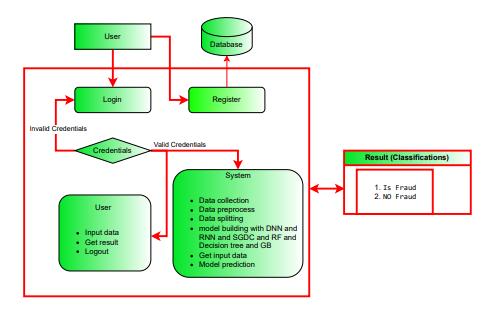
The implementation of the proposed financial fraud detection system focuses on integrating machine learning techniqueswithExplainableArtificialIntelligence(XAI)and Federated Learning (FL) to accurately detect fraudulent financial transactions while ensuring data privacy. The system is developed using the Python programming languagealongwithseveralmachinelearninglibrariessuch as Scikit-learn, TensorFlow, and XGBoost. The PaySim dataset is used for training and evaluating the predictive models.Theimplementationprocessinvolvesseveralstages including dataset collection, data preprocessing, model training,explainabilityanalysis,andpredictiongeneration through a web-based interface. Each stage contributes to improvingtheefficiency,reliability,andtransparencyofthe frauddetectionsystem.
The proposed system consists of multiple functional modules that collectively perform fraud detection tasks. These modules ensure proper data processing, model training,predictiongeneration,andresultinterpretation.
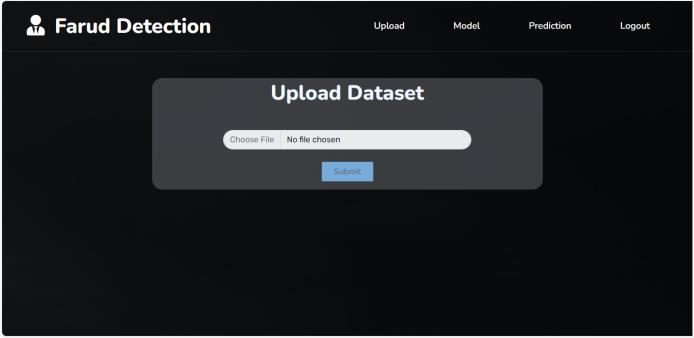
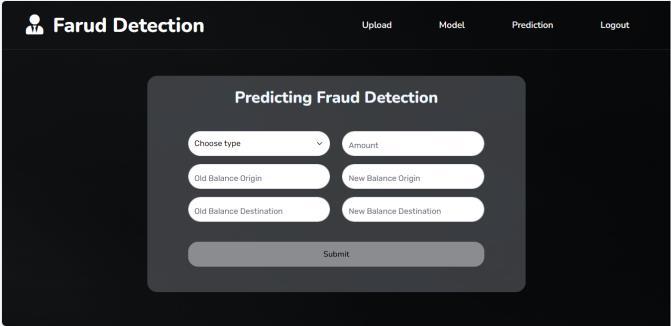
TheUserInterfaceModuleallowsuserstointeractwiththe systembyprovidingfunctionalitiessuchasuserregistration, login,datasetupload,modelselection,andtransactioninput forprediction.TheDatasetUploadandManagementModule enables users to upload the PaySim dataset. This module
Volume: 13 Issue: 03 | Mar 2026 www.irjet.net p-ISSN: 2395-0072
validates the dataset format and allows users to view transaction records for analysis. The Data Preprocessing Module prepares the dataset for machine learning model training.Itperformsoperationssuchasremovingirrelevant attributes, handling missing values, encoding categorical variables,andfeatureextractiontoimprovemodelaccuracy. The Machine Learning Training Module trains multiple machinelearningalgorithmsusingtheprocesseddatasetto classify transactions as fraudulent or legitimate. The PredictionModuleallowsuserstoinputtransactiondetails and obtain fraud prediction results. Finally, the Explainability and Visualization Module interprets model predictions using SHAP values and presents performance metrics such as accuracy scores, confusion matrices, and ROCcurves.
ThePaySimdatasetisusedfortrainingandevaluatingthe fraud detection models. This dataset simulates mobile financial transactions and contains features such as transaction type, transaction amount, sender balance, receiverbalance,andtransactiondestination.
Before model training, the dataset undergoes several preprocessing steps to ensure data quality. These steps include removing redundant attributes, converting categoricalvariablesintonumericalform,andnormalizing numerical features. The processed dataset is then divided into training and testing subsets to evaluate model performance.
Severalmachinelearningalgorithmsareimplementedinthe proposed system to detect fraudulent transactions. These algorithmsareselectedbasedontheirabilitytohandlelarge datasets and provide reliable predictions. A Deep Neural Network (DNN) is used to capture complex patterns in transactiondatausingmultiplehiddenlayers.ARecurrent NeuralNetwork(RNN)isimplementedtoanalyzesequential relationships between transactions, which is useful for identifyingfraudpatternsovertime.TheStochasticGradient Descent Classifier (SGDC) is employed as an efficient optimization-basedclassificationmodelthatprocessesdata iteratively, making it suitable for large-scale datasets. The DecisionTreealgorithmisusedasaninterpretablemodel that classifies transactions based on hierarchical decision rules.
The Random Forest algorithm improves prediction performancebycombiningmultipledecisiontrees,thereby reducing overfitting and improving classification accuracy.Additionally, Gradient Boosting and XGBoost algorithms are implemented to enhance predictive performance by sequentially combining weak learners to minimizeclassificationerrors.
Toimprovetransparencyinfrauddetectiondecisions,the system integrates Explainable Artificial Intelligence techniques using SHAP (Shapley Additive Explanations) SHAP values quantify the contribution of each feature toward the final prediction generated by the machine learning model.SHAP analysis helps visualize feature importanceandexplainshowdifferenttransactionattributes influence fraud predictions. For instance, features such as transactionamount,balancedifference,andtransactiontype maysignificantlyimpactthe classificationoutcome.These insightsenablefinancialanalyststobetterunderstandthe model'sdecision-makingprocess.
Federated Learning is incorporated into the proposed systemtoensureprivacy-preservingmodeltraining.Instead oftransferringrawfinancialtransactiondatatoacentralized server, the training process occurs locally on multiple devices or nodes. Each local model is trained using the availabledataandonlythemodelupdatesaretransmittedto a central server. The server aggregates these updates to createaglobalmodelthatbenefitsfromknowledgelearned across all devices. This decentralized learning approach ensures that sensitive financial data remains on local devices,therebyreducingtheriskofdatabreaches.
The system is deployed through a web-based interface developedusingPythonframeworks.Theinterfaceallows userstouploaddatasets,selectmachinelearningalgorithms, andperformfraudpredictiontasks. Thesystemgenerates prediction outputs indicating whether a transaction is fraudulentorlegitimate.Inaddition,theinterfaceprovides visualoutputssuchasconfusionmatrices,ROCcurves,and SHAP feature importance graphs to help users interpret modelperformance.
International Research Journal of Engineering and Technology (IRJET) e-ISSN: 2395-0056
Volume: 13 Issue: 03 | Mar 2026 www.irjet.net p-ISSN: 2395-0072
Theperformanceoftheproposedfinancialfrauddetection system was evaluated using the PaySim dataset. Multiple machine learning algorithms were implemented and compared to analyze their effectiveness in detecting fraudulenttransactions.Theevaluationwasconductedusing standardperformancemetricsincludingaccuracy,precision, recall, F1-score, and confusion matrix. The dataset was dividedintotrainingandtestingsubsetstoensureunbiased model evaluation. After preprocessing, several machine learning algorithms such as Deep Neural Network (DNN), Recurrent Neural Network (RNN), Stochastic Gradient Descent Classifier (SGDC), Decision Tree, Random Forest, GradientBoosting,andXGBoostweretrainedandtestedfor fraudclassification.
Toevaluatetheeffectivenessofthefrauddetectionmodels, severalperformancemetricswereused.Accuracymeasures theproportionofcorrectlyclassifiedtransactions.Precision indicatesthepercentageofpredictedfraudulenttransactions thatareactuallyfraudulent. Recall measurestheability of themodeltocorrectlyidentifyfraudulenttransactions.The F1-score provides a balanced measure of precision and recall,whichisparticularlyusefulforhandlingimbalanced datasets. Additionally, the confusion matrix was used to analyze the classification results by identifying true positives,truenegatives,falsepositives,andfalsenegatives.
Theexperimentalresultsdemonstratethatmachinelearning models are capable of effectively detecting fraudulent transactions. Among the evaluated algorithms, ensemble learning techniques such as Random Forest, Gradient Boosting,andXGBoostachievedhigherpredictionaccuracy compared to traditional models. Decision Tree models provided interpretable classification rules, while Random Forest improved model stability by combining multiple decision treesand reducing overfitting. Gradient Boosting andXGBoostfurtherenhancedpredictionperformance by sequentiallyminimizingclassificationerrors.Althoughdeep
learningmodelssuchasDNNandRNNalsoachievedgood detection performance, they lacked interpretability when comparedwithtree-basedensemblemodels.
ExplainableArtificialIntelligencetechniqueswereappliedto interpretthepredictionsgeneratedbythemachinelearning models.SHAP(ShapleyAdditiveExplanations)valueswere used to measure the contribution of different features in determining fraud predictions. The analysis revealed that featuressuchastransactionamount,balancedifference,and transaction type significantly influence the detection of fraudulenttransactions.SHAP-basedexplanationsimprove transparency by providing insights into how the model arrivesatitspredictions.
Acomparativeanalysisofallimplementedmodelsindicates that ensemble learning algorithms outperform individual models in terms of prediction accuracy and stability. RandomForestandXGBoostachievedthebestperformance among the evaluated algorithms. The integration of Explainable AI improves model transparency, while Federated Learning ensures privacy-preserving model training. Overall, the proposed system demonstrates effective fraud detection capability while maintaining transparencyanddataprivacy,makingitsuitableforrealworldfinancialsecurityapplications.
Financial fraud detection has become increasingly critical withthe rapidgrowthofdigital financial transactionsand onlinebankingsystems.Traditionalfrauddetectionmethods often rely on complex deep learning models that achieve high accuracy but lack transparency and depend on centralizeddataprocessing,whichraisesconcernsregarding interpretabilityanddataprivacy.
In this research, a financial fraud detection framework integrating Explainable Artificial Intelligence (XAI) and Federated Learning (FL) was proposed to address these challenges.ThesystemutilizesthePaySimdatasettoanalyze transactionpatternsanddetectfraudulentactivitiesusing multiple machine learning algorithms, including Decision Tree, Random Forest, Gradient Boosting, XGBoost, Deep NeuralNetwork(DNN),RecurrentNeuralNetwork(RNN), andStochasticGradientDescentClassifier(SGDC).
The experimental results show that ensemble learning methods such as Random Forest and Gradient Boosting achievehigherpredictionaccuracyandstabilitycomparedto traditional models. Additionally, the use of Explainable AI techniquessuchasSHAPvaluesimprovesthetransparency of model predictions by identifying the contribution of
International Research Journal of Engineering and Technology (IRJET) e-ISSN: 2395-0056
Volume: 13 Issue: 03 | Mar 2026 www.irjet.net p-ISSN: 2395-0072
differenttransactionfeatures.Thisenablesfinancialanalysts tobetterunderstandthemodel’sdecision-makingprocess. Furthermore,theintegrationofFederatedLearningenables privacy-preservingmodeltrainingbyallowingdecentralized learning across multiple devices without sharing raw financialdata.Thisapproachsignificantlyreducestheriskof data breaches while maintaining effective fraud detection performance.
Although the proposed financial fraud detection system improvestransparency,accuracy,andprivacypreservation, there are several opportunities for further enhancement. Future research can focus on integrating more advanced machinelearninganddeeplearningtechniquestoimprove thedetectionofcomplexfraudpatterns.Hybridmodelsthat combine interpretable algorithms with advanced architectures such as transformer-based models or graph neuralnetworkscouldbeexploredtocapturemorecomplex relationships within financial transaction data.Another potential direction is the development of real-time fraud detection systems capable of analyzing streaming transaction data and identifying suspicious activities instantly.Suchsystemswouldenablefinancialinstitutionsto preventfraudulenttransactionsbeforetheyarecompleted, thereby reducing financial losses and enhancing system security.Inaddition,thefederatedlearningframeworkused in this research can be further strengthened by incorporating techniques such as differential privacy and secureaggregation.Theseapproachescanprovideadditional protection for sensitive financial data while maintaining collaborative model training across decentralized devices.Future research may also involve evaluating the proposedsystemonlarge-scalereal-worldfinancialdatasets from multiple institutions to assess its scalability and robustness. Moreover, integrating advanced visualization and explainability tools could further improve the interpretabilityof model predictionsforfinancial analysts andregulatoryauthorities.
[1] UK Finance, “Annual Fraud Report 2022,” UK Finance, 2022.[Online].Available: https://www.ukfinance.org.uk/policy-andguidance/reports-and-publications/annual-fraud-report2022
[2]A.Abdallah,M.A.Maarof,andA.Zainal,“FraudDetection System: A Survey,” Journal of Network and Computer Applications,vol.68,pp.90–113,Jun.2016.
[3] A. Pascual, K. Marchini, and S. Miller, “Identity Fraud: SecuringtheConnectedLife,”JavelinStrategy &Research, 2017.
[4] S. Bhattacharyya, S. Jha, K. Tharakunnel, and J. C. Westland, “Data Mining for Credit Card Fraud: A ComparativeStudy,”DecisionSupportSystems,vol.50,no.3, pp.602–613,Feb.2011.
[5]L.T.Rajesh,T.Das,R.M.Shukla,andS.Sengupta,“Give and Take: Federated Transfer Learning for Industrial IoT Network Intrusion Detection,” arXiv preprint arXiv:2310.07354,2023.
[6]S.Vyas,A.N.Patra,andR.M.Shukla,“Histopathological Image Classification and Vulnerability Analysis Using FederatedLearning,”arXivpreprintarXiv:2306.05980,2023.
[7]R.J.BoltonandD.J.Hand,“StatisticalFraudDetection:A Review,”StatisticalScience,vol.17,no.3,pp.235–255,Aug. 2002.
[8]H.vanDriel,“FinancialFraud,Scandals,andRegulation:A Conceptual Framework and Literature Review,” Business History,vol.61,no.8,pp.1259–1299,Nov.2019.
[9]G.M.Trompeter,T.D.Carpenter,N.Desai,K.L.Jones,and R. A. Riley, “A Synthesis of Fraud-Related Research,” Auditing:AJournalofPractice&Theory,vol.32,no.S1,pp. 287–321,May2013.
[10] P. Raghavan and N. E. Gayar, “Fraud Detection Using MachineLearningandDeepLearning,”inProceedingsofthe InternationalConferenceonComputationalIntelligenceand KnowledgeEconomy(ICCIKE),2019,pp.334–339.