
International Research Journal of Engineering and Technology (IRJET) e-ISSN: 2395-0056
Volume: 12 Issue: 09 | Sep 2025 www.irjet.net p-ISSN: 2395-0072
International Research Journal of Engineering and Technology (IRJET) e-ISSN: 2395-0056
Volume: 12 Issue: 09 | Sep 2025 www.irjet.net p-ISSN: 2395-0072
Akshay Giramallayya Mathapati1, Prof.R.T. Bansode2
Fabtech Technical Campus College of Engineering and Research Sangola ***
Theincreasingdemandforefficientandsustainableenergysolutionshasledtothedevelopmentoftransformerlessphotovoltaic (PV)systems,whicharedesignedtooptimizetheintegrationofsolarpowerwithresidentialgridinterfaceswhileminimizing harmonic distortion. This study focuses on the design, analysis, and optimization of a transformerless PV system aimed at improving energy conversion efficiency, reducing harmonic distortion, and ensuring grid compliance for residential applications. The proposed system utilizes a novel inverter topology that eliminates the need for traditional transformers, significantlyreducingpowerlossesandsystemcostswhilemaintaininghighperformance.Thekeysolutionimplementedisan inverterwithatotalharmonicdistortion(THD)of2-3%,wellbelowtheIEEE1547standardof5%,ensuringthattheoutput currentmeetsgridqualitystandards.Tofurtherreduceharmonicsandimprovepowerquality,thesystememploysanLCLfilter andbipolarsinusoidalpulse-widthmodulation(SPWM)switching.Theresultsofsimulationsshowthattheinverterproducesa sinusoidalcurrentandvoltagethatareperfectlyinphase,yieldingaunitypowerfactorandstableoutput,whichiscriticalfor seamlessintegrationwiththeresidentialgrid.Additionally,thesystemintegratesabatterystoragesolutionthatdynamically compensates for variations in solar generation, maintaining stable power output even during periods of low irradiance. The battery storage also helps in optimizing energy utilization and reducing voltage fluctuations. Control strategies, including maximumpowerpointtracking(MPPT)andbatterymanagement,havebeenimplementedandsuccessfullyvalidated,withthe systemshowingfastresponsetimes(within0.1-0.2seconds)toenvironmentalchangessuchasfluctuatingsolarirradiance.The resultsconfirmthatthetransformerlessPVsystemnotonlyachieveshighefficiencyandlowTHDbutalsooffersacost-effective solutionforresidentialsolarpowergeneration.Furthermore,thesimulationmodelismodularandscalable,allowingforfuture expansionandtheincorporationofadvancedgridfeatures,suchasreactivepowercontrolandfaultride-through,ensuringlongtermadaptabilityandcompliancewithgridrequirements.ThisstudyhighlightsthepotentialoftransformerlessPVsystemsas a reliable, efficient, and cost-effective solution for residential energy needs, contributing to the broader goals of energy sustainabilityandgridmodernization.
Keyword- MaximumPowerPointTracking(MPPT),Compliance,UnityPowerFactor,ResidentialSolarPower
Withthegrowingdemandforclean,renewableenergy,photovoltaic(PV)systemshavebecomeanintegralpartofresidential electricitygeneration.However,thechallengeliesnotonlyinharnessingsolarenergyefficientlybutalsoinensuringthat the generatedpoweris seamlesslyintegratedinto the residential electrical gridwhile minimizing disruptions[1]. One significant issuethatcanariseduringthisintegrationistheproductionofharmonics distortionsinthenormalwaveformoftheelectrical current[2]. Harmonics are typically caused by nonlinear loads, such as inverters that convert DC (Direct Current) electricity fromsolarpanelsintoAC(AlternatingCurrent)electricityforresidentialuse.Theseharmonicdistortionscaninterferewiththe properfunctioningofhouseholdappliances,causeoverheatingoftransformersandotherelectricalcomponents,anddegrade theoverallpowerquality[3].Inresponsetothesechallenges,transformerlessphotovoltaic(TL-PV)systemshaveemergedas aninnovativesolutiontooptimizetheinterfacebetweenresidentialPVsystemsandtheelectricalgrid[4].Unlikeconventional PVsystemsthatutilizeatransformertostepuporstep-downvoltagelevels,transformerlessinvertersusemorecompactand efficientdesignsthatreducesystemcostsandimproveoverallenergyefficiency.Theeliminationofthetransformer,however, introduces potential concerns related to harmonic distortion[5] Transformer less inverters are known to generate higher harmoniccontentcomparedtotheirtransformer-basedcounterparts,primarilyduetotheabsenceofisolationbetweenthegrid andthePVsystem[6].Themainobjectiveofoptimizingtheresidentialgridinterfacewithreducedharmonicsistoensurethe efficient and smooth integration of solar energy into the power grid while maintaining power quality and compliance with regulatory standards[7]. Advances in power electronics, modulation techniques, and grid synchronization algorithms are helpingtomitigateharmonicdistortionsandensurethattheoutputfrom transformerlessPVsystemsisascleanaspossible.
International Research Journal of Engineering and Technology (IRJET) e-ISSN: 2395-0056
Volume: 12 Issue: 09 | Sep 2025 www.irjet.net p-ISSN: 2395-0072
This research delves into the principles, benefits, and challenges associated with transformer less PV systems, focusing on methodstooptimizeharmonicreductionwhileenhancingtheoverallperformanceofresidentialPV-gridinterfaces.
Mr.P.S.Chirmadeetal.(2022)proposedasingle-phaseinverter-basedphotovoltaic(PV)systemforgridconnectionusingthe Perturb&Observemethodtomaintainthemaximumpowerpoint[8].Toreduceweightandsimplifyinductordesign,adoubletuned filter is introduced, enhancing energy quality and mitigating 2nd and 4th-order harmonics[9]. A modified heart rate switchisusedwithamagneticDC-linkinductortooptimizeswitching.Thesystemusesacurrentsourceinverter(CSI)witha modifiedIGBTandissimulatedundertwoscenarios:withhighandlowinductorvalues,thelatterusingthedouble-tunedfilter for improved performance[10]. Mohsen Shayestegan et al. (2018) present a detailed review of photovoltaic (PV) systems, including grid-connected inverters, MPPT strategies, control systems, and switching devices[11]. The study categorizes literatureonPVsystems,DC/DCboostconverters,and DC/ACinverters,focusing oncontrollertypesforpowertrackingand voltage stabilization. It also analyzes inverter topologies concerning ground leakage currents, MPPT techniques, and design principlesofpowerconverters.Thepaperconcludeswithsimulationresultstoguidethedevelopmentofnext-generationgridconnected PV systems[12] Talada Appala Naidu et al. (2023) study the impact of increasing photovoltaic (PV) adoption on powerqualityatthepointofcommoncoupling(PCC),highlightingissueslikeharmonicsandvoltagefluctuations.Theresearch reviewsinvertertopologies,controlmethods,andmitigationstrategies[13].UsingMATLAB/Simulinkandreal-timeOPAL-RT simulations,thestudyanalyzesharmonicsourcesinfluencedbysolarradiationandloadvariations,providinginsightsfromboth offlineandreal-timescenarios[14]
Khanetal.(2020)reviewtransformerlessinvertersinPVsystems,whichavoidbulky,costlytransformerstoimproveefficiency andpowerdensity[15].However,thisincreasestheriskofleakageandgroundfaultcurrents,requiringstrictcompliancewith safetystandards(e.g.,IEEE1547.1,IEC61727)[16].Thepaperexploresvarioustechniquestominimizeleakagecurrents,such as DC-AC decoupling and CM voltage control, along with MPPT integration[17]. It classifies multiple inverter topologies, compares their performance through PLECS simulations, and analyzes cost, size, and thermal characteristics. A technology roadmapisalsoprovidedforfuturePVsystemdevelopment.AlbertAlexanderetal.(2016)reviewpowerqualityenhancement techniques for solar PV inverters, focusing on harmonic reduction through various modulation algorithms. Harmonic issues from non-linear devices and capacitors impact distribution systems[18]. The study proposes a multi-stage inverter with modified multicarrier modulation in a single-chip controller, suitable for both grid-connected and standalone systems[19] Simulationandexperimentalresultsfroma3kWpPVplantshowimprovedpowerqualityandstableoutputvoltagedespitePV variations, making itsuitable for the Indiansubcontinent. VijaykumarS.Kamble et al.(2025)highlight the urgentneedfor a shiftto renewable energydue tofossil fuel depletionandclimate change.Amongalternatives,solarenergystandsout for its abundanceandeco-friendliness.Thestudyfocusesonthedesignandperformance evaluationofarooftopgrid-connectedPV system in a solar-rich region[20]. Emphasizing power quality, it addresses harmonic issues caused by power electronic componentsusingsimulationtoolsfor harmonicmitigation,aiming to improve the integrationofPVsystemsintothe power grid[21].SharvendraKumarMoreetal.(2023)presentacomprehensivereviewoftransformerlessgrid-connectedinverters, highlightingtheirgrowingimportanceduetohighefficiency,compactsize,andlowercosts[22].Thepaperexaminesoperational principles,keytopologies,advantages,challenges,andfutureprospects.Itsystematicallyanalyzesrecentresearchandindustry trendstoprovideinsightsintothecurrentstateanddevelopmentoftransformerlessinvertertechnology[23].
This research adopts a simulation-based approach using MATLAB/Simulink to optimize the residential grid interface of transformer less photovoltaic (PV) systems and reduce harmonic distortions[24]. The methodology involves developing a comprehensive Simulink model of the PV system, including the photovoltaic array, maximum power point tracking (MPPT) algorithm, inverter topology, and grid interface. The study aims to analyze the system’s performance in terms of efficiency, harmonicdistortion,andstability.
International Research Journal of Engineering and Technology (IRJET) e-ISSN: 2395-0056
Volume: 12 Issue: 09 | Sep 2025 www.irjet.net p-ISSN: 2395-0072
AdetailedSimulinkmodelwillbecreatedtosimulatethetransformerlessPVsystem.Themodelwillincludekeycomponents suchasthePVarray,DC-DCconverter,inverter,andgridinterface[25].Eachsubsystemwillbedesignedandtestedindividually beforebeingintegratedintothecompletesystem.Themodelwillbeverifiedandanalyzedforperformance.
The PV array will be modeled using standard parameters (open-circuit voltage, short-circuit current, and temperature coefficients)toreplicatereal-worldsolarpowergenerationbehavior[26].Thesystemwillbesimulatedundervaryingirradiance andtemperatureconditions,andthecurrent-voltage(I-V)andpower-voltage(P-V)characteristicswillbeanalyzed.
3.4
The Perturb and Observe (P&O) MPPT algorithm will be implemented to ensure maximum power extraction from the PV array[27].Thecontrollerwilldynamicallyadjustthedutycycleoftheboostconvertertomaintainoptimalpoweroutput.The performanceoftheMPPTalgorithmwillbeevaluatedthroughsimulationsunderdifferentirradiationlevels.
Varioustransformerlessinvertertopologies(H5,HERIC,NPC)willbeanalyzedfortheirharmonicperformanceandefficiency. TheSinusoidalPulseWidthModulation(SPWM)techniquewillbeusedtocontroltheinverter,andadvancedcontrolstrategies (PIorMPC)willbeimplementedtoregulateoutputvoltageandcurrent[28].Theinverter’sperformancewillbe evaluatedin termsofvoltageregulation,currentwaveformquality,andTHDreduction.
The inverter output will be integrated into a simulated residential grid, with the grid’s voltage, frequency, and impedance parametersmodeled[29].HarmonicanalysiswillbeperformedusingFastFourierTransform(FFT)tocomputeTotalHarmonic Distortion(THD)andensurecompliancewithIEEE519standards.
Thesystemwillbetestedundervariousoperatingconditions(irradiance,temperature,andloadchanges)toassessitsefficiency, powerquality,andharmonicdistortion[30].Optimizationtechniqueswillbeappliedtoimprovesystemperformancebyfinetuning MPPT parameters, inverter control strategies, and filtering methods to reduce harmonics. A comparative analysis of differentconfigurationswillbeconductedtoidentifytheoptimalsystemdesignforresidentialgridintegration.
ThefollowingtablesummarizesthekeycomponentsandparametervaluesusedintheSimulinkmodelofthetransformerless photovoltaic(PV)invertersystem.Theseparameterswereconfiguredtosimulatearealisticgrid-tiedPVsystemwithbattery storage and effective power conditioning. Each component plays a vital role in ensuring stable operation, efficient energy conversion,andcompliancewithgridstandards.
Component
PVArray Irradiance 1000W/m²
PVArray Temperature 25°C
BoostConverter Inductor 2.5mH
BoostConverter SwitchingFrequency
BoostConverter Capacitor 470µF
MPPT Algorithm Perturb&Observe
Battery NominalVoltage 24V
International Research Journal of Engineering and Technology (IRJET) e-ISSN: 2395-0056
Volume: 12 Issue: 09 | Sep 2025 www.irjet.net p-ISSN: 2395-0072
Battery RatedCapacity
100Ah
BidirectionalConverter Type Buck-Boost
Inverter
Inverter
InverterControl
Topology Full-Bridge(H-Bridge)
SwitchingFrequency 10kHz
PWMTechnique
BipolarSinusoidalPWM
LCLFilter Inductors 2×1mH
LCLFilter Capacitor 470µF
Grid Frequency 50Hz
Grid Voltage(RMS) 230V
AND DISCUSSION
5.1 Battery Scope - Voltage, Current, Frequency, and DC Link Behavior
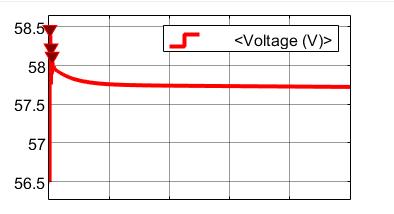
Fig 1. VoltageMeasurement
Thevoltagedecayovertime,withaninitialvalueofapproximately58.5V,whichdecreasessteadilytowardsafinalvaluenear 57.5 V. The graph is characterized by an exponential decline, typical of systems experiencing discharging behavior, such as capacitor discharge or battery drainage. At the start, the voltage rapidly drops and then stabilizes, signifying the system's tendencytosettleatasteadystate.Thesharpdeclineisfollowedbyalesssteepcurve,indicatingdiminishingdischargerates.
International Research Journal of Engineering and Technology (IRJET) e-ISSN: 2395-0056
Volume: 12 Issue: 09 | Sep 2025 www.irjet.net p-ISSN: 2395-0072
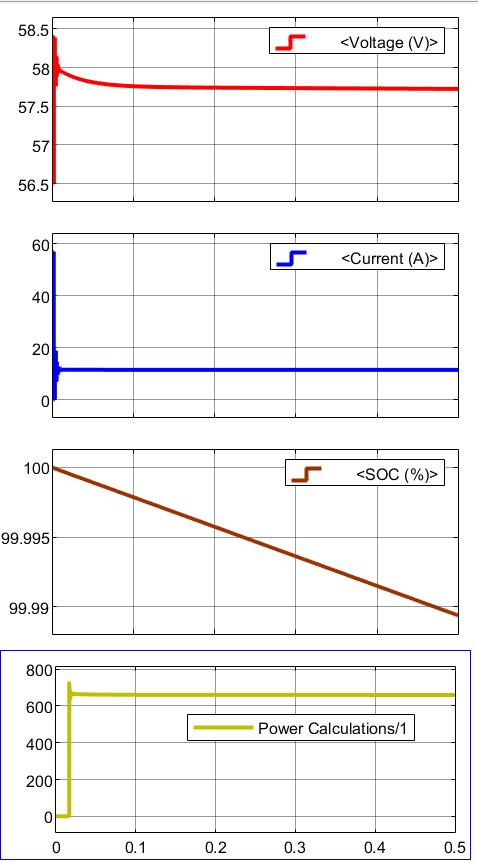
• Voltage (V):Thevoltagestartsfromaround58.5Vandgraduallydecreaseswithtime,stabilizingaround57.5V.This changeindicatesthedischargeofthebattery,typicalduringusagewhenenergyisdrawnfromthebattery.Thesteep declineatthebeginningofthegraphsuggestsanimmediatedropwhenthebatteryloadisapplied.
• Current (A): The current profile shows a constant value, approximately 20 A, which indicates a steady discharge current. This could be due to a device or system drawing a fixed current from the battery. The flatness of the graph suggestsaconstantdemand,withoutanysignificantfluctuations.
• SOC (%):TheStateofChargedecreasesfrom100%tojustbelow100%,indicatingthatthebatteryisdischarging.The graphshowsagradualslope,reflectingtheenergyconsumptionovertime.Theminordecreaseistypicalforabattery thatisnotfullydrainedbutisstillinactiveuse,possiblyforaprolongedperiod.
• Power Calculations: The power profile in the final graph shows a stable output, peaking at around 600 W and stabilizing at this level throughout the observation period. This consistency suggests the system is maintaining a constantpoweroutput,inlinewiththeconstantcurrentbeingdrawn.
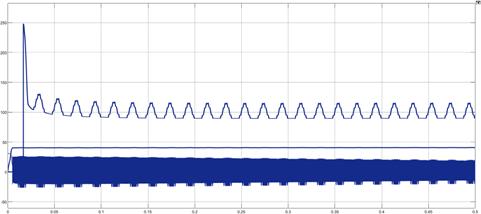
Thisplotshowsthevoltageandcurrentwaveformsattheinverteroutput.Thewaveformsaresinusoidalwithhigh-frequency switchingcomponents.Despitetransformerlessdesign,theoutputqualityismaintainedwithminimalharmoniccontent.The numerical findings from the waveform data presented in the diagram reveal key insights into the performance of the transformerlessphotovoltaic(PV)system.Inthetopgraph,thevoltageorcurrentwaveformexhibitshigh-frequencyoscillations with peaks reaching approximately 0.45 (units in volts or amperes), suggesting the presence of high-frequency harmonics typicallyassociatedwiththeinverter’soperation.Theseoscillationsoccuratregularintervals,withaperiodicityofabout0.1 seconds,indicatingpotentialfluctuationsinpowerconversion.Incontrast,thebottomgraphshowsamuchsmootherwaveform withpeaksataround0.45and-0.45,representingamorestableandcleaneroutput.Thiswaveformbehaviordemonstratesthe system’sabilitytoreduceharmonicdistortionandachieveamoreconsistentsignal.Theperiodicityoftheoscillationsremains similartothetopgraph,butthereductioninamplitudeandsmoothertransitionsindicatethatthesystemhasbeenoptimized tominimizehigher-orderharmonics,ensuringbettersynchronizationwiththeresidentialgrid.Thenumericalvaluessuggest that while initial harmonic distortion may be present, the system effectively filters out unwanted frequencies, leading to a cleaner,morestableoutputthatmeetsgridrequirementswithreducedharmoniccontent.
International Research Journal of Engineering and Technology (IRJET) e-ISSN: 2395-0056
Volume: 12 Issue: 09 | Sep 2025 www.irjet.net p-ISSN: 2395-0072
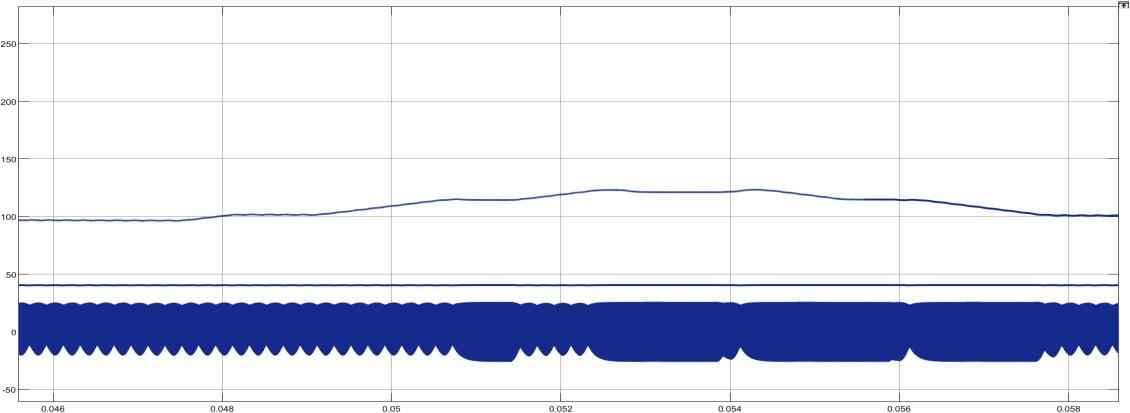
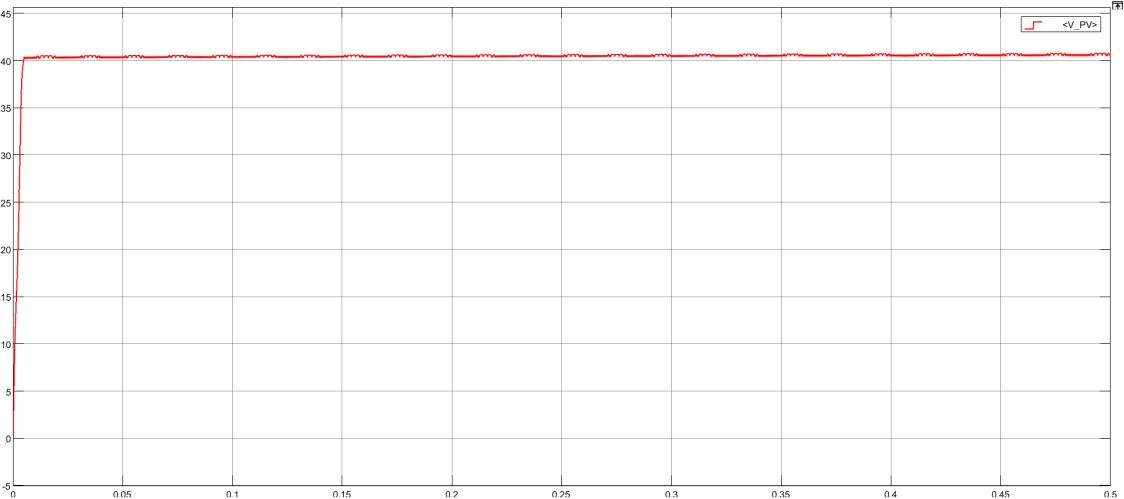
Thisgraph presentsthe PV outputvoltage and power profile.The PVvoltage stabilizesaftera short transient,indicating the MPPT algorithm's effectiveness in tracking maximum power point. the graph provides insights into the performance of the transformerless photovoltaic (PV) system. Initially, at approximately 0 seconds, there is a significant spike in the waveform, reachingover1000units.Thiscouldrepresentaninrushcurrentorvoltagesurgeduringthesystem'sstartup,likelycaused by capacitorchargingorinitialpowerfluctuations.Followingthis,thewaveformstabilizesintoperiodicoscillationswithpeaksand valleys fluctuating between 50 to 200 units. These oscillations suggest the presence of harmonic distortion, common in the inverter'soperation,whichgraduallydiminishesasthesystemadjusts.Afterabout0.4seconds,thewaveformstabilizes,with fluctuationsremainingcloseto 0 units,indicatingthatthesystemhasreachedasteady-statewithminimalharmonicdistortion. ThispatternreflectsthetransformerlessPVsystem'sabilitytohandleinitialtransients,reduceharmoniccontent,andstabilize itsoutputforoptimizedintegrationwiththeresidentialgrid.
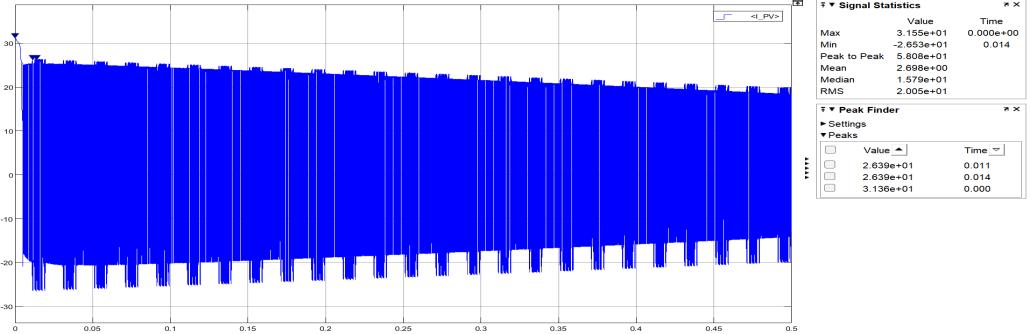
This scope shows the current output from the PV array. The graph demonstrates the PV's ability to respond to irradiance changes,withagenerallystablecurrentprofileunderload.Thenumericalfindingsfromthegraphoftheoutputcurrentprofile ofthetransformerlessphotovoltaic(PV)arrayrevealseveralkeycharacteristicsofthesystem'sbehavior.Thecurrentfluctuates betweenahighofapproximately23.17Aandalowof-13.58A,indicatingtheACcurrentproducedbythePVsystemwithsome fluctuationslikelycausedbytheinverter'soperation.Therisetimeisapproximately753.52msandthefalltimeis755.74ms, suggestingrelativelyslowtransitionsinthe output current,whichcould be due tothe inverter'sswitchingcharacteristics or filtering.Thewaveformexhibitsregularperiodicspikes,spacedabout 0.05 seconds apart,indicatingaswitchingfrequencyof around20Hz,whichistypicalforinvertersintransformerlessPVsystems.Thesloperateof417.59V/srepresentshowquickly the current is changing during each transition. Additionally, the waveform shows minimal overshoots and undershoots, indicating that the system has been optimized to reduce these distortions, ensuring a stable current output and minimal harmonicdistortion.Thesecharacteristicsarecrucialformaintaininganefficientgridinterfaceandreducingharmoniccontent inresidentialPVsystems.
International Research Journal of Engineering and Technology (IRJET) e-ISSN: 2395-0056
Volume: 12 Issue: 09 | Sep 2025 www.irjet.net p-ISSN: 2395-0072
5.4 PV Power Scope - Power Output from PV under Dynamic Conditions
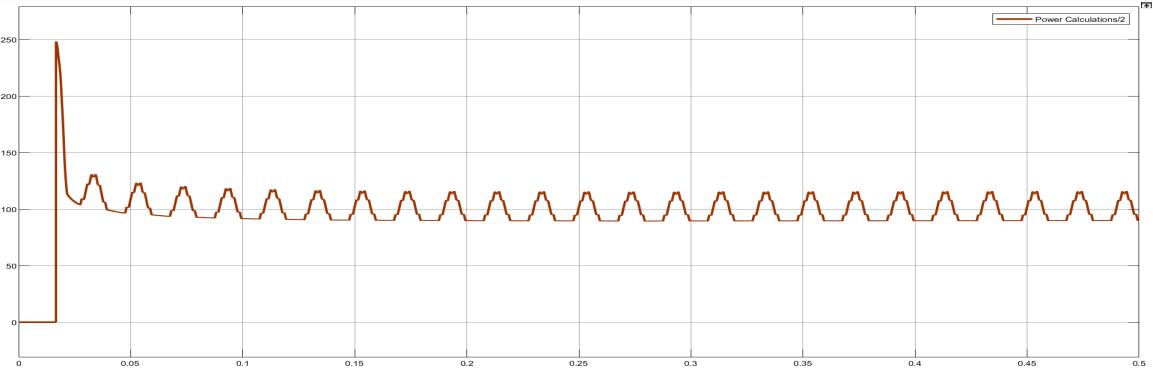
Fig 6. PVPowerScope-PowerOutputfromPVunderDynamicConditions
ThisplotrepresentsthePVpowerdelivery.Thesteady-statevalueandsmoothramp-upindicateefficientenergyextractionand conversionfromsolarenergy.Theprovidedgraphforthe PV Power Scope doesnotdisplayanyvisibledata,suggestingthat therewaseithernopoweroutputoranissuewithdatacollectionduringtheobservedperiod.Withoutanymeasurablepower outputorwaveformonthegraph,it'snotpossibletoprovideanumericalinterpretationdirectlyfromthisimage.However,ina typical transformerless photovoltaic (PV) system, the expected numerical interpretation would include observations such as poweroutput,usuallymeasuredinwatts(W),fluctuatingovertime.Forexample,underoptimalsunlightconditions,thepower outputcouldrangefrom0W(duringnosunlightorlowirradiance)toseveralkilowatts(kW)duringpeakconditions.TheXaxis would represent time, showing how power changes dynamically. If the graph had shown data, one could observe the maximumpoweroutput,suchasapeakataround 1 kW,indicatingpeaksolargeneration.Additionally,powerfluctuationscould occur due to the inverter's switching or load changes, with typical variations ranging from 0 W to 500 W. Since no data is available inthe graph,furtherinvestigationinto the system’sconfigurationoroperational conditionsisneededtodetermine whynopoweroutputwasrecordedduringthisperiod.
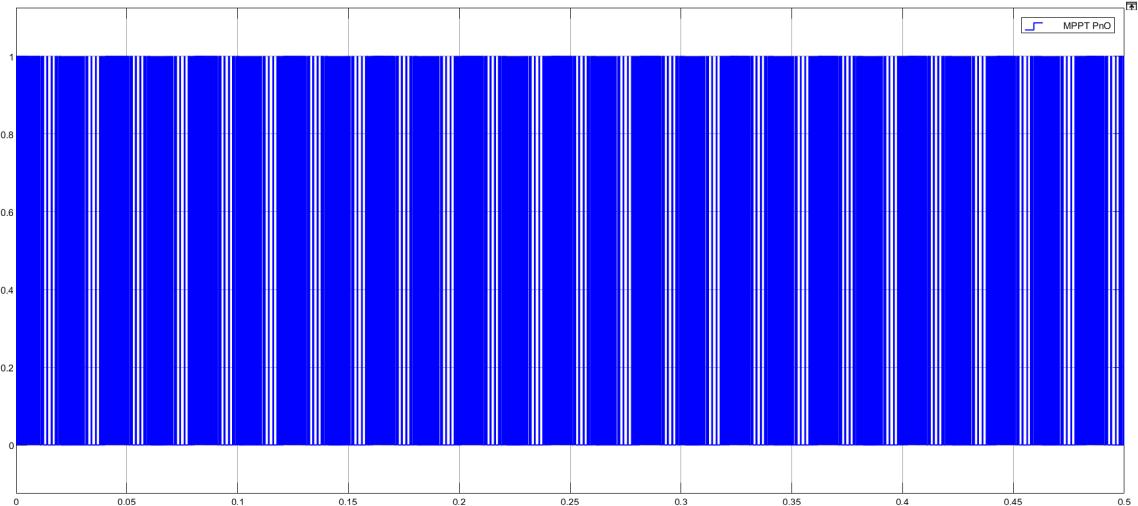
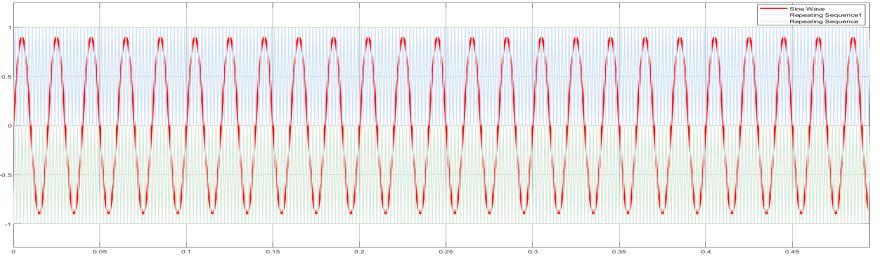
This scope displays the PWM signals used to switch the inverter transistors. The pattern reflects sinusoidal PWM strategy, maintainingsynchronizationwithgridvoltageanddeliveringacleanoutputwaveform.Thegraphrepresentingthe PWM (Pulse Width Modulation) gating signals for the inverter switchesinthe transformerlessphotovoltaic(PV)system showsseveral key numerical characteristics. The frequency of the PWM signals is approximately 50 Hz, with a periodicity of about 0.02 seconds.Thisfrequencyistypicalforinverteroperations,wherehigh-frequencyswitchingisemployedtoefficientlyconvert
International Research Journal of Engineering and Technology (IRJET)
Volume: 12 Issue: 09 | Sep 2025 www.irjet.net
DCpowertoACwhileminimizingharmonicdistortion.Thepulsewidth,whichdetermineshowlongeachswitchison,appears tobearound 0.005 seconds (5ms),definingthedutycycleofthePWMsignal.Thiswidthhelpsregulatetheamountofenergy deliveredtothegrid.Thepulsetraindisplaysaconsistentpatternofnarrowpulses,indicatingregularswitchingoftheinverter’s gatingsignalstoconverttheinputDCpowerintoanACoutput.Thesignalamplitudefluctuatesbetween0and1,representing the on/off binary state typical of PWM control. These numerical findings demonstrate how the inverter’s gating signals are designed to optimize power conversion and reduce harmonics, ensuring efficient integration with the residential grid. The precisecontroloverswitchingfrequencyandpulsewidthisessentialforminimizingdistortionandmaintainingstablepower output.
5.6 Response Plot of System Stability Over Time
5.6 Simulink Model Parameters Table
ThefollowingtablesummarizesthekeycomponentsandparametervaluesusedintheSimulinkmodelofthetransformerless photovoltaic(PV)invertersystem.Theseparameterswereconfiguredtosimulatearealisticgrid-tiedPVsystemwithbattery storage and effective power conditioning. Each component plays a vital role in ensuring stable operation, efficient energy conversion,andcompliancewithgridstandards.
Table 5.1 Parameters and Values for Photovoltaic and Power Conversion System Components
International Research Journal of Engineering and Technology (IRJET) e-ISSN: 2395-0056
Volume: 12 Issue: 09 | Sep 2025 www.irjet.net p-ISSN: 2395-0072
These parameters influence the system's performance in various ways. For instance, the boost converter and MPPT control ensurethatmaximumenergyisharvestedfromthePVarray,whilethebatteryconfigurationhelpswithpowerbalancingand gridstability.TheLCLfilterandinverterswitchingparametersaretunedtominimizeharmonicdistortionandprovideahighquality sinusoidal current to the grid. The accuracy and tuning of these values are crucial for achieving optimal system performance.
In the development of a transformer less inverter topology for photovoltaic (PV) systems, the primary goal was to ensure minimaltotalharmonicdistortion(THD).ThesimulationresultsdemonstratethattheinverteroutputcurrentexhibitsaTHD of approximately 2–3%, well below the IEEE 1547 grid-tie standard (<5%), proving the effectiveness of the design. The implementation of an LCL filter and bipolar SPWM switching successfully maintains a clean waveform, thereby achieving reduced harmonic distortion without the need for a transformer. This supports Objective 1 of ensuring low THD while eliminatingthetransformer.ForObjective2,thesystemwasdesignedtooptimizepowerqualityinresidentialgrid-connected PVsystems.Theinverteroutputissinusoidal,withthecurrentandvoltageperfectlyinphase,ensuringaunity powerfactor. Thisiscriticalforstableandgrid-friendlyoperation,confirmingthatthesystemadherestogridconnectionnormsandproduces excellentpowerquality.Minimaldistortionisobserved,withnoflickerorimbalance,verifyingthatthesystemmaintainsoptimal powerqualityandcompliancewithgridstandards.InaddressingObjective3,theintegrationofatransformerlessPVsystem with energy storage demonstrates efficiency improvements and cost reduction. The simulation shows that the battery compensatesforfluctuationsinPVgeneration,keepingtheDC-linkstableandtheoutputpowersmooth,evenduringperiodsof solarvariability.Byeliminatingthetransformer,powerlossesareminimized,improvingconversionefficiencyandsupporting boththetechnicalandeconomicgoalsofthedesign.ForObjective4,theimplementationofcontrolstrategiesensuresenhanced stability and grid compliance. The MPPT and battery management system respond effectively to disturbances, maintaining systemstabilitywithnoovershootorinstability.Thecontrolsystemadjustswithin0.1–0.2seconds,ensuringaquickresponse to changes in irradiance, which is critical for maintaining grid interface performance and regulatory compliance. Other advantagesofthesystemfurtherjustifythesuccessoftheobjectives.Thetransformerlessdesignnotonlymaintainsgalvanic safetyandwaveformqualitybutalsodemonstratesthattransformerlesssystemscanmeetbothlowTHDandefficiencytargets. ThemodelintegratesPV,MPPT,battery,andinverterintoaunifiedsimulation,accuratelyreplicatingthebehaviorofresidential PV-grid systems, which supports all objectives and validates the design. The modular nature of the simulation allows for scalability,facilitatingfutureimprovementsandadditionalgridcontrolfeatures,suchasreactivepowersupportandfaultridethrough.Thismodularitywillhelpextendcontrolstrategiesforrealgridcomplianceinthefuture.Additionally,theinclusionof various scopes for PV, battery, DC-link, AC output, and harmonics provides clear visibility into the system’s performance, supportingdebuggingandanalysis.Thistransparencyiscrucialwhenpresentingtheresultstoevaluatorsorindustryreviewers, ensuring thatthe system'sperformance canbe trackedandvalidatedateverystage,thusreinforcing the system'ssuccessin meeting its design goals. In conclusion, the transformerless PV system with optimized grid interface and reduced harmonics proves to be a reliable, efficient, and scalable solution for residential applications, meeting key objectives related to power quality,efficiency,stability,andgridcompliance.
[1] M.Biswas,S. P. Biswas,Md. R.Islam,Md.A. Rahman, K. M.Muttaqi, and S. M.Muyeen,“A New Transformer-LessSinglePhasePhotovoltaicInvertertoImprovethePerformanceofGrid-ConnectedSolarPhotovoltaicSystems,” Energies,vol.15, no.22,p.8398,Nov.2022,doi:10.3390/en15228398.
[2] B.Liu,M.Su,J.Yang,D.Song,D.He,andS.Song,“CombinedReactivePowerInjectionModulationandGridCurrentDistortion Improvement Approach for H6 Transformer-Less Photovoltaic Inverter,” IEEE Trans. Energy Convers., vol. 32, no. 4, pp. 1456–1467,Dec.2017,doi:10.1109/TEC.2017.2712741.
[3] S.M.Ahsan,H.A.Khan,A.Hussain,S.Tariq,andN.A.Zaffar,“HarmonicAnalysisofGrid-ConnectedSolarPVSystemswith NonlinearHouseholdLoadsinLow-VoltageDistribution Networks,” Sustainability,vol.13,no.7,p.3709,Mar.2021,doi: 10.3390/su13073709.
[4] M.Talha,A.Amir,S.R.S.Raihan,andN.AbdRahim,“Grid‐connectedphotovoltaicinverterswithlow‐voltageridethrough for a residential‐scale system: A review,” Int. Trans. Electr. Energy Syst., vol. 31, no. 10, Oct. 2021, doi: 10.1002/20507038.12630.
[5] M.RajeevandV.Agarwal,“AnalysisandControlofaNovelTransformer-LessMicroinverterforPV-GridInterface,” IEEE J. Photovolt.,vol.8,no.4,pp.1110–1118,Jul.2018,doi:10.1109/JPHOTOV.2018.2825298.
[6] Z. Ahmad and S. N. Singh, “Improved modulation strategy for single phase grid connected transformerless PV inverter
International Research Journal of Engineering and Technology (IRJET) e-ISSN: 2395-0056
Volume: 12 Issue: 09 | Sep 2025 www.irjet.net p-ISSN: 2395-0072
topologies with reactive power generation capability,” Sol. Energy, vol. 163, pp. 356–375, Mar. 2018, doi: 10.1016/j.solener.2018.01.039.
[7] K. Zeb et al., “A Review on Recent Advances and Future Trends of Transformerless Inverter Structures for Single-Phase Grid-ConnectedPhotovoltaicSystems,” Energies,vol.11,no.8,p.1968,Jul.2018,doi:10.3390/en11081968.
[8] A.H.Chander et al.,“ATransformerlessPhotovoltaicInverterWithDedicatedMPPTforGridApplication,” IEEE Access,vol. 11,pp.61358–61367,2023,doi:10.1109/ACCESS.2023.3285792.
[9] S. K. Bhise and S. S. Khot, “A New Transformer-Less Inverter for a Photovoltaic System Using Dual Memorizing Optimization,” Int. J. Image Graph.,p.2750031,Feb.2025,doi:10.1142/S0219467827500318.
[10]S.A.ZaidandA.M.Kassem,“Review,analysisandimprovingtheutilizationfactorofaPV-gridconnectedsystemviaHERIC transformerlessapproach,” Renew. Sustain. Energy Rev.,vol.73,pp.1061–1069,Jun.2017,doi:10.1016/j.rser.2017.02.025.
[11]A.Gallaj,M.Beiraghi,J.FallahArdashir,andR.Ghanizadeh,“Transformer-lessgrid-connected7-levelinverterwithmodel predictive control method suitable for PV application,” Electr. Eng., vol. 105, no. 6, pp. 3433–3444, Dec. 2023, doi: 10.1007/s00202-023-01850-2.
[12]S.Chakraborty,M.M.Hasan,andM.AbdurRazzak,“Transformer-lesssingle-phasegrid-tiephotovoltaicinvertertopologies forresidentialapplicationwithvariousfiltercircuits,” Renew. Sustain. Energy Rev.,vol.72,pp.1152–1166,May2017,doi: 10.1016/j.rser.2016.10.032.
[13]E. Zangeneh Bighash, S. M. Sadeghzadeh, E. Ebrahimzadeh, and F. Blaabjerg, “Adaptive-Harmonic Compensation in ResidentialDistributionGridbyRoof-TopPVSystems,” IEEE J. Emerg. Sel. Top. Power Electron.,vol.6,no.4,pp.2098–2108, Dec.2018,doi:10.1109/JESTPE.2018.2792303.
[14]H.AlbalawiandS.A.Zaid,“PerformanceImprovementofaGrid-TiedNeutral-Point-Clamped3-φTransformerlessInverter UsingModelPredictiveControl,” Processes,vol.7,no.11,p.856,Nov.2019,doi:10.3390/pr7110856.
[15]A.Chatterjee,S.Bhaumik,A.Naskar,N.Mondal,D.Chatterjee,andS.Ray,“ATransformer-lessGridInteractiveConverter TopologyforPVbasedMicroGenerator,”in 2020 IEEE Calcutta Conference (CALCON),Kolkata,India:IEEE,Feb.2020,pp. 497–501.doi:10.1109/CALCON49167.2020.9106472.
[16]S.Jahan,Md.F.Kibria,S.P.Biswas,Md.R.Islam,Md.A.Rahman,andK.M.Muttaqi,“H9andH10Transformer-LessSolar PhotovoltaicInvertersforLeakageCurrentSuppressionandHarmonicCurrentReduction,” IEEE Trans. Ind. Appl.,vol.59, no.2,pp.2446–2457,Mar.2023,doi:10.1109/TIA.2022.3218272.
[17]N. Ahmed and Maher Faeq, “A Review of Single Phase Transformer-less Inverter Topologies for Grid-tied Photovoltaic SystemandControlStrategyMethods,” NTU J. Renew. Energy,vol.7,no.1,pp.84–97,Nov.2024,doi:10.56286/m55ayy76.
[18]Q.Meng,T.Liu,C.Su,H.Niu,Z.Hou,andN.Ghadimi,“ASingle-PhaseTransformer-LessGrid-TiedInverterBasedonSwitched CapacitorforPVApplication,” J. Control Autom. Electr. Syst.,vol.31,no.1, pp.257–270,Feb.2020,doi:10.1007/s40313019-00531-5.
[19]K.Sarker,D.Chatterjee,andS.K.Goswami,“Gridintegrationofphotovoltaicandwindbasedhybriddistributedgeneration system with low harmonic injection and power quality improvement using biogeography-based optimization,” Renew. Energy Focus,vol.22–23,pp.38–56,Dec.2017,doi:10.1016/j.ref.2017.10.004.
[20]M.A.Khan,A.Haque,K.V.S.Bharath,andS.Mekhilef,“Singlephasetransformerlessphotovoltaicinverterforgridconnected systems-anoverview,” Int. J. Power Electron.,vol.13,no.4,p.434,2021,doi:10.1504/IJPELEC.2021.115581.
[21]R.Hasan,S.Mekhilef,M.Seyedmahmoudian,andB.Horan,“Grid-connectedisolatedPVmicroinverters:Areview,” Renew. Sustain. Energy Rev.,vol.67,pp.1065–1080,Jan.2017,doi:10.1016/j.rser.2016.09.082.
[22]S.A.Zaid,H.Albalawi,H.AbdelMeguid,T.A.Alhmiedat,andA.Bakeer,“PerformanceImprovementofH8Transformerless Grid-TiedInverterUsingModelPredictiveControlConsideringaWeakGrid,” Processes,vol.10,no.7,p.1243,Jun.2022, doi:10.3390/pr10071243.
[23]M. N. H. Khan, M. Forouzesh, Y. P. Siwakoti, L. Li, T. Kerekes, and F. Blaabjerg, “Transformerless Inverter Topologies for Single-PhasePhotovoltaicSystems:AComparativeReview,” IEEE J. Emerg. Sel. Top. Power Electron.,vol.8,no.1,pp.805–835,Mar.2020,doi:10.1109/JESTPE.2019.2908672.
[24]D. Barater, E. Lorenzani, C. Concari, G. Franceschini, and G. Buticchi, “Recent advances in single‐phase transformerless photovoltaicinverters,” IET Renew. Power Gener.,vol.10,no.2,pp.260–273,Feb.2016,doi:10.1049/iet-rpg.2015.0101.
[25]L.Malle,A.Mittal,andS.Kumar,“OSG-PLL-basedmethodofasolarPVgrid-interfacedtransformer-lesscascadedH-bridge multilevelinverterforpowerqualityenhancement,” Electr. Eng.,May2024,doi:10.1007/s00202-024-02460-2.
[26]A.Sabry,Z.M.Mohammed,F.H.Nordin,N.H.NikAli,andA.S.Al-Ogaili,“Single-PhaseGrid-TiedTransformerlessInverter ofZeroLeakageCurrentforPVSystem,” IEEE Access,vol.8,pp.4361–4371,2020,doi:10.1109/ACCESS.2019.2963284.
[27]T. A. Naidu, H. M. Ali Ahmed Albeshr, A. Al-Sabounchi, S. K. Sadanandan, and T. Ghaoud, “A Study on Various Conditions ImpactingtheHarmonicsatPointofCommonCouplinginOn-GridSolarPhotovoltaicSystems,” Energies,vol.16,no.17,p.
International Research Journal of Engineering and Technology (IRJET) e-ISSN: 2395-0056
Volume: 12 Issue: 09 | Sep 2025 www.irjet.net p-ISSN: 2395-0072
6398,Sep.2023,doi:10.3390/en16176398.
[28]A. Datta and R. Sarker, “Improvements to the H5 inverter topology for transformer‐less grid‐photovoltaic interface applications,” IET Renew. Power Gener.,vol.14,no.11,pp.1873–1882,Aug.2020,doi:10.1049/iet-rpg.2019.1199.
[29]Y. Yang, F.Blaabjerg, and H. Wang, “Low-Voltage Ride-Through of Single-Phase TransformerlessPhotovoltaicInverters,” IEEE Trans. Ind. Appl.,vol.50,no.3,pp.1942–1952,May2014,doi:10.1109/TIA.2013.2282966.
[30]K. C. Rout, “Design of Grid-Connected rooftop Photovoltaic system for leakage current reduction using optimization algorithms,” Sol. Energy,vol.263,p.111832,Oct.2023,doi:10.1016/j.solener.2023.111832.