
International Research Journal of Engineering and Technology (IRJET) e-ISSN:2395-0056
Volume: 12 Issue: 12 | Dec 2025 www.irjet.net
p-ISSN:2395-0072
International Research Journal of Engineering and Technology (IRJET) e-ISSN:2395-0056
Volume: 12 Issue: 12 | Dec 2025 www.irjet.net
p-ISSN:2395-0072
Ashutosh Pawan1, Dr. Om Prakash Dubey2
1Research Scholar, Department of Computer Science, Veer Kunwar Singh University, Ara, Bhojpur, Bihar, India
2Assistant Professor, Department of Mathematics, JagJiwan College, Ara, Veer Kunwar Singh University, Ara, Bhojpur, Bihar, India
Abstract - In this paper, we attempt to draw a conclusion about the topics related to our study, as specifically operations research, simulation, and simulation programming languages. The use of operations research nowadays can be felt in every aspect of life, like network scheduling, traffic, transportation, military operations, and many more areas. Simulation, being one of the techniques to optimize operations research problems and to formulate a system model, becomes an important area of study. A comprehensive literature review was conducted, covering key works in simulation, operations research, and simulation programming languages. Operations Research (OR) development phases were reviewed to understand the procedural basis for simulation modelling. This study adopts an interdisciplinary methodological framework, integrating mathematical operations research, computer science, and simulation theory. Various simulation classifications deterministic vs. stochastic, continuous vs. discrete, and discrete-event models were compared to determine appropriate modelling applications. By examining simulation methods, random-variable generation, and simulation programming languages, the research highlights how computational modeling enhances decision-making, system optimization, and realworld problem solving, offering insights and guidance for future simulation-based research and applications. This study uniquely integrates the mathematical foundations of Operations Research with the evolving landscape of simulation programming languages to present a unified interdisciplinary perspective. By linking classical simulation theory, modern SPLs, and computational modeling approaches, the work highlights conceptual advances, historical evolution, and methodological gaps. It offers a consolidated framework valuable for future researchers developing or applying simulationbased decision-support systems.
Key words: Operations Research, Simulation, Computer Simulation Languages, Random Variable, Random Variate, Probability Distribution Function.
1. Introduction:
Duringtheresearchwork,wefoundthatsimulationisnotonlyapartofoperationalresearchinthesubjectofmathematics butalsorelatedtoPhysics,Economics,Management-Sciences,Education,andwiththeadventofcomputertechnologies,it is being implemented in the form of many applications using the programming languages known as simulation programminglanguages(SPLs).Hence,whenwefoundthetopicofresearch tobeaninterdisciplinarytopic,weaimedto have a conclusive study in this field so that we may mark the aspects, projects, and shortcomings of the research done earlierinthisfieldandmaycomeupwithsomesuggestionsthatwillcertainlybenefittheforthcomingresearchersin this field.
We have presented in this paper how simulation is being implemented using simulation programming languages by the useofcomputerstobenefittheworldandhumanbeings.
Operations Research has a vast range of computer-oriented applications these days, as the approaches of Operations Research are applicable in business industries as well as the government sector, or both. The areas where operations research applications are useful are – Accounting, Construction, Facilities Planning, Finance, Marketing, Manufacturing, HumanResources,andothers. OperationsResearch, beinga part ofmathematics,is alsoimplemented inmanagement to make appropriate decisions by optimizing the problem (Savage, 2003), Simulation is one of the tools and approaches of Operations Research. A number of existing literatures present a wide variety of diagrams and conceptual frameworks describing the essential stages of a simulation study, with each author offering a slightly different perspective. Notable contributions include those by Shannon (1975, 1998), Szymankiewicz et al. (1988), Hoover and Perry (1990), Ulgen (1991),Dietz(1992),GoggandMott(1992),Musselman(1992),Nordgren(1995),LawandKelton(2000),andBanksetal.
International Research Journal of Engineering and Technology (IRJET) e-ISSN:2395-0056
Volume: 12 Issue: 12 | Dec 2025 www.irjet.net p-ISSN:2395-0072
(2001) Other tools and approaches in the subject of mathematics are linear programming, integer programming, game theory,decisiontheory,dynamicprogramming,andothers(ShingChihTsai,2022).Themathematicalmodelisrequiredto describetheoverallsystemwhenanyoftheabove-statedtechniques/methodsisusedtosimulateaproblem.
When we think about the processes or phases required in operations research development, it can be classified into the followingsixrespectivesteps(WayneL.Winston,2004):
1. TakenoteforformulatingtheO.R.problem
Until the observation of the problem environment is not done, as the first step, we can not have proper information about how to formulate the problem. This phase includes the activities, likely conferences, observations,sitevisits,andresearch.
2. ScanningandDefiningtheConcernsoftheO.R.Problem
After observing the problem, the second step that should be taken to formulate OR problem is defining and analyzing. We discover in this step the aims, possible inputs, and constraints that define the problem. Also, this resultsintheinformationabouttheactualrequirementforasolutionanditsnature.
3. Creatingamodel
With the help of the mathematical model that must represent either hypothetical or real-world situations, the third step of operations research is met. This mathematical model comprises variable definitions, equations, formulae, and linkages that describe the systems and the processes of the problem being formulated. Once the model is constructed, it is put on trial in the concerned field under various environmental conditions and then fine-tunedtomakeitwork.Inthisprospect,therequirementsofthemanagementshouldalsobeconsidered.
4. Selectionofaccurateinputdata
The main focusof thisstep istoobtain a streamofdata to testandrunthe mathematical model designed in the previous step. For testing and executing the mathematical model, the selection of accurate input data, a crucial phase of Operations Research Development, becomes compulsory. Some of the tasks related to this phase are External/Internaldataandfactanalysis,opiniongathering,andutilizationofcomputerdatabanks.
5. Furnishingasolutionanditstesting
Boththeabove phasesofoperationsresearchdevelopment, whencompletedaccurately,canleadto thesolution to the problem being reached. This solution may not appear as an adaptable solution in some cases when it is tested with the created mathematical model, but it can be used to identify the other constraints affecting the solution of the problem in such cases. So to support current organizational objectives, it becomes necessary to maketheadjustmentsandredesignthemathematicalmodel.
6. Implementationoftheobtainedformulationoftheproblem
Ifeverythinghappenstobecorrectandapropersolutionhasbeenobtainedandtested successfully, then, resolving the issues of implementation authority, which is a behavioural issue to assure a qualityofworkandgetthesupportofmanagement,thesolutionisimplementedintheconcernedhypotheticalor realworksituation.
While reviewing the existing literature related to operational research, it is important to understand that the nine taxonomies required for preservation and development of knowledge in related scientific or other such fields are being taken into account. These are tutorial review, scoping review, selective review, theoretical review, algorithmic review, computational review, meta-analysis, qualitative systematic review, and meta review. Between the years 2008-2020, a total of 38 journals and 709 reviews were published in OR and management science journals. After reviewing many of these published papers, we found that the literature reviewed in them is pursuing different goals and provides different natures of contributions. Surprisingly, these reviews provide knowledge of different types of applications of operations research, along with important information about the research gaps, as well as the provision of research agendas. Methodologicalprospectivevariancehasalsobeenfoundintheearlierreviews.
Wealsoagreewiththefactthatreviewsofexistingliteratureplayasignificantroleinnumerousscientificdisciplinesand havebeenextensivelyacknowledgedasaresearchgenreaswellasmethodology.Wearelistingheresomeofthescientific disciplinesthathavebeenreviewedearlier,andthesereviewsareshowingdifferentapplicationstovariousdomainsand topics, with diversity in the methodology of reviewing the literature of operations research. Such as particularly in psychology(BaumeisterandLeary,1997;Cooper,2010;Siddawayetal.,2019),socialsciences(Hart,1998;Petticrewand
International Research Journal of Engineering and Technology (IRJET) e-ISSN:2395-0056
Volume: 12 Issue: 12 | Dec 2025 www.irjet.net
p-ISSN:2395-0072
Roberts, 2006), information system research (Webster and Watson, 2002; Schryen, 2010; Rowe, 2014; Paré et al. 2015; Schryen, 2017; Budgen et al., 2018; Rios et al., 2018), management (Tranfield et al., 2003; Zorn and Campbell, 2006; Alvesson and Sandberg, 2011; Cubric, 2020), organization science (Denyer and Tranfield, 2009; Aguinis et al., 2023), health sciences (Grant and Booth, 2009; Lachkhem et al., 2018; Marsilio and Pisarra, 2021), software engineering (Kitchenham et al., 2010; Cruzes and Dyba, 2011; Garousi and Mäntylä, 2016; Hoda et al., 2017; Oliveira et al., 2018; Barros-Justoetal.,2019;Curcioetal.,2019),supplychainmanagement(SeuringandGold,2012;KacheandSeuring,2014; Hochrein etal.,2015;Durachetal.,2017;Carterand Washispack,2018;MartinsandPato,2019;Bai etal.,2021; Barata, 2021;Seuringetal.,2021)andengineering(Diazetal.,2020;KimandKim,2021;Lassalle,2021).
Asitiswellknownfactthatsimulationisabranchofoperationalresearchandhasimplementationsinanumberoffields related to it like Healthcare, Transportation, Accounting, Construction, Facilities Planning, Finance, Marketing, Manufacturing, Human Resources etc. we agree that to highlight the importance, applicability and implementation of simulation through simulation programming languages using an application it is important to review the earlier work conductedinabovementionedfields.
Thefollowingtableisimportanttounderstandtheapplicabilityofsimulationinthefieldofhealthcare,whichpresentsthe dataaboutthefocusareaandthekeythemesofthereviewsconductedearlier.ThedatatabulatedinTable1isenough to conclude that a substantial and increasing size of review literature on simulation across healthcare has been conducted earlier,coveringdiversedomains(listedinthethirdcolumnofTable1)asthereviewfocusarealistedinthefirstcolumn ofTable1.Dependingontherequirementandinterest,likeimplementation,technique,setting,oroutcome,oftheresearch scholarsinthisfield,thereexistrichmaterialstoinvestigate.
ReviewFocusArea Number of Included Reviews/ Studies Key themescovered
DESimplementation(2010-2022)
616publications(349casestudies)
QI + Simulation integration (2015 –2021) 18studies
Umbrella review of Simulation reviews 37systematicreviews
Simulationasassessmenttool 21studies
Humanfactorsviasimulationtraining 72studies
SystemDynamicssimulationreview 253papers
Historicalsimulationresearchreview 250articles
Simulationincancercare 51papers
Patientflow,resourcemanagement,trends
Patient care, education, safety threats, process/design
Techniques, applications, data sources, software
Competency evaluation methods, reliability, validity
Team skills, effectiveness, simulation training impact
Operations, diseases (Communicable & noncommunicable),patientflow
Broad simulation techniques, implementation, software
Scheduling,resourceallocation,patientflow
Similarly,wefounda numberofreviewsandresearchconductedearlierinthefieldoftransportationcoveringtopicslike transportation infrastructure Resilience, Deep Reinforcement Learning (DRL) in transportation, Transport–Territory Interaction Models, Continuum Approximation (CA) Models in Logistics, Simulation in Public Transportation, and Maas System Simulation Tools. The focus area elaborated in these reviews in the field of transportation include Resilience & robustness simulations; various methods (Monte Carlo, ABM, etc.), DRL applications across transport domains and discussiononimplementationissues,Spatial – temporal scale;interdisciplinarity; model topologies,CAmodelsinfacility location; SCM; comparative advances & Gaps, Discrete; agent-based; multilevel; hybrid models; implementation steps; whole-systemsimulations;toolefficacy;modelingofdemographicsandmodechoicerespectively.
As we go to look at the studies and reviews conducted in the field of finance, we found that more than 15000 review papers exist about bibliometric studies in 487 publications deemed high quality for analysis. Out of these studies, 85 papersarerelatedtoelaborateFinancialModeling(FM),and 47paperselaborateRiskModeling(RM).Studiesconducted
International Research Journal of Engineering and Technology (IRJET) e-ISSN:2395-0056
Volume: 12 Issue: 12 | Dec 2025 www.irjet.net
p-ISSN:2395-0072
in the field of finance in the category of Systematic Review of Deep Learning (DL) for Financial Time Series Forecasting (Tsai,S.C.et.al.,2021)duringthespanoftimebetween2005and2019focusedonareasforforecastingofstockindices, forexmarkets,commodities,analysisaccordingtoDLmodelchoice,etc.Ontheotherhand,studiesconductedonasurvey on Multilevel Monte Carlo (MLMC) in Finance highlighted the key concept of progress and development of MLMC techniques, their implementation across pricing, risk, and stochastic simulations tasks, as well as challenges and future researchsuggestions.
Intending driving and traffic simulators that allow validating and training driving automation from an artificial and algorithmicpointofview,manyofthesimulatorsorientedtowards vehicleautomationexistintheliteratureauthoredby Michael Aeberhard, 2018, Institute for Transport Studies (ITS), 2016, Dosovitskiy, A., et. al., 2017, Costa, V. et. al, June, 2016,Apollo,2018,MADRaS,2018,Taheri,S.M.,et.al.,2017
Lackner (1964) was among the first to advocate for applying systems theory as the foundation for simulation modeling. Building on this idea, Zeigler later advanced a formal theoretical framework for simulation initially through a 1972 journalarticleandsubsequentlyinhis1976monograph.Hiswork,groundedinsystems-theoreticprinciples,significantly influenced efforts to distinguish the conceptual representation of simulation from its implementation in simulation programminglanguages.Moreover,theunifiedtheoretical structureZeigler proposedfordiscrete-event,continuous,and hybridmodelsestablishedconceptualconnectionsthatpreviouslyhadbeendifficultformanyresearcherstoarticulate.
The study done in this paper is related to Operations Research, Simulation, and Simulation Languages. Many books, journals,andwebsitepageshavebeenstudied,andthecontentofthepaperhasbeenprepared,leavingthestatementsor earlier research. The gist of all the above topics has been presented in this paper contributing to the earlier research by describingtheC++implementationforgeneratingrandomnumbers
The study adopts an interdisciplinary research approach to examine simulation as a mathematical, computational, and applied science tool. A comprehensive literature review was conducted, covering key works in simulation, operations research, and simulation programming languages. Foundational frameworks proposed by Shannon, Hoover and Perry, Law and Kelton, Banks et al., and others were systematically analyzed to map stages of simulation studies. The research synthesizes contributions from mathematics, management sciences, economics, physics, and computer science to contextualize simulation’s cross-domain relevance. Operations Research (OR) development phases were reviewed to understand the procedural basis for simulation modelling. Each OR phase problem formulation, problem definition, model construction, data selection, solution testing, and implementation was critically examined. Conceptual models frompriorstudieswerecomparedtoidentifyrecurringstructuresanddifferencesinsimulationpractices.Emphasiswas placed on understanding how mathematical modelling supports simulation within real-world decision-making contexts. Insights derived from this analysis were used to propose recommendations aimed at guiding future interdisciplinary simulation research. This study adopts an interdisciplinary methodological framework, integrating mathematical operations research, computer science, and simulation theory. Both analytical and logical approaches were examined to determine their suitability for simulation-based problem-solving in dynamic and static systems. Mathematical model construction procedures were analysed, including variable specification, equation formation, and system linkage design. Random variable generation techniques, such as linear congruential generators and inverse transform sampling, were evaluated for their role in stochastic simulation. Various simulation classifications deterministic vs. stochastic, continuousvs.discrete,anddiscrete-eventmodels werecomparedtodetermineappropriatemodellingapplications.The study critically assessed simulation programming languages (SPLs), including FORTRAN, GPSS, SIMULA, SLAM, and modern languages like C++, Java, and Python. Core modelling paradigms process-interaction, event-scheduling, and entity/attribute/set frameworks were analysed for their structural and computational advantages. The historical evolutionandinfluenceofobject-orientedprinciplesoriginatingfromSIMULAwereexaminedtounderstandtheirrolein contemporary simulation modelling. Based on the above analyses, the methodology identifies strengths, limitations, and practical considerationsforselectingsimulationapproachesandtoolsforfutureresearch.The methodologyofourstudy canbedepictedinthediagram.
International Research Journal of Engineering and Technology (IRJET) e-ISSN:2395-0056
Volume: 12 Issue: 12 | Dec 2025 www.irjet.net p-ISSN:2395-0072
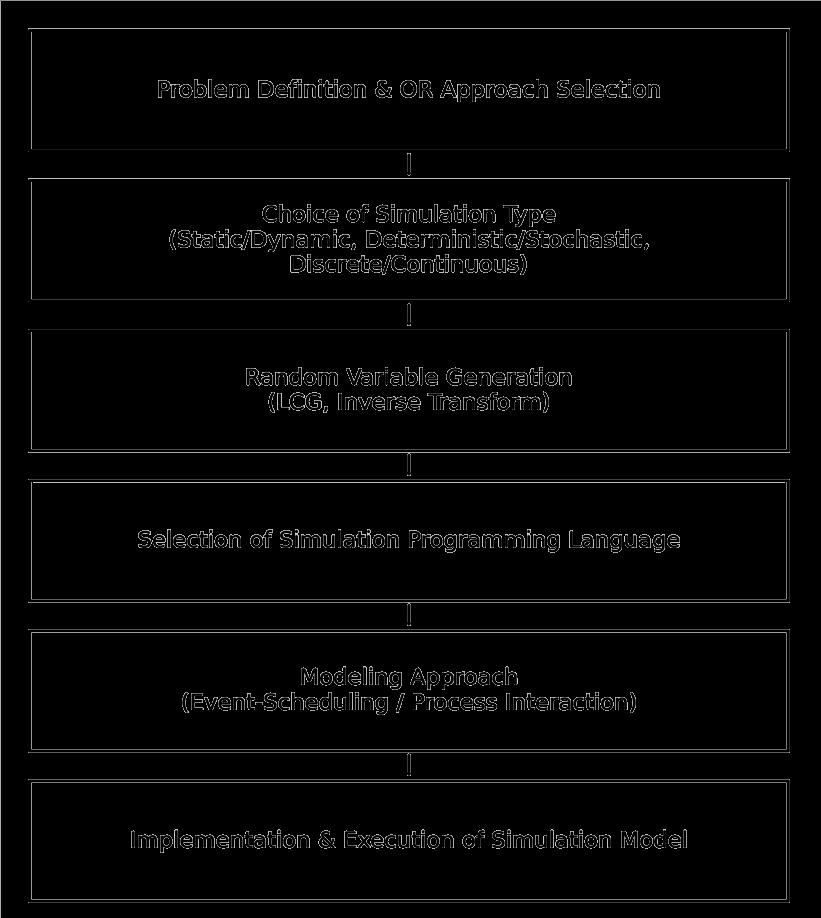
The study done in this paper has been able to illustrate the processes or phases required in Operations Research Development. For this, we have presented a relation to generate random numbers. Its algorithm and the CPP program have also been presented in this paper. In the CPP program, we have taken care of all the steps of Operations Research Development and tested the program with different accurate data inputs. This CPP program is ready to be implemented either in hypothetical areas or in real-world systems. Thus, we have also tried to summarize one technique related to simulation in the branch of Operations Research of the subject Mathematics, and its implementation using the generalpurposesimulationprogramminglanguage.
Thefindingsofthisstudydemonstratethatsimulationoccupiesacentralandmultidisciplinaryroleextendingfarbeyond its traditional placement within Operations Research and mathematical problem-solving. Its conceptual foundations and methodological practices connect directly with diverse fields such as physics, economics, management sciences, engineering,and education, anditspractical relevancehasexpandedsignificantlywithadvancesincomputer technology and the development of simulation programming languages (SPLs). By examining the theoretical bases, computational techniques, and programming paradigms that underpin simulation modelling, this research provides an integrative perspective that highlights how simulation supports decision-making, optimizes system performance, and models complex,dynamicenvironments.
Theapplicationofthisstudyliesinitscapacitytoguidefutureresearchersandpractitionerstowardselecting,designing, andimplementingsimulationmodelsthatalignwiththestructuralcharacteristicsofreal-worldsystems.Thediscussionof Operations Research development phases clarifies how simulation supports problem formulation, model construction, data selection, solution testing, and implementation across a wide variety of industries and organizational contexts. Likewise, the classification of simulation types static, dynamic, deterministic, stochastic, discrete, continuous, and discrete-event enables researchers to adopt the most suitable modelling approach for the nature of the system under investigation. Moreover, the detailed examination of random-variable generation methods, including the linear congruential generator and inverse transform technique, equips users with foundational tools for incorporating probabilistic behavior into simulation models. The review of general-purpose and special-purpose simulation languages offerspractical guidancefor selectingprogrammingenvironmentsthatsupportcomplexmodellingtasks.Inaddition,the
Volume: 12 Issue: 12 | Dec 2025 www.irjet.net
p-ISSN:2395-0072
analysisofkeycomputational concepts suchasprocessinteraction,entity–attribute–setstructures,and object-oriented programming illustrates how modern simulation environments benefit from computational paradigms originally developedwithincomputerscience.
Overall,thestudyservesas a comprehensive reference forapplyingsimulationtointerdisciplinaryresearchproblems.It helps researchers identify methodological gaps, understand earlier contributions, and recognize opportunities for advancement. By consolidating theoretical frameworks, modelling techniques, and computational tools, this research ultimately supports the development of more accurate, efficient, and scalable simulation models that can contribute meaningfully to academic inquiry, professional practice, and real-world decision-making. The aim of the study has been achieved.
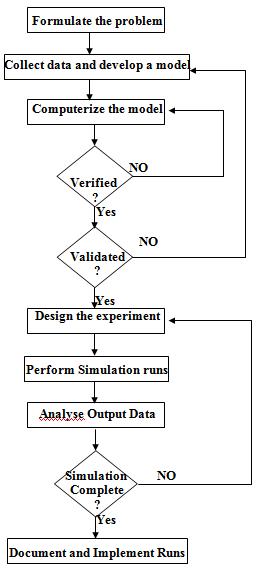
Thereare twodifferent approachesto performing all theabove-mentioned phases ofOperationsResearchDevelopment, oneisanalyticalandtheotherislogical(D.S.Hira,P.K.Gupta,2014).Thebenefitofalogicalapproachisthatwecancome upwitha solutionforthereal-worldsystemasitchangesovertime.Here, wewill findsimulationasthebestoperations research technique for such problems. Static and Dynamic simulation models are the two types of simulation. The problemsofasystemataparticularpointintimecanbeformulatedusinga static simulation model,whereasontheother hand,the problemsofa systemthatchangesovertimecanbe formulatedusinga dynamic simulation model.(Kao,1996) Theproblemswithnorandomvariablecanbeformulatedusing deterministic simulation,andthosethathaveoneormore randomvariablescanbeformulatedusing stochastic simulation.Basedonthemodelconstructedtoformulatea problem, thesimulationcanbeclassifiedintotwocategories: discrete and continuous models.Whenthedecisionvariablesvaryonly at discrete points of time, discrete simulation is applicable, and when the decision variable changes randomly over time, continuous simulation is applicable. Using a simulation model to formulate problems in which the decision variable changes in discrete time intervals is known as a discrete-event simulation model. The steps in a simulation study can be representedbyusingthefigurepresentedbelow.
Computer programming languages are important tools running on computers as application software to develop other requiredprogramsorsoftware,includingoperatingsystems,utilities,andotherrequiredapplicationsoftware.Writingthe codetodevelopanyprogramorsoftwarerequiresproperknowledgeabouttheproblemand/orperspectiveforwhichthe computer-orientedsolutionisgoingtobeimplemented.Writingthecodeforacomplexsimulationmodelisalsoatedious and challenging task. (Fourer, Gay & Kernighan, 2003) For this very reason and to simplify the programming for simulation models, special computer-oriented languages known as computer simulation languages have been developed (Mobin Ahmad, 2017). ForTran, Basic, GPSS, GASP IV, and SLAM, as well as several others, are best-known simulation programming languages. In modern days, programming languages that are part of academic education in several universities at the graduate and post-graduate levels, like C, C++, Java, Python, and several others that suit the managementauthority,arealsobeingusedtoprogramsimulationmodels
Theprocessconcept,theentity/ attribute/setconcept,andtheobject-orientedprogrammingconcepthavehadthemost importantcontrolintheadvancementofcomputingtechnologyandintheareasofcomputerscience.
The Process Concept. Initially implemented in a limited form within the GPSS transaction framework and later articulatedmorecomprehensivelythroughtheprocess-interactionperspectiveofSIMULA,theprocessconceptrepresents afoundationalcontributiontobothsimulationandoperatingsystems.Insimulation,itenabledtheexplicitmodelingofan entity whose evolving behavior the model sought to emulate. Within operating systems, the process served as a quasiautonomous executingprogramsegmentand becamecentral tothe developmentofcomputational models.SIMULA’scoroutine–based execution environment further strengthened this concept, offering a highly effective mechanism for describingandmanagingcomplexsystembehaviors. International Research Journal of Engineering and Technology (IRJET) e-ISSN:2395-0056
International Research Journal of Engineering and Technology (IRJET) e-ISSN:2395-0056
Volume: 12 Issue: 12 | Dec 2025 www.irjet.net p-ISSN:2395-0072
The Entity/Attribute/Set Concept. Kiviatet.al.(1968)introducedthisconceptualframeworkinSIMSCRIPTII,offeringa systematicmethodforrepresentingstaticrelationshipsamongobjects.Underthisparadigm,entitiescouldsimultaneously belongtosetsandownthem,whilealsomaintainingdistinctattributesthatdefinedtheirindividualcharacteristics.When combined with Mealy’s (1967) formal treatment of relationships among entities, this approach foreshadowed the core principles of the entity–relationship model later formalized in the database field nearly a decade after these ideas had alreadyappearedinsimulationmodeling.
Object-Oriented Programming. The development of SIMULA 67, an extension of the earlier SIMULA I, marked the introduction of object-oriented programming (OOP) through mechanisms such as abstract data types, encapsulation, inheritance, and message passing. Building upon the earlier co-routine structure, these OOP features enabled an exceptionally expressive and robust approach to simulation programming. Over the following two decades, OOP evolved intothedominantparadigminsoftwaredevelopmentmorebroadly.Itsinfluenceisevidencedbythefactthatfourofthe eightlanguagesrecognizedas historicallysignificantatthe1993HistoryofProgrammingLanguagesIIConference Ada, C++, CLU, and Smalltalk trace substantial aspects of their design to SIMULA (Bergin & Gibson, 1996). Despite its broad impact, Nygaard (1978), one of SIMULA’s creators, noted that the full extent of its power could only be appreciated by thosewhohadusedthelanguagespecificallyforsimulation.
International Research Journal of Engineering and Technology (IRJET) e-ISSN:2395-0056
Volume: 12 Issue: 12 | Dec 2025 www.irjet.net
p-ISSN:2395-0072
Twodifferentmodelingapproachescanbeusedaccordingtotheselectionofcomputersimulationlanguagestoprograma simulation model (Seila, Ceric & Tadikamalla, 2003). One such approach is the event-scheduling approach, in which we have to identify the characteristic events to model the system and then write the required modules to describe the state changesoccurringatthetimeofeachevent.Anotherapproachistheprocessinteractionapproach,inwhichwedependon the entity (or a customer) that necessarily goes through the system to create the model of the system. ForTran, Basic, C, C++, and Java, like general-purpose languages, use an event-scheduling approach, and on the other hand, the processinteractionapproachisusedinGPSS.Thesystemmodeler,whileusingSLAM,canuseeitherofthetwoapproachesoreven amixtureofthetwothatsuitsthemodelbeinganalysed.
General-purposeprogramminglanguagesprovidegreaterflexibilityandarewidelyusedandavailable.Ontheotherhand, computer simulation and special-purpose languages offer a number of advantages. Most of the features required to program a simulation model and a natural framework are provided by the latter. For example, SLAM – special-purpose simulation language- provides us with the features to program simulation models as discrete event models, continuous models,networkmodels,oranycombinationofthese.
(Minh, 2001; Anthony Hayter, 2012) The Probability distribution helps represent Random Variables. The method of generating random variables from a set of given probability generation is known as Monte Carlo Sampling or random variate generation.Thetheoryofsuchsamplingisrootedintheinterpretationofprobabilityfrequencyandisentailedbya stablestreamofrandomnumbers.
Definition: A congruential method known as the linear congruential method, with the following relation, is used to generaterandomnumbers:
) ( )
Proof: Theabove-representedlinearcongruentialgeneratorgivestheremainderafterperformingthedivisionof( ) by m,andrandomnumbersarethusgeneratedbytherelation ( ) (1)
The inverse transformation method, requiring a cumulative frequency distribution in closed form, can be used, and the algorithm canberepresentedas:
Step 1: ( ) isa given probabilitydensityfunction,andforthis,the cumulativedistribution functionisto bederived by usingtherelation ( ) ∫ ( )
Step 2: Randomnumberrisnowgenerated.
Step 3: Setting ( ) ,asolutionisobtainedfor x.Hence,theobtainedvariable x isarandomvariateforaprobability distributionfunction(pdf)givenby ( ).
WenowdevelopaCPPprogramtogeneraterandomnumbersusingtherelation(1)presentedearlier SupposexintherelationisrepresentedintheCPPlanguageasanarrayofintegersandiswrittenas: int x[]={10,20,30,40,50,60,70,80,90,100}; andmis100.
iisthelocationorindexoftheelementinx,startingwith0andrangingupto9 (i=0,1,2,3,4,5,6,7,8,9)
ThesetofrandomnumbersRi,alsorepresentedasanarrayintheCPPlanguageas: int R[10];
International Research Journal of Engineering and Technology (IRJET) e-ISSN:2395-0056
Volume: 12 Issue: 12 | Dec 2025 www.irjet.net
iscalculatedbyusingthefollowingCPPprogram:
#include<iostream.h>
#include<stdlib.h>
#include<time.h>
#include<conio.h>
p-ISSN:2395-0072
voidmain(){ intx[]={10,20,30,40,50,60,70,80,90,100},m=100,R[10],i; clrscr(); for(i=0;i<10;i++){ R[i]=random(x[i]%m); cout<<R[i]<<”\t”; } } Whentheprogramistested,thefollowingoutputoftheaboveprogramis10randomcomputer-generatednumbersafter execution,asfollows:
0 0 10 1 17 13 37 15 63 0
Also,ifthecontentofthearrayx[]andthevalueofmarechanged,therandomnumbersduringeachtimeoftheprogram executiongetchanged.
6. Conclusion
OperationsResearch,beingapartofmathematics,isalsoimplementedinmanagementtomakeappropriatedecisionsby optimizingtheproblem.Simulationisoneofthetechniquesforoptimizingtheproblemandcreatingmodelsforthesystem that suit management authorities. Other techniques for Operations Research are analytical or more theoretical, whereas simulationappearstobelogical.Hence,theimplementationof a simulationmodel byusinga computer becomesaneasy task.Forthisspecialpurpose,simulationprogramminglanguagesaswellasgeneral-purposeprogramminglanguagescan beused.
7. Limitations
This study is primarily conceptual and relies heavily on secondary literature, which may limit the depth of empirical validation. The interdisciplinary scope of simulation spanning mathematics, operations research, computer science, healthcare, transportation, and finance makes it challenging to capture every methodological nuance within a single review. Many referenced studies differ in purpose, taxonomy, and methodological rigor, which may introduce inconsistency in comparative interpretation. The implementation component focuses only on a basic C++ illustration of randomnumbergeneration,whichdoesnotrepresentthefullcomplexityofmodernsimulationpractice.Additionally,the studydoesnotincludeexperimentalresultsorreal-worldcaseapplications.
8. Authors’ Contribution
We collectively conceived and structured the study, recognizing simulation as an interdisciplinary domain that bridges mathematics,operationsresearch,computerscience,andappliedfieldssuchashealthcare,transportation,andfinance.We conducted an extensive and integrative review of literature spanning simulation theory, modeling approaches, and simulation programming languages. The authors analyzed foundational concepts, identified methodological advancements, and highlighted gaps in existing research We further contributed original implementation insight by demonstrating the generation of random numbers through C++-based Monte Carlo methods. Together, these efforts provide a consolidated understanding of simulation’s evolution, applications, and computational realization for future researchers.
References
1. Savage (2003). Decision Making with Insight ThomsonLearning,London,UnitedKingdome
2. Shannon,R.E.(1975). Systems Simulation: the Art and Science.EnglewoodCliffs,NJ:Prentice-Hall.
3. Shannon,R.E.(1998).Introductiontotheartandscienceofsimulation, Proceedings of the 1998 Winter Simulation Conference (Medeiros, D.J., Watson, E.F., Carson, J.S. and Manivannan, M.S., eds),Piscataway,NJ:IEEE,7–14.
International Research Journal of Engineering and Technology (IRJET) e-ISSN:2395-0056
Volume: 12 Issue: 12 | Dec 2025 www.irjet.net p-ISSN:2395-0072
4. Szymankiewicz, J., McDonald, J. and Turner, K. (1988). Solving Business Problems by Simulation. Maidenhead, UK: McGraw-Hill.
5. Hoover,S.V.andPerry,R.F.(1990). Simulation: A Problem-Solving Approach.Reading,MA:Addison-Wesley.
6. Ulgen, O. (1991). Proper management techniques are keys to a successful simulation project. Industrial Engineering,23(8),37–41.
7. Dietz,M.(1992).Outlineofasuccessfulsimulationproject. Industrial Engineering,24(11),50–53.
8. Gogg, T. and Mott, J. (1992). Improve Quality and Productivity with Simulation. Palos Verdes Pnsl., CA: JMI ConsultingGroup.
9. Musselman, K.J. (1992). Conducting a successful simulation project, Proceedings of the 1992 Winter Simulation Conference (Swain, J.J., Goldsman, D., Crain, R.C. and Wilson, J.R., eds),Piscataway,NJ:IEEE,115–121.
10. Nordgren, W.B. (1995). ‘Steps for proper simulation project management, Proceedings of the 1995 Winter Simulation Conference (Alexopoulos, C., Kang, K., Lilegdon, W.R. and Goldsman, D., eds),Piscataway,NJ:IEEE,68–73.
11. Law,A.M.andKelton,W.D.(2000).SimulationModelingandAnalysis,2ndedn.,NewYork,McGraw-Hill.
12. Banks,J.,Carson,J.S.,Nelson,B.L.andNicol,D.M.(2001).Discrete-EventSystemSimulation,3rdedn. Upper Saddle River,NJ:PrenticeHall.
13. Shing Chih Tsai, Honggang Wang, & Li Hsuan Hung. (2022). Mixed Integer Simulation Optimization for multechelonInventoryProblemswithlostsales. Journal of the Operational Research Society,74(11),2312-2326
14. Wayne L. Winston. (2004). Operations Research Applications and Algorithms, Fourth Editions, Indiana University withcasesbyJeffreyB.Goldberg
15. BaumeisterR.F.,&NewmanL.S.(1994).Self-regulationofcognitiveinferenceanddecisionprocesses. Personality and Social Psychology Bulletin,20,3–19.
16. Cooper, P. (2010). Pauline Cooper: The Use of Creative Writing as a Therapeutic Activity for Mental Health in OccupationalTherapy. British Journal of Occupational Therapy,73,436.
17. Siddaway, A. P., Wood, A. M., & Hedges, L. V. (2019). How to do a systematic review: A best practice guide to conductingandreportingnarrativereviews,meta-analyses,andmeta-syntheses. Annual Review of Psychology,70.
18. Hart,C.(1998).DoingaLiteratureReview:ReleasingtheSocialScienceResearchImagination. Thousand Oaks,CA: SagePublications.,London,ThousandOaks,NewDelhi,1-26
19. PetticrewandRoberts.(2006).SystematicReviewsintheSocialSciences. Blackwell Publishing,OxfordUK,1-354
20. WebsterandWatson.(2002).ANALYZINGTHEPASTTOPREPAREFORTHEFUTURE:WRITINGALITERATURER EVIEW. Guest Editorial, MIS Quarterly,Vol.26No.2,xiii-xxiii
21. Schryen. (2010). A Decision-Theoretic Foundation of IS Business Value Research, European Conference on InformationSystems. ECIS 2010 proceedings,1-12
22. Rowe. (2014). Situating the Self in Prison Research: Power, Identity, and Epistemology, Vol. 20, Issue 4, https://doi.org/10.1177/1077800413515830
23. Paréetal.(2015).Synthesizinginformationsystemsknowledge:Atypologyofliterature reviews,Vol.52,Issue2, p.183-199
24. Schryen. (2017). Literature Reviews in IS Research: What Can Be Learnt from the Past and Other Fields?. Communications of the Association for Information Systems,paper30,vol.41,759-774
25. Budgen et al. (2018). The contribution that empirical studies performed in industry make to the findings of systematicreviews:Atertiarystudy, ELSEVIER,Vol.94,p.234-244
26. Rios et al. (2018). A tertiary study on technical debt: types, management strategies, research trends, and base informationforpractitioners. Inf Softw Technol,102:117–145.
27. Tranfield et al. (2003). Towards a methodology for developing evidence-informed management knowledge by meansofsystematicreview. Br J Manag,14(3):207–222.https://doi.org/10.1111/1467-8551.00375
28. Zorn and Campbell. (2006). Improving The Writing Of Literature Reviews Through A Literature Integration Exercise. Business Communication Quarterly,Vol.69,No.(2),172-183
29. Alvesson and Sandberg. (2011). Generating Research Questions through Problematization. Academy of Management Review,36,247-271. http://dx.doi.org/10.5465/AMR.2011.59330882
30. Cubric (2020).Drivers,barriersandsocialconsiderationsforAIadoptioninbusinessandmanagement:Atertiary study, ELSEVIER, Technology in Society,Vol.62,https://doi.org/10.1016/j.techsoc.2020.101257
31. Denyer, D. and Tranfield, D. (2009). Producing a Systematic Review. In: Buchanan; D. and Bryman, A. Eds., The Sage Handbook of Organizational Research Methods,Sage,London,671-689.
32. Aguinis et al. (2023). Best-practice recommendations for producers, evaluators, and users of methodological literaturereviews. Organizational Research Methods,26(1):46–76
33. Grant and Booth. (2009). A typology of reviews: an analysis of 14 review types and associated methodologies, UniversityofSalford,Salford,UK,Vol.26,Issue2,89-168
International Research Journal of Engineering and Technology (IRJET) e-ISSN:2395-0056
Volume: 12 Issue: 12 | Dec 2025 www.irjet.net p-ISSN:2395-0072
34. Lachkhemetal.(2018).Understandingdelaysinacutestrokecare:asystematicreviewofreviews. The European Journal of Public Health,28(3):426–433
35. MarsilioandPisarra.(2021).Leanmanagementinhealthcare:areviewofreviewsofsocio-technicalcomponents foreffectiveimpact. Journal of Health Organization and Management,1-27,DOI:10.1108/JHOM-06-2020-0241
36. Kitchenhametal.(2010).Systematicliteraturereviewsinsoftwareengineering–Atertiarystudy,Vol.52,Issue8, 792-805
37. CruzesandDyba.(2011).ResearchSynthesisinSoftwareEngineering:ATertiaryStudy. Information and Software Technology,53,440-455
38. Garousi and Mäntylä. (2016). A systematic literature review of literature reviews in software testing, ELSEVIER, INFORMATION AND SOFTWARE TECHNOLOGY,Vol.80,195-216
39. Hodaetal.(2017).Systematicliteraturereviewsinagilesoftwaredevelopment:atertiarystudy. Information and software technology,Vol.18,60-70
40. Oliveiraetal.(2018).Imaginariesandtheorganisedlife, Thesis,UniversityofLondon,1-239
41. Barros-Justo et al. (2019). Trends in software reuse research: A tertiary study Computer Standards & Interfaces, Vol.66,2019,103352
42. Curcioetal.(2019).Usabilityinagilesoftwaredevelopment:atertiarystudy. Comput Stand Interfaces,64:61–77. https://doi.org/10.1016/j.csi.2018.12.003
43. Seuring and Gold. (2012). Conducting Content-Analysis Based Literature Reviews in Supply Chain Management. Supply Chain Management,17,544-555, https://doi.org/10.1108/13598541211258609
44. Kache and Seuring. (2014). Linking collaboration and integration to risk and performance in supply chains via a reviewofliteraturereviews, Supply Chain Management: An International Journal,Vol.19Nos5/6,664-682.
45. Hochrein et al. (2015). Literature reviews in supply chain management: a tertiary study Management Review Quarterly,65(4),DOI:10.1007/s11301-015-0113-4
46. Durachetal.(2017).ANewParadigmforSystematicLiteratureReviewsinSupplyChainManagement. Journal of Supply Chain Management,Vol.53,Issue4,1-36,https://doi.org/10.1111/jscm.12145
47. CarterandWashispack. (2018).MappingthePathForwardforSustainable Supply ChainManagement:AReview ofReviews. Journal of Business Logistics,Vol.39,Issue4,242-247
48. Martins andPato. (2019).SupplyChainSustainability: Atertiaryliteraturereview. Journal of Cleaner Production, Vol.225,995-1016
49. Bai et al. (2021). The role of business and social networks in the effectual internationalization: Insights from emergingmarketSMEs. Journal of Business Research.Vol.129,96-109
50. Barata. (2021). The fourth industrial revolution of supply chains: A tertiary study. Journal of Engineering and Technology Management,Vol.60,https://doi.org/10.1016/j.jengtecman.2021.101624
51. Seuring et al. (2021). Developing and Publishing Strong Empirical Research in Sustainability Management Addressing the Intersection of Theory, Method, and Empirical Field, Chair of Supply Chain Management. Sec. Sustainable Organizations,Vol.1,p.1-9,https://doi.org/10.3389/frsus.2020.617870
52. Diazetal.(2020).Setambitiousgoalsforbiodiversityandsustainability. sciencedirect,Vol.XXX,IssueXXXX,2-4
53. KimandKim.(2021).InfluencerAdvertisingonSocialMedia:TheMultipleInferenceModelonInfluencer-Product Congruence and Sponsorship Disclosure. Journal of Business Research, 130, 405-415. https://doi.org/10.1016/ j.jbusres.2020.02.020
54. Lassalle (2021). Notions and Practices of Differences: An Epilogue on the Diversity of Entrepreneurship and Migration. Global Migration, Entrepreneurship and Society,195-211,DOI:10.1108/S2040-724620210000013010
55. Tsai, S. C., Chen., H., Wang., H., & Zhang, Z. G. (2021). Simulation Optimization in Security Screening Systems subjecttobudgetandwaitingtimeconstraints. Naval Research Logistics (NRL),68(7),920-936
56. Morse,PJune.(2017).VirtuallyAutonomous.Availableonline:https://www.ansiblemotion.com/ansible-motionautomotive-driver-in-the-loop-simulation-news/ virtually-autonomous-driving-simulator-use-in-cardevelopment.
57. MichaelAeberhard(BMW) (2018).AutomatedDrivingwithROSatBMW ROSRoboticsNews,Availableonline: http://www.ros.org/news/2016/05/michael-aeberhard-bmw-automated-driving-with-ros-at-bmw.html
58. Institute for Transport Studies (ITS) (2016) Driving Simulators to Support the Design of Autonomous Vehicles; InstituteforTransportStudies(ITS).UniversityofLeeds:Leeds,England.
59. Dosovitskiy,A.;Ros,G.;Codevilla,F.;Lopez,A.;Koltun,V.(2017).CARLA:AnOpenUrbanDrivingSimulator. arXiv, arXiv:171103938.
60. Costa, V.; Rossetti, R.J.F.; Sousa, A. (June 2016). Autonomous driving simulator for educational purposes, In Proceedings of the 2016 11th Iberian Conference on Information Systems and Technologies (CISTI), Las Palmas, Spain,15–18;1–5.
61. Apollo.(2018).Availableonline:http://apollo.auto/
International Research Journal of Engineering and Technology (IRJET) e-ISSN:2395-0056
Volume: 12 Issue: 12 | Dec 2025 www.irjet.net p-ISSN:2395-0072
62. MADRaS. (2018). A Multi-Agent DRiving Simulator, Available online: https://software.intel.com/enus/articles/madras-a-multi-agent-driving-simulator
63. Taheri, S.M.; Matsushita, K.; Sasaki, M. (2017). Virtual Reality Driving Simulation for Measuring Driver Behavior andCharacteristics. J. Transp. Technol.,7,123.
64. Lackner, M. R. (1964). Digital simulation and system theory. SDC Document SP-1612, System Development Corp., SantaMonica,CA.
65. Zeigler, B. P. (1972). Towards a formal theory of modelling and simulation: Structure preserving morphisms. J. Assoc. Comput. Mach.,19(4),742–764.
66. Zeigler,B.P.(1976). Theory of Modelling and Simulation.JohnWiley&SonsInc.,NewYork.
67. D.S.Hira&P.K.Gupta.(2014). Operations Research,S.Chand&CompanyLtd.Publication
68. Kao,EdwardP.C.(1996). Introduction to Stochastic Processes,DuxburyPress,USA.
69. Minh.(2001). Applied Probability Models Duxbury,PacificGrove
70. AnthonyHayter.(2012). Probability and Statistics for Engineers and Scientists Paperback
71. Fourer,Gay&Kernighan.(2003). AMPL: A Modeling language for Mathematical Programming SecondEdition
72. MobinAhmad.(2017). Impact of Operations Research on Computer Science IOSRJournalofComputerEngineering (IOSR-JCE).19.4,50–53
73. Kiviat, P. J., R. Villanueva, H. M. Markowitz. (1968). SIMSCRIPT II Programming Language. Prentice-Hall, Inc. EnglewoodCliffs,NJ.
74. Mealy,G.H.(1967).Anotherlookatdata.Proc.1967FallJointComput.Conf.AmericanFederationofInformation ProcessingSocieties,Montvale,NJ,31525–534.
75. Bergin,Jr.,T.J.,R.G.Gibson,Jr.,eds.(1996). History of Programming Languages–II ACMPress,NewYork.
76. Nygaard, K. (1978). Personal communication during the ACM SIGPLAN History of Programming Languages Conference.June1–3,LosAngeles,CA.
77. Seila,Ceric&Tadikamalla.(Feb.2003). Applied Simulation Modeling paperback,26