
International Research Journal of Engineering and Technology (IRJET) e-ISSN: 2395-0056
Volume: 12 Issue: 06 | Jun 2025 www.irjet.net p-ISSN: 2395-0072
International Research Journal of Engineering and Technology (IRJET) e-ISSN: 2395-0056
Volume: 12 Issue: 06 | Jun 2025 www.irjet.net p-ISSN: 2395-0072
Hsu-Kuang Chang
I-Shou University, No.1, Sec. 1, Syuecheng Rd., Dashu Township, Kaohsiung,Taiwan ***
Abstract - The CPR dictionary and the inverted index presented as the central data structures in XML information retrieval [1]. It can be seen that the index structure could be very large since the CPR for each tree can be generated from many path combinations. For a larger and deeper tree, the index structure could grow exponential. Therefore, the proposed method of representing XML document with complete paths practical and scalable for use in web environment in which XML structure could be complicated. In this paper, we employ a number of compression techniques for CPR dictionary and inverted index that are important for efficient XML IR systems. There are two subtle benefits of compression. The first is increased use of caching. Search systems use some parts of the dictionary and the index much more than others. For example, if we cache the XML postings list of a frequently used query paths p, then the computations necessary for responding to the paths query p can be entirely done in memory. With compression, we can fit a lot more information into main memory. Instead of having to expand a disk seek when processing a query with p, we instead access its XML postings in memory and decompress it. The second more subtle advantage of compression is faster transfer of data from disk to memory. For instance, we can reduce input/output (I/O) time by loading much smaller compressed XML postings, even when you add on the cost of decompression. So, in most cases, the retrieval system runs faster on compressed XML postings than on uncompressed postings lists.
Key Words: CPR,XML,Posting,dictionary
1.
The amount of data in our world has been exploding exponentially as a result of the rapid development of the Internetandmessaging-relatedtechnology,soavarietyof different data formats has resulted. Unfortunately, the different data formats cause significant difficulties in the exchangeofinformationdestinedfordatastorageandfile formats used commercially or for business purposes. ThereforeW3C[1]definesXMLasastandardinformation description language widely used in the exchange of information and data storage. The increased amounts of data transfer have also increased the demand for efficacious XML data query search processing. Therefore, the use of the tree model for XML files has been the core query search process to satisfy user requirements. In order to describing the XML query language, first proposed by the Xpath [2] and XQuery [3], the process is
based on path expressions. In order to process XML queries,allportionsmatchingthequerytreepatterninthe XML documentmust befound.Thesepatternsincludethe most important query axes: parent child (PC, / for short) and ancestor descendant (AD, // for short). Some methods, related to [4] and [5], match all query results in the contents of the XML document, but this is a timeconsuming task, especially considering the increasingly large amount of data. Therefore, research is required to improve the efficiency of path expressions [6-16]. Path approaches use sub-paths as their feature, and represent each XML datum as a binary vector. An element in the binary vector denotes whether the datum involves a correspondingfeature,wheresuchfeaturescanbedefined astreenodes[7],two-nodesub-paths(i.e.node-pair(NP)) [8-9], or whole paths (WP) [10-11]. To improve search efficiency, several path representation modifications have beenproposed.Yangetal.[12]usedthecontentinsteadof the leaf node for node representation. Liu et al. [13] presented a hybrid definition that combines NP and WP forXMLdatadescription.
The rest of the paper is organized as follows: first, it examines XML CPR representation. Second, it presents compression method for XML postings. Next, it shows the experimentresultsofhandlingcompressingpostingusing variant approaches. Conclusions are drawn in the final section.
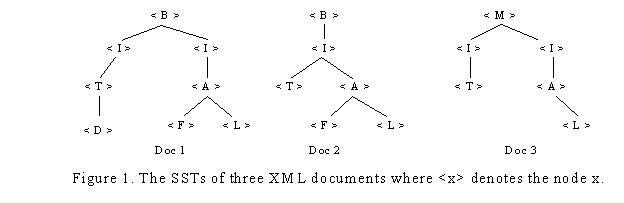
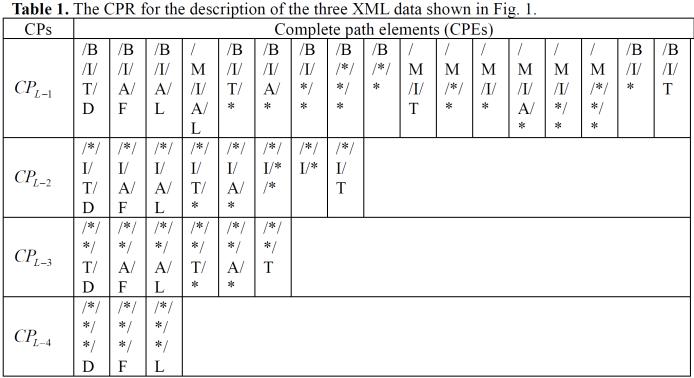
An example of level definition is shown in Figure 1, where four CPE sets: CPL-1, CPL-2, CPL-3, and CPL-4, can be defined. The elements of the four CPE sets are shown in Table1.TraditionalWPandNPrepresentations,withtheir lack of linking information, cannot serve such queries as (/B/*/*/*/*) and (/*/I/A/L) where * means “don’t care” about the node name. For efficient query service, CPR describesXMLdata withtheCPEs ofallSSTs.TheCPE set of a tree is defined as all the branches, (i.e., sub-paths) startingfromeachleveltotheleaves.Forconvenience,let CPL-i denoteasetofCPEsstartingfromthe ithlevel,where therootlevelisdefinedasoneandisincreasedtowardthe leaves.
Essentially, this algorithm is an exhaustive search that isguaranteedtofindallofthebranchesofa SST TheCPR forthedescriptionofSSTscanbedefinedas:
International Research Journal of Engineering and Technology (IRJET) e-ISSN: 2395-0056
Volume: 12 Issue: 06 | Jun 2025 www.irjet.net p-ISSN: 2395-0072
is a set involving the i-th level
CPEsofallXMLdata},
where ∪ denotes union operation and L is the maximum level number. Considering a database comprised of the threeXMLdatashowninFigure1,theCPRcanbefoundin Table 1. In Figure 1,there are two I nodes for bothDOC1 and 3. The two nodes with different children are distinct andcannotbemerged.Thetwosub-paths/B/I/TinDOC2 and/B/I/T/*inDOC1havethesamepathlengthequalto 3, but have distinct distances from leaf node. The same distinctions also exist between the two sub-path elements /M/I/*and/M/I/*/*intheCPL-1.
ACPEwiththetreecharacteristicisahighdimensional feature. Traditional B-tree indexing based on node relationships is suitable for WP, NP and twig queries, but isinefficientforCPR,which regardseachCPEasafeature element. In this section, a new index with feature similarity structure (FSS) is presented for CPE management. The FSS provides a fast template-based hierarchicalindexing.
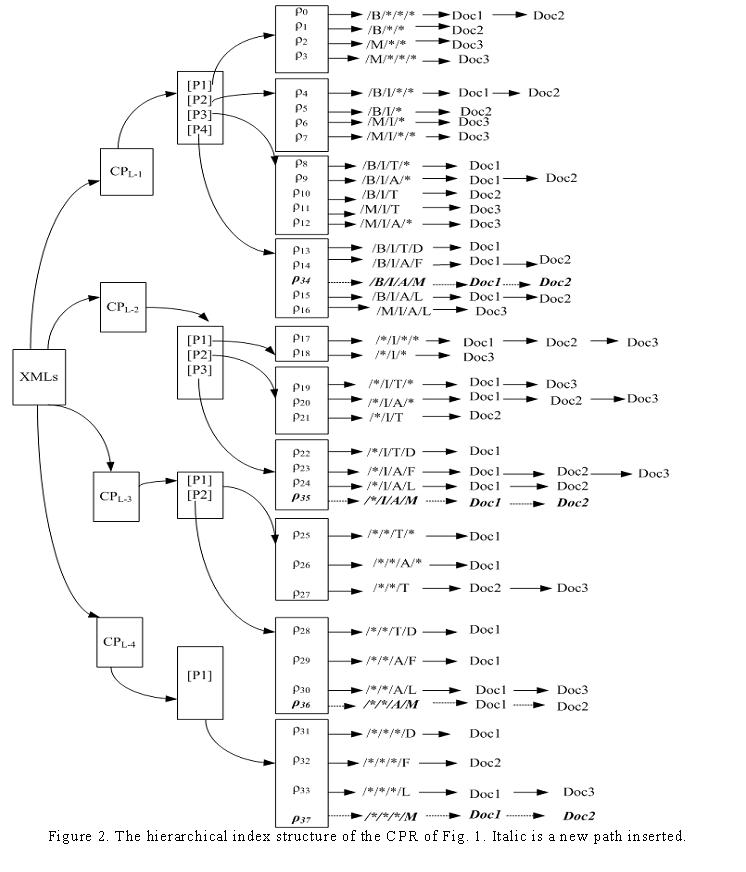
The CPEs of Table 1 can be represented with a tree structure, as shown in Figure 2, where Pi denotes a CPE subsetwithpathlengthequalto i.TheCPEsinFigure2are inherent with the hierarchical information involving path
length (Pi)and level ( lL CP ) that areavailable forinferring
semantic relations, e.g., ancestor-descendant (AD), sibling (SB)andcousin(CN)relationships.B-treeindexwithakey design can achieve balanced binary tree structure for efficientlyindexingthe elementsof NPand WP, butcannot
providehierarchicalinformation.Tofacilitatetheinference of semantic information, the inverted index structure with additionalfieldsisappliedforCPEindexing.
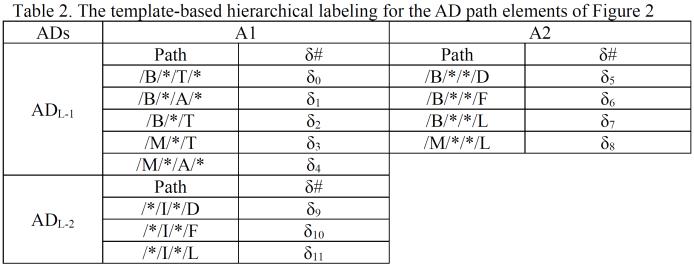
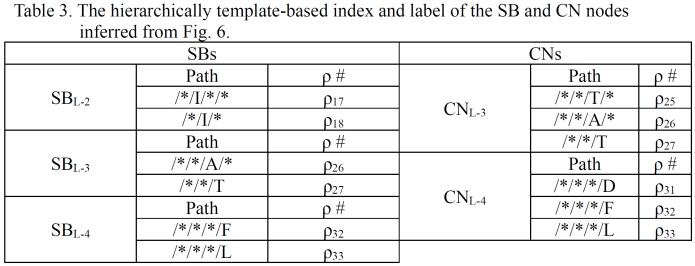
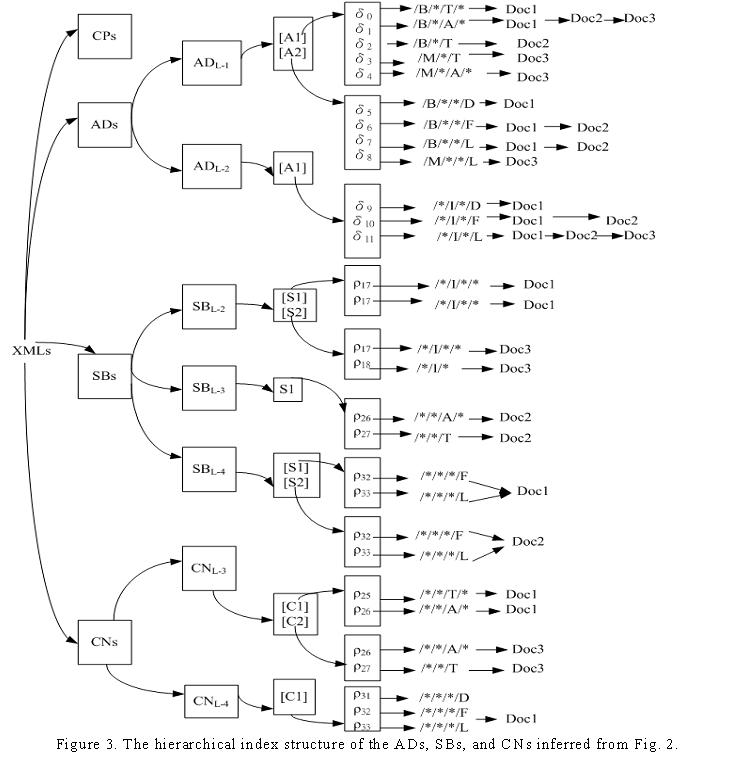
The path elements with AD relationships can be easily obtainedfromtheCPEswiththepathlengthfieldfilledinPi for 3 i ,i.e., path length ≥3. For the example ofFigure2, there are two kinds of AD relationship shown in Table 2, where A1 involves the path elements with one-generation AD,andA2involvesthepathelementswithtwo-generation AD. Note that these path elements are different from CPE, and are labeled with . SB and CN are relations among nodes, where these nodes have different descendantsbuthavethesamefatherandgrandfathernode, respectively.ForSB,thefathernodescanbefoundinlevels CPL-l for Furthermore, the search of CN nodes is to verify whether their father nodes are inherent with a SB relationship. The hierarchical labeling templates of SB and CN relations are shown in Table 3. The tree structure index, including semantic information, is illustrated in Figure 3, where SB and CN indexing requires fewerlevelsthantheindexingofAD.


International Research Journal of Engineering and Technology (IRJET) e-ISSN: 2395-0056
Volume: 12 Issue: 06 | Jun 2025 www.irjet.net p-ISSN: 2395-0072
4.1
Assuming we have 800,000 XML documents, 200 paths per document, six characters per path, and 100,000,000 XML postings where we define a posting as a docID in a postings list. XML document identifiers are log2 800,000 ~= 20 bits long. Thus, the size of the collection is about 800,000*200*6 bytes=960 MB and the size of the uncompressed XML postings file is 100,000,000*32/8 = 400 MB (32-bit word) and 100,000,000*20/8 =250 MB (20-bitword)respectivelyasshownintheTable4

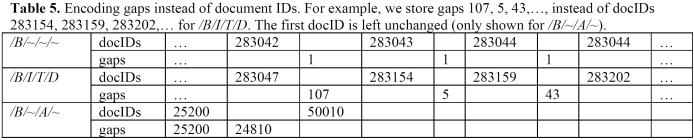
To devise a more efficient representation of the XML postings file, the proposed methods that uses fewer than 20 bits per XML document, we observe that the XML postings for frequent paths are close together. Imagine going through the documents of a collection one by one andlookingforafrequentpathlike /B/I/T/D.Wewillfind a document containing /B/I/T/D, then we skip a few documents that do not contain it, then there is again a document with the path and so on (see Table 5). The key idea is that the gaps between XML postings are short, requiringalotlessspacethan20bitstostore.Infact,gaps for the most frequent paths such as /B/~/~/~ are mostly equal to 1. But the gaps for a rare path that occurs only once or twice in a collection (e.g., /B/~/A/~ in Table 5) havethesameorderofmagnitudeasthedocIDsandneed 20 bits. For an economical representation of this distribution of gaps, we need a variable encoding method thatusesfewerbitsforshortgaps.
To encode small numbers in less space than large numbers, we look at two types of methods: bytewise compression and bitwise compression. As the names suggest, these methods attempt to encode gaps with the minimumnumberofbytesandbits,respectively.
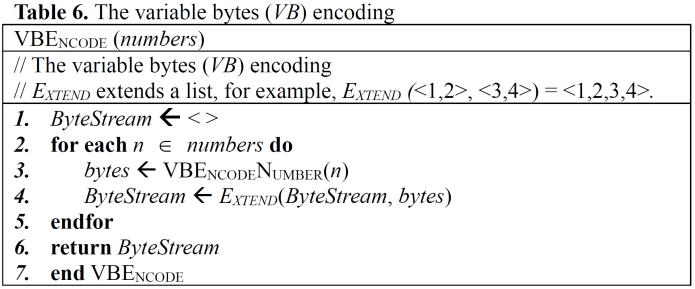
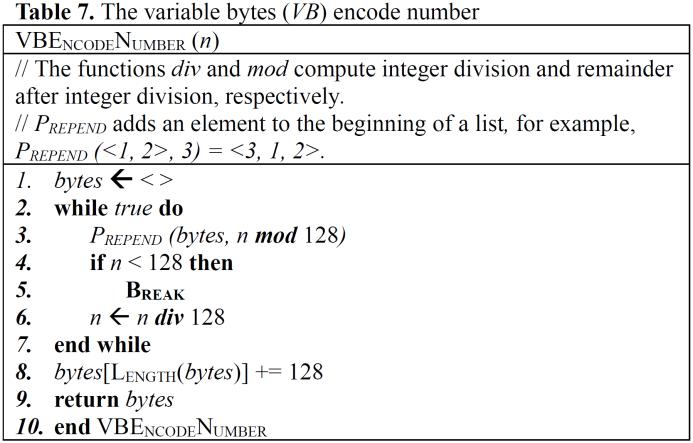
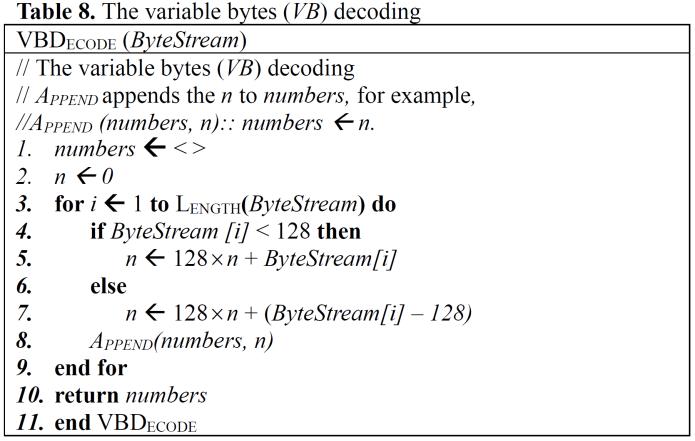
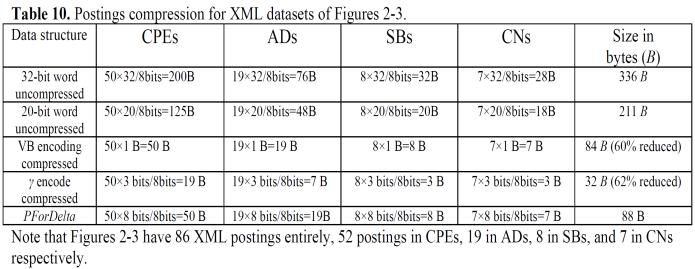
Bytewise variable byte (VB) encoding uses an integral number of bytes to encode a gap. The last 7 bits of a byte are “payload” and encode part of the gap. The first bit of thebyteisa continuation bit.Itissetto1forthelastbyte of the encoded gap and to 0 otherwise. To decode a variable byte code, we read a sequence of bytes with continuation bit 0 terminated by a byte with continuation bit 1. We then extract and concatenate the 7-bit parts. Tables 6-8 give pseudo code for VB encoding and decoding. Note the VB encoding 60% reduced compared with the 20-bits uncompressed can be denoted in the Table10.
International Research Journal of Engineering and Technology (IRJET) e-ISSN: 2395-0056
Volume: 12 Issue: 06 | Jun 2025 www.irjet.net p-ISSN: 2395-0072
VB codes use an adaptive number of bytes depending on the size of the gap. Bit-level codes adapt the length of the code on the finer grained bit level. The simplest bit-level code is unary code. The unary code of n is a string of n 1s followedby0asshownthefirsttwocolumnsoftheTable 9.Assumingthe2n gaps G with areallequally likely, the optimal encoding uses n bits for each G. The γ codesimplementvariable-lengthencodingbysplittingthe representation of a gap G into a pair of length and offset (<length, offset>). The offset is G in binary, but with the leading 1 removed. For example, for the gap number 9 (binary 1001) offset is 001. Length encodes the length of offset inunarycode.Fornumber9,thelengthof offset is3 bits, which is 1110 in unary. The γ code of 9 is therefore 1110001,theconcatenationof length 1110and offset 001.
The right hand column of Table 9 gives additional examplesofγcodes.
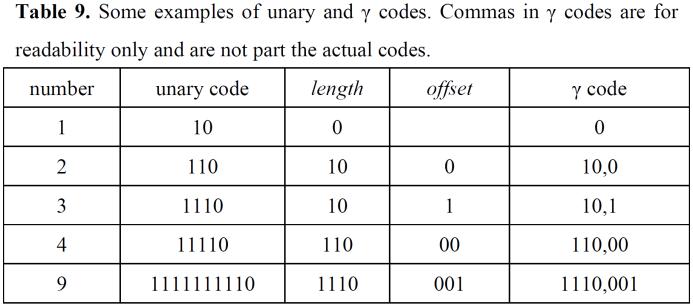
A γ code is decoded by first reading the unary code up to the 0 that terminates it, for example, the four bits 1110 when decoding 1110001. Now we know how long the offset is: 3 bits. The offset 001 can then be read correctly andthe 1 that waschopped off in encodingis prepended: 001 1001=9.
The length of offset is G 2log bits and the length of length is G 2log +1bits,sothelengthoftheentirecode is 1 log 2 2 G bits. The γ codes are always of odd lengthandtheyarewithinafactorof2ofwhatweclaimed to be the optimal encoding length G 2log . Table 26 denotes the γ-encoded of Figures 6-7 XML postings comparing with various schemes. Note the γ-encoded is reducedto32 B,bringusdownto62%comparedwiththe VB encodingshownintheTable10.
4.4 Patched Frame-Of-Reference Delta (PForDelta) Coding
The PForDelta use the compressing structures including the header, code, and exception which contain 32-bits for header, 8-bits for code (172 xml postings), and 4-byte for exception respectively. The CPEs for PForDelta is derived as 50*8-bits =400 bits/8=50 Bytes, ADs 19*8=152/8=19 Bytes. The total size bytes for PForDelta be 32B+50B+19B+8B+8B=88Bytes. This strategy for PForDelta is space saved and good performance of efficientretrieval.ThePForDeltaforXMLpostingisshown astheTable10.

International Research Journal of Engineering and Technology (IRJET) e-ISSN: 2395-0056
Volume: 12 Issue: 06 | Jun 2025 www.irjet.net p-ISSN: 2395-0072
For efficiently serving versatile queries, a new XML data representation referred to as CPR Huffman Coding has been presented in this paper. The proposed method of representing XML document with complete paths is practical and scalable for the usage in web environment We employ a number of compression techniques for CPR dictionary and XML postings that are important for efficient XML IR systems and give a satisfied experiment result.
[1] World Wide Web Consortium. The document object model.http://www.w3.org/DOM/
[2] Berglund A, Boag S, and Chamberlin D, XML Path Language (XPath) 2.0, W3C Recommendation, http://www.w3.org/TR/xpath20/(January2007)
[3] Robie J and Hat R. XML Processing and Data Integration with XQuery IEEE Internet Computing 2007; 11:62-67.
[4]Dalamagas T, et al. Clustering XML Documents using Structural Summaries. EDBT Work-shop on Clustering InformationovertheWeb(ClustWeb04)2004.
[5] Nierman A and Jagadish HV. Evaluating Structural Similarity in XML Documents Fifth International WorkshopontheWebandDatabases2002.
[6] Flesca S, et al Fast Detection of XML Structural Similarity. IEEE Transactions on Knowledge and Data Engineering2004;17:160-175.
[7] Lian W, et al. An Efficient and Scalable Algorithm for Clustering XML Documents by Structure. IEEE Transactions on Knowledge and Data Engineering 2004; 16:82-96
[8]KozielskiM.ImprovingtheResultsandPerformanceof Clustering Bit-encoded XML Documents. Sixth IEEE InternationalConferenceonDataMining-Workshop2006.
[9]YuanJS,LiXYandMaLN.AnImprovedXMLDocument Clustering Using Path Feature. Fifth International Conference on Fuzzy Systems and Knowledge Discovery 2008;2:400-404.
[10] Leung HP, Chung FL, Chan SCF and Luk R. XML Document Clustering Using Common Xpath Proceedings of the International Workshop on Challenges in Web InformationRetrievalandIntegration2005;91-96.
[11] Termier A, Rousset MC and Sebag M. treefinder: a firststeptowardsXMLdatamining.ProceedingsofIEEE InternationalConferenceonDataMining2002;450-457.
[12]YangJ,CheungWKandChenX.LearningtheKernel MatrixforXMLDocumentClustering.IEEEInternational Conferenceone-Technology,e-Commerceande Service2005;353-358.
[13] Liu J, Wang JTL, Hsu W and Herbert KG. XML Clustering by Principal Component Analysis. Proceedings. Of the16thIEEEInternationalConference onToolswithArtificialIntelligence.2004;658-662.
[14] Lee JW, Lee K and Kim W. Preparation For Semantic-Based XML Mining. IEEE International ConferenceonDataMining2001,pp.345-352.
[15] Qureshi MH and Samadzadeh MH. Determining the Complexity of XML Documents. Proceedings of the International Conference on Information Technology: CodingandComputing2005;2:416-421.
[16] Li XY. Using Clustering Technology to Improve XML SemanticSearch.ProceedingsoftheSeventhInternational ConferenceonMachineLearningandCybernetics2008;5: 2635-2639.

Hsu-Kuang Chang He is associative professor in the Department of Information Engineering, I-Shou University, Taiwan. His research interests include data mining, multimedia media database, and information retrieval. 1’st Athor Photo