
Volume: 11 Issue: 12 | Dec 2024 www.irjet.net p-ISSN:2395-0072

Volume: 11 Issue: 12 | Dec 2024 www.irjet.net p-ISSN:2395-0072
Sepideh Alaei Varnousfaderani
1Student, Dept of Computer Engineering, Azad University, Isfahan, Iran
Abstract - Smart grids have emerged as a promising solution to meet increasing electricity demand and reduce environmental pollution. However, the high volume of data transmission and storage poses significant challenges, including delays, interference, increased power consumption, and storage limitations. This paper investigates data compression as a solution, focusing on Compressed Sensing due to its efficiency and low computational complexity. A smart grid model comprising wind turbines, solar panels, and battery banks connected to a DC bus is analyzed, with local controllers for generators and a supervisory controller for power allocation based on load demand, environmental conditions, and generator constraints. Data acquisition and compression units are incorporated to optimize data handling. Simulation results demonstrate that Compressed Sensing significantly reduces datavolumewhilepreservingsignalaccuracy.
Key Words: Smart Grid, Data Compression, Compressed Sensing,RenewableEnergy,PowerAllocation.
1.INTRODUCTION
Smart grids have garnered significant global attention due to their numerous advantages, such as providing efficient and reliable power delivery systems [1], integrating renewable and alternative energy sources through automated control [2], and enabling real-time monitoring with offline analysis capabilities [3]. As a result,substantialresearchhasbeenconductedtoexpand smartgridcapabilitiesandaddressitschallenges.
Onemajorchallengeinsmartgridsisthehighvolumeof transmitted and stored data due to the extensive data exchange required among various control units and computational systems [4]. High data volume can lead to transmissionissuessuchasdelays,interference,excessive power consumption, increased network traffic, and demands for additional bandwidth. In terms of storage, limited space presents significant constraints. Data compressionisapracticalandefficientsolutiontoaddress these issues. It offers three key benefits [4]: significant reduction of data volume, preservation of essential information, and high-precision reconstruction of data at thereceiver.
Various data compression techniques have been explored for smart grids. Wavelet transform has been
applied to electrical signals [3]-[5], including simulated data collected from Phasor Measurement Units (PMUs) [3], though not specifically within a smart grid model. Lossless compression methods, such as those defined by IEEE 1159 [6], achieve exact signal reconstruction but offer limited compression efficiency. The Discrete Cosine Transform (DCT) has also been utilized [7], but its effectiveness is limited to signals with sinusoidal properties.
Recently, Compressed Sensing (CS) has emerged as a promisingtechniqueforsimultaneoussignalsamplingand compression [5]-[6]. CS exploits the sparsity of signals in onedomaintoachievehigh-precisionreconstructionfrom a reduced number of measurements in another domain [7]. It has been successfully implemented in applications such as large-scale wireless sensor networks [8]-[9], biological signals like ECG and EEG [10]-[11], and video rate control [12], demonstrating reduced communication costs and increased network capacity. Despite its success intheseareas,CShasnotbeenwidelyappliedtoelectrical signals in smart grids. Given the sparsity of electrical signals in the DCT domain, CS presents a compelling method for addressing data volume challenges in smart grids.
This paper introduces a smart grid model comprising wind turbines, solar panels, and battery banks connected to a DC bus, managed through a two-level control architecture. The first level employs local sliding mode controllers for individual generators and a control algorithm for battery banks. The second level features a supervisorycontroller to allocatepower references based on demand, environmental conditions, electricity prices, and generator constraints, along with a monitoring unit forsystemoversight.
High data volumes transmitted to the supervisory and monitoring units necessitate the introduction of two additional components: the Data Acquisition and Compression Unit (DACU) and the Data Analysis Unit (DAU). These units enable the application of compression algorithms to transmitted and stored data. Simulation results demonstrate that Compressed Sensing effectively reduces data volume while maintaining high-precision signal reconstruction, ensuring optimal performance of thesupervisorycontrollerandoverallsystemefficiency.
International Research Journal of Engineering and Technology (IRJET) e-ISSN:2395-0056
Volume: 11 Issue: 12 | Dec 2024 www.irjet.net
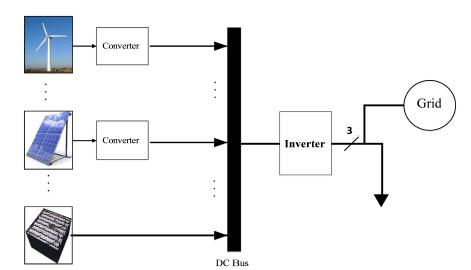
The smart grid represents a transformative approach in powersystems,gainingglobalrecognitionforitsabilityto enhance efficiency, reliability, and sustainability. This section presents a general smart grid model comprising wind turbines, solar panels, battery banks, local controllers, a supervisory controller, and a monitoring unit. The functionality of each component (except the monitoringunit,whichisbeyondthescopeofthisarticle) isdiscussedbelow.
The smart grid model,asshown in Fig. 1, integrates wind and solar generators connected to a DC bus via power converters. The DC bus voltage is regulated by the terminal voltage of the battery bank. Each generator is controlled bya local controllerthat adjuststhe dutycycle ofitsconvertertomanagepowergenerationeffectively.
As depicted in Fig. 2, data from the generators is transmitted to a remote control room during each sampling period. This control room houses the supervisory controller and monitoring unit. To minimize wiring costs due to the physical distance between the control room and generators, communication networks areusedfordatatransmission.Thesupervisorycontroller processes the received data along with generator constraints,environmentalconditions,demand(load),and power costs to determine the reference power for each generator. Meanwhile, the monitoring unit analyzes the data to track environmental conditions and evaluate the performanceofsmartgridcomponents.
This model ensures seamless integration of energy resources and facilitates efficient management, control, andmonitoringofthesmartgridsystem.
The wind turbine in this model employs a Permanent Magnet Synchronous Generator (PMSG), which offers two
p-ISSN:2395-0072
significantadvantages.First,theabsenceofrotorcurrents reducesmaintenancecosts.Additionally,PMSGsdonot
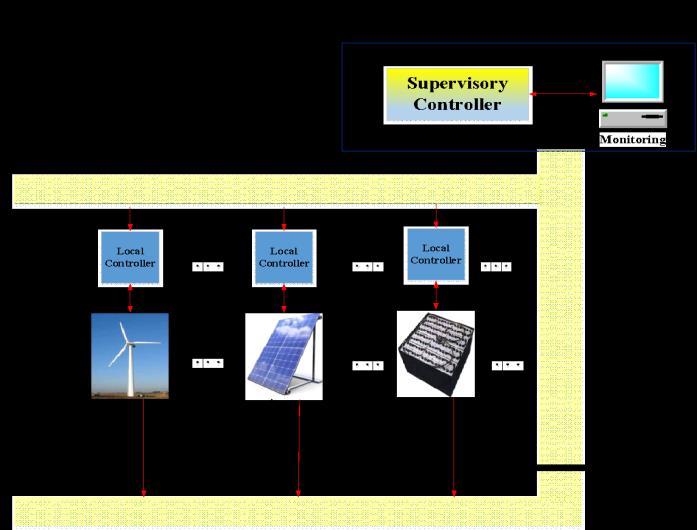
Fig -2:ModelofSmartGrid:DataExchangePerspective requirea gearbox, minimizingtheoverall weightandcost oftheturbine[13].
The wind subsystem consists of a windmill, a PMSG, a rectifier, and a DC/DC converter. The windmill captures energy and drives the PMSG, which converts mechanical energyintoelectricalenergy.TherectifierconvertstheAC output of the PMSG into DC, while the DC/DC converter regulatestheDCoutputandconnectstheturbinetotheDC bus.
Tocontroltheturbine'soperatingpointandconsequently its generated power, the voltage at the PMSG terminals is adjusted by modifying the duty cycle of the DC/DC converter. The dynamic model of the turbine in a rotor referenceframeisprovidedin[14].
Thesolarsubsystemcomprisesphotovoltaic(PV)panels connected to the DC bus through half-bridge buck DC/DC converters. The operating point of the PV panels is controlledbyadjustingthestateoftheconverter,allowing forefficientpowerregulation.
ThemathematicalmodelofthePVpanelsisdescribedin [15].
The battery bank in the smart grid model plays a crucial role in balancing energy supply and demand. It compensates for energy shortages by discharging and stores excess energy by charging, thereby mitigating sudden power fluctuations. In this model, the battery is a
International Research Journal of Engineering and Technology (IRJET) e-ISSN:2395-0056
Volume: 11 Issue: 12 | Dec 2024 www.irjet.net
conventional 48-volt rechargeable battery. Since the voltage drop across the battery's internal resistor and capacitor is negligible, its voltage is assumed constant. Consequently, the DC bus voltage, determined by the batterybankvoltage,remainsconstantaswell.
A key parameter for rechargeable batteries is the state of charge (SOC), which is defined as:
SOC(t) = SOC(t₀) - (1 / Qmaxᶜ) ∫[t₀ to t] i(τ) dτ (1)
Where t is Time (hours), Qmaxᶜ is Maximum capacity of thebattery(ampere-hours,Ah),andi(τ)isBatterycurrent (amperes,A).
The SOC is always a value between 0 and 1, where values closer to 1 indicate a fully charged battery, and valuescloserto0representadischargedstate.Monitoring SOC is essential for efficient and safe operation of the batterybankinthesmartgrid.
The primary objective of the wind local controller is to ensuretheturbinetracksthereferencepowerdetermined by the supervisory controller whenever feasible. If the referencepowercannot be achieved,theturbine operates to generate the maximum available power. Additionally, the controller is responsible for maintaining the stability ofthewindsubsystem.
To achieve these control objectives, this paper employs a sliding mode controller designed using the differential geometricapproachoutlinedin[16].Thismethodensures robust performanceandstabilityundervaryingoperating conditions.
The controller considered to set the performance of the solar panel is a sliding mode controller proposed in [17]. The objective of the solar local controller is like the wind subsystemcontroller.
Theperformancecharacteristicsofarechargeablebattery are significantly influenced by its type, size, and manufacturer. To ensure optimal operation of the battery bank in the smart grid model, the proposed controller performstwoessentialfunctions.
First, the controller limits the battery bank's exchanged current with the DC bus to remain below the rated current.Thispreventspotentialdamagetothebatteryand
p-ISSN:2395-0072
helps stabilize the DC bus voltage by minimizing voltage drops. Second, to extend the battery's lifespan, the controlleradjuststhebatterycurrentbasedonitsstateof charge(SOC).WhentheSOCreaches1(fullycharged),the input current is set to zero. Conversely, when the SOC reaches 0 (completely discharged), the output current is set to zero. This approach ensures safe and efficient operation of the battery bank while maintaining system stability.
In order to calculate the proper reference power of each generator based on demand, environmental conditions, cost of electricity, and limitations of each generator, a supervisory controller is needed. In this paper, the supervisory controller is an optimal controller similar to [6]. The advantage of this supervisory controller is applyingtherestrictionseasilyaswellassimplicity.
In this paper, based on the cost of electricity, the supervisory controller has two different working modes. When electricity is cheap, it is not economical that smart gridsellselectricitytothegrid.Thus,referencepowersare calculatedusinganoptimalalgorithmandsenttothelocal controllers. On the other hand, when the electricity is expensive, the reference is set on the maximum available powerofeachgenerator.
The smart grid model and its components, introduced in the previous section, include a supervisory controller and monitoring unit typically located remotely from the generators.Bothunitsrequiredatatofunctioneffectively.
The sampling time of the local controllers is smaller than that of the supervisory controller, resulting in a high volume of data generated during each sampling interval. This data includes parameters such as generator voltage and current. The supervisory controller uses the latest sample of this data to simulate the smart grid's behavior duringthenextsamplingperiodandcalculateappropriate referencevalues.Meanwhile,themonitoringunitrequires all samples to continuously track environmental conditionsandassessthesmartgrid'sperformance.
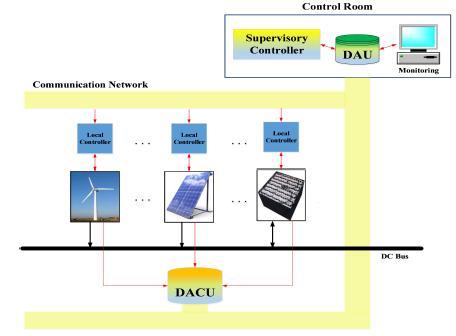
Since data for both the supervisory controller and monitoring unit is transmitted via a shared communication network, the volume of transmitted data can become significant, potentially causing network congestion. To address this issue, the proposed solution involvesmodifyingthesmartgridmodel byincorporating two additional units: the Data Acquisition and
International Research Journal of Engineering and Technology (IRJET) e-ISSN:2395-0056
Volume: 11 Issue: 12 | Dec 2024 www.irjet.net
Compression Unit (DACU) and the Data Analysis Unit (DAU).TheupdatedmodelisshowninFig.3.
The DACU collects and compresses data to reduce its volume before transmission.Thecompressed data is then sent to the DAU through an appropriate communication network. In the DAU, the data is reconstructed with high precision and subsequently forwarded to the monitoring unitandsupervisorycontroller.
Since the compression method employed is Compressed Sensing (CS), the structure and functionality of the DACU andDAUare explainedin detail followinganintroduction toCS.
CompressedSensing(CS)isatechniqueusedtocompress and reconstruct signals by exploiting their sparsity. A signal can often be represented as a combination of specific base vectors, where only a few coefficients (entries)arenonzero.Thispropertyisknownassparsity.
In CS, a signal is compressed by multiplying it with a measurement matrix, producing a shorter representation called the measurement vector. The measurement matrix is designed to preserve the essential information of the original signal, even after compression. This ensures that thesignalcanbeaccuratelyreconstructedlater.
To reconstruct the signal, the CS process identifies the sparserepresentationofthesignalusingthemeasurement vector,themeasurementmatrix,andtheknowledgeofthe sparse basis. The original signal can be recovered by solving an optimization problem. Since finding the sparsest representation (using the ℓ0 norm) is computationally challenging, an alternative optimization problem using the ℓ1 norm is solved instead. This approach is computationally efficient and yields accurate results.
Applying CS involves three main steps. First, a suitable basis is chosen where the signal is sparse, such as DCT, DWT, DST, or FFT. Second, an appropriate measurement matrix is designed, often using random matrices with specific properties. Finally, a reconstruction algorithm is applied to recover the original signal. Two common categories of reconstruction algorithms are Basis Pursuit (BP), which offers high precision but is slower for largescale problems, and Greedy Algorithms, which are faster butlessprecise.
In summary, CS is a powerful method for compressing signals with high efficiency and reconstructing them accurately,providedthesignalissparseinachosenbasis,
p-ISSN:2395-0072
and the measurement and reconstruction processes are well-designed.
The Data Acquisition and Compression Unit (DACU) requires memory,a processor,a transceiver, and a power supply unit. With Compressed Sensing (CS) chosen as the compression method, a portion of the memory is dedicated to storing an appropriate measurement matrix. Another portion of the memory is used to store incoming data during each specified interval, corresponding to the samplingtime
ofthesupervisorycontroller.ThestructureoftheDACUis depictedinFig.4.
The processor in the DACU performs the task of multiplying the measurement matrix by the input data, enabling efficient compression. This operation is computationally simple, resulting in high processing speed. The same measurement matrix can be used for compressing data sets with similar sparsity characteristics. The input data is represented as a matrix with dimensions N×J, where N is the number of data samplesforaspecifictypeoverthespecifiedtimeinterval, andJisthenumberofdifferentdatatypes.
The Data Analysis Unit (DAU), shown in Fig. 5, also consists of memory, a processor, a transceiver, and a power supply. A portion of the DAU memory is allocated for storing the measurement matrix, which must be identical to the matrix stored in the DACU. This ensures that the data can be accurately reconstructed to closely match the original signal. The reconstruction algorithm applied in the DAU can be either a Basis Pursuit (BP) methodforhighprecisionoragreedyalgorithmforfaster
International Research Journal of Engineering and Technology (IRJET) e-ISSN:2395-0056
Volume: 11 Issue: 12 | Dec 2024 www.irjet.net
processing,depending onthespecificrequirementsof the application.
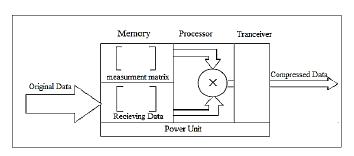
Fig -4:DACUModel
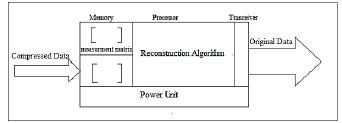
Fig -5:DAUModel.
To demonstrate the effectiveness of Compressed Sensing (CS) in data compression, this technique was applied to a setofrealelectricaldataprovidedbytheIsfahanRegional Electricity Dispatching. The dataset includes frequency, voltage, current, power factor, power, and phase, with a sampleintervalofoneminute.
A compression method is considered effective if it achieves a high compression percentage while ensuring accurate reconstruction of the original data. The compressionpercentageinCSisdefinedas:
Compression Percent = [(N - M) / N] × 100 (2)
Here, N is the length of the original signal, and M is the lengthofthecompressedsignal.
After analyzing the real data, it was observed that these signalsaresparseintheDiscreteCosineTransform(DCT) domain, making them suitable for compression using CS. For instance, the power signal, along with its DCT coefficientsfor100samples,areshowninFig.6Thesmall numberofnonzeroDCTcoefficientscomparedtothetotal samples confirms the sparsity of this signal in the DCT domain.
To compress these signals using CS, the measurement matrixwasdefinedas:
φ = sign(randn(M, N)) + ones(M, N) (3)
p-ISSN:2395-0072
Reconstruction accuracy is evaluated using the NormalizedMeanSquareError(NMSE),calculatedas:
NMSE = X - X ₂² / ∥X∥₂² (4)
where Xis the original signal,and X isthe reconstructed signal. A lower NMSE indicates higher reconstruction accuracy.The Orthogonal Matching Pursuit (OMP) algorithm was employed for reconstruction, with M=300, corresponding to a compression percentage of 70%. This setup yielded an NMSE of less than 0.01 for all signals, demonstratingsatisfactoryperformance.
Reconstructed power signal using OMP for 1000 samples is depicted in Fig. 7, showcasing the accuracy and effectivenessofCSincompressingandreconstructingreal electricaldata.
In the smart grid model, a significant volume of data is transmitted duringeachsamplingintervalfromthe smart grid to the supervisory controller for proper operation and to the monitoring unit for overseeing system performance and environmental conditions. However, transmitting such a large volume of data introduces various challenges. To address this, data is first compressed in the Data Acquisition Unit (DACU) before being sent to the supervisory controller and monitoring unit. Subsequently, the data is reconstructed in the Data AnalysisUnit(DAU)anddistributedtotherespectiveunits asrequired.
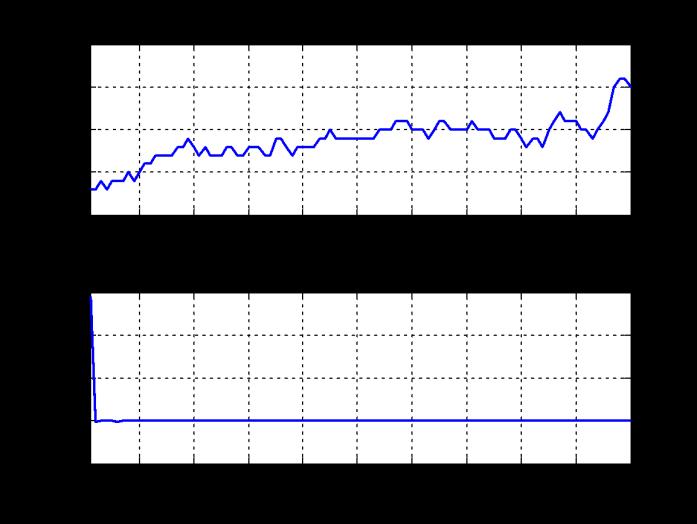
Fig -6:PowerSignalandItsDCTCoefficients(100 Samples).
International Research Journal of Engineering and Technology (IRJET) e-ISSN:2395-0056
Volume: 11 Issue: 12 | Dec 2024 www.irjet.net
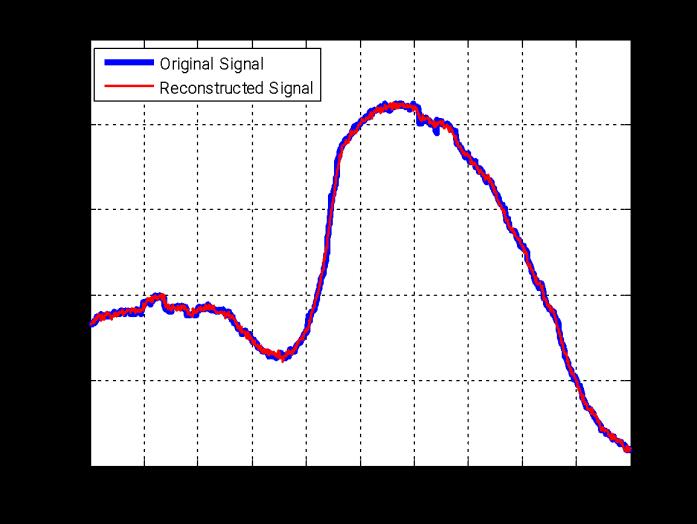
Simulations conducted in this study demonstrate that using Compressed Sensing (CS), data compression is achieved effectively, and signals are reconstructed with high precision. Additionally, despite the reduced data volume, the supervisory controller maintains satisfactory performance.
Toreducethevolumeofdata inthesmart grid, data from eachsamplingintervalofthesupervisorycontrollerisfirst sent to the Data Acquisition Unit (DACU). Since the data volume from batteries is relatively small, no compression isappliedtothem.Additionally,solardata,despiteitshigh volume due to the low sampling rate of the local controller, does not require all samples to be transmitted due to its dynamic nature. Therefore, before applying compressionalgorithms,anaverageofthesolardataover aspecifiedtimeintervaliscalculated.Themethodusedin this study for data volume reduction is Compressed Sensing(CS).
IntheCompressedSensing(CS)method,dataismultiplied by an appropriate measurement matrix stored in the memory of the Data Acquisition Unit (DACU). After analyzing the smart grid signals, the selected measurementmatrixisdefinedas:
φ=sign(randn(M,N))+ones(M,N)
Here,Nisthedimensionoftheoriginalsignal,andMisthe dimension of the compressed signal. This random matrix effectively preserves the essential information of the signal while ensuring high reconstruction accuracy. The compression process involves a simple matrix multiplication,highlightingthecomputationalsimplicityof this approach. Consequently, the processing time is very short,enablingthealgorithmtooperateinreal-time.
p-ISSN:2395-0072
Compressed data is sent to the Data Analysis Unit (DAU), where it is reconstructed using either an optimizationbased method or a greedy algorithm. The optimization method offers high precision, while the greedy algorithm providesfasterprocessing,makingitessentialtoconsider these trade-offs in a real-world network. Once reconstructed with high accuracy, the necessary data is transmittedtothesupervisoryandmonitoringunits.
Applying Compressed Sensing (CS) to smart grid data demonstrated that compressed signals could be reconstructed with high precision, comparable to the results achieved using wavelet transform. This confirms the effectiveness of CS for data compression and reconstructioninsmartgridapplications.
The sampling time of the supervisory controller is set to 10 minutes. During each interval, the supervisory controller requires specific data to allocate power correctlytoeachgenerator.Thisdataincludeswindspeed, direct and quadrature currents, rotational speed of each turbine generator, solar panel voltage, temperature, light intensity, solar panel output current, and battery state of charge.
Additionally, data sent to the monitoring unit includes environmental parameters such as temperature, light intensity, and wind speed for monitoring environmental conditions. Performance-related data such as currents, rotationalspeed,generatedpower,thedifferencebetween generated and reference power for each turbine, voltage, current,andpowerofthesolarpanel,alongwiththestate of charge, output power, and power difference of the battery, is also sent to the monitoring unit for overseeing theperformanceofthesmartgrid.
In the smart grid model, with the sampling time of the windcontrollersetto0.1second,andconsideringthecase study from the previous section (six turbines, one solar panel, and one energy storage unit), each wind signal generates 6000 samples during the supervisory controller's interval. Given the number of turbines and required signals, the total number of wind data samples perintervalis216,000.
The sampling time of the solar controller is 0.1 milliseconds. Since it is unnecessary to transmit all data, theaverageofeachsolarsignal over1-secondintervalsis calculated. As a result, each solar signal generates 600 samples per interval, and the total number of solar panel datasamplesis4200.
To synchronize the received data, the initial time of each generator is also transmitted. Excluding the battery data (which is minimal), the total number of transmitted data
International Research Journal of Engineering and Technology (IRJET) e-ISSN:2395-0056
Volume: 11 Issue: 12 | Dec 2024 www.irjet.net
samples per interval is 220200. This approach ensures efficientdatamanagementwithinthesmartgrid.
Itis evidentthat transmittingsucha large volumeofdata during each interval poses significant challenges. By applying a 75% compression rate to all signals (due to their similarsparsity levels),thetransmitteddata volume wasreducedto one-fourth, amounting to55,050 samples. This compression rate was chosen because higher compression resulted in reduced signal reconstruction accuracy.
The advantage of Compressed Sensing (CS) over wavelet transform becomes clear here. In wavelet transform, it is necessary to define a specific threshold level for each signal, which complicates the process. Using a uniform threshold leads to varying compression rates across signals. In contrast, CS provides consistent and efficient compression while maintaining high reconstruction accuracy.
To demonstrate the high reconstruction accuracy of wind turbine data compressed using Compressed Sensing (CS) at a 75% compression rate, the results are presented in Fig-8. The original wind speed signals (colored lines) and the signals reconstructed using CS (black lines) are displayed. For better clarity, the black lines in the figures represent the original signals, while the dotted colored lines represent the reconstructed signals. These visual comparisons highlight the effectiveness of CS in maintaininghighreconstruction
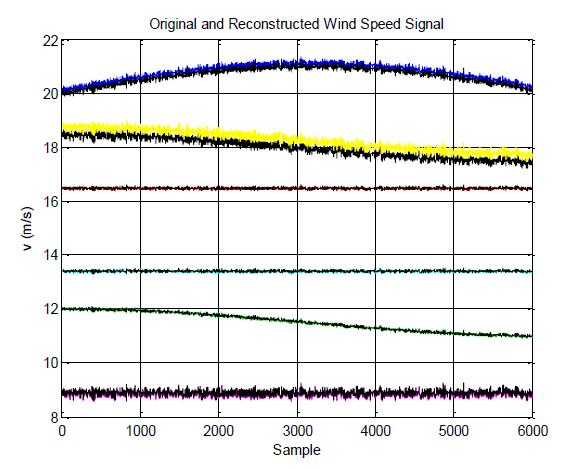
Fig -8:OriginalandReconstructedWindSpeedSignal.
accuracy despite significant data compression. The reconstructionerrorsforthesesignalsarebelow0.001.
The results in this section illustrate that Compressed Sensing (CS) has been effective in reducing the volume of
p-ISSN:2395-0072
solardatawhilemaintainingreconstructionaccuracy.The findings presented in Fig-9 show the current and voltage signals of the solar panel. Similar to wind data, the reconstructionerrorsforthesesignalsarebelow0.001.
This study highlights the effectiveness of Compressed Sensing (CS) for data compression in smart grid applications. Using real electrical data from the Isfahan Regional Electricity Dispatching, CS achieved up to 75% compression with reconstruction errors (NMSE) below 0.001.IntegratingDataAcquisitionandCompressionUnits (DACU) and Data Analysis Units (DAU) effectively addressed high-volume data transmission challenges, ensuring efficient performance of the smart grid. CS proves to be a scalable and reliable solution for modern powersystems,offeringsignificantpotentialforimproved datamanagement.
TheauthorwouldliketothankIsfahanRegionalElectricity Dispatching for providing the real electrical data used in this study, which was instrumental in validating the proposed method and demonstrating its practical applicability.
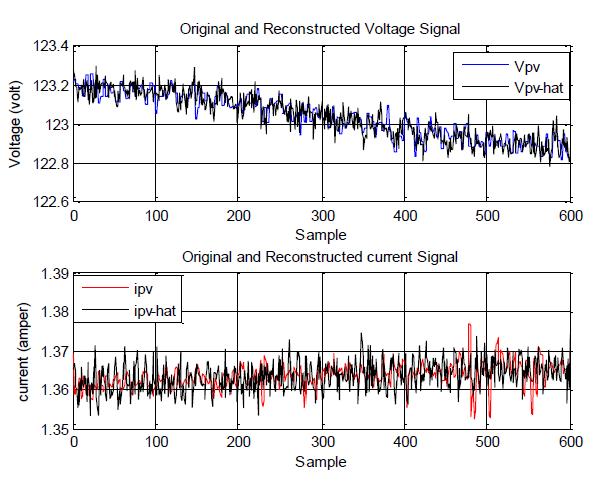
Fig -9:OriginalandReconstructed CurrentandVoltage Signal.
[1] Luo, J., Xiang, L., Rosenberg, C., “Does compressed sensing improve the throughput of wireless sensor networks?”, IEEE International Conference on Communications(ICC),pp.1-6,2010.
[2] Chen, W., Wassell, I. J., “Energy-efficient signal acquisition in wireless sensor networks: a compressive
International Research Journal of Engineering and Technology (IRJET) e-ISSN:2395-0056
Volume: 11 Issue: 12 | Dec 2024 www.irjet.net p-ISSN:2395-0072
sensing framework”, IET wireless sensor systems, vol. 2, no.1,pp.1-8,2012.
[3] Ning, J., Wang, J., Gao, W., Liu, C., “A wavelet-based data compression technique for smart grid”, IEEE Transactions on Smart Grid, vol. 2, no. 1, pp. 212-218, 2011.
[4] [Online].Available:http://openpdc.codeplex.com/
[5] Ning, J., Wang, J., Gao, W., Liu, C., “A wavelet-based data compression technique for smart grid”, IEEE TransactionsonSmartGrid,vol.2,no,pp.212-218,2011.
[6] IEEEP1159.3/D9, “Recommended practice for the transferofpowerqualitydata”.
[7] Qing, A., Hongtao, Z., Zhikun, H., Zhiwen, C., “A compression approach of power quality monitoring data basedontwo-dimensiondct”,InInternationalConference on Measuring Technology and Mechatronics Automation (ICMTMA),vol.1,pp.20-24,2011.
[8] Quer,G.,Masiero,R.,Munaretto,D.,Rossi,M.,Widmer, J.,Zorzi,M.,“Ontheinterplaybetweenroutingandsignal representationforcompressivesensinginwirelesssensor networks”, In Proc. Information Theory and Applications Workshop,pp.206-215,2009.
[9] Luo, C., Wu, F., Sun, J., Chen, C. W., “Efficient measurement generation and pervasive sparsity for compressive data gathering”, IEEE Transactions on Wireless Communications, vol. 9, no. 12, pp. 3728-3738, 2010.
[10] Garudadri, H., Baheti, P. K., Majumdar, S., Lauer, C., Massé, F., Van de Molengraft, J., Penders, J., “Artifacts mitigation in ambulatory ecg telemetry”, IEEE International Conference on e-Health Networking ApplicationsandServices(Healthcom),pp.338-344,2010.
[11] Mamaghanian, H., Khaled, N., Atienza, D., Vandergheynst, P., “Compressed sensing for real-time energy-efficientECGcompressiononwirelessbodysensor nodes”,IEEETransactionsonBiomedicalEngineering,vol. 58,no.9,pp.2456-2466,2011.
[12] Pudlewski,S.,Prasanna,A.,Melodia,T.,“Compressedsensing-enabled video streaming for wireless multimedia sensor networks”, IEEE Transactions on Mobile Computing,vol.11,no.6,pp.1060-1072,2012.
[13] Rolan,A.,Luna,A.,Vazquez,G.,Aguilar,D.,Azevedo,G., “Modeling of a variable speed wind turbine with a permanent magnet synchronous generator”, IEEE
International Symposium on Industrial Electronics, pp. 734-739,2009.
[14] Valenciaga, F., Puleston, P. F., Battaiotto, P. E., Mantz, R. J., “Passivity/sliding mode control of a stand-alone hybrid generation system”, IEE Proceedings-Control Theory and Applications, vol. 147, no. 6, pp. 680-686, 2000.
[15] Hussein, K. H., Muta, I., Hoshino, T., Osakada, M, “Maximumphotovoltaicpowertracking:analgorithm for rapidly changing atmospheric conditions”, IEE Proceedings-Generation, Transmission and Distribution, vol.142,no.1,pp.59-64,1995.
[16] Valenciaga, F., Puleston, P. F., Battaiotto, P. E., “Variable structure system control design method based onadifferentialgeometricapproach:applicationtoawind energy conversion subsystem”, IEE Proceedings-Control TheoryandApplications,vol.151,no.1,pp.6-12,2004.
[17] Valenciaga,F.,Puleston,P.F.,Battaiotto,P.E.,“Power control of a photovoltaic array in a hybrid electric generation system using sliding mode techniques”, IEE Proceedings-ControlTheoryandApplications,vol.148,no. 6,pp.448-455,2001.
© 2024, IRJET | Impact Factor value: 8.315 | ISO 9001:2008