
International Research Journal of Engineering and Technology (IRJET) e-ISSN: 2395-0056
International Research Journal of Engineering and Technology (IRJET) e-ISSN: 2395-0056
Ms. Harshada D. Parde1, Ms. Rutuja L. Shinde2, Ms. Pratiksha N. Garad3, Ms. Gauri K. Waghmare4
Prof. Sachin D. Pandhare5
1,2,3,4 Student,
5Assistant Professor, Dept. of Computer Science and Engineering, SMSMPITR, Akluj, Maharashtra, India ***
Abstract –
Thispaperpresentsthedevelopmentandimplementationof an advanced college enquiry chatbot, utilizing Natural Language Processing (NLP) techniques to address the escalatingstrainoncollegeresourcesduetotheincreasing volumeofstudentinquiries.Ashighereducationinstitutions experience growing numbers of prospective and current students seeking information, traditional methods of handling these inquiries have proven inefficient. The proposed chatbot is designed to alleviate this issue by providing immediate, accurate, and contextually relevant responsestofrequentlyaskedquestionsrelatedtovarious aspects of college life, including courses, admissions, scholarships, and campus facilities. By employing sophisticated AI algorithms and NLP models, the chatbot effectively interprets user queries in natural language, offering personalized and real-time assistance. This approach not only streamlines the process of information retrievalbutalsosignificantlyenhancestheuserexperience by reducing the time students spend searching for information and improving overall website usability. The chatbotoffersacutting-edgeapproachtoenhancingcollege resourcemanagementbyprovidingdynamicandinteractive assistance to students. This not only streamlines support services but also strengthens the overall efficiency and responsivenessofcampuscommunicationsystems.
Key Words: Student Helper Chatbot Web-based Application, HTML, CSS, JAVASCRIPT, MongoDB
Thecollegeadmissionsprocesshaslongbeenacomplexand time-consuming task, both for prospective students and collegestaff.Withanincreasingnumberofstudentsseeking information on courses, admissions criteria, scholarships, and campus facilities, the pressure on traditional support resourceshasneverbeenhigher.Collegewebsites,although providing valuable resources, are often insufficient in managingthegrowingvolumeofinquiriesinanefficientand timelymanner.Asaresult,theexistingsupportstructures are stretched thin, making it difficult for college staff to addressallinquiriesinatimelyandpersonalizedmanner. Thisimbalancecanleadtofrustrationamongstudentsand increasedworkloadsforcollegestaff.
Toaddressthischallenge,theimplementationofacollege enquirychatbotpoweredbyNaturalLanguageProcessing (NLP)presentsa promising solution.AchatbotusingNLP techniquescanbeemployedtointeractwithusersinnatural language, effectively answering a wide range of questions related to admissions, academic programs, scholarships, campusfacilities,andmore.Thisnotonlyreducesthestrain on college staff but also ensures that students receive accurate,prompt,andrelevantinformationatanytimeofthe day.
The college enquiry chatbot is built with sophisticated AI algorithms,enablingittoaccuratelyunderstandandprocess awiderangeofuserqueries.Thisintelligentsystemensures quick, relevant, and human-like responses, making the college enquiry experience smooth and efficient. Unlike traditional chatbots, which may rely on predefined responses,thisAI-drivensystemiscapableofunderstanding complexqueries,providingtailoredanddynamicanswers, andcontinuouslyimprovingitsaccuracythroughmachine learning.Byleveragingthesesophisticatedcapabilities,the chatbotenhancesuserexperiencebyreducingsearchtimes, improving website navigation, and making the process of obtaining information more seamless and efficient for prospectivestudents.
Inadditiontoenhancingtheuserexperience,theintegration of this AI-driven chatbot contributes significantly to improvingtheusabilityandefficiencyofthecollege’sonline resources. The chatbot can answer frequently asked questionsinreal time,guidestudentsthroughapplication processes, and reduce the need for human intervention, whichcanbeespeciallyhelpfulduringpeakperiodssuchas applicationdeadlinesorenrollmentseasons.
Theprimaryobjectiveofthiscollegeenquirychatbotisto streamlinetheadmissionsandregistrationprocessforboth prospective students and college staff. By providing comprehensivecollegeinformation,ensuringeasyaccessto information, minimizing query resolution time enabling effective communication, and simplifying the user experience,thechatbotaimstoreducethetimeandeffort required for students to enroll, while also improving the efficiencyofcollegeadmissionsprocesses.
Volume: 12 Issue: 05 | May 2025 www.irjet.net p-ISSN: 2395-0072 © 2025, IRJET | Impact Factor value: 8.315 |
International Research Journal of Engineering and Technology (IRJET) e-ISSN: 2395-0056
Volume: 12 Issue: 05 | May 2025 www.irjet.net p-ISSN: 2395-0072
An NLP-powered college inquiry chatbot can transform studentinteractionbyprovidinginstant,accurateresponses, improving communication efficiency, and reducing administrativeworkload.Byunderstandingandprocessing natural language, it can provide real-time, personalized responsestoqueriesaboutadmissions,courses,campuslife, financialaid,andmore.Thechatbotcanautomatetaskslike application tracking, fee payments, and scheduling, while alsoansweringfrequentlyaskedquestions24/7.
In our time at college, we often need access to various types of information whether it’s about fee structures, pending dues, or how to complete certain administrative procedures.Sadly,gettingthisinformationisusuallyfarmore complicatedthanitneedstobe.Forsomethingassimpleas checkingduefees,wemighthavetovisittheadministration block, locate the right office or window, collect a no-dues form,fillitoutproperly,andthenwaitforsomeonetoverify it.Thisoutdatedsystemwastestimeandenergy,especially when we live in an era of advanced technology and automation.
Ascomputersciencestudents,webelievethatrepetitiveand tedioustaskslikethesecanbesimplifiedusingthetoolswe study.That’swhywecameupwiththeideaofanintelligent voice bot designed specifically for college-related queries. Imagine just asking a voice assistant, “Do I have any due fees?” or “What’s the fee structure for my program?” and getting the answer instantly, without standing in lines or fillingforms.
This bot could also help new students by answering questionsaboutcollegeadmissionprocedures,hostelrules, or campus facilities saving them from hunting through multiplewebpagesormakingunnecessaryphonecalls.It’s all about making information more accessible, reducing friction, and using technology to improve the everyday collegeexperience
In the past, students and their parents faced significant challengeswhenseekinginformationaboutcollegecourses, fee structures, and the admission process. To gather such details,theyoftenhadtophysicallyvisitthecollege,navigate long processes, and spend considerable time waiting for responses. This traditional method was not only timeconsuming but also required considerable manpower to manageinquiriesandprovidethenecessaryinformation.
However,withtheadvancementoftechnology,theeducation system has undergone significant transformations. The traditionalapproachofcollectinganddisseminatingcourse informationmanuallyisincreasinglybeingreplacedbymore
efficient, technology-driven solutions. Over time, various digital systems and devices have emerged to simplify the process,reducingtheneedforphysicalvisitsandthelaborintensiveworkinvolvedinmanaginginquiries.
As a result, students and parents no longer need to go throughthecumbersomeprocessofvisitingthecampusto obtaindetailsaboutcourses,fees,andadmissionprocedures. Modern technology, particularly through online platforms andautomatedsystems,nowenablesinstantaccesstothis information. This shift not only saves time but also eliminates the need for excessive manpower, allowing collegestostreamlinetheir operationsandfocusonother criticaltasks.
By leveraging these technological advancements, colleges cannowprovideinstantandaccurateresponsestoinquiries, making the process more convenient for students and parents while also optimizing administrative workflows. This evolution in the education sector highlights how technologyhasplayedapivotalroleintransformingtheway educational institutions manage and deliver essential information.
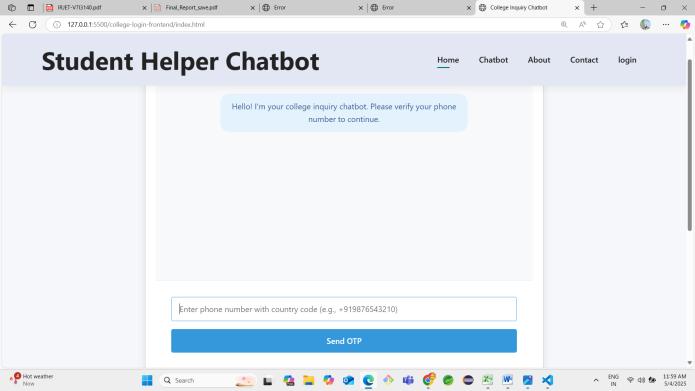
Theuserjourneybeginswhentheindividualinitiatescontact byenteringtheirphonenumberintothesystem.Following this, the system triggers a One-Time Password (OTP) verification process, sending a unique code to the user's device, which they must enter to proceed. Once authenticated,theuserispresentedwithachatbotinterface where they can type in their query. This input is then forwarded by the chatbot to a backend processing unit or machine, which analyzes the query through pattern matching mechanisms. By comparing the input against a structured database or external data services, the system identifies the most relevant information. The matched resultsarethenreturnedtothechatbot,whichformulatesan appropriate and understandable response. Finally, the chatbotdisplays thisresponseto theuser, completingthe interactioncycle.
International Research Journal of Engineering and Technology (IRJET) e-ISSN: 2395-0056
Volume: 12 Issue: 05 | May 2025 www.irjet.net p-ISSN: 2395-0072
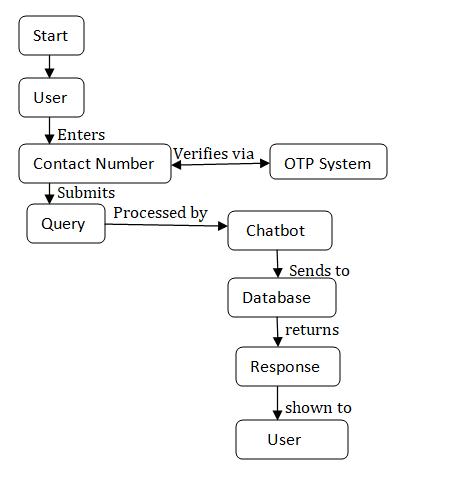
Fig-1: FlowChartdiagramforCollegeEnquiryChatbot
The process starts with a User who Enters their Contact Number.ThiscontactnumberisVerifiedviaanOTPSystem. The user then Submits a Query, which is Processed by a Chatbot.TheChatbotSendsthisquerytoaDatabase,which thenreturnsaResponse.Finally,thisResponseisshownto theUser.
ItdescribesthetechniqueusedinthisCHATBOTUSINGAIas wellastheplanningit.Thisdesignwillbecreatedusingthe most advanced technology that are currently used, which givesthewebsitemorecapabilityandproductivity.
Theplanningandworkflowforthedesignarecoveredinthis section.Theextensionwillbecreatedwiththehelpofmostly threelinesandthedatabaseprovider.
-TheHTMLextension.htmlandusedasframeworkforthe frontendinourproject.
-JavaScripttheoperation'sbackendfunctionalityisprovided byJavaScripttrain(extension.js).
- CSS used for the better graphical interface to the html extensions.
-PHPisaserversidescriptinglanguagethatisembeddedin HTML. It is used to manage dynamic content, databases, sessiontracking,evenbuildentiree-commercesites.
- For the database we implemented MySQL as database provider.
- XAMPP webserver areusedforapplicationtestingon a localhostwebserver.
Student:
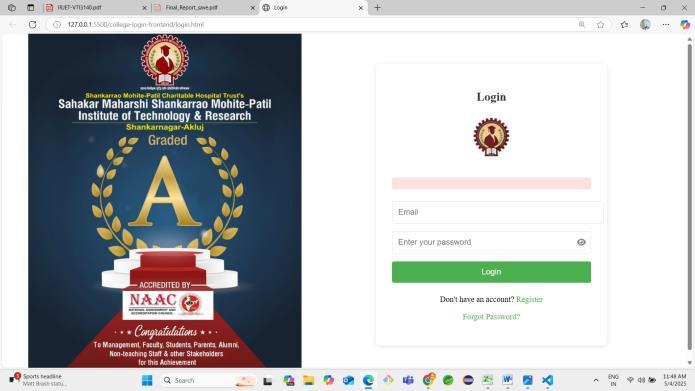
TheStudentLoginfeatureallowsstudentstoaccesstheapp using a password sent to their mobile number, with the option to save the login credentials for future access. For adding a new student, the Admin initiates the process by enteringthestudent'sdetails.Thesystemthengeneratesan OTP (One-Time Password) and sends it directly to the student'smobilephoneforverification.Thisensuressecure andeasyregistrationforstudentsontheplatform.
1. OTP Authentication:
OTPauthenticationisa securitymeasurethatensuresthe identityoftheuserbysendingaunique,temporarycodeto the registered mobile number of the user (in this case, a student).Thecodeisusedforone-timeaccess,enhancingthe securityofthesystembyensuringthatonlythepersonwith thecorrectmobilenumbercanauthenticatetheiridentity.
2.
When a student tries to access the system, an OTP is generated automatically by the system and sent to the student'sregisteredmobilenumber.Thestudentthenenters thisOTPintothesystemtoverifytheiridentity.Thisprocess ensures that the person accessing the system is the legitimateuser.
3. Student Registration:
The Admin is responsible for adding the student to the system.Oncethestudent'sinformationisenteredintothe systembytheadmin,anOTPisgeneratedbythesystemand sent to the student's mobile number for verification. This ensures that the student’s registration is legitimate and connectedtoavalidmobilenumber.
4. Access Control:
The final step in this process is access control, which is achievedbasedonthesuccessfulOTPauthentication.Ifthe student enters the correct OTP received on their mobile device,theyaregrantedaccesstothesystem.IftheOTPis incorrectorexpires,thestudentwillnotbeabletoproceed, preventingunauthorizedaccessandmaintainingthesecurity ofthesystem.
International Research Journal of Engineering and Technology (IRJET) e-ISSN: 2395-0056
Volume: 12 Issue: 05 | May 2025 www.irjet.net p-ISSN: 2395-0072
Usecasediagramsidentifythefunctionalityprovidedbythe system(usecases),theuserswhointeractwiththesystem (actors), and the association between the users and the functionality. Use cases are used in the analysis phase of software development to articulate the high-level requirementsofthesystem.
6. Workflow Explanation:
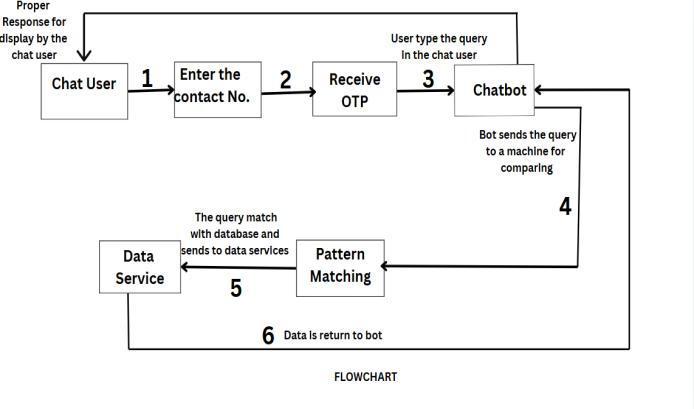
Chatbot with Contact NumberVerification and OTP
User Enters Contact Number:
Theprocessbeginswhentheuserinteractswiththechatbot byenteringtheircontactnumberintothechatbotinterface. This number could be used for various purposes, such as verification,registration,oraccount-relatedinquiries.The chatbotcapturesthisinputtoinitiatethenextstep.
Upon receiving the contact number, the chatbot employs pattern matching techniques to verify that the entered number is in a valid format (e.g., checking for the correct numberofdigits,countrycode,andproperstructure).Ifthe formatisincorrect,thechatbotpromptstheusertore-enter the correct contact number. Once validated, the chatbot confirmsthevalidityofthenumberandmovesontothenext step.
Aftervalidatingthecontactnumber,thechatbotinitiatesthe OTP(One-TimePassword)generationprocess.Thesystem generatesaunique,time-sensitivecodethatwillbesentto the provided contact number. This OTP serves as a temporaryauthenticationkeyfortheuser,ensuringthatthe numberenteredbelongstotheuserandislegitimate.
ThegeneratedOTPisthensenttotheuser’scontactnumber viaanSMSorothermessagingservices,dependingonthe
setup.ThechatbotnotifiestheuserthattheOTPhasbeen sentandprovidesinstructionsforitsuse.
TheuserreceivestheOTPontheirmobiledeviceandenters itintothechatbotinterface.Thechatbotpromptstheuserto input the code, ensuring that it matches the one sent previously. This step helps ensure that the user is the legitimateowneroftheenteredcontactnumber.
Once the user submits the OTP, the chatbot compares it against the generated code stored in its system. If the enteredOTPmatchestheonesenttotheuser,thechatbot verifies the user’s identity successfully. In case of an incorrect OTP, the user is prompted to retry entering the correctcodeortorequestanewOTPifnecessary.
Upon successful OTP verification, the chatbot can now provideaccesstotheintendeddataservices,suchasaccount registration, personalized assistance, or any other feature thatrequiresverification.IftheOTPisvalid,thechatbotmay proceed with further interactions, like answering user queries,providinginformation,orcompletingtransactions.If theverification fails(after multipleattempts),the chatbot may offer the user the option to restart the process or contactcustomersupport.
Aftercompleting the verificationprocess,the chatbot can end the interaction or continue offering other services as needed.Theuserisnowauthenticatedandcanproceedwith their intended activities, such as accessing services or engaginginfurtherchatbotinteractions.
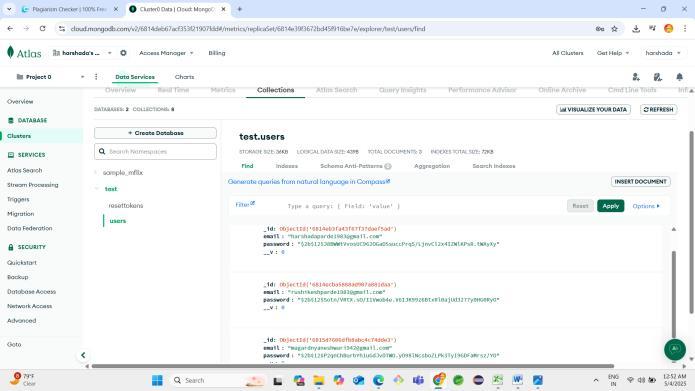
In MongoDB, to create a database for student and faculty registration,youdefineadatabase(e.g.,college_registration) andcreatecollectionssuchas`students`and`faculty`.The `students` collection stores information like student ID, name,email,course,andacademicyear,whilethe`faculty` collectionholdsfacultyID,name,department,andcontact details.Unliketraditionalrelationaldatabases,MongoDB does not require predefined schemas, and collections are automaticallycreatedwhenthefirstdocumentisinserted. Thisflexible,document-basedstructureallowseasystorage and retrieval of registration data for both students and faculty.
International Research Journal of Engineering and Technology (IRJET) e-ISSN: 2395-0056
Volume: 12 Issue: 05 | May 2025 www.irjet.net p-ISSN: 2395-0072
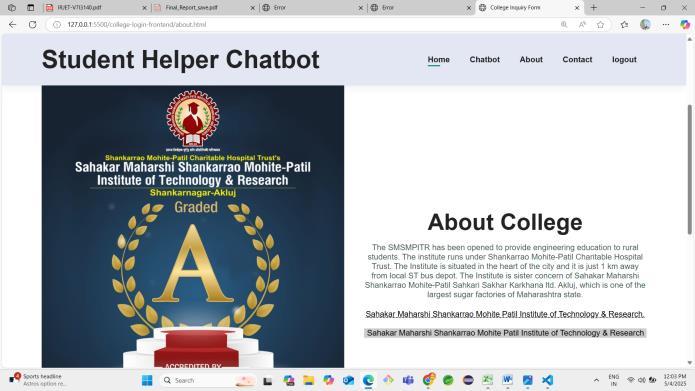
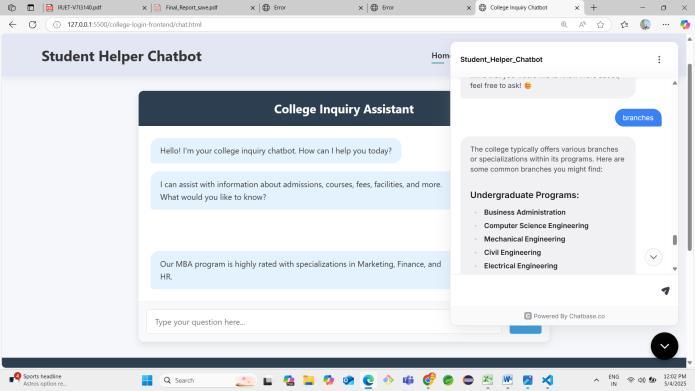
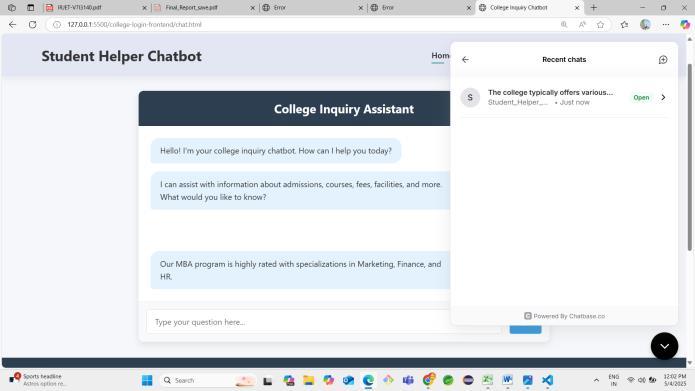
The proposed system is a College Enquiry Chatbot, developed to reduce paperwork, manpower, and time by allowinguserstointeractwiththecollegethroughachatbot interface. Instead of physically visiting the college for information, users can ask questions through the chatbot, makingtheprocessfasterandmoreconvenient.Thechatbot handlescommonqueries,whileanyunansweredquestions are monitored and updated by the admin, ensuring continuous improvement. The system facilitates smooth communication between students/users and the college administration.

International Research Journal of Engineering and Technology (IRJET) e-ISSN: 2395-0056
Volume: 12 Issue: 05 | May 2025 www.irjet.net p-ISSN: 2395-0072
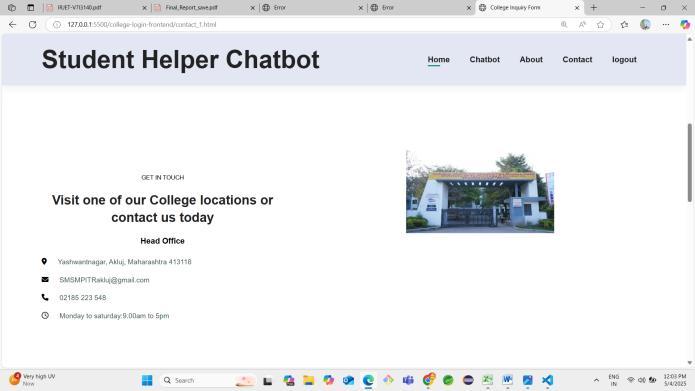
The development of a college enquiry chatbot using NLP presents an opportunity to revolutionize the college admissions process by providing an efficient and userfriendly interface for prospective students. The chatbot’s abilitytounderstandnaturallanguageandprovideinstant responseswillalleviatetheburdenoncollegestaff,reduce waiting times and enhance the overall experience for students.ByleveragingthepowerofNLP,thechatbotwill offer accurate and personalized information ,fostering a positive impression of the college and increasing the likelihood of successful enrollments. Ultimately, the implementation of this innovative solution will lead to improved efficiency, customer satisfaction , and increased enrollmentratesforthecollege.
ACKNOWLEDGEMENT
Wewouldliketoexpressourheartfeltthankstothosewho haveplayedapivotalroleinthecompletionofthisproject. Firstofall,wewouldliketothankourprojectguide,Prof.S. D.Pandhare,foralwayshelping,supporting,andguidingus during the entire project. Their expert advice and encouragementhavebeeninvaluablefromstarttofinish.We alsoextendoursincerethankstoourHeadofDepartment, Prof.S.D.Pandhare,fortheirsteadfastmoralsupportand motivation, which have been crucial in the successful completionofthisproject.
The project has a broad reach in the current context. The proposal’s majority of proposed features have been implemented. So, if I continue working on this project , I intendtocreateadatabaseforthesystemwheretheadmin may keep the extracted data. Further, future study will includeamorein-depthexaminationofcertaintechniques, furtherresearchonotherlibraries,andnewapproachesto exploredifferentmethods
[1] CHATBOT BASED ON AI Information technology professors Ashwini Patil 2, and Diksha Gondane 3123 are from Nagpur/RTMNU in India. Volume 3, Issue 2 (MarchApril 2016), International Journal of Emerging Trends in EngineeringandBasicSciences(UEEBS),ISSN(Online)23496967)
[2]Kakumanimanasa,Collegeenquirychatbot(Dec2022)
[3] Karim ali, An interactive chatbot for college enquiry. (2023)
[4]GokulR,KalaivaniS,AIcollegeenquirychatbotsystem. (Feb2023)
[5]GeethuWilson’s,chatbotforcollegeenquiry(Mar2021)
[6]MinaRafik, Aninteractivechatbotforcollegeenquiry. (2023)
[7] Mayur Pawar, RUBON college enquiry chatbot(May 2021)
[8]RishiKrishna,collegeenquirychatbot(Mar2020)
[9] Pranali Patil, intelligent chatbot for college enquiry system(Apr2022)
[10]KishorKumar,Collegeenquirybot(2019)
[11]VishalPatil,CollegeenquiryforstudentusingAIchatbot
[12] KusunamNandini,Collegeenquirychatbot.(2021)
[13] Payal Jain, College enquiry chatbot using iterative Model.