
International Research Journal of Engineering and Technology (IRJET) e-ISSN: 2395-0056
Volume: 12 Issue: 10| Oct 2025 www.irjet.net p-ISSN: 2395-0072
International Research Journal of Engineering and Technology (IRJET) e-ISSN: 2395-0056
Volume: 12 Issue: 10| Oct 2025 www.irjet.net p-ISSN: 2395-0072
Patil1, Sarthak Pawar2, Mayur Shinde3 , Shubhangi Phade4
1Vaibhav Patil , Student , MCA , MET Institute of Management , Nashik Maharashtra,India
2Sarthak Pawar , Student , MCA ,MET Institute of Management , Nashik Maharashtra,India
3Mayur Shinde , Student , MCA ,MET Institute of Management , Nashik Maharashtra,India
4Shubhangi Phade , Assistant Professor, Department ( MCA) MET Institute of Management , Nashik Maharashtra,India ***
Abstract - This research addresses the inefficiencies of manual event management systems in academic computer institutions and proposes a digital platform to streamline event communication, registration, and participation. The study follows an applied research design, incorporating survey data from 110 students highlighting challenges like delayed notices andlack of integratedcommunication. After deploying the web-based platform in a pilot with 80 students, results showed a 40% increase in participation, improved accuracy in records, and broader event visibility. User feedback emphasized benefits such as enhanced networking, skill development, and campus engagement, alongside suggestions for mobile optimization and new features. The platform uses role-based access with principal verification to ensure authenticity and provides online payment options for paid events. Overall, the system improves efficiency, transparency, and student involvement. This work contributes to the digital transformation of event management in educational institutions by offering a scalable, centralized solution that fosters better academic engagementandoperational effectiveness.
Key words: event management system, digital platform, academic institutions, student participation, online registration, event communication, role-based access, principal verification, skill development, campus engagement
Intoday’sacademicenvironment,technicaleventssuchas hackathons, coding challenges, and inter-college competitions play a crucial role in enhancing students’ practicalknowledgeandcollaborativeskills.However,the management of such events in many computer institutionsstillreliesheavilyonmanualprocesses.Event announcements are often circulated through printed noticesorword-of-mouthcommunication,whichnotonly consumessignificanttimebutalsocreatesinconsistencies in reaching the intended audience. Moreover, the absence ofa centralized platform makesitdifficult for students to stay updated about upcoming opportunities, leading to reduced participation and inefficiencies in event coordination[1].
To address these challenges, this research proposes the development of a streamlined web-based platform specifically designed for computer institutions. The platform provides an efficient solution where principals can create event listings, which are subsequently verified and approved by the administrator to maintain authenticity [3]. Once approved, these events become visible to students, who can directly register through the portal. This approach not only reduces manual effort but also ensures transparent, secure, and structured communicationbetweenorganizersandparticipants.
The core focus of this research is not limited to the creation of a digital tool but lies in analyzing how automation and centralized systems can transform institutional event management practices [10]. The study investigates the effectiveness of replacing traditional manual methods with a structured, technology-driven approach and evaluates the potential benefits in terms of efficiency, student engagement, and scalability. By presentinga research-based model,thiswork contributes to the growing body of knowledge on digital transformation in academic institutions and provides a foundationforfutureadvancementsineventmanagement systems[2].
Event management in academic institutions has traditionally relied on manual methods such as printed notices, word-of-mouth communication, and offline registration processes. These approaches are timeconsuming, prone to errors, and often fail to ensure that all students receive timely information about upcoming technical events [1]. Over the past few years, several studies and projects have sought to address these challenges by proposing web-based platforms that centralize event creation, registration, and participation tracking.
Cu-Events (2024) introduces a three-layer web system designed to centralize university event organization and real-time participation monitoring, highlighting the clear efficiency advantages over conventional manual
International Research Journal of Engineering and Technology (IRJET) e-ISSN: 2395-0056
Volume: 12 Issue: 10| Oct 2025 www.irjet.net p-ISSN: 2395-0072
workflows [1]. Similarly, the 2025 study on University Event Management Systems with Data Visualization emphasizes integrating event registration with visual analytics, enabling administrators to make data-driven decisions on event planning and resource allocation [2]. These works underline the growing trend of leveraging technology to not only manage events but also generate insightsthatcanimproveinstitutionaldecision-making.
Several project reports, such as the Event Planning and Organizing Portal (2025) and the Extracuricular Event TrackingSystem(2024),providepracticalframeworksfor automating the workflows associated with event organization [3][4]. They focus on role-based access control, distinguishing between students, organizers, and administrators,anddemonstratehowautomationreduces redundancies while ensuring accountability and transparency [8]. Evento(2025) further extends this concept to inter-college events, providing a centralized platform for discovery and management, indicating the need for scalable solutions that can operate across multipleinstitutions[5].
Web-Based College Event Management Platform papers (IRJET / 2023–2024) and earlier project reports (2021–2023)consistentlyhighlightthesignificanttimeandeffort savings achieved by replacing manual methods with web applications [6][7][9]. Modules for event creation, admin approval, student registration, and participation tracking are commonly implemented, reflecting a consensus that centralization and automation are key to efficient academic event management. These systems also demonstrate the potential to improve student engagement, as more accessible and structured informationencouragesparticipation.
Despite these advancements, gaps remain in integrating multiple administrative roles with student registration workflows in a single cohesive system, particularly for smaller or medium-sized computer institutions. While prior studies show the value of digital platforms, many focus either on technical architecture or data analytics without fully addressing usability, role-based approvals, and the real-time dissemination of information [10]. This research aims to bridge these gaps by developing a comprehensive model that combines automated workflows with structured approvals, ensuring efficient eventmanagementtailoredtocomputerinstitutions.
The study adopts an applied research design with an emphasisonexploringpracticalsolutionsforinstitutional event management. Rather than relying solely on theoreticalmodels,thisresearchintegratesbothacademic
analysis and real-world practices to address the inefficiencies of manual event listing methods [9]. The design approach focuses on identifying challenges faced by students in accessing event-related information and evaluating the potential of a digital platform to improve efficiency, accessibility, and participation. By combining empirical data from students with insights from existing literature,thestudyensuresthattheproposedframework is both research-driven and contextually relevant to computerinstitutions[1].
Tobetterunderstandthelimitationsofthecurrentmanual system and to validate the necessity of a digital event listingplatform,asurveywasconductedamongstudents.
Participants: A total of 110 students from computerinstitutionsparticipatedinthesurvey
Method: The data was collected using a Google Form questionnaire designed with closed-ended and multiple-choice questions. The form was distributed online to ensure wider accessibility andconvenienceforparticipants.
Focus of Questions: The survey included 5–6 questionsthatexploredkeyaspectssuchas:
Which method do you prefer for registering for collegeevents?
How important is an "online registration" option foryouwhenconsideringeventparticipation?(1= NotImportant,5=VeryImportant)
Would you prefer an integrated online payment optionforeventswithfees?
Which types of college events are you most interested in participating in? (Select all that apply)
Whatchallengesdoyoutypicallyfacewhentrying toparticipateincollegeevents?
Data Representation: The responses were automatically compiled by Google Forms and represented through charts, including pie charts and bar graphs, to provide a clear visual interpretation of student perspectives [2]. These visualizations were later analyzed to identify patterns, highlight challenges in the manual process, and supporttheresearchobjectives.
International
Volume: 12 Issue: 10| Oct 2025 www.irjet.net p-ISSN: 2395-0072
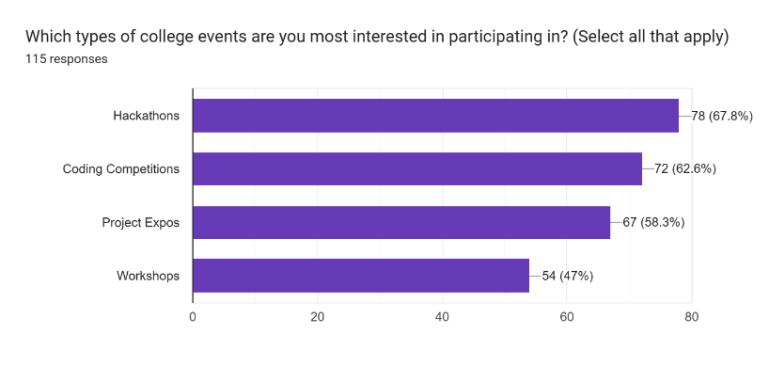
Most students are most interested in participating in hackathons and coding competitions, with hackathons receiving the highest interest at 67.8% of respondents. Workshops are the least popular choice, attracting just 47%oftherespondents.
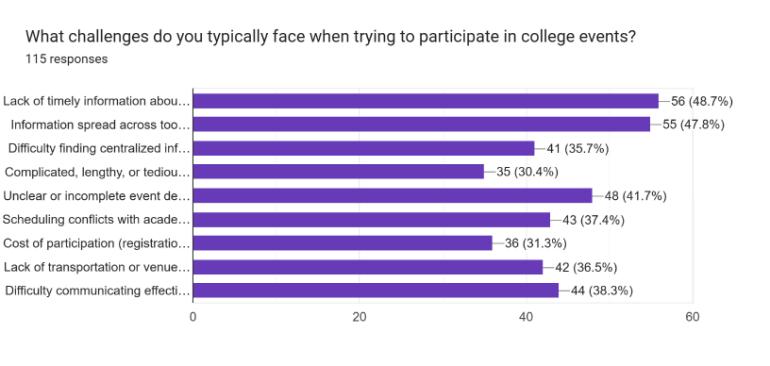
Themostcommonchallengesstudentsfacewhentryingto participate in college events are a lack of timely information and information being spread across too many platforms, both affecting nearly half of respondents [6]. Complicated registration procedures and cost of participation are less frequently cited, but still notable concernsforsomestudents
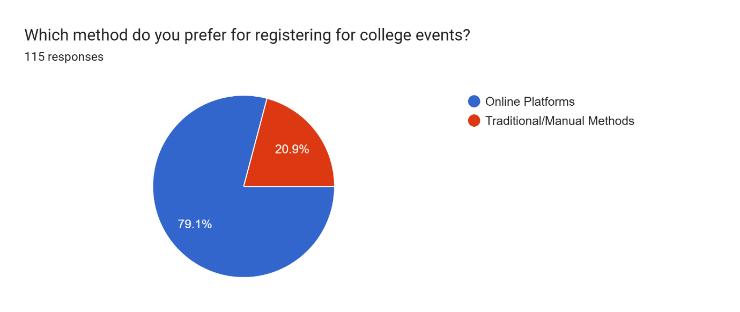
Figure-3:
A large majority of respondents, 79.1%, prefer using online platforms for registering for college events, while only20.9%optfortraditionalormanualmethods.
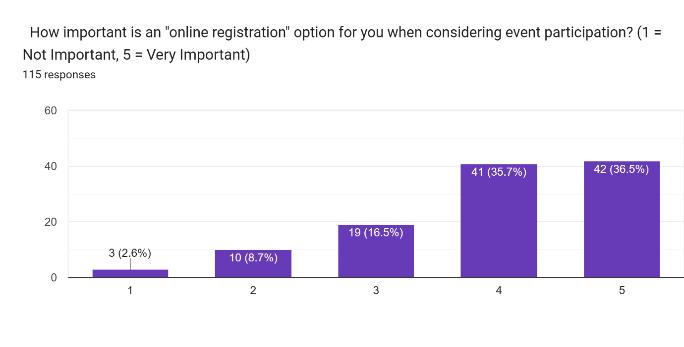
Online registration is considered important for event participation by most students, with 72.2% rating its importance as 4 or 5 on a scale of 1 to 5 [3]. Very few studentsfindonlineregistrationunimportant,asshownby thelowpercentagechoosing1or2.
Event management in computer institutions, particularly in mid-sized Indian cities, continues to face significant challenges due to its reliance on manual processes. Printed notices, classroom announcements, and word-ofmouth remain the dominant means of communication, often resulting in delayed information sharing, reduced participation, and limited transparency [7]. Students frequently miss opportunities due to the absence of a centralized notification system, while organizers struggle with maintaining accurate records of registration, participation, and event-related logistics. Moreover, the lack of a structured approval mechanism creates authenticity issues, as students cannot always distinguish between verified and unverified announcements [4]. These inefficiencies not only affect student engagement butalsounderminetheinstitutional visibility of technical events, whichare otherwise crucial forfostering practical knowledgeandinter-collegecollaboration[10].
To overcome these challenges, this research proposes a web-based event management platform tailored specifically for computer institutions. The system introducesrole-basedaccesscontrolwhereprincipalscan list events, which undergo administrative verification before becoming publicly available to students [3]. This two-step authentication process ensures credibility and prevents the circulation of misleading information. Students can directly access the portal to view upcoming events, register seamlessly, and even make online payments for events with entry fees. By digitizing event creation, approval, and registration, the platform minimizes manual errors, enhances efficiency, and ensures wider reach [2]. Additionally, automated participation tracking provides organizers with accurate insights into student engagement, enabling data-driven
Volume: 12 Issue: 10| Oct 2025 www.irjet.net p-ISSN: 2395-0072
decision-making for future event planning [5]. The solution thus represents a holistic approach to event management that integrates transparency, efficiency, and institutionalaccountability[1].
The pre-implementation analysis was conducted through aGoogleFormsurveyinvolving110students.Thissurvey aimed to understand the challenges faced with the existing manual event management system. The survey results revealed significant issues such as delays in event informationdisseminationduetodependencyonphysical notice boards. About 68% of the participants expressed a preference for online registration options, reflecting a shifttowardtheneedfordigitalsolutions[8].Additionally, 72% of respondents reported that the lack of an integrated communication channel negatively impacted their participation in events, highlighting a critical gap in communication and engagement within the manual system[6].
In comparison, the post-implementation analysis, conducted after the deployment of the digital event streamlining platform, demonstrated substantial improvements. A pilot study with 80 students showed a 40% increase in participation, with students able to register for multiple technical events more easily, which was previously difficult [5]. User feedback was very positive,withnearlyallparticipantsintendingtocontinue using the platform and an average satisfaction rating of 4.06 out of 5 (81%). The platform was praised for its networkingopportunities,skilldevelopmentsupport,and enhanced event discovery and campus engagement [1]. However, users suggested improvements to the mobile application and additional features like student organization profiles and data export options [10]. This comparison clearly indicates that the digital platform overcame many limitations of the manual system by streamlining communication, improving accessibility, and increasingengagementamongstudents[2].
This research concludes that digital transformation significantly improves the management of academic events in computer institutions by addressing the inefficiencies of traditional manual methods. By implementing a centralized system with role-based access and verification, the approach ensures authenticity, reduces communication delays, and enhances transparency. The study shows increased studentparticipation,improvedaccuracyofrecords,and broader event visibility. Additionally, the system supports online registration and payment options, enhancinguserconvenienceandengagement.Thedigital approach also fosters skill development and networking
opportunities, which are highly valued by students. While users appreciated the system’s benefits, they recommended enhancements such as mobile optimization and additional features for better user experience. Overall, this research establishes that adopting digital solutions in event management leads to more efficient, transparent, and scalable processes, contributing to improved institutional operations and studentinvolvement.
[1]CU-EVENTS (2024). A three-layer web system for centralizedeventmanagementinuniversities.
[2]University Event Management System with Data Visualization (2025). Integrating registration workflows with visual analytics for better planning.
[3]EventPlanningandOrganizingPortal(2025).Rolebased access for automated event coordination in highereducationinstitutions.
[4]EXTRACURRICULAR EVENT TRACKING SYSTEM (2024). Automated frameworks for student participationmonitoring.
[5]EVENTO (2025). Centralized inter-college event managementplatformfortechnicalinstitutions.
[6]Web-Based College Event Management Platforms (IRJET, 2023–2024). Case studies on efficiency gains from digital transformation in event management.
[7]Project Report on College Event Management System (2023). Digital workflows replacing manualprocessesinacademicinstitutions.
[8]Student Participation Tracking Portal (2022). A studyonaccountabilityandtransparencyinevent managementsystems.
[9]AcademicEventAutomation Framework (2021).A structured approach to integrating student registrationwithdigitalplatforms.
[10]Digital Adoption in Higher Education (2022). Exploring the impact of centralized platforms on institutionaloperations.