
International Research Journal of Engineering and Technology (IRJET) e-ISSN: 2395-0056
Volume: 12 Issue: 06 | Jun 2025 www.irjet.net p-ISSN: 2395-0072
International Research Journal of Engineering and Technology (IRJET) e-ISSN: 2395-0056
Volume: 12 Issue: 06 | Jun 2025 www.irjet.net p-ISSN: 2395-0072
Rishikesh Bhaybhang1 , Indu Dhumal2 , Kundan Jakhete3, Ashvini Lokare4, Vaishnavi Paygude5, S S
123454Student, Department of Mechanical Engineering, Savitribai Phule Pune University, Pune, India
6 Assistant Professor, Department of Mechanical Engineering, Savitribai Phule Pune University, Pune, India
Abstract - The chassis frame structure serves as a critical support system for various mechanical components in any vehicle, making its analysis a key aspect for the automotive industry. Intrucks, the chassis acts asthestructuralbackbone, designedto safely withstand maximumloadsunderbothstatic and dynamic conditions.Itmustendurestresses,deformations, fatigue failures, and potential welding cracks. This study focuses on analyzing the stresses and deformations experienced by the chassis frame through material optimization. A 3D model ofthe chassis was createdusingUGNX, and static structural analysis was performed in ANSYS MECHANICAL 2025 R1 for both the existing and optimized materials. The results of the analysis have been compiled and compared.
Key Words: chassisframe,UG-NX,ANSYS,Von-Misesstress, Totaldeformation.
The chassis is one of the most essential structural componentsofanautomobile,servingasthefoundational framethatsupportsthevehiclebodyandvariousmechanical systems such as the engine, drivetrain, axles, wheels, suspension, brakes, and steering mechanisms. It provides the necessary structural integrity to support these components along with the payload, ensuring the vehicle remainsrigidandstableunderdiverseloadingconditions. Asaresult,thechassissignificantlycontributestotheoverall safety of the vehicle. Additionally, it helps in minimizing noise, vibration, and harshness (NVH) across the entire vehiclesystem.
A well-designed chassis must be rigid enough to endure shocks,twists,vibrations,andvariousformsofmechanical stress.Alongsidestrength,achievingsufficientbendingand torsional stiffness is critical to improving the vehicle’s handling characteristics. Therefore, strength and stiffness are two primary criteria in chassis design. Today’s automotive industry faces challenges such as meeting demands for enhanced performance, reduced weight, increasedcomponentlife,andcost-effectivenesswithintight development timelines. Given its importance, the truck chassis is frequently targeted for refinement and optimization.
Truckchassisarewidelyusedacrossindustriessuchas logistics, agriculture, manufacturing, and more. It is responsible for maintaining the structural integrity of the vehiclewhiletransferringverticalandlateralloads caused by motion and acceleration through the wheels to the ground. The chassis must be capable of supporting all components and loads without failure. The body of the vehicle,whichhousesmechanicalsystemsandpassengers,is mountedonthisstructure.
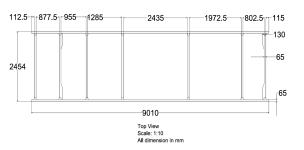
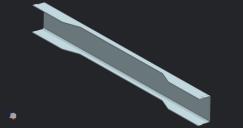
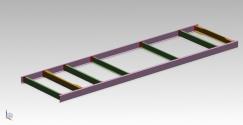
Thechassisframeistypicallycomposedofsidemembers (orrails),whicharethemainload-bearingelements.These railsaredesignedwithanarrowerfrontsectiontoallowfor areducedturningradiusandawidermidsectionforoptimal support under the body. Truck and trailer frames often utilizestraightsidememberstoenhancestructuralstrength and accommodate various body designs. Cross members connect the side rails, providing resistance against frame twistingandflexing.Theirnumberandplacementdependon the intended application and vehicle design. Front cross memberssupporttheradiatorandenginefront,whilerear crossmemberssupportfueltanksandtowingcomponents. Additionalcrossmembersmayalsosupporttherearengine and drivetrain. For heavy-duty applications, gusset plates areusedtoreinforcehigh-stressregionsoftheframe.
Insuchconstructions,thevehiclebodyprimarilyserves toholdcargoandabsorbvibrationsandshockstransmitted through the frame. In some severe use cases, the body structure might also bear some torsional stresses not entirelymanagedbytheframe.
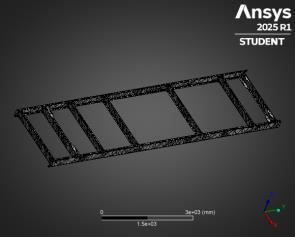
To facilitate the design process, a 3D CAD model of the chassis was created using UG-NX (Siemens NX) software. This digital modelling approach enabled detailed visualizationofthe designinthree dimensions,helping to minimize errors during fabrication. For structural evaluation, ANSYS software was used to carry out the analysis.Thefocusofthisstudyisonthestressbehaviourof the chassis, with particular emphasis on material optimization for the TATA 2518TC model. The analysis concentratedonkeyparameterssuchasVonMisesstress, maximumprincipalstress,andtotaldeformation.
Mr. Akash Singh Patel and Mr. Atul Shrivastava (2016) conductedastudytitled“Modeling,Analysis&Optimization
International Research Journal of Engineering and Technology (IRJET) e-ISSN: 2395-0056
Volume: 12 Issue: 06 | Jun 2025 www.irjet.net p-ISSN: 2395-0072
ofTATA2518TCTruckChassisFrameusingCAETools”.In their research, they evaluated various materials for the chassisframe,includingStructuralSteelST37,GreyCastIron, AISI4130SteelAlloy,andASTMA710Steel,acrossdifferent cross-sectionalprofilessuchasC-section,I-section,andBoxsection.Thestudyinvolvedacomparativeanalysisbetween theconventionalstructuralsteelchassisandalternativealloy steels,focusingonstressanddeformationtodeterminethe mostsuitablematerialoption[1].
Additionally,Pateletal.carriedoutadesignoptimizationof theTATA2516TCchassisframeaimedatreducingitsweight, usingPro-Mechanicasoftware.Initially,theycalculatedthe total assembly weight, maximum stress, strain, and displacementfortheexistingchassissections(C,I,andBox) using ANSYS. They then modified the dimensions of the original C-section and repeated the analysis. The results showedthattheoriginalC-sectionperformedbetterthanthe other sections interms of stress,displacement,strain,and shearstress,thoughitwasnotthelightest.ThemodifiedCsectionoffereda significantweightreductioncomparedto theotherconfigurations.Specifically,theyachievedaweight savingofapproximately105.50kgperchassisassembly equivalent to an 11% reduction which also implies a potentialcostsavingofabout11%.Basedonthesefindings, themodifiedC-sectionwasrecommendedastheoptimized chassisdesign[2].
A. Problem Statement
Afterreviewingvariousresearchpapers,itisobserved that common issues in chassis design include excessive weight, high stress and strain levels, significant deformation, and inefficiencies related to the crosssectionalgeometryofthechassis.Therefore,theobjective of our work is to design and analyze the chassis by modifying its cross-sectional profile and evaluating the resulting changes in stress, strain, and deformation characteristics.
B. Vehicle Specification
Table1
VehicleSpecification
Properties Values
Totallengthofchassis
Widthofchassis
Wheelbase
Frontoverhang
Rearoverhang
GroundClearance
Capacity(GVW)
KerbWeight
mm
mm
mm
mm
mm
mm
ton
kg Payload
kg
The chemical composition of grey cast iron includes the followingelementsinapproximateproportions:Carbon(up to4%),Silicon(upto3%),Manganese(around0.8%),Sulfur (approximately 0.07%), Phosphorus (up to 0.2%), Molybdenum(upto0.75%),Chromium(about0.35%),and Vanadium(around0.15%).
AISI 4140 is a low alloy steel known for its high strength, toughness, and wear resistance, making it ideal for use in demanding applications such as automotive chassis, axles, and crankshafts. Its typical chemical composition includes Carbon in the range of 0.38% to 0.43%, Manganese from 0.75%to1.00%,andSiliconbetween0.15%and0.30%.It alsocontainsChromium(0.80%to1.10%)andMolybdenum (0.15% to 0.25%), which enhance its hardenability and corrosion resistance. In addition, it has small amounts of Phosphorus(upto0.035%)andSulfur(upto0.040%).This balanced composition provides AISI 4140 with excellent mechanical properties suitable for high-stress structural applications.
Structural steel is widely used in construction and manufacturing due to its excellent strength, ductility, and weldability.Thetypicalchemicalcompositionofcommonly usedstructuralsteelgrades(suchasS275orS355)includes Carbonupto0.25%,Manganeserangingfrom1.0%to1.6%, andSiliconupto0.05%.SmallamountsofPhosphorusand Sulfurarealsopresent,eachtypicallylimitedto0.04%orless to maintain good weldability and toughness. Some grades mayalsoincludetraceamountsofelementslikeCopper(up to 0.55%), Nitrogen (up to 0.012%), and Aluminum (as a deoxidizer). These steels are known for their high yield strength,typicallyrangingfrom275MPato355MPa,making them suitable for heavy structural components such as beams,columns,frames,andchassisstructuresinvehicles.
4. AluminiumAlloy
Aluminiumalloys,particularly6061-T6,arewidelyusedin the automotive and aerospace industries due to their excellentstrength-to-weightratio,corrosionresistance,and good weldability. The typical chemical composition of Aluminium6061-T6includesAluminiumasthebaseelement (about95.8%to98.6%),withMagnesiumrangingfrom0.8%
International Research Journal of Engineering and Technology (IRJET) e-ISSN: 2395-0056
Volume: 12 Issue: 06 | Jun 2025 www.irjet.net
to1.2%andSiliconfrom0.4%to0.8%toimprovestrength andhardness.ItalsocontainssmallamountsofIron(upto 0.7%), Copper (0.15% to 0.4%), Chromium (0.04% to 0.35%), Zinc (up to 0.25%), Titanium (up to 0.15%), and residual elements. This alloy offers a good balance of mechanicalpropertieswithatypicalyieldstrengthofaround 240MPaandultimatetensilestrengthofapproximately290 MPa.Duetoitslightweightanddurablenature,aluminium alloy6061-T6iscommonlyusedinstructuralapplications, includingvehiclechassisframesandaerospacecomponents.
Table2
D. Calculation
TheoveralllengthofC-Section:
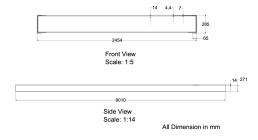
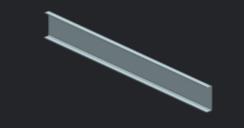
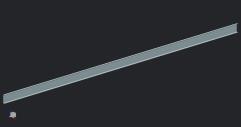
ChannelswithHeight(H)=285mm,Width(B)=65mm, Thickness(t)=7mm
1) Basiccalculationforchassisframe
ModelNo.=LPT2518TC(TATA)
CapacityofTruck=25ton(KerbWeight+Payload) =25000kg=245250N
CapacityofTruckwith1.25%=245250*1.25N=306562N
TotalLoadactingontheChassis=306562N 285mmx65mmx7mm
Thetwobeamsareusedinthischassissothehalfloadacting.
Load acting on the single frame = Total load acting on the chassis/2 =306562/2 =153281N/Beam
2) Loadingconditions
LoadactingonEntirespanofthebeamis153281N.Length oftheBeamis9010mm.
UniformlyDistributedLoadis153281/9010=17.0N/mm
Volume: 12 Issue: 06 | Jun 2025 www.irjet.net
3. Result Table
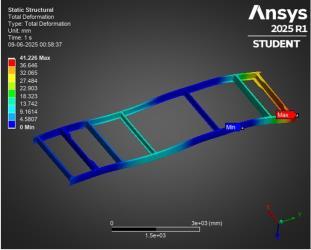
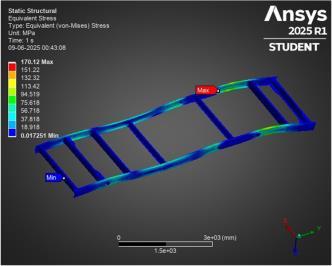
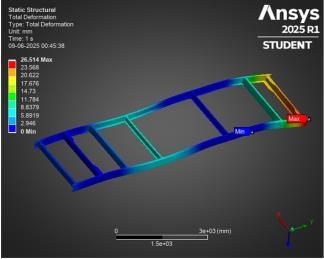
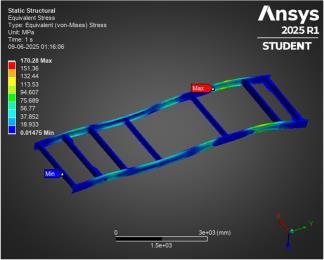
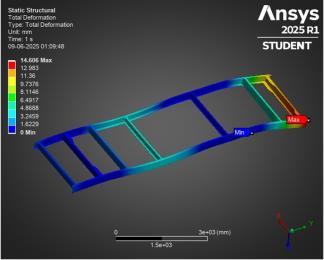
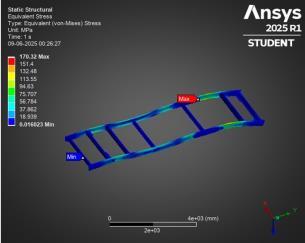
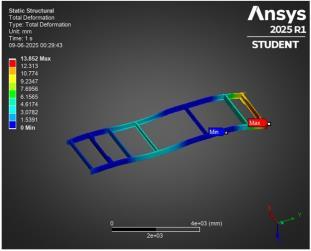
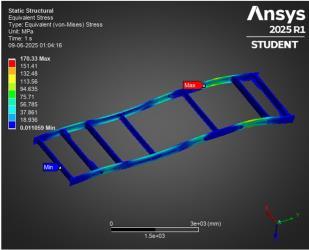
Based on the comparative analysis of different materials used for the Tata LPT 2518 chassis frame namely Structural Steel, Grey Cast Iron, Aluminum Alloy, and AISI 4140 it is evident that AISI 4140 offers the best overall performance.Itexhibitstheleastdeformation(13.852mm) while maintaining a high strength level (170.32 MPa), making it the most suitable choice for high-load and durability-critical applications. Structural Steel also performswell,showingmoderatedeformation(14.606mm) and high strength, making it a reliable and cost-effective optionforgeneralchassisdesign.Incontrast,GreyCastIron andAluminumAlloy,thoughlighterinweight,demonstrate significantlyhigherdeformationsof26.514mmand41.226 mmrespectively.Thismakesthemlessidealforapplications where structural stiffness and dimensional stability are critical.AluminumAlloy,whileofferingsubstantialweight savings,compromisesonrigidity,limitingitseffectivenessin heavy-duty structural applications. Hence, AISI 4140 is recommendedastheoptimalmaterialchoiceforensuring strength,stiffness,andlong-termperformanceofthechassis frame.
1) Mr.RahulL.Patel,Mr.DivyeshB.MorabiyaandMr.Anil N.Rathour“Weightoptimizationofchassisframeusing Pro-Mechanica” ISSN: 2348-8360, SSRG International JournalofMechanicalEngineering(SSRG-IJME)-vol.1 Issue8,pp.4-9,December2014
2) Goolla Murali, Subramanyam B and Dulam Naveen “Design Improvement of a Truck Chassis based on Thickness” Altair Technology Conference, Sigma ConsultancyServiceIndiapp.1-6,2013.
3) S.Prabakaran and K.Gunasekar “Structural Analysis of ChassisFrameandModificationforWeightReduction” ISSN:2277-9655,InternationalJournalofEngineering Sciences&ResearchTechnology(IJESRT),vol.3Issue.5, pp.595-600,May,2014.
International Research Journal of Engineering and Technology (IRJET) e-ISSN: 2395-0056
Volume: 12 Issue: 06 | Jun 2025 www.irjet.net p-ISSN: 2395-0072
4) AbhishekSharma,Mr.PramodKumar,AbdulJabbarand Mohammad Mamoon Khan “Structural Analysis of a Heavy Vehicle Chassis Made of Different Alloys by DifferentCrossSections”ISSN:2278-0181,International JournalofEngineeringResearch&Technology(IJERT) Vol.3Issue6,pp.17781785,June-2014.
5) Akash Singh Patel and Jaideep Chitransh “Design And Analysis of TATA 2518TC Truck Chassis Frame With Various Cross Sections Using CAE Tools” ISSN: 22779655, International Journal of Engineering Sciences & Research Technology (IJESRT), vol. 5 Issue 9, pp.692714,September,2016.
6) ManpreetSinghBajwa,SinthiyaPundirandAmitJoshi “Static Load Analysis of Tata Super Ace Chassis and StressOptimisationUsingStandardTechniques”ISSN: 2320-2092, International Journal of Mechanical and ProductionEngineering,Vol.1,Issue-3pp.41-45,Sept2013.
7) R.L.Patel,K.R.GawandeandD.B.Morabiya“Designand analysisofchassisframeofTATA2516TC”ISSN:23219653, International Journal for Research in Applied ScienceandEngineeringTechnology(IJRASET)-Vol.2 IssueIIIpp.115-119,March2014.
8) KamleshY.PatilandEknathR.Deore“StressAnalysisof LadderChassiswithVariousCrossSections”ISSN:22781684,IOSRJournalofMechanicalandCivilEngineering (IOSR-JMCE)Vol.12,Issue4,pp.111-116,August-2015.