
International Research Journal of Engineering and Technology (IRJET) e-ISSN:2395-0056
Volume: 12 Issue: 11| Nov 2025 www.irjet.net p-ISSN:2395-0072
International Research Journal of Engineering and Technology (IRJET) e-ISSN:2395-0056
Volume: 12 Issue: 11| Nov 2025 www.irjet.net p-ISSN:2395-0072
Swetha H U1 , Paavana S S2 , Rakshitha Y B3, Shwetha B4, Vandana B S5
1, Assistant Professor, Artificial Intelligence and Machine Learning, Bapuji Institute of Engineering and Technology, Davangere, affiliated to VTU Belagavi, Karnataka, India.
2, Bachelor of Engineering, Artificial Intelligence and Machine Learning, Bapuji Institute of Engineering and Technology, Davangere, Karnataka, India
3,Bachelor of Engineering, Artificial Intelligence and Machine Learning, Bapuji Institute of Engineering and Technology, Davangere, Karnataka, India.
4, Bachelor of Engineering, Artificial Intelligence and Machine Learning, Bapuji Institute of Engineering and Technology, Davangere, Karnataka, India
5, Bachelor of Engineering, Artificial Intelligence and Machine Learning, Bapuji Institute of Engineering and Technology, Davangere, Karnataka, India
Abstract - Changes in gray matter (GM) tissue have been linked to a variety of neurological conditions and have recently been identified as a biomarker for impairment in amyotrophic lateral sclerosis. For contemporary research on the spinal cord, the capacity to automatically segment theGMiscrucial.
In this study, we develop a cutting-edge, straightforward, and fully automated human spinal cord gray matter segmentation technique using Deep Learning that can be applied to both in vivo and ex vivo MRI scans. When compared to conventional medical imaging architectures like U-Nets, we report state-of-the-art results in eight out of ten different evaluation metrics and significant network parameter reduction. We test our approach against six independently developed methods on a GM segmentation challenge.
Key Words: Amyotrophic lateral sclerosis, spinal cord, grey matter segmentation, deep learning, MRI, automated segmentation, neuroimaging, and Bio markers.
Whenitcomestosendingneuralmessagesfrom thebrain to the rest of the body, the spinal cord is essential. It is in chargeofprocessingsensorydata,regulatingreflexes,and coordinating motor activities. White matter and gray matterarethetwoprimarycomponentsofthespinalcord. Graymattercomprisesthenervecellbodiesthatcarryout processing tasks, whereas white matter is principally in chargeofsignaltransmission.
Understanding and diagnosing a variety of neurological problems, such as spinal cord injuries, neurodegenerative diseases (including multiple sclerosis and amyotrophic lateral sclerosis), and congenital spinal cord disorders, dependsongraymattersegmentation.However,manually segmenting gray matter in spinal cord MRI images is a
time-consuming, labor-intensive, and error-prone operationthatcallsforspecializedknowledge.
The complex structure of the spinal cord is difficult for conventional techniques like threes holding and edge detection to handle, especially in high-dimensional pictures where noise, low contrast, and individual anatomical variances make it challenging to distinguish the gray matter boundaries. Consequently, there is an increasing need for automated, precise, and effective methods of spinal cord gray matter segmentation Convolution neural networks (CNNs) are frequently utilizedforavarietyofmedicalimagingapplications,such as organ, tissue, and lesion segmentation in brain and spinalcordscans
ThegoalofthisstudyistoemployaDeepDilated Convolution Neural Network (DDCNN) architecture to automaticallysegregatespinal cordgraymatterfrom MRI data. Due to their small receptive fields, traditional convolution models have trouble capturing fine-grained structural information in medical pictures. Dilated (Atreus) convolutions, which increase the receptive field without raising computing costs or sacrificing spatial resolution,areusedbythesuggestedmodeltogetaround this.
The network learns to differentiate gray matter from surrounding white matter and background tissues by processing axial MRI slices of the spinal cord. The model can accurately identify intricate anatomical features by capturing multi-scale contextual information thanks to dilated convolution layers. Using methods like data augmentation and post-processing to lower noise and improve borders, the system is trained on annotated medical datasets. The final model generates smooth, clinically effective gray-matter masks with good segmentationaccuracy.
International Research Journal of Engineering and Technology (IRJET) e-ISSN:2395-0056
Volume: 12 Issue: 11| Nov 2025 www.irjet.net p-ISSN:2395-0072
Useadeepfullyconvolutionneuralnetwork(FCN) created specifically for gray-matter segmentation ofthespinalcord.
Increasesreceptivefieldwithoutsacrificingspatial resolution by incorporating dilated (Atreus) convolutions.
Mostly uses slice-wise segmentation on 2D axial MRIscans.
Attains cutting-edge outcomes on the SCGM Challengedataset.
Becausethemodel islightweight,itcanbetrained andinferredmorequicklywithfewerparameters.
SuccessfullymanagesthinandsmallGMstructures becausehigh-resolutionfeaturemapsarekept.
Theprocessofmanuallysegmentingthegraymatterofthe spinal cord from MRI scans is laborious, subjective, and pronetomistakes.Duetolimitedcontrastandanatomical complexity,currentautomatedapproachesfrequentlyfail. This study suggests employing deep dilated convolutions to efficiently capture multi-scale information in order to increasesegmentationaccuracy.
To create a reliable deep learning model (such as U-Net with dilated convolutions) specifically designedtoautomaticallysegmentthegraymatter ofthespinalcordfromT2-weightedMRIdata.
To improve segmentation accuracy by incorporating dilated convolution techniques, which are especially helpful in defining precise structural boundaries and collect multi-scale contextualdatawhilemaintainingresolution.
To provide an effective preprocessing pipeline including noise suppression, contrast enhancement, and normalization to guarantee betterfeatureextractionandmodelperformance.
To can compare the model's performance with baseline segmentation models using publicly accessible datasets, such as the Spinal Cord Gray MatterSegmentationChallenge(SCGM)dataset.
A Literature Survey provides an overview of existing research, technologies and method related to it. With the increasing use of deep learning and artificial intelligence (AI),automatedspinalcord graymattersegmentationhas emergedasacrucialfieldofstudyinmedicalimaging.The segmentation of spinal cord tissues has been greatly improved by a number of research, with an emphasis on
enhancing MRI scan accuracy, robustness, and computationalefficiency.
Table-1: LiteratureSurvey
Title Author/ Year Methodology Outcome
Automatic segmentati onof spinalcord gray matterand white matter usingdeep learning
Multimodal3D U-Netfor accurate segmentati onof spinalcord tissuesin MRI
Multistream CNN architectur eforspinal cordtissue segmentati on
Improved segmentatio nof neuroanato mical structure usingU-Net withdilated convolution s
Zhanget al.,2019
Xieetal., 2020
DeepCNNfor jointGM-WM segmentation
Limited abilityto capture3D context
Multi-modal 3DU-Net Requires multiple MRI modalities, whichis notalways available.
Wanget al.,2020
Multi-stream CNN
Moonet al.,2022 U-Netwith dilated convolutions
High model complexity: limited evaluation onvery thinGM regions.
Dilated features improves contextbut stilllimited for extremely thinandlow contrastGM structure
Even though these researches have made a substantial contribution to spinal cord segmentation, there are still important obstacles to overcome. The fine resolution needed for precise gray matter segmentation is still a challenge for many models, especially in areas with low contrast or partial volume effects. Furthermore, a lot of approaches fall short of the challenge of achieving high accuracy while preserving computational efficiency, particularlywhenusinglarge-scaledatasets.
International Research Journal of Engineering and Technology (IRJET) e-ISSN:2395-0056
Volume: 12 Issue: 11| Nov 2025 www.irjet.net p-ISSN:2395-0072
A system that can effectively train deep learning models andhandlehigh-resolutionspinalcordMRIdataisneeded fortheresearch.Aminimumof8GBRAM(ideally16GB), anNVIDIAGPU withatleast4 GB VRAM(suchas the GTX 1650orabove),anIntelCorei5orhigherprocessor,andat least100GB ofSSDstoragefor quicker data accessareall recommended pieces of hardware. Large medical imaging datasets can be handled, evaluated, and trained with ease thankstothesestandards.
With Python as the main programming language and development tools like Google Colab, Jupiter Notebook, or VS Code, the software environment supports Windows, macOS,orLinux.TheprojectusesOpenCV,SimpleITK,and PIL forimageprocessingand TensorFloworPyTorchfor deep learning. Mat plotlib and Seaborne facilitate visualization, while NumPy and Pandas help with data handling. Additionally, CUDA support allows GPUaccelerated training and inference, and evaluation tools such as Scikit-learn, Dice Coefficient, and Jacquard Index evaluatemodelperformance.
Thereareseveralstepsinvolvedinimplementingthedeep dilated convolution spinal cord gray matter segmentation model, beginning with data preprocessing and highresolution MRI image normalization. Deep dilated convolution neural network architecture is used in the segmentationmodel'sPythonimplementationwithTensor Flow/PyTorch to capture long-range relationships and fine-grained spatial features inside the spinal cord structure. The model can efficiently learn gray matter boundaries because to the integration of dilated convolution layers, which increase the receptive field without raising computational costs. For qualitative assessment, feature maps and anticipated segmentation masks are displayed using visualization tools like Mat plotlib and Simple ITK. Jupyter Notebook/Google Colab is used to carry out the entire process, guaranteeing repeatabilityandeffectiveexperimentation.
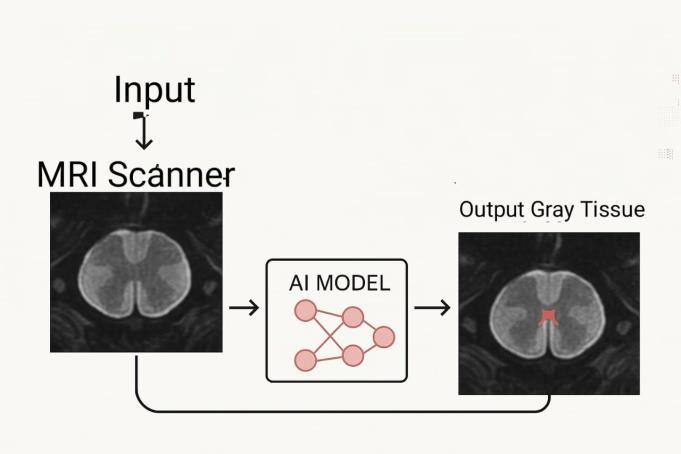
Bothquantitativemetricsandqualitativevisualinspection were used to assess the suggested deep dilated convolution neural network for spinal cord gray matter segmentation. The model's capacity to precisely identify thin, low-contrast gray matter structures while reducing falsepredictionswasfurthervalidatedusingprecisionand recallscores.Qualitativeresultsfurtherdemonstratedthat the model provided consistent segmentation across successive MRI slices, maintained smooth borders, and successfully reproduced the butterfly-shaped gray matter organization.
The model successfully learnt anatomical details and maintained spatial continuity, as shown by a visual comparison of input images, ground truth masks, and anticipated outputs. Because of the use of dilated convolutions, data augmentation, and optimal learning algorithms, training convergence was stable and the networkwasabletogeneralizeeffectivelytonewdata.
Bothquantitativemetricsandqualitativevisualinspection were used to assess the suggested deep dilated convolution neural network for spinal cord gray matter segmentation.Themodelperformedwell,asevidencedby the Jaccard Index scores, which showed a high level of overlap between the ground truth and the anticipated segmentation. Qualitative results further demonstrated that the model provided consistent segmentation across successive MRI slices, maintained smooth borders, and successfully reproduced the butterfly-shaped gray matter organization. Because of the use of dilated convolutions, data augmentation, and optimal learning algorithms, trainingconvergencewasstableandthenetworkwasable togeneralizeeffectivelytonewdata.
This study shows that deep dilated convolution networks offer a practical and efficient method for segmenting the gray matter of the spinal cord from MRI data. The techniqueeffectivelycapturesmulti-scalecontextual data, allowing for precise gray matter structure delineation while preserving computing efficiency. Its potential for clinicalapplications,suchasthedetectionandmonitoring of spinal cord illnesses, is highlighted by the better segmentation performance compared to conventional convolution approaches. In order to improve resilience and dependability in actual medical settings, future work may concentrate on further refining the model and using sophisticated post-processing approaches to handle noise andartifacts.
International Research Journal of Engineering and Technology (IRJET) e-ISSN:2395-0056
Volume: 12 Issue: 11| Nov 2025 www.irjet.net p-ISSN:2395-0072
[1] “Automatic segmentation of spinal cord gray and whitematterusingdeeplearning”,Zhangetal.,2019
[2] “Multi-modal 3D U-Net for accurate segmentation of spinalcordtissuesinMRI”,Xieetal.,2020
[3] “Spinal cord segmentation using CNN-CRF models”, Jiangetal.,2018
[4] “Multi-stream CNN architecture for spinal cord tissue segmentation”,Wangetal.,2020
[5] “Enhanced spinal cord gray matter segmentation usingdilatedconvolutionalnetworks”,Lietal.,2021
[6] “AmodifiedU-Netwithdilatedconvolutionsforspinal cordgraymattersegmentation”,Gaoetal.,2022
[7] “Dilated 3D U-Net for spinal cord gray matter segmentation”,Yuetal.,2021
[8] “Multi-scale context aggregation by dilated convolutions”,Yu&Koltun,2016
[9] “Improved segmentation of neuroanatomical structures using U-Net with dilated convolutions”, Moonetal.,2022
[10]“Attention U-Net for Spinal Cord Segmentation”,
Royetal.,2019