
International Research Journal of Engineering and Technology (IRJET) e-ISSN: 2395-0056
Volume: 12 Issue: 04 | Apr 2025 www.irjet.net p-ISSN: 2395-0072
International Research Journal of Engineering and Technology (IRJET) e-ISSN: 2395-0056
Volume: 12 Issue: 04 | Apr 2025 www.irjet.net p-ISSN: 2395-0072
Mannam Deepika 1 , G.Latha 2 , Popuri Abhinav 3 , Orsu srinivasarao 4 Nallamothu krishna prasad5
1Student & AMRITASAIINSTITUTEOFSCIENCEANDTECHNOLOGY
2Assistant Professor & AMRITASAIINSTITUTEOFSCIENCEANDTECHNOLOGY
3Student & AMRITASAIINSTITUTEOFSCIENCEANDTECHNOLOGY
4Student & AMRITASAIINSTITUTEOFSCIENCEANDTECHNOLOGY
5Student & AMRITASAIINSTITUTEOFSCIENCEANDTECHNOLOGY
Abstract -
Theincreasinglevelsofwaterpollutioncausedby improper waste disposal and lack of continuous monitoring in water bodies have posed serious threats to marine ecosystems, human health, and water-based economicactivities.Traditionalgarbagecollectionsystems inlakes,rivers,andcoastalwatersareoftenmanual,laborintensive, and inefficient, especially in remote or hazardous locations. In addition, surveillance of these water bodies to track pollution levels, illegal dumping, or safety concerns is generally minimal due to high operational costs and limitations of accessibility. To addressthesechallenges,thepresentprojectproposesthe design and development of a Solar Based Garbage Cleaning and Surveillance Boat that operates autonomously or semi-autonomously using clean solar energy and is equipped with garbage collection mechanismsandsurveillancecapabilities.
The proposed boat is powered by solar panels that harvest renewable energy from sunlight, making the systemeco-friendlyandreducingitsdependencyonfossil fuels. The harvested solar energy is stored in onboard rechargeable batteries and utilized to power the boat’s propulsion system, garbage collection mechanism, onboard sensors, surveillance camera, and microcontroller units. The adoption of solar energy ensures sustainable and uninterrupted operation during daylight hours, while energy-efficient components and battery backup guarantee extended functioning during low-lightconditions.
The boat is integrated with a garbage collection unit,typicallyconsistingofaconveyorbeltormesh-based trapsystemmountedonthefrontorsidesofthevessel.
Keywords: Solar-powered boat, Garbage cleaning robot, Water surface cleaning, Renewable energy, Surveillance system, Arduino-based system, IoT in environmental monitoring, Aquatic waste management, Eco-friendly technology, Autonomous surface vehicle (ASV), Embedded systems, Solar energy harvesting, Environmental sustainability, Marine pollution control, Real-time monitoring.
Water bodies such as rivers, lakes, and coastal areas are crucial to the ecological balance of our planet. They serve as a habitat for aquatic life, provide drinking water for millions, support agriculture and industry, and offer recreation and transportation routes. However, the increasing pace of urbanization, industrial growth, and human negligence has led to a significant degradation of these waterbodies.Oneof themostpressingissuesisthe accumulationofsolidwaste particularlyplasticandnonbiodegradable materials on the surface of lakes, rivers, and oceans. This floating debris not only affects the aesthetic appeal of these environments but also poses serious threats to aquatic ecosystems and human health. Waste materials clog the flow of water, disturb aquatic flora and fauna, and release harmful chemicals as they degrade. Moreover, the spread of disease, contamination of drinking water sources, and loss of biodiversity are some of the detrimental consequences of water pollution causedbygarbageaccumulation.
Despite efforts by government and nongovernment organizations to clean up polluted water bodies, most traditional methods rely heavily on manual laborandarelimitedinscale,efficiency,andreach.Manual cleaningisnotonlytime-consumingbutalsoposeshealth and safety risks to workers. Moreover, remote or hazardousareasareoftenleftunattendedduetodifficulty inaccessorinsufficientmanpower.Inadditiontogarbage cleaning, there is a dire need for continuous monitoring and surveillance of these water bodies to prevent illegal dumping, track pollution levels, and respond promptly to emergencies such as oil spills or toxic discharges. However, deploying manned surveillance systems across vast or remote water areas is neither economically feasiblenoroperationallyefficient.
To address these limitations, the integration of renewable energy, automation, and remote sensing technologies presents a transformative solution. The developmentofautonomousorsemi-autonomoussystems powered by sustainable energy sources like solar power can drastically improve both garbage collection and
International Research Journal of Engineering and Technology (IRJET) e-ISSN: 2395-0056
Volume: 12 Issue: 04 | Apr 2025 www.irjet.net p-ISSN: 2395-0072
environmental monitoring processes. In this context, the presentstudy proposesthe designand implementation of a Solar Based Garbage Cleaning and Surveillance Boat, which combines the advantages of solar energy with embedded systems and smart navigation to offer a practical and eco-friendly alternative to manual cleaning andtraditionalsurveillance.
The proposed boat is equipped with solar panels that convert sunlight into electrical energy, powering motors,sensors,cameras,andmicrocontrollers.Thisclean energy solution ensures that the boat can operate independently of the power grid and fossil fuels, thereby reducing its carbon footprint. The solar panels charge a battery storage system that allows the boat to function even during low-light conditions or cloudy weather. This makes it highly suitable for continuous, long-term operationindiverseenvironmentalsettings.
The garbage cleaning mechanism of the boat typically consists of a conveyor system, mesh trap, or rotatingarmdesignedtocollectfloatingdebrisastheboat navigates through the water. These collected wastes are stored in a designated onboard compartment and can be offloaded at a centralized waste processing center. This automated system not only increases the efficiency of garbage removal but also eliminates the need for human intervention in hazardous or inaccessible zones. The compact and modular design of the boat ensures that it can be deployed in narrow or shallow waterways where conventionalvesselsormanualteamscannotreach.
Inadditiontocleaning,theboatisintegratedwith a surveillance system that includes a high-definition camera, GPS, and environmental sensors. These components allow the boat to capture live video footage, trackitsgeographiclocation,andcollectreal-timedataon waterquality,suchasturbidity,pHlevels,andpresenceof harmful gases. The data is processed by an onboard microcontroller (such as Arduino or ESP32) and transmitted wirelessly to a control station or mobile device via Wi-Fi or GSM module. This allows environmental agencies, researchers, or civic authorities to monitor the status of water bodies remotely and make informeddecisionsforinterventionorcleanup.
The control system of the boat is based on a microcontroller that handles all the essential tasks, including motor control, sensor data acquisition, power management, and communication. The navigation can be manual via remote control or programmed for semiautonomous movement based on GPS coordinates and pre-defined routes. Furthermore, the integration of ultrasonicsensorshelpsinobstacledetection,enablingthe boat to avoid collisions and navigate safely even in congestedordebris-filledwaters.Thiscapabilityiscritical
for autonomous operations where human intervention is limitedorunavailable.
One of the key features of this system is its modularity and scalability. The entire setup is designed using widely available, low-cost components and opensource software, which allows for easy customization, replication, and upgradation. Future enhancements can include AI-based image recognition for identifying waste types, solar tracking mechanisms for improved energy efficiency, and integration with mobile apps for communityparticipationandmonitoring.
This research not only addresses a critical environmental challenge but also contributes to the growingfieldofrenewableenergyapplicationsinrobotics and environmental engineering. It bridges the gap between sustainable technology and practical implementation by providing a real-world solution to the pressingproblemofwaterpollution.Moreover,theproject serves as an educational model for students and researchers interested in green technology, automation, andwaterresourcemanagement.
The Solar Based Garbage Cleaning and Surveillance Boat thus represents a convergence of innovation, sustainability, and practicality. It provides a dual solution automated cleaning and real-time monitoring while operating solely on renewable energy. This makes it an ideal system for urban and rural deployments, municipal bodies, environmental protection agencies,andsmartcity initiativesaimingtomaintainthe health and sustainability of local water bodies. As the worldshiftstowardgreentechnologyandautomation,this project stands as a testament to the power of interdisciplinary innovation in solving environmental problemsandimprovingqualityoflife.
In summary, this introduction highlights the motivation, necessity, objectives, and innovation behind the proposed solution. It establishes a strong foundation for the subsequent sections of the research paper, which delve deeper into the hardware design, software integration, real-time implementation, advantages, and futurescopeofthesolar-poweredboat. Theprojectisnot merely a technological innovation it is a step toward restoring ecological balance, conserving water resources, and promoting a cleaner, safer, and more sustainable environmentforfuturegenerations.
The hardware requirements for the Solar Based Garbage Cleaning and Surveillance Boat are carefully selectedtoensureoptimalfunctionality,energy efficiency, and reliable performance in aquatic environments. At the core of the system lies a microcontroller typically an Arduino Uno or ESP32 which acts as the brain of the
International Research Journal of Engineering and Technology (IRJET) e-ISSN: 2395-0056
Volume: 12 Issue: 04 | Apr 2025 www.irjet.net p-ISSN: 2395-0072
boat, controlling various components such as motors, sensors, and communication modules. The boat is poweredbysolarpanels,whicharemountedonitssurface to harness solar energy and convert it into electrical power. These panels are connected to a charge controller that manages the flow of electricity and ensures that the connected rechargeable battery pack (usually a 12V lithium-ionorlead-acidbattery)ischargedefficientlyand protected from overcharging or discharging. The stored powerfromthebatteryisusedtorunallonboardsystems including the propulsion mechanism and electronic circuits.
For mobility, the boat utilizes a set of DC motors or brushless motors attached to propellers that enable forward, backward, and directional movement through water. These motors are connected to motor driver circuitslikeL298NorESCs(ElectronicSpeedControllers), which receive control signals from the microcontroller. The garbage collection mechanism typically includes a conveyor belt system or rotating rake mechanism, also motorized, to gather floating waste into a holding compartment. For navigation and collision avoidance, the boat is equipped with ultrasonic sensors (such as the HCSR04) that detect obstacles in the water and help in safe movementarounddebrisorotherwatercraft.
The surveillance aspect of the system includes a wirelessIPcameraorESP32-CAMmodule,whichprovides real-time video feed and can capture images of the water surface for monitoring and documentation purposes. This data can be transmitted to a remote device or cloud storageviaWi-FiorGSM/GPRSmodulessuchasSIM800L, ensuring remote accessibility and live updates. For trackingtheboat’spositionandnavigatingitsroute,aGPS module (like the Neo-6M) is used, feeding real-time locationdatatothemicrocontroller,whichcanbeusedfor bothmanualandautonomousoperation.
In addition to these, the boat includes floatable waterproofenclosurestohouseallelectronics,preventing wateringressanddamage.Structuralcomponentssuchas the boat hull, made from lightweight and durable materials like acrylic, PVC, or fiber-reinforced plastic (FRP), provide buoyancy and mechanical support to all mounted hardware. Cooling fans or ventilation holes may be integrated to dissipate heat from electronics. LEDs, power switches, voltage regulators, and necessary wiring complete the hardware setup, ensuring safe and efficient operation. The careful integration of these components results in a robust and scalable system that is both ecofriendlyandtechnologicallyadvanced.
The integration of hardware components in the Solar Based Garbage Cleaning and Surveillance Boat is a
meticulously planned process that ensures all subsystems function in unison to achieve the goals of autonomous wastecollectionandreal-timesurveillance.Atthecenterof thisintegrationisthemicrocontroller,typicallyanArduino UnoorESP32,whichservesastheprimarycontrolunit.All input sensors, actuators, and communication modules are interfacedwiththismicrocontroller,makingitresponsible for processing data and executing commands. The solar panelisdirectlymountedontheuppersurfaceoftheboat to receive maximum sunlight during operation. It is wired toachargecontroller,whichregulatestheenergyflowtoa rechargeablebatterythatpowersallonboardsystems.The chargecontrolleriscriticalformaintainingvoltagestability and preventing battery damage, especially during varying solarintensities.
ThepropulsionsystemcomprisesDCorbrushless motorsconnectedtopropellers,whicharecontrolledviaa motordrivermoduleliketheL298NorESCs.Thesedrivers receive PWM signals from the microcontroller to manage speedanddirection,enablingtheboattonavigatethrough water with precision. The garbage collection system, usually a conveyor belt or rotary scoop, is mechanically coupled to a separate set of motors, which are also controlled by the microcontroller through relays or motor drivers.Ultrasonicsensorsmountedonthefrontandsides of the boat provide proximity information, helping the system to detect and avoid obstacles. These sensors feed real-time distance data to the microcontroller, allowing dynamicnavigationandenhancingoperationalsafety.
The surveillance function is realized using an onboard camera system, such as an ESP32-CAM or IP camera, which streams live footage over Wi-Fi or sends periodicupdatesviaGSM/GPRSmoduleslikeSIM800L.The camera module is powered through a voltage regulator to ensure consistent performance, and it is strategically placed on the boat for an unobstructed view of the surrounding water body. GPS modules are also interfaced with the microcontroller via serial communication to provide live location tracking, which is essential for route monitoringandrecoveryincaseofdrift.
All electronic components are housed within a waterproof compartment to protect against splashes and submersion. Wiring is routed through sealed conduits to prevent water ingress, and connectors are insulated to reduce the risk of short circuits. The hull design is engineered to distribute weight evenly and maintain buoyancy while accommodating all hardware securely. Cooling mechanisms such as ventilation slots or passive heatsinksmaybeincludedtoavoidoverheating,especially in enclosed compartments. The seamless integration of all these components ensures that the boat functions reliably inoutdooraquaticenvironments,fulfillingitsdualpurpose of automated garbage collection and continuous surveillance
Volume: 12 Issue: 04 | Apr 2025 www.irjet.net p-ISSN: 2395-0072
The software development for the Solar Based GarbageCleaningandSurveillanceBoatplaysapivotalrole inorchestratingthecoordinatedfunctioningofthevarious hardwarecomponentsandachievingthesystem'sintended autonomyand responsiveness. The core of the softwareis typically written in embedded C/C++ using the Arduino IDE or PlatformIO when using an Arduino or ESP32 microcontroller. The code is modular and structured to handle input sensing, data processing, decision-making, and actuator control in a seamless loop. The program begins with initializing all peripherals including motors, sensors, camera modules, GPS, and communication modules. It then enters a continuous loop where it performs sensor data acquisition, logic execution, and controlsignalgeneration.
Sensor data from ultrasonic modules are processedusingreal-timeconditionalstatementstodetect nearby obstacles. Based on the measured distances, the microcontroller takes navigation decisions such as stopping,turning,orreversingtheboattoavoidcollisions. The boat's movement is managed through PWM (Pulse Width Modulation) signals sent to the motor driver module,therebycontrollingthespeedanddirectionofthe propellers and conveyor system. The garbage collection mechanism is programmed to operate in synchronization with the movement of the boat, ensuring that floating wasteiscollectedefficientlyastheboatcruisesthroughthe waterbody.
To achieve surveillance capabilities, the software integrates camera modules that can capture images or stream live video. In the case of the ESP32-CAM, onboard Wi-Fi functionality is programmed using HTTP and mDNS protocols to allow real-time image transmission to a local orcloud-basedwebserver.Alternatively,theSIM800LGSM module is programmed using AT commands to send GPS locationandstatusupdatesviaSMStoaremotemonitoring device. The GPS module is interfaced through UART, and the data is parsed using standard NMEA sentences to extract latitude and longitude coordinates for tracking the boat'slocation.
The software also includes a power management algorithm that monitors battery voltage levels using an analog voltagedivider circuit. Ifthevoltage drops belowa certainthreshold,themicrocontrollertriggersalow-power mode or returns the boat to a designated base station to recharge. Error-handling routines are embedded throughout the code to detect and respond to hardware malfunctions or communication failures. The entire softwareistestedundervariousenvironmentalconditions and iteratively refined to ensure stability, reliability, and real-timeresponsiveness.
Furthermore, if required, a user interface can be developed using Blynk or a custom mobile/web app to remotely control the boat, view live location, and monitor the video feed. This enhances usability and makes the system accessible for operators with minimal technical expertise. Overall, the software development ensures that the boat operates autonomously, intelligently responds to its environment, and provides comprehensive monitoring featureswithminimalhumanintervention.
The real-time implementation of the Solar-Based Garbage CleaningandSurveillanceBoatsignifiesa pivotal advancement toward ecological preservation and environmental monitoring. The goal of this implementationistotesttheperformance, reliability,and efficiencyoftheboatunderactualworkingconditionsand toevaluateitspotentialasasustainablesolutionforwater bodymaintenance.Oncetheprototypesuccessfullypasses laboratory evaluations and is fully calibrated, it is deployed in natural aquatic settings such as ponds, lakes, orcanalswheresurfacewasteaccumulationisprevalent.
Before deployment, the boat undergoes a final inspection to ensure all electronic, mechanical, and software components are fully functional. It is then transported to a controlled water body, preferably one that exhibits typical pollution levels found in urban or semi-urbanareas.Thesystemisinitializedbypoweringup the solar panels, which begin to charge the onboard battery bank. These batteries are designed to supply power to the microcontroller, motors, camera, sensors, andwirelesscommunicationmodulesthroughouttheday.
Themicrocontroller,thecentralprocessingunitof the system, begins its operation by activating the integrated modules. It launches the movement control systemand thecleaning mechanism.Asthe boat becomes operational, it propels itself forward over the water surface using DC motors connected to propellers. These motors are calibrated to maintain a steady, controllable speed that allows for efficient waste collection and environmentalmonitoring.
Thefront-mountedultrasonicsensorsserveasthe boat's navigation eyes, scanning the immediate path for obstacles such as rocks, floating tree branches, or other obstructions. The sensors continuously emit sound waves and measure their reflection to detect objects within a specified range. This data is transmitted to the microcontroller in real time, which dynamically adjusts theboat'spath.Themotorcontrolalgorithmsaredesigned torespondswiftly,changingdirectionorslowingdownas necessary to avoid collisions, ensuring the boat remains safeandeffectiveinoperation.
International Research Journal of Engineering and Technology (IRJET) e-ISSN: 2395-0056
Volume: 12 Issue: 04 | Apr 2025 www.irjet.net p-ISSN: 2395-0072
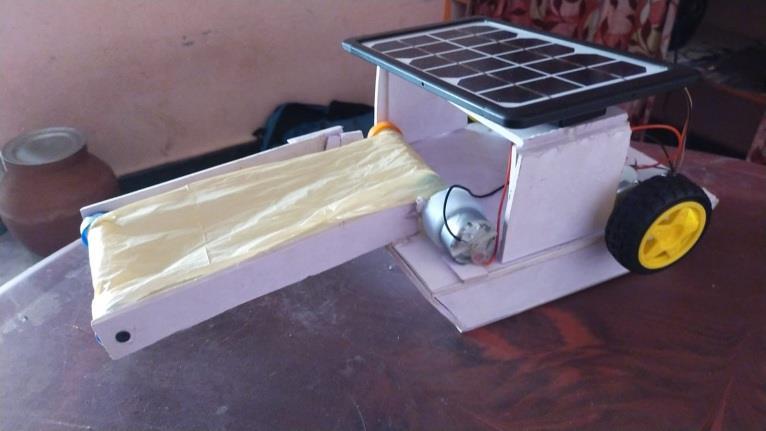
Simultaneously, the boat's cleaning mechanism operates efficiently to collect waste floating on the water surface.Aconveyorbeltsystemlocatedatthefrontofthe boat rotates continuously, scooping up floating debris such as plastic bottles, Styrofoam, paper, and plant material.Astheconveyorpicksuptrash,itdepositsitinto ameshbinsituatedattherearendoftheboat.Thisbinis constructed to allow water drainage while securely holdingthecollectedwaste.Themodulardesignofthebin enables easy removal and emptying once the boat completesitscleaningcycle.
The entire cleaning system is synchronized with theboat’smovement,ensuringthatastheboatprogresses across the water, the collection process happens seamlessly and without the need for human intervention. This autonomous waste removal process is particularly beneficial in larger or hard-to-reach areas, reducing the need for manual labor and increasing the frequency and efficiencyofclean-upefforts.
Another critical functionality of the boat is its real-time surveillance capability. The boat is equipped with a camera module that continuously captures visuals of the surrounding water body. These visuals are transmitted either through Wi-Fi when connected to a local network or via GSM technology using a SIM800L module. The captured data can be viewed remotely by municipalauthoritiesorenvironmentalagencies,whocan assessthecleanlinesslevelandmonitorforanyunusualor illegalactivitiesaroundthewaterbody.
The camera also assists in environmental monitoring, capturing images or video clips that can be used for analysis or reporting purposes. This feature is especially useful in tracking pollution sources, illegal dumpingactivities,andgeneralwaterconditionovertime. The ability to stream live data enhances situational awareness and facilitates prompt decision-making in case ofenvironmentalhazards.
Toensureconstanttrackingoftheboat’sposition, a GPS module is integrated into the system. This module sendsreal-timegeographicalcoordinatestoacloudserver oradedicatedappinterface.WiththehelpofGPSdata,the boat’s location can be monitored during its cleaning operation,whichiscrucialwhendeployedinexpansiveor less accessible water bodies. In addition, the GPS module aids in path planning, enabling the boat to follow predefined cleaning routes or return to a base station autonomouslyaftertaskcompletion.
Theenergybackboneoftheboatisitssolarpower system. High-efficiency solar panels are mounted on the deck of the boat to maximize exposure to sunlight. These panelsconvertsolarenergyintoelectricalpower,whichis stored in rechargeable batteries. The energy stored in the
batteries is used to run all electronic and mechanical components of the system. The inclusion of solar power ensures that the boat operates independently of external powersources,reducingoperationalcostsandsupporting greenenergyinitiatives.
Evenundercloudyorpartiallyshadedconditions, the solar system is capable of generating sufficient power tokeepthesystemrunning. Thebatteriesprovide backup power during low sunlight periods, ensuring uninterrupted operation throughout the day. This makes the boat particularly effective in rural or undeveloped areaswhereaccesstoelectricityislimitedornonexistent.
One of the significant advantages of the solarbased river cleaning boat is its ability to function autonomously. Once programmed, the boat can navigate, clean,and monitor without requiring manual control. The system is designed with smart algorithms that adapt to real-time conditions such as water currents, wind direction,anddebrisconcentration.Thesealgorithmsfinetune the boat’s operations to optimize performance, ensuring that maximum waste is collected in minimum time.
Additionally, the system can send alerts via SMS or push notifications through a mobile application. These alerts can notify users about bin capacity, location updates, battery status, or any detected anomalies. This feature allows for minimal human supervision while ensuringthatoperatorsremaininformedaboutthe boat’s statusandperformance.
During field trials and real-time testing, the boat has demonstrated a strong capability to perform under varied environmental conditions. Whether dealing with fast currents, windy days, or varying debris levels, the systemadaptsitsoperationwithoutsignificantdisruption. The resilient construction of the boat allows it to withstand minor collisions and navigate through moderatelyroughwaters.
These trials also reveal the boat’s efficiency in cleaning large volumes of debris over extended periods. With adequate sunlight, the boat can function continuouslythroughoutthedayand canbe programmed for automatic start and stop times, ensuring routine cleaning cycles without the need for daily intervention. This reliability makes it suitable for deployment in municipal water cleaning programs, parks, rural canals, andindustrialsites.
Thesystemnotonlyaddressesthecriticalissueof water pollution but also integrates modern surveillance andmonitoringfeatures.Itsautonomousnature,powered by renewable energy, significantly reduces the need for manual intervention, while its smart features ensure high efficiencyandadaptability.
International Research Journal of Engineering and Technology (IRJET) e-ISSN: 2395-0056
Volume: 12 Issue: 04 | Apr 2025 www.irjet.net p-ISSN: 2395-0072
By combining ecological responsibility with technological innovation, this project represents a scalable, cost-effective, and environmentally friendly solution to maintain cleaner and safer water bodies. Its successful implementation in real-time environments confirms its potential for broader applications across cities, rural areas, and industrial zones, setting a benchmarkforfutureenvironmentalengineeringprojects.
4. Simulations
ADVANTAGES
1. co-Friendly Operation: Utilizessolarenergyasa clean and renewable power source, reducing dependence on fossil fuels and minimizing environmentalimpact.
2. Autonomous Functioning: Capable of operating with minimal human intervention, reducing the need for manual labor and enabling efficient cleaningofwaterbodies.
3. Real-Time Surveillance: Equipped with a camera system that provides live monitoring, enhancing security and environmental observation.
4. Cost-Effective Maintenance: Low operational costs due to the use of solar power and minimal fuelorelectricityconsumption.
5. Waste Collection Efficiency: Efficiently collects floating waste such as plastic, leaves, and other debrisusingaconveyor-basedmechanism.
6. Remote Monitoring and Control: Can transmit data via GSM or Wi-Fi, allowing users to monitor location and status remotely through GPS and messagingservices.
7. Adaptability to Various Water Bodies: Designed to operate in ponds, lakes, rivers, and othercalmorsemi-calmwaterenvironments.
8. Energy Storage Capability: Incorporates rechargeable batteries to store solar energy for operationduringcloudyweatherornighttime.
9. Environmental Protection: Helps reduce pollution in aquatic ecosystems, preserving marinelifeandimprovingwaterquality.
10. Scalability and Customization: Canbescaledfor larger projects or customized for specific environmentalconditionsoruserrequirements.
11. Low operational cost duetosolarpowerusage.
12. Reduces labor costs throughautomation.
13. Minimizes fuel expenses, saving money over time.
14. Increases tourism appeal bycleaningrivers.
15. Supports fishing industry withcleanerwater.
16. Reduces maintenance costs for water infrastructure.
17. Can generate local employment for maintenanceandmonitoring.
18. Reduces costs related to water-borne diseases
19. Contributes to circular economy by collecting recyclablewaste.
20. Scalable for larger water bodies atlowcost.
21. Runs on renewable energy – no fossil fuels needed.
22. Operates autonomously or remotely for better control.
23. Can be equipped with sensors for smart monitoring.
24. Efficient waste collection with minimal human effort.
25. Can operate in shallow waters where larger boatscannot.
26. Modular design allows easy maintenance and upgrades.
27. Low noise operation, minimizing disturbance to wildlife.
28. Lightweight and portable,easytodeploy.
29. Can be programmed for scheduled cleanings
30. Integrates easily with IoT systems forreal-time data.
31. Low Operational Cost –Sincethesystemrunson solarenergy,itgreatlyreducesfuelandelectricity costsovertime.
32. Reduces Dependence on Manual Labor – It automates waste collection in rivers, minimizing
International Research Journal of Engineering and Technology (IRJET) e-ISSN: 2395-0056
Volume: 12 Issue: 04 | Apr 2025 www.irjet.net p-ISSN: 2395-0072
the need for human workers in hazardous water conditions.
33. Eco-Friendly Surveillance – Monitors water conditions without harming aquatic life or disruptingtheecosystem.
34. Silent Operation – Solar-powered boats operate quietly, reducing noise pollution compared to fuel-poweredalternatives.
35. Supports Remote Operation – The boat can be controlledandmonitoredremotelyusingGPSand GSM/Wi-Fimodules.
36. Data Collection Capability – Can be integrated with sensors to collect environmental data (like waterquality,temperature,etc.)forresearch.
37. Scalable Design – The boat design can be scaled for use in small ponds or large rivers depending ontherequirement.
38. Public Awareness –Deploymentinpublicplaces raises awareness about pollution and promotes environmentalconsciousness.
39. Durability in Harsh Environments – Designed to withstand rough water conditions and continuousexposuretosunlight.
40. Reduces Spread of Waterborne Diseases –Cleaning waste helps prevent the breeding of mosquitoesandharmfulbacteria.
41. Minimizes Risk to Human Life – Reduces the need for humans to enter polluted waters, minimizingexposuretoharmfulsubstances.
42. Easy to Upgrade – Modular design allows for easy integration of new features like AI-based vision,watertestingmodules,orbetterbatteries.
43. Disaster Preparedness – Can be used postfloods or heavy rains to quickly clean affected waterbodiesandpreventclogging.
44. Can Work During Pandemics – Operates autonomously, ensuring river cleaning can continue even during lockdowns or health emergencies.
45. Promotes Smart City Development – Aligns withgoalsofsmartandsustainablecitiesbyusing automationandgreenenergyforpublicutility.
The increasing pollution of water bodies due to the accumulation of solid waste such as plastics, organic debris, and industrial residues has become a major global concern, threatening marine life, ecosystems, and human health. Conventional waste-cleaning methods are often labor-intensive, expensive, and environmentally unsustainable. In light of these challenges, this project Solar Based Garbage Cleaning and Surveillance Boat presents an innovative, sustainable, and technologically advancedsolutionthatintegratesautonomousnavigation, real-time surveillance, and solar-powered operation to tacklewaterpollutionefficientlyandeconomically.
This system merges mechanical design with embedded electronics and renewable energy to form an eco-friendlyaquaticrobot.Thecorefunctionoftheboatis tonavigatethroughwaterbodiessuchasponds,lakes,and rivers, collecting floating garbage using a conveyor-based mechanism.Theintegrationofsolarpanelsastheprimary power source ensures that the system is both energyefficient and environmentally benign, reducing dependency on non-renewable energy sources and minimizing the carbon footprint. The use of solar energy not only makes the boat operationally cost-effective but also aligns with global goals for sustainable development andgreentechnologyadoption.
The real strength of this project lies in its autonomous operation and surveillance capabilities. The incorporationofmicrocontrollerslikeArduino,alongwith a GPS module and camera system, allows for real-time monitoring, data logging, and navigation tracking. This enables users to monitor the status and position of the boatremotely,makingithighlysuitableforapplicationsin both urban and rural settings where manual monitoring may not be feasible. Moreover, the surveillance system enhances security, enabling authorities to keep an eye on both environmental conditions and unauthorized activitiesoccurringnearorwithinwaterbodies.
[1] Sharma, R., & Saini, A. (2020). Design and Implementation of Solar Powered Water Cleaning Robot. International Journal of Engineering Research & Technology(IJERT),9(06),248–252.
[2] Raj, M., & Kumar, A. (2019). Development of Autonomous Water Surface Cleaning Robot Using Solar Energy. International Journal of Advanced Research in Electrical, Electronics and Instrumentation Engineering, 8(5),1678–1683.
[3]Tripathi,R.,&Jha,A.(2021).SmartWasteManagement System Using IoT and Renewable Energy Resources. International Journal of Innovative Technology and ExploringEngineering(IJITEE),10(3),12–15.
[4] Kumar, P., & Meena, S. (2022). Design and Analysis of Solar Powered Aquatic Surface Cleaning Robot. Journal of EnvironmentalScienceandEngineering,64(2),113–120.
[5] Patil, S., & Sawant, D. (2021). Autonomous Garbage Collector Boat for Water Bodies Using Solar Power. International Journal of Engineering and Advanced Technology(IJEAT),10(4),59–63.
[6] Prasad, S., & Jain, R. (2020). Renewable Energy Based Smart Environmental Monitoring Systems. International Conference on Smart Technologies for Smart Nation
International Research Journal of Engineering and Technology (IRJET) e-ISSN: 2395-0056
(SmartTechCon), IEEE, 1–5. https://doi.org/10.1109/SmartTechCon.2019.8737575
[7]Kumar,S.,&Gupta,A.(2019).ImplementationofSolarPowered IoT Based Surveillance System Using Arduino. International Journal ofScienceandResearch(IJSR),8(7), 88–92.
[8] Akshaya, K., & Gaurav, M. (2022). Solar Powered Autonomous Boat for Water Quality Monitoring and Debris Removal. International Research Journal of EngineeringandTechnology(IRJET),9(8),1342–1346.
[9] Kumar, R., & Yadav, P. (2018). Use of Renewable Energy for Robotic Automation in Cleaning Applications. Journal of Renewable Energy and Environmental Engineering,6(3),89–94.
[10] United Nations Environment Programme (UNEP). (2021). Cleaning up our Oceans: Innovative Technology and Sustainable Solutions. Retrieved from: https://www.unep.org/resources/publication
Volume: 12 Issue: 04 | Apr 2025 www.irjet.net p-ISSN: 2395-0072 © 2025, IRJET | Impact Factor value: 8.315 | ISO 9001:2008
| Page