
International Research Journal of Engineering and Technology (IRJET) e-ISSN: 2395-0056
Volume: 12 Issue: 10 | Oct 2025 www.irjet.net p-ISSN: 2395-0072
International Research Journal of Engineering and Technology (IRJET) e-ISSN: 2395-0056
Volume: 12 Issue: 10 | Oct 2025 www.irjet.net p-ISSN: 2395-0072
Antony
Varghese1 , Jayaram S.2
1Student, Department of Electrical and Electronics Engineering, Sree Narayana Gurukulam College of Engineering, Ernakulam, Kerala, India
2Associate Professor, Department of Naval Architecture and Ship Building Engineering, Sree Narayana Gurukulam College of Engineering, Ernakulam, Kerala, India
Abstract – Inland vessels, such as houseboats, traditionally rely on diesel generators to meet their onboard electrical demands which leads to fuel consumption and emissions. This study focuses on the design of a battery pack that can replace the conventional diesel generator in a houseboat with Li-ion batteries that can cater for all auxiliary equipment and devices on the vessel. The study has assessedthefeasibilityand identified the benefits of the proposed transition from conventional fossil fuel-based power generation system to an all-electric solution for inland vessels. Electric power is generated onboard using the solar photovoltaicsystem,which is a renewable energy source. The proposed design of battery pack includes estimation of electrical load of the vessel, required battery capacity, voltage and other parameters; selection of a Li-ion cell for the battery pack; and assessment of space and weight considerations, safety and reliability. The study has also addressed aspectsonreductionofemissions and reduction of fuel cost that can be achieved by using the proposed system.
Key Words: SolarPoweredHouseboat,RenewableEnergy, Photovoltaic system, Battery Management System, Hotel Loads, Li-Ion Battery, Inland Vessel, Electrical Power Generation
Houseboats form an essential part of tourism in various statesinIndia,especiallyinKerala,astheyprovideaunique and scenic travel experience Conventionally, these boats depend on diesel generators to supply electric power to variouselectricalequipmentanddevicesonboard,suchas lighting,airconditioningandgalleyequipment.Eventhough diesel generators are capable for providing the required electrical power, they have several disadvantages as describedbelow:
(i) Environmentalimpact:Dieselenginesemitgreenhouse gases, which contribute to air pollution and climate change. The noise pollution and vibrations from generators can also disrupt the natural environment anddisturbwildlife.Fuelleakagestotheinlandwaters can result in pollution and it can adversely affect the aquaticlife.
(ii) Economicimpact:Thecostofdieselfuelhasincreased in recent years, placing a financial burden on
houseboatoperators.Furthermore,dieselgenerators require regular maintenance, adding to operational costs.
(iii) Reliabilityandconvenience:Dieselgeneratorsrequire fuelstorage,regularrefuelling,andoperationalspace, whichcanbeinconvenientandpronetodisruptionsto theirroutineoperations.
Given these factors, there is a necessity for a sustainable, reliable,andcost-effectivealternativetodieselgenerators for supplying the power to the auxiliary systems of a houseboat. The integration of renewable energy sources, particularly solar power, offers a promising solution to addresstheseissues.
The main objective of this study is to design a battery packpoweredbysolarenergytoreplacetheconventional diesel generators used on houseboats for powering the auxiliarysystems.Thissolar-poweredsystemaimsto:
(i) Reduce emissions: By replacing diesel with solar energy,thesystemwillreducethecarbonfootprintand pollutantsreleasedintotheatmosphereandwater.
(ii) Lower operational costs: Solar energy is a free resource, and with the correct system setup, the dependency on costly diesel fuel will be minimized, reducinglong-termcosts.
(iii) Enhanced reliability and convenience: With a solarpoweredbatterypack,theneedforregularrefuelling and generator maintenance is eliminated, offering a moreautonomousanduser-friendlysolution.
Solar energy is a clean, renewable resource that can providesubstantial energy. Byplacingsolarpanelsonthe houseboatroof,thevesselcanharnesssunlightthroughout the day to charge the battery pack, hence replacing the conventionaldieselgeneratorsanditreducestheemission of harmful gases. The reduction in fuel consumption and emissions aligns with global sustainability goals and enhancestheeco-tourismappealofhouseboats.
For houseboat propulsion system, diesel based internal combustionenginesarewidelyused.Enginesusedintrucks
International Research Journal of Engineering and Technology (IRJET) e-ISSN: 2395-0056
Volume: 12 Issue: 10 | Oct 2025 www.irjet.net p-ISSN: 2395-0072
are modified and it is commonly used as the engine for houseboat’spropulsionsystem.ADieselGeneratorset(DG set)isusuallyusedtomeetthehotelloads,i.e.theelectrical energydemandsfortheelectricalappliancesandequipment ADGsetincludesadieselenginecoupledwithanalternator to produce electricity. Therefore, for both the propulsion systemandhotelloads,theprimarysourceofenergyisfossil fuel. The use of fossil fuels contributes to emission of greenhouse gases into the atmosphere and results in significantcarbonemissionsfromhouseboats.Additionally, DGsetsareverynoisyandrequiresregularmaintenanceand refuelling.Thestudyproposesthedesignofasolarpowered batterypacktoimplementafossilfuel-freeandbattery-based powerdistributionsystemforallhotelloadsinhouseboats boats through imparting solarsystemand replacingdiesel generators.
The detailed design of the proposed electrical power generation system for the houseboat is described in the followingsections.
3.1.
The proposed system is designed to replace the conventionaldieselgeneratorwithaLi-Ionbatterypackand solarastheprimarysourceofenergy.Thesolarpanelsare placedontherooftopandthepowerfromsolarisusedfor hotelloadsandtochargethebatterypack.Ablockdiagramof theproposedsystemisshowninFig-1.
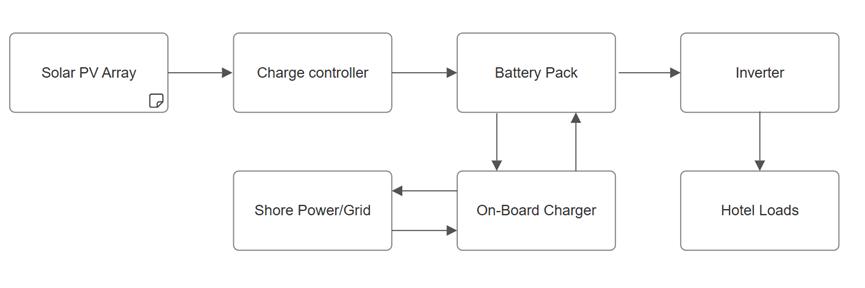
The above block diagram shows the general stages in power conversion required to implement the proposed system.ThesolarPhotoVoltaic (PV) arrayproducesDirect Current (DC), which is then Boosted into required voltage necessarytochargethebatterybythechargecontroller.For hotelloads,AlternatingCurrent(AC)isrequired.Fromthe battery pack, the DC is converted into AC by an inverter. Duringrainyseasonsandcloudydays,thesunlightreaching thesolarpanelsmaynotbesufficienttorunthesystem.So, during these times, the battery pack can be charged using shorepowerwiththehelpofanonboardoroffboardcharger
Commonelectricalloadsinahouseboatincludelighting, fans, air conditioning, water pumps, kitchen appliances
(electricstoves,kettles),entertainmentsystems,navigational equipmentetc.Thetotalloadandpowerconsumptionvaries betweendifferenttypesofhouseboats. AtwoBedroom,one HallandoneKitchen(2BHK)houseboathasbeenselectedfor thecasestudy.Thegeneralarrangementofthehouseboatis showninFig-2.
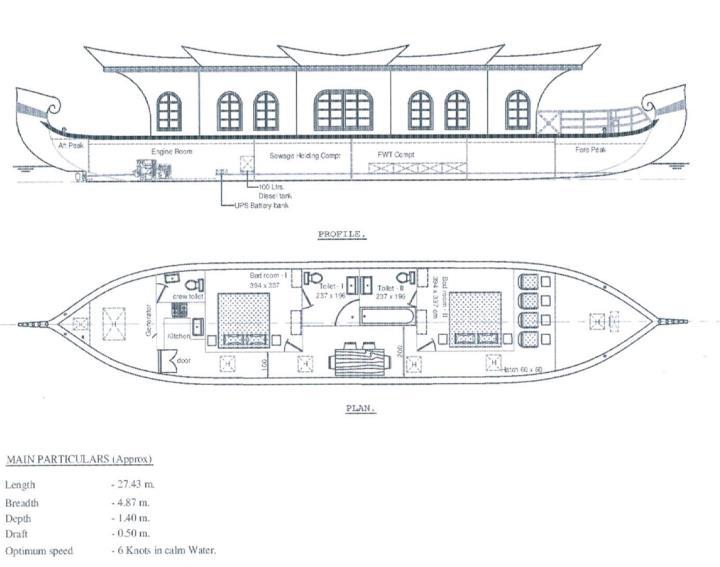
Fig -2:Generalarrangementofa2BHKhouseboat[1]
Alltheelectricalappliancesareassumedtobeofthebest quality and of high efficiency. In order to achieve this, appliances with 5-star ratings have been selected. In addition, Brushless Direct Current (BLDC) fans have been consideredtobeusedonboardsincetheseneedtobeofonly halfofthepowerratingofcorrespondingconventionalfans. Table-1indicatestheelectricalloadchartwhichtakesinto account all the estimated electrical loads and its power ratingsoftheequipmentonboardthehouseboat.
International Research Journal of Engineering and Technology (IRJET) e-ISSN: 2395-0056
Volume: 12 Issue: 10 | Oct 2025 www.irjet.net p-ISSN: 2395-0072
Total daily energy demand is the sum of daily energy consumption,anditisestimatedtobe20,560WhfromTable -1.
Therequirednumberofsolarpanelsdependsonthedaily energy demand of the houseboat and therefore it varies betweendifferenthouseboats Thenumberofpanelsthatcan beaccommodatedontheroofofthehouseboatisalsolimited. Based on the load chart shown in Table -1, the number of panelsrequiredisestimatedasfollows:
Itisassumedthatthesolarpanelneedstoproduce30% more energy than the required value of 20560 Wh/day in order to compensate for the energy loss in batteries and connectingwires.Therefore,energytobegeneratedbythe solarpanelbecomes26,728Wh/day.Aparameterknownas Panel Generation Factor (PGF) has to be considered for calculating the size of solar panel. Several factors such as temperature variance, dust accumulation, ageing, inverter efficiencyandbatteryefficiencyaffecttheperformanceofthe solarpanels.Ade-ratingfactorof0.77hasbeenassumed[2] totakeintoaccounttheabovefactorsandalsoaminimum solarirradianceof5.5hasbeenconsidered[3].
PGF =minimumsolarirradiance*de-ratingfactor
=5.59*0.77=4.304
Sizeofsolarpanelrequired
=Energy(inWh)perdaytobegenerated/PGF
=26,728/4.304
=6210.03W
Therefore, after compensating for all the losses in the system,suchaslossesingenerationduetodust,inefficient sunlight and losses in electrical conversion stages, a solar panelsystemratedfor6210Wisproposedtobeconstructed. Tomeetthiscapacityrequirement,solarpanelshavingapeak powerof550Wpperpanel,havebeenselected Therefore, therequirednumberofPVmodules
= totalrequiredpanelsize/ratedpeakpower ofaPVmodule
= 6210W/550W=11.29 ≈ 12panels
Basedontheabove,twelvesolarpanelsareproposedto beprovided.Therefore,thetotalavailablecapacityofsolar panelstogetherbecomes12x550W=6600W
3.4
Itisnecessarytoidentifyadequatespaceontheexposed roofareaofthehouseboatinordertoinstallthetwelvesolar panels.Fromthegeneralarrangementofthevessel,shownin
Fig-2,itisfoundthatatotalroofareahaving18mlengthand 3.5mbreadthisavailable.
Totalroofareaavailable =18x3.5=63m2
AreaofonePVmodule =2278mmx1134mm =2.583m2
ArearequiredfortwelvePVmodules =12x2.583 =30.996m2
Therefore, the twelve solar panels can be efficiently accommodated on the roof top of the houseboat. The orientationlayoutofthepanelsshallbesuchthatthereare twosolarpanelsintheathwartshipdirectionandsixpanels inthefore-aftdirection,asshowninFig-3.

forward
The panel are to be placed such that the weight of the panels are evenly distributed over the roof top. Adequate inclination shall be provided for the solar panels for maximum output generation and it will depend upon the shapeandslopeoftheroof.Eachpanelwouldweigharound 28kg.Thereforethetotalweightoftwelvepanelswillbe336 kg
Themassof336kgwouldimpartasignificantamountof loadontherooftop.Typicallythestrengthofmaterialsused to construct roof of the houseboats are low; therefore additionalloadbearingstructureslikestiffenersandpillars are to be additionally fitted to strengthen the roof of the vessel.Additionofsuchlargeweightsonhouseboatsroofcan adversely affect its stability and therefore the effect of the weight on the transverse stability is to be given due consideration
Forconstructingthebatterypack,Li-Ioncellsarechosen. Lithiumbatteriesareavailablewithdifferentchemistry,some of them are Lithium Titanium Oxide (LTO), Lithium Iron Phosphate (LFP), Lithium Nickel Manganese Cobalt Oxide (LMO)andLithiumNickelCobaltAluminumOxide(NCA).
After comparing the safety and performance of the differentlithiumchemistry,itisfoundthatLTOandLFPare clearlybetteroptions.Fig4showsthecomparisonofvarious
International Research Journal of Engineering and Technology (IRJET) e-ISSN: 2395-0056
Volume: 12 Issue: 10 | Oct 2025 www.irjet.net p-ISSN: 2395-0072
Li-Ionbatterieswithrespecttotheirperformanceandsafety [4].
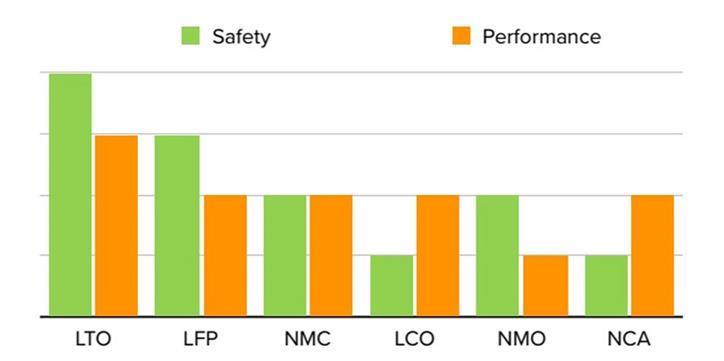
Fig- 4:Comparisonofsafetyandperformanceofdifferent Li-Ionbatteries[4]
Followingassumptionshavebeenmadeforselectingthe requiredcapacityofthebatterypack
(i) Batteryefficiencyisassumedtobe95%
(ii) Depthofdischargeisassumedtobe80%
(iii) Numberofcloudydaysisassumedtobe2
Batteryvoltagelevels arechosen basedon the wattage capacityofthepanels,asgivenbelow:
a) 12Vforupto500Wcapacity
b) 24Vforupto1000Wcapacity
c) 48Vforupto2000Wcapacity
Sincetheestimatedcapacityofpanelsisabove2000W,a 48Vsystemhasbeenadoptedforthebatterypackandthis wouldalsofacilitateoptimalchargingofthebattery
Basedonassumption(i)givenabove,thebatteryhasan efficiencyof95%.Therefore,tocompensateforthe5%losses inbattery,batterymustsupply5%morethanthetotaldaily energydemandof20,560Wh,i.e.atotalof21,642Wh/day. Basedonassumption(ii),thedepthofdischargeis80%,that is the battery can only be used up to 80% of its capacity, thereforebatterybankmustbeabletosupply20%extra,i.e. atotalof27,052Wh/day
Sincethereisapossibilityofchargingthebatteryusing shore supply during emergencies or during cloudy days, batterybankcanbedesigneduptoaratedcapacityof27,052 W
CorrespondingcapacityofbatteryinAh =batterybanksize(W)/voltage =27052W/48V=5635≈570Ah
It is proposed to use cells with the individual cell specificationofEVE3.2V105AhLiFePO₄.Thebatterypack
can be constructed by combinations of series and parallel connections ofthecells toachieve thedesiredvoltageand current.
(i) Series configuration: 15 cells each with 3.2 V in seriestoachieveanominal48V
(ii) Parallelconfiguration:Toachievethetotalbattery capacity of 570 Ah, it is required to provide 570Ah/(105Ahpercell)i.e5.42cells.Therefore,itis proposedtousesixcellsinparallel
(iii)Therefore,totalnumberofcellsrequiredtomeetthe dailyloaddemandisgivenby15(inseries)x6(in parallel)i.e.90cells.
Total weightofninety cellsisestimatedtobelessthan 200kg.Sincethetotalmassofbatteriesof200kgtogether withthemassofpanelsof336kgismuchsmallercompared tothetotalweightofthevesselandsinceitisgoingtoreplace the diesel generator set on board, the effect on draught is consideredtobenegligible.
Thechargecontrollerforthebatteryistobespecifiedin termsofcurrentandvoltage.Itisrecommendedtooperate thechargecontrolleratacurrentof30%morethantheshort circuitcurrentofthePVarray.Sincethebatteryvoltagehas beenselectedas48V,thevoltageratingofchargecontroller has also been selected as 48V. The short circuit current of eachpanelis13.9A[6].Since6panelsareproposedtobe connectedinparallel,thetotalshortcircuitcurrentofthePV arraybecomes83.4A Accordinglyachargecontrollerrated 48V, 110 A capacity has been chosen which is rated more than 30% of the short circuit current of 83.4 A. Rating of inverterisfoundusingthefollowingformula:
Ratingofinverter
=(ConnectedloadinVAxSafetyfactor)
/Efficiencyofinverter
=(4750*1.2)/0.9=6.33kVA
Basedontheabove,a7kVA,48/230Vsinglephasesine waveinverterhasbeenchosen.
Theproposedsystemcanbecomecompletelyautonomous after its implementation. There won’t be much operating costs during its lifetime. The only requirement would be cleaningsolarpanelsonceeverytwoorthreemonths.Forthe solarpanelthemanufacturerwouldnormallygive30yearsof performancewarranty.Forthebatterypack,thecellswould have4000cyclesoflife,whichwouldextendtomanyyears evenifthebatteryischargedanddischargedonadailybasis
International Research Journal of Engineering and Technology (IRJET) e-ISSN: 2395-0056
Volume: 12 Issue: 10 | Oct 2025 www.irjet.net p-ISSN: 2395-0072
Two litres of diesel would be required per hour for runningthehotelloadsinahouseboatandabouttwenty-two litresofdieselwouldbeusedonaday[5].Thetotalcostof diesel consumption for operating the hotel loads is approximately₹2000perday Consideringthedieselpriceof ₹95perlitreandanannualoperationof350days,thetotal operationalcostsamounttonearly₹7,00,000peryear
The estimated cost for procuring and installing the proposedsystemisabout₹6,00,000[6]-[8].Accordingly,the paybackperiodfortheproposedsystemwillbelessthana year, making it a highly economical and sustainable alternativetoexistingarrangementwithDGsets.Afterthe paybackperiodofoneyear,themaintenancerequirementsof thesolarpowersystem wouldcontinuetobeminimal and there won’t be any further recurring diesel expenses for poweringhotelloads.Thiscanleadtosignificantlong-term savingsandareductionincarbonemissions,contributingto botheconomicandenvironmentalsustainability.
Also,thesolarenergyproducedbythehouseboatduring non-operationalperiodcouldbefedtotheKSEBelectricity grid, whichin turn will generateadditional incomefor the houseboat owners. Also, the proposed system is environmentallyfriendlyasthereisnopollution,noiseand vibrationswhencomparedtodieselgeneratorsthatproduce noisepollutionandvibrationandtherebyadverselyaffectthe comfort of people onboard The proposed system is completelyautonomous,unlikedieselgenerators,sincethere is no need for refueling and routine maintenance for the proposedsystem.
Itisconcludedthatintegratingasolar-poweredlithiumIonbatterysystemintohouseboatscanprovideasustainable and efficient alternative to conventional diesel generators. Thestudyhasanalyzedtheenergyrequirementsofatypical 2BHK houseboat and proposed an environment-friendly design consisting of a 48V, 570Ah LiFePO₄ battery pack supportedbya6.6kWsolarPVarray.Thedesignhastaken intoconsiderationthestructuralfeasibility,energyefficiency, andsystemreliability.Economically,thesystemcaneliminate therecurringfuelcostsassociatedwithdieselgeneratorsand itcanprovideareturnoninvestmentwithinashortperiod. Furthermore, the proposed system can operate with less noiseandlow-maintenance,anditwillconformtotheecotourism goals by reducing emissions and enhancing passenger comfort. The proposed approach not only addressessustainabilityconcernsbutalsosetsareplicable modelforcleanenergyadoptionininlandwatertransport.
In the future, the proposed solar-powered lithium-ion battery system can be further enhanced by extending its applicationbeyondpoweringhotelloadstosupportingfull electric propulsion of the houseboat. This would enable
completeeliminationoffossilfueldependency,makingthe vessel entirely electric and emission-free. By integrating a largercapacitybatterysystemwithsuitableelectricmotors forpropulsion,thehouseboatcanachievesilentandefficient navigation, which is particularly beneficial in ecologically sensitive backwater regions. Additionally, incorporating smartEnergyManagementSystems(EMS)canhelpoptimize power distribution between propulsion and hotel loads, ensuring efficient energy use. Hybrid energy systems combiningsolarwithshorechargingorauxiliaryrenewable sources like wind can also be explored for increased reliability.Incorporatingbidirectionalchargingandgrid-tie capabilities would allow excess solar energy generated duringidleperiodstobefedbacktotheutilitygrid,creating an additional source of revenue for houseboat operators. Furthermore,advancementsinbatterytechnologiessuchas solid-state batteries could enhance energy density, safety, andlifecycle.Expandingthismodeltolargerhouseboatsor smallpassengerferriescouldsignificantlyreducefossilfuel dependencyintheinlandwatertransportsector.Lastly,realworld pilot implementations and long-term performance assessmentscanhelprefinethesystemdesignandpromote wider adoption of clean energy solutions in tourism and transportation.
[1] Andhra Pradesh Tourism Development Corporation (APTDC),RFPforProcurementofHouseboats,2018
[2] A.YounisandY.Alhorr,“ModelingofDustSoilingEffects on Solar Photovoltaic Performance: A Review”, Solar Energy,2021,220pp.1074–1088
[3] Ganesh Hegde and Ramachandra T.V, “Scope for Solar Energy in Kerala and Karnataka”, in Proc. LAKE 2012: NationalConferenceonConservationandManagementof Wetland Ecosystems,Kottayam,India,Nov2012.
[4] SandithThandasherry,SolarElectricBoats-Plan.Build& Benefit,1Ed.,EmergingTechnologyNews,2021.
[5] MohammedAjlif,A.,SigiC.Joseph,AbyJoseh,JayanP.P. and Dhanesh P.R., "Energy Efficient House Boats for Sustainable Backwater Tourism," in Proc. 2019 Global Conference for Advancement in Technology (GCAT), Bangalore,India,Oct2019
[6] “WAAREE Solar Panels Mono PERC Monofacial 520550Wp,”IndiaMART,https://www.indiamart.com/prodd etail/waaree-solar-panels-mono-perc-monofacial-520550wp-2856446898848.html(accessed05-Oct-2025).
[7] “EVE 105AH LiFePO4 (LFP) 3.2V Battery,” IndiaMart, https://www.indiamart.com/proddetail/eve-105ahlifepo4-lfp-3-2v-battery-19719983291.html (accessed 05-Oct-2025).
International Research Journal of Engineering and Technology (IRJET) e-ISSN: 2395-0056
Volume: 12 Issue: 10 | Oct 2025 www.irjet.net p-ISSN: 2395-0072
[8] “6 KW Xwatt Hybrid Solar Inverter,” IndiaMART, https://www.indiamart.com/proddetail/6-kw-xwatthybrid-solar-inverter-2855694347362.html (accessed 05-Oct-2025).
© 2025, IRJET | Impact Factor value: 8.315 | ISO 9001:2008 Certified
| Page665