
International Research Journal of Engineering and Technology (IRJET) e-ISSN: 2395-0056
Volume: 12 Issue: 08 | Aug 2025 www.irjet.net p-ISSN: 2395-0072
International Research Journal of Engineering and Technology (IRJET) e-ISSN: 2395-0056
Volume: 12 Issue: 08 | Aug 2025 www.irjet.net p-ISSN: 2395-0072
Alberto Deliña1 , Cloue Deriada2 , Leslie Esparar3
1 Assistant Professor, Department of Electrical Engineering, CPSU, Kabankalan City, Philippines
2 Instructor, Department of Electrical Engineering, CPSU, Kabankalan City, Philippines
3Science & Research Specialist, Department of Science and Technology, Philippines
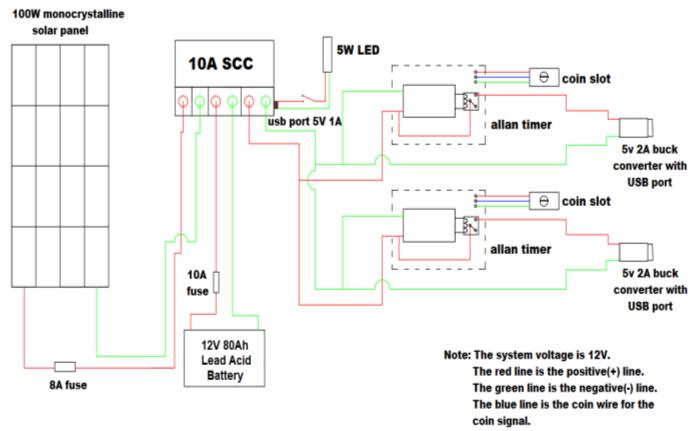
Abstract - The Solar-Powered Charging Station Vending Machine is a standalone device designed to provide reliable mobile phone charging services in areas with limited or no access to electricity. Developed to address the growing dependence on mobile phones for communication, online learning, and business especially inremotecommunities and during power outages the system harnessesrenewablesolar energy, thereby reducing carbon footprint and promoting environmental sustainability. The design process involved determining load requirements, sizing solar panels, charge controllers, batteries, conductors, andover-current protection devices. The final prototype featured two USB charging ports and an LED light, powered by a 100 W solar panel, 10 A charge controller, and 80 Ah sealed lead-acid battery, with vending capability based on coin operation. Reliability testing was conducted over 20 days at a public transport terminal, serving 35 smartphones and 40 basic phones. Results showed the vending mechanismperformedpreciselyaccordingtocoinset charging times, with smartphones achieving an average 57% increase in battery capacityandbasicphonesachievinga 248% increase in charge bars. The study concludes that the machine is highly reliable for both charging and vending operations. Recommendations include increasing the number of charging ports, adding laptop-compatible outlets, and improving portability. This project demonstrates a practical, eco-friendly, and income-generatingsolutionforenergyaccess in underserved areas, contributing to both technological innovation and sustainable development goals.
Key Words: Solar energy, charging station,vending machine, renewable energy, mobile phone charging, off-grid system, sustainable technology
Solarenergyisamajorrenewableenergysourcethatisboth eco-friendlyandcapableofaddressingmanyoftheworld’s pressing challenges. With technological advancements, variousdeviceshavebeendevelopedtoharnesssolarpower, suchastheSolarHomeSystem(SHS)andBatteryCharging Station(BCS).Alongsidethesedevelopments,mobilephones have become an essential part of daily life for people worldwide.Theirroleinmaintainingcommunicationwith family, managing business affairs, connecting with associates, and providing instant access to social media underscorestheirgrowingimportance.However,frequent usageleadstohighbatteryconsumption,resultinginfaster
battery depletion. This becomes a significant concern for commuterswithoutpowerbanks,aswellasforcommunities inremoteareasandduringpoweroutages,whereaccessto chargingfacilitiesislimited.
TheCOVID-19pandemichasmadecellphones,particularly smartphones,anessentialtoolintheacademe,asacademic institutions shifted from traditional face-to-face classes to onlinelearning.However,notallcommunitieshaveaccessto electricity, and those beyond the reach of electric utilities struggletochargetheirdevices nowvitalforeducationand communication. Frequent brownouts caused by system failures, environmental factors, and human error further compound the problem. To address these challenges, the researchers developed a stand-alone, solar-powered charging station for mobile phones, independent of the electricalgrid.Designedasavendingmachine,thesystem alsooffersanincome-generatingopportunityforindividuals who adopt the technology. This project is especially beneficialtopeopleinremoteareas,commuters,andsmall entrepreneursseekingpassiveincomeduringthepandemic. Byusingarenewableenergysource,itproduceszerocarbon emissions, contributing to climate change mitigation. The studyaimstodesignandtestthereliabilityofthecharging station’svendingandchargingcapabilities,whileprovidinga sustainablepowersourceforunderservedareas.
Thisstudyemployedanappliedresearchapproach,focusing onthedesign,fabrication,andperformanceevaluationofa solar-powered charging station vending machine. The methodologywasstructuredtoensurethedevice’stechnical reliability, operational efficiency, and suitability for deploymentinoff-gridandpublicareas.Theprocessbegan with determining the total daily load requirements of the chargingstation,whichservedasthebasisforthesizingof majorsystemcomponents,includingthesolarpanel,charge controller, battery storage, conductors, and over-current protection devices. Standard engineering calculations and relevant provisions of the Philippine Electrical Code were applied to ensure safety, efficiency, and compliance with industry standards. Once the design parameters were established, the prototype was fabricated using readily availablematerialsandcomponentsinthelocalmarket.The assembledunitwasthensubjectedtoa20-dayfieldtesting
International Research Journal of Engineering and Technology (IRJET) e-ISSN: 2395-0056
Volume: 12 Issue: 08 | Aug 2025 www.irjet.net p-ISSN: 2395-0072
period at a public transport terminal to evaluate both its chargingperformanceandvendingfunctionalityunderrealworld conditions. Data gathered from the tests were analyzed to determine the system’s charging efficiency, reliability, and potential scalability for commercial and communityapplications.
2. 1. Steps in designing solar-powered charging station vending machine
Step1.Determineyourpower/loadconsumption(Whper day);
Step2.Sizingofsolarpanel(Wp);
Step3.SizingtheDCchargecontroller(A);
Step4.Sizingthebatteries(Ah).;
Step5.Sizingofconductors(mm2);
Step6.Sizingofover-currentprotection(A).
2. 2. Design Analysis with load consideration
2-USBport,10wattseachforchargingmobilephonesin 10hours(8am-6pm)everyday.
1-5VDCLEDbulb,5wattsfor1hr(5pm-6pm)everyday.
Five (5) hours as the average daily solar exposure (SunHour)inaday.
Table -1: Scheduleofloads
Determination of power consumption in Watt-hour/day
Power consumption in watt-hour/day, taking the overall efficiency of the system to be seventy percent. Power consumption=[(10Wx10hours)+(10Wx10hours)+(5Wx 1hour)]/0.7=292.85watt-hour/day
Sizing of solar panel (Wp)
Ipv=[PowerConsumption]/[systemvoltagexsunhours in a day] Where: Ipv = photovoltaic total current required to charge the battery from the solar panel (Amperes)Systemvoltage=dcvoltageusedinthesystem (12vdcsystem)Sun-hoursinaday=theaveragenumberof hours the solar energy canbe captured within aday(sun-
hours).Ipv =[PowerConsumption]/[systemvoltagexsunhoursinaday]=[292.85watt-hour/day]/[12Voltsx5sunhours)=4.88Amperes
Therefore,basedonsolarpanelwattageratingfor2Wattsto 300Watts,theapproximatesolarpanelwattagewouldbe90 wattsbutduetoavailabilityconstraintsinthemarketofthat sizetheresearchersused100wattssolarpanelinstead.
Sizing the charge controller
ThechargecontrollerisratedinAmperes.Itsratingdepends ontheamountofphotovoltaiccurrent,Ipv.Toensurethatitis notoverloaded,20%ofIpvisusuallyaddedasanallowance. Chargecontrollersize
=Ipv+(20%ofIpv) =4.88+(4.88x0.2)=5.86Amperes. Therefore,thesizeofthesolarchargecontrollertobeused must be 5.86A or higher in rating. Due to unavailability of thatratinginthemarketthenexthigherof10Aratingwas usedinthisproject.
Sizing the battery & battery sizing considerations
Themachineshouldbe12Voltsdcsystem.Batteryshouldbe usedonlyatfiftypercentdeepofdischarge(50%DOD)Days of autonomy should be 2 days or 48 hours. Battery size = [Total load in watt- hour] / [battery deep of discharge x systemvoltage)]=[205watt-hour/day]/[0.5x12V]=34.17 Ampere-hourrequiredbatterysizefortwodaysautonomy:
Required battery size= [battery size in Ampere-hour] x [numberofdaysofautonomy]=[34.17Ampere-hour]x[2 days] = 68.34 Ampere-hours. Therefore, the battery to be used must be equal to 68.34 Ampere-hours or higher in rating.Sincethesaidratingisnotavailableinthemarketthe researcherusedthenexthigherratingof80Ampere-hours. For this project, the researchers used 80 Ampere-hours sealedleadacidbattery.
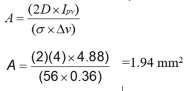
Conductor size calculation

Where: A : cross-sectional area of the cable; D: maximum lengthofthecable:4m Ipv:currentfromthesolarpanel : 4.88A;σ:conductorusedforthecable(specificconductivityof copper):56x106A/V;Δv:totalvoltagedropsbythecable; : this isusually takento be3%ofthesystem voltage.; Δv : (3%of12V)=0.03x12=0.36V
International Research Journal of Engineering and Technology (IRJET) e-ISSN: 2395-0056
Volume: 12 Issue: 08 | Aug 2025 www.irjet.net p-ISSN: 2395-0072
Theconductorsizetobeusedshouldbeequaltoor greaterthan1.94mm2.Sincethesaidconductorsizeisnot availableinthemarkettheresearchersusedthenexthigher sizeof2.0mm2.Theresearcherused2.0mm2 THWcopper conductor.
Solar panel to charge controller OCPD size
OCPD size = short circuit rating of the pv panel x 125%
=6.25AX1.25
=7.81Amperes
Therefore,theOCPDsizetobeusedmustbeequalto7.81Abut since the said rating is not available in the market the researchersusedthenexthigherratingof8Amperes.Inthis projecttheresearchersused1-8Amperesfuse.
Charge controller to battery OCPD size
In determining the fuse size needed between the charge controllerandbatteryitsimplyneedtomatchtheamperage ratingonthechargecontroller.Therefore,chargecontroller tobatteryOCPDsizeisequaltoChargecontrollersize.Inthis projecttheresearchersused10Amperefuse.
3. Results
Thesolar-poweredcharging stationvending machinewas testedovera20-dayperiodattheCeresTerminal,Barangay Bantayan, Kabankalan City, serving a total of 35 smartphonesand40basicphonesofvariousbrands.
Table 2. Testresults
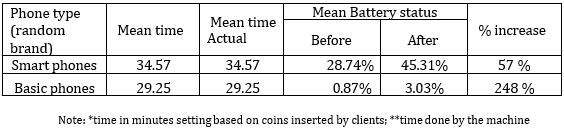
Thevendingmechanismdemonstratedpreciseperformance, deliveringchargingdurationsexactlymatchingthetimeset by coin insertion. For smartphones, the device increased battery levels from an average of 28.74% to 45.31%, equivalenttoa57%gain.Forbasicphones,batterystatus rose from an average of 0.87 to 3.03 bars, representing a 248%increase.Theseresultsindicatethatthesystemisboth reliableandeffectiveinprovidingtimedchargingservices fordifferentmobilephonetypesunderreal-worldoperating conditions.
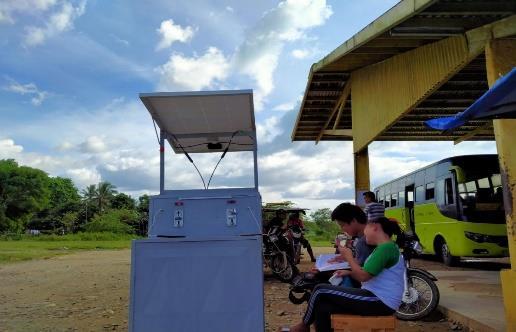
The results of the 20-day field test demonstrated that the solar-poweredvendingmachinechargingstationishighly reliable. Its vending mechanism consistently delivered chargingdurationsthatmatchedthepresettimebasedon thecoinsinserted,whileeffectivelychargingvarioustypes and brands of mobile phones. This validates the system’s capability as both a sustainable energy solution and a functionalincome-generatingdevice.
Tofurtherenhancethemachine’sfunctionalityandmarket potential,thefollowingimprovementsarerecommended:
1. Increase the number of charging ports to allow simultaneouschargingofmoremobiledevices.
2. Add charging ports compatible with laptop computers.
3. Upgrade the machine’s construction using lightweight materials to improve portability and easeoftransport.
[1] M. Boxwell, Solar Electricity Handbook 2017 Edition: A Simple, Practical Guide to Solar Energy How to Design and Install Photovoltaic Solar Electric Systems.Birmingham,U.K.: GreenstreamPublishingLtd.,2017.
International Research Journal of Engineering and Technology (IRJET) e-ISSN: 2395-0056
Volume: 12 Issue: 08 | Aug 2025 www.irjet.net p-ISSN: 2395-0072
[2] BatteryStuff.com, “Battery basics: A layman’s guide to batteries,” We Have The Stuff, Apr. 12, 2021. [Online]. Available: https://www.batterystuff.com/kb/articles/batteryarticles/battery-basics.html
[3] CCL Components, “Choosing the correct solar charge controller,” Aug. 2020. [Online]. Available: https://blog.cclcomponents.com/solar-charge-controllerchoosing-the-right-one
[4] R. Elder, “Creating new markets in the lifecycle of connected things: Starting at the end Obsolescence planning,” Feb. 11, 2019. [Online]. Available: https://blog.equinix.com/blog/2019/02/11/creating-newmarkets-in-the-lifecycle-of-connected-things/
[5] P. I. Okwu et al., “Details of photovoltaic solar system design calculations and accessories,” International Journal for Research in Applied Science in Engineering Technology (IJRASET),vol.5,no.6,pp.1–6,2017.
[6] Philippine ElectricalCode Part 1.QuezonCity,Philippines: InstituteofIntegratedElectricalEngineersofthePhilippines, Inc.,2017.
[7]WindyNation,“HowtoproperlyfuseasolarPVsystem,” Jan. 13, 2010. [Online]. Available: http://www.windynation.com/articles/how-properly-fusesolar-pv-system
[8]S.Writer,“Whatisalistofelectronicdevices?,”Apr.1, 2020. [Online]. Available: https://www.reference.com/world-view/list-electronicdevices