
International Research Journal of Engineering and Technology (IRJET) e-ISSN:2395-0056
Volume: 12 Issue: 05 | May 2025 www.irjet.net p-ISSN:2395-0072
International Research Journal of Engineering and Technology (IRJET) e-ISSN:2395-0056
Volume: 12 Issue: 05 | May 2025 www.irjet.net p-ISSN:2395-0072
AJINKYA VALANJOO, PUJA VAKHARE, DIVYAM POPTANI, SHREYAS PATIL, NIHARIKA BULANI
Dept. of Artificial Intelligence and Data Science, VES Institute of Technology, Mumbai, India
Abstract SMARTPARK AI is an intelligent parking management system aimed at streamlining urban commuting. Leveraging YOLO-based object detection, it analyzes CCTV footage to identify available parking slots in real time, enabling users to locate and book spots quickly. The platform includes a dynamic pricing model that adjusts rates based on time, demand, and occupancy, optimizing both space utilization and revenue. Users can pre-book slots using voice commands, and the system supports multiple languages such as English, Hindi, Marathi, Gujarati, and Bengali. CombiningAI, real-time analytics, anduser-friendly features, SMARTPARK AI redefines the modern parking experience.
Key Words: YOLOv5, Real-Time Detection, Dynamic Pricing, Slot Booking, Multilingual Support, Geolocation. Urban Mobility
1.INTRODUCTION
Urbanizationhasled toa sharpincrease in the number of vehicles, resulting in serious parking challenges in metropolitan cities. Drivers frequently spend excessive time searching for vacant parking spots, leading to increased traffic congestion, fuel consumption, and frustration.Traditionalparkingsystemsareinefficientand fail to address the growing demand for intelligent and real-timesolutions.
To overcome these limitations, we present SMARTPARK AI, a smart parking management system that integrates Artificial Intelligence (AI), computer vision, and real-time data processing. The system leverages YOLOv5-based object detection to process live CCTV footage and accurately detect vacant parking slots, enabling users to locateandreserveavailablespacesefficiently.
SMARTPARK AI also incorporates a dynamic pricing model, which varies parking fees based on demand, occupancy, time, and location. This ensures optimized space utilization and promotes fair pricing strategies for users while increasing revenue potential for parking providers.
In addition to real-time detection, the platform offers advanced features such as slot booking up to one hour in advance, voice-assisted reservation, and multi-language support (English, Hindi, Marathi, Gujarati, and Bengali), enhancing accessibility for a diverse user base.
Thesystemalsoincludesachatbotassistantthatprovides users with the fastest route to their selected parking slot alongwithcostestimationbasedondistance.Moreover,a dailyquizontrafficrulesisintegratedintotheplatformto promote road safety awareness. A leaderboard rewards the top performers with discounts, thereby encouraging continueduserengagement.
By combining AI-powered detection, smart pricing, navigation support, and gamified user interaction, SMARTPARK AI offers a holistic and scalable solution to themodernurbanparkingcrisis.
In this section, we review existing research and approaches related to smart parking systems, real-time objectdetection,anddynamicpricingmodels,whichform thefoundationof Smart Park AI
In [1], the authors explore the use of deep learning models, particularly YOLO, for real-time object detection in various applications, including traffic monitoring and surveillance. The study highlights YOLO’s efficiency in detecting multiple objects with high accuracy, making it a suitable choice for parking slot detection from CCTV footage. This research supports the feasibility of using computer vision-based models, like YOLO, to automate parkingmanagement,acorefeatureofSmartParkAI.
In[2], X.Zhang etal.discusstheintegrationofAIandIoT for smart parking solutions. They propose a cloud-based systemthatcollectsparkinglotdataviaIoTsensors,which is then processed using machine learning algorithms. While IoT-based approaches improve parking availability prediction, they require additional infrastructure, unlike ourvision-basedapproach, whichsolelyrelieson existing CCTVnetworks.ThismakesSmartParkAIamorescalable solution, as it eliminates the need for extra hardware whilestillensuringefficientparkingmanagement.
In [3], A. Sharma et al. present an automated parking reservation system that allows users to book slots in advance. Their study emphasizes the role of mobile applications in improving the user experience by providing real-time slot availability. However, their approach lacks an AI-based detection mechanism. Smart Park AI, on the other hand, integrates YOLO-based realtime detection with a slot booking feature, making it a morecomprehensivesolutionfor both detecting available spacesandfacilitatingreservations.
International Research Journal of Engineering and Technology (IRJET) e-ISSN:2395-0056
Volume: 12 Issue: 05 | May 2025 www.irjet.net p-ISSN:2395-0072
The concept of dynamic pricing in smart parking is explored in [4] by L. Fernandez and M. Gupta, who propose a demand-based pricing model to optimizespace utilization and revenue generation. Their research suggests that an adaptive pricing mechanism encourages efficient use of parking resources. Smart Park AI builds upon this idea by implementing real-time, demand-based pricing, ensuring fair cost allocation and optimized revenuemanagementforparkingspaces.
Through these studies, we identify the strengths and limitations of existing parking management approaches. By leveraging real-time object detection, integrating dynamic pricing, and offering a user-friendly slot booking feature, Smart Park AI aims to address gaps in current systems and contribute to the advancement of smart urbaninfrastructure.
Thedevelopment ofSmart Park AIinvolvesintegrating realtimeobjectdetection,dynamicpricingalgorithms,and a user-friendly slot booking system. This section outlines the core technologies and methodologies used in implementingthesystem.
The system employs the YOLO (You Only Look Once) model for real-time object detection. YOLO is a deep learning model based on Convolutional Neural Networks (CNNs), enabling rapid and accurate detection of vehicles in parking lots [1]. The captured footage from CCTV cameras is preprocessed and fed into the YOLO model, which identifies empty and occupied parking slots [7]. Thisreal-timeinformationisrelayedtothecentralsystem, enablingefficientparkingmanagement[8].
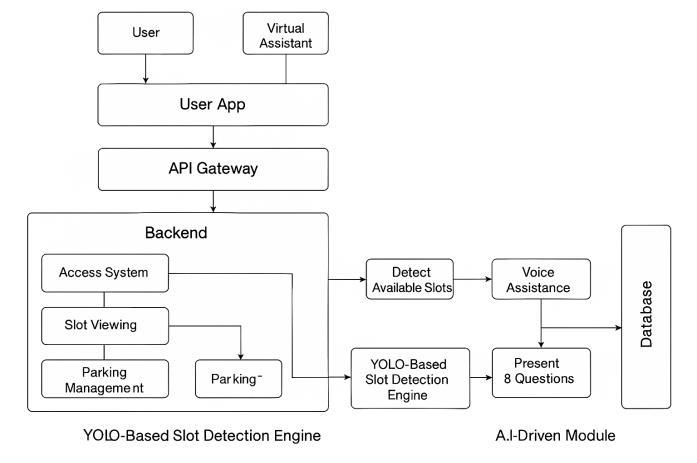
Adynamicpricingisimplementedtooptimizeparkingslot allocation based on demand and supply. The pricing mechanism considers factors such as the time of the day (peakvs.non-peakhours),durationofparking,availability of parking slots, and special events in the vicinity [11]. Usingmachinelearningmodelsandstatisticalanalysis,the system adjusts parking rates dynamically, ensuring fair pricing while also maximizing revenue. As described in Figure1,thissystemisintegrated withothercomponents toenableseamlesspricingoptimization[14].
The system provides a web and mobile-based application that allows users to view real-time parking slot availability, reserve slots in advance, make secure payments via blockchain transactions, and receive notificationsabouttheirparkingstatus[14].Thefrontend
is built using React.js to offer a seamless user experience, while the backend leverages Next.js for efficient serverside rendering and API management [7]. The system is designed to be intuitive, allowing for quick booking and reliable real-time updates on parking space availability, which is essential for enhancing user satisfaction and overallsystemeffectiveness[1].
Thesystemintegratesbothrelationalandnon-relational databases to manage data efficiently. PostgreSQL is used for structured data storage, including user information andbookingdetails,whileMongoDBhandlesunstructured data suchaslogsandanalytics [8].ensuringthat parkingrelated data remains accessible and immutable. These technologies ensure that the system can manage large amounts of data while maintaining flexibility and scalability[14].
To protect user data and ensure secure transactions, the system employs AES encryption for sensitive data storage,SSL/TLSprotocolsforsecurecommunication,and role-based access control (RBAC) for managing administrative privileges [11]. By utilizing these security features, the system ensures that user information and transactiondataareprotectedfrompotentialbreaches[8].
The system undergoes rigorous testing using Ganache for blockchain contract simulation, Jest for frontend testing, and Postman for API validation [14]. Deployment ismanagedthroughDockercontainersandKubernetesfor orchestration, ensuring high availability and fault tolerance [7]. This methodology ensures a robust, secure, and scalable smart parking system, revolutionizing the wayurbanparkingismanaged.
4.1
The system consists of several interconnected components that work together to enable real-time parking space detection, dynamic pricing, and seamless user interaction. It integrates a YOLO-based object detection model for identifying available parking slots from CCTV footage [1], a cloud-based backend for processing and storing data [14], and a user-friendly mobile/webinterfaceforslotbooking[7].
4.2
The system includes a CCTV camera feed that captures real-time footage of the parking area to monitor vehicle
International Research Journal of Engineering and Technology (IRJET) e-ISSN:2395-0056
Volume: 12 Issue: 05 | May 2025 www.irjet.net p-ISSN:2395-0072
movements and vacant slots [8]. A preprocessing module enhances the captured video by applying noise reduction and frame extraction techniques before model inference [7]. A YOLO-based detection model, trained to detect vehicles and classify parking slots as occupied or vacant, powers the core of the system [1]. The cloud backend stores and processes parking slot data, enabling seamless integration between the detection model and the user application [11]. As seen in Figure 1, the backend and frontend are designed to ensure smooth data flow and interaction[14].
4.3PARKING
The system continuously extracts frames from the CCTV feed to analyze parking occupancy in real time [6]. Each extracted frame is processed through the YOLO model, whichdetectsvehiclesanddeterminesslotavailability[1]. The processed results are then transmitted to the cloud backend[11].Thisintegrationallowsforefficienttracking and updating of parking slot occupancy, providing accurate and up-to-date information to both users and administrators[2].
Users log in through the web or mobile application to access the booking system [7]. They can view available parkingslots on a map in real timeandselecta preferred space [8]. Once a slot is selected, the system temporarily locksituntilthepaymentiscompleted,ensuringasmooth andsecurereservationprocess[14].
Thedynamicpricingmoduleadjustsparkingfeesbasedon demand, time, and location to ensure fair and optimized pricing. Users complete their transactions through a secure, integrated digital payment gateway. Once the payment is confirmed, an automated e-receipt is generated and sent to the user via email or directly throughtheapp.
Smart Park AI transforms urban parking management by integrating cutting-edge technologies such as real-time vehicledetectionusingYOLO,dynamicpricingalgorithms, and a user-friendly slot booking system. The YOLO-based objectdetectionmodeliscrucialforaccuratelyidentifying vehicles from CCTV footage, providing real-time updates on parking space availability. This helps reduce congestion,optimizeparkingspaceutilization,andensure a smoother parking experience for users, ultimately improvingtheoverallflowoftrafficinurbanareas.
The dynamic pricing algorithm is another key feature, enabling parking rates to adjust based on several factors, includingdemandandsupply,thetimeofday(peakvs.offpeak hours), parking duration, and events happening nearby. This approach ensures that parking pricing is fair and reflects real-time conditions, while also maximizing revenue and minimizing parking shortages during busy times. The system employs machine learning techniques to predict parking demand, allowing it to adjust prices accordinglyandefficientlymanageurbanparking.
The slot booking system further enhances user convenience, allowing users to reserve parking spots in advance via a web or mobile application. This eliminates the need for users to spend time searching for available parking, guaranteeing a spot when they arrive. The integration of blockchain technology for secure payments ensures that transactions are transparent, tamper-proof, and recorded in an immutable ledger, providing a secure and trustworthy transaction environment. Additionally, AES-256 encryption with a 256-bit key is employed to protect sensitive user data during both storage and transmission, ensuring the highest level of data security andprivacy.
SmartParkAIalsoutilizesLicensePlateRecognition(LPR) for automated vehicle entry and exit, ensuring that only authorizedvehiclesaregrantedaccesstoreservedparking spots.Thisfeaturereducesfraudandimprovessecurity,as only registered license plates can gain entry to specific spaces. The system’s backend architecture, built using bothPostgreSQLforstructureddatastorageandMongoDB for handling unstructured data like logs and analytics, ensures high scalability, flexibility, and efficient data managementasthesystemgrows.
Additionally, the cloud-based infrastructure allows Smart Park AI to handle large volumes of data while ensuring that data is processed in real-time. This ensures that parkingavailabilityisalwaysup-to-date,offeringusersthe best possible experience when searching for and booking parking spaces. The system’s flexibility supports the addition of future enhancements and integrations, ensuringlong-termscalability.
International Research Journal of Engineering and Technology (IRJET) e-ISSN:2395-0056
Volume: 12 Issue: 05 | May 2025 www.irjet.net p-ISSN:2395-0072
In conclusion, Smart Park AI’s seamless integration of AIdriven detection, dynamic pricing, blockchain-based payments, and secure booking mechanisms provides a comprehensivesolutiontourbanparkingmanagement.By optimizing parking space utilization, improving efficiency, andofferingauser-friendly,secureexperience,SmartPark AI is set to revolutionize the way parking is managed in modern cities, making it an essential tool for addressing thegrowingdemandforparkinginurbanareas.
In the development of Smart Park AI, several models and techniques were used to ensure the system's efficiency andaccuracy.Thecoreof theparkingspacedetectionlies intheYOLO(YouOnlyLookOnce)model,adeeplearningbased object detection framework. YOLO is known for its real-timeobjectdetectioncapabilities,enablingthesystem to identify vehicles and vacant parking slots from CCTV footage accurately. YOLO processes individual frames captured by CCTV cameras and uses a convolutional neuralnetworktodetectandclassifyobjects.Theformula forYOLOmodelinferenceinvolves:
P(Class∣Object)=σ(WX+b)
WherePrepresentstheprobabilityoftheclass,σ\sigmaσ is the sigmoid activation function, W and bbb are weights and biases, and X is the feature map obtained from the inputimage.
Thedynamicpricingalgorithmadjustsparkingfeesbased on demand and supply. The formula used for dynamic pricingis:

Wherethe"BasePrice"istheinitialrate,"DemandFactor" and "Supply Factor" represent the demand and supply rates, and "Base Supply" is the baseline level of available parkingslots.
For security, License Plate Recognition (LPR) is used to validate bookings. The formula to match license plates from the image and database involves Optical Character Recognition(OCR)andcomparingstrings:
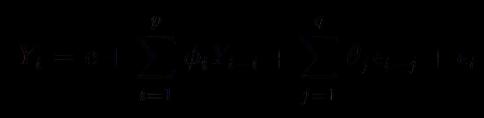
Where Yt is the predicted value at time ttt, ϕ and θ are coefficients,andϵistheerrorterm.
Overall, the integration of these models and formulas in SmarkPark AI has led to improved parking space utilization, dynamic pricing, and a user-friendly experience,helpingreducecongestionandmakingparking moreefficient.
InthecontextofSMARTPARKAI,selectingtherightobject detectionmodeliscrucialforachievingreal-time,efficient parking slot detection. The comparison table highlights that YOLOv8 stands out as the best choice, offering the highestspeed(95FPS)andexcellentaccuracy(96%)with low complexity and hardware demands [1]. This makes it ideal for processing live CCTV feeds quickly and accurately, ensuring drivers receive up-to-date parking availability information. YOLOv5, with its lightweight architectureandgoodperformance,couldalsobesuitable for mobile or cloud-based extensions of SMARTPARK AI [2]. In contrast, models like Faster R-CNN, while highly accurate, have lower speeds and higher hardware requirements, making them less practical for real-time parkingmanagementsystems[3].Forsegmentationtasks, suchasdistinguishingbetweenparkinglanesandslots,UNet or DeepLab v3+ could be used; however, given their higher complexity and slower speed, they would be more appropriate for offline analysis rather than live applications[4][5].
The system's predictive analytics model is built using historical data and traffic patterns, using time-series forecasting methods like ARIMA (AutoRegressive Integrated Moving Average) for predicting parking demand:
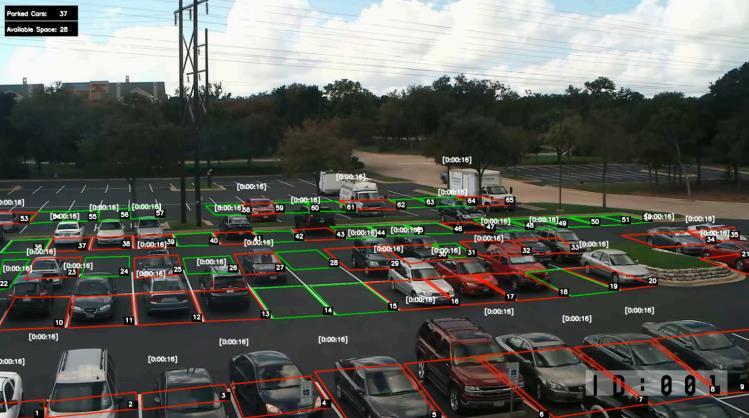
Theimageaboveshowsaliveparkinglotbeingmonitored using the YOLOv5 object detection model. Each parking slot is outlined and color-coded green for available and red for occupied. YOLOv8 accurately detects parked cars and vacant spaces, even in complex scenes. The system also displays real-time statistics such as the number of parkedcars(37)andavailablespaces(28),showcasingits utilityinsmartparkingmanagement.
International Research Journal of Engineering and Technology (IRJET) e-ISSN:2395-0056
Volume: 12 Issue: 05 | May 2025 www.irjet.net p-ISSN:2395-0072
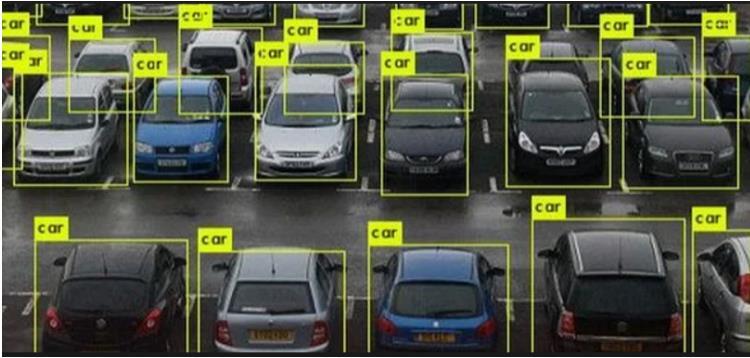
R-CNN models work by first proposing potential regions whereobjectsmightexistandthenclassifyingeachregion individually.Inthecontextofsmartparking,R-CNNcanbe used to detect vehicles by scanning static images of parkinglots,thoughitisslowercomparedtoYOLO.While accurate, R-CNN’s two-step process (region proposal + classification) leads to higher computational load and latency,makingitmoresuitableforofflineanalysisrather thanreal-timemonitoring.
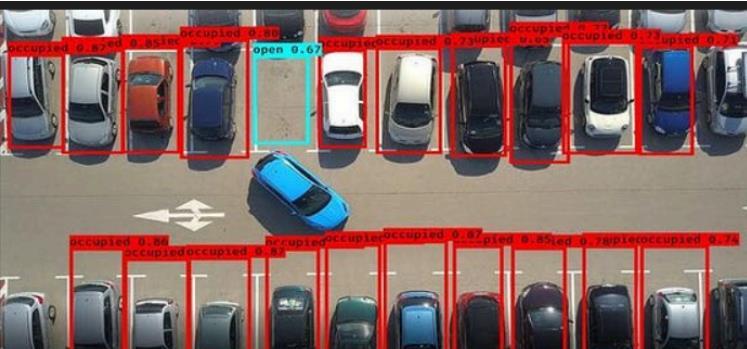
This image illustrates the use of DeepLabV3+, a semantic segmentation model, to identify parking slot status (occupied/open). Unlike object detection models like YOLO or R-CNN, DeepLabV3+ labels each pixel in the image, making it highly precise for segmenting and classifying individual parking spaces. The model assigns confidence scores to each slot, with red boxes for "occupied"andacyanboxfor"open"space.Thisapproach enhancesaccuracyinsmartparkingsystemsbyproviding afine-grainedanalysisofslotavailability.
YOLOv8 was chosen for our smart parking system due to its exceptional speed and accuracy in real-time object detection. Unlike traditional models, YOLOv8 can detect multiplevehiclessimultaneously,evenincrowdedparking lots, with high precision. Its lightweight architecture allows it to run efficiently on modest hardware without compromising performance. This makes it ideal for scalable deployment in real-world environments. Additionally,YOLOv8’seasyintegrationwithcamerafeeds and backend systems ensures seamless processing and monitoring. Its robust detection capabilities and low latency make it the best fit for automating parking slot
detectionandenhancinguserexperienceinsmartparking solutions.
While the current version of the smart parking system effectively fulfills its foundational objectives such as real-timevehicledetectionandslotavailabilitymonitoring there remains significant potential for future enhancements to improve its scalability, efficiency, and userconvenience.
One promising direction is the integration of predictive analytics using machine learning. By analyzing historical parking data, traffic flow, and peak usage times, the system can forecast future slot availability. This would allow users to plan their parking in advance, reducing congestion and idle search time. It would also help administrators optimize slot allocation during highdemandperiods.
To promote sustainable mobility, the system could incorporate support for Electric Vehicle (EV) charging stations. Users could not only check parking availability butalsoviewandreserveEVchargingpoints,encouraging eco-friendly transportation and improving the system’s valueformodernurbanneeds.
Furthermore, integration with smart traffic signals would allow real-time updates on parking demand, enabling more dynamic slot assignment and reducing bottlenecksatparkingentries.Enhancinguserexperience through Augmented Reality (AR) is another innovative step AR can provide visual cues through smartphone cameras, guiding drivers to vacant slots efficiently within largeorcomplexparkinglots.
From a security perspective, implementing blockchain technology can enhance trust and transparency in the system. Blockchain-based smart contracts can automate payments, secure user credentials, and log reservations, reducingtheriskoffraudordatatampering.
In conclusion, these enhancements not only increase the system’s utility but also align it with the future of intelligent urban infrastructure, making it more robust, user-friendly,andenvironmentallysustainable.
[1] Smart Park – An Intelligent Parking Management System,"ResearchGate,December2024.
[2] "AI and IoT-Enabled Automated Parking System for UrbanEfficiency,"ResearchGate,February2025.
[3] "A Smart Parking System Combining IoT and AI to AddressImproperParking,"IJITS,December2024.
International Research Journal of Engineering and Technology (IRJET) e-ISSN:2395-0056
Volume: 12 Issue: 05 | May 2025 www.irjet.net p-ISSN:2395-0072
[4] "AI-Driven Smart Parking Systems," ResearchGate, February2025.
[5] "Smart Parking Management System Using AI," ResearchGate,January2022.
[6] Gustavo P. C. P. da Luz, Gabriel Massuyoshi Sato, Luis Fernando Gomez Gonzalez, and Juliana Freitag Borin, "Smart Parking with Pixel-Wise ROI Selection for Vehicle Detection Using YOLOv8, YOLOv9, YOLOv10, andYOLOv11,"arXiv,December2024.
[7] Debaditya Acharya, Weilin Yan, and Kourosh Khoshelham, "Real-Time Image-Based Parking Occupancy Detection Using Deep Learning," Webology,2018.
[8] Hamed Al-Kharusi and Ibrahim Al-Bahadly, "IntelligentCarParkingManagementSystemBasedon ImageProcessing,"SCIRP,2014.
[9] M. Patil and V. Patil, "Smart Parking Systems: Comprehensive Review Based on Various Aspects," ScienceDirect,2021.
[10] "AI-PoweredParkingManagementSystems:AReview ofRecentDevelopments,"EKBJournals,2024.
[11] Michael M. Arrow and James J., "AI-Powered Smart Parking Management: Optimizing Allocation and Pricing,"ACMDigitalLibrary,2025.
[12] Abdelrahman Osman Elfaki, Wassim Messoudi, Anas Bushnag, Shakour Abuzneid, and Tareq Alhmiedat, "A Smart Real-Time Parking Control and Monitoring System,"MDPISensorsJournal,December2023.
[13] Yoones Rezaei, Stephen Lee, and Daniel Mosse, "Energy-Efficient Parking Analytics System Using Deep Reinforcement Learning," arXiv:2202.08973, February2022.
[14] Rania Djehaiche, Salih Aidel, Ahmad Sawalmeh, Nasir Saeed, and Ali H. Alenezi, "Adaptive Control of IoT/M2M Devices in Smart Buildings Using Heterogeneous Wireless Networks," arXiv:2302.13343,February2023.
[15] Walaa H. Elashmawi, Ahmad Akram, Mohammed Yasser,MennaHisham,ManarMohammed,NohaIhab, and Ahmed Ali, "IoT Based Smart Parking System Using Ensemble Learning," Intelligent Automation & SoftComputing,March2023.
[16] Tuan T. Nguyen and Mina Sartipi, "Smart Camera Parking System With Auto Parking Spot Detection," arXiv:2407.05469,July2024.
[17] S. Siva Shankar, S. Srinivas, Sarangam Kodati, Kondalarao Punati, P. Purushotham, Koppuravuri GurnadhaGupta,G.Manikandan,Y.J.NagendraKumar, and Amit Dutt, "IoT-based Parking Surveillance Scheme: Emerging a Smart, Effective, and Secured Solution for Urban Parking Management and Performance Improvement," MATEC Web of Conferences,March2024.
[18] Dhiraj Neupane, Aashish Bhattarai, Sunil Aryal, Mohamed Reda Bouadjenek, Uk-Min Seok, and Jongwon Seok, "SHINE: Deep Learning-Based Accessible Parking Management System," arXiv:2302.00837,February2023.
[19] Rani Astya, Soni Jain, Sukriti Sachan, and Aish Aggarwal, "A Review on Smart Car Parking System," Global Journals of Research in Engineering, April 2022.
[20] Vesna Knights, Olivera Petrovska, and Marija Prchkovska, "Enhancing Smart Parking Management through Machine Learning and AI Integration in IoT Environments,"IntechOpen,August2024.
[21] SumitDasandR.Kayalvihzi,"AdvancedMultiLocation IoTEnabledSmartCarParkingSystemwithIntelligent Face Recognition," International Journal of Research in Engineering, Science and Management, January 2024.