
International Research Journal of Engineering and Technology (IRJET) e-ISSN: 2395-0056
Volume: 12 Issue: 06 | Jun 2025 www.irjet.net p-ISSN: 2395-0072
International Research Journal of Engineering and Technology (IRJET) e-ISSN: 2395-0056
Volume: 12 Issue: 06 | Jun 2025 www.irjet.net p-ISSN: 2395-0072
Anirban Banerjee1 , Ritam Paul2 , Rudrajit Saha Roy3, Debraj Banik4, Sarbik Kumar Sinha5 , Manabendra Maiti6
1, 2, 3, 4, 5 B.Tech Student, Dept. of Electronics & Communication Engineering, Techno International New Town, Kolkata, West Bengal, India
6 Assistant Professor, Dept. of Electronics & Communication Engineering, Techno International New Town, Kolkata, West Bengal, India
Abstract – This research presents the design and development of Smart Water Level Monitoring and Motor Pump Controlling Systemaimedat preventing water wastage andautomatingpump operation in water tanks. Thesystemis implemented using two approaches: one based on Arduino Uno and another using NodeMCU with IoT integration. Both systems utilize an ultrasonic sensor to measure water level and a relay module to control the pump. In the Arduino based system, realtime water level displays onthe 16×2 LCDandthe pump is automaticallyonor offbasedonpredefinedthreshold values, ensuring the efficient water usage without manual interference. The NodeMCU based system enhances the solution by integrating with the Blynk IoT platform, allowing users to monitor water level and control the pump remotely through a smartphone application. It also displays the water level locallyusingLCD andsends alertsviatheBlynkappwhen critical levels are reached. This project provides sustainable water management by reducing water wastage, providing user convenience and enabling both remote and local access.
Key Words: Smart Water Monitoring, Automatic Pump Control, Ultrasonic Sensor, Arduino Uno, NodeMCU, IoTbased Water Management
Waterisoneofthemostimportant,valuableandessential natural resources. Its efficient management is complex in bothurbanandruralareas.Inhouse,agriculturalsectorand other sectors, water is stored in tanks and monitored manuallythatleadstooverflow,wastageandinconvenience. Moreover,forgettoturnoffthepumpafterthetankisfullor fail to switch on when the water level is low that leads to resource loss as well as component damage. To overcome these issues, the real-time monitoring technologies have emergedaspracticalsolutions.
ThispaperpresentsthedevelopmentofaSmartWater Level Monitoring and Motor Pump Controlling System implementedusingtwodifferentmicrocontrollerplatforms: ArduinoUnoandNodeMCU(ESP8266).Thefirstsystemis built using Arduino Uno, an ultrasonic sensor, a 1 channel
relay module and a 16×2 LCD to provide a low-cost, standaloneandautomaticpumpcontrolsolution.Thesecond systemisbuiltusingNodeMCU,enablingIoTbasedremote monitoring and controlling through the Blynk application. This allows users to view the current water level, receive alertsandcontrol themotorpumpbyusinga smartphone withinternetconnectionandBlynk.
Theultrasonicsensorensurestheaccuratemeasurement ofwaterlevels,whiletherelaymoduleactsasanelectrical switchtooperatethepumpautomaticallybasedonthewater level of the tank. The LCD provides the real time data for locallyobservations.TheBlynkplatformaddsrealtimedata visualization, remote control features and user-defined thresholdsforalertnotifications.TheadvantageofthisBlynk platformisonlyaccessibleinNodeMCUbasedsystem.
The proposed systems can be applied in households, apartments,farmsandindustriestoconservewater,reduce human efforts and improve reliability in water supply management.
Asystemmadewithanultrasonicsensortomonitorthe tankwaterlevel,processedbyNodeMCU[1],whileawater levelsensorchecksthesump.DataissenttoBlynkIoTfor remotemonitoring.Thesystemreplenishesthetankwhen waterislowandstopspumpingwhenfull.Notificationsalert usersoftankstatus,powerfailures,andallowmanualpump control.Thestudydemonstratedthesystemeffectivenessof wirelessIoTbasedwaterlevelmonitoringandcontrolling system.
Asystemisdesignedasmartirrigationandwaterlevel detectionsystem[2]usinganultrasonicsensorandArduino Uno. The system monitored tank water levels and automaticallyinitiatedirrigationwhenlevelsweresufficient. Theirresearchemphasizedtheimportanceofsuchsystems in optimizing water usage in agriculture, specifically in drought-proneregions.
International Research Journal of Engineering and Technology (IRJET) e-ISSN: 2395-0056
Volume: 12 Issue: 06 | Jun 2025 www.irjet.net p-ISSN: 2395-0072
A system is developed a water level monitoring and controlsystem[3]usinganHC-SR04ultrasonicsensorand Arduino Uno. The system continuously measured water levelsinatankanddisplayedreal-timedataonanLCD.The authorshighlightedthesystem’seffectivenessinpreventing overflowandmaintainingefficientwaterusage.Thestudy demonstratedhighaccuracyandacost-effectivedesignfor residentialandagriculturaluse.
A system is designed for automated water level monitoringandmotorcontrol[4]usinganultrasonicsensor, relayandmicrocontroller.Thesystemautomaticallyturned on/offthepumpbasedonpredefinedwaterlevelthreshold values, reducing the need for manual inference. Their research emphasized the importance of automation in conservationofbothelectricityandwater.
The system comprises three overhead tanks, each contains with a water level sensor, controller and IoT module[5].Whentank1’ssensordetectsalowwaterlevel, it wirelessly sends signals to the underground tank. The underground tank’s sensor checks its water level; if sufficient,itactivatesthetank1’ssolenoidvalve.Subsequent tanksarefilledintheorderoftheirlowlevels,ensuringthat once a tank reaches 50% capacity, the next tank is prioritizeduntilallarefilledasneeded.
A system is developed for water level monitoring [6] using an ultrasonic sensor, relay and microcontroller. Dependingonthewaterlevelinthetank,thepumpturnsON whenthewaterlevelgoesbelowapredefinedlevelandthe pump turns OFF when the tank is full. Displays the water levelandotherimportantdataona7-SegmentDisplay.Their research emphasized the saving of electricity, water and time.
A system is implemented an IoT-based smart water monitoring system [7] using the NodeMCU ESP8266, an ultrasonicsensorandBlynkmobileapplication.Thesystem provided real-time water level updates and remote pump control. Their approach showcased energy-efficient monitoringwithuser-friendlymobileintegration,makingit idealforhouseholduse.
AproposedsystemisdesignedforIoTBasedWaterLevel Monitoring&ControllingSystem[8]UsingArduinoUno,an ultrasonic sensor, relay, LCD and buzzer. The system continuouslymeasuredthewaterlevelsanddisplayedrealtimedataonanLCD.Ifthewaterlevelsreachedthethreshold valuesitalertstheuserbybuzzer.Whenthewaterlevelis lowitsendscontrolsignalstostartthepumpandwhenitis fullitsendssignalstostopanddisplays‘Engine’and‘ENGINE OFF’ respectively. Their research emphasized the water saving.
Thisprojectworkinvolvesthedesignandimplementsthe prototypesoftwosystemsi.e.ArduinoUnomicrocontrollerbasedsystemandNodeMCUbasedIoTenabledsystemusing the Blynk platform to monitor the waterlevel in a tank or storageandcontrolasubmersiblemotorpumpautomatically andremotely.
ArduinoUNOcollectsandprocessesthesensordataand determinesifthewaterlevelhasreachedathresholdvalue for pump activation or deactivation. The Arduino UNO transmits the water level data to 16×2 LCD for locally observation. This part focuses on developing a low-cost standalonesystemforautomaticwaterlevelmonitoringand pumpcontrol.
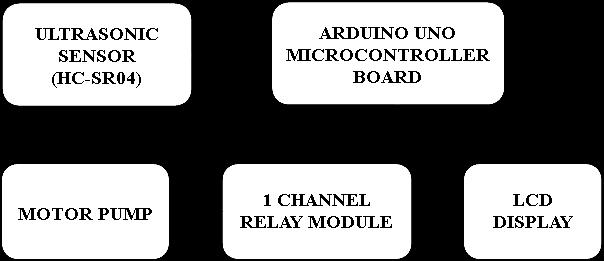
Fig- 1: BlockDiagramofArduinoBasedSystem
Arduino Uno: Actsasthecentralcontroller,readingdata from the ultrasonic sensor and processing it to determinethewaterlevel.Thenitusesthisinformation tosendacontrolsignaltotherelay,suchasactivatingor deactivating the pump and send a signal to the lcd to displaythewaterlevelinformofpercentageonit.
Ultrasonic Sensor:Emitssoundwavesandmeasuringthe time it takes for the echo to return, which is directly proportional to the distance to the water surface. The equationforcalculatingthedistanceis:

16×2 LCD: TheLCDservesasavisualinterfacetoshow thecurrentwaterlevel.Itdisplaysthewaterlevelinrealtime,enablinguserstomonitorthetank’sstatus.
Relay Module: The relay moduleacts as an electrical switch and controls the motor pump based the water level.
TheNodeMCUESP8266transmitsthewaterleveldatato anBlynkIoTplatformusingin-buildWi-Fimodule,enabling
International Research Journal of Engineering and Technology (IRJET) e-ISSN: 2395-0056
Volume: 12 Issue: 06 | Jun 2025 www.irjet.net p-ISSN: 2395-0072
local and remote access to water level readings through a 16×2 LCD and Blynk IoT mobile app. The platform allows users to monitor tank levels in real time, receive alert notificationswhencriticallevelsarereachedandcontrolthe pumpremotely.
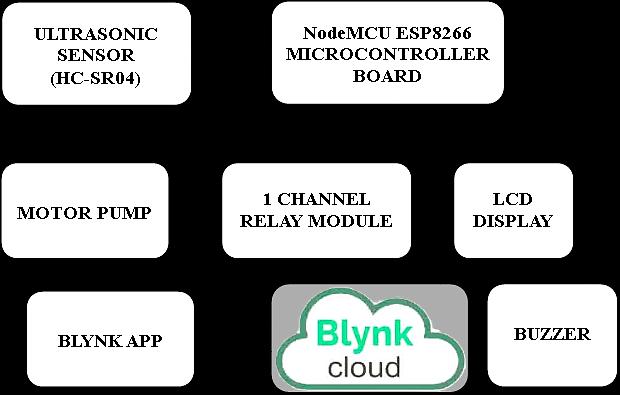
Fig- 2: BlockDiagramofNodeMCUBasedSystem
NodeMCU ESP8266: The NodeMCU acts as the central processingunit,responsibleforcollectingsensordata, processingitandcommunicatingwiththeBlynkappfor remote monitoring and control.The NodeMCU also controls the water pump via a relay module based on pre-defined waterlevel thresholdvalues. Italsosends thewaterleveldatatotheLCDforlocallyobservation.
Ultrasonic Sensor:Emitssoundwavesandmeasuringthe time it takes for the echo to return, which is directly proportional to the distance to the water surface. The equationforcalculatingthedistanceis:
16×2 LCD: TheLCDservesasavisualinterfacetoshow thecurrentwaterlevel.Itdisplaysthewaterlevelinrealtime,enablinguserstomonitorthetank’sstatus.
Relay Module: The relay moduleacts as an electrical switch and controls the motor pump based the water level.
Blynk App: TheBlynkappactsastheuserinterfaceand controlhub,allowinguserstoremotelymonitorwater levels, adjust pump activation or deactivation and receivealertnotificationswhenthewaterlevelreached pre-defined thresholdvalues.It enables real-time data visualizationandcontrol,makingitacrucialcomponent forefficientwatermanagement.
Buzzer: acts as an alert mechanism, signalling when a waterlevelispre-definedloworhighvalueisdetected.
4.1
The Smart Water Level Monitoring and Motor Pump ControllingSystemwassuccessfullyimplementedandtested intwoconfigurations:
1. StandaloneSystemusingArduinoUno
2. IoT Based System using NodeMCU ESP8266 and Blynk
Boththesystemworksaccuratelyandreliablyandmonitors the water level using ultrasonic sensor and controls the motorpumpthroughrelaymoduleperfectly.
Theultrasonicsensoraccuratelymeasuredthedistance betweenthesensorandthewatersurface.
Themotorpumpwasautomaticallyswitchedonwhenthe water level fell down below or equal to 25% and switchedoffaboveorequalto90%.
The calculated water level in form of percentage was correctlydisplayedontheLCD.
Thesystemresponsetimeisfastandefficientlyworksin real-time.
TheexperimentalsetupofthissystemisshownintheFig 3.
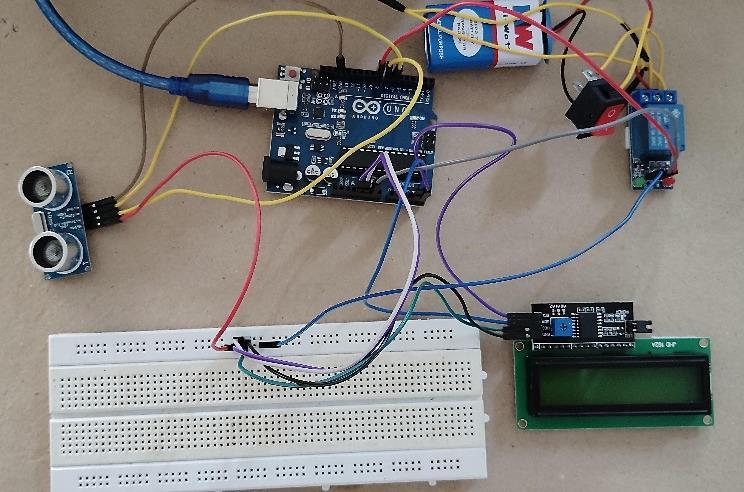
Fig -3: ExperimentalsetupofArduinoBasedSystem
International Research Journal of Engineering and Technology (IRJET) e-ISSN: 2395-0056
Volume: 12 Issue: 06 | Jun 2025 www.irjet.net p-ISSN: 2395-0072
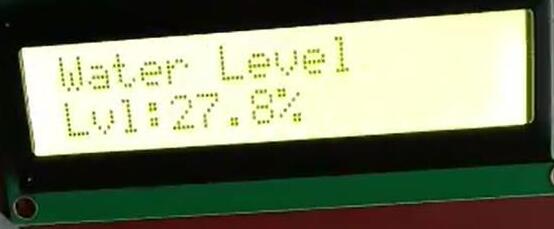
The Fig 4 illustrated that the water level in the tank is displayingonthe16×2LCD.Therealtimedataisdisplayed.
Theultrasonicsensoraccuratelymeasuredthedistance betweenthesensorandthewatersurface.Thesensor readingsupdatedapproximatelyineveryseconds.
Thesystemalertstheuserwhenthewaterlevelreached atbeloworequalsto25%andaboveorequalsto85%by buzzer(if it is turns on throughBlynk app)and Blynk notifications.
The calculated water level in form of percentage was correctlydisplayedontheLCDandtheBlynkapp.
The system is totally depended on Wi-Fi or internet connectionsfortheIoTfeatures.Iftheconnectivityloss onlytheLCDcontinueddisplayingvalues.
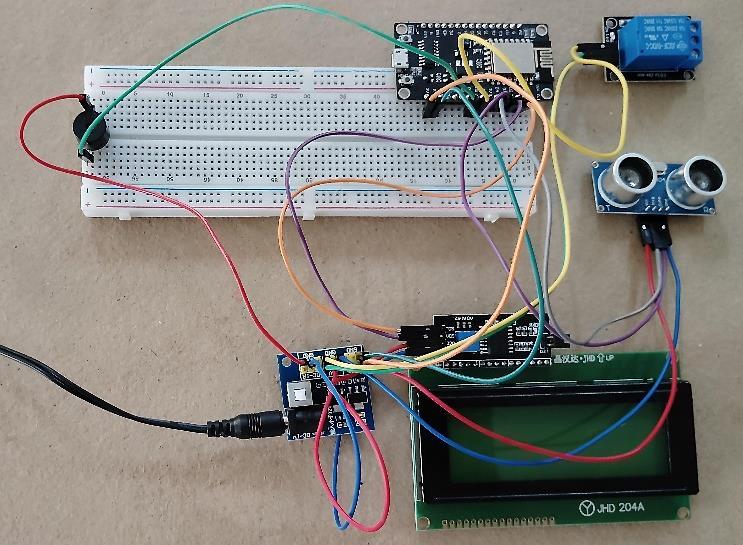
TheFig5illustratedthattheexperimentalsetupofthis system.
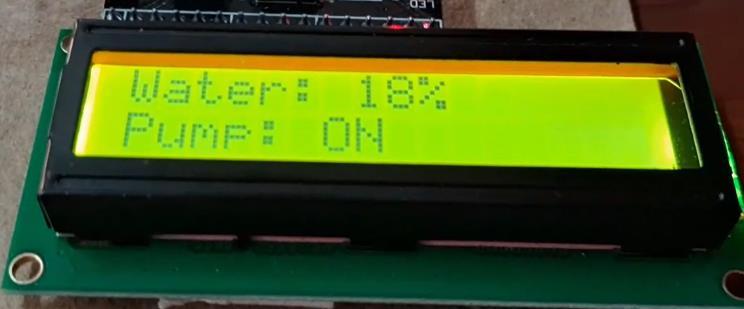
The Fig 6 illustrated that the water level in the tank is displayingonthe16×2LCD.Therealtimedataisdisplayed andthepumpstatusi.e.ONorOFF.
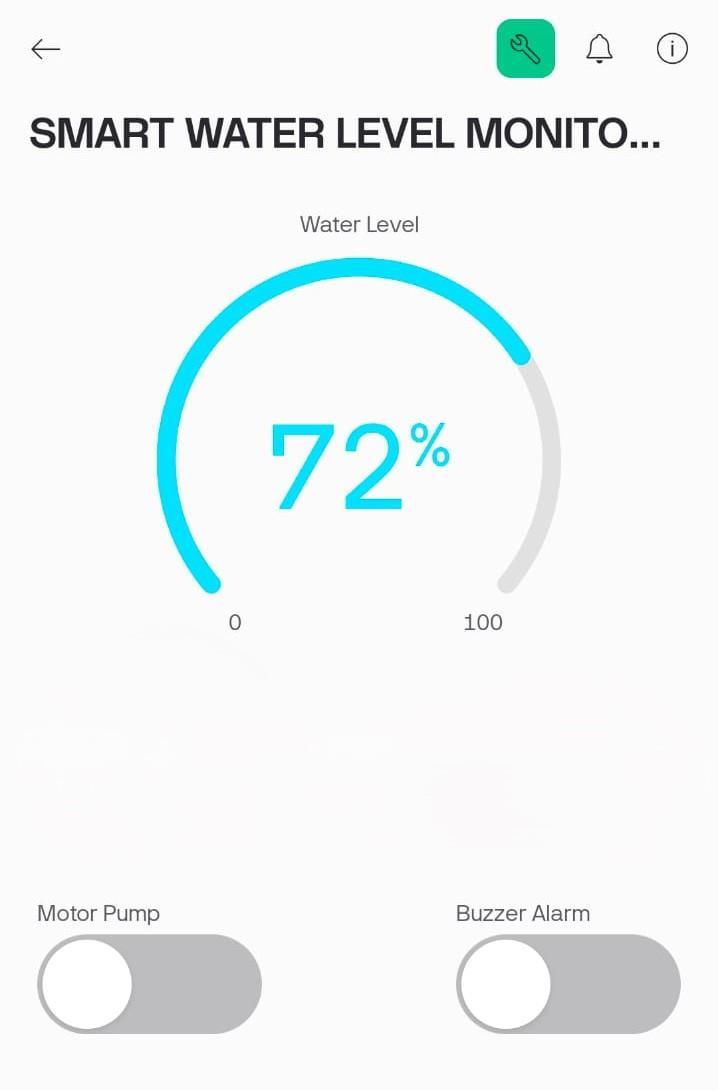
Thebelowfigure(Fig7)illustratedtheBlynkdashboard foroperatingthesystem.ItisthemobiledashboardofBlynk Application Hereweusedgaugefordisplayingtherealtime water level and two buttons for ON/OFF the motor pump andenable/disablethebuzzeralarm.IftheNodeMCUaccess the internet and communication established between the BlynkandNodeMCUthentheBlynkwilloperatethesystem remotely.Lastly,withoutinternetconnectionBlynkwillnot doanyoperations
Volume: 12 Issue: 06 | Jun 2025 www.irjet.net p-ISSN: 2395-0072
Table -1: StatusofwaterlevelbasedontheBlynkApp
Sl.
1 Online On WaterLevelstarts increasing
2 Online Off WaterLevelstops increasing
3 Offline Notworks Notworks
TheTable-1demonstratethestatusofwaterlevelinthe water tank based on the Blynk App. When the Blynk App ensurethatthedeviceisonline,onlythedeviceiscontrolled throughBlynkAppotherwiseitwillnotwork.Wheneverthe userturnsONthepumpswitchontheBlynkApp,thewater level starts increasing and when the user turns OFF the pump,itwillstopincreasing.
Table -2: WorkingofBuzzerAlert
Sl. No. Device Status Buzzer Switch Status Water Level Alerts to the User
1 Online On >85% Yes
2 Online On <25% Yes
3 Online Off >85%or <25% No
TheTable-2demonstratetheworkingofbuzzeralert.If thebuzzerturnsON,itwillalerttheuserifthewaterlevel goesbelow25%andabove85%toawaretheuserthatturns ON the pump and turns OFF the pump respectively. If the buzzer turns OFF, it will doesn’t alert the user until and unlesstheuserturnsONthebuzzerswitchthroughBlynk App.
4.4 Comparative Analysis
Table -3: ComparativeAnalysisBetweenTwoSystem
The Table -3 demonstrate the comparative analysis between two system. The importance of both systems is equalbutNodeMCUbasedsystemhassomespecialfeature overtheArduinobasedsystem.
4.5 Discussion
Level Monitoring and Motor Pump Controlling. The Arduinobasedsystemissuitableforofflineoperationsand cost effective where remote access is not required. In contrast, NodeMCU based system is ideal for remote operationandalerts.Bothsystemsareusefulforsmarthome orindustrialsetup.
However, NodeMCU based system depended on Wi-Fi connectivity for accessing IoT features and could limit its effectivenessinruralorlowconnectivityareas.
Thisprojectsuccessfullydesignedandimplementedthe prototypeofSmartWaterLevelMonitoringandMotorPump Controlling using two different approaches–one with ArduinoUnoandanotheronewithNodeMCUandBlynkIoT platform.
TheArduinobasedsystemdemonstratedacosteffective and offline system, capable for automatic switching the motorpumponoroffbasedonthewaterlevel,withareal time LCD. This version is applicable in those areas where internetaccessislimitedornotrequired.
1 Local Water LevelDisplay Yes(LCD) Yes(LCD)
2 MobileApp Monitoring No Yes(Blynk)
3 RemoteMotor Control No Yes
4 Automatic
5
TheNodeMCUbasedsystemhassomeextrafunctionality overtheArduinobasedsystembyenablingIoTfeatures.It enables real time water level monitoring and controls the pumpthroughtheBlynkmobileapplication.Italertstheuser bysendingnotificationsorbuzzerforthepre-definedwater levelthresholdvalues.
Bothsystemsprovedthatthesearereliable,accurateand responsiveduringtesting.
The novelty of the project work is its side-by-side developmentandevaluationoftwowaterlevelmonitoring systems,onestandaloneandoneIoTenabledwithreal-time
International Research Journal of Engineering and Technology (IRJET) e-ISSN: 2395-0056
Volume: 12 Issue: 06 | Jun 2025 www.irjet.net p-ISSN: 2395-0072
monitoring, local and remote control, user alerts and a structured performance comparison. This dual approach designfillsagapincurrentliteraturewheretypicallyonly oneplatformisexploredperproject.
SincerethanksaregivenbytheauthorstotheDepartment of Electronics & Communication Engineering of Techno International New Town for providing the infrastructural supporttocontinuetheresearchwork.Wewishtothankall the faculty and technical staff members of the ECE Departmentfortheirco-operation.
[1] A Sharma A S, “Review on IoT Based Water Level Sensing and Controlling,” International Journal of Engineering Research & Technology (IJERT), vol. 9, issue 7,pp.1092–1094,2020
[2] P. K. Singh and R. Verma “Smart Irrigation and Water TankMonitoringUsingArduinoandUltrasonicSensor,” InternationalJournalofComputer Applications,vol.178, issue31,pp.19–23,2019.
[3] N.Patel,“SmartWaterLevelMonitoringSystemUsing ArduinoandUltrasonicSensor,” InternationalJournalof Innovative Research in Science, Engineering and Technology,vol.8,issue5,pp.4125–4129,2019
[4] S. Ramesh and M. Pavithra, “Automated Water Level MonitoringandPumpControlSystemUsingArduino,” International Journal of Engineering Trends and Technology (IJETT),vol.57,issue2,pp.67–70,2018.
[5] P.Mahale,S.PanseandP.Rajule“IoTBasedWaterLevel Monitoring System,” International Research Journal of Modernization in Engineering Technology and Science (IRJMETS),vol.4,issue3,pp.2262–2264,2022.
[6] V.S.Pawar,S.B.Kale,S.A.Patil,R.N.VhankadeandA.A. Bamnikar, “Water Level Monitoring System,” International Research Journal of Modernization in Engineering Technology and Science (IRJMETS), vol. 4, issue5,pp.3914–3918,2022.
[7] T.Pradeep,“IoTBasedWaterLevelMonitoringSystem Using NodeMCU and Ultrasonic Sensor,” Journal of EmergingTechnologies andInnovativeResearch(JETIR), vol.7,issue5,pp.156–162,2020.
[8] R.Rucha,ShastrakarandV.Sakinala,“IoTBasedWater Level Monitoring &ControllingSystemUsingArduino UnoESP8266Module,” InternationalResearchJournalof Modernization in Engineering Technology and Science (IRJMETS),vol.6,issue5,pp.9207–9211,2024.
[9] S.K.SharmaandA.Tiwari,“Low-CostAutomaticWater LevelMonitoringSystemUsingArduino,” International Journal of Scientific and Research Publications (IJSRP), vol.8,issue4,pp.222–225,2018.
[10] M. B. Kumar and H. Singh, “Solar Powered IoT-Based SmartWaterMonitoringSystem,” International Journal of Scientific & Engineering Research,vol.13,issue1,pp. 78–82,2022.
[11] N.B.Jape,A.B.Jape,P.S.Jape,I.N.Ajmera,D.U.Bhamre andR.M.Dhokane,“IOTBasedWaterLevelMonitoring &ControllingSystem,” International Journal of Creative Research Thoughts (IJCRT),vol.10,issue2,pp.725–728, 2022.
[12] A.R.Jadhav,“GSM-BasedWaterTankMonitoringSystem Using Ultrasonic Sensor,” International Journal of Research in Engineering, Science and Management (IJRESM),vol.4,issue2,pp.34–38,2021.
[13] V. B. Patil and A. M. Shaikh, “Review on Sensing Techniques for Water Level Monitoring Systems,” International Journal of Engineering Trends and Technology(IJETT),vol.8,issue2,pp.1096–1100,2021.
[14] M.A.Rahman,“Design ofa Smart WaterManagement System Using Ultrasonic Sensor and GSM Module,” International Journal of Scientific & Engineering Research,vol.8,issue10,pp.1231–1235,2017.
[15] K.S. Shilpa,“IoTBasedSmart WaterTank Monitoring SystemUsingUltrasonicSensor,” InternationalJournalof Engineering and Advanced Technology (IJEAT), vol. 9, issue6,pp.45–48,2020.
[16] A. Verma and S. Patel, “Integration of IoT for Efficient WaterResourceManagementinSmartCities,” Journalof Smart Systems andTechnologies,vol.9,issue2,pp.102–110,2022.
[17] P. Yadav, “Real-Time Water Level Monitoring System UsingIoTandCloudComputing,” International Journal of Innovative Science and Research Technology, vol. 7, issue5,pp.98–104,2023.
[18] R.KumarandA.Reddy,“SmartWaterTankAutomation System for Households and Agriculture,” Journal of Modern Engineering,vol.8,issue1,pp.29–36,2023.
[19] P. Singh, “Automation in Water Management Using ArduinoandSensors,” InternationalJournalofElectrical andElectronics Research,vol.6,issue2,pp.77–83,2023.
[20] F. Rahman, “IoT-Based Water Pump Controller: An EfficientWaytoPreventWaterWastage,” Journal of IoT Applications and Research, vol. 4, issue 3, pp. 56–64, 2022.
International Research Journal of Engineering and Technology (IRJET) e-ISSN: 2395-0056
Volume: 12 Issue: 06 | Jun 2025 www.irjet.net p-ISSN: 2395-0072
[21] R.GuptaandS.Yadav,“Design andImplementationof IoT-EnabledSmart WaterTank ManagementSystem,” InternationalJournalofAdvancedResearchinElectronics andCommunicationEngineering,vol.5,issue6,pp.123–128,2022.
[22] J. Smith, “A Low-Cost Approach to Water Tank Monitoring Using Arduino and IoT,” Journal of Sustainable Technologies, vol. 10, issue 4, pp. 34–41, 2023.
[23] R.Patel,“IoT-BasedWaterLevelMonitoringSystemfor SustainableWaterResourceManagement,” International Journal of Engineering Trends and Technology,vol.69, issue3,pp.85–90,2022.
[24] A. Kumar and N. Sharma, “Automation of Water Management System Using IoT,” Journal of Emerging Technologies andInnovative Research,vol.8,issue2,pp. 12–19,2023.
[25] K. Arunkumar, “Smart Water Level Monitoring and Pump Controlling System Using IoT,” International Journal of Advanced Research in Computer Science and Electronics Engineering,vol.7,issue5,pp.45–50,2023.