
International Research Journal of Engineering and Technology (IRJET) e-ISSN: 2395-0056
Volume: 12 Issue: 12 | Dec 2025 www.irjet.net p-ISSN: 2395-0072
International Research Journal of Engineering and Technology (IRJET) e-ISSN: 2395-0056
Volume: 12 Issue: 12 | Dec 2025 www.irjet.net p-ISSN: 2395-0072
Faisal Hussain1 , Prasenjit Mondal2 , Rashidul Alom3 , Rupam Halder4 , Tapas Kumar Nandi5
1, 2, 3,4 , Mechanical Engineering 4rd Year, Techno International New Town, Kolkata700156, India
5HOD Mechanical Engineering Department, Techno International New Town, Kolkata700156, India ---
Abstract- This paper's goal is to offer a solution that will ensure road safety for both drivers and pillion drivers. The bike will not start unless the rider is wearing a helmet in order to ensure that they do so. Additionally, the paper suggests that the driver wear a helmet and breathe cleanly. This system involves attaching the transmitter to the helmet and installing the appropriate receiver in the car. A helmet-mounted alcohol sensor is positioned near the driver's mouth to detect alcohol consumption, and a sensor verifies that the driver has correctly put on the helmet. Through a relay interface circuit, a microcontroller unit (MCU) regulates the ignition and the relay's operation. To increase road safety, this system ensures that the engine is turned off if the driver is not wearing a helmet or if the alcohol sensor picks up alcohol.
Key Words: Accident, Drunken Driving, Smart Helmet, Micro-Controller.
Road accidents remain a significant global concern, with a substantial number of incidents attributed to factors such as drunk driving and non-compliance with safety regulations. India, in particular, grapples with a disturbingly high numberof roadaccidentseachyear,asubstantialproportionofwhicharecausedbydriversoperatingundertheinfluenceofalcohol. Despite efforts by traffic authorities to enforce safety regulations, many individuals continue to disregard these rules, puttingtheirlivesandthelivesofothersatrisk.Inresponsetothispressingissue,wepresentan innovative solution: the "SmartHelmet."Thisintelligentsystemisdesignedtoautomaticallyverifywhetheramotorcyclistiswearingahelmetand if they are sober before allowing the vehicle's engine to start. By addressing these critical safety concerns, we aim to contribute to a reduction in road accidents, injuries, and fatalities caused by drunk driving and non- compliance with safetyregulations.
1.1 The issues addressed or faced along with our solutions are as follows:
•Drunk driving Epidemic: The prevalence of drunk driving on Indian roads is one of the main causes for concern. To detectalcoholuse,theSmartHelmethasanalcoholsensorbuiltinclosetothedriver'smouth.Theengineisnotallowedto startifalcoholisfound,loweringtheriskofaccidentsbroughtonbydrunkdriving.
•Helmet Non-Compliance: Despite widespread use-required helmet laws, compliance is still difficult to achieve. To addressthisproblem,webuiltasensorintothehelmetthatcheckstoseeiftherideriswearingthehelmet. Theengine won'tstartifthehelmetisn'tworn,whichencouragesriderstoputtheirsafetyfirst.
• Enforcement of Safety Regulations: Traditional enforcement strategies frequently fail to ensure that safety regulationsarefollowed. TheSmartHelmeteases theburden onlawenforcementagenciesbyofferinganautomatedand proactivemethodofenforcingsafetyregulations.
• Technology Integration: To transmit data between the helmet and the bike in a seamless and secure manner, the system uses radio frequency (RF) encoding and decoding. The ignition is controlled by an embedded microcontroller unit(MCU)viaarelay,whichgivesthevehicle'sstartupprocedureanextralayerofintelligence.
• Enhancing Road Safety: In the end, the Smart Helmet contributes to an ecosystem that improves road safety by preventing accidents caused by drunk driving and encouraging motorcycle riders to wear helmets. The likelihood of accidents brought on by negligence or human error is significantly decreased by the integration of technology and automation.
International Research Journal of Engineering and Technology (IRJET) e-ISSN: 2395-0056
Volume: 12 Issue: 12 | Dec 2025 www.irjet.net p-ISSN: 2395-0072
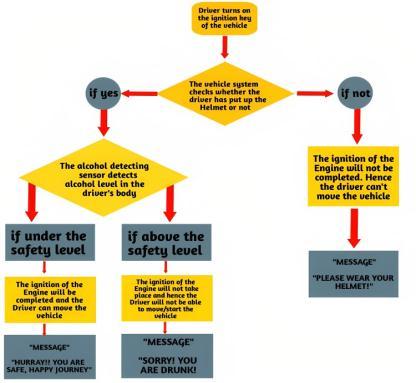
The "Helmet Unit" and the "Bike Unit" are the two separate sections of the entire project. As a result, each unit's functionality is governed by two distinct circuits, each of which is managed by an individual Arduino microcontroller. TheuseofRF(RadioFrequency)modules,whichenablewirelessdatatransmissionandreceptionbetweenthetwounits, facilitates communication between these two Arduinos. Powering the Units: The "Bike Unit" is powered by the bike's batterythroughadirectconnection.Asaresult,the "BikeUnit"turnsonautomaticallywhentheriderturnsontheignition keyofthebike.The"HelmetUnit",incontrast,reliesonanexternalbatteryasitspowersource. Theridermustwearthe helmet and fasten the strap tightly in order to turn on the "Helmet Unit" because these actions act as a switch. Initiating CommunicationorDataTransfer:Whenbothunitsareturnedon,aprocessof SerialCommunicationorData TransferbetweenthetwoArduino microcontrollersstartsthroughRFmodules.UsinganRFencoder,the Arduinoinside the"HelmetUnit"continuouslytransmitsdata,aspecificfrequencyofsignalissentwhethertheriderhaswornthehelmet appropriately and has a breath that is free of alcohol. The RF decoder within the RF module then allows the Arduino insidethe"BikeUnit"toreceivethisdataandworkaccordingly.
TheArduino microcontrollerisinchargeofcontrolling the relay switch, which isacrucial part of the"Bike Unit”. After receiving the data from the RF module, the Arduino in the "Bike Unit" keeps the relay switch in the OFF position, if it receives data indicating that the rider has not correctly fastened their helmets or is intoxicated. Ontheotherhand, the Arduinoactivatestherelayswitch,placingitintheONstate,whenitreceivesdataconfirmingthattheriderhassecurely fastenedthehelmetandisnotundertheinfluence of alcohol. Control of the ignition system: It is well known thattwowheeler engines are typically powered by internal combustion engines that make use of spark plugs. Uninterrupted electriccurrentflowisessentialtoproducea sparkinsidethesparkplug.Inthissituation,arelayswitchthattakescontrol of the engine's ignition system has been added to the spark plug circuit. Due to the spark plug's continued inactivity when the relay switch is in the OFF position, the engine is unable to start by cranking. In conclusion, the rider's smooth and safe journey is ensured by the relay switch activating and the engine performing flawlessly, only when the rider correctlyputsonthehelmetandnoalcoholisdetected.


International Research Journal of Engineering and Technology (IRJET) e-ISSN: 2395-0056
Volume: 12 Issue: 12 | Dec 2025 www.irjet.net p-ISSN: 2395-0072
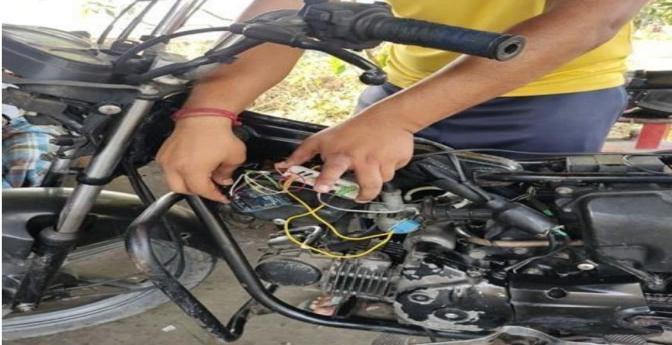
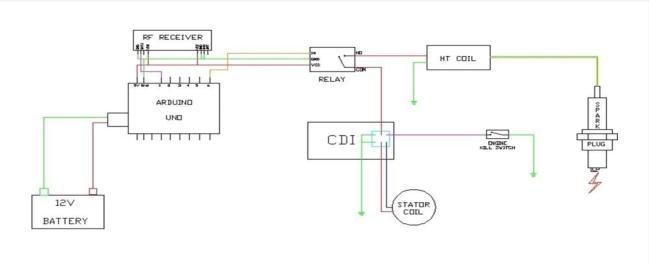
Control of the Relay Switch: The Arduino microcontroller is in charge of controlling the relay switch, which is a crucial partofthe"BikeUnit".AfterreceivingthedatafromtheRFmodule,theArduinointhe"BikeUnit"keepstherelayswitch intheOFFposition,ifitreceivesdataindicatingthat the rider has not correctly fastened their helmets or is intoxicated. On theother hand, theArduino activates the relayswitch,placingitintheONstate,whenitreceivesdata confirming that theriderhassecurelyfastenedthehelmetandisnotundertheinfluenceofalcohol.
Control of the ignition system: It is well known that two- wheeler engines are typically powered by internal combustionenginesthatmakeuseofsparkplugs.Uninterruptedelectriccurrentflowisessentialtoproduceasparkinside thesparkplug. Inthissituation,arelayswitch that takes control of the engine's ignition system, has been added to the sparkplugcircuit.Duetothesparkplug'scontinuedinactivitywhen therelayswitchisintheOFFposition,theengineis unabletostartbycranking.
In conclusion, the rider's smooth and safe journey is ensured by the relay switch activating and the engine performing flawlessly,onlywhentheridercorrectlyputsonthehelmetandnoalcoholisdetected.
International Research Journal of Engineering and Technology (IRJET) e-ISSN: 2395-0056
Volume: 12 Issue: 12 | Dec 2025 www.irjet.net p-ISSN: 2395-0072
Result and Discussion:
The implementation of the Smart Helmet system, as described in the previous sections, represents a significant advancement in enhancing road safety and addressing the critical issues associated with helmet compliance and drunk driving.Inthissection,wewilldiscusstheresultsobtainedandtheimplicationsofthisinnovativesystem.
•Results:
• Enhanced Safety: The Smart Helmet system has demonstrated its ability to significantly enhance the safety of twowheeler riders. By ensuring that the rider is wearing the helmet correctly and is free from the influence of alcohol, the system effectively mitigates the risk of accidents and injuries resulting from non-compliance with these crucial safety measures.
•Effective Communication: The RF modules employed in the system have proven to be reliable for wireless data transmission and reception between the Helmet Unit and Bike Unit Arduinos. This enables real-time communication, ensuringthattherelayswitchandignitionsystemrespondpromptlytorideractions.
•Reliable Data Transfer: The Serial Communication protocol makes it easier for the two Arduinos to exchange data. Thanks to the incorporation of sensors in the Helmet Unit circuit, the system can detect whether the rider is wearing theirhelmetproperlyandwhethertheyareundertheinfluenceofalcohol.
• Controlling the ignition system is made possible by a reliable relay switch built into the Bike Unit circuit. The relay switchstaysintheOFFposition,stoppingtheenginefromstarting,protectingtheriderwhenthesystemdetectsfailure to wearahelmetorthepresenceofalcohol.•Discussion:SL. No.ComponentsQuantity1ArduinoUNO12RFTransmitter13 RFReceiver1412VBattery15Relay16CDI17StatorCoil18HTCoil1ArduinoIDE
• Road Safety: Improving road safety is the Smart Helmet system's main objective. The system directly contributes to reducing accidents and fatalities, acritical concern, especially in areas with a highincidence oftwo-wheeleraccidents, byenforcingtheuseofhelmetsandcheckingthesobrietyofriders.
•User Compliance: The system promotes user compliance with safety regulations while also enhancing safety. A more responsible and safe riding culture results from motivating riders to wear helmets properly and avoid riding while drunk.
• Technology advancements: The combination of RF modules, sensors, and Arduino microcontrollers demonstrates how technology hasthepotential toaddress important safety concerns. It serves as an example of how well hardware andsoftwarecomponentscanworktogethertoaccomplishasharedsafetyobjective.
•Future Development: Although the Smart Helmet system is a significant advancement, there is room for more advancement. Additional safety features, integration with smartphone apps, and the potential for data collection and analysistoimprovetrafficsafetyregulationsareallexamplesofimprovements.
•Advantages of Smart Helmet System:
•Enhanced Road Safety: By ensuring that riders are wearing helmets correctly and are not under the influence of alcohol, theSmartHelmetsystemsignificantlyimprovesroadsafetyandlowersthelikelihoodofaccidentsandinjuries.
• Accident Prevention: The system assists in preventing accidents and fatalities brought on by non-compliance with theseessentialsafetyprecautionsbycontrollingtheignitionsystembasedonhelmetcomplianceandsobriety.
• Deterrence of Drunk Driving: By preventing the engine from starting if alcohol is detected, the system discourages drunkdrivingandencouragessoberriding.
International Research Journal of Engineering and Technology (IRJET) e-ISSN: 2395-0056
Volume: 12 Issue: 12 | Dec 2025 www.irjet.net p-ISSN: 2395-0072
• User Compliance: It promotes a more responsible and compliant riding culture by enticing drivers to follow safety regulations.
•Real-time data transfer between the Helmet Unit and Bike Unit is made possible by the RF modules and Serial Communicationprotocol,ensuringquickresponsestorideractions.
•Ease of Use: Riders can easily ensure helmet compliance by activating the Helmet Unit by simply donning thehelmetand fasteningthestrap.
• Data transfer between units is accurate thanks to the system's sensors, which are used to detect alcohol levels and helmetusage.
• Technology Integration: The integration of Arduino microcontrollers, RF modules, and sensors demonstrates how technologycanbeusedtoaddressimportantsafetyconcerns.•Customization:Thesystemisflexibleandcanbe expanded toincludemoresafetyfeatures,meetingavarietyofneedsandrequirements.
•An overall improvement in riding culture and adherence to safety regulations is brought about by the system's promotionofresponsibleridingpractices.
•Reduction in Fatalities: The system is essential in lowering fatalities and injuries from collisions caused by failure to wearahelmetanddrivingundertheinfluenceofalcohol.
• Future Development: The technology employed in the Smart Helmet system presents opportunities for additional development,whichcouldeventuallyresultinmorecutting-edgesafetyinnovationsandsolutions.
In conclusion, the Smart Helmet system represents a significant technological development that could potentially solve important road safety issues. By promoting the use of helmets and preventing drunk driving-related accidents, this revolutionary system is an essential instrument for improving road safety. The effectiveness and advantages of this system are underscored by the alarming statistics of accidents caused by drunk driving, particularlyamong two- wheeler riders.
Drunk driving on two-wheelers causes a shocking amount of accidents in India each year. These accidents have terrible results, including injuries, deaths, and significant financial burdens. The Smart Helmet system can play a pivotal role in reducingthesestatisticsandimprovingroadsafetyinthefollowing ways:
• Reducing DrunkenDrivingAccidents:Thesystemactsasadeterrenttodrunkdrivingbypreventingtheenginefrom starting if alcohol is detected in the rider's breath. By doing so, it mitigates the risk of accidents caused by alcoholimpairedriders.
• Promoting Helmet Compliance: The system ensures that riders wear helmets correctly, thus reducing head injuries andfatalitiesthatoftenresultfromnoncompliancewithhelmetusage.
•Safety in Two-Wheeler Transportation: The Smart Helmet system caters specifically to the safety needs of two-wheeler riders,whoareparticularlyvulnerableontheroad.
• Potential for Government Initiatives: The Indian government can leverage this technology to enhance road safety andreducetheburdenonhealthcareandemergencyservices.Initiativesthatpromotetheadoptionofsuchsystemscan significantlyimpactroadsafety.
•Integration with Road Safety Schemes: The Smart Helmet system aligns with the government's ongoing efforts to enhance road safety through various schemes and initiatives. It complements programs that focus on creating safer roadways.
International Research Journal of Engineering and Technology (IRJET) e-ISSN: 2395-0056
Volume: 12 Issue: 12 | Dec 2025 www.irjet.net p-ISSN: 2395-0072
In light of the Smart Helmet system's potential, it is essential for the Indian government to consider its widespread adoption and promote its use through incentives and regulatory measures. This system aligns with existing schemes such as the "National Road Safety Policy" and "Pradhan Mantri Suraksha Bima Yojana," which are aimed at improving roadsafetyandprovidingfinancialprotectionintheeventofaccidents.
By integrating the Smart Helmet system into the broader framework of road safety initiatives, India has the opportunity to reduce the number of accidents caused by drunk driving, save lives, reduce healthcare costs, and promote a safer and more responsible riding culture. This technology represents a significant step towards a safer and moresecurefuturefortwowheelerridersinthecountry.
[1] Ping Li, Ramy Meziane, Martin J.-D. Otis, Hassan Ezzaidi, September 2015” A Smart Safety Helmet using IMU and EEG sensors for worker fatigue detection” REPARTI Center, University of Quebec at Chicoutimi, Canada Email: Martin_Otis@uqac.caPhilippeCardouREPARTICenter,LavalUniversityQuebec,Canada.
[2] Sudarsan. K and Kumaraguru. P (2014), “Helmet for Road Hazard Warning with Wireless Bike Authentication and TrafficAdaptiveMp3Playback”,InternationalJournalofScienceandResearch(IJSR),Vol.3,No.3,ISSN.
[3] Pratiksha Bhuta, Karan Desai, Archita Keni “Alcohol Detection and vehicle controlling", International journal of EngineeringTrendsandapplication,2015.
[4] M. Ramkumar Prabhu, J.R. Arunkumar, A. Rajalingam, R. Anusuya “A Modified Square Patch Antenna with Rhombus slot for High bandwidth” International Journal of Innovative Technology and Exploring Engineering (IJITEE) ISSN: 2278-3075,Volume-8Issue-9,July2019.
[5] Sudarshanraju, Manjesh, January 2015” Two Wheelers By Smart Helmet And Four Wheelers by Vehicular Communication”,InternationalJournalOfEngineeringResearch,Hindupur.61
[6] Vijay J, Saritha B, Priyadharshini B, Deepeka S and Laxmi R (2011), “Drunken Drive Protection System”, InternationalJournalofScientific&EngineeringResearch,Vol.2,No.12,ISSN:2229-5518.
[7] D.Dekiaris,A.SpadoniandS.I.Nikolaou,May2009,"Newsafetyandcomfortinpoweredtwo wheelers".
[8] HarishChandraMohandas,RajaKumarMahapatraandJyotirmayeeModule(2014)”,Anti-TheftMechanismSystem with Accidental Avoidance and Cabin Safety System for Automobiles”, International Refereed Journal of Engineering andScience(IRJES),Vol.3,No.4.
[9] M. Pieve, F. Tesauri and A. Spadoni, May 2009,"Mitigation accident risk in powered two wheelers: Improving effectivenessofhumanmachineinterfacecollisionavoidancesystemintwowheelers".