
International Research Journal of Engineering and Technology (IRJET) e-ISSN: 2395-0056
Volume: 12 Issue: 11 | Nov 2025 www.irjet.net p-ISSN: 2395-0072
International Research Journal of Engineering and Technology (IRJET) e-ISSN: 2395-0056
Volume: 12 Issue: 11 | Nov 2025 www.irjet.net p-ISSN: 2395-0072
Chaitra K J1 ,Abhishek G V2 , Adarsh R Bongale3 , Channabasappa Gowda B S4 ,Harshith K S5
1 Assistant Professor, Information Science and Engineering, Bapuji Institute of Engineering and technology, Karnataka, India
2 Bachelor of Engineering, Information Science and Engineering, Bapuji Institute of Engineering and technology, Karnataka, India
3 Bachelor of Engineering, Information Science and Engineering, Bapuji Institute of Engineering and technology, Karnataka, India
4 Bachelor of Engineering, Information Science and Engineering, Bapuji Institute of Engineering and technology, Karnataka, India
5 Bachelor of Engineering, Information Science and Engineering, Bapuji Institute of Engineering and technology, Karnataka, India ***
Abstract - Smart Proctor is an AI-powered online examination monitoring system developed to ensure academic integrity during remote assessments. The system uses a combination of deep learning and computer vision technologies such as YOLOv8, MediaPipe, OpenCV, and Face Recognition models to detect impersonation, additional persons, gaze deviation, and suspicious audio activity. A Flask-based backend processes webcam and audio streams in real time, while a MySQL database securely stores violation logs and session histories. The system achieved more than97% face-matching accuracy and maintained an average processing latency of 1.3 seconds during testing. Smart Proctor provides a reliable, scalable, and automated proctoringsolutionsuitableforacademicinstitutions.
Key Words: Online Exam Monitoring, Smart Proctoring, YOLOv8, MediaPipe, Deep Learning, Computer Vision, Face Recognition, Flask
1.INTRODUCTION
With the increasing shift toward online learning and remote examinations, maintaining academic integrity has become a significant concern for educational institutions. Traditional in-person invigilation is no longer feasible in virtual exam environments, resulting in a rise in impersonation, unauthorized assistance, and other forms of malpractice. Although many institutions initially relied on manual video monitoring or basic webcam-based supervision,thesemethodsarehighlyinefficient,proneto human error, and incapable of detecting subtle or realtime violations. The absence of standardized monitoring mechanisms often leads to unresolved malpractice, affectinggradingfairnessandoverallacademicstandards.
Recent advancements in artificial intelligence, deep learning, and computer vision have enabled the development of automated proctoring systems that can mimic and even surpass human invigilators. Leveraging
thesetechnologies,thisprojectintroduces Smart Proctor, an AI-driven remote exam monitoring solution that ensures secure, transparent, and real-time supervision. The system utilizes YOLOv8 for multi-person detection and object recognition, MediaPipe for accurate facial landmark tracking and gaze estimation, and facerecognition models for validating student identity throughout the exam. Together, these modules enable the detection of impersonation, additional persons in the frame, frequentheadmovements,screen diversion,use of prohibiteddevices,andsuspiciousbackgroundactivity.
To support continuous monitoring, Smart Proctor integrates a Flask-based backend that processes live webcamfeedsandaudioinrealtime.Eachdetectedevent is logged into a MySQL database with timestamps, confidence levels, and violation categories, creating a complete behavioral record for exam administrators. In addition, background voice activity is monitored to identify instances of verbal prompting or external assistance. Unlike traditional systems that rely solely on manual supervision, Smart Proctor offers automated decision-making capabilities that reduce human involvementwhileimprovingdetectionaccuracy.
By combining advanced AI models with a scalable webbased architecture, the proposed system provides a reliable, privacy-aware, and efficient solution for conducting secure remote examinations. Its modular design allows institutions to customize sensitivity levels, extend features, and deploy the system across various online learning platforms. Smart Proctor represents a modern approach to protecting academic integrity and ensuringfairevaluationintheeraofdigitaleducation.
The integrated system combines AI-powered exam monitoringwithautomatedviolationlogging,creatinga completeend-to-endonlineinvigilationpipeline.
Volume: 12 Issue: 11 | Nov 2025 www.irjet.net p-ISSN: 2395-0072
1. Video Processing Unit: The student's webcam feed is continuously streamed into the system, where each video frame is captured and preprocessed using OpenCV. The frames are standardized for brightness, orientation, and resolution to ensure accurateAIanalysisduringtheexamination.
2. YOLOv8 Detection Model: YOLOv8 is trained and fine-tuned to detect multiple persons, mobile phones, books, and other prohibited objects within theexamenvironment.Itcontinuouslyscansthelive video stream and identifies any unusual activity or unauthorizedpresencewithhighprecision.
3. Face Recognition & Liveness Verification: Adeeplearning-based face recognition module validates the identity of the student at login and periodically throughout the exam. Liveness checks prevent spoofing attempts such as using printed photos, recordedvideos,ordeepfakemodels.
4. MediaPipe Gaze & Head Pose Tracking: MediaPipe facial landmark detection tracks eye direction, blinking patterns, and head rotation. This helps identify suspicious behaviors such as frequently looking away from the screen, checking notes, or attempting to communicate with someone offcamera.
5. Audio Monitoring Module: The microphone input is analyzed to detect human speech or whispering. Speech-based assistance during the exam is a commoncheatingmethod,andthesystemflagsany detectedvoiceanomalies.
6. Violation Control & Logging Module: When a violation is detected, the system automatically recordstheincidentwiththetime,typeofviolation, andconfidencescore.Alldataissecurelystoredina MySQL database, enabling instructors to review the entireexamsessionaftercompletion.
7. Real-Time Dashboard & Trust Score System: A real-time dashboard provides continuous monitoringandvisual flagsfor eachdetectedevent. A trust score is dynamically updated based on the severity and frequency of violations, giving invigilators a clear summary of the student's behavior
3.1 Dataset Creation
A custom dataset was created using webcam recordingsfromcontrolledtestenvironmentsand simulated online exam conditions. Video frames were captured using OpenCV, and key regions such as faces and background objects were extractedforanalysis.
More than 1500 frames were collected from multiplestudentenvironments
Frames were annotated manually to identify face regions, background disturbances ,and presence orabsenceofthestudent
Data preprocessing steps such as resizing, normalization,and illumination adjustments were appliedtoensureconsistentmodelperformance.
3.2 Model Training
TrainingwasperformedusingGPUaccelerationin GoogleColab.
The model was fine-tuned on custom studentenvironmentframes.
MediaPipe FaceMesh and Face Detection models were integrated to improve accuracy in recognizinggazepatternsandheadorientation.
Face recognition embeddings were generated using the face_recognition library to validate studentidentityduringtheexam.
3.3
Webcam frames are captured at ~10 FPS and processedinrealtime.
Face verification ensures the correct student remainspresent.
Gaze tracking identifies off-screen movements or suspiciousheadrotation.
YOLOv8 identifies prohibited objects and additionalpersonsifpresent.
Audio analysis is performed through the microphonetodetectbackgroundvoice
3.4
Every suspicious activity is logged in real time and stored securelyinthedatabaseforlaterreview.
All violations include the timestamp, type of activity,andconfidencescore.
A Trust Score decreases dynamically as more violationsoccur.
The system maintains logs for face absence, gaze deviations,audiodetections,andprohibiteditems.
At the end of the exam, the final log is compiled intoanexamintegrityreport.
International Research Journal of Engineering and Technology (IRJET) e-ISSN: 2395-0056
Volume: 12 Issue: 11 | Nov 2025 www.irjet.net p-ISSN: 2395-0072
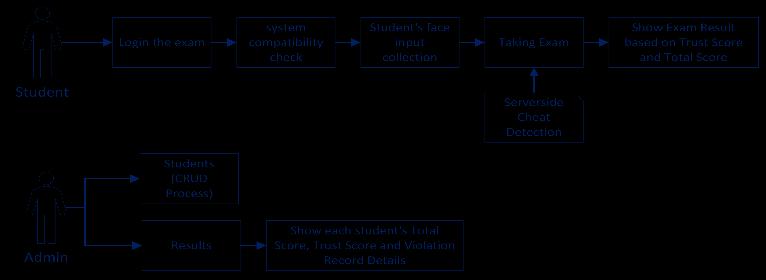
The overall workflow of the Smart Proctor integrates all detectionmodulesintoaunifiedmonitoringpipeline:
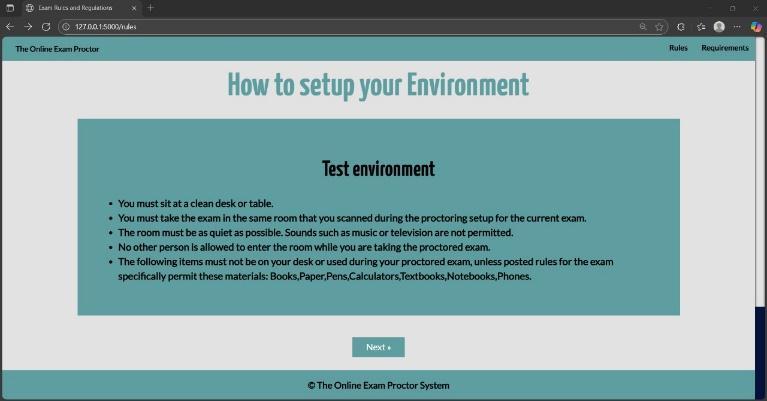
Student logs in and completes system check (camera+microphone).
Face registration and liveness verification are performed.
During the exam, video and audio streams are analyzedcontinuously.
Suspiciousactivitiestriggerimmediateloggingand trust-scorereduction.
Upon completion, the system calculates results andgeneratesareport.
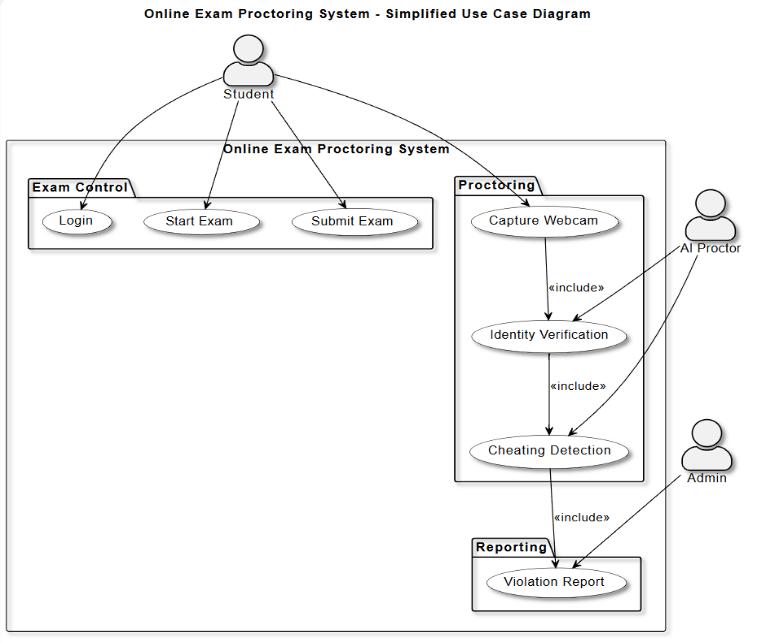
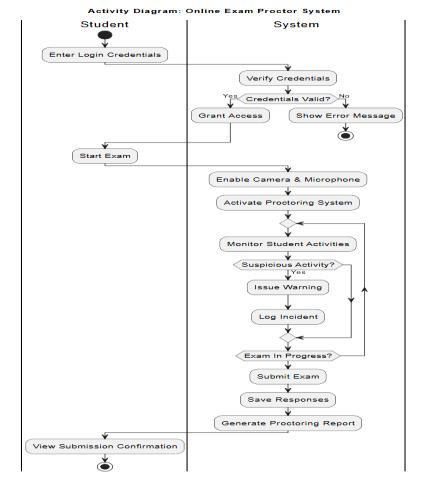
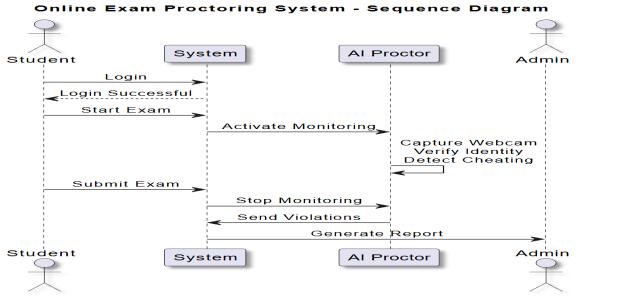
The Smart Proctor system demonstrated stable and accurateperformanceduringtesting.Thecombineduseof YOLOv8, MediaPipe, OpenCV, and face-recognition algorithms enabled the system to detect exam-related violations in real time with minimal delay. Throughout multiple simulated online exam sessions, the system consistently tracked the student’s presence, gaze direction, and background environment without interruptions. Face recognition maintained identity verification with high accuracy, ensuring that impersonation attempts were effectively prevented.The detection modules such as multiple-person detection, face absence detection, and audio-based anomaly detection functioned reliably under varying lighting conditions and camera qualities. The system architecture processed live video frames smoothly, maintaining stable frame rates and continuous monitoring. Each detected violationwasautomaticallyloggedintheMySQLdatabase with timestamps and confidence scores, enabling detailed post-examanalysis.
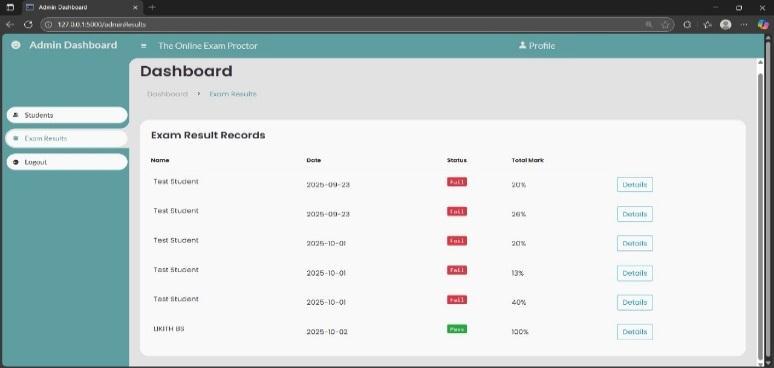
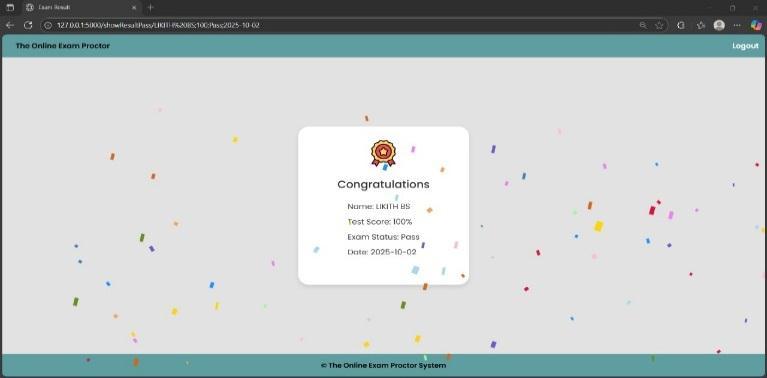
At the end of each session, the system successfully generated an exam integrity report summarizing all violations and updating the student’s Trust Score. The workflow diagrams, database connectivity, and user interface components indicated that the solution could operatecontinuouslyandscaleeffectivelyforinstitutional use. Overall, the Smart Proctor system proved efficient, responsive,andaccurateinensuringsecureandfaironline examinations.
International Research Journal of Engineering and Technology (IRJET) e-ISSN: 2395-0056
Volume: 12 Issue: 11 | Nov 2025 www.irjet.net p-ISSN: 2395-0072
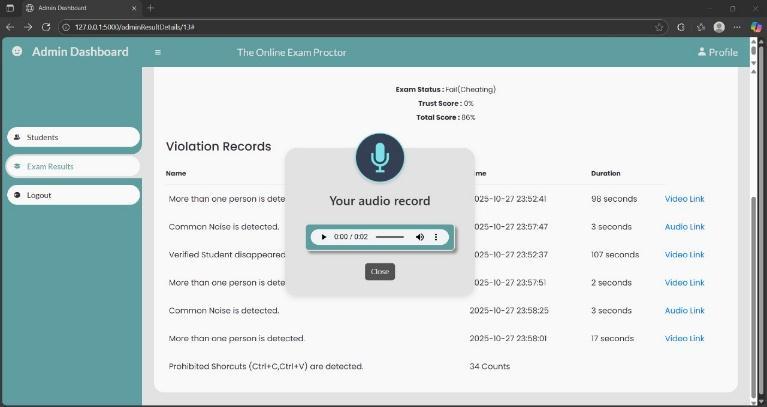
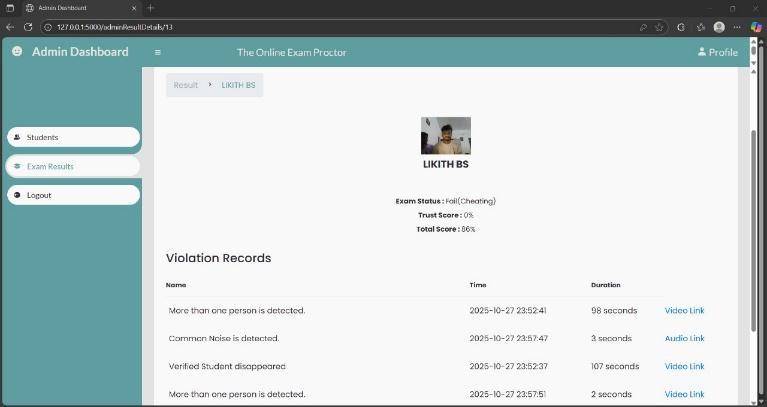
The project successfully demonstrates an automated online exam proctoring solution that integrates real-time video analysis, face recognition, gaze tracking, and object detection to ensure secure and fair remote examinations. By leveraging the accuracy of YOLOv8, MediaPipe, and deep-learning-based identity verification, the system minimizes the chances of malpractice and continuously monitors the student without requiring human supervision. The automated violation logging and Trust Score mechanism provide clear, data-driven insights into student behavior, enhancing transparency and integrity. Designedtooperatereliablyacrossvaryingenvironments, the system is scalable, efficient, and capable of uninterruptedmonitoring,offeringapracticalandmodern approach to supporting academic institutions in conductingsecureonlineassessments.
[1] Aggarwal, C. C. (2018). Data Mining: The Textbook Springer.
[2] Kumar,A.,&Suryawanshi,A.(2020). FaceRecognition Techniques: A Review. International Journal of ComputerApplications,975,8887.
[3] Zhang,K.,Zhang,Z.,Li,Z.,&Qiao,Y.(2016). Joint Face Detection and Alignment Using Multitask Cascaded Convolutional Networks. IEEE Signal Processing Letters,23(10),1499–1503. https://doi.org/10.1109/LSP.2016.2603342
[4] Ultralytics. (2023). YOLO Object Detection Documentation https://docs.ultralytics.com/
[5] Google.(2023).MediaPipeDocumentationhttps://media pipe.dev/
[6] Ageitgey, A. (2023). face_recognition Python Library Documentation https://facerecognition.readthedocs.i/
[7] OpenCV Team. (2023). OpenCV Documentation https://opencv.org/
[8] Bouchard, H. (2023). PyAudio Documentation https://people.csail.mit.edu/hubert/pyaudio/
[9] Redmon, J., & Farhadi, A. (2018). YOLOv3: An Incremental Improvement. arXiv:1804.02767. https://arxiv.org/abs/1804.02767
[10] Schroff, F., Kalenichenko, D., & Philbin, J. (2015). FaceNet:AUnifiedEmbeddingforFaceRecognitionand Clustering.CVPR,815–823. https://doi.org/10.1109/CVPR.2015.7298682
[11] Viola, P., & Jones, M. J. (2001). Rapid Object Detection Using a Boosted Cascade of Simple Features. CVPR, I511518.https://doi.org/10.1109/CVPR.2001.990517
[12] Dhamija, E., Dhamija, A., & Dhamija, S. (2021). AIBased Online Proctoring for Educational Institutions: Challenges and Opportunities. Journal of Educational Technology Systems, 49(3), 319–336. https://doi.org/10.1177/00472395211007238
International Research Journal of Engineering and Technology (IRJET) e-ISSN: 2395-0056
Volume: 12 Issue: 11 | Nov 2025 www.irjet.net p-ISSN: 2395-0072
[13] Baltrusaitis, T., Ahuja, C., & Morency, L. P. (2018). MultimodalMachineLearning:ASurveyandTaxonomy. IEEE Transactions on Pattern Analysis and Machine Intelligence, 41(2), 423–443. https://doi.org/10.1109/TPAMI.2018.2798607
[14] Zhang, Y., Zheng, Y., & Zhou, Y. (2019). A Survey of Online Proctoring Systems for Online Exams International Journal of Emerging Technologies in Learning, 14(10), 111–123. https://doi.org/10.3991/ijet.v14i10.10203
[15] Goodfellow, I., Bengio, Y., & Courville, A. (2016). Deep Learning.MITPress.
© 2025, IRJET | Impact Factor value: 8.315 | ISO 9001:2008 Certified
| Page617