
International Research Journal of Engineering and Technology (IRJET) e-ISSN:2395-0056
Volume: 12 Issue: 07 | Jul 2025 www.irjet.net p-ISSN:2395-0072
International Research Journal of Engineering and Technology (IRJET) e-ISSN:2395-0056
Volume: 12 Issue: 07 | Jul 2025 www.irjet.net p-ISSN:2395-0072
S. Malusare1, Avani A Karawade2, Aditi G. Kudale3
123UG Student, School of Mechatronics Engineering, Symbiosis Skills and Professional University, Maharashtra, India
Abstract - Coming from a household where family members needed regular reminders to take their medicines on time, I often found it challenging to manage this task, especially when I wasn't around. To address this issue, we created a Smart Pill Reminder system. This device helps people take their medications on schedule without needing someone else to remind them. The system uses an ESP8266 microcontroller with a real-time clock connected via NTP (Wi-Fi), a buzzer, an LCD, and a push-button, all controlled through the Blynk IoT platform. Users can set multiple daily alarms through the Blynk app, receive audio-visual reminders, and confirm they took their pills using either a physical button or a virtual button in the app. The system also tracks missed or confirmed doses, improving health compliance andproviding peace of mindfor caregivers.
Key Words: Smart Pill Reminder, ESP8266MOD, IoT (Internet of Things), Blynk App, NTP (Network Time Protocol), Medication Adherence, Remote Monitoring, Embedded Systems, etc.
The Smart Pill Reminder is a microcontroller-based embedded system designed to automate medication reminders using IoT features. Its main goal is to provide scheduledpillalertswithoutneedinghumanintervention, which helps users stick to their prescribed medication routines. The system centers around the ESP8266MOD microcontroller, which includes Wi-Fi for smooth connectiontotheBlynkIoT platform[1][2].Userscanset several daily alarm times through the Blynk mobile app with Time Input widgets, allowing for flexibility and remotescheduling[10].
The system continuously tracks the current time, synchronized using the Network Time Protocol (NTP), so there is no need for an external Real-Time Clock (RTC) module [9]. When the current time matches a scheduled alarm, the ESP8266 activates a buzzer and shows a notification on a 16x2 LCD screen, reminding the user to take their medication [3]. A push-button linked to the system lets the user manually acknowledge and stop the alarm. There is also a virtual button in the Blynk app for
remote acknowledgment, which improves accessibility [10].
This device is perfect for people who need regular reminderswithoutrelyingoncaregivers.Itcombinesbasic electronic parts with cloud control to provide a budgetfriendly, dependable, and scalable solution for daily medication management. The design focuses on modularity, remote operation, and ease of use, making it idealforbothhomeandhealthcaresettings.
Currentsystemsforpillmanagementmainlyrelyonalarm clocks or smartphone apps, and they offer limited feedback options.Recenttrendsincludeusingautomation andIoTtoimproveusability.
The Smart Pill Reminder uses an embedded system architecture thatis mainly builtaround the ESP8266MOD microcontroller. This Wi-Fi-enabled microcontroller provides wireless connectivity and serves as the brain of the system, processing inputs and carrying out scheduled tasks [1][2]. Embedded systems like this work well for real-timecontrol applicationsbecausetheyconsumelittle power, are reliable, and integrate easily with various peripheral devices. The project takes advantage of IoT (Internet of Things) features by connecting the microcontroller with the Blynk IoT platform [10]. Blynk allowsuserstocreate a custommobile interfaceto set up multiplemedicationalarmsusingTimeInputwidgets.The platform communicates over the internet with the ESP8266, allowing remote access, real-time updates, and two-way communication between the user and the system. This mobile-based control improves usability, making the device accessible from remote locations and providing a smooth user experience for setting schedules andinteractingwiththesystem.
Conventional embedded timing systems often rely on dedicated hardware modules like the DS3231 Real-Time
International Research Journal of Engineering and Technology (IRJET) e-ISSN:2395-0056
Volume: 12 Issue: 07 | Jul 2025 www.irjet.net p-ISSN:2395-0072
Clock (RTC) to keep accurate time [4]. However, this project takes a more efficient and modern approach by using Network Time Protocol (NTP) over Wi-Fi. The ESP8266 connects with global time servers through the internet[9].Thisapproachensuresthatthesystemworks with high accuracy and stays updated automatically, even duringpowercyclesorresets.Byremovingtheneedfora physicalRTCchip,thedesignlowershardwarecomplexity, reducescosts,andcutsdownonpotentialpointsoffailure. This leads to a more reliable and maintainable system. Moreover, NTP-based synchronization ensures consistent timekeeping across multiple devices when scaled, improvingsystemuniformityandreliability.
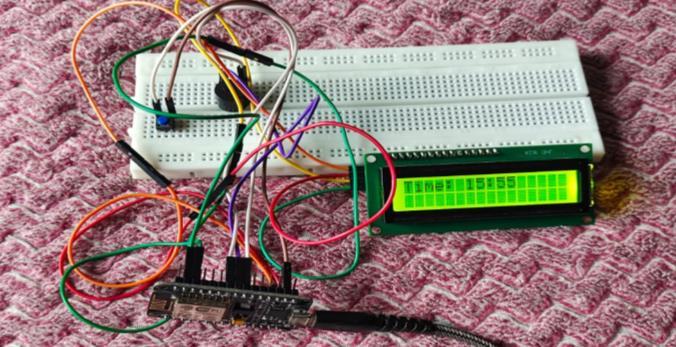
Fig. -1: ImagewithPushbutton(manual)
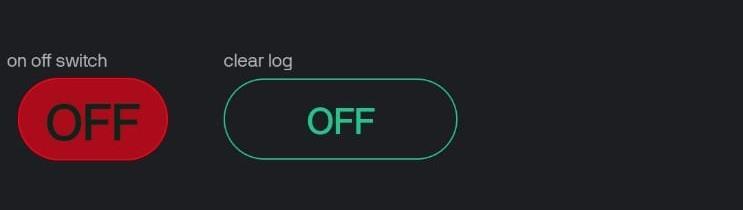
Fig. -2: ImagewithPushbutton(application)
Akeypartofanyreminderoralertsystemismakingsure the user has acknowledged the notification. To suit different user needs, the Smart Pill Reminder uses a dual acknowledgmentsystem.A physicalpush-buttonattached to the device lets local users stop the buzzer and confirm pill intake right away. For remote or less mobile users, a virtualbuttonintheBlynkappoffersthesamefunctionon asmartphone[10].
This dual-input approach gives users more flexibility and ease of use. It allows the system to work well, no matter how close the user is to the device. It also improves accessibilityforelderlyordisabledusers whomight need usercontroloperations
The Smart Pill Reminder system was created utilizing the ESP8266MOD (NodeMCU) as the microcontroller because of its Wi-Fi features [2]. An I2C LCD with 16x2 resolution was utilized to show alerts, a buzzer for sound notifications, and a push button for confirming pill intake [3]. The Blynk IoT application was chosen to remotely establish pill alarms and track pill consumption via a smartphone[10].
The hardware was set up on a breadboard, linking the LCD, buzzer, and button to the ESP8266. Code was developed in Arduino IDE [11] to retrieve real-time data through NTP [9], match it against user-defined alarms from Blynk, and activate the buzzer and LCD notification at the appropriate moment. The alarm can be disabled using either the physical button or a virtual button in the application[10].
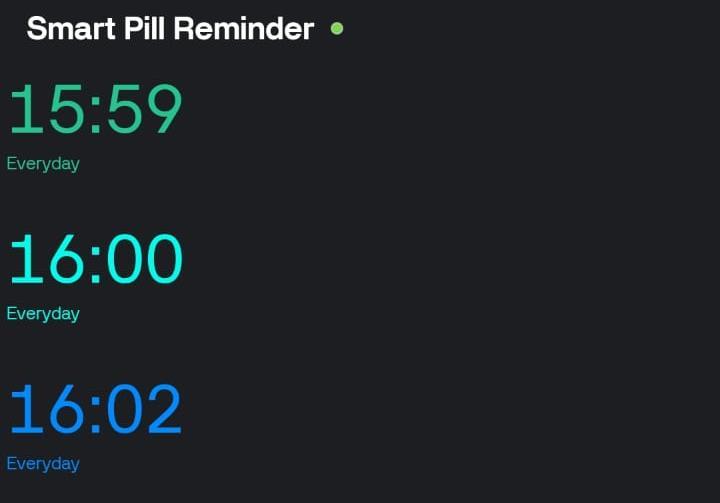
Blynk was set up with Time Input widgets (V0–V2) for alarm configurations, a virtual button (V3) to verify pill consumption, a label (V4) for system updates, and a terminal(V6)torecordinstancesofpillstakenorskipped [10]. The system underwent testing in actual conditions for reliability, timing precision, and strength. After validation, it was encased in a compact housing for everydayuse
4.1. Ease Of Development
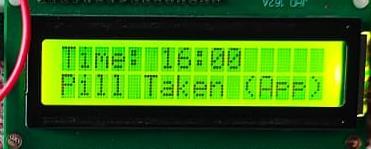
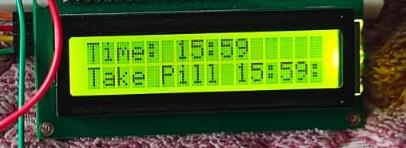
Fig. -3: Display1(LCD)
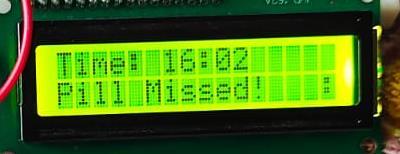
Fig. -4: Display2(LCD)
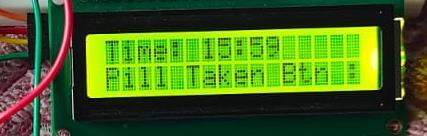
Fig. -5: Display3(LCD)
Volume: 12 Issue: 07 | Jul 2025 www.irjet.net p-ISSN:2395-0072
The Smart Pill Reminder system takes advantage of the simplicity and flexibility of the Arduino IDE [11] and the ESP8266MOD microcontroller [2]. This makes it ideal for rapid prototyping and real-world deployment. The Arduino programming environment, along with widely available libraries for LCDs, Wi-Fi connectivity, and Blynk IoT integration, allows developers to quickly implement key functions such as scheduling alarms, synchronizing real-time clocks, and triggering alerts. This ease of development significantly shortens the system's iteration and debugging cycles, which helps with efficient deploymentinreal-worldhealthcaresettings.
4.2. IOT Platform Integration



Integrating the Blynk IoT platform enables real-time mobile interaction and remote configuration. Blynk offers a drag-and-drop interface to create customized mobile dashboards without complicated coding [10]. This allows for easy integration of features like Time Input widgets, virtual buttons, and live status displays. As a result, user interaction becomes simpler, and there is no need for separate mobile app development. This makes it accessibleforbothdevelopersandend-users.
Traditional embedded systems often rely on external hardware modules like the DS3231 RTC. However, this projectusesNetworkTimeProtocol(NTP)togetaccurate real-time data over Wi-Fi [9]. This reduces the number of components and hardware complexity while improving time accuracy and reliability. The system automatically updates from global time servers, ensuring consistent operation even after power cycles without needing manualresetsorbattery-backedRTCchips
To improve flexibility and accessibility, the system includesa dual-modeacknowledgmentmechanism. There is a physical push-button for local confirmation and a virtual button on the Blynk app for remote acknowledgment [10]. This ensures users can interact with the system regardless of their location, making it suitableforelderlyusers,patientswithmobilityissues,or situations involving remote caregivers. The combination of tactile and cloud-based inputs boosts user engagement andsystemeffectiveness.
Future work may include adding audio output for voice alerts, sensor-based pill detection, or a mobile notification/logging system to enhance compliance tracking. Additionally, incorporating AI-based user behavior analysis could help predict missed doses and send preventive reminders. Integrating with healthcare databasesor platformsmightallowphysiciansto monitor patient adherence remotely and adjust prescriptions as needed.
International Research Journal of Engineering and Technology (IRJET) e-ISSN:2395-0056
Theglobalriseinchronicillnesses,agingpopulations,and a greater focus on preventive healthcare is increasing the demand for medication adherence solutions. According to Allied Market Research, the global smart pill market is expectedtoreach$6.8billionby2030,growingatarateof 18.9% per year [6]. This growth comes from the need to reduce medication errors, improve patient compliance, andlowerhospitalreadmissionsduetomisseddoses.
Smart pill reminder systems are part of a larger group of digital health and IoT medical devices. These systems are gaining popularity in home healthcare, elderly care facilities, and remote patient monitoring setups. Affordable, Wi-Fi-enabled microcontrollers like the ESP8266 make these systems accessible for widespread use, especially in developing countries where continuous caregivingishardtofind.
IoTsolutionssuchastheonedevelopedinthisprojectare especially useful in urban middle-class households. In these homes, family members are often away for work, leaving senior citizens unsupervised during the day. The ability to monitor and remind patients remotely with mobileappslikeBlynkfillsanimportantgapinmedication management.
Emergingtrendssuggestintegrationwithwearables,voice assistants like Alexa and Google Home, and AI-driven analytics. This makes the field highly scalable and a promisingareaforinnovationandentrepreneurship.
[1] Wikipedia contributors, “ESP8266,” Wikipedia, The Free Encyclopedia. [Online]. Available: https://en.wikipedia.org/wiki/ESP8266
[2]Arduino,“NodeMCUESP8266–TechSpecs,” Arduino Official Store. [Online]. Available: https://store.arduino.cc/products/nodemcu-esp8266
[3]EmbeddedRobotics,“5SimpleStepsforProgramming ESP8266 NodeMCU 12‑E,” [Online]. Available:https://www.embeddedrobotics.com/programming-esp8266
[4]SparkFunElectronics,“WiFiModule–ESP8266(4 MB Flash),” [Online]. Available: https://www.sparkfun.com/products/13678
[5]Wikipediacontributors,“ESP32,” Wikipedia, The Free Encyclopedia. [Online]. Available: https://en.wikipedia.org/wiki/ESP32
Volume: 12 Issue: 07 | Jul 2025 www.irjet.net p-ISSN:2395-0072 © 2025, IRJET | Impact Factor value: 8.315 | ISO 9001:2008
[6] Allied Market Research, “Smart Pills Technology MarkettoReach$7.5Billionby2030,” PR Newswire,2023. [Online]. Available: https://www.alliedmarketresearch.com/Smart-pillstechnology-market
[7] Allied Market Research,“SmartPillsMarketExpected to Reach $650 Million by 2025,” [Online]. Available:https://www.alliedmarketresearch.com/pressrelease/smart-pills-market.html
[8]GrandViewResearch,“SmartPillsMarketSize,Share& Trends Analysis Report 2030,” [Online]. Available:https://www.grandviewresearch.com/industryanalysis/smart-pills-market
[9] NTP.org, “Network Time Protocol (NTP),” [Online]. Available:http://www.ntp.org
[10] Blynk Inc., “Blynk IoT Platform – Documentation,” [Online].Available:https://docs.blynk.io
[11] Arduino, “Arduino IDE – Open-source Software,” [Online]. Available:https://www.arduino.cc/en/software
| Page