
International Research Journal of Engineering and Technology (IRJET) e-ISSN: 2395-0056 p-ISSN:2395-0072

Volume:12Issue:08|Aug2025 www.irjet.net

International Research Journal of Engineering and Technology (IRJET) e-ISSN: 2395-0056 p-ISSN:2395-0072
Volume:12Issue:08|Aug2025 www.irjet.net
Anwesha Sahoo¹, Bidipta Das², Ankita Mukherjee³, Monidipa Ghoshal⁴, Anubhab Chattopadhyay⁵, Dr. Krishna Bhowal⁶
¹²³´µB.Tech Student, Dept. of CSE, Academy of Technology, Adisaptagram, India
¶Associate Professor, Dept. of CSE, Academy of Technology, Adisaptagram, India
Abstract - Phishing is one of the most widespread and damaging forms of cybercrime today. With the increase in the use of digital services, attackers are increasingly creating deceptive websites to trick users into sharing sensitive data. This paper proposes a Smart Phishing URL Detection System using machine learning techniques. The system extracts various features from a URL and uses a trained classification model to detect whether the URL is phishing or legitimate. The model was trained on a publicly available dataset and implemented in a Flask-based web application, allowing real-time detection through a userfriendly interface. Experimental results show high accuracy, makingthis solutioneffective for practical applications.
Key Words- Phishing Detection, Machine Learning, URL Classification, Flask Web App, Gradient BoostingClassifier.
Phishing is a social engineering technique that deceives usersintorevealingpersonalandconfidentialinformation bymimickinglegitimatewebsites.Traditional approaches, likeblacklistsorbrowserfilters,areofteninadequatedue to the dynamic nature of phishing URLs. Hence, we propose a machine learning-based approach to identify phishing websites by analyzing URL features and predictingmaliciousintent.
The rising dependence on online platforms for banking, shopping, and communication has led to a dramatic increase in phishing attacks. Static blacklist-based detection systems are reactive in nature and often fail to keep up with new threats. Therefore, there is a need for dynamic, real-time, and intelligent phishing detection systems.
According to the Anti-Phishing Working Group (APWG), over 1 million phishing attacks were recorded in 2023 alone, indicating a sharp rise in cyber threats. Given the dynamic nature of such attacks, a machine learningdriven approach provides a scalable and intelligent defensemechanism.

This project aims to develop a smart phishing URL detection system using machine learning, capable of classifying URLs as phishing or legitimate. The solution is built as a web-based interface where users can input any suspicious URL and receive real-time predictions, backed byarobustmodeltrainedonURL-basedfeatures.
Machine learning has been used extensively for phishing detection over the past decade. Researchers have implemented techniques ranging from blacklists and content-basedfilterstoadvancedensembleclassifiers.
Traditional detection systems rely on static blacklists or heuristic rule engines. However, these are reactive in nature and can be easily bypassed by attackers who slightlyaltertheURLstructureordomainnames.
MLtechniquessuchasdecisiontrees,randomforests,and gradient boosting classifiers have shown improved accuracy in detecting phishing attempts. These models analyze several features from the URL structure, domain information, and presence of special symbols.Some existing studies have implemented Random Forest or Decision Tree models for phishing detection but have not integrated them into real-time systems. Our work enhancesthisbyprovidingaworkingwebapplicationthat makesdetectionaccessibletonon-technicalusers.
Table-1:ComparisonofMLModelsforPhishing Detection


International Research Journal of Engineering and Technology (IRJET) e-ISSN: 2395-0056 p-ISSN:2395-0072
Volume:12Issue:08|Aug2025 www.irjet.net
Sahin & Duman (2011)
3.1 System Overview
The proposed system is designed to detect phishing URLs using machine learning algorithms. The system architecture consists of four key modules: feature extraction, data preprocessing, model training, and webbased prediction. Users interact with the system via a simple web interface where they can input any URL and receiveanimmediateclassificationresult.
3.2 Feature Extraction
ThismoduleisresponsibleforconvertingarawURLintoa numerical feature vector that can be processed by the machine learning model. The project utilizes a publicly available Kaggle Phishing Dataset, which consists of a large set of URLs, each labeled as either phishing or legitimate. The dataset includes pre-engineered features such as the presence of special characters, URL length, subdomain count, and other lexical and domain-based indicators. Each URL is assigned a binary label 1 for legitimate and 0 for phishing allowing the model to learn patterns that distinguish malicious links from safe ones.Someofthekeyfeaturesusedinclude:
1) PresenceofanIPaddress
2) LengthoftheURL
3) Presenceofspecialsymbolslike@,//,or4) UseofHTTPS
5) Abnormal URL patterns (like too many dots or redirects)
6) DomainregistrationnameandDNSrecordpresence.
These features are extracted using a Python script and passedtotheclassifierinreal-timewhenausersubmitsa URL.Properfeatureextractionisessentialtomaintainthe highaccuracyofthepredictionsystem.
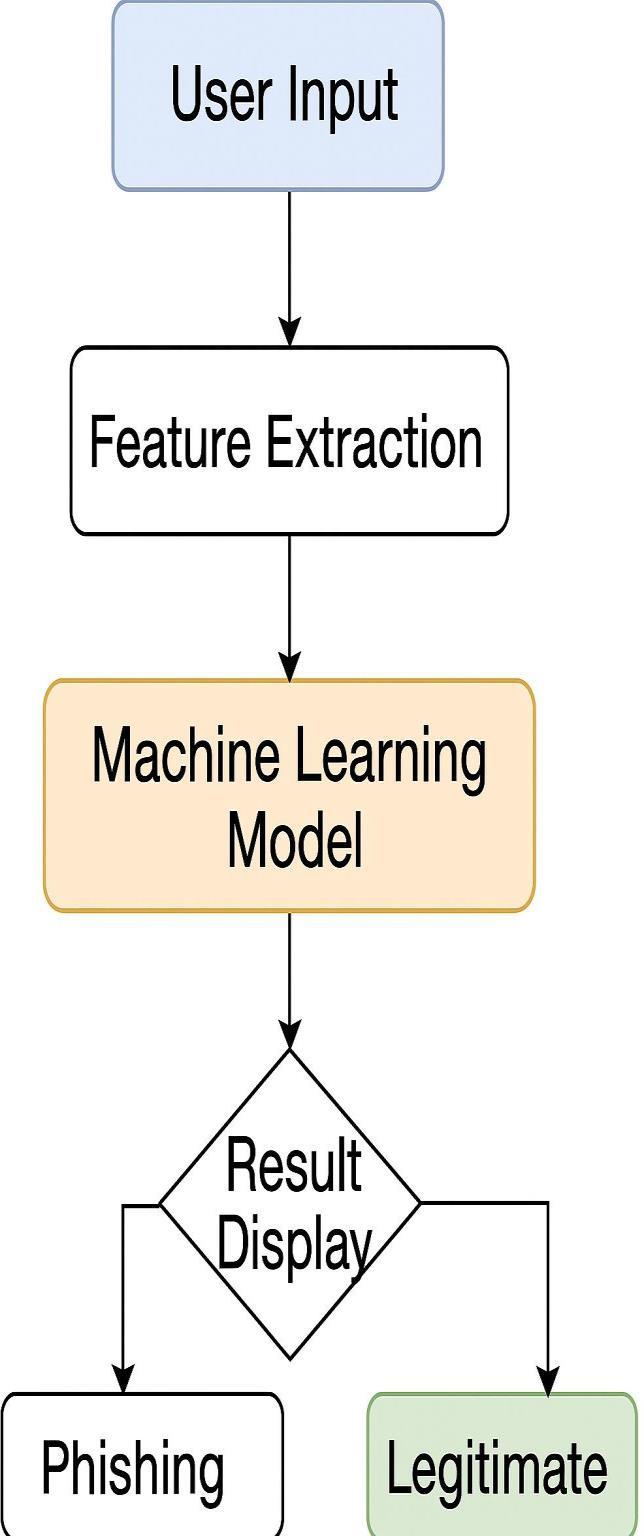
The system follows a modular architecture, as shown below:
3.4
UserInput:UserentersaURLviathewebform.
Feature Extraction: The backend script extracts predefinedfeaturesfromtheURL.
Model Prediction: The trained machine learning model (GradientBoostingClassifier)processestheinputfeatures.
Result Display: The system returns whether the URL is “Phishing” or “Legitimate” along with the model confidencescore.
Volume:12Issue:08|Aug2025 www.irjet.net
International Research Journal of Engineering and Technology (IRJET) e-ISSN: 2395-0056 p-ISSN:2395-0072
This modular design ensures that each component can be maintainedorupgradedindependently.
4.1
The dataset used for this project was obtained from Kaggle,consistingoflabeledURLscategorizedasphishing (0) or legitimate (1). It includes multiple engineered features representing URL structure, behavior, and hostinginformation.
The dataset was loaded using Python's pandas library. Missing values and duplicate rows were checked and cleaned. The features were already numeric, so minimal encoding was required. The dataset was then split into training and testing sets usingan80:20ratiotoevaluate modelperformance.
4.2
Multiple classification algorithms were evaluated during model selection, such as Logistic Regression, Support Vector Machine (SVM), and Random Forest. Among these, theGradientBoostingClassifier(GBC)wasselectedforits superior accuracy and its capability to capture complex, non-linearrelationshipsbetweenfeatures.GBCfollowsan ensemble strategy that incrementally builds a robust modelbycombiningasequenceofweaklearners.
4.3
The model training process was carried out using the scikit-learn library in Python. The Gradient Boosting Classifier was fit on the training data, and key hyperparameters such as the number of estimators, learning rate, and maximum tree depth were adjusted throughexperimentationtoimproveperformance.
Once trained, the model was serialized using the Pickle module, enabling seamless integration with the Flaskbased web application for real-time phishing URL detection.
The performance of the model was evaluated using the followingmetrics:
Accuracy:Proportionoftotalcorrectpredictions.
Precision: Ratio of correctly predicted phishing URLs to allpredictedphishingURLs.
Recall: Ratio of correctly predicted phishing URLs to all actualphishingURLs.
F1Score:Harmonicmeanofprecisionandrecall.
The model achieved an overall accuracy of approximately 97.4%, indicating high reliability for phishingdetection.
To evaluate the effectiveness of the proposed phishing URL detection system, various machine learning models weretrainedandtestedontheKaggledataset.Themodels were assessed using accuracy, precision, recall, and F1score. The Gradient Boosting Classifier (GBC) outperformed other models and was selected for deployment.
Table-2:EvaluationMetricsoftheFinalModel(GBC)
The GBC model demonstrated a strong ability to distinguish phishing URLs from legitimate ones. Its high precision ensures few false positives, and high recall ensuresactualphishingURLsareeffectivelycaught.
Acomparativeanalysisofdifferentmodelsimplementedis shownbelow:
Table-3:ModelComparison(BasedonProject Experimentation)
The comparison shows that the Gradient Boosting Classifier achieved the best balance across all evaluation metrics,makingittheoptimalchoicefordeployment.
Additionally, the model was integrated into a web application using Flask. Users can input a suspicious URL and receive instant classification results (Phishing or Legitimate). This real-time prediction system is
Volume:12Issue:08|Aug2025 www.irjet.net
International Research Journal of Engineering and Technology (IRJET) e-ISSN: 2395-0056 p-ISSN:2395-0072
lightweight and user-friendly, making phishing detection accessibletonon-technicalusers.
The Smart Phishing URL Detection System proposed in this paper demonstrates the effective use of machine learning for detecting malicious websites based on URL features. Among the models tested, the Gradient Boosting Classifier(GBC)achievedthebestresultswithanaccuracy of97.4%,makingitthemostsuitablefordeployment.
Thesystemisintegratedintoauser-friendlywebinterface usingFlask,whichallowsreal-timeURLclassification.This practical implementation ensures the tool can be easily used by both technical and non-technical users. The results validate that machine learning models, when properly trained and deployed, can serve as powerful tools in enhancing cybersecurity and reducing phishingrelatedthreats.
There are several areas where the system can be improvedorextendedinfuturework:
1)Deep Learning Models: Incorporating neural networkbased models such as LSTM or CNN could help capture morecomplexpatternsinURLs.
2)Content-Based Features: Adding analysis of website content (HTML, JavaScript) or screenshots could improve detectionforsophisticatedphishingattacks.
3)Browser Integration: The system can be packaged as a browser extension or mobile app to provide real-time protectionwhilebrowsing.
4)Real-Time Threat Intelligence: Integrating live threat feedsorblacklistscouldmakethesystemadaptivetonewly emergingphishingthreats.
These enhancements can improve robustness, adaptability, andusabilityofthedetectionsystem.
[1] ➝ Scikit-learn:MachineLearninginPython.Available at:https://scikit-learn.org/(Accessed:July2025)
[2] ➝ Kaggle Phishing Websites Dataset. Available at: https://www.kaggle.com/datasets/sid321axn/phishingwebsite-detector(Accessed:July2025)
[3] Sahoo, D., Liu, C., & Hoi, S.C.H. (2017). Malicious URL Detection using Machine Learning: A Survey. arXiv:1701.07179.
[4] Jain, A.K., & Gupta, B.B. (2018). Phishing Detection: Analysis of Visual Similarity-Based Approaches. Security andPrivacy,1(1),e15.
[5] Abdelhamid, N., Ayesh, A., & Thabtah, F. (2014). Phishing detection based on hybrid intelligent model. ExpertSystemswithApplications,63,321-332.
[6] Sahin, Y., & Duman, E. (2011). Detecting Phishing Websites using Machine Learning Algorithms. In Proceedings of the IEEE International Conference on InformationSecurityandCryptology.
2025, IRJET | Impact Factor value: 8.315 | ISO 9001:2008 Certified Journal | Page114