
International Research Journal of Engineering and Technology (IRJET) e-ISSN: 2395-0056
Volume: 12 Issue: 05 | May 2025 www.irjet.net p-ISSN: 2395-0072
International Research Journal of Engineering and Technology (IRJET) e-ISSN: 2395-0056
Volume: 12 Issue: 05 | May 2025 www.irjet.net p-ISSN: 2395-0072
KEERTHI P1 , MONICA M2 , SIVARANJANI S3, SOWMIYA P4
1,2,3,4Computer Science and Engineering ,Government College of Engineering Srirangam, Trichy ,Tamil Nadu -620 012
5Asst.Prof Bhuvaneswari P , Dept. of Computer Science and Engineering, Government college of Engineering Srirangam, Tamil Nadu, India ***
Abstract - Human-Computer Interaction(HCI)isbecoming more intuitive, intelligent, and accessible by doing away with physical input devices. This project puts forwarda completely hands-free HCI systemthatincorporatesBlueEyesTechnology (BET) along with Computer Vision and Voice Recognition for facilitating natural interaction for users, particularly those who have physical impairments. The system utilizes MediaPipe, FaceMesh for real-time eye tracking and blink detection, supporting precise gaze-based cursor movement and click simulation using Convolutional Neural Networks (CNN) andbinary classification. A regressionmodelisusedfor estimating the gaze direction accurately. Concurrently, Whisper AI, a powerful transformer-based voice recognition model, is used for voicecommandtranscription,enablingusers to perform system-level operations like application control, webbrowsing, andfile manipulationthroughvoicealone.This multimodal system incorporating visual and auditory feedback provides effortless interaction with computing environments without the need for hand gestures. The architecture is lightweight and deployable on low-resource devices, enhancing accessibility on both personal and professionallevels. The solutionproposed is improvingHCI by offering a more intelligent, adaptive, and inclusive interface.
Key Words: Human-Computer Interaction, Blue Eyes Technology, Eye Tracking, Blink Detection, Voice Recognition,MediaPipe,WhisperAI,CNN,GazeEstimation, Hands-FreeSystem
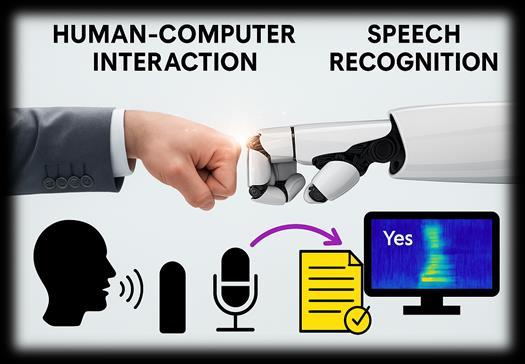
Human-ComputerInteraction(HCI)iscentraltofillingthe gap between humans and machines, facilitating easy communication and task performance. Conventional HCI approaches are based on physical input devices like keyboardsandmice,whicharenotalwayswithineveryone's reach, especially those with physical disabilities like amputees. This necessitates the need for alternative interaction models that provide equal usability and accessibility.Tofillthisvoid,cutting-edgetechnologiessuch as Blue Eyes Technology, computer vision, and voice recognitionprovideexcitingpossibilities,allowingpeopleto engage with digital systems more naturally and automatically.
Eye-trackingtechnologyhasarisenasasignificanttoolfor sidestepping classical input constraints. Through the detectionandinterpretationofthedirectionofauser'sgaze, itismadepossibletodirectcursormovementonascreen without physical contact so that users can accomplish pointingtasksbymerelyglancingatvariousregionsofthe display.Also,blinkdetectioncanbeusedtosimulatemouse clicks,whicheliminatestherequirementforphysicalmouse inputs.Althougheye-trackingsystemsareveryeffectivefor cursor control, they frequently face limitations when performingmorecomplicatedtasksorgivingcommands.
In order to provide a solution for such limitations, our project puts forth voice recognition as an additional modality. By pairing speech-based command processing withgaze-basedcursorcontrol,thesystemempowersusers to execute a broad variety of activities ranging from launching applications, browsing, and interacting with systemcomponents tobeingcompletelyhands-free.This multimodal HCI system utilizes Blue Eyes Technology, MediaPipe FaceMesh for facial landmark detection, and WhisperAI,atransformer-basedspeechrecognitionmodel, toprovideanaccessibleandintuitiveinterface.
Thesystemisnotonlygearedtoimprovetheaccessibilityof the physically impaired, but also experts, teachers, and anyoneengagedinhands-occupiedenvironmentsrequiring aneffectivehands-freeinterface.Forthephysicallydisabled, people withamputation or restrictedmotion inlimbs,the system is a useful addition to conventional input devices, facilitatingtheirinteractionwithdigitalsystemswithgreater inclusivenessandease.Inaddition,professionalsinactive working environments e.g., surgeons, lab technicians, or fieldoperatives mayfindvalueinthesystem'scapacityto execute intricate operations without pauses in their work processes.Teachers,forinstance,maymanagepresentations oreducationalresourceswithoutphysicallybeingincontact withtheircomputers,creatingabetterlearningenvironment whilestayinginvolvedwithstudents.
Withthecombinationofeye-trackingandvoicerecognition, thesystemgeneratesasmoothandsmartHCIinterfacethat enablesuserstointeractwithandcontroldigitalspaceswith ease.Theintegrationminimizescognitiveandphysicalload, whichdecreasesmentallydemandingtasksandmakesthem
International Research Journal of Engineering and Technology (IRJET) e-ISSN: 2395-0056
Volume: 12 Issue: 05 | May 2025 www.irjet.net p-ISSN: 2395-0072
morefluid.Theusercanoperateapplications,launchfiles, surf the web, and carry out other activities by merely glancingatthescreenorgivingvoiceinstructions,without necessarilyhavingtousetheirhands.Thesystemnotonly makesiteasytodoeverydayactivitiesbutalsoeliminates multitaskingbetweenvariousinputdevices,allowingusers toconcentrateontheirmaintasks.
ThisnewHCIstrategyprovidesamoreintuitiveandnatural meansofengagingwithtechnologysothatusersareableto have control without physical discomfort or mental overload. Furthermore, the capacity of the system to accommodate varying user requirements provides it with versatility in a broad spectrum of settings, ranging from personal use to high-demand business applications. By givingusersthepowertoengagemorenaturallywiththeir devices,thissystemredefinesaccessibilityandprovidesnew opportunities for more inclusive, productive, and efficient workandlearningenvironments.
1.1 Motivation
Withcomputersincreasinglybeingusedacrossallindustries, there is an escalating demand for accessible and intuitive userinterfaces.
TheconventionalHCIsystemslackinprovidingsupportto userswhosufferfrommobilityimpairments.Thispresentsa hindranceindigital accessibilityandlimitsinvolvementin education,employment,anddailycomputer-basedtasks.To resolvethisproblem,ourinspirationcomesfromtheneedto have a system that can be an alternative interface particularly for those who cannot utilize a keyboard or mouse.Byintegratingvoicerecognitionandeyemovement, the project seeks to develop a smart, hands-free control system that maximizes interaction and accessibility. The solution also enhances efficiency, as users are able to interactwithinterfacesandperformtaskswithouthavingto togglebetweeninputdevices.Thisfusionofvisualtracking andaudiocommandsprovidessmootherandmoreintuitive
interaction while minimizing fatigue from long periods of usingconventionaldevices.
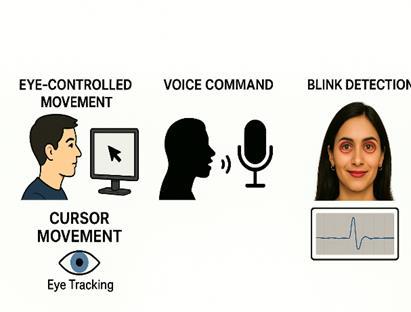
AnHCIsystemhands-freeisenvisioned,whichexploitseye movement to control the cursor, blink to click, and voice commands for executing instructions. CNN-based eye trackingandbinaryclassificationfordetectionofblinkshave beenadoptedforprecisesimulationofmousefunctionalities. A regression model is used to estimate gaze direction and filtercursor movements. The system is entirely developed without usinghand gestures but onlythrough visual (eye) and audio (voice) feedback for interaction. Theprototypeisdeployableonweb-basedsystemsaswellas low-resource systems, hence versatile and accessible. The suggested solution makes a contribution to accessible computing and aligns with the mission of inclusive technologyforeveryone.
The rest of the paper is structured as follows: Section 2 providesanoverviewoftherelatedwork.Section3presents the methodology; Section 4 gives implementation and analysis; Section 5 depicts applications and evaluation; Section6reflectstheconclusionandfuturework;andSection 7givesthereferences.
Human-Computer Interaction (HCI) has also undergone considerable development with the incorporation of intelligentsensingtechnologies,providingmorenaturaland accessible ways of interaction for common users and physically disabled individuals alike. Various studies have also suggested systems based on gesture recognition, eye gaze,andfacialfeaturestoconstructadaptiveandreal-time interactivesystems.
Zhu et al. [4] created a stable 3D hand-based humancomputer interaction platform that fused data glove input andpositiontrackingtechnology.
Their solution employed OpenGL and VC++ to display a realistic3Dhandmodelwith26DegreesofFreedom(DOF), allowingittoexhibitalargevarietyofhandgestures.Oneof the key contributions was the enhanced thumb model, createdbasedonhumanphysiologicalproperties.Thesystem captured joint angles and hand rotations correctly using synchronized glove and tracker information, providing a stable platform for gesture-based interaction in virtual worlds.
Pastooretal.[10]introducedanewmultimediasystemwith 3Dvisualizationandeye-controlledinteraction,withoutthe need for users to wear any head-mounted equipment. Their prototype combined autostereoscopic displays and headandgazetrackingtoprovidenatural interaction.The systemutilizedintelligentinterfaceagentsthatinterpreted
International Research Journal of Engineering and Technology (IRJET) e-ISSN: 2395-0056
Volume: 12 Issue: 05 | May 2025 www.irjet.net p-ISSN: 2395-0072
attention from the user using gaze input, dynamically reconfiguring display and interaction context. They also integrated multimodal interactions via voice control and gesture recognition, which offered a very immersive user experience. The research highlighted the necessity of responsive and non-command interfaces for effective and user-friendlycomputingenvironments.
Parmar et al. [13] introduced a facial-feature based HCI systemspeciallytailoredforuserswithphysicaldisabilities. Theirsystemusedcommonwebcamsforpassive,real-time eyeblinkandfacialfeaturetrackinglikethenosetipandeye corners.Theyusedasix-segmentrectangular(SSR)filterfor accuratefacedetectionandSupportVectorMachines(SVM) for classification. The system enabled users to operate computer functions using blink patterns and facial movements without any extra hardware. Their findings exhibitedhighprecisionanduserfamiliarity,indicatingthe viabilityofnon-intrusiveandlow-costHCIsolutions.
In another example, hand motion trajectories for gesture recognition was examined in Reference Paper 3, where a rangeofalgorithmssuchasHiddenMarkovModels(HMM), Dynamic Time Warping (DTW), and Longest Common Subsequence(LCS)wereassessedontheirperformanceto recognize continuous and multi-stroke hand gestures. The research highlighted the importance of preprocessing methods like trajectory normalization, rotation alignment, and noise filtering in enhancing the precision of gesture classification. Depth data usage and multi-modal fusion furtherimprovedgesturerecognitionperformanceinrealtimesystems.Collectively,thesecontributionshighlightthe progress in HCI systems that utilize physical motion, gaze direction,andfacialexpressionsforinteraction.
3. PROPOSED SYSTEM & METHODLOGY
A. System architecture
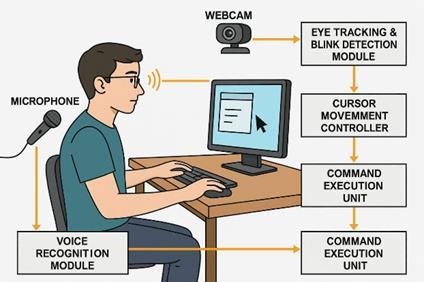
Thesystemarchitecturecombinesvoicerecognitionand eye tracking to provide hands-free human-computer interaction.Thesystemconsistsofhardwareandsoftware
components, collectively responsible for controlling the cursorandperformingcommandswithouttheuseofphysical inputdevices
1.DataAcquisitionLayer
This layer captures real-time user input from:
•Webcam:Continuouslyrecordsreal-timevideoframesof the user's face, with particular emphasis on the eyes.
• Microphone: Records the user's voice commands for processing.
2.PreprocessingLayer
2.1FaceandEyeTracking:
Media Pipe and Face Mesh identify facial landmarks, separating eye areas. These are cropped, resized, and convertedtograyscale,withsimplenoiseremovalperformed to prepare the data for use by CNN-based blink and gaze detection.
2.2VoiceRecognition:
The voice command is treated using Whisper AI, a transformer-based speech model, that converts what's spokentotext.
3.FeatureExtractionandProcessingLayer
A CNN model processes the eye region to conduct regressionforcursorcontrol (gaze estimation)andbinary classificationforsimulatingmouseclicks(blinkdetection). Whisper AI processes the Mel-spectrogram to transcribe speechintotext.Thetranscribedcommandsaremappedto individual system actions like opening apps, scrolling, or clicking.
4.MultimodalProcessing
Thesysteminspectsforfacedetectionandvoicedetection. Upondetectionoffaceandeyes,cursorcontrolgetsactivated. Incaseofrecognitionofvoiceinput,correspondingactivities are initiated jointly or separately depending on the input context.
5.ExecutionLayer
PyAutoGUIisemployedforsystemcontrolbysimulating mousemovementsandclicksaccordingtogazeinformation, and executing keyboard or system actions like opening programs or surfing according to voice commands interpreted.
6.OutputActions
The integration of eye-gaze cursor control and voiceactivatedcommandsenablescompletehands-freeoperation. Users are able to make typical mouse actions like click, scrolling,andselection.
International Research Journal of Engineering and Technology (IRJET) e-ISSN: 2395-0056
Volume: 12 Issue: 05 | May 2025 www.irjet.net p-ISSN: 2395-0072
(SystemArchitectureofproposedsystem)(Fig.3)represents the System Architectureofproposed system that provides effortless, precise, and convenient interaction for users, particularlyforpeoplewithphysicaldisabilities,providinga smartsubstituteforconventionalinputdevices.
B. Methodology
The offered hands-free HCI system uses eye tracking andspeechrecognitioninreal-timetobeaneasy,intuitive input replacement for standard devices. The core componentsofthissystemandtheinteractionsamongthem areexplainedbelow,designedprimarilyforuserswhohave physicalhandicaps.
1.WebcamAccess
Theprocedurestartsbyopeningthesystem'swebcam, whichrecordsvideoframesataconstantrateofabout30 frames per second. This continuous flow of visual informationactsasinputforfaciallandmarkdetection,with ahighfocusoneyeareasforcursorcontrol.
2.BlinkDetectionandEyeMovement
Each frame captured in the video sequence is preprocessed with images utilizing OpenCV before being sent through MediaPipe and FaceMesh for detection and faciallandmarkmappingto468faces.Certainspecificpoints neartheeyesarechosentocalculateEyeAspectRatio(EAR) anddetectblinks.Blinkstylesaredecodedinabinarymodel ofclassificationwheremouseclickresponses(leftclickand rightclick)areimitated.Moreover,regressionmethodsare used to predict the direction of the gaze, thus enabling smoothandprecisecursormovementsynchronizedwiththe positionoftheuser'seyes.
Tosupplementtheeyetrackingsystem,WhisperAI,a sophisticatedtransformer-basedspeechrecognitionmodel created by OpenAI, is implemented to translate voice commands. This supports users in conducting operations likefileopening,webbrowsing,orsystemfunctioncontrol throughvoicecommandalone.Thevoicerecognitionmodel providesmultilingualsupportandstrongaccuracyinnoisy environments, thus improving system use in various environments.
4.MultimodalControlIntegration
The system integrates visual and auditory inputs to facilitate cursor movement and command execution. For instance,eyegazecanbeusedtomovethepointer,ablinkto triggeraclick,andavoicecommandsuchas"openbrowser" to open an application. This combination control system providesflexible,smoothinteractionthatisidealforpeople withvaryingcapabilities
Theobservedfacialmovementsandvoicecommands are mapped to equivalent mouse actions left click, right click,doubleclick,andscrolling.Patternsofeyeblinksand voicecommandsareprocessedinreal-timetotriggerthese controls. Individualized thresholds for EAR and gaze estimationaredynamicallysetforresponsiveness.Thistwomodal interaction provides a completely hands-free and user-friendlycomputingexperience.
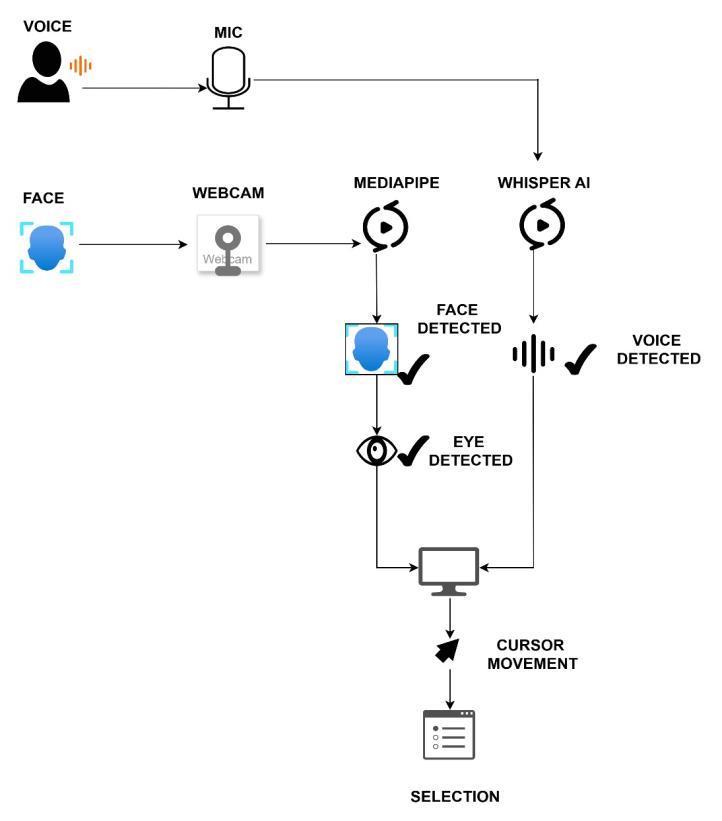
Fig.3a.ProposedSystemArchitecture
Fig.3b.SystemWorkflowDiagram
4.EXPERIMENTAL EVALUATION
Table 1 describes the experimental setup used in the research. The system was tested in a typical environment usinganIntelCorei5(10thGen)processor,8GBRAM,HD webcam(30fps),andbuilt-inmicrophone,onWindows10 (64-bit). It was coded in Python 3.10 with libraries like OpenCV,Mediapipe,PyAutoGUI,Whisper,TensorFlow,and
International Research Journal of Engineering and Technology (IRJET) e-ISSN: 2395-0056
Volume: 12 Issue: 05 | May 2025 www.irjet.net p-ISSN: 2395-0072
NumPy for real-time vision, voice recognition, and automation.
B.DatasetandDataCollection
Theexperimentalenvironmentdidnotuseexistingdatasets. Rather, the system was tested based on live user input to best mimic real-world usage scenarios with gaze tracking andvoicerecognition.Thetestingphasewasconductedby 10participantswithmixed voicetonesandsomewearing glassestogaugesystemflexibility.Theevaluationsituations involvedeye-gaze-controlledcursormovement,mouseclicks initiatedbyblinkdetection,performanceofvoicecommands like "open Notepad" or "close window," and multimodal interactionusingbothgazeandvoiceinputs.
C.Preprocessing
In the real-time processing pipeline, some preprocessing operations were performed to make it reliable in performance.For detecting gaze, face and eye areas were localizedusingMediapipe.Blinkdetectionwasdoneutilizing aConvolutionalNeuralNetwork(CNN)modelthatlearned to identify the state of eyes as open or blink. Speech commandswereheardandtranslatedtotextwiththehelpof Whisper AI, which were then subjected to a minimalistic naturallanguageparsertodetecttheintendedinstruction. All the inputs were filtered and normalized to eliminate noiseandminimizetheimpactofambientinterferenceprior topassingthemtothesystemforexecution.
D.EvaluationMetrics
Weutilizedstandardclassificationmetricstoevaluatethe performance of the proposed Smart Hands-Free Control System. These metrics enable us to assess how effectively the system accomplishes tasks like gaze-based cursor movement,blinkdetection,andvoicecommandrecognition.
1.Accuracy
Accuracyreferstothepercentageofcorrectpredictions made by the system. It includes correctly detected blinks, gaze positions, or voice commands compared to the total numberofpredictions.
Where,
TP =TruePositives
TN =TrueNegatives
FP =FalsePositives
FN =FalseNegatives
2.Precision
Precision tells us how many of the detected actions (likeablinkorvoicecommand)wereactuallycorrect.
3.Recall
Recall measures how many of the actual correct actionsweresuccessfullydetectedbythesystem.Itisuseful toknowwhetherthesystemismissinganyrealuserinputs.
The F1-score is the balance between precision and recall.Itisespeciallyusefulinblinkdetection,whereboth avoiding false positives (natural blinks) and missing true blinks(intentionalclicks)areimportant.
TABLE1.EXPERIMENTALSETUPFORPROPOSEDMODEL
Component Specification
Processor IntelCorei5(10thGeneration)
Camera HDWebcam(30framesper second)
Microphone Integratedsystemmicrophone OperatingSystem OperatingSystem
ProgrammingLanguage Python3.10
Libraries/Frameworks OpenCV,Mediapipe, PyAutoGUI,WhisperAI, TensorFlow,NumPy
Smart Hands-Free Control System was tested by different performance measures. The eye direction-based gaze tracking module yielded an accuracy rate of 88.2% with consistentcursormovementaccordingtoeyedirection.The blink detection system performed highly with a precision rateof 90.5%,i.e., thevast majority ofthedetected blinks were correct, and a recall rate of 87.4%, i.e., the system correctly identified the majority of voluntary blinks. Moreover,theWhisper-poweredvoicecommandrecognition modulerecordedaremarkableaccuracyof95.6%,verifying itscompetenceininterpretingusercommandsevenunder varyingacousticconditions.
International Research Journal of Engineering and Technology (IRJET) e-ISSN: 2395-0056
Volume: 12 Issue: 05 | May 2025 www.irjet.net p-ISSN: 2395-0072
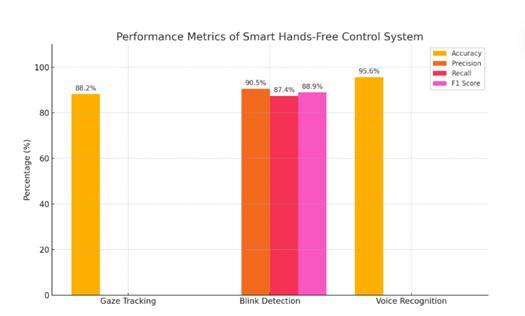
PerformanceEvaluationofGaze,Blink,andVoice Modules
ThesuggestedHuman-ComputerInteraction(HCI)system, which integrates eye tracking and voice recognition, presentsafunctionalandaccessiblesolutionforhands-free computeroperation. Throughtheuseofonlyawebcamand microphone, the system presents an accessible and affordable alternative to conventional input, making it particularly useful for users with physical or motor disabilities. The combination of gaze-based cursor movement, blink detection for clicks, and voice command recognition provides natural and unobtrusive user interaction. With a light and modular architecture, the system efficiently applies computer vision and speech recognitiontechnologiestoachievereal-timeperformanceat low hardware costs. Test results in the form of 88.2% accuracyingazetracking,90.5%precision,87.4%recall,and 95.6% accuracy in voice recognition affirm the system's dependabilityandresponsiveness.Nonetheless,tofurther advanceitsusabilityandperformance,futureresearchwill target enhancing gaze accuracy across various lighting conditions, advancing blink detection to minimize false positives, increasing the number of voice commands supported,andaddingadaptivelearningforindividualized interaction. Moreover, the latency will be minimized and long-termusersatisfactionwillbetestedthroughreal-world trials,especiallyamongpeoplewithdisabilities.Overall,this projectpointsoutthepromiseofAI-basedHCIsystemsto improveassistivetechnologiesandmakecomputingmore inclusive
[1] Li, F., Feng, J., & Fu, M. (2019). A Natural Human Computer Interaction Method in Virtual Roaming. Proceedings of the 15th International Conference on ComputationalIntelligenceandSecurity(CIS),IEEE.
[2] Zhang, S., & Zhang, S. (2019). A Novel Human-3DTV Interaction System Based on Free Hand Gestures and a Touch Based Virtual Interface. IEEE Access, 7, 165961–165974.
[3]Richhariya,P.,Kane,L.,Chauhan,P.,&Nigam,M.(n.d.).A Survey: Movement of the Hand Motion Trajectory for DependentandIndependentRecognition.IEEEXplore.
[4]Zhu,D.,Feng,Z.,Yang,B.,Jiang,Y.,&Yang,T.(2010).The Design and Implementation of 3D Hand-based Human Computer Interaction Platform. 2010 International ConferenceonComputerApplicationandSystemModeling (ICCASM),IEEE.
[5]Monteiro,P.,Gonçalves,G.,Coelho,H.,Melo,M.,&Bessa, M. (2021). Hands-Free Interaction in Immersive Virtual Reality: A Systematic Review. IEEE Transactions on VisualizationandComputerGraphics,27(5),2702–2717.
[6] Shibly, K. H., Dey, S. K., Islam, M. A., & Showrav, S. I. (2019). Design and Development of Hand Gesture Based Virtual Mouse. Proceedings of the 1st International Conference on Advances in Science, Engineering and RoboticsTechnology(ICASERT),IEEE.
[7] Yang, S., & Zheng, Y. (2008). Research on Human Computer-InteractionDesignofSoftwareBasedonBarrier free Principle. 2008 IEEE International Conference on Computer Science and Software Engineering, 978-1-4244 3291-2.
[8] Vasisht, V. S., Joshi, S., Shashidhar, S., Shreedhar, C., & Gururaj,C.(2019).Humancomputerinteractionbasedeye controlled mouse. Proceedings of the Third International
International Research Journal of Engineering and Technology (IRJET) e-ISSN: 2395-0056
Conference on Electronics Communication and Aerospace Technology(ICECA),IEEE,ISBN:978-1-7281-0167-5.
[9]Krahnstoever,N.,Schapira,E.,Kettebekov,S.,&Sharma, R. (2002). Multimodal Human-Computer Interaction for Crisis Management Systems. Proceedings. Sixth IEEE Workshop on Applications of Computer Vision (WACV 2002).
[10]Pastoor,S.,Liu,J.,&Renault,S.(1999).AnExperimental Multimedia System Allowing 3-D Visualization and Eye Controlled Interaction Without User-Worn Devices. IEEE TransactionsonMultimedia,1(1),41–54.
[11]Chathuranga,S.K.,Samarawickrama,K.C.,Chandima,H. M.L.,Chathuranga,K.G.T.D.,&Abeykoon,A.M.H.S.(2010). Hands Free Interface for Human Computer Interaction. ProceedingsoftheInternationalConferenceonInformation andAutomationforSustainability(ICIAfS),IEEE,359–364.
[12]Hossain,M.S.,Huda,K.,&Ahmad,M.(2014).Command theComputerwithYourEye–AnElectrooculographyBased Approach.ProceedingsoftheInternational Conference on Informatics,Electronics&Vision(ICIEV),IEEE
[13] Parmar, K., Mehta, B., & Sawant, R. (2012). Facial Feature Based Human-Computer Interface for Disabled People.2012InternationalConferenceonCommunication, Information&ComputingTechnology(ICCICT),IEEE.
[14] El-Afifi, L., Karaki, M., Korban, J., & Al Alaoui, M. A. A. (2004).Hands-FreeInterface–AFastandAccurateTracking Procedure for Real Time Human Computer Interaction. ProceedingsoftheInternationalConferenceonInformation and Communication Technologies: From Theory to Applications,IEEE,517–522.
[15]Abdeen,M.,Mohammad,H.,&Yagoub,M.C.E.(2008). An Architecture for Multi-Lingual Hands-Free Desktop Control System for PC Windows. Proceedings of the Canadian Conference on Electrical and Computer Engineering(CCECE),IEEE,NiagaraFalls,Canada
[16]Sancheti,K.,Krishnan,S.,Suhaas,A.,&Suresh,P.(2018). Hands-freeCursorControlusingIntuitiveHeadMovements andCheekMuscleTwitches.ProceedingsofTENCON20182018IEEERegion10Conference,Jeju,Korea.IEEE.
[17]Pariselvam,S.,Dhanuja,N.,Divya,S.,&Shanmugapriya, B.(2021).AnInteractionSystemUsingSpeechandGesture BasedonCNN.ProceedingsofanIEEEconference,Manakula VinayagarInstituteofTechnology,Puducherry,India.
[18] Tu, J., Huang, T., & Tao, H. (2005). Face as Mouse Through Visual Face Tracking. Proceedings of the Second Canadian Conference on Computer and Robot Vision (CRV’05),IEEE.
[19] Neßelrath, R., Moniri, M. M., & Feld, M. (2016). Combining Speech, Gaze, and Micro-gestures for the MultimodalControlofIn-CarFunctions.Proceedingsofthe 12thInternationalConferenceonIntelligentEnvironment.
Volume: 12 Issue: 05 | May 2025 www.irjet.net p-ISSN: 2395-0072 © 2025, IRJET | Impact Factor value: 8.315 | ISO 9001:2008