
International Research Journal of Engineering and Technology (IRJET) e-ISSN: 2395-0056
Volume: 12 Issue: 11 | Nov 2025 www.irjet.net p-ISSN: 2395-0072
SMART EMERGENCY RESPONSE SYSTEM FOR REAL TIME ACCIDENT
DETECTION AND AUTOMATED REPORTING
Chaitra K J1 ,Sunil L M2, Sooraj Kumar N R3 , Sanjay M R4 ,Prajwal B M5
1 Assistant Professor ,Information Science and Engineering ,Bapuji Institute of Engineering and Technology, Karnataka, India
2 Bachelor of Engineering, Information Science and Engineering, Bapuji Institute of Engineering and technology, Karnataka, India
3 Bachelor of Engineering, Information Science and Engineering, Bapuji Institute of Engineering and technology, Karnataka, India
4 Bachelor of Engineering, Information Science and Engineering, Bapuji Institute of Engineering and technology, Karnataka, India
5 Bachelor of Engineering, Information Science and Engineering, Bapuji Institute of Engineering and technology, Karnataka, India ***
Abstract - Road accidents continue to be one of the leading causes of fatalities and congestion in rapidly growing nations. Traditional accident detection methods relying on manual monitoring, on-vehicle sensors, or delayed public reporting often fail to provide timely alerts to emergency services, resulting in increased casualties and slower incident response. To address these challenges, this project presents anAI-driven Accident Detection and Alert System that uses the YOLOv8 object detection algorithm to analyze live CCTV footage for real-time accident identification. The systemis trainedusinga custom dataset created from annotatedaccident video frames, enabling it to accurately detect collision events. Upon detection, an automated alert is sent instantly through the Twilio cloud communication API to emergencyservices such as ambulance, police, and fire departments. The integration of high-speed AI inference with cloud-based communication ensures rapid response, continuous monitoring, and minimal human involvement.
Key Words: Accident detection, YOLOv8, Twilio, SMS alert, Object Detection
1.INTRODUCTION
With the expansion of urban road networks and the increasingnumberofvehicles,roadaccidentshavebecomea criticalpublicsafetyconcern.Incountriesexperiencingrapid urbanizationandeconomicgrowth,trafficdensitycontinues torise,makingtimelyaccidentdetectionmorechallenging. Conventional surveillance systems depend heavily on manual observation or limited hardware sensors, which often leads to delayed detection, missed incidents, and slower emergency response times. Such limitations significantly increase the risks associated with road accidents, including fatalities, severe injuries, and traffic disruptions.
Advancements in artificial intelligence, deep learning, and computervisionhaveenabledthedevelopmentofintelligent
transportation systems that are capable of real-time monitoring and automated decision-making. Leveraging thesetechnologies,thisprojectintroducesaSmartAccident Detection and Alert System that utilizes the YOLOv8 deep learningmodeltoidentifyaccidentscenariosfromliveCCTV feedswithhighaccuracy.Themodelistrainedonacustom dataset of annotated accident frames, ensuring it can distinguishbetweennormaltrafficmovementandcollision events.
When the system detects an accident, it seamlessly integrates with the Twilio cloud communication API to deliverinstantSMSnotificationstoemergencyresponders. Thisautomated alert mechanismsignificantlyreduces the dependency on human reporting and ensures that help is deployedintheshortestpossibletime.Thesystemoperates continuously,provides24/7monitoring,andcanbescaled acrossurbanandruralsurveillancenetworks.Bycombining high-performance AI detection with reliable cloud communication, the proposed solution offers a modern approach to improving road safety and accelerating emergencyresponse.
2. PROPOSED SYSTEM
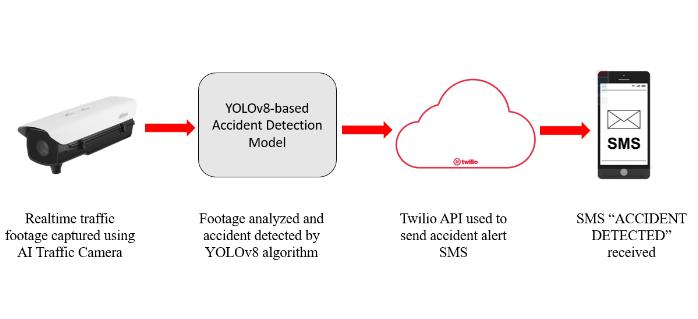
The integrated system combines AI-powered accident detection with cloud-based automated alerting, creating a completeend-to-endemergencyresponsepipeline.
Key Components
1. Video Processing Unit: Traffic camera footage is continuouslystreamedintothesystem,whereeach videoframeisconvertedintoananalysableformat usingOpenCV.
2. YOLOv8 Detection Model: YOLOv8 Trained on a customaccidentdatasetbuiltfromannotatedCCTV accidentfootage.Itdetectsvehicles,pedestrians,and crashpatterns.
International Research Journal of Engineering and Technology (IRJET) e-ISSN: 2395-0056
Volume: 12 Issue: 11 | Nov 2025 www.irjet.net p-ISSN: 2395-0072
3. Alert Control Module: Whenacrashis recognizedwithconfidence,thesystemforwards theincidentdetails(time,location,detection score)tothealertmodule.
4. Twilio SMS Notification: Twilio’scloudAPIsends SMSalertsdirectlytoemergencycontactnumbers. Thesystemensuresthatthealertisdispatched withinseconds,enablingrapidmobilizationof rescueteams.
This architecture ensures automatic detection, zero manual intervention, and fast and reliable alert delivery, making it suitable for deployment across city-wide surveillancenetworks.
3. Methodology
3.1 Dataset Creation
Acustomdatasetwasdevelopedusingrealaccidentfootage collectedfrompublicsources.
Over1000frameswereextractedusingOpenCV.
Frames were labelled using Labelling, annotating vehicles,pedestrians,andaccidentevents.
Data augmentation techniques (flipping, colour adjustments, resizing) strengthened the model’s robustness to different lighting and weather conditions.
3.2 Model Training
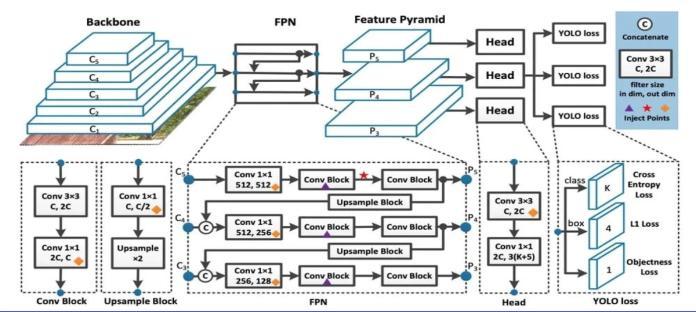
YOLOv8wasselectedduetoitssuperiordetection speedandlightweightarchitecture.
TrainingwasperformedinGoogleColabusingGPU accelerationforfastercomputation.
Themodellearnedtodifferentiatebetweennormal trafficflowandaccidentscenarios.
3.3 Real-Time Detection
Thetrainedmodelprocessesliveframesinrealtime.
YOLOv8 assigns confidence scores to detected objectsandidentifiescollisionevents.
Ifanaccident’sconfidencescoreexceedsthedefined threshold,thealertmechanismisactivated.
3.4 Automated Alerting
ThealertsystemusestheTwilioAPI,whichoffers:
Cloud-based,hardware-freemessaging
HighreliabilityandglobalSMSdelivery
EasyintegrationwithPython
Oncetriggered,thesystemsendsanSMScontaining:
Accidenttime
Location (if integrated with GPS or camera metadata)
Severityindicator
Theeventisalsologgedforauditandanalysis.
4. RESULTS
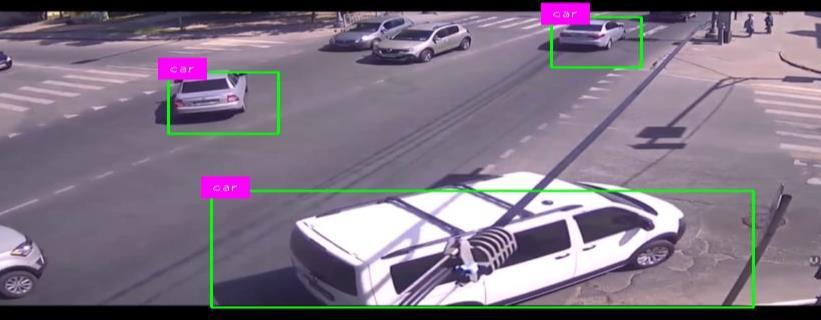
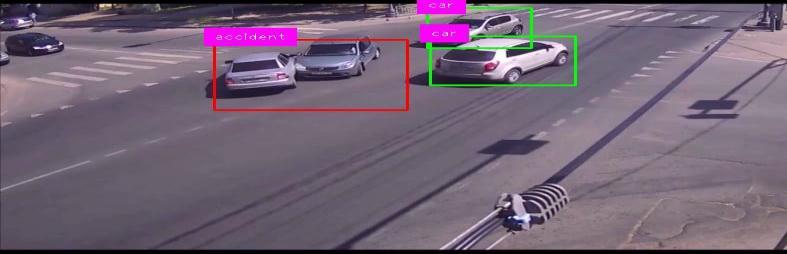
TheAccidentDetectionandAlertSystemdeliveredreliable performanceduringtesting.TheYOLOv8modelaccurately identifiedaccidenteventsinrealtime,highlightingcollision frames with consistent precision. The system maintained smooth video processing with minimal delay and stable framerates.Onceanaccidentwasdetected,theintegrated alert module automatically triggered an SMS notification withinseconds,ensuringrapidcommunicationtoemergency contacts. Overall, the system proved efficient, responsive, andcapableofoperatingcontinuouslywithhighaccuracy.
International Research Journal of Engineering and Technology (IRJET) e-ISSN: 2395-0056
Volume: 12 Issue: 11 | Nov 2025 www.irjet.net p-ISSN: 2395-0072
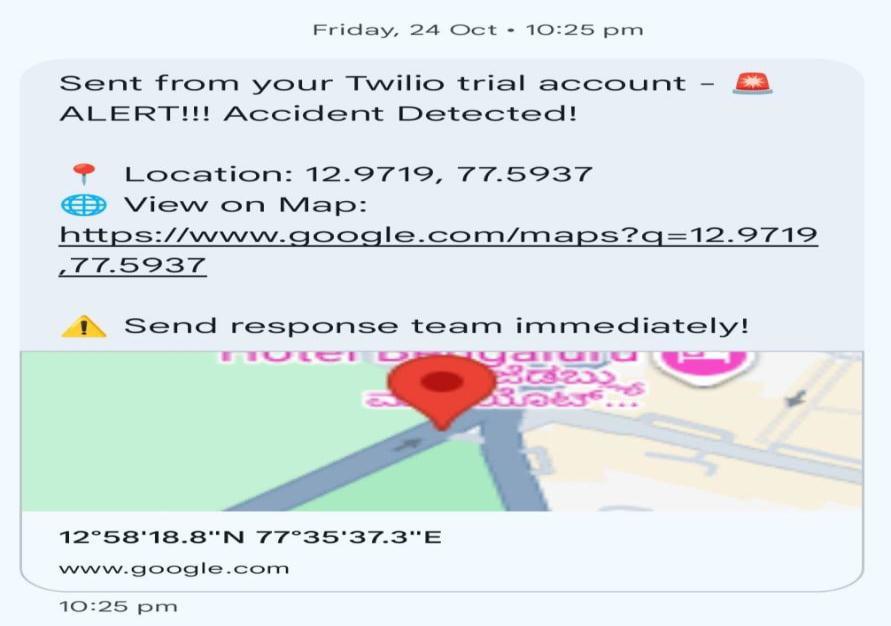
:AlertMessage
5. CONCLUSION
The project successfully demonstrates an automated accident detection solution that combines real-time video analysiswithaninstantalertmechanism.Byleveragingthe speed and accuracy of YOLOv8 along with a cloud-based messaging system, the solution significantly reduces the delaybetweenanaccidentandemergencynotification.The system is scalable, operates without human intervention, andenhancesthereliabilityoftrafficmonitoring.Itoffersa practicalandmodernapproachtoimprovingroadsafetyand enablingfasteremergencyresponse.
REFERENCES
[1] Sayed A. Sayed, Yasser Abdel-Hamid, Hesham Ahmed Hefny, Artificial Intelligence-Based Traffic Flow Prediction,Springer,2023,pp.45-78.
[2] XueyanYinetal.,DeepLearningforTrafficPrediction: Models,Applications,andChallenges,IEEETransactions onIntelligentTransportationSystems,IEEEPress,2020, pp.789-812.
[3] Wang S., Shao C., Zhang J., Zheng Y., Meng M., BidirectionalGatedRecurrentUnitModelforTrafficFlow Prediction, Journal of Intelligent Transportation Systems,Taylor&Francis,2022,pp.145-168
[4] Waymo&GoogleAITeam,IntegrationofMultimodalAI for Real-Time Traffic Prediction in Autonomous Vehicles,IEEEPress,2024,pp.200-225.
[5] HuangJ.,LiuY.,ZhaoP.,SpatiotemporalGraphNeural NetworksforTrafficFlowPrediction,ACMPress,2021, pp.99-120.