
International Research Journal of Engineering and Technology (IRJET) e-ISSN: 2395-0056
Volume: 13 Issue: 02 | Feb 2026 www.irjet.net p-ISSN: 2395-0072
International Research Journal of Engineering and Technology (IRJET) e-ISSN: 2395-0056
Volume: 13 Issue: 02 | Feb 2026 www.irjet.net p-ISSN: 2395-0072
5ANIL NAIK
1Student , Department of Computer Engineering, S.Y.P Shreeyash College of Engineering and Technology (Polytechnic) ,Aurangabad / Chh. Sambhajinagar , India.
2Student , Department of Computer Engineering, S.Y.P Shreeyash College of Engineering and Technology (Polytechnic) ,Aurangabad / Chh. Sambhajinagar , India.
3Student , Department of Computer Engineering, S.Y.P Shreeyash College of Engineering and Technology (Polytechnic) ,Aurangabad / Chh. Sambhajinagar , India.
4Guide(lecturer) , Department of Computer Engineering, S.Y.P Shreeyash College of Engineering and Technology (Polytechnic) ,Aurangabad / Chh. Sambhajinagar , India.
5HOD , Department of Computer Engineering, S.Y.P Shreeyash College of Engineering and Technology (Polytechnic) ,Aurangabad / Chh. Sambhajinagar , India.
Abstract - The integrity and transparency of electoral processes are critical in any democratic system. Traditional voting systems often face challenges such as voter fraud, vote manipulation, lack of transparency, and inefficiency in vote counting. Blockchain technology, with its decentralized, immutable, and transparent nature, offers a promising solution. This project proposes a Smart Contract-Based Voting System that leverages blockchain to conduct secure, tamper-proof, and transparent elections. Smart contracts automate the voting process, ensuring that each vote is recordedimmutablyandcountedaccuratelywithouttheneed foracentralauthority.Thesystemenablesvoterstocasttheir votes online securely while maintaining voter privacy and ensuringtheelectionresultsareverifiablebyallstakeholders. This approach enhances trust, reduces administrative overhead, and provides a scalable solution for modern electoral challenges.
Votingisthecornerstoneofdemocracy,allowingcitizensto express their preferences and influence decision-making. Traditional voting methods, including paper ballots and centralizedelectronicvotingmachines,arepronetoerrors, fraud,anddelaysinvotecounting.Inaddition,thesesystems oftenrequiresignificantadministrativeresourcestoensure accuracyandsecurity.
ASmartContract-BasedVotingSystemutilizesblockchain smartcontractstoautomateandenforcevotingrules.Smart contracts are self-executing programs that run on the blockchainandexecutepredefinedconditionsautomatically. Inthecontextofvoting,smartcontractscanmanagevoter registration, vote casting, vote tallying, and result declarationwithouthumanintervention.
Key benefits of a blockchain-based voting system include:
Security:Eachvoteiscryptographicallysecuredand immutable.
Transparency:Alltransactions(votes)arevisibleon theblockchainforverification.
Efficiency: Automatic vote counting reduces time andhumanerror.
Trust: Eliminates the need for a central authority andreducesthepossibilityoftampering.
This project aims to develop a secure, transparent, and decentralizedvotingsystemthatleveragessmartcontracts toenhancetheintegrityofelections,makingitsuitablefor governmental, organizational, and community-level elections.
Traditional voting systems, whether paper-based or electronic,faceseveralcriticalchallenges:
Fraud and Manipulation: Votescanbetampered withormiscountedduetocentralizedcontrol.
Lack of Transparency: Voters cannot independentlyverifythattheirvotewasrecordedor countedcorrectly.
Inefficiency: Manual vote counting is timeconsumingandpronetohumanerror.
Security Risks: Centralizeddatabasesofvotesare vulnerabletohackingorunauthorizedaccess.
Theseissuesreducepublictrustintheelectoralprocess.A secure, transparent, and decentralized voting system is required to ensure the integrity of elections, protect voter privacy,andstreamlinevotemanagement.
International Research Journal of Engineering and Technology (IRJET) e-ISSN: 2395-0056
Volume: 13 Issue: 02 | Feb 2026 www.irjet.net p-ISSN: 2395-0072
1. Voter Registration Module:
Votersregisterusingtheiruniqueidentity(e.g.,ID, email,orblockchainwallet).
Registration data is stored securely on the blockchainorasecuredatabase.
2. Smart Contract Layer:
Smart contracts manage the voting rules and processautomatically.
Responsibilitiesinclude:
Verifyingvotereligibility
Recordingvotesimmutably
Ensuringonevotepervoter
Countingvotesinreal-time
3. Voting Interface (Frontend):
Providesauser-friendlyinterfaceforvoterstocast theirvotes.
Interactswiththesmartcontracttosubmitvotes securely.
4 Block chain Network:
Actsasadecentralizedledgerwherevotesare recorded.
Ensures transparency, immutability, and auditabilityofallvotes.
Result Declaration Module:
Automaticallytalliesvotesusingsmartcontracts.
Publishesresultsontheblockchain,allowing anyonetoverifythem.
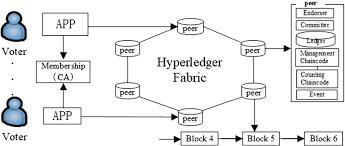
BLOCKCHAIN OF SMART
1.Voters (Users)
These are the participants who want to cast their votes.
Eachvoterinteractswiththevotingsystemthrough an application (APP).
2. Membership (CA - Certificate Authority)
Before voting, each voter must be authenticated and authorized bythe Certificate Authority (CA)
TheCAissuesdigitalcertificatestovoters,verifying theiridentityandeligibility.
This ensures that only registered and legitimate voterscanparticipate.
3. Application (APP)
TheAPPactsasthe user interface forvoters.
Votersusetheapptoregister,authenticate,andcast theirvotes.
The app communicates with the underlying blockchainnetworktosubmitandretrievedata.
4. Hyperledger Fabric Network
Thecoreofthesystemisthe Hyperledger Fabric blockchain, which is a permissioned blockchain framework.
It consists of several peers (nodes), each representing an organization or entity in the network.
5. Peers
Peers maintain the ledger and smart contracts (called chain code inFabric).
Theyvalidateandrecordtransactions(votes)onthe blockchain.
Peers communicate with each other to keep the ledgerconsistentandsynchronized.
6. Transaction Flow in Hyperledger Fabric
When a voter casts a vote, the APP sends the transactionproposaltothepeers.
Peers endorse the transaction by executing the smartcontractandverifyingthevotevalidity.
Once endorsed, the transaction is sent to the Ordering Service tobeorderedandgroupedinto blocks.
7. Ordering Service (Order)
Theordercollectsendorsedtransactionsfrompeers.
Itsequencestransactionsintoblocksanddistributes thembacktopeersinthenetwork.
8. Ledger
The ledger is the blockchain itself, where all validatedtransactions(votes)arestoredimmutably.
Theledgercontainstwoparts:
International Research Journal of Engineering and Technology (IRJET) e-ISSN: 2395-0056
Volume: 13 Issue: 02 | Feb 2026 www.irjet.net p-ISSN: 2395-0072
o Blockchain: Sequenceofblockscontaining transactions.
o World State: Thecurrentstateofthedata, suchasthetallyofvotesorvoterstatuses.
9. Manage Chaincode (Smart Contract)
Chaincodeenforcesvotingrulessuchas:
o Onevotepervoter
o Validcandidateselection
o Votetallyinglogic
Thechaincoderunsonpeersandisinvokedduring transactionendorsement.
10. Counting Chaincode & Event
Thecountingchaincodehandlestheaggregationand countingofvotes.
Eventscanbeemittedfromtheblockchaintonotify theapplicationoradministratorsabouttransaction statusesorfinalresults.
11. Blocks (Block 4, Block 5, Block 6, ...)
Transactionsaregroupedintoblocksbytheorderer.
Each block is appended sequentially to the blockchain ledger, ensuring data integrity and traceability.
Execution Flow-
1. User Registration and Authentication
o Votersregisterthroughthe Membership Service Provider (CA), which issues digitalcertificatesconfirmingtheiridentity andeligibility.
o Only authenticated voters can access the votingapp.
2. Voting via Application (APP)
o VoterslogintotheAPPand choosetheir preferredcandidate.
o TheAPPpackagesthevoteasatransaction proposal and sends it to the blockchain networkpeers.
3. Transaction Endorsement
o Peersreceivethetransactionproposaland simulatethesmartcontract(chaincode)to verifythevote(e.g.,checkvotereligibility, preventdoublevoting).
o If valid, peers endorse the transaction by signingit.
4. Transaction Ordering
o Endorsed transactions are sent to the Ordering Service, which sequences and batchesthemintoblocks.
5. Block Distribution and Ledger Update
o Blocksaredistributedtoallpeers.
o Peers validate the block and append it to theirlocalcopyoftheblockchainledger.
o Theledgernowholdsanimmutablerecord ofthevote.
6. Vote Counting and Result Declaration
o Chaincode handles vote tallying automaticallybasedonrecordedvotes.
o The system emits events or updates that can be accessed by administrators and votersfortransparentverification.
Table:-System Specifications and Development Prameters
Hardwarerequirements Processor, RAM, Storage , Internet,Device
SoftwareRequirements OS, Solidity, JavaScript, Node.js, React.js, GitHub, Blockchain,HTML,CSS
Development Parameters BlockchainPlatformSelection (Ethereum,Hyperledger)
SecurityParameters Cryptographichashing
Module Description
1. Voter Registration Module
Handlesvoterenrollmentandidentityverification viatheCertificateAuthority(CA).
Issues digital certificates used to authenticate votersontheblockchainnetwork.
2. Voting Application (APP) Module
Userinterfacethatallowsvoterstosecurelylogin andcasttheirvotes.
Communicates with the blockchain network by sending transaction proposals and receiving feedback.
3. Smart Contract (Chaincode) Module
Implementsvotingrules:onevotepervoter,valid candidateselection,andvotetallyinglogic.
Runsonpeersduringtransactionendorsementto validateandprocessvotes.
Updatestheworldstateandblockchainledgerwith votesandresults.
4. Peer Node Module
Executes chaincode to validate and endorse transactions.
International Research Journal of Engineering and Technology (IRJET) e-ISSN: 2395-0056
Volume: 13 Issue: 02 | Feb 2026 www.irjet.net p-ISSN: 2395-0072
Maintainsacopyoftheblockchainledgerandworld state.
Participatesinconsensusandsharesledgerupdates withotherpeers.
5. Ordering Service Module
Collectsendorsedtransactionsfrompeers.
Orders and batches transactions into blocks to ensureaconsistenttransactionsequence.
Distributesblockstoallpeersforledgerupdate.
6. Ledger Module
Stores the blockchain (immutable record of all transactions) and the world state (current vote countsandvoterstatuses).
Providestransparencyandauditabilitybyallowing stakeholderstoverifytheelectionresults.
7. Event Notification Module
Emits events during key processes, such as vote submission confirmation and result announcements.
Allows real-time updates and notifications to the APPandelectionadministrators
The Smart Contract-Based Voting System built on HyperledgerFabricoffersarobustandtrustworthysolution tomanychallengesfacedbytraditionalvotingmethods.By leveragingblockchain’sdecentralization,immutability,and transparency, this system ensures secure voter authentication,tamper-proofvoterecording,andautomated, accurate vote counting. The use of smart contracts eliminatestheneedforintermediaries,reducestheriskof fraud, and allows all stakeholders to independently verify electionresults.Overall,thisapproachenhancestheintegrity andefficiencyoftheelectoralprocess,makingitwell-suited formoderndemocraticsystemsandvariousorganizational voting scenarios. Future improvements may focus on scalability, user experience, and integration with other digitalidentityplatformstofurtherstrengthenthesystem’s usabilityandsecurity.
1. S. Nakamoto, “Bitcoin: A Peer-to-Peer Electronic Cash System,”2008.[Online].Available: https://bitcoin.org/bitcoin.pdf
2.HyperledgerFabricDocumentation,Hyperledger,[Online]. Available:https://hyperledgerfabric.readthedocs.io/en/latest/
3. M. Castro and B. Liskov, “Practical Byzantine Fault Tolerance,”OSDI’99ProceedingsoftheThirdSymposiumon OperatingSystemsDesignandImplementation,1999.
4. A. Kiayias, A. Russell, B. David, and R. Oliynykov, “Ouroboros: A Provably Secure Proof-of-Stake Blockchain Protocol,”Crypto,2017.
5.Z.Zheng,S.Xie,H.Dai,X.Chen,andH.Wang,“AnOverview of Blockchain Technology: Architecture, Consensus, and Future Trends,” 2017 IEEE International Congress on Big Data,2017.
6. J. Jaiswal and A. Yadav, “Blockchain-based E-voting SystemtoMakeElectionTransparent,”InternationalJournal ofComputerApplications,vol.180,no.16,pp.31–36,2018.
7. E.Androulakietal.,“HyperledgerFabric:ADistributed Operating System for Permissioned Blockchains,” ProceedingsoftheThirteenthEuroSysConference,2018.
8. S. Kshetri, “1 Blockchain’s roles in meeting key supply chain management objectives,” International Journal of InformationManagement,vol.39,2018,pp.80–89.
9. V. Buterin, “A Next-Generation Smart Contract and DecentralizedApplicationPlatform,”EthereumWhitePaper, 2013.[Online].Available: https://ethereum.org/en/whitepaper/
1.MS. NISHAD SAYYED
PursuingPoly(CO)
S.Y.P.SHREEYASHCOLLEGEOFENGINEERING ANDTECHNOLOGY(POLYTECHNIC)
2.MS .SAYALI MIRGE
PursuingPoly(CO)
S.Y.P.SHREEYASHCOLLEGEOFENGINEERING ANDTECHNOLOGY(POLYTECHNIC)
3.MS. RAJESHWARI SATPUTE PursuingPoly(CO)
S.Y.P.SHREEYASHCOLLEGEOFENGINEERING ANDTECHNOLOGY(POLYTECHNIC)
4.Ms.Prof.RACHANA KSHIRSAGAR Dept.OfComputerEngineering
S.Y.P.SHREEYASHCOLLEGEOFENGINEERING ANDTECHNOLOGY(POLYTECHNIC)
5.Mr.Prof.ANIL NAIK Dept.OfComputerEngineering
S.Y.P.SHREEYASHCOLLEGEOFENGINEERING ANDTECHNOLOGY(POLYTECHNIC)