
International Research Journal of Engineering and Technology (IRJET) e-ISSN: 2395-0056
Volume: 12 Issue: 11 | Nov 2025 www.irjet.net p-ISSN: 2395-0072
International Research Journal of Engineering and Technology (IRJET) e-ISSN: 2395-0056
Volume: 12 Issue: 11 | Nov 2025 www.irjet.net p-ISSN: 2395-0072
Riyaj Mulla1 , Akshay Managave2 , Santosh Dugane3 , Sammed Badde4, Mrs.P.P.Mane5
Department of Computer Engineering, Sharad Institute of Technology, College of Engineering, Yadrav, Maharashtra, India
Abstract - This paper presents the design and implementation of Smart Attendance, an automated attendance management system that uses artificial intelligence and facial recognition. The system identifies students in real time through a webcam and marks attendance automatically without manual effort. A webbasedinterfaceallowsteachersto view,edit,anddownload daily reports, while all data are stored securely in a centralized database. The system reduces human error, saves time, and provides accurate tracking of attendance. Experimental use in a classroom environment showed that the proposed approach achieves high recognition accuracy andsimplifiestheoverallprocessofattendancemonitoring.
KeyWords: Attendancesystem,facialrecognition,web application, artificial intelligence, automation, databasemanagement
1.INTRODUCTION
Attendance plays an important role in educational institutions as it reflects student participation and discipline. Traditional attendance methods such as roll calls or manual registers are time-consuming, prone to mistakes, and difficult to maintain. With increasing digitalization, there is a growing demand for smart systems that can automate this routine task. Smart Attendance is developed to overcome these issues by applying artificial intelligence and face recognition technology. The system captures a student’s face image, verifies identity with the existing database, and records attendance automatically. The collected data can be viewed online by teachers and administrators through a simplewebinterface.Themaingoalofthisworkistosave time, ensure accuracy, and minimize manual effort in the attendance process. With the introduction of modern technologies such as artificial intelligence and machine learning, it has become possible to automate repetitive academic tasks efficiently. The Smart Attendance system aims to combine face recognition, web-based user interaction, and secure data handling in one unified platform.Itnotonlyhelpsindailyrecordmaintenancebut also supports teachers by automatically generating attendance summaries and reducing paperwork. The use of web technologies makes the system portable and accessiblefromanydevicewithinthenetwork.
Manual attendance tracking leads to inefficiency and inaccuracy. Teachers spend a considerable amount of lecture time marking attendance, which reduces effective teaching hours. Smart systems using artificial intelligence canautomatethisrepetitiveprocessandimproveaccuracy andconvenience
The objective of the Smart Attendance system is to minimize manual effort, ensure real-time attendance marking, and maintain secure digital records. It also aims to provide a web-based dashboard for teachers to view, edit,anddownloadreportseasily.
The Smart Attendance system follows a modular architecture consisting of four major parts: face detection andrecognition,databasemanagement,webinterface,and reporting.
The system uses a laptop or external webcam to capture live images of students. Faces are detected using the OpenCV library and encoded through a deep learningbasedrecognitionmodel.Eachfaceismatchedwithstored records in the database, and attendance is marked automatically once the match is confirmed. The frontend of the web application is built using HTML, CSS, and JavaScript to create a user-friendly interface. The backendisdevelopedinPythonusingtheFlaskframework, whileMySQLisusedforsecuredatastorage.Teacherscan log in to check attendance statistics, generate reports, and export data in Excel format. The system also includes an adminmoduleformanagingstudentrecords.
The Smart Attendance workflow begins when the camera capturesliveimagesoftheclassroom.Thecapturedimage isprocessedbytherecognitionmodulethatextractsfacial features using a pretrained deep learning model. These featuresarecomparedwithstoredencodingsofregistered students. Once a match is found, the student’s ID and timestamp are recorded automatically in the database. In case of multiple faces, the system handles recognition sequentiallytoensureeverystudentismarkedonlyonce.
International Research Journal of Engineering and Technology (IRJET) e-ISSN: 2395-0056
Volume: 12 Issue: 11 | Nov 2025 www.irjet.net p-ISSN: 2395-0072
The major components of the system include:
1.Cameramoduleforimageacquisition
2.Facedetectionandrecognitionmodule
3.Databaseandstoragesystem
4.Webdashboardformonitoringandreports
Figure1showstheoverallarchitectureoftheSmart Attendancesystem.
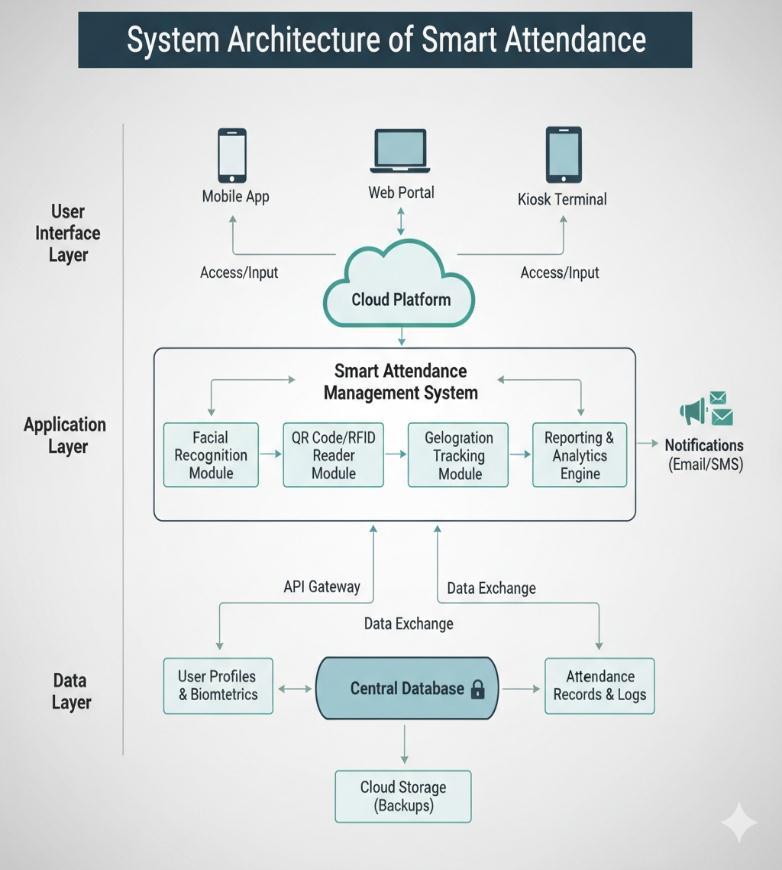
Figure1:SystemArchitectureofSmartAttendance
Table 1: shows the comparison between the traditional manualsystemandtheSmartAttendancesystem.
The comparison in Table 1 highlights how automation significantly improves efficiency and reliability. The proposed system reduces manual effort, prevents duplication, and maintains a complete record of attendanceforfutureanalysis.
Table 1: ComparisonbetweenManualandSmart AttendanceSystems
Averagetime
The prototype of Smart Attendance was tested in a classroomwithmultiplestudents.Thesystemsuccessfully detectedandrecognizedmostfacesundernormallighting conditions. The average recognition accuracy obtained wasabout95%,andattendancemarkingtimeperstudent was less than two seconds. Compared with manual entry, the automated method reduced processing time by more than 70%. The web interface allowed easy monitoring of attendance records and reduced the possibility of duplicate entries. The systemperformedconsistentlyacrossseveraltestsessions and proved to be an efficient alternative to conventional methods.
In addition to recognition accuracy, the usability of the system was also evaluated through user feedback from teachers. Most users reported that the interface was easy tooperateandrequiredminimaltechnicalknowledge.The systemcouldhandleuptofiftystudentsinasinglesession without any noticeable delay. Even under varying light conditions, the recognition process maintained stable performance. Thedatabase queriesand reportgeneration features worked smoothly on both laptop and desktop environments,demonstratingthescalabilityofthesystem.
The system performance slightly varied depending on camera quality and lighting conditions. Under low light, recognition accuracy decreased by around 5%. However, overallsystemstabilityremainedhigh,andtheapplication continued to record attendance without interruption. The
International Research Journal of Engineering and Technology (IRJET) e-ISSN: 2395-0056
Volume: 12 Issue: 11 | Nov 2025 www.irjet.net p-ISSN: 2395-0072
results confirm that Smart Attendance can operate effectivelyinnormalclassroomenvironments.
4. Conclusion
SmartAttendanceprovidesareliableandefficientsolution for automating attendance in educational institutions. It eliminates the need for manual registers, minimizes human errors, and ensures real-time record keeping. The integration of AI and web technology makes the system scalable and adaptable for larger classrooms or corporate environments. The proposed system successfully reduces manual effort, improves accuracy, and enhances overall managementefficiencyinattendancetracking.
TheauthorswouldliketoexpresssinceregratitudetoDr. S. Debnath for valuable guidance and support throughout the development of this project. The authors also thank Sharad Institute of Technology, College of Engineering, Yadrav, for providing resources and encouragement duringthiswork.
[1] IEEE Paper Template. IEEE Conferences. Available at:https://www.ieee.org/conferences/publishing/tem plates.html
[2] M. Turk and A. Pentland, “Face recognition using eigenfaces,” Proceedings of the IEEE Conference on ComputerVisionandPatternRecognition,1991.
[3] Kumar and S. Singh, “Automated attendance system using facial recognition,” International Journal of ComputerApplications,vol.182,no.32,2020.
[4] IRJETOfficialWebsite,https://www.irjet.net/
[5] R. Kumar et al., “A web-based student attendance management system,” International Journal of AdvancedResearchinComputerScience,vol.11,no.5, 2020.