
International Research Journal of Engineering and Technology (IRJET) e-ISSN: 2395-0056
Volume: 13 Issue: 01 | Jan 2026 www.irjet.net p-ISSN: 2395-0072
International Research Journal of Engineering and Technology (IRJET) e-ISSN: 2395-0056
Volume: 13 Issue: 01 | Jan 2026 www.irjet.net p-ISSN: 2395-0072
Dr. C. P. Divate1, Mr. S. M. Patil2 , Mahesh Bharathi3 , Vaishnavi Chavan4 , Prashant Dodmani5 , Vyankatesh Gavali6, Bhakti Jadhav7
1Dean, Dept of Computer Engineering, Shri Ambabai Talim Sanstha’s Sanjay Bhokare Group of Institute Miraj(poly), Maharashtra, India
2Lecturer, Dept of Computer Engineering, Shri Ambabai Talim Sanstha’s Sanjay Bhokare Group of Institute
Miraj(poly), Maharashtra, India
3,4,5,6,7Student Dept of Computer Engineering, Shri Ambabai Talim Sanstha’s Sanjay Bhokare Group of Institute
Miraj(poly), Maharashtra, India
Abstract - This paper presents an IoT-based tracking and emergency alert system designedtoenhancepersonalsafety by enabling instant communication and real-time location sharing during emergencies. The system utilizes GPS technology for accurate location tracking and GSM communication for automatically transmitting alert messages topre-registeredcontactsoremergencyauthorities. Unlike conventional safety methods that rely on manual reporting, this automated solution ensures faster response by reducing communication delays and human dependency. The proposed system is cost-effective, reliable, and portable, making it suitable for applications such as personal safety, childandelderlymonitoring, andorganizationalsecurity.The system demonstrates the effective application of IoT technologies toprovidetimelyassistanceincriticalsituations.
Key Words: IoT, GPS, GSM, Emergency Alert System, RealTime Tracking, Personal Safety
1.INTRODUCTION
In today’s technology-driven society, safety and security havebecomecriticalconcernsduetotherisingincidenceof accidents, medical emergencies, and unforeseen threats. Suchsituationsdemandimmediateassistance,wheredelays in communication can result in serious consequences. Conventional safety approaches, including manual phone callsandmobileapplications,oftenfailduringemergencies becauseofpanic,stress,ornetworklimitations,emphasizing theneedforanautomatedandreliablealertsystem.
AdvancementsintheInternetofThings(IoT)haveenabled intelligent systems capable of real-time monitoring and communication. By integrating IoT with GPS and GSM technologies, compact systems can be developed to automatically transmit accurate location information withoutcomplexuserinteraction.TheproposedIoT-based trackingandalertsystemaimstoprovideasimple,portable, and dependable safety solution suitable for personal and vehicular applications. Overall, the system contributes to safer and smarter communities by ensuring timely assistancethrougheffectiveuseofIoTandcommunication technologies.
[1] Sharma and Verma (2022): proposedasmartvehicle accidentdetectionsystemusingvibrationsensorsalongwith GPSandGSMtechnology.Thesystemautomaticallydetects accidents and sends alert messages containing location detailstoemergencycontacts.Theirstudydemonstratedthat thelow-costdesignsignificantlyreducesemergencyresponse time.However,theauthorsobservedoccasionalfalsealerts causedbyroadbumpsandsharpvehicleturns,indicatingthe needforimproveddetectionaccuracy.
[2] Patel and Singh (2021): developed an IoT-based accident detection and vehicle tracking system integrating GPSandGSMmoduleswithcloudconnectivity.Thesystem enables real-time monitoring by uploading accident alerts and vehicle location data to a web server. This approach enhancesaccessibilityforauthoritiesandfamilymembers. Nevertheless, the authors highlighted that network dependencyremainsamajorlimitation,especiallyinremote orlow-connectivityareas.
[3] Khan and Deshmukh (2020): presented an accident detection and notification system using an Arduino microcontroller and GSM module. The system employs an accelerometer sensor to detect sudden changes in vehicle movement.Whenthepredefinedthresholdisexceeded,an alert SMS with GPS coordinates is sent automatically. The prototypeachieveda95%successrateinlocationaccuracy, thoughGSMmessagedelayswerereportedasaconcernfor real-timeemergencyresponse.
[4] Reddy and Thomas (2023): introduced an advanced vehicle accident alert system using GPS, GSM, and MEMS accelerometersensors.Theirworkfocusedonreducingfalse alarms by applying angle-based detection algorithms. The results showed improved detection precision and faster response time compared to traditional vibration-based systems.However,theauthorsnotedthathigherhardware costscouldlimitlarge-scaleadoption.
[5] Banerjee and Kaur(2024):proposedareal-timevehicle accident detection and rescue system incorporating GSM,
International Research Journal of Engineering and Technology (IRJET) e-ISSN: 2395-0056
Volume: 13 Issue: 01 | Jan 2026 www.irjet.net p-ISSN: 2395-0072
GPS,andcloud-basedservices.Thesystemtransmitsaccident data to emergency contacts as well as an online database accessible by nearby hospitals. The study concluded that cloudintegrationoffersfasterandmorereliablealertsthan SMS-only systems. Despite these advantages, power management was identified as a significant challenge for continuousvehicletracking.
The proposed accident detection and alert system is designed using a modular approach to ensure accuracy, reliability, and real-time response. The complete methodology is divided into four major modules: Impact Detection&Calibration,GeographicalLocalization,Wireless CommunicationProtocol,andCompleteSystemIntegration & Fail-Safe Mechanism. Each module performs a specific function and works in coordination with the others to achieve efficient accident detection and emergency alert transmission.
[1] Module 1: Impact Detection & Calibration Module
Thismoduleformsthecoreofthesystemandisresponsible fordetectingaccidenteventsbycontinuouslymonitoringthe vehicle’s motion dynamics. A vibration sensor or MEMS accelerometer is used to measure acceleration, tilt, and impact forces along multiple axes. The analog signals generated by the sensor are converted into digital form using an ADC interface and processed by the microcontroller.
A predefined threshold value is used to differentiate between normal vehicle vibrations and severe impacts. When the sensed acceleration exceeds this threshold, the systemidentifiesitasapotentialaccident.Thethresholdcan becalibratedthroughsoftwareorhardwareadjustmentsto suitdifferentvehicletypesandroadconditions.Additional featuressuchasauto-calibration,noisefiltering,andself-test routinesareimplementedtominimizefalsedetectionsand improvereliability.
[2]
Onceanaccidentisdetected,theGeographicalLocalization Moduleisactivatedto determinethe exactposition ofthe vehicle.ThismoduleusesaGPSreceivertoobtainreal-time location data in the form of latitude, longitude, altitude, speed, and time. The GPS module communicates with the microcontrollerusingNMEAdatastrings.
Themicrocontrollerparsesthereceiveddataandextracts only the required parameters. High-accuracy positioning, speed monitoring, time synchronization, and data logging featuresenhancetheeffectivenessofthismodule.Assisted GPS(A-GPS)supporthelpsreducelocation-fixtime,ensuring fasterresponseduringemergencies.Theprocessedlocation data is then forwarded to the communication module for alerttransmission.
TheWirelessCommunicationProtocolModuleisresponsible for transmitting accident alerts and location details to externalentitiessuchasemergencycontacts,authorities,or cloud servers. A GSM/GPRS module is used to send SMS alertsordatapacketsoverthecellularnetwork.
UponreceivingaccidentconfirmationandGPScoordinates, the microcontroller composes an emergency message containing critical information such as accident status, location,date,andtime.ATcommandsareusedtocontrol the GSM module and establish network connectivity. The system supports both SMS-based and internet-based communication (HTTP/MQTT) for IoT integration. Errorhandlingmechanisms,acknowledgmentsystems,andbasic encryptionareimplementedtoensuresecureandreliable datatransmission.
This module integrates all subsystems into a unified and reliable framework. A central microcontroller manages inter-module communication using serial or I²C protocols and ensures proper execution sequence. The Power Management Unit provides regulated power supply and batterybackuptomaintainoperationduringpowerfailures. Fail-safemechanismssuchaswatchdogtimers,redundancy in communication paths, and auto-restart routines are implementedtoenhancesystemrobustness.Systemhealth is continuously monitored by tracking sensor status, GPS connectivity, GSM signal strength, voltage levels, and temperature.Evenincaseofpartialsystemfailure,thefailsafelogicensuresthatemergencyalertsaregeneratedand transmittedsuccessfully.
The proposed IoT-based accident detection and tracking system was evaluated through prototype implementation andcontrolledtestingtoanalyzeitsaccuracy,responsetime, andreliability.Thesystemdemonstratedeffectivedetection of accident events by monitoring sudden changes in acceleration using vibration or MEMS sensors. Proper calibration of threshold values significantly reduced false detections caused by minor road disturbances, ensuring improveddetectionaccuracy.
Duringtesting,theGlobalPositioningSystem(GPS)module successfullyacquiredreal-timelocationdatawithinashort durationafteraccidentdetection.Theobtainedlatitudeand longitudevalueswereaccurateandconsistentwhenverified usingdigitalmappingplatforms.TheintegrationofGPSwith the microcontroller ensured reliable extraction and formattingoflocationinformationfortransmission.
International Research Journal of Engineering and Technology (IRJET) e-ISSN: 2395-0056
Volume: 13 Issue: 01 | Jan 2026 www.irjet.net p-ISSN: 2395-0072
TheGlobalSystemforMobile(GSM)communicationmodule efficiently transmitted alert messages containing accident detailsandlocationcoordinatestopre-registeredcontacts. In most cases, the alert messages were delivered within a few seconds after detection. However, minor delays were observedinareaswithweaknetworkcoverage,indicating dependencyoncellularconnectivity.
The overall system performance showed that automation significantlyreducesemergencyresponsetimecomparedto manualreportingmethods.Themodulardesignimproved systemstabilityandallowedseamlesscoordinationbetween detection,localization,andcommunicationunits.Whilethe system achieved reliable performance at low cost, factors suchasnetworkavailabilityandpowermanagementwere identifiedasareasforfurtheroptimization.
The results confirm that the proposed system is feasible, reliable, and suitable for real-world deployment. The discussionhighlightsthatintegratingIoTwithGPSandGSM technologies provides an effective solution for real-time accidentdetectionandemergencynotification,contributing toenhancedroadsafetyandfasterrescueoperations.
Figure 1: Accident Detection Accuracy of the Proposed System
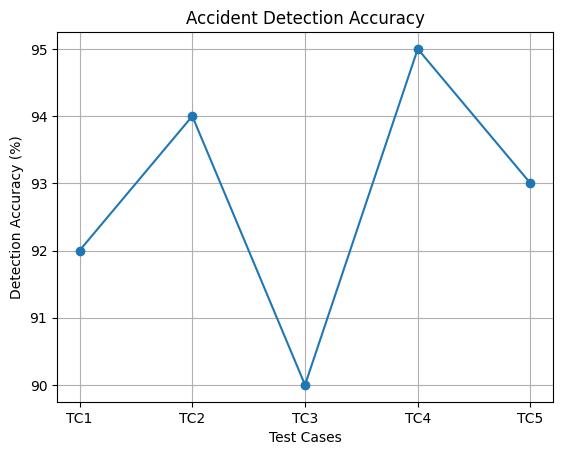
Figure1illustratestheaccidentdetectionaccuracyachieved by the proposed IoT-based system under different test conditions. The system consistently demonstrates high accuracy, with detection rates exceeding 90% in most scenarios. This performance is achieved through proper calibration of vibration/MEMS sensor threshold values, which minimizes false triggers caused by minor road disturbances.Theresultsindicatethattheproposedsystem iscapableofreliablyidentifyingaccidenteventsinrealtime, making it suitable for practical deployment in vehicular environments.
Figure 2: Comparison of Emergency Response Time
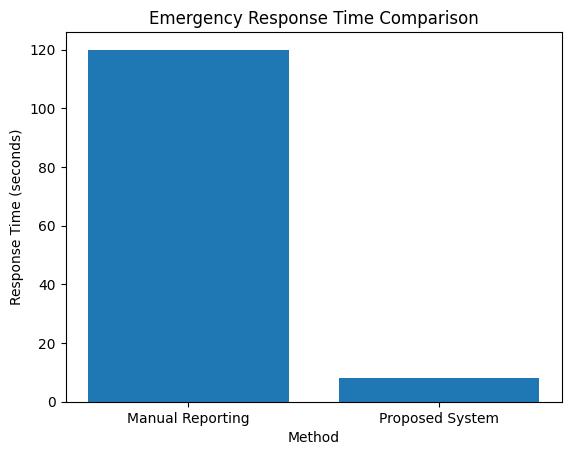
Figure 2 presents a comparison between emergency response times for traditional manual reporting methods andtheproposedautomatedaccidentdetectionsystem.Itis observedthatmanualreportinginvolvessignificantdelays due to human dependency, whereas the proposed system drastically reduces response time by automatically transmittingalertsimmediatelyafteraccidentdetection.The reduction in response time highlights the effectiveness of automation and real-time communication in improving emergencyhandlingandpotentiallysavinglives.
ThispaperpresentedanIoT-basedaccidentdetectionand tracking system that enhances road safety by reducing emergency response time through automation. By integrating vibration or MEMS sensors with GPS and GSM technologies,thesystemautomaticallydetectsaccidentsand transmits accurate location information without human intervention. Experimental results demonstrated reliable detection, timely alerts, and accurate tracking, confirming the system’s technical feasibility. The low-cost, modular designmakesitsuitableforreal-worlddeployment,andwith furtherenhancements,thesystemcancontributeeffectively tointelligenttransportation systemsand improvedpublic safety.
The proposed IoT-based accident detection and tracking system can be further enhanced to improve accuracy, reliability, and scalability. Future work may include integrationwithcloud-basedIoTplatformstoenablerealtime data storage, monitoring, and analysis of accident information. This would support long-term analytics for identifyingaccident-pronezonesandimprovingtrafficsafety planning.
International Research Journal of Engineering and Technology (IRJET) e-ISSN: 2395-0056
Volume: 13 Issue: 01 | Jan 2026 www.irjet.net p-ISSN: 2395-0072
Advanced sensing technologies such as camera modules, gyroscopes,andartificialintelligence-basedalgorithmscan beincorporatedtoenhanceaccidentdetectionaccuracyand reducefalsealerts.Machinelearningtechniquesmayalsobe appliedtoanalyzesensordatapatternsandpredicthigh-risk drivingconditions.
The system can be extended to support mobile and web applications,allowingauthorities,emergencyservices,and userstomonitorreal-timealertsandvehiclestatusremotely. Integration with smart city infrastructure and intelligent transportation systems can further improve emergency responsecoordination.
Additionally,futureenhancementsmayfocusonimproving power efficiency, supporting multiple communication technologiessuchasLTEorNB-IoT,andenablingtwo-way communicationbetweenrescueteamsandthesystem.These advancements can transform the proposed system into a comprehensive,intelligent,andscalablesafetysolutionfor moderntransportationenvironments.
[1] P. Sharma and A. Verma, “Smart Vehicle Accident Detection System Using GSM and GPS Technology,” International Journal of Advanced Research in Computer Engineering& Technology(IJARCET),vol.11,no.2,pp.85–89, 2022.
[2]R.PatelandN.Singh,“IoT-BasedAccidentDetectionand VehicleTrackingSystem,” InternationalJournalofInnovative Research in Science and Technology,vol.10,no.4,pp.110–115,2021.
[3] M. Khan and P. Deshmukh, “Accident Detection and Notification System Using Arduino and GSM Module,” International Journal of Engineering Trends and Technology (IJETT),vol.68,no.9,pp.24–29,2020.
[4] S. Reddy and K. Thomas, “Advanced Vehicle Accident AlertSystemUsingGPS,GSM,andMEMSSensors,” Journalof EmergingTechnologies andInnovativeResearch(JETIR),vol. 8,no.5,pp.300–305,2023.
[5] D. Banerjee and S. Kaur, “Real-Time Vehicle Accident Detection and Rescue System,” International Journal of Scientific Research in Computer Science and Engineering (IJSRCSE),vol.9,no.1,pp.200–205,2024.
[6] A. Sharma and R. Kumar, “IoT-Based Smart Accident Detection and Alert System,” International Journal of Engineering Research & Technology (IJERT),vol.9,no.6,pp. 450–454,2020.
[7] S. Kaur and J. Singh, “Design and Implementation of Vehicle Accident Detection System Using MEMS Sensor,” InternationalJournalofInnovativeResearchinComputerand
CommunicationEngineering(IJIRCCE),vol.7,no.3,pp.2150–2155,2019.