
International Research Journal of Engineering and Technology (IRJET) e-ISSN:2395-0056
Volume: 12 Issue: 11 | Nov 2025 www.irjet.net p-ISSN:2395-0072
International Research Journal of Engineering and Technology (IRJET) e-ISSN:2395-0056
Volume: 12 Issue: 11 | Nov 2025 www.irjet.net p-ISSN:2395-0072
Mrs. S. Cynthia Juliet1 , S. M. Sindhu2
1Assistant Professor & Head, Department of Computer Applications, Jaya College of Arts & Science, Chennai. 2PG Student, Department of Computer Applications, Jaya College of Arts & Science, Chennai.
Abstract - Skin analysis is an important process in dermatology and cosmetology because it plays a significant role in diagnosing various skin conditions and identifying suitable skincare routines. Dermatologists' subjective and inconsistent visual judgment is a major component of traditional skin examination techniques. Automated skin analysishasdrawnalotofattentionwiththedevelopmentof AI and computer vision because it offers a dependable, effective, and scalable solution. In this paper, a deep learning-drivenskinanalysissystemthatusesfacialimages to predict skin type and identify common skin issues is proposed. To identify several skin conditions at once, the system makes use of preprocessing, skin segmentation, convolutional neural networks, and multi-label classification. Dermatology clinics, cosmetic companies, and consumer applications can benefit from the suggested solution's increased dependability, decreased manual labor, andreal-timeanalysis.
Keywords: Computer Vision, Skin Type Classification, Skin Problem Prediction, Deep Learning, Image Processing, CNN Models, Dermatology AI, Feature Extraction, Mobile Skin Analysis, Health Monitoring System
Determining the right skincare treatments requires understanding skin types and identifying skin issues. But manual skin diagnosis takes a lot of time and expertise. People frequently misjudge their own skin type, which leads to inappropriate product use that can exacerbate skin conditions. Automated skin analysis using computer vision has become a feasible and affordablesolution with thegrowingavailabilityofhigh-resolutionmobilecameras. Skin texture, color variations, oiliness, pore interpretability, this paper presents a workable, scalable method for developing customer behavior prediction systems that support both batch and near-real-time use cases. By applying deep learning models, it is possible to detect subtle differences that might go unnoticed by the human eye. The combination of CNNs and transfer learning allows machines to learn complex patterns from thousands of facial images. With the help of a straightforwardmobile photo,userswill be able to obtain an immediate and customized skin assessment, bridging
thegapbetweensophisticateddermatologytoolsanddaily skincarerequirements.
[1].Manystudieshaveusedcomputervisiontechniquesto analyze skin images for detecting texture, color changes, and visible skin issues. Earlier research used basic image processing methods like filtering and segmentation to identifyproblemssuchasrednessoracne.
[2]. Recent works show that deep learning models, especiallyCNNs,canpredictskindiseasesmoreaccurately than traditional methods. Researchers used networks like VGG, ResNet, and MobileNet to classify skin conditions fromfacialimages.
[3]. Some studies focused on building mobile applications thatallowuserstotakeaphotoandgetdiagnosticresults. These systems use lightweight deep learning models to identify issues like acne, oiliness, dryness, and pigmentationinreal-time.
[4]. Researchers have used datasets such as DermNet, HAM10000, and self-collected skin image datasets. Many papers highlight that lack of diverse data (different skin tones, lighting conditions) is a major challenge for accurateprediction.
Data collection, preprocessing, feature extraction, model training,andevaluationaresome of the stages in the methodology. For training, both custom face images and images from public datasets are utilized. To guarantee consistency, lighting correction, gamma adjustment,filtration, and facial alignment are all part of thepreprocessingstep.Thefaceregionisdetected using MTCNN. Deep CNN models areresponsible for feature extraction. Models pre-trained onmassive datasets like ImageNet, such as VGG16,MobileNetV2, and ResNet50, are used to apply transfer learning. From edges and colors to intricate facial textures, these models extract multi-levelfeatures. Skin type classification is performed with a softmax activation layer that assigns one of the predefined types. For skin problem prediction, a sigmoid-based multi-label classifier identifies the presenceof multiple conditions.
International Research Journal of Engineering and Technology (IRJET) e-ISSN:2395-0056
Volume: 12 Issue: 11 | Nov 2025 www.irjet.net
Skin problem
Acne
Pigmentation
Wrinkles
Enlarged Pores

Visual indicators
Red spots, bumps
Darkpatches
Finelines
Texture irregularities
Model used
YOLO/CNN
UNet/CNN
Edge-based CNN
MobileNet filters
Redness Colorvariation LAB color analysis

Dermatologist examinations, portable diagnostic tools, smartphone apps, and sophisticated skin analyzers are some of the methods used today for skin diagnosis. Although dermatologists produce accurate results, the procedure is expensive and not available to all users on a regular basis. Although they are heavy and only found in clinics or beauty salons, professional analyzers offer multi-parameter skin reports. Despite being accessible, mobile apps rely on basic filters that misinterpret skin patternsandlacksophisticatedAI.
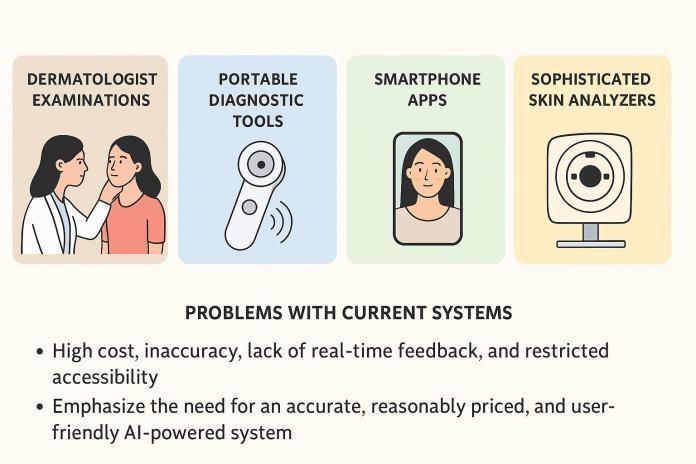
Fig 1: Problems With Current Systems
As a result, problems with current systems include their high cost, inaccuracy, lack of real- time feedback, and restricted accessibility. These disadvantages emphasize the need for an accurate, reasonably priced, and userfriendlyAI-poweredsystem.
p-ISSN:2395-0072
The proposed system introduces an automated skin type and skin problem prediction approach using computer vision and deep learning. It starts with image acquisition andpreprocessingtoimproveclarityandconsistency.The face area is separated from the background using skin segmentation techniques. Oiliness, texture, pigmentation, and pore density are just a few of theintricate patterns captured by CNN-based feature extraction. A multi-label classifier that can recognize wrinkles, redness, acne, pigmentation, and enlarged pores is used for skin problem detection, whereas a softmax model is usedforskin type classification.Astructured skincarereportwithpredictedskin type, identified issues, and severity levels can be produced by the system. This output can be used by dermatologists for initial screening or by consumers for daily skincare routines.
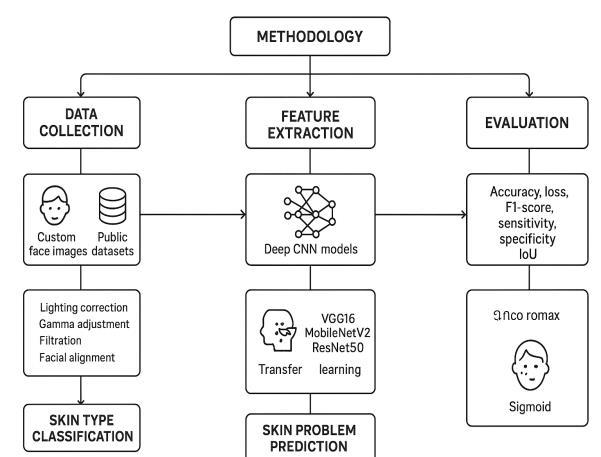
Data collection, preprocessing, feature extraction, model training, and evaluation are some of the stages in the methodology. For training, both custom face images and images from public datasets are utilized. To guarantee consistency, lighting correction, gamma adjustment, filtration, and facial alignment are all part of the preprocessing step. The face region is detected using MTCNN. Deep CNN models are responsible for feature extraction. Models pre-trained on massive datasets like ImageNet,suchasVGG16,MobileNetV2,andResNet50,are usedtoapplytransferlearning.From edgesandcolors to intricate facial textures, these models extract multi-level features. Skin type classification is performed with a softmaxactivationlayerthatassignsoneofthepredefined types.Forskinproblemprediction,asigmoid-basedmultilabel classifier identifies the presence of multiple conditions.
International Research Journal of Engineering and Technology (IRJET) e-ISSN:2395-0056
Volume: 12 Issue: 11 | Nov 2025 www.irjet.net
Performance metrics like accuracy, loss, F1-score, sensitivity, and specificity are assessed to guarantee dependability. The IoU metric is used in segmentation tasks such as pigmentation area detection. TensorFlow/Keras is used to train the entire system, and Flask is used to deploy it for real-time prediction capabilities.
Deep learning frameworks and Python are used in the implementation. In order to facilitate deep CNN training, the model is trained on GPU- enabled hardware. Flask is used to build the backend, and HTML/CSS is used for the frontend's straightforward user interface. The system preprocesses and forecasts the outcomes in a matter of secondsafterusersuploadanimage.
The model is optimized for mobile deployment using TensorFlow Lite. This ensures that even mid-range smartphonescanrunthepredictionmodellocallywithout needinghighcomputationalpower.
Thepredictionworkflowinvolves:
1. Acceptinganimageinput
2. Performingfaceandskindetection
3. Passing the image through the CNN models
4. Generating an output with confidencescores
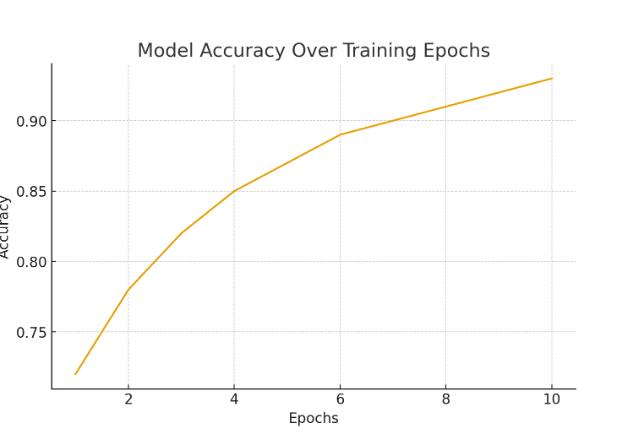
3: Model Accuracy graph
The use of deep learning ensures that predictions are consistent, reliable, and significantly faster than manual diagnosis.
The suggested system effectively predicts skin type and automatically identifies common skin issues using computer vision and deep learning. A comprehensive dermatology-inspired solution is produced by combining
p-ISSN:2395-0072
preprocessing, segmentation, CNN feature extraction, and multi- label classification. Theoutcomes demonstratethat the system is capable of processing facial images effectively and accurately identifying a variety of skin conditions. Through mobile devices and online platforms, this technology can provide regular users with skincare analysisattheprofessionallevel.
Future developments might include video-based skin monitoring, IoT sensors for moisture and hydration analysis, and 3D skin reconstruction for more precise wrinkleandporemeasurement. More varied datasets can be added to the model to improve performance across a range of skin tones. Accuracy can be further improved by utilizing sophisticated architectures like Vision Transformers. Additionally, based on the identified skin issues, an AI-based personalized skincare recommendation engine can be created to make product androutinerecommendations.
[1] Omiye, J. A., Gui, H., Daneshjou, R., Cai, Z. R., &
Muralidharan, V. (2023). Principles, applications, and future of artificial intelligence in dermatology FrontiersinMedicine, 10, 1278232https://doi.org/10.3389/fmed.2023.127 8232
[2] Du-Harpur, X., Watt, F. M., Luscombe, N. M., & Lynch, M. D. (2020). What is AI? Applications of artificial intelligence to dermatology. British JournalofDermatology, 183(3), 423–430.https://doi.org/10.1111/bjd.18880
[3] Liopyris, K., Gregoriou, S., Dias, J., & Stratigos,A.J. (2022). Artificial intelligence in dermatology: Challenges and perspectives. Dermatology and Therapy,12(12), 2637–2651. https://doi.org/10.1007/s13555-022-00833-8
[4] Murphree,D.H.,Puri,P.,Shamim,H.,etal.(2022). Deep learning for dermatologists: Part I. Fundamental concepts. Journal of the American AcademyofDermatology,87(6),1343–1351.
[5] De,A.,Sarda,A.,Gupta,S.,&Das,S.(2020).
[6] Use of artificial intelligence in dermatology. Indian Journal of Dermatology, 65(5), 352–357. https://doi.org/10.4103/ijd.IJD_418_20
[7] Wang, G., Meng, X., & Zhang, F. (2023). Past, present, and future of global research on artificial intelligence applications indermatology: A
International Research Journal of Engineering and Technology (IRJET) e-ISSN:2395-0056
Volume: 12 Issue: 11 | Nov 2025 www.irjet.net p-ISSN:2395-0072
bibliometricanalysis.Medicine,102(45),
e35993. https://doi.org/10.1097/md.0000000000035993
[8] Shah, M., Burshtein, J., Zakria, D., & Rigel, D. (2024). Analysis of trends in US dermatologist density and geographic distribution. Journal of the American Academy of Dermatology, 91(2), 338–341.https://doi.org/10.1016/j.jaad.2024.03.037
[9] Burshtein,J.,Zakria,D.,Shah,M.,Miller,L.,&Rigel, D. (2024). Trends in US dermatology physician assistant density 2016 to 2023: A cross-sectional analysis. Journal of the American Academy of Dermatology, 90(3), 640–642. https://doi.org/10.1016/j.jaad.2023.11.009
© 2025, IRJET | Impact Factor value: 8.315 | ISO 9001:2008 Certified
| Page