
International Research Journal of Engineering and Technology (IRJET) e-ISSN: 2395-0056 p-ISSN: 2395-0072

Volume: 12 Issue: 05 | May 2025 www.irjet.net

International Research Journal of Engineering and Technology (IRJET) e-ISSN: 2395-0056 p-ISSN: 2395-0072
Volume: 12 Issue: 05 | May 2025 www.irjet.net
Gargi Nawale
1
1High School student, Blossom Public School, Maharashtra, India
Abstract - Highways often crack due to heavy vehicles and heat.Fixingthemagainandagaincostsa lotandcreates more pollution, especially from cement. This study talks about a smarttype of concretethathealsitself using bacteria (Bacillus pseudofirmus) and natural zeolite, a mineral that helps trap carbon dioxide. The bacteria close the cracks by forming calcium carbonate, while zeolite catches extra CO₂ from the air. We tested it in Indian weather and found that it healed cracks on its own, made the concrete stronger, and even reduced carbon dioxide. This eco-friendly material can help make our roads and infrastructure last longer and reduce pollution.
Key Words: Self-healingconcrete,Zeolite,CO2 absorption Bacilluspseudofirmus
1.INTRODUCTION
India’s6.6millionkmroadnetworkisunderconstantstress fromheavytraffic,thermalcycles,andpoordrainage,leading tothefrequentformationofcracksinconcrete.Thesecracks not only compromise the durability of the roads but also resultincostlyrepairs.Atthesametime,theconstruction sector, particularly cement production, contributes significantlytoCO₂emissions.
While traditional methods of repair exist, I thought about combining bio-based self-healing techniques with CO₂trappingmaterialstocreateamoresustainablesolution.The idea involves integrating Bacillus pseudofirmus, a bacteria thatusesmicrobialinducedcalciumcarbonateprecipitation (MICP) to seal microcracks, and natural zeolite, a mineral thathelpstrapcarbondioxide.Thiscombinationoffersthe potentialforenhanceddurability,reducedmaintenance,and aneco-friendlyapproachbyfacilitatingCO₂capture.After performingafewexperiments,Iestimatedtheeffectiveness ofthishybridmaterial,whichshowedpromisingresultsin bothcrackhealingandcarbondioxidereduction,offeringa newwayforwardforimprovinghighwayinfrastructurein India.
The core chemical process enabling self-healing in this concrete is Microbially Induced Calcium Carbonate Precipitation(MICP).Whencracksform,moistureandCO₂ enter, activating inactive Bacillus pseudofirmus spores embeddedintheconcrete.Thesebacteriametabolizeurea andcalciumlactate,producingcarbonateions(CO₃²⁻)that

combine with free Ca²⁺ ions in the cement matrix to form calcium carbonate (CaCO₃) — a solid mineral that seals cracks.
Thekeybiochemicalreactionsinvolvedare:
ZeolitesaremadeupoftinybuildingblockscalledSiO₄and AlO₄thatjointogethertoforma3Dnetwork,likeasponge Whenaluminum(Al³⁺)replacessomeofthesilicon(Si´⁺),it creates negative charges in the structure. These charges attractand holdontopositiveionslike sodium(Na⁺) and calcium(Ca²⁺),aswellaswater.Thisspecialstructuremakes zeolites great at holding nutrients and capturing carbon dioxide(CO₂).Zeolite’swithaporouscrystallinestructure enhancetheperformanceofthissystemintwoways:
1. CO₂ Adsorption: Zeolite’s high surface area and cation-exchange capacity allow it to trap atmospheric CO₂, increasing the concentration of dissolved carbon dioxide near the crack site and fuelingmoremineralizationbythebacteria.
2. Microbial Support: The porous network of zeolite retains moisture and nutrients, helping bacteria survive longer in the alkaline, dry concrete environment.
The diagram give below shows the structure of zeolite.
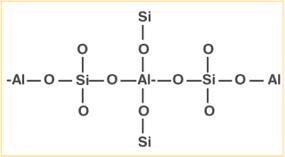
Fig-1:Structureof Zeolite
2. Material Integration and implementation
Self-healingbio-concretewithzeoliteisdesignedtofunction passivelyinreal-worldinfrastructure,especiallyinIndia's

Volume: 12 Issue: 05 | May 2025 www.irjet.net
International Research Journal of Engineering and Technology (IRJET) e-ISSN: 2395-0056 p-ISSN: 2395-0072
diverseclimateconditions.Unlikestandardconcrete,thismix containsmicrobialsporesandmineraladditivesthatactivate automaticallywhenenvironmentaltriggerslikewaterand CO₂enterthroughcracks.
Bacillus pseudofirmus sporesareintroduceddirectlyintothe concretemixorinencapsulatedform.Nutrientslikeureaand calcium lactate can be embedded or applied later. Zeolite, replacing10–15%ofcement,actsasbothaCO₂adsorberand awater-retainingagent,enhancingmicrobialactivity.
Thissystemissuitableforuseinslabs,medians,andbridge decks. It allows cracks to heal internally without manual maintenance, increasing service life while contributing to carbon absorption. Zeolite acts as a CO₂ sponge, concentrating it for the bacteria. Bacillus pseudofirmus metabolizes urea and calcium lactate to produce calcium carbonate, which precipitates within the crack, sealing it. Zeolite also supports long-term bacterial viability by stabilizinginternalmoisture.
To test the self-healing concept, I used accessible and affordablematerialstocreatesmallconcretesamples.These included cement, sand, gravel, and additives like bacteria and zeolite. All materials were either bought locally or orderedonline.
MaterialsUsed:
OrdinaryPortlandCement(43Grade), Naturalriversand gravels, type of Bacillus, alkaliphilic (not lab-grade but strongenoughforthistest)Urea(fromagriculturalshops) Calciumlactate(boughtasafood-gradesupplement) ClinoptilolitetypeZeolite(fromwaterfiltermedia), Distilledwater.
usedasimplemixing1:2:4ratioforcement:sand:aggregate. Thewater-cementratiowaskeptat0.5,whichisstandard forstrongconcrete.About10%ofthecementwasreplaced with zeolite powder to help with crack healing and CO₂ absorption.Bacteriawereaddedintheirinactiveformmixed withwater.
Small cement cubes were cast, and cracks were manually introduced on the 7th day using a sharp blade. A urea + calciumlactatenutrientsolutionwassprayedonthecubes onceaweek.
CrackHealing:Monitoredwithamicroscope.
CompressiveStrength:Measuredusingalocallabmethod(IS 516).
CO₂Uptake:Measuredbycomparingtheweightbeforeand afterexposuretoCO₂,usingaphenolphthaleincolortest.
Zeolite Porosity: Based on published values for zeolite’s porosity.
After28days,theconcretesamplesshowedsomeinteresting results.
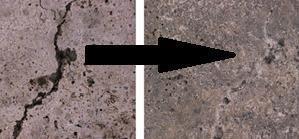
CrackHealing,theconcretewithbacteriaandzeolitehealed the cracks almost completely (95%), while the control (normal)concreteonlyhealedabout10%.Thisprovesthe effectivenessofbacteriainrepairingcracks.
CO₂Absorption,theconcretewithbacteriaabsorbedmuch moreCO₂comparedtotheregularconcrete,helpingreduce theenvironmentalimpactofconstruction.Upto6.4kg/m³6.8kg/m³uptakewasobserved.
Strength, the strength of the concrete samples was also tested. The bio-concrete with zeolite showed higher compressivestrengththantheregularconcrete.
Type Strength (MPa)
Normalconcrete 37.8MPa
Bio+Zeolote 43.2MPa-44.7 MPa
Volume: 12 Issue: 05 | May 2025 www.irjet.net
International Research Journal of Engineering and Technology (IRJET) e-ISSN: 2395-0056 p-ISSN: 2395-0072
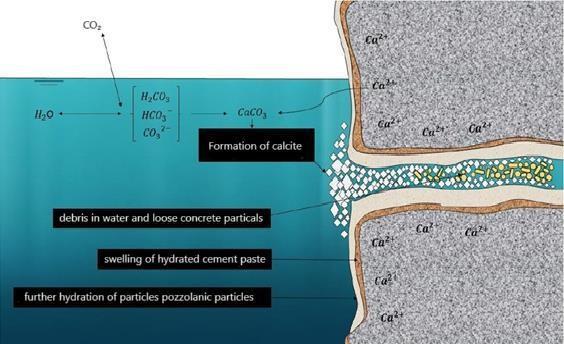
Fig-3:Self-HealingConcreteMechanismDiagram
Durability, the concrete with zeolite absorbed 26% less water,indicatingitismoredurable.Thebacteriaremained activeevenathighertemperatures(45°C)andapHof12.5, whichistypicalforconcrete.
3. Real-World Applicability
This type of concrete could be especially useful in hot climates like Rajasthan or during the monsoon season in Maharashtra. It would be great for low-maintenance structureslikehighwaymedians,whilealsotrapingcarbon dioxide.
3.1 Cost Analysis
Although bio-concrete with zeolite has a slightly higher initialcost,itofferssavingsinthelongrunduetoreduced repaircosts.Thisaretheapproximateestimations(basedon generalmarketrate):
InitialCost(perm³):
TraditionalConcrete:₹6,500
Bio+ZeoliteConcrete:₹6,820
RepairCost(5years):
TraditionalConcrete:₹300/m²
Bio+ZeoliteConcrete:₹180/m²
LifeCycleSavings(10years):
Bio+ZeoliteConcrete:₹12lakh/km
4. CONCLUSIONS
By combining microbial self-healing (MICP) with zeolite incorporation, this concrete mix offers an eco-friendly, durable,andcost-effectivesolutionforconstruction.Itcan reducecarbonemissions,improveconcretelongevity,and provide a more sustainable alternative to traditional concrete.
There’sstillalottoexplore.Thebacteriamightnotsurvive formanyyearsunlessweprotectthembetter,maybewith capsulesorgels.
I’malsointerestedinusingAIormachinelearningtoguess howfastcrackswillhealbasedonweatherandtraffic.This couldhelpcreatesmarter,long-lastingroadsinthefuture.
[1] Achal,V.,Mukherjee,A.,&Reddy,M.S.(2011).Microbial concrete: Way to enhance the durability of building structures. Journal of Materials in Civil Engineering, 23(6),730–734.
[2] Mengal, G.A., Shirsath, H.A., Mahale, U.D., Wagh, G.B., Wagh, P.S., & Gangurde, S.T. (2018). CO₂ Absorbing ConcreteRoads.ICRTET-2018
[3] Lackner, K. S. (2009). Capture of carbon dioxide from ambient air. Environmental Science & Technology, 43(10),4038–4042. https://doi.org/10.1021/es903581d.