
International Research Journal of Engineering and Technology (IRJET) e-ISSN: 2395-0056
Volume: 12 Issue: 08 | Aug 2025 www.irjet.net p-ISSN: 2395-0072
International Research Journal of Engineering and Technology (IRJET) e-ISSN: 2395-0056
Volume: 12 Issue: 08 | Aug 2025 www.irjet.net p-ISSN: 2395-0072
Amith K S1 , Dr. S. Vijaya2
1A postgraduate student, Dr. Ambedkar institute of technology, Bangalore, Karnataka, India. 2Professor, Dept. of Civil Engineering, Dr. Ambedkar institute of technology, Bangalore, Karnataka, India.
Abstract - Seismic analysis is critical for ensuring the stability and resilience of high-rise buildings in earthquakeprone regions. Coupled shear wall systems, consisting of interconnected shear walls and beams, enhance structural performance under seismic loading. This study compares the seismic behaviour of spandrel beams and regular beams within coupled shear wall systems. A B+G+16 storey high-rise building was modelled in ETABS and analyzed using the Response Spectrum Method as per IS 1893 (Part 1): 2016 across Zones II, III, IV, and V. Key parameters studied include storeydisplacement, inter-storeydrift, andbaseshear.Results reveal that while both beam types perform adequately in low seismic zones, spandrel beams offer superior stiffness, lower displacement, and better seismic resilience in moderate to high seismic zones. These findings suggest that spandrel beams provide a more effective design solution for tall buildings in high-risk regions.
Key Words: Seismic Analysis, Spandrel Beam, Regular Beam, Coupled Shear Wall System, ETABS, Storey Drift, Base Shear, Seismic Zones
1.INTRODUCTION
High-risebuildingsarecontinuouslysubjectedtodynamic forcessuchaswind,seismicactivity,andoperationalloads, allofwhichinfluencetheirstabilityandservicelife.Among these,seismicactivityisthemostcriticalduetoitssudden and unpredictable nature, often resulting in severe structural damage. Hence, the development of efficient lateralload-resistingsystemsisessentialforensuringsafety andresilienceinearthquake-proneregions.
One of the most widely adopted systems for improving seismicresistanceintallbuildingsisthe coupledshearwall system,whereshearwallsareinterconnectedbycoupling beams.Thesebeamsenhancethestiffnessofthestructure, improve energy dissipation, and reduce lateral displacements under seismic loading. The performance of these coupling beams significantly influences the overall seismicresponseofthesystem.
Regular beams and spandrel beams arethetwoprimary typesofcouplingelementsusedinpractice.Regularbeams are generally uniform and free from architectural interruptions, allowing efficient transfer of shear and bendingforcesbetweenwalls.Incontrast,spandrelbeams
are often located along the façade and may incorporate architecturalfeaturessuchaswindowsorserviceopenings, whichaltertheirstiffnessandenergydissipationcapacity. Thisfunctionaldifferencemakesthechoiceofcouplingbeam criticalindeterminingseismicbehavior.
The comparative study of spandrel and regular beams provides insights into their effectiveness in controlling lateral displacements, minimizing inter-story drifts, and enhancingductility.Advancedstructuralanalysistoolssuch as ETABS enable detailed evaluation through response spectrum and time-history analyses, assessing key parameterslikedisplacement,drift,energydissipation,and theresponsemodificationfactor(R-factor).
This research focuses on the seismic performance of spandrel and regular beams in coupled shear wall systems, evaluated across different seismic zones. By examiningtheirbehaviourundervaryinggroundmotions, thestudyaimstoidentifyoptimalbeamconfigurationsthat balance structural safety, stiffness, and architectural requirements.Theoutcomesareexpectedtocontributeto improved design guidelines for high-rise structures, promoting resilience and sustainability in seismic-prone regions.
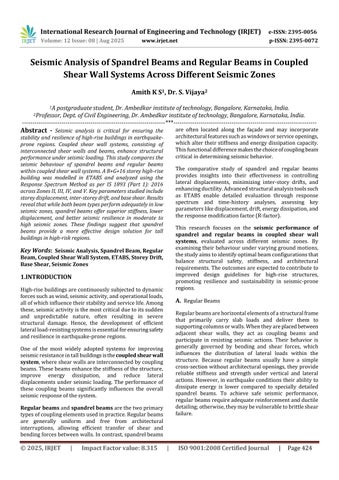
Regularbeamsarehorizontalelementsofastructuralframe that primarily carry slab loads and deliver them to supportingcolumnsorwalls.Whentheyareplacedbetween adjacent shear walls, they act as coupling beams and participate in resisting seismic actions. Their behavior is generally governed by bending and shear forces, which influences the distribution of lateral loads within the structure. Because regular beams usually have a simple cross-sectionwithoutarchitecturalopenings,theyprovide reliable stiffness and strength under vertical and lateral actions.However,inearthquakeconditionstheirabilityto dissipate energy is lower compared to specially detailed spandrel beams. To achieve safe seismic performance, regularbeamsrequireadequatereinforcementandductile detailing;otherwise,theymaybevulnerabletobrittleshear failure
International Research Journal of Engineering and Technology (IRJET) e-ISSN: 2395-0056
Volume: 12 Issue: 08 | Aug 2025 www.irjet.net p-ISSN: 2395-0072
B. SpandrelBeams
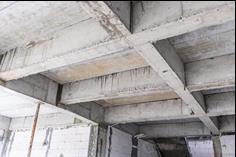
Spandrelbeamsarehorizontalmemberscommonlyfound alongtheouteredgesofbuildings,wheretheylinkvertical components such as shear walls or columns while also supporting slabs and façades. Unlike regular beams, spandrels often need to accommodate architectural requirements,includingwindoworserviceopenings,which influences their stiffness and strength. In the context of a coupled shear wall system, spandrel beams enhance the seismic response by transferring lateral loads between adjacent walls and by improving the building’s overall energy dissipation capacity. Despite their greater design complexity and the challenges posed by openings, welldetailedspandrelbeamsaremoreeffectiveinlimitinginterstorey drift and torsional effects. As a result, they are consideredadvantageousintallbuildingslocatedinhigher seismiczones
C. CoupledShearWall
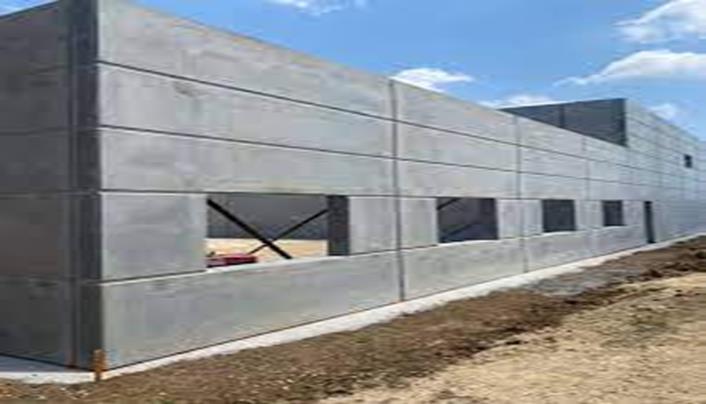
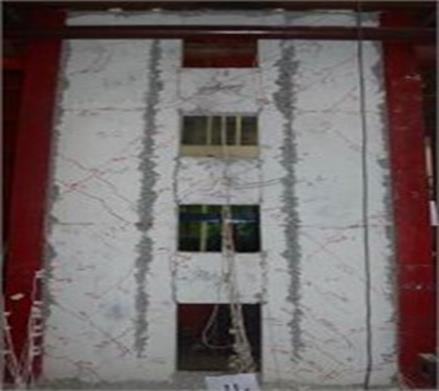
Coupledshearwallsystemsconsistoftwoormorevertical wallsthatareinterconnectedbycouplingbeams,whichmay beregularorspandrelinform.Thisarrangementtransforms the individual walls into a unified lateral force–resisting systemcapableofwithstandingsignificantseismicorwind loads. During earthquake excitation, the coupling beams distribute shear and bending forces between walls, improving ductility and reducing excessive lateral displacements. Such systems are widely used in high-rise
buildings because they combine high stiffness with the capacityforenergyabsorption.Theireffectivenessdepends stronglyontheperformanceofthecouplingbeams;ifthese beamsareinadequatelydesigned,stressconcentrationand earlydamagecanoccur.Nevertheless,withproperdetailing, coupledshearwallsystemsprovideanefficientandreliable solutionforseismicresistanceintallstructures.
Mahmoudietal. [1]showedthatspandrelbeamstiffness and reinforcement strongly influence the response modification factor (R-factor), with higher stiffness improvingductilityandenergyabsorption.
Hindi and Hassan [2] demonstrated that diagonally reinforced coupling beams enhance shear strength and ductilitycomparedtoconventionaldetailing.
Cattari and Lagomarsino [3] emphasized the contribution of spandrels in unreinforced masonry walls, showingthatneglectingthemleadstoconservativeseismic assessments.
Parisi et al. [4]furtherconfirmedthroughexperimental testingthatspandrelsimprovestiffness,strength,andenergy dissipationinmasonrywallswithopenings.
Ali’s [5] study on reinforced concrete spandrel beams revealed that adequate longitudinal and transverse reinforcementimprovestorsionalresistance,ductility,and overallseismicresilience.
Whilestudiesexistoncouplingandspandrelbeams,direct comparisons with regular beams in coupled shear wall systems are limited. Research on their behavior across differentseismiczonesandvaryinggroundmotionsisalso scarce. The effects of spandrel beam geometry, size, and reinforcement detailing on coupling action and ductility remain unclear. Current design guidelines offer little directionforoptimizingspandrelbeams.Thislackofclarity
International Research Journal of Engineering and Technology (IRJET) e-ISSN: 2395-0056
Volume: 12 Issue: 08 | Aug 2025 www.irjet.net p-ISSN: 2395-0072
affects understanding of energy dissipation and displacement control. Hence, further study is needed to improveseismicdesignandsafetyofhigh-risebuildings.
A. Objective –
• TodevelopanETABSmodelofa,B+G+16-storybuilding withacoupledshearwallsystem.
• To evaluate the seismic behaviour of spandrel and ordinarybeamsindifferentseismiczonesincoupledshear wallsystems.
• To investigate the influence of spandrel beam specificationsoncrucialseismicparameterssuchasstorey shear,storeydrift,andlateraldisplacement.
B. Methodology -
Objective→ ETABSModel Generation→ Analyzing the Buildings for Different Cases → Presentation and comparisonofresultsintheformofgraphsandtables→ ResultsandConclusion.
Inthecurrentresearch,aB+G+16storeyRCCbuildingwith coupled shear wall system is analyzed through ETABS. Regularcouplingbeamsandspandrelbeamsareconsidered intwodifferentconfigurations.Themodelsarecheckedfor seismic loads in Zones II, III, and IV according to IS 1893 (Part1):2016toinvestigatestoreydisplacementanddrift
Table-1:Buildingdetailsforthemodels
No.ofStorey
FloortofloorHeight
B+G+16
2.95m
Gradeofconcreteused(fck) M40&M30
Heightofthebuilding 53.25m
GradeofConcreteforcolumn&shearwall M40
GradeofConcreteforbeams&slabs M30
GradeofConcreteforGirderbeams M40
Gradeofsteel Fe500
Densityofconcrete 25kN/m2
The study considers a B+G+16 reinforced concrete residential building of 53.25 m height, modeled in ETABS with a coupled shear wall system. The structure includes basementforparkingandservices,withloadsassignedas per IS 875. Seismic performance is evaluated using two beam configurations spandrel beams and ordinary beams underZonesII,III,IVandVasperIS1893(Part1):
2016.MaterialpropertiesfollowIScodes,withwindloads appliedasperIS875(Part3).Dynamicresponsespectrum analysisisusedtocomparestoreydisplacement,drift,and shear,highlightingtheinfluenceofbeamtypeonstructural performanceacrossdifferentseismiczones.
Table-2:LoadTypesandTheirValuesasPerIs875 Part1&Is875Part2
Typeofload LoadCalculation
LiveloadonResidentialroomslabs 3kN/m2
LiveloadonStaircase 3kN/m2
FloorfinishonBalconyandLobbyslab(SDL) 3kN/m2
MainWallLoadonbeams
kN/m PartitionWallLoadonbeams
Table-3:ResponseSpectrumPropertiesasPerIS1893 Part1(2016)
Zone II,III,IV&V
SoilCondition II
Seismiczonefactor 0.1,0.16,0.24&0.36
Responsereductionfactor 3
Importancefactor 1.2
AsperIS1893(Part1):2016,seismicanalysisisbasedon thedesignresponsespectrummethod.ZonesII,III,IV,andV areconsideredwithseismiczonefactors0.10,0.16,0.24,and 0.36 respectively. Medium soil condition (Type II) is adopted,whichgovernsthespectralaccelerationvalues.
Aresponsereductionfactorof3andanimportancefactorof 1.2 are used in the analysis.These parameters define the designspectrumandensurerealisticevaluationofseismic performance.
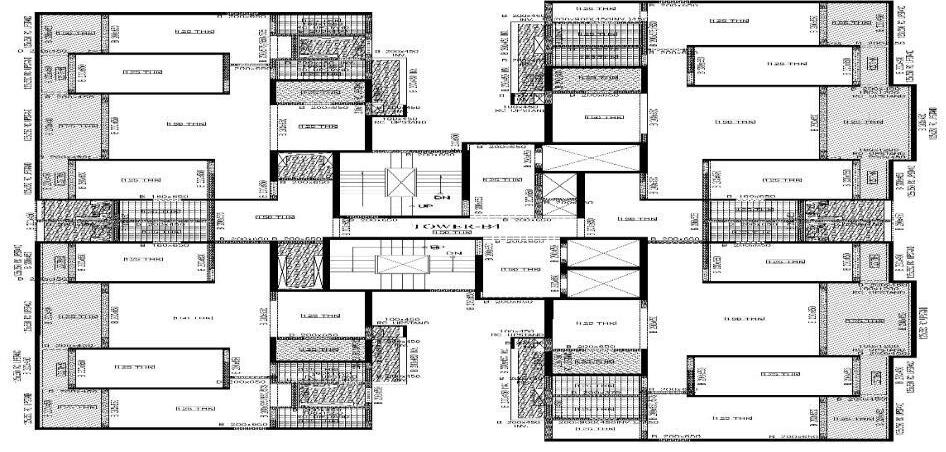
Fig-4: BeamLayout
International Research Journal of Engineering and Technology (IRJET) e-ISSN: 2395-0056
Volume: 12 Issue: 08 | Aug 2025 www.irjet.net p-ISSN: 2395-0072
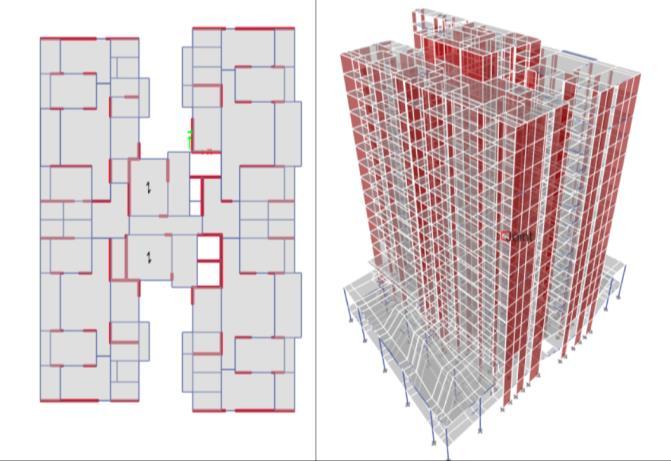
Planviewand3-DViewofStructurewithRegular Beams
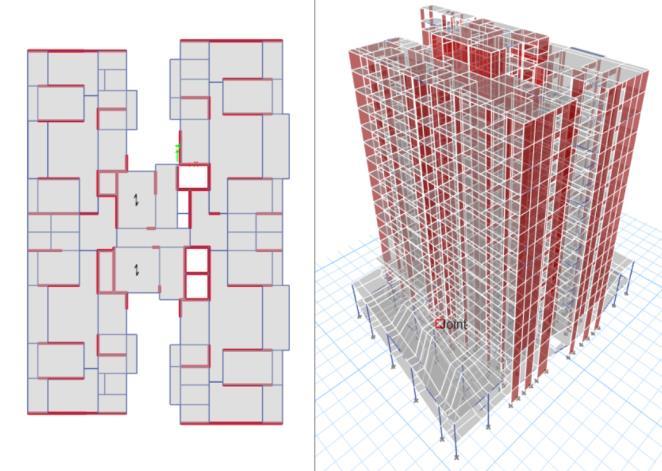
Fig-6: Planviewand3-DViewofStructurewith SpandrelBeams
2. RESULTS AND DISCUSSION
The seismic performance of the high-rise building models was evaluated using ETABS 2016 under varying seismic intensities across Zones II, III, IV, and V. The study consideredtwoconfigurationsofcouplingbeams regular beams and spandrel beams within a coupled shear wall system. The results were analyzed in terms of three key parameters: maximum storey displacement, maximum storeydrift,andmaximumstoreyshear.Theseparameters are critical indicators of the building’s lateral stability, serviceability,andoverallseismicresilience.Thefollowing discussion presents a comparative analysis of the results obtainedforbothbeamtypesacrossdifferentseismiczones.
A. Comparison of regular beams and spandrel beams in zone II, III, IV and V w.r.t Storey Displacement.
Maximum storey displacement increased steadily with seismiczoneseverity.InZoneII,valueswerearound60mm
andwithinIS1893limits,whileinZoneVtheyexceeded240 mm in the RY direction, indicating higher vulnerability. Regular beams showed greater displacements, whereas spandrel beams reduced them, improving stiffness and controloflateralmovement.
Table-4: ComparisonofMaximumstoreydisplacement forregularbeamsandspandrelbeamsinzoneII,III,IV andV StoreyDisplacementinmm→
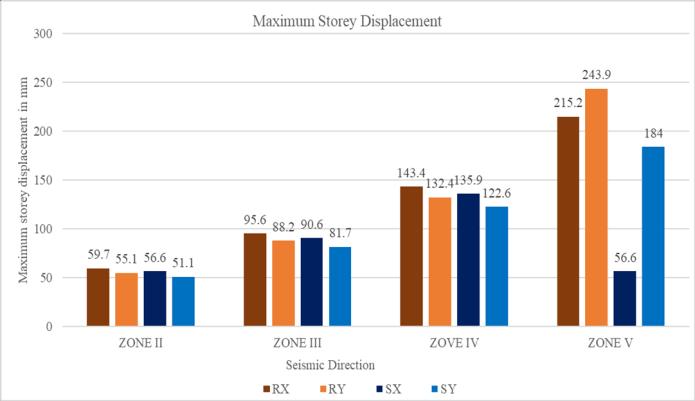
StoreyDisplacement.
B. Comparison of regular beams and spandrel beams in zone II, III, IV and V w.r.t Storey Drift.
Storey drift followed the same pattern, rising from about 1.5E-03 in Zone II to 6.1E-03 in Zone V. The IS 1893 drift limit (0.004h/storey) was exceeded in Zone V for regular beams,butspandrelbeamskeptvaluesclosertopermissible levels.Maximumdriftwasgenerallyobservedinthemiddle storeys, a common feature in tall buildings under seismic loads.
Table-5: ComparisonofMaximumstoreydriftforregular beamsandspandrelbeamsinzoneII,III,IVandV
Storeydrift isUnitless→ RX
International Research Journal of Engineering and Technology (IRJET) e-ISSN: 2395-0056
Volume: 12 Issue: 08 | Aug 2025 www.irjet.net p-ISSN: 2395-0072
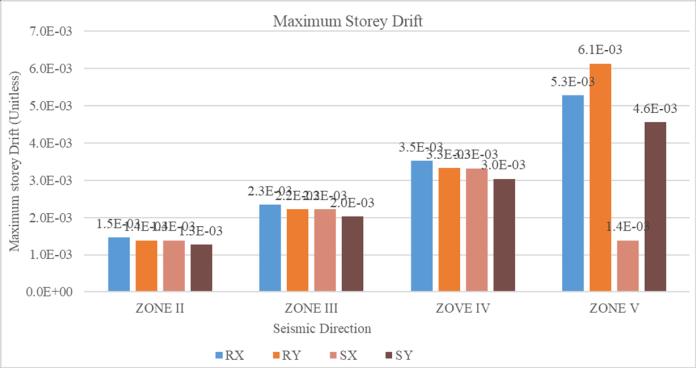
Chart -2: Comparisonofregularbeamsandspandrel beamsinzoneII,III,IVandVw.r.tStoreyDrift.
C. Comparison of regular beams and spandrel beams in zone II, III, IV and V w.r.t Storey Shear.
Storey shear also increased with seismic intensity, from about 5000 kN in Zone II to nearly 18,800 kN in Zone V. Spandrel beam models distributed shear more uniformly across the height, reducing stress concentrations, while regularbeamsshowedlessefficientenergydissipationwith unevensheardistribution.
Table-6: ComparisonofMaximumstoreyshearfor regularbeamsandspandrelbeamsinzoneII,III,IVandV
Storey shearinkN
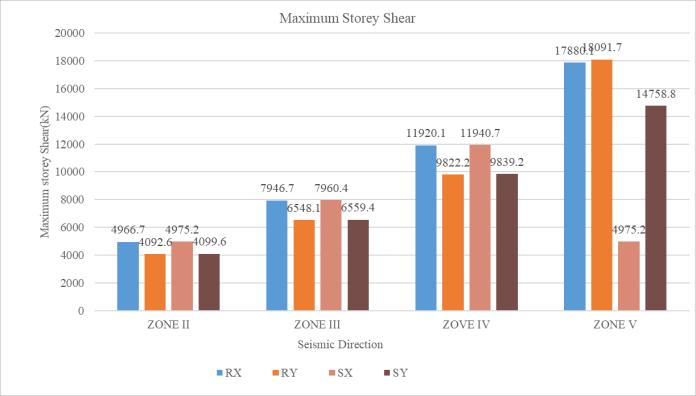
Chart -3: Comparisonofregularbeamsandspandrel beamsinzoneII,III,IVandVw.r.tStoreyShear.
The study compared the seismic performance of high-rise buildings with regular beams and spandrel beams in coupled shear wall systems usingETABS.
Spandrelbeamsreduced storey displacement by about 15–20%, especially in higher seismic zones, making structures stiffer and more stable.
Storeydriftincreasedwithseismicintensity,and in Zone V regular beams crossed IS limits, while spandrel beams lowered drift by 18–22%, keepingvaluesclosertosafelimits.
Storeyshear wasbettermanagedinspandrelbeam models, with about 10–15% more uniform distribution, whileregularbeamsshoweduneven sheartransfer.
In lower seismic zones (II and III), both beam typesperformedwithincodalrequirements,butin higherzones(IV and V)spandrelbeamsshowed clear superiority.
Overall, spandrel beams are a more effective choice for tall buildings in high seismic regions, ensuringbetter safety,resilience,andcompliance withearthquakedesigncodes.
[1] M. Mahmoudi, S. M. R. Mortazavi, and S. Ajdari, “The effect of spandrel beam’s specification on response modification factor of concrete coupled shear walls,” Civil Engineering Infrastructures Journal,vol.49,no.1, pp.33–43,2016,doi:10.7508/ceij.2016.01.003.
[2] R. A. Hindi and M. A. Hassan, “Shear capacity of diagonally reinforced coupling beams,” Engineering Structures, vol. 26, no. 10, pp. 1437–1446, Aug. 2004, doi:10.1016/j.engstruct.2004.05.012.
[3] S.CattariandS.Langommarsino,“a strengthcriterion fortheflexuralbehaviourofspandrelsinun-reinforced masonrywalls,”presentedatthe14thWorldConference onEarthquakeEngineering,Beijing,China,Oct.2008.
[4] F.Parisi,N.Augenti,andA.Prota,“Theroleofspandrels withinmasonrywallswith openings:anexperimental investigation,”inProc.9thPacificConf.EarthquakeEng.: Building an Earthquake-Resilient Society, Auckland, NewZealand,Apr.14–16,2011.
International Research Journal of Engineering and Technology (IRJET) e-ISSN: 2395-0056
Volume: 12 Issue: 08 | Aug 2025 www.irjet.net p-ISSN: 2395-0072
[5] A. A. M. Ali, “Strength and behaviour of reinforced concretespandrelbeams,”Ph.D.dissertation,Dept.Civ. Eng.Build.Sci.,Univ.Edinburgh,Edinburgh,U.K.,1983.
[6] K. Orakcal, L. M. Massone, and J. W. Wallace, “Shear strengthoflightlyreinforcedwallpiersandspandrels,” presentedatthe 14th World Conference on Earthquake Engineering,Beijing,China,Oct.2008.
[7] G. Abdollahzadeh and H. Malekzadeh, “Response modificationfactorof coupledsteel shear walls,”Civil Engineering Infrastructures, vol. 1, no. 1, pp. 15–26, 2013.
[8] M. R. Dupuis, T. D. D. Best, K. J. Elwood, and D. L. Anderson,“Seismicperformanceofshearwallbuildings withgravity-inducedlateraldemands,”CanadianJournal ofCivilEngineering,vol.41,no.4,pp.323–332,2014, doi:10.1139/cjce-2012-0482.
[9] S.A.Meftah,F.Mohri,andE.M.Daya,“Seismicbehavior ofRCcoupledshearwallswithstrengthenedcoupling beamsbybondedthincompositeplates,”KSCEJournal of Civil Engineering, vol. 17, no. 2, pp. 403–414, Mar. 2013,doi:10.1007/s12205-013-1286-9.
[10] I.Mahidul,A.Easin,andM.S.Azam,“Buildingdesignfor lateral earthquake forces on a multi-story reinforced cementconcrete(RCC)structureincludingashearwall,” Journal of ICT, Design, Engineering and Technological Science,vol.7,no.2,2023,doi:10.33150/jitdets-7.2.2.
[11] O. A. El-Azizy, M. Ezzeldin, and W. El-Dakhakhni, “Comparative analyses of reinforced masonry and reinforced concrete shear walls with different end configurations: Seismic performance and economic assessment,” Engineering Structures, vol. 296, Dec. 2023,doi:10.1016/j.engstruct.2023.116852.
[12] R. Aguayo, J. Carvallo, and J. C. Vielma, “Evaluating seismic performance in reinforced concrete buildings withcomplexshearwalls:Afocusonaresidentialcase in Chile,” Buildings, vol. 14, no. 3, p. 761, 2024, doi: 10.3390/buildings14030761.