
International Research Journal of Engineering and Technology (IRJET) e-ISSN: 2395-0056
Volume: 12 Issue: 12 | Dec 2025 www.irjet.net p-ISSN: 2395-0072
Smart Health Watch For Stroke Detection
Rajeshwari Kisan 1 Apoorva K2 , Ashwini B3 , Vinayak C4 , Komal R5
1Assistant Professor, S G Balekundri Institute of Technology, Belagavi, Karnataka, India
2Student, S G Balekundri Institute of Technology, Belagavi, Karnataka, India
3Student, S G Balekundri Institute of Technology, Belagavi, Karnataka, India
4Student, S G Balekundri Institute of Technology, Belagavi, Karnataka, India
5Student, S G Balekundri Institute of Technology, Belagavi, Karnataka, India
Abstract - Stroke and cardiac emergencies are often precededbyasuddenandunnoticedriseinbloodpressure. EarlyidentificationofabnormalBPlevelscanhelpprevent severehealthcomplications.ThisprojectproposesanIoTbased Stroke Detection System using an ESP8266 microcontrollerandadigitalbloodpressure(BP)module. Thesystemmeasuressystolic,diastolic,andpulsevaluesand displays them locally on an LCD module. Based on BP threshold classification, the ESP8266 sends email notificationstothedoctorusingtheBlynkIoTplatform.An alert message is shared to help healthcare providers take timelyaction.Thesystemtherefore,supportsearlystroke risk detection through automatic monitoring and notification. The system continuously measures systolic, diastolic,andpulsevaluesanddisplaysthemlocallyonan LCDmoduleforimmediatevisibility.BasedonBPthreshold classification, the ESP8266 automatically sends email notifications to the concerned doctor using the Blynk IoT platformwheneverabnormalconditionsaredetected.This real-time alert mechanism assists healthcare providers in taking timely preventive or emergency actions. The proposed system supports early stroke risk detection throughcontinuousmonitoring,automaticclassification,and instantnotification.Strokeandcardiovascularemergencies remain one of the leading causes of death and long-term disability across the world. A major contributing factor to stroke is prolonged hypertension or sudden abnormal changes in blood pressure that often go unnoticed. Continuousmonitoringofbloodpressureplaysacrucialrole inearlydiagnosisandpreventionofseverecomplications. This project presents a Smart Health Watch for Stroke DetectionbasedonInternetofThings(IoT)technologyusing an ESP8266 microcontroller and a digital blood pressure monitoring module. The system continuously measures systolic pressure, diastolic pressure, and pulse rate, and displaysthevalueslocallyonanLCDscreenforimmediate awareness.Thecollecteddataisanalyzedusingpredefined medicalthresholdstodetectabnormalBPconditions.When anabnormalconditionisdetected,thesystemautomatically sends an email alert to the concerned doctor through the BlynkIoTplatform.Thisproactivealertmechanismenables early medical intervention, reduces emergency response time, and enhances patient safety. The proposed system offersalow-cost,reliable,andscalablesolutionforreal-time
stroke risk monitoring in both home-based and clinical environments.
Keywords: Abnormal, Pulse value, Blynk IOT, email notification,Strokedetection.
1. INTRODUCTION
Strokes often occur due to uncontrolled or rising blood pressure.MostpatientsdonotmonitortheirBPthroughout the day, which makes early detection difficult. Regular hospital-based monitoring is inconvenient, and manual measurement cannot capture sudden fluctuations. To address this, the proposed project uses IoT-assisted automaticalerting.AdigitalBPmodulerecordsthepatient’s BP at the wrist and sends the values to the ESP8266. The readings are displayed on an LCD screen for local monitoring. If the systolic value falls outside the normal range, the system categorizes the condition and instantly sends an email alert to the doctor through the Blynk platform. This timelynotificationhelpsidentifya possible stroke risk in advance. To address these challenges, the proposed project introduces a Smart Health Watch for Stroke Detection using IoT-assisted automatic monitoring andalerting.AdigitalBPmodulewornonthewristrecords thepatient’sbloodpressureparametersandtransmitsthem tothe ESP8266microcontroller.Themeasuredvaluesare displayedonanLCDscreenforlocalmonitoring.Whenthe systolicBPfallsoutsidepredefinedsafelimits,thesystem categorizestheconditionandinstantlysendsanemailalert to the doctor through the Blynk IoT platform. This timely notification enables early medical intervention and significantlyreducestheriskofstroke-relatedcomplications.
TraditionalBPmonitoringmethodsarelargelymanualand hospital-centric, requiring frequent visits to healthcare centers.Thesemethodsareinconvenientforelderlypatients, individualswithmobilityissues,andpeoplelivinginrural areas.Moreover,manualmeasurementsdonotproviderealtimealertsduringcriticalsituations.Withadvancementsin IoT and wearable technology, it is now possible to design smart healthcare systems that continuously monitor vital parameters and provide instant alerts. The Smart Health Watch for Stroke Detection aims to bridge this gap by providinganautomated,wearable,andIoT-enabledsolution for continuous BP monitoring. By integrating a digital BP
International Research Journal of Engineering and Technology (IRJET) e-ISSN: 2395-0056
Volume: 12 Issue: 12 | Dec 2025 www.irjet.net p-ISSN: 2395-0072
module with the ESP8266 microcontroller, the system ensuresreal-timedataacquisition,processing,andremote communication.Theuseofcloud-basedIoTplatformsallows healthcare professionals to receive timely alerts, enabling preventive care and reducing stroke-related mortality. ResearchObjectives
1.1 RESEARCH OBJECTIVES
Themainobjectiveofthisprojectistodesignanddevelopan IoT-basedwearablesystemforcontinuousbloodpressure monitoring. The system measures systolic, diastolic, and pulseratevaluesusingadigitalBPsensorandclassifiesthe readings based on standard medical threshold guidelines. ThemeasuredvaluesaredisplayedinrealtimeonanLCD module, providing users with instant local feedback. By continuously monitoring BP patterns, the system enables early detection of abnormal conditions that may indicate stroke risk. The system incorporates an automated alert mechanismusingIoTtechnologytosendemailnotifications todoctorsthroughtheBlynkplatformwheneverabnormal BP levels are detected. This supports remote health monitoring, minimizes delays in medical response during hypertensive emergencies, and reduces dependence on manualBPmeasurementsandfrequenthospitalvisits.The overall goal is to develop a cost-effective, user-friendly wearablehealthmonitoringsolutionsuitableforbothhome andclinicalenvironments.
1.2 OPERATIONAL MODES
The blood pressure monitoring system works in different modestoensurepatientsafety.InNormalandContinuous MonitoringMode,thesystemcontinuouslymeasuresblood pressureandpulserateanddisplaysthereadingsontheLCD withoutgeneratinganyalertsaslongasthevaluesremain within the normal range. When the readings begin to approachabnormallimits,thesystementersWarningMode, whereitidentifiesconditionssuchaspre-hypertensionor hypotension and prepares the alert mechanism while continuing monitoring. If the systolic BP goes beyond the defined thresholds, the system switches to Alert Mode, categorizestheconditionaslow,pre-high,orhighBP,and immediately sends an email notification to the healthcare provider through the Blynk platform. In cases of critically highBP,thesystemactivatesEmergencyMode,prioritizing rapid alert transmission to enable immediate medical intervention.
2. METHODOLOGY
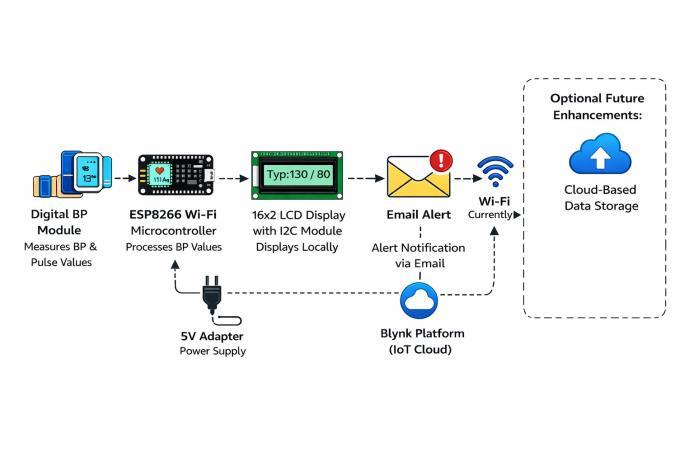
ThemethodologyoftheIoT-BasedStrokeDetectionSystem involvescontinuousmonitoringofapatient’sbloodpressure using a digital BP module connected to an ESP8266 Wi-Fi microcontroller. The BP sensor automatically measures systolic,diastolic,andpulsevalueswhenpoweredthrougha 5V adaptor. These readings are then sent to the ESP8266, whichprocessesthedataandcomparesitwithpredefined
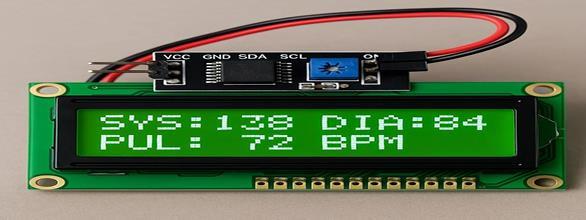
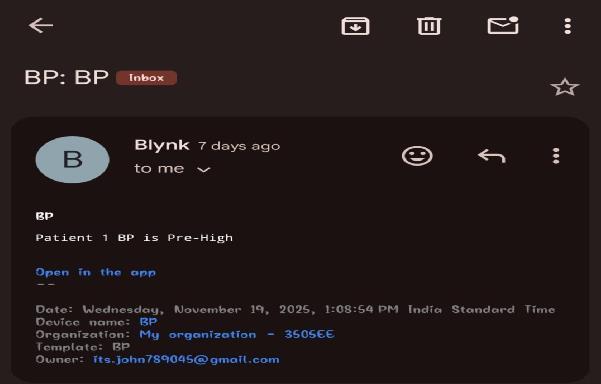
threshold ranges to determine whether the BP level is normal, low, pre-high, or high. The processed values are displayed locally on a 16×2 I2C LCD screen so that the patientcanseetheirBPinstantly.Ifthesystolicvaluegoes outsidethenormalrange,theESP8266sendsanautomatic email alert to the doctor through the Blynk IoT platform. This timely alert helps in early detection of abnormal BP variationsthatmayindicate strokerisk.Themethodology ensuresreal-timemonitoring,immediateclassification,and quick notification to the healthcare professionals. The microcontroller compares the acquired BP values with predefined threshold ranges to classify the patient’s conditionintonormal,low,pre-high,orhighBPcategories. Theprocessedreadingsaredisplayedinrealtimeona16×2 I2CLCDscreen,allowingpatientsandcaregiverstoinstantly observetheirBPstatus.IfthesystolicBPvalueexceedsor drops below the normal range, the ESP8266 triggers an automatic email alert to the doctor via the Blynk IoT platform.Thismethodologyensuresreal timemonitoring, accurate classification, and prompt notification for early stroke risk identification. The measured values are transmitted to the ESP8266, which acts as the central processingunit.ThemicrocontrollerexecutesathresholdbasedalgorithmtoanalyzetheBPvaluesanddeterminethe patient’s health condition. The system categorizes the BP readings into normal, hypotensive, pre-hypertensive, and hypertensivestates.Allreadingsaredisplayedinrealtime on a 16×2 I2C LCD module for local monitoring. When abnormalBPvaluesaredetected,theESP8266establishesa Wi-Fi connection and communicates with the Blynk IoT platform.Anautomaticemailalertcontainingthepatient’s BPstatusissenttothedoctororhealthcareprovider.This methodologyensuresuninterruptedmonitoring,immediate classification,andrapidalertdelivery.
2.1 WORKFLOW
3. RESULTS AND DISCUSSION
Theresultsoftheimplementationshowedthatthesystem successfullymeasuredanddisplayedBPvaluesontheLCD screen and accurately classified the readings using the
International
Volume: 12 Issue: 12 | Dec 2025 www.irjet.net p-ISSN: 2395-0072
threshold model. Whenever the systolic BP crossed the definedlimits,theESP8266immediatelytriggeredanemail alertthroughtheBlynkplatform,notifyingthedoctorabout the abnormal condition. This demonstrated that the IoTbasedalertmechanismworkedefficientlyandwithoutdelay. Thediscussionrevealsthatthesystemisveryusefulforthe earlydetectionofstrokesymptoms,asrisingBPisoftena prime indicator. It also reduces the need for manual BP checkingandensurescontinuousmonitoring,especiallyfor elderly or high-risk patients. However, the system’s performancedependsonstableWi-Fiavailability,andtheBP readingsmayvaryifthesensorisnotproperlypositioned. Evenwiththeselimitations,thesystemprovidesavaluable and cost-effective solution for early medical intervention. The discussion highlights that the system is particularly beneficialforelderlypatients,individualswithhypertension, andpatientswithahistoryofstroke.Itminimizestheneed formanualBPmonitoringandsupportscontinuous,remote healthsupervision.However,systemperformancedepends onstableWi-Ficonnectivity,andimproperplacementofthe BPsensormayaffectaccuracy.Despitetheselimitations,the system offers a practical and affordable solution for early strokeriskdetection.Experimentalresultsindicatethatthe SmartHealthWatchaccuratelymeasuresbloodpressureand pulse rate under normal operating conditions. The threshold-based classification algorithm successfully identifiesabnormalBPvariationsandtriggersalertswithout noticeabledelay.TheLCDdisplayprovidesclearandrealtimevisualizationofpatientdata.Thediscussionhighlights thepracticalbenefitsofthesystem,particularlyforelderly patients, individuals with chronic hypertension, and poststrokepatientsrequiringconstantsupervision.Thesystem reducesrelianceonhospitalvisitsandmanualmonitoring. However,factorssuchasWi-Fistability,sensorplacement, and user compliance may affect accuracy. Despite these limitations, the system demonstrates strong potential for real-worldhealthcareapplications.
4. CONCLUSION
The IoT-Based Stroke Detection System offers a reliable solutionforcontinuousbloodpressuremonitoringandearly identification of stroke risk. Using a digital BP sensor, ESP8266microcontroller,andBlynk-basedalertsystem,it ensuresaccurateBPclassificationandtimelynotificationsto healthcareproviders,reducingdelaysinmedicalresponse. Thesystemiscost-effective,user-friendly,andsuitablefor use in homes, hospitals, rural clinics, and elderly care facilities. With future enhancements such as mobile application integration, cloud data storage, and additional biosensors, the system can evolve into a more comprehensivesmarthealthmonitoringsolution.
5. REFERENCES
[1] WorldHealthOrganization,"Stroke,"WHOFactSheets, 2022. [Online]. Available: https://www.who.int/newsroom/fact-sheets/detail/stroke
[2] J. Smith, M. Johnson, and L. Brown, "Wearable Sensor Systems for Stroke Detection: A Comprehensive Review," IEEE Sensors Journal, vol. 20, no. 14, pp. 7891-7905, July 2020.doi:10.1109/JSEN.2020.2991234.
[3] A.GuptaandR.Kumar,"MachineLearningTechniques for Stroke Prediction Using Wearable Devices," Journal of BiomedicalInformatics,vol.102,pp.103363,2020.
[4] M.LeeandS.Park,"Real-TimeStrokeDetectionUsing Multisensor Wearable Devices," Proceedings of the IEEE EMBSInternationalConference,pp.1239,2022.
[5] Apple Inc., “Apple Watch ECG App,” 2023. [Online]. Available:https://www.apple.com/watch/ecg/
International Research Journal of Engineering and Technology (IRJET) e-ISSN: 2395-0056
Volume: 12 Issue: 12 | Dec 2025 www.irjet.net p-ISSN: 2395-0072
[6]S.Patel,H.Park,P.Bonato,L.Chan,andM.Rodgers,"A reviewofwearablesensorsandsystemswithapplicationin rehabilitation," Journal of NeuroEngineering and Rehabilitation,vol.9,no.21,2012.
[7]. R. S. Parikh et al., "Stroke Detection and Monitoring UsingWearableDevices:ChallengesandFutureDirections," Sensors,vol.21,no.6,2021.
BIOGRAPHIES




ApoorvaKisafinal-yearComputer Science and Engineering student. She is currently pursuing her degree at SG Balekundri Institute ofTechnology.
AshwiniBisafinal-yearComputer Science and Engineering student. She is currently pursuing her degree at SG Balekundri Institute ofTechnology
VinayakCisafinal-yearComputer Science and Engineering student. Heiscurrentlypursuinghisdegree at SG Balekundri Institute of Technology.
KomalMisafinal-yearComputer Science and Engineering student. He is currently pursuing her degree at SG Balekundri Institute ofTechnology