
International Research Journal of Engineering and Technology (IRJET) e-ISSN: 2395-0056
Volume: 13 Issue: 03 | Mar 2026 www.irjet.net p-ISSN: 2395-0072
International Research Journal of Engineering and Technology (IRJET) e-ISSN: 2395-0056
Volume: 13 Issue: 03 | Mar 2026 www.irjet.net p-ISSN: 2395-0072
Ronit Sarkar1 , Manish Mahimkar2 , Atharva Shelke3, Sahilkumar Basude4, Prof. Rajni Ratnaparkhi5
1,2,3,4 Student, Dept. of Computer Engineering, Dilkap College of Engineering, Maharashtra, Raigad, India 5 Professor, Dept. of Computer Engineering, Dilkap College of Engineering, Maharashtra, Raigad, India
Abstract - SecureConnect, a very extensively modular full-stack messaging and voice-calling platform, which was designed with a rigid zero-knowledge architecture. To grant the highest level of privacy, our team adopted a client-side only cryptographic design where all sensitive processes such as the RSA-2048 key generation and the AES-256 encryption are done in the browser by the Web Crypto API, so that the customer messages and the raw confidential keys are not disclosed to the server. The system is a layered Model-ViewController (MVC) architecture, which is based on a Node.js runtime and a thin, 119-line server.js entry point that delegates business logic to special directories.
The backend architecture relies solely on the HTTP framework layer and is built with Express.js, which provides RESTful API routing and a powerful security middleware bundle that incorporates Helmet to manage the Content Security Policy (CSP) and JWT authentication along with a brute-force protection layer via express-rate-limit. On the other hand, the real-time communication layer is driven by pure Node.js and makes use of Socket.IO to support two-way messaging and WebRTC to support peer-to-peer (P2P) and mesh-based group calls. In order to be scalable, we added an optional multi-instance Socket.IO synchronization Redis adapter,
The integrity of the data is ensured by the Sequelize ORM linked with an SQLite3 database, which has a comprehensive schema, which deals with the users, messages, groups, and credit transactions. One of the most important innovations of our project is an integrated credit management system, which makes use of the atomic Sequelize transactions to safely deduct user credits to perform certain operations, like sending a message or connecting the WebRTC calls. Without jeopardizing security, we designed a key synchronization flow to secure the access of the private keys by cross-device access using PBKDF2derived keys.
Lastly, our team implemented a current DevOps and testing process using Jest and Supertest to validate the API and Playwright to test the end-to-end browser. The app is also streamlined with the configuration of the high-performance cloud on AWS EC2 through GitHub Actions CI/CD, with the PM2 process manager as a constant performance monitor and automatic restart. In conclusion, it can be stated that
SecureConnect manages to prove that advanced digital privacy does not have to be costly and technologically vulnerable.
Key Words: SecureConnect, MVC Architecture, End-toEnd Encryption (E2EE), Node.js, Socket.IO, WebRTC, Sequelize ORM, SQLite3, Pay-per-use, Web Crypto API.
Our group came up with a complete web application named SecureConnect, which is created in a digital world whereprivacyanddatasecurityarethemainpriority,and it is implemented through effective communication. It offers a combined solution to end-to-end encrypted (E2EE)messagingandvoicecallandhasaveryresponsive anduser-friendlywebinterface.
Thekeytoourprojectisthezero-knowledgearchitecture, and therefore, all cryptographic functions are performed on the client side only. Our system uses RSA-2048 keys and AES-256 encryption in the browser directly by using theWebCryptoAPI.Thisarchitecturewillensurethatour servers are never exposed to plaintext messages, private keys, or raw passwords; they can be nothing more than unsaferelaystoencryptedblobs.
Inadditiontosecurity, wehada new monetizationmodel that was flexible and pay-as-you. SecureConnect has an inbuilt credit management system unlike the traditional subscription-based services which tend to confine a user to strict levels of payments. This system makes use of the atomic database transactions to withdraw credits on certainactions-sendingamessage,creatingaWebRTCcall connection, etc.- to be financially transparent and, at the sametime,data-intensive.
Tomaketheplatformscalableandmaintainable,ourteam has developed the platform on a modular MVC (ModelView-Controller) pattern. We have used Express.js as the HTTP framework layer to address RESTful API routing, security middleware and the core of the system runs on Node.js. This has Socket.IO to direct peer-to-peer audio streams (WebRTC), and Socket.IO to direct peer-to-peer messaging events. Data is operated through the Sequelize ORM over an SQLite3 dialect, an easy to lightweight although powerful relational database framework to manage users, groups, and histories of transactions.
Volume: 13 Issue: 03 | Mar 2026 www.irjet.net p-ISSN: 2395-0072
Finally, SecureConnect is the solution that connects the digital privacy and advanced technologies with the accessibleandpracticalcommunication.
Our team put together SecureConnect using this modular setup with microservices and MVC patterns. We mixed in serverless stuff from the cloud and made sureto followstrongcryptorulesrightfromthestart.Itwaskind of a layered approach, breaking everything into parts that couldworkseparatelybutstillconnect.
Frontend: Our group project frontend is written in a VanillaES6architecturebasedonVanillaHTML5,CSS3and JavaScript, which offers a lightweight and highperformance interface across seven separate pages. We divided the client-side logic in to functional modules such as api.js, a fetch wrapper, used to communicate with the RESTful server, socket.js, which is used to deal with realtime bidirectional events, and webrtc.js, which is used to peer-to-peerandmeshgroupvoicesignaling.Thecrypto.js module,whichisbasedontheWebCryptoAPI,wasusedin order to perform all thecryptographic operations,suchas RSA-OAEP 2048-bit key generation and AES-GCM 256-bit encryption entirely in the browser of the user, to ensure the environment is zero-knowledge. Such a flexible architecture is facilitated by dedicated UI assistants and core logic scripts such as auth.js and chat.js to make the implementation of a security-enhancing and real-time messagingintegrationgosmoothly.
Backend: SecureConnect has its backend designed in a modular MVC (Model-View-Controller) pattern that runs on the runtime of the Node.js the Express.js framework. The system uses a skinny, 119-line server.js entry point, which transfers business logic to controllers, routes, and specialized middleware directories. Where Express makes use of the HTTP request/response cycle, pure Node.js makes use of real-time capabilities via Socket.IO with a bidirectional messaging protocol and WebRTC signaling and an optional Redis adapter to scale horizontally to multiple instances. Persistence and relational integrity are ensured by the Sequelize ORM implementation using SQLite3 dialect which implements the atomic transactions in the database when performing critical operations like group management and pay-per-use credit system. Lastly, the backend implements a multi-layered security design comprisingoftheJWTauthentication,whichissentbythe use of cookies (http Only) and password hashing (bcrypt) andbruteforce(express-rate-limit).
Data storage: SecureConnect is an application based on the file-based SQLite3 database which is managed by the SequelizeORMtokeeptherelationaldatain6majortables. In order to preserve the zero-knowledge architecture, the servermerelystoresencryptedmessageblobsandthekeys to the encryption which are derived by the PBKDF2 and
which is securely encrypted, so that there is complete plaintext obfuscation. Moreover, the system ensures data integrity of important tasks such as credit management usingatomicSequelizetransactions.
Authentication: The SecureConnect authentication model is based on a zero-knowledge security model, which is a mix of strong back-end verification and client-side cryptography. The system uses regex-based input validationintheregistrationprocess,ahashpassword(10 rounds)basedonthebcrypthashfunctionandstoresclient generated RSA-2048 public keys and password-encrypted privatekeyssothattheserverdoesnothaveaccesstoraw credentials. JSON Web Tokens (JWT) are used to control usersessionsandoperatewith24-hourexpirationperiods assignedtothemandsentwithcookiesthatarehttpOnlyto eliminatetheriskofXSSandCSRF-relatedissues.
Theauthenticationmiddlewareisaspecializedone,taking over all requests and checking tokens signature against real-time ban status with the help of the Sequelize database. The system is further secured with rate-limiting middlewarethatlimitsusersto10attemptsin15minutes and WebSocket connections are authenticated separately usingJWTverificationintheconnectionhandshake.
Encryption: Security drove the whole encryption layer. Hybrid end-to-end in the browser via Web Crypto API, zero-knowledgesotheserverstaysblind.Asymmetricwith RSA-OAEP, 2048-bit keys for public-private pairs, exchanging publics to wrap session keys. Then symmetric AES-GCM at 256-bit for messages and streams, since its quicker for bigger stuff. Private keys get protected by deriving from password with PBKDF2, 600,000 iterations and salt, then encrypting with AES-GCM before database storage.Syncsacrossdeviceswithoutserverexposure.This part gets a bit technical, I am not totally sure how to explainthekeyexchangeperfectly,butitworksforprivacy.
Monetization: SecureConnect is being monetized through a combination of built-in pay-per-use credit management frameworks, and the notion of top-up credit models has been displacing subscription-based revenue collection models. Each user will have a credit balance (initially 500 atthetimeofregistration),thatwillbeshownintheUsers tableunderSequelizeORM.
The process of monetization is programmatic in nature; it uses a dedicated creditHelper.js utility, which conducts atomic credit deductions whenever a user sends a private message, when he/she sends a group message, or when he/she manages to connect to a WebRTC voice call. In order to guarantee data integrity and avoid race conditions, the system will use User.decrement() function ofSequelizewitha WHEREguard,sothatonlyactionsare authorizedwhenthebalanceoftheuserisabovezero.
Volume: 13 Issue: 03 | Mar 2026 www.irjet.net p-ISSN: 2395-0072
To refill their balance, users have to request their balance byputtinginacreditrequestwithatransactionreference; credits requests are held in the CreditTransaction table in the pending status until an administrator views and validatesthemintheAdminDashboard.Inordertoensure financialaccuracy,theadminapproval processisenclosed with a Sequelize database transaction, which synchronously updates the transaction status and adds credittotheuserinonesecureoperation.
Zero Knowledge Architecture: Webuiltthishybridendto-end encryption all on the client side using Web Crypto API. That meant combining RSA-OAEP with 2048-bit keys for exchanging stuff and AES-GCM at 256-bit for encryptingmessages.Thebackendservernevergottosee anyplaintextorprivatekeys,whichfeltsecure.Ithinkthat makesitviableforrealuse.
Cross-Device Synchronization: Wefiguredoutuserscan have convenience without losing security. It seems like protecting the private key with PBKDF2, running like 600,000 iterations and a random salt to get an AES-GCM keyfromthepassword,letsusstoreencryptedkeysonthe server safely. So, people can sync across devices without worries.Thatpartgetsabitmessytoexplainbutitworks.
Performance: A modular MVC structure makes the project efficient by refactoring business logic to be specializedlayerswithathinentrypoint(server.js)of119 lines. With the use of Express.js serving as only the HTTP framework layer and real-time communication being assigned to pure Node.js and Socket.IO, the system allows managingresourcesefficientlyandsimplifyingtheprocess of handling a specific traffic type. One of the most important performanceindicatorsamong the resources is thefactthattheplatformispreparedtoscalehorizontally with the optional Redis adapter, that allows synchronization between multi-instances of real-time events. Also, voice calling using the WebRTC is more efficient since it creates a direct peer-to-peer (P2P) audio stream, so the load on the server is minimized since the media content does not go through the central server. Lastly, the Sequelize ORM is included to support the maximum use of database communication involving the SQLite3 relational database, which requires little time to execute advanced joins on chat history and atomic transactionstomanagecredit.
Advanced Security: We also beefed-up security against web attacks. Using Node.js 20's experimental permission model put these restrictions on file system access, child processes, and network stuff. It is like seat belts in runtime. Plus, the dual-delivery for JWT tokens, sending themthroughHTTP-onlycookieswithSameSitestrictand in JSON responses at the same time, helped against XSS
andCSRF.Somepeoplemightthinkthatisoverkill,others seeitasnecessary.
P2P Integration: separating Express.js for HTTP routing from plain Node.js for WebSocket’s made things efficient. Socket.IO handled messaging states well, and WebRTC tookcareofsignallingforaudioandvideocalls,likeoffers, answers,andICEcandidates.Itallcametogethersmoothly enough.
Pay-As-You-Go Model: Backed by Sequelize ORM and database transactions, we did atomic decrements for micro-transactions. Like taking 1 credit per message or 5 per minute of calling, no race conditions or corruption. I am not totally sure how scalable that is long term but for nowitholdsup.
Toensurehighperformanceandmaintainability,ourgroup architected SecureConnect using a highly modular clientserver model that distinctly separates HTTP routing from real-time communicationand coresystem processing.The central entry point of our backend is server.js, which seamlessly integrates the Express application, the HTTP server,andtheSocket.IOenvironment.
A. Frontend (Client Layer): The browser-based interface is built with HTML, CSS, and highly modular Vanilla JavaScript to ensure a lightweight and responsive experience. Our team segregated the frontend logic into specializedmodules:
The overall system architecture is divided into four primarylayers:
api.js: Acts as an HTTP fetch wrapper for interacting withourRESTAPI.
socket.js: Manages real-time bidirectional WebSocket events.
webrtc.js: Handlespeer-to-peeraudio/videocalllogic.
crypto.js: Executes client-side End-to-End Encryption usingtheWebCryptoAPI.
B. HTTP Framework Layer (Express.js): We used Express.jsasthemainframeworkforhandlingalltheHTTP requests and responses in our REST API setup. It was straightforwardforthatpart.
Whenarequestcomesintotheserver,itgoesthroughthis middleware stack first. Things like Helmet to add security headers, and then parsers for JSON and cookies, plus sessionstuff,ratelimitingsoitdoesnotgetoverwhelmed, and JWT for authentication. I think that covers the basics beforeanythingelsehappens.
After validation, the request heads to specific route files. For example, authRoutes.js for login related things, creditRoutes.js,orgroupRoutes.js.Thoseroutesconnectto
International Research Journal of Engineering and Technology (IRJET) e-ISSN: 2395-0056
Volume: 13 Issue: 03 | Mar 2026 www.irjet.net p-ISSN: 2395-0072
controller functions in files like authController.js or creditController.js.
In the controllers, that’s where the real work gets done. Like user login, topping up credits, and some admin actions.
C. Real-Time WebSocket Layer (Pure Node.js): Because ExpressisonlyoptimizedforHTTP,ourreal-timechatand calling features are powered entirely by pure Node.js and Socket.IO.
ThesocketManager.jshandlesincomingconnectionsand independently verifies user identity using JWT authentication.
Once authenticated, distinct event modules take over: chatEvents.js processes one-on-one messaging, groupEvents.js manages group interactions, and webrtcEvents.js specifically routes the signaling data (calls, answers, and ICE candidates) necessary to establishpeer-to-peerconnections
D. Data & ORM Layer (Sequelize & SQLite): To manage our application's relational data integrity securely, we employed the Sequelize Object-Relational Mapper (ORM) connectedtoaSQLitedatabase(secureconnect.db).
This layer defines and associates critical database models, including User, Message, Group, GroupMember, GroupMessage,andCreditTransaction.
Execution Flow Example: Sending a Message To demonstratehowtheselayersinteract,considertheflowof sendingachatmessage:
1.The browser's socket.js emits a send-message event containing the target user ID and the End-to-End Encryptedpayload.
2.The pure Node.js backend intercepts this event in chatEvents.js.
3.Before saving the message, the system calls creditHelper.js to deduct credits. Sequelize queries the User model, verify the balance, decrements the user's creditsby1,andsavestheupdatedbalancetotheSQLite database.
4.Uponsuccessfulpaymentdeduction,Sequelizewritesthe encrypted message payload to the Message table, and a receive-message event is instantly emitted to the recipient'sbrowser.
5. Cryptographic Implementation
To guarantee total data privacy for SecureConnect, our team implemented robust hybrid Encryption (E2EE) architecturedirectlywithinthebrowserutilizingtheWeb
Crypto API. This ensures a strict zero-knowledge environment where our servers act strictly as relays and neverhaveaccesstoplaintextmessages,rawprivatekeys, orplaintextpasswords.
Table 1: AlgorithmusedinthisProject
RSA-OAEP 2048-bit
AES-GCM 256-bit
PBKDF2 600,000iterations
SHA-256 256-bit
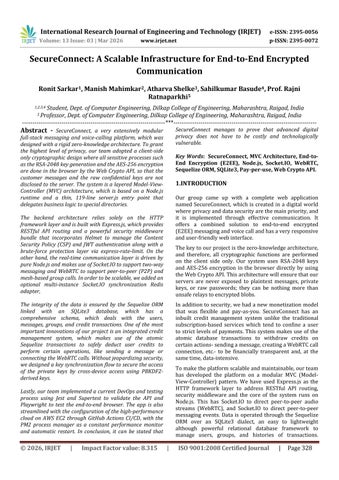
A. Key Registration:
EncrypttheAESkey foreachrecipient
Encrypttheactual messagecontent
Deriveencryptionkey frompassword
HashfunctionforRSAOAEPandPBKDF2
Thewholethingrunsrightinthebrowser,usingthatWeb Crypto API stuff from window.crypto.subtle. It keeps everything sensitive away from the server, which seems important. I think the key part starts with generating this RSA-OAEPkeypair,2048bits.Sothere’sapublickeyanda privateone,linkedmathematically.
The public key gets sent over to the server, turned into a Base64stringandstoredinthedatabase.Serverscanuseit to encrypt data just for that user, since its public. But the privatekey,thatstaysonthedevice,inlocalStorage.It’sfor decrypting whatever was encrypted with the public one. Kindofmakessense,right.
On security, it following this zero-knowledge idea. The server never gets the raw private key at all. Even if someone hacks the server, they can’t decrypt the user’s stuff because the decryption happens only locally on the machine. Though, storing the private key in localStorage meansitdependsalotonhowsecuretheuser’sdeviceand browserare.
2395-0056
Volume: 13 Issue: 03 | Mar 2026 www.irjet.net p-ISSN: 2395-0072
B. Private Key protection
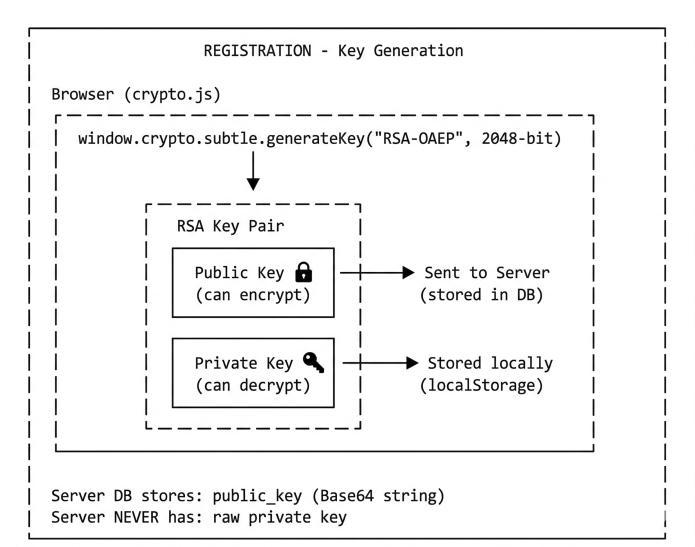
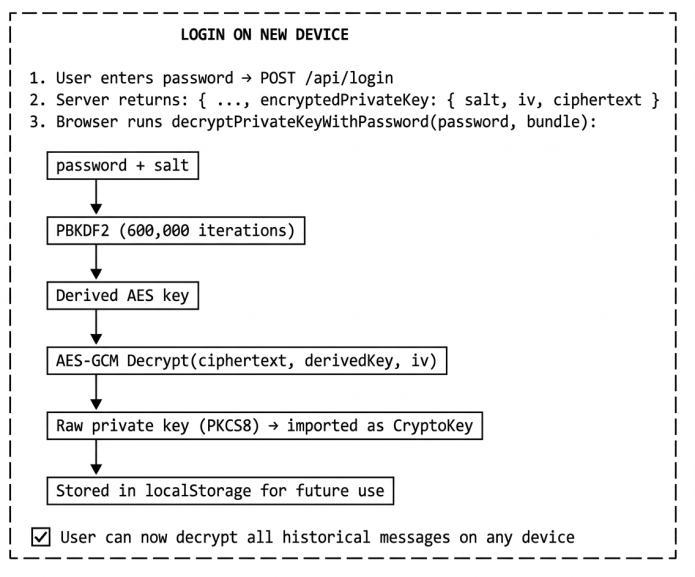
To make the password useful, they derive a key from it first.UsingPBKDF2,with600,000iterationsandSHA-256. Plus, a 16-byte random salt to add entropy. Ends up with thisderivedAES-256key,highentropy.Then,thatderived key encrypts the actual private key, which is in PKCS8 format. Uses AES-GCM, with a 12-byte IV. The output is this bundle, encrypted private key with the salt and IV included. Finally, it sends the bundle to the server via POST, to the registration endpoint. Database just stores theencryptedversion.Theserveronlyhasacrypthashof the password for login, so there is no way to reverse the PBKDF2ordecryptanything.Thatbarrierkeepsitsecure, Isuppose.Butyeah,thewholeprocessstartswiththeraw passwordandbuildsfromthere.
C. Message Encryption
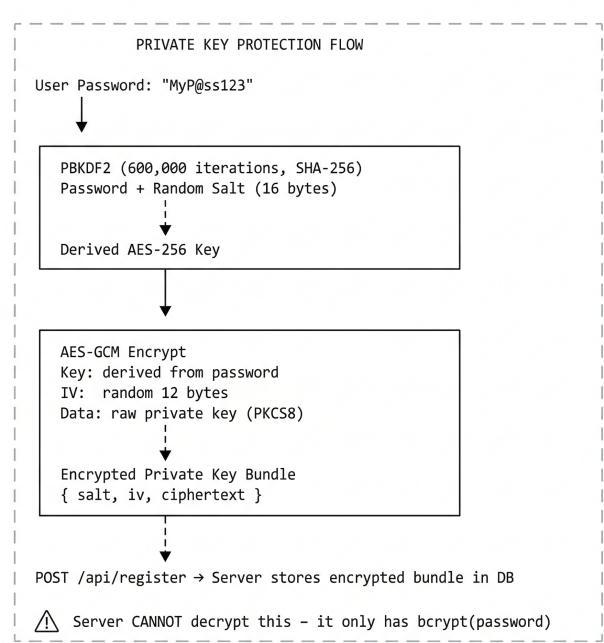
The whole idea here is to keep private keys safe from anyonesnoopingontheserverside.So,inphaseone,they turn the user’s password into something stronger, like usingthisPBKDF2thingwithatonofiterations,Ithinkit’s 600,000, and a random salt to make brute force way harder. That derived key then gets used to encrypt the actualprivatekey,therawPKCS8one,withAES-GCMand someIVtokeepitunique.Onlyafterthatdotheysendthis bundleover,thesalt,IV,andtheciphertext,buttheserver justhasacrypthashforloginstuff,soitcan’tdoanything withit.It’szeroknowledge,meaningtheserverisclueless without the password. I might be oversimplifying the encryption part a bit. Anyway, moving to when messages get sent, like Alice to Bob, they mix symmetric and asymmetricencryptionbecausehybridisfaster.
Alice’s browser makes a one-time AES-256 key and IV, encryptsthemessagerightthereintociphertext.Thenthat keygetswrappeduptwice withRSA-OAEP,onceforBobs public key so only he can unwrap it, and once for Alices own public key, that way she can look back at what she sentlater.
Everything goes into a JSON package, the ciphertext, IV, both wrapped keys, and it shoots off via Socket.IO. Server storestheblobbutyeah,can’treaditatall.
International Research Journal of Engineering and Technology (IRJET) e-ISSN: 2395-0056
Volume: 13 Issue: 03 | Mar 2026 www.irjet.net p-ISSN: 2395-0072
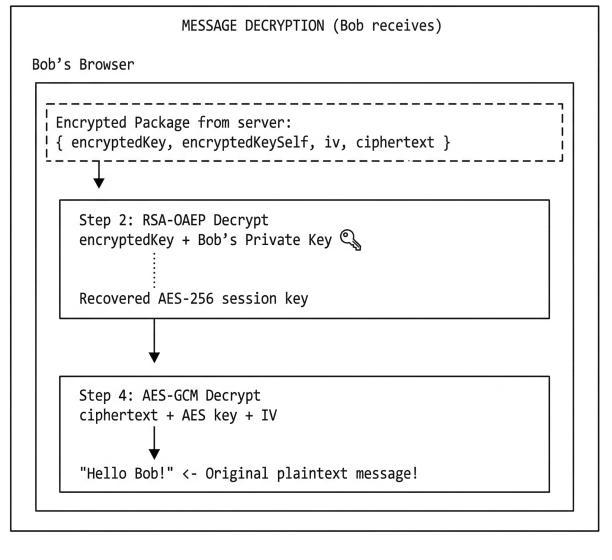
For receiving, Bob gets the package and his browser unlocks the session key using his private key on that encryptedKey part with RSA-OAEP again. Once he has the AES key back, he uses it with the IV to decrypt the ciphertext in AES-GCM mode, and there you go, the messagepopsoutlikeHelloBob.
This part gets a bit messy explaining the flows, but it seems solid for keeping things private end to end. The server just passes stuff around without knowing what’s inside,whichisthemainpoint,Ithink.Somepeoplemight worryaboutthe browserside, but that’s where theheavy liftinghappensanyway.
The wholeidea behind this securemessaging setupstarts withprotectingtheuser'sprivatekey,right.Youcan’tjust leaveitsittingthereinplaintextontheserver,thatwould beadisaster.Soinstead,theyusethepasswordtowrapit upsecurely.
First off, the password gets mixed with a random 16-byte salt, and then that goes through this PBKDF2 process, 600,000 iterations with SHA-256, to make a strong AES256 key. It seems like that’s to make it hard to crack if someonegetsholdofit.Then,witha12-byteIVthrownin, they encrypt the raw private key, which is in PKCS8 format, using AES-GCM. The server ends up with this bundle,saltandIVandthe ciphertext,butitonlyknowsa crypt hash of the password for login stuff. Without the actualpassword,theservercan’tderivethekeyordecrypt anything,it’sallzero-knowledge.
WhensomeonelikeAlicewantstosendamessagetoBob, it switches to this hybrid encryption thing, which mixes symmetricandasymmetricforspeedandsecurity,Iguess Alice’s browser makes a one-time AES-256 key and IV, encrypts the message content with it via AES-GCM. But
then that symmetric key needs protection too, so it gets wrappedwithRSA-OAEP,onceusingBobspublickeysohe can unlock it, and again with Alices own public key, that way she can see her sent messages later. All of it, the ciphertext,thetwowrappedkeys,theIV,getspackedinto a JSON and sent over Socket.IO to the server. The server storestheblobbutyeah,can’treadthemessageitself.
On the receiving end, Bob gets the package. His browser pulls his private key, uses it to decrypt the part wrapped withhis publickeyvia RSA-OAEP,andthatgivesback the AESsessionkey.ThenwiththatkeyandtheIV,itdecrypts the actual message. Pretty straightforward once you have thekeys.
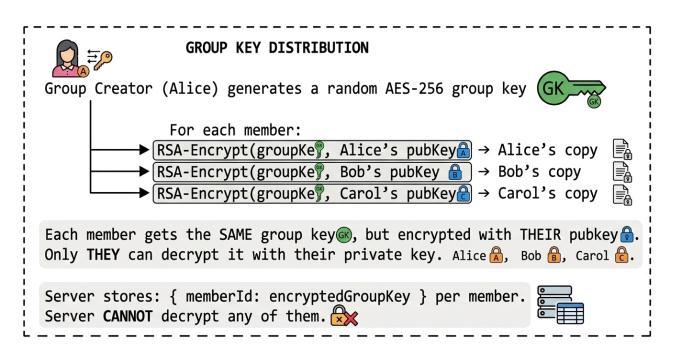
For groups, it’s a bit different to make it scale. The group creator, like Alice, generates one AES-256 group key for the whole chat. She encrypts a copy of that key for each person, Bob, Carol, whoever, using their individual RSA public keys. The server holds these pairs, member ID to their encrypted group key, so everyone can use the same symmetric key to encrypt and decrypt messages in the group.Nooneelsecanpeek,andtheserverstaysneutral.
F. Key Sync Across multiple devices
If you log in to a new device, it fetches the encrypted private key bundle from the server. The browser just reruns the PBKDF2 with your password and the salt to remake the AES key, then unlocks the raw private key right there locally. That part feels like it keeps things portablewithouttrustingtheservertoomuch.
This whole flow has some repetition in how keys get handled, like deriving and wrapping repeatedly, but I thinkitmakessenseforthesecuritylayers.Noteverything is totally clear on how the group key gets updated if someoneleavesorsomething,thatmightgetmessy.
International Research Journal of Engineering and Technology (IRJET) e-ISSN: 2395-0056
Volume: 13 Issue: 03 | Mar 2026 www.irjet.net p-ISSN: 2395-0072
6. Comparison against the current competitors
Table 2: Differentcompetitorsandtechniques
Messaging App
SecureConnect
Standard
ZeroKnowledge; no metadata tracking
WhatsApp High;tracks contacts, location, andIP
Signal Minimal; only registration date
Telegram Moderate; logs IPs/Phone numbersfor legal requests
SignalProtocol/Libsodium
SignalProtocol(E2EEbydefault)
SignalProtocol(GoldStandard)
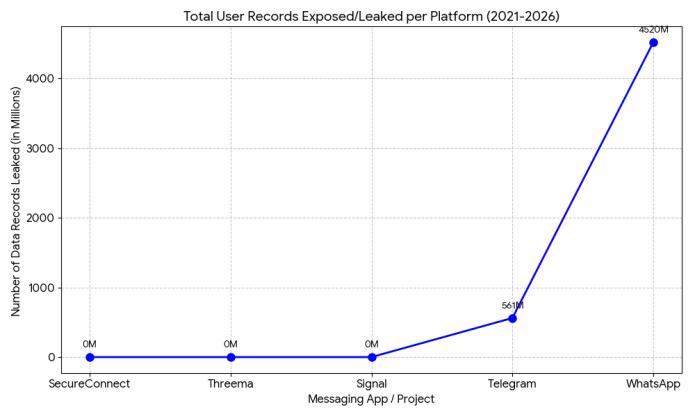
WhatsApp: Its massive count of leaks can be frequently attributed to scraping flaws, which are based on the necessity to register a phone number, which is a vulnerability that is addressed in your project through employingemail/username-basedidentification.
Telegram: Since it is encrypted by default (between the client and the server, but not the end-to-end) its central databaseattractshackersmore,whichexposesmillionsof userprofiles.
6.2
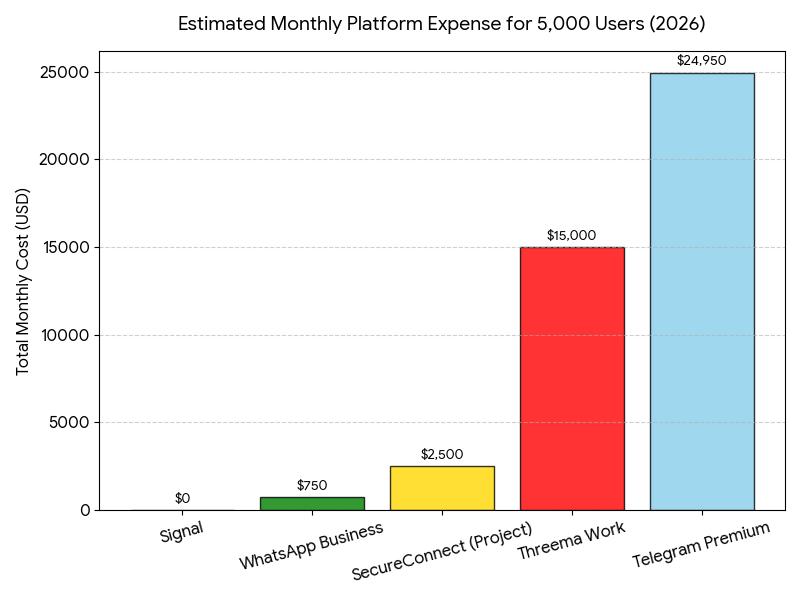
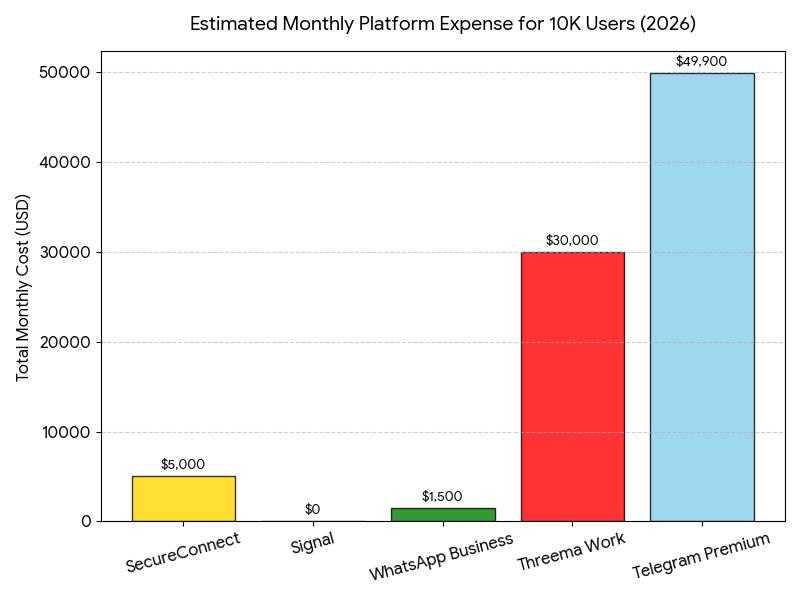
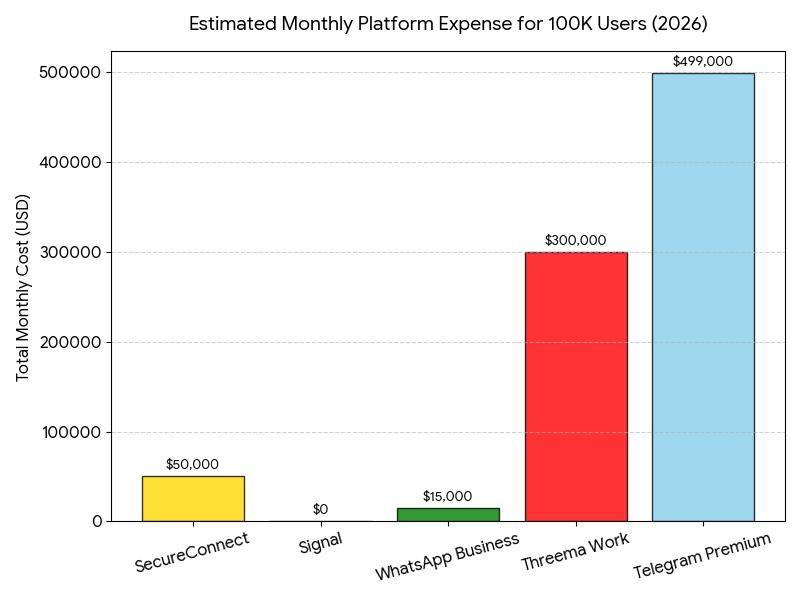
Cost Efficiency: As you noted in your project report, SecureConnectwill be50to 90percentlower pricedthan existingenterprisesolutionssuchasThreemaWork,Wire, or Slack. Signal is free, but SecureConnect is a sustainable high-privacyalternativeto peoplewhowould ratherhave dedicated infrastructure without paying the high price as TelegramorThreema.
Flexible Monetization: SecureConnect is a wallet-based systemcomparedtoTelegramPremium,whichwillneeda fixedmonthlysubscriptionfee of4.99.Inthecase when a customer does not receive the messages within one month,theydonotpayanything,butaTelegramPremium userwouldpaytheentiresubscriptionfee.
MTProto(NotE2EEbydefault)
Threema Low;hashes contactinfo immediately NaClLibrary(XSalsa20/Poly1305)
SecureConnect, Signal, and Threema: These applications have a similar philosophy of reducing the data gathering. With no data kept as personal identifiers or relationship metadata, then there is not even any data to compromise incaseofanattack.
WhatsApp API Costs: As free to individuals, WhatsApp Business API is charged per conversation to businesses that require 5,000 or less customers to communicate via theWhatsAppAPI(Marketing,Utility,orService).In2026, theIndianmarketingmessageswouldbeabout0.88each, so extensive broadcasting is more costly than the onecredit-per-messagesystemofSecureConnect.
International Research Journal of Engineering and Technology (IRJET) e-ISSN: 2395-0056
Volume: 13 Issue: 03 | Mar 2026 www.irjet.net p-ISSN: 2395-0072
To sum up, the emergence of SecureConnect effectively addressestheemergentneedofuncompromising,privacyoriented communication in a connected world that is usuallyriddledwithcomputerinfections,surveillance,and data breaches. With a hereby innovation of combining military-grade End-to-End Encryption (E2EE) with a pioneering credit-based top-up monetization system, our group project would provide a viable and usercontrollable alternative to conventional messaging systemsthatoftensellcustomerdatatogenerateprofits.
Our system proves that security at a high level does not necessarily require it to be at the cost of usability or affordability. Our servers are not transparent and plain text messages or raw private keys are never accessed by them, by a zero-knowledge architecture we ensure absolute confidentiality. Besides, we have scaled the platform by utilizing AWS serverless, such as Lambda, DynamoDB, and Cognito, making it highly scalable and performantatthesametime.Thetechnicalbenefitsofthe usage of the Node.js 20.x runtime include 400% to 500% faster URL parsing speeds, as compared to the older versions, which reduces the latency in real-time communication.
Another important outcome of our work is that it will be economicallyaccessible;SecureConnectwilloffer50to90 percent cost reduction in the occasional users in comparison withstrictsubscription modelsandavoidthe tracking risks caused by compulsory phone number registration. In the end, this project will bring the two worlds together, i.e. privacy and practicality, which will provideagoodbaseonwhichotherimprovementswillbe made in the future including cross-platform mobile applications and improved media handling through encryptions. SecureConnect is an affirmation that digital privacy will be empowering and sustainable and will lead toasaferdigitalfuture.
[1]ACM Digital Library. Modern Encryption and Messaging.2019,dl.acm.org/doi/book/10.5555/1206501.
[2]AWSDocumentation.UsingAWSLambdawithAmazon DynamoDBStreams.2025, docs.aws.amazon.com/lambda/latest/dg/with-ddbexample.html.
[3] Bernstein, Daniel J., et al. NaCl: Networking and CryptographyLibrary.2011, en.wikipedia.org/wiki/NaCl_(software).
[4] Blaise, Ohwo Onome. "An Understanding and Perspectives of End-To-End Encryption." International Research Journal, vol. 8, no. 4, 2021,
International Research Journal of Engineering and Technology (IRJET) e-ISSN: 2395-0056
Volume: 13 Issue: 03 | Mar 2026 www.irjet.net p-ISSN: 2395-0072
www.researchgate.net/publication/350850077_An_Under standing_and_Perspectives_of_End-To-End_Encryption.
[5] Gupta, Sandeep, and Bruno Crispo. "End-to-End Encryptionfor SecuringCommunicationsin Industry4.0." 2022 4th IEEE Middle-East & North African Communication Conference, IEEE, 2022, pure.qub.ac.uk/en/publications/end-to-end-encryptionfor-securing-communications-in-industry-40/.
[6] IEEE Software Journal. Pay-as-You-Go SaaS Pricing Models.IEEEXplore,2016, ieeexplore.ieee.org/document/7427835/.
[7] Libsodium Documentation. A Modern and Easy-to-Use CryptographyLibrary.doc.libsodium.org/.
[8] Marlinspike, Moxie. "Introduction to the Signal Protocol."WIRED,July2016, www.wired.com/2016/07/meet-moxie-marlinspikeanarchist-bringing-encryption-us/.
[9] Parkes, David C., and Michael P. Wellman. "The EconomicsofPay-per-UsePricing."IEEESoftware,vol.35, no.4,2018,pp.59-63, ieeexplore.ieee.org/document/8497014.
[10] Perrin, Trevor, and Moxie Marlinspike. The Signal Protocol: Double Ratchet Algorithm. Open Whisper Systems GitHub, 2013, github.com/signalapp/libsignalprotocol-javascript.
[11]R.L.Rivest,A.Shamir,andL.Adleman,"AMethodfor Obtaining Digital Signatures and Public-Key Cryptosystems," Communications of the ACM, vol. 21, no. 2,pp.120–126,Feb.1978,doi:10.1145/359340.359342.
[12] M. Marlinspike and T. Perrin, "The Double Ratchet Algorithm,"OpenWhisperSystems,Tech.Rep.,Nov.2016. [Online].Available: https://signal.org/docs/specifications/doubleratchet/
[13] A. Herzberg, "On Deploying Secure Messaging: A Survey of End-to-End Encrypted Messaging Applications," IEEE Communications Surveys & Tutorials, vol. 22, no. 4, pp.2432–2468,2020.
[14] European Data Protection Supervisor (EDPS), "TechDispatch: End-to-End Encryption – ProtonMail and Beyond," EDPS, Brussels, Belgium, Tech. Rep. 2021/01, Jan.2021.
[15] B. Dowling, F. Günther, U. Maurer, and D. Stebila, "A Cryptographic Analysis of the Signal Protocol," in Proc. IEEE Symposium on Security and Privacy (SP), San Jose, CA,USA,2017,pp.905–925.
[16]MozillaDeveloperNetwork(MDN),"WebCryptoAPI: SubtleCrypto Interface," Mozilla Foundation, 2025. [Online]. Available:https://developer.mozilla.org/enUS/docs/Web/ API/SubtleCrypto
[17] National Institute of Standards and Technology (NIST), "Recommendation for Block Cipher Modes of Operation: Galois/Counter Mode (GCM) and GMAC," NIST SpecialPublication800-38D,Nov.2007,updated2024.
[18] D. McGrew and K. Igoe, "AES-GCM Authenticated Encryption in the Secure Real-time Transport Protocol (SRTP),"IETFRFC7714,Dec.2015.[Online].Available: https://www.rfc-editor.org/rfc/rfc7714
[19] M. B. Jones, J. Bradley, and N. Sakimura, "JSON Web Token (JWT)," IETF RFC 7519, May 2015. [Online]. Available:https://www.rfc-editor.org/rfc/rfc7519
[20] C. Jennings, H. Boström, and J.-I. Bruaroey, "WebRTC 1.0: Real-time Communication Between Browsers," W3C Recommendation,Jan.2021.[Online].Available: https://www.w3.org/TR/webrtc/
[21] OWASP Foundation, "OWASP Top 10:2025 – The StandardAwarenessDocumentfor Web Application Security," 2025. [Online]. Available: https://owasp.org/Top10/
[22] T. Dierks and E. Rescorla, "The Transport Layer Security(TLS)ProtocolVersion1.3," IETF RFC 8446, Aug. 2018. [Online]. Available: https://www.rfc-editor.org/rfc/rfc8446
[23] Socket.io Team, "Socket.io v4.x Documentation: Bidirectional Real-time Communication," 2026. [Online]. Available:https://socket.io/docs/v4/
[24] Sequelize Contributors, "Sequelize v6: A Modern TypeScriptandNode.jsORM,"2025. [Online].Available:https://sequelize.org/docs/v6/
[25] National Institute of Standards and Technology (NIST), "Recommendation for Password-Based Key Derivation, Part 1: Storage Applications," NIST Special Publication 800-132,Dec.2010.