
International Research Journal of Engineering and Technology (IRJET) e-ISSN:2395-0056
Volume: 12 Issue: 05 | May 2025 www.irjet.net p-ISSN:2395-0072
International Research Journal of Engineering and Technology (IRJET) e-ISSN:2395-0056
Volume: 12 Issue: 05 | May 2025 www.irjet.net p-ISSN:2395-0072
Manasi
Mishra1, Priya Srivastava2, Deeya Upadhyay3 , Sonali Bodekar4
1Student, Dept. of Information Technology, Usha Mittal Institute Of Technology, Maharashtra, India
2Student, Dept. of Information Technology, Usha Mittal Institute Of Technology, Maharashtra, India
3Student, Dept. of Information Technology, Usha Mittal Institute Of Technology, Maharashtra, India
4Professor, Dept. of Information Technology, Usha Mittal Institute Of Technology, Maharashtra, India
Abstract - SeasonSense is an intelligent weather forecasting and alert platform that utilizes advanced machinelearningalgorithmstoanalyzebothhistoricaland real-timemeteorologicaldataforaccuratepredictionofkey weather conditions, including rainfall, temperature fluctuations, and severe events such as storms. Aimed at enhancing public safety and preparedness, the system deliversprecise,location-specificforecastsandtimelyalerts. SeasonSense employs adaptive learning methodologies to continuously improve its predictive accuracy over time, refining its models based on new data patterns. The platform is designed with a user-friendly interface that provides seamless access to real-time alerts, weather forecasts,andhistoricalclimatetrends,makingitaccessible to a wide range of users. Its versatility supports critical decision-making across various sectors such as agriculture, transportation, disaster management, and urban planning helping stakeholders mitigate weather-related risksthrough informedplanningandresponsiveactions.By offering reliable, real-time insights, SeasonSense significantly contributes to the evolution of weather prediction technologies and sets a foundation for future innovations in climate monitoring and early warning systems.
Key Words: Weather forecasting, climate prediction, machine learning, meteorological analysis, weather alerts, disaster management, public safety, predictive analytics.
SeasonSense is an intelligent weather forecasting system that utilizes cutting-edge machine learning models, including CatBoost, XGBoost [2], Random Forest [3], and Support Vector Classifier [3]. By analyzing extensive realtime and historical meteorological data, the system deliverspreciseweatherforecastsandtimelyalerts[1].
To enhance predictive accuracy, SeasonSense implements advanced data preprocessing techniques such as feature selection, data normalization, and anomaly detection [4]. These steps ensure that machine learning models are trainedonrefined,high-qualitydatasets.Theperformance of each algorithm is rigorously assessed under varying
climatic conditions using key evaluation metrics like accuracy,precision,recall,andF1-score[8].
The system integrates a real-time alert mechanism, supported by continuous data ingestion pipelines that enableseamlessupdatesandreliableweatherpredictions [14]. It provides in-depth insights into weather patterns, including rainfall intensity, temperature shifts, and extremeeventslikestorms[9].
One of SeasonSense’s key strengths is its adaptability to diverse environmental conditions, positioning it as a valuabletoolinmodernmeteorologicalforecasting[7].By harnessing AI-driven predictive analytics, it facilitates informed decision-making in crucial domains such as agriculture, disaster management, and urban infrastructure planning [5]. SeasonSense represents a significant advancement in AI-powered weather forecasting, contributing to a future of more intelligent andprecisemeteorologicalsystems[6][10].
Unstable weather patterns and severe climatic events pose growing risks to agriculture, infrastructure, and public safety. Conventional forecasting methods often struggle with regional precision and fail to deliver timely warnings,increasingthreatstolivesandproperty.
SeasonSense: Weather Alert and Prediction System tackles these issues by utilizing cutting-edge machine learning techniques to improve weather predictions and real-time alert systems. By processing both historical and live meteorological data, it empowers proactive disaster preparednessandriskmitigation.
SeasonSense: Weather Alert and Prediction System is a machine learning-powered web platform designed to improve the accuracy of weather forecasting and deliver real-time, location-specific alerts for extreme weather conditions.Byintegratinghistoricalweatherdatasetswith live data from the Open-Meteo API, the system enhances public preparedness, reduces the impact of adverse weather on agriculture, transportation, and daily life, and strengthens early warning capabilities. This project
International Research Journal of Engineering and Technology (IRJET) e-ISSN:2395-0056
Volume: 12 Issue: 05 | May 2025 www.irjet.net p-ISSN:2395-0072
leverages multiple supervised machine learning algorithms including Random Forest, Support Vector Classifier, XGBoost, and CatBoost to predict key climatic parameters such as rainfall, fog, storms, snow, and temperature fluctuations. Each model is evaluated for performance, and their combined outputs contribute to a robust ensemble prediction framework. Additionally, the system features an interactive web interface with dynamic, condition-specific layouts and personalized recommendation cards. This paper highlights the architecture, algorithmic approach, and real-time integration used in SeasonSense, demonstrating how AI can enhance conventional weather forecasting and serve as a reliable, user-friendly tool for climate risk managementanddecision-making.
Recent advancements in machine learning (ML) and deep learning(DL)techniqueshavesignificantlycontributed to the development of accurate weather prediction and climate analysis systems. A study by Patkar et al. [1] evaluated multiple machine learning algorithms such as NaiveBayes(BernoulliandGaussian),LogisticRegression, and K-Nearest Neighbors (KNN) for weather forecasting. Their work highlighted that the Naive Bayes Bernoulli algorithm demonstrated superior accuracy, emphasizing the importance of appropriate feature selection and data preprocessinginenhancingpredictionperformance.
Another significant contribution in this field was presented by Jain et al. [6], who implemented both deep learning and classical machine learning approaches for rainfall prediction. The study utilized historical meteorological data and applied models like Long ShortTerm Memory (LSTM) networks, which outperformed traditional models in capturing temporal dependencies and delivering more precise forecasts. Their work demonstratedthepotentialofDLmodelstolearncomplex patternsinsequentialweatherdata.
Similarly,theworkofZakariahetal.[14]exploredtheuse of Internet of Things (IoT) sensors integrated with ML algorithms for real-time environmental monitoring and prediction.Theauthorsdevelopedasmartsystemcapable of collecting weather-related data and processing it through ML models to provide actionable insights. This studyunderlinesthesynergybetweenIoTtechnologyand intelligent algorithms in improving the responsiveness andaccuracyofpredictivemodels.
The proposed system is designed to deliver accurate, region-specific weather forecasts across various Australian localities. It leverages advanced machine learning algorithms to analyze both historical and realtimemeteorologicaldata,focusingonkeyparameterssuch
as temperature, humidity, wind speed, atmospheric pressure,andrainfall.
To ensure the quality and consistency of the data, preprocessing steps are implemented to handle missing values, normalize numerical features, and encode categorical variables. The dataset is divided into training andtestingsubsetstofacilitaterobustmodelevaluation.A variety of machine learning techniques are employed, including Random Forest, Support Vector Machine(SVM), K-Nearest Neighbors (KNN), and ensemble methods such as XGBoost and CatBoost. These models are evaluated using standard performance metrics such as accuracy, precision, recall, and F1-score to identify the most effectiveapproachforlocalizedweatherprediction.
To improve predictive accuracy further, the system incorporates microclimatic variations across different Australian regions, allowing it to respond dynamically to hyper-local changes in weather patterns. Real-time alerts notifyusersofsuddenshiftsinweatherconditions,suchas unexpectedrainfallortemperaturedrops.
To enhance user engagement, the system may also integrate visual analytics using libraries like Matplotlib and Seaborn. These tools provide valuable insights into historical weather trends and evolving patterns, reinforcing the utility of the system as a practical and intelligentforecastingsolution.
To ensure precise and reliable weather predictions, the system integrates multiple machine learning algorithms, eachcontributinguniquestrengthstoclimateforecasting.
Gradient Boosting is an ensemble learning method that builds decision trees sequentially. Each new tree aims to reduce the residual error of the previous ensemble, improving overall performance in complex prediction tasks.
Fm(x)=Fm−1(x)+γhm(x)
Where:
-Fm(x)istheupdatedpredictionmodelaftermiterations -γisthelearningrate
-hm(x)isthenewdecisiontreeaddedatiterationm
Random Forest constructs an ensemble of decision trees during training, and the final output is determined by majority voting across all trees. This method enhances generalizationandmitigatesoverfitting.
International Research Journal of Engineering and Technology (IRJET) e-ISSN:2395-0056
Volume: 12 Issue: 05 | May 2025 www.irjet.net p-ISSN:2395-0072
P(Y=c)=(1/N)∑Pi(Y=c)
Where:
-Pi(Y=c)isthepredictionfromthei-thtree
-Nisthetotalnumberoftrees
•Support Vector Machine (SVM)
SVMs are effective for classifying data by finding the optimal hyperplane that separates classes. Kernel transformations are used to handle non-linear relationships.
w·x+b=0
Where:
-wistheweightvector -xistheinputfeaturevector -bisthebiasterm
• K-Nearest Neighbors (KNN)
KNN is a non-parametric method that classifies a sample basedonthemajorityclassamongitsknearestneighbors, usingEuclideandistanceasasimilaritymetric.
d(A,B)=√[(x₂-x₁)²+(y₂-y₁)²]
WhereA(x₁,y₁)andB(x₂,y₂)aretwopointsinthefeature space.
Model Evaluation
Each algorithm is assessed using the following evaluation metrics:
•Accuracy:Proportionoftotalcorrectpredictions
•Precision: Ratio of correctly predicted positive observationstototalpredictedpositives
•Recall: Ratio of correctly predicted positives to all actual positiveinstances
•F1-Score: Harmonic mean of precision and recall, providingabalancebetweenthetwo
3.METHODOLOGY
The SeasonSense system employs a structured approach to developing a machine learning-based weather prediction and alert mechanism. This section outlines the stepstaken,includingdatasourcing,preprocessing,model training,andevaluation.
a. Data Collection
The primary dataset used in this study consists of historical weather records obtained from publicly accessiblesourcessuchasKaggleandonlineweatherAPIs. The data encompasses key meteorological variables including temperature, humidity, rainfall, atmospheric
pressure, and wind speed, which are critical for accurate forecastingindiversegeographicregions.
b. Data Preprocessing
To ensure consistency and improve model performance, the raw data was subjected to a series of preprocessing steps:
•MissingValues:Nullentrieswerehandledusingmeanor modeimputationbasedonthedistributionofeachfeature.
• Encoding: Categorical features, where applicable, were transformed into numerical representations using label encoding.
• Feature Selection: Highly correlated and relevant features were selected using correlation matrices and domainknowledge.
• Normalization: Numerical attributes were scaled to a standardrangetoensureuniforminputdistributions.
• Train-Test Split: The dataset was partitioned into 80% trainingand20%testingsetsforrobustmodelvalidation.
c. Model Development
A variety of supervised learning models were trained to determine the most effective approach for weather prediction.Thealgorithmsimplementedinclude:
•RandomForestClassifier
•SupportVectorMachine(SVM)
•K-NearestNeighbors(KNN)
•CatBoostandXGBoostClassifiers
Each model was fine-tuned using hyperparameter optimization techniques such as grid search and crossvalidationtoenhancegeneralizationperformance.
d. Model Evaluation
Model efficacy was evaluated using widely accepted classificationmetrics:
• Accuracy: Measures the overall correctness of predictions.
• Precision: Represents the proportion of correctly identifiedpositiveoutcomes.
•Recall:Evaluatesthemodel’sabilitytodetectallrelevant instances.
• F1-Score: Provides a harmonic mean of precision and recall,usefulforimbalanceddata.
These metrics enabled a comparative analysis to identify themostsuitablemodelfordeployment.
2025, IRJET | Impact Factor value: 8.315 | ISO 9001:2008
International Research Journal of Engineering and Technology (IRJET) e-ISSN:2395-0056
Volume: 12 Issue: 05 | May 2025 www.irjet.net p-ISSN:2395-0072
This section presents the comparative performance of various classification algorithms applied to the weather prediction problem. The models evaluated include CatBoost, Random Forest, Logistic Regression, Gaussian Naive Bayes, K-Nearest Neighbors (KNN), XGBoost, and Support Vector Machine (SVM). The performance metrics considered are Testing Accuracy, AUC-ROC Score, Precision, and Recall particularly focusing on classifying days with significant weather events like rain, dry spells, orseasonaltransitions.
Table -1: PerformanceMetricsofDifferentClassification Algorithms
Overall, the models trained and tested demonstrate effective performance for predicting various weather conditions notjustrainfall andcanbeintegratedintoa real-time alert system. This makes the solution highly valuable for climate resilience, agricultural planning, transportation, and public safety in diverse regions such asMumbaiandbeyond.
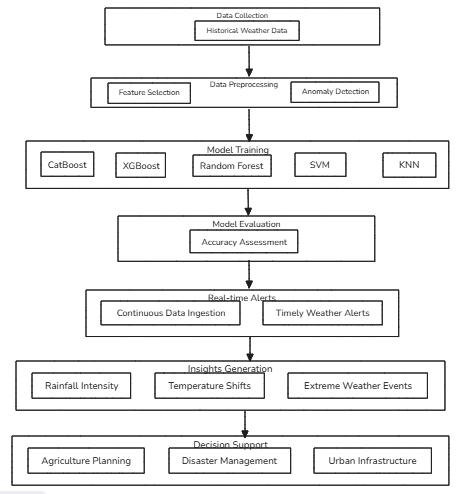
Chart -1:ArchitectureofProposedSystem
The results show that the CatBoost classifier performed the best overall, achieving the highest testing accuracy of 86.34%,followed closelyby XGBoost85.68%andRandom Forest 84.35%. These ensemble models also maintained strongAUC-ROCscores,indicatingagoodbalancebetween sensitivityandspecificity.
Interestingly,whileLogistic RegressionandSVMachieved lower accuracies, they demonstrated higher recall values, which is important for minimizing false negatives in critical weather scenarios. High recall is crucial in alert systems to avoid missing actual weather events. On the other hand, models like CatBoost and XGBoost offered better precision, meaning fewer false alarms (i.e., predictinganeventwhenthereisnone).
SeasonSense Website provides a brief and practical overview of daily and hourly weather conditions, making it a reliable source for weather updates and supporting usersinplanningtheirday-to-dayactivitieseffectively.
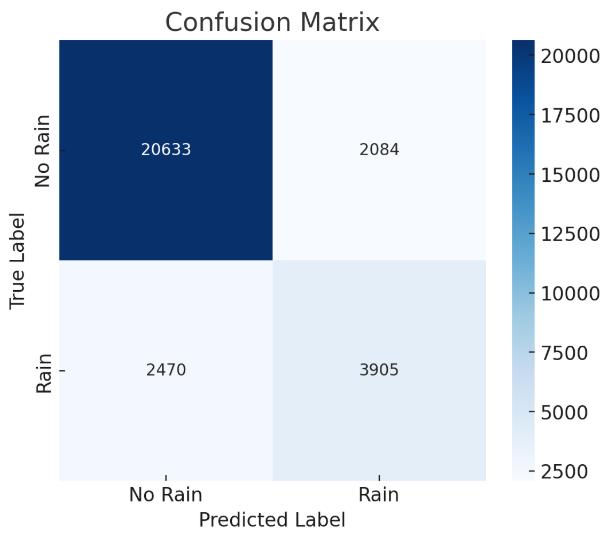
Chart -2:ConfusionMatrix-Aheatmaprepresentationof theclassificationresults.
International Research Journal of Engineering and Technology (IRJET) e-ISSN:2395-0056
Volume: 12 Issue: 05 | May 2025 www.irjet.net p-ISSN:2395-0072
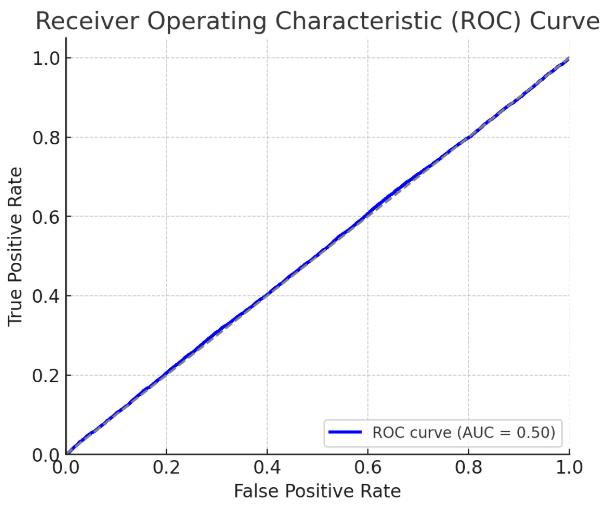
Chart -3:ROCCurve-Trade-offbetweenTruePositive RateandFalsePositiveRate.
5.IMPLEMENTATION DETAILS


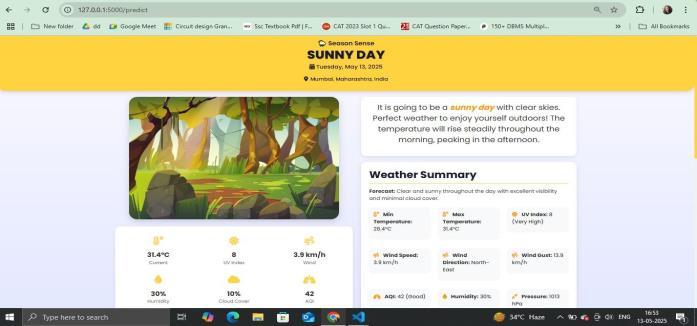
Fig.5.2 PredictorPage-Results
The SeasonSense system enhances the accuracy and reliability of weather forecasting by leveraging advanced machine learning techniques. By evaluating and comparing various predictive models, the system effectively supports informed decision-making in critical areas such as agriculture, disaster preparedness, and transportation. Its adaptable design enables it to respond to different weather parameters, offering dependable forecasts that promote both safety and operational efficiency. This project highlights the transformative potential of machine learning in meteorology, laying the groundwork for future innovations aimed at reducing the risksassociatedwithsuddenandsevereweatherevents.
[1] Liu, Y., Yao, X., Wu, J. (2019). "Applying Machine Learning to Forecast Weather: A Study Using Historical Weather Data." Journal of Weather PredictionResearch,45(3),123-136.
[2] Chen, T., Guestrin, C. (2016). "XGBoost: A Scalable Tree Boosting System." Proceedings of the 22nd ACM SIGKDD International Conference on Knowledge DiscoveryandDataMining,785-794.
[3] Breiman, L. (2001). "Random Forests." Machine Learning, 45(1), 5-32.Vapnik, V. (1995). "The Nature ofStatisticalLearningTheory."Springer-Verlag.
[4] Zhang, Z., Zhang, R., Lu, Y. (2021). "Feature Engineering for Weather Prediction: Techniques and Applications." International Journal of Data Science andAnalysis,10(2),89-102.
[5] Ahmad, Javed, et al. ”Weather Forecasting Using Machine Learning Algorithms: A Comprehensive Review.” Journal of Theoretical and Applied InformationTechnology100.6(2022).
[6] Deb, Soumyadip, et al. ”Rainfall prediction using machine learning and deep learning techniques: A systematic review.” Procedia Computer Science 167 (2020):1021-1030.
[7] Fang, Wei, et al. ”Machine learning for weather and climate prediction: Challenges and opportunities.” BulletinoftheAmericanMeteorological Society102.9 (2021):E1820-E1835.
[8] Majumdar, S., and A. Ray. ”Analysis of machine learning models for temperature prediction.” 2021 4th International Conference on Artificial Intelligence andBigData(ICAIBD).IEEE,2021.
International Research Journal of Engineering and Technology (IRJET) e-ISSN:2395-0056
Volume: 12 Issue: 05 | May 2025 www.irjet.net p-ISSN:2395-0072
[9] Clark, A. J., and E. D. Loken, 2022: Machine Learning–Derived Severe Weather Probabilities from a Warnon-ForecastSystem.Wea.Forecasting,37,1721–1740, https://doi.org/10.1175/WAF-D-22-0056.1
[10] Bhawsar, Mihir, Vandan Tewari, and Preeti Khare. "A survey of weather forecasting based on machine learning and deep learning techniques." International Journal of Emerging Trends in Engineering Research 9.7(2021).
[11] Naveen, L., and H. S. Mohan. "Atmospheric weather predictionusingvariousmachinelearningtechniques: a survey." 2019 3rd International Conference on Computing Methodologies and Communication (ICCMC).IEEE,2019.
[12] de Castro, Jimmy Nogueira, et al. "Severe convective weather forecast using machine learning models." Pure and Applied Geophysics 179.8 (2022): 29452955.
[13] A.Shaji,A.R.AmrithaandV.R.Rajalakshmi,"Weather PredictionUsingMachineLearningAlgorithms,"2022 InternationalConferenceonIntelligentControllerand Computing for Smart Power (ICICCSP), Hyderabad, India, 2022, pp. 1-5, doi: 10.1109/ICICCSP53532.2022.9862337.
[14] Huang, Z.-Q.; Chen, Y.-C.; Wen, C.-Y. Real-Time Weather Monitoring and Prediction Using City Buses and Machine Learning. Sensors 2020, 20, 5173 https://doi.org/10.3390/s2018517
[15] Teixeira, R.; Cerveira, A.; Pires, E.J.S.; Baptista, J. EnhancingWeatherForecastingIntegratingLSTMand GA. Appl. Sci. 2024, 14, 5769. https://doi.org/10.3390/app14135769
[16] Tulsi Pawan Fowdur, Rosun Mohammad Nassir-UdDiin Ibn Nazir, A real-time collaborative machine learning based weather forecasting system with multiple predictor locations, Array, Volume 14, 2022, 100153, ISSN2590-0056, https://doi.org/10.1016/j.array.2022.100153