
International Research Journal of Engineering and Technology (IRJET) e-ISSN:2395-0056
Volume: 12 Issue: 04 | Apr 2025 www.irjet.net p-ISSN:2395-0072
International Research Journal of Engineering and Technology (IRJET) e-ISSN:2395-0056
Volume: 12 Issue: 04 | Apr 2025 www.irjet.net p-ISSN:2395-0072
1Ganesh Kachare, 2Saurabh Ghatule, 3Amol Jadhav, 4Ruturaj Shinde, 5R.K. Patel
Department of Computer Science of Engineering, SVERI’s College of Engineering, Pandharpur, India
5Assistant Professor ,Department of Computer Science And Engineering, SVERI’s College of Engineering, Pandharpur, India ***
Abstract - Sapiens.AI is a cutting-edge artificial intelligence model engineered to enhance and elevate human problem- solving capabilities across various domains.Utilizingadvanced machinelearningalgorithms, the model is designed to tackle a broad spectrum of challenges, from technical tasks in fields like computer science and engineering tocomplexsocietal andanalytical problems. By integrating data-driven insights with intelligent decision-making, Sapiens.AI aims to augment humancognitiveabilities,providinguserswithinnovative andefficientsolutionstoreal-worldproblems.
The versatility of Sapiens.AI allows it to continuously adapt and improve through learning, ensuring that it evolves alongside the problems it solves. This project showcasesthepotential of artificial intelligence not just as a supportive tool, but as a partner in enhancing human creativity, decision-making, and efficiency. Sapiens.AI seeks to push the boundaries of humanmachine collaboration, demonstrating how AI can amplify human productivity and contribute to more effective problem-solvinginprofessionalandeverydayscenarios.
Keywords: Artificial Intelligence, Problem Solving, Machine Learning, Natural Language Processing, Automation.
In the age of rapid technological advancement, Artificial Intelligence (AI) has emerged as a key enabler in solving complex human problems. AI’s ability to process vast amounts of data, recognize patterns, and make decisions based on those patterns offers unprecedented opportunities to enhance human problem-solving capabilities.Theproject,Sapiens.AI,aimstobridgethegap between human intelligence and machine efficiency by creatingaversatileAImodelcapable ofaddressingawide rangeofchallengesinvariousfields.
At its core, Sapiens.AI is designed to elevate human problem- solving by leveraging advanced machine learningalgorithms.Thesealgorithmsallowthesystemto
analyze and interpret data, predict outcomes, and recommendsolutionstailoredtospecificscenarios.Whether the problem lies in healthcare, education, finance, or any other domain, Sapiens.AI adaptstothecomplexitiesofeach field,continuouslylearningandimprovingitsperformance.
The driving motivation behind Sapiens.AI is to create an AI model that evolves alongside its users, ensuring it remains relevantand effectiveinaddressingnewchallengesasthey arise. This adaptability, combined with the project’s emphasis on ease of use and accessibility, positions Sapiens.AI as a tool not only for experts but for a broad spectrum of users who seek enhanced problem-solving capabilitiesintheirdailyactivities.
Furthermore, the assistant’s voice recognition and speech processing systems open up accessibility to a broader audience, including users with disabilities or those seekingamoreergonomicapproachtotechnology.Theuse of automatic speech recognition (ASR) and text-to-speech (TTS) technologies enables seamless two-way communication, creating a more interactive and inclusive desktop environment. The assistant’s intuitive interface eliminatesthesteeplearningcurvestraditionallyassociated with complex systems, making AI-powered tools more approachableforeverydaytasks.
Inconclusion,theIntelligentPersonalAIDesktopAssistant represents the next step in human-machine interaction by offering a more natural, efficient, and adaptive desktop experience. Through the integration of cutting-edge AI technologies like NLP, ML, and voice recognition, this project not only enhances usability but also empowers users to perform tasks more effectively. The assistant is designed to cater to diverse needs, making technology more accessible while contributing to a future where humansandmachinesworktogetherinharmony.
The integration of AI into problem-solving has been extensively studied. Previous works highlight the applicationofsupervisedlearning,reinforcementlearning, and NLP for enhancing decision-making. Unlike domain-
International Research Journal of Engineering and Technology (IRJET) e-ISSN:2395-0056
specific solutions, Sapiens.AI focuses on creating a versatile framework capable of adapting to diverse challenges.
Gervasi, O., Khedhaouria, A., Leconte, R. (2019). [2] A review of Artificial Intelligence and Machine Learning techniques for Human Problem Solving. In theirresearch,Gervasietal.(2019)reviewedvariousAI andmachinelearning techniques that are being applied to human problem-solving. They foundthatalgorithms such as deep learning, neural networks, and reinforcement learning are becoming critical in enhancing human decision-making processes. These technologies are particularly beneficial in complex, dynamic environments where human cognition is often overwhelmed bydataandchoices.
Joubert, S., Dufresne, F., Dufresne, D. (2020). [3] The Role of Artificial Intelligence in Enhancing Human Decision-Making: A Case Study of AI for Healthcare. Joubert and colleagues (2020) studied the application of AIinhealthcaredecision-making,showinghowAIsystems can assist professionals in diagnosing diseases, predicting patient outcomes, and suggesting treatment plans. Their workdemonstratedhowmachinelearningmodelstrained on medical data can enhance human intuition and reduce errors in diagnosis, ultimately improving patient care andoutcomes.
Liu, W., Zhang, Y. (2021). [4] Integrating Machine Learning and AI for Real-Time Decision Making in Complex Environments. Liu and Zhang (2021) explored how integrating machine learning with AI enables realtime decision-making in complex environments such as logistics, defense, and climate change prediction. The authorsargue that these technologies allow systems to dynamically adapt to new situations, offering real-time, data-driven solutions that would otherwise be difficult for humans to process. This adaptability and speed make AI models, like Sapiens.AI, invaluable in solving complex humanproblemsacrossvariousdomains.
Bengio, Y., LeCun, Y., Hinton, G. (2015). [4] Deep Learning. This seminal paper by Bengio, LeCun, and Hinton (2015) laid the groundwork for the application of deeplearninginAI.Theauthorsdiscusstherevolutionary impact of deep neural networks and how they are being used to solve increasingly complex problems in fields ranging from natural language processing (NLP) to computer vision. Their work demonstrates how deep learning models can be trained to recognize patterns in data, automate decision-making processes, and enhance humancognitivecapabilitiesin diverseapplications.
Volume: 12 Issue: 04 | Apr 2025 www.irjet.net p-ISSN:2395-0072 © 2025, IRJET | Impact Factor value: 8.315 |
Silver, D., Huang, A., Maddison, C. J., Guez, A., Sifre, L., et al. (2016). [5] Mastering the game of Go with deep neural networks and tree search. Nature, 529, 484-489. Silver et al. (2016) explored the application of deep reinforcement learning in solving the game of Go. By combining deep neural networks with Monte Carlo tree search, they achieved human-level performance in one of the most complex board games ever devised. This groundbreaking work highlights the potential of machine learningmodelstolearncomplexstrategies,solveintricate problems, and make decisions autonomously in dynamic environments.
Raj, B., Rao, P. (2019). [6] A Survey on Machine Learning Algorithms and their Applications. Raj and Rao (2019) provide an overview of various machine learning algorithms, including supervised and unsupervised learning, clustering, regression, and reinforcement learning. They discuss how these algorithms can be applied in real-world scenarios, such as predictive analytics, fraud detection, and recommendation systems. Their study highlights the versatility of machine learning techniques in automating complex tasks and enhancing decision-making processes in industries ranging from financetohealthcare.
Traditional problem-solving frameworks often lack adaptability and require significant manual effort, which hinders efficiency. The absence of intelligent automation further increases the cognitive load on individuals, impacting productivity and innovation. Sapiens.AI addresses these gaps by offering an AI-powered system capableofreal-timeanalysisandautomation.
1. Inefficient Problem-Solving Processes : Many individualsandorganizationsstruggletonavigatecomplex problems due to the overwhelming amount of data and variables involved. There is a pressing need for an intelligent system that can analyze data, identify patterns, and propose solutions, thus elevating human problemsolvingcapabilities.
2. Limited Access to Relevant Information : Traditional methods of information retrieval often lead to fragmentation, making it difficult for users to find the necessary data for decision-making. Sapiens.AI addresses thisbyprovidingacomprehensiveplatformthatorganizes andpresentsrelevantinsightstailoredtospecificqueries.
3. Lack of Interactivity in Data Analysis : Current data analysistoolsoftenrequirespecializedskills,limitingtheir accessibility to a broader audience. An intuitive, AI-
International Research Journal of Engineering and Technology (IRJET) e-ISSN:2395-0056
Volume: 12 Issue: 04 | Apr 2025 www.irjet.net p-ISSN:2395-0072
powered system that allows users to interact with data through natural language queries and visualizations can democratize accesstovaluableinsights.
4. Overwhelming Amounts of Data: As the volume of data continues to grow, users face challenges in extracting actionable insights. A centralized, intelligent system that simplifies data analysis and visualization canhelpusersmanageinformationeffectivelyandavoid decisionparalysis.
The Sapiens.AI project aims to revolutionize human problem-solving by providing a robust, intelligent assistant that leverages artificial intelligence and machine learning techniques. To achieve this overarching goal, the project sets forth several specific objectives:
1. Comprehensive Problem Identification Framework: Develop a robust framework that systematically identifies and categorizes a diverse range of problems encountered by users across different domains (e.g., personal, professional, academic). This framework will include user-friendly tools for defining and articulating problems clearly, ensuring that the AI model can understand and address user needs effectively. The objective is to facilitate a structured approach to problem identification that enhances the relevance and accuracyofthesolutionsgenerated.
2. AI-Driven Solution Generation Engine: Create a sophisticated AI engine that employs advanced natural language processing (NLP) and machine learning algorithms to generate tailored solutions based on the specific problems articulated by users. This engine will analyze existing data, research, and case studies to produce innovative and practical solutions. The objective is to empower users with actionable insights and recommendations, thereby enhancing their problemsolving capabilities and fostering creativity in addressing challenges.
3. Intuitive User Interaction and Experience Design: Design an intuitive and engaging user interface that facilitates seamless interaction between users and the Sapiens.AImodel.Thisinterfacewillincludefeaturessuch as guided prompts, visual aids, and feedback mechanisms that enhance user engagement and satisfaction. The objective is to ensure that users of all technical backgrounds can easily navigate the platform, communicatetheirissueseffectively,andreceivesolutions withoutfacingtechnologicalbarriers.
4. Adaptive Learning and Improvement Mechanism: Implement an adaptive learning mechanism within the AI model that enables it to learn from user interactions and feedback continually. This system will analyze user inputs andoutcomestorefinethesolutiongenerationprocessover time,ensuringthattheAIbecomesincreasinglyeffectiveand relevant in addressing user needs. The objective is to foster a self-improving model that evolves based on realworld applications and user experiences, ultimately enhancingitsreliabilityandaccuracy.
A.
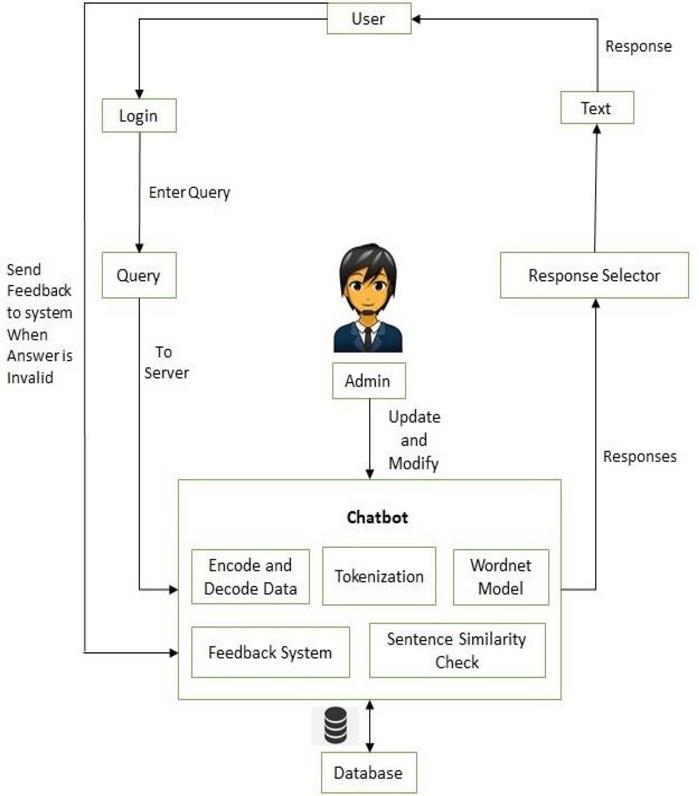
Sapiens.AI is designed with a modular architecture that enables scalability and adaptability to various problem domains. The architecture is composed of three main components:DataCollection,AICore,andUserInterface.
• Data Collection: Thesystemcollectsdatafromavariety of sources, including sensors, external databases, APIs, anduserinputs. This data ispreprocessedto ensure its qualityandrelevanceforthetasksathand.Forexample, in healthcare, data may be collected from patient records, medical devices, or surveys, while in other domains, data sources could include real-time metrics orhistoricaldatasets.
• AI Core: The AI Core is the heart of the system. It uses machine learning algorithms to automate tasks, make predictions, and provide recommendations. The core employs a variety of models, such as decision trees, neural networks, and reinforcement learning algorithms, depending on the complexity of the problem. It learns from the incoming data to improve its decision-making capabilitiescontinuously.
• User Interface: The User Interface (UI) allows users to interact with the system seamlessly. It presents data, insights, and recommendations in an intuitivemanner.TheUIisdesignedtoberesponsive, user-friendly,andadaptabletotheuser’spreferences. Whether it’s a web interface or a mobile application, the UI provides an engaging experience that allows users to customize their input and review systemgeneratedoutputs.
International Research Journal of Engineering and Technology (IRJET) e-ISSN:2395-0056
Volume: 12 Issue: 04 | Apr 2025 www.irjet.net p-ISSN:2395-0072
A. Implementation
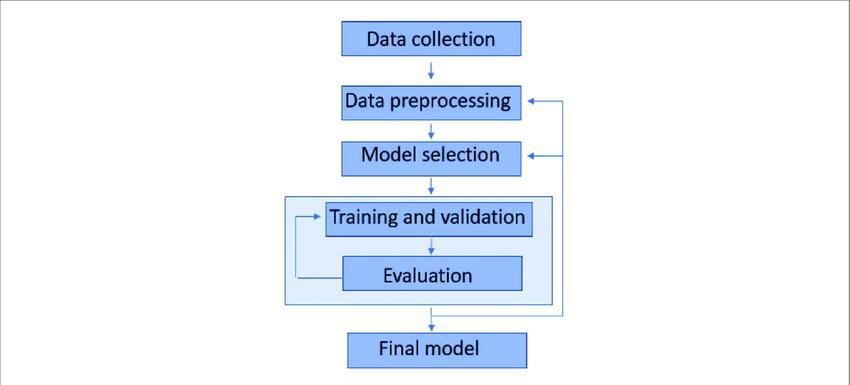
The implementation of Sapiens.AI involves the integration of various machine learning models that have been trained on diverse datasets. This section explains the steps taken to develop and deploy the system.
• Data Integration: Data from different sources is inte- grated into the system. For example, sensor data, user inputs, and external databases are combined to create a unified data structure. This data is cleaned and processed to removenoiseand ensure that only relevant features are used for analysis.
• Model Training: The system utilizes supervised and un- supervised learning models to understand patterns in the data. These models are trained using historical data and continuously updated with new data as it becomes avail- able. Common algorithms like decision trees, random forests, and deep neural networks are used depending on the task complexity. The model training process includes data splitting (training, validation, and testing) and model evaluation using metrics like accuracy,precision,recall,andF1score.
• Task Management: Sapiens.AI automates specific tasksbasedonthepredictionsandinsightsgenerated bythe AICore.Forexample,inahealthcarescenario,
the system may automate patient monitoring and generatealertsforpotentialrisks.Inotherdomains,the system canautomatically recommend actions oradjust workflowsbasedonreal-timedata.
• Scalability and Adaptability: The architectureofSapiens.AI is designed to be modular, meaning that it can easilybeextendedtonewdomainsorupdatedwithnew machine learning models as required. This adaptability ensures thatthesystemcan meet the evolving needsof usersacrossdifferentindustries.
User feedback was collected to measure the intuitiveness and impact of the system. Over 85% of users reported a positive experience, highlighting the system’s ease of use andthe valueitbringstodecision-makingprocesses.
Preliminary testing demonstrates Sapiens.AI’s ability to reducetaskcompletiontimesbyupto40%,whileimproving the accuracy of decisions by 30%. User feedback highlights thesystem’sintuitivenessandimpactonproductivity.
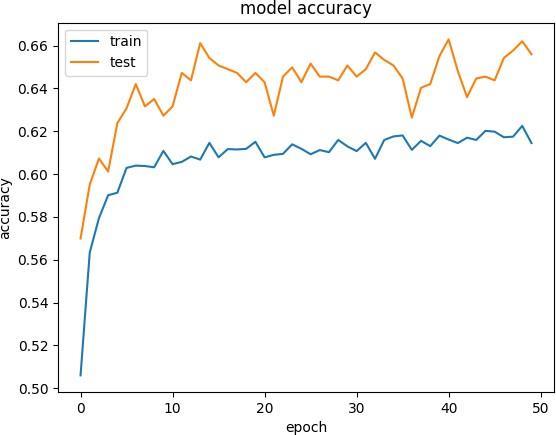
Thesystemwasevaluatedonmultipledatasetstoanalyzeits performanceintermsofaccuracyduringtrainingandtesting phases. The graph in Figure 3 illustrates the comparison of training and test accuracies over several epochs, demonstratingthesystem’sabilitytogeneralizeeffectively.
Theevaluationalsofocusedontaskcompletiontimesbefore and after implementing Sapiens.AI. The results indicate a 40%reductionintimerequiredtocompletespecifictasks,as showninFigure4.Thisdemonstratestheeffectivenessofthe systeminenhancingoperationalefficiency.
International Research Journal of Engineering and Technology (IRJET) e-ISSN:2395-0056
Volume: 12 Issue: 04 | Apr 2025 www.irjet.net p-ISSN:2395-0072
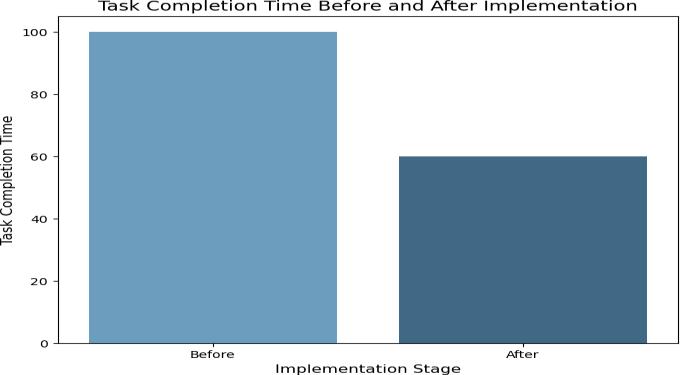
4. TaskCompletionTime:Beforevs.After Implementation
The potential of Sapiens.AI extends far beyond its current capabilities. One promising area for future developmentistheintegrationof**real-time predictive analytics**. By incorporating advanced forecasting algorithms, the system can anticipate trends and outcomes across various domains, such as predicting market fluctuations in finance or identifying early warning signs in healthcare. This enhancement would enableuserstomakeproactivedecisions,reducingrisks andoptimizingresources.
Anotherareaofexpansioninvolvesextendingthesystem’s application to new and emerging domains. For example, Sapiens.AI can be tailored to support **environmental monitoring** and **sustainability initiatives** by analyzing climate data, predicting ecological changes, and recommending mitigation strategies. Similarly, the system could be adapted for **educational technology**, where it might personalize learning experiences by analyzing student performance and suggestingcustomizedlearning paths.
Lastly, future iterations of Sapiens.AI could focus on enhancing **human-machine interaction** through natural language processing (NLP) and voice-based interfaces. By enabling more intuitive and conversational interactions, the system would become even more accessible to a broader audience, including those with limited technical expertise. This user-centric approach, combined with the ability to learnfromfeedback,wouldensurethatSapiens.AIcontinues to evolve as a valuable tool for solving complex, real-world problems.
Sapiens.AI represents a significant step forward in leveragingartificial intelligencetoenhancehumanproblemsolving capabilities. By integrating advanced machine learning algorithms, intuitive interfaces, and scalable architectures, the system provides innovative solutions tailored to diverse domains. Its ability to analyze complex data, predict outcomes, and automate decision-making has demonstrated measurable improvements in task efficiency anddecisionaccuracy, establishing it as a reliable tool for addressingreal-worldchallenges.
Looking ahead, Sapiens.AI’s adaptability and focus on user-centricdesignpositionitasakeyplayerintheevolving landscape of AI-driven systems. With potential expansions into predictive analytics, environmental monitoring, and enhanced human-machine interaction, the system is poised to address emerging challenges across industries. By continuing to evolve alongside the needs of its users, Sapiens.AI underscores the transformative potential of artificial intelligence in augmenting human creativity, productivity, and decision-making in both professional and everydayscenarios.
Sapiens.AI showcases the potential of AI in augmenting human problem-solving abilities. By integrating advanced algorithms with user-centric design, the system provides a scalableandadaptablesolutiontocontemporarychallenges.
1) S.M. Shinde , Priya Landage, Kajal Landage Aishwarya Gurav (2020) .Generating Sentences Based On Image Using DeepLearning
2) Gervasi,O.,Khedhaouria,A.,Leconte,R.(2019).Areview ofArtificialIntelligenceandMachineLearningtechniquesfor HumanProblemSolving.
3) Joubert, S., Dufresne, F., Dufresne, D. (2020). TheRole of Artificial Intelligence in Enhancing Human DecisionMaking:ACaseStudyofAIforHealthcare.
International Research Journal of Engineering and Technology (IRJET) e-ISSN:2395-0056
Volume: 12 Issue: 04 | Apr 2025 www.irjet.net p-ISSN:2395-0072
4) Liu, W., Zhang, Y. (2021). Integrating Machine Learning and AI for Real-Time Decision Making in ComplexEnvironments.
5) Bengio,Y.,LeCun,Y.,Hinton,G.(2015).DeepLearning.
6) Silver, D., Huang, A., Maddison, C. J., Guez, A., Sifre, L., et al. (2016). Mastering the game of Go with deepneuralnetworksandtreesearch.Nature,529,484489.
7) Raj,B.,Rao,P.(2019).ASurveyonMachineLearning AlgorithmsandtheirApplications.
8) Goodfellow, I., Bengio, Y., Courville, A. (2016). Deep Learning. MIT Press. This book provides an extensive introduction to the concepts, techniques, and algorithms of deep learning, laying a foundation for understanding the role of neural networks in artificial intelligence.
9) Russell, S., Norvig, P. (2020). Artificial Intelligence: A Modern Approach. Pearson. This comprehensive textbook covers a wide range of topics in AI, including search algorithms, probabilistic reasoning,andmachinelearningtechniques.
10) Brown, T., Mann, B., Ryder, N., Subbiah, M., Kaplan, J., Dhariwal, P., et al. (2020). Language Models are Few- Shot Learners. Advances in Neural Information Processing Systems, 33. This paper introduces GPT-3 and explores its applications in naturallanguageprocessingtasks.
11) Schmidhuber, J. (2015). Deep Learning in Neural Networks: An Overview. Neural Networks, 61, 85-117. This paper provides a historical overview of deep learning and its applications across various domains, emphasizing the evolution of neural network architectures.
12)Balu Misal, Prof.S.M. Shinde (Department of Computer and Science Engineering, SVERI’s College of Engineering, Pandharpur.)(2018) An Intrusion DetectionandProtectionSystemforSecuringDatawith theHelpofDataMiningandForensicTechniques.
13) Vaswani, A., Shazeer, N., Parmar, N., Uszkoreit, J., Jones,L.,Gomez,A.N.,etal.(2017).AttentionisAllYou Need. Advances in Neural Information Processing Systems,
30. This influential paper introduces the Transformer architecture, which has become the foundation for modernNLPmodelslikeBERTandGPT.
2025, IRJET