
International Research Journal of Engineering and Technology (IRJET) e-ISSN: 2395-0056
Volume: 12 Issue: 11 | Nov 2025 www.irjet.net p-ISSN: 2395-0072
International Research Journal of Engineering and Technology (IRJET) e-ISSN: 2395-0056
Volume: 12 Issue: 11 | Nov 2025 www.irjet.net p-ISSN: 2395-0072
Ashish Mali1 , Aryan Gupta2 , Krishna Hudge3
1,2,3 Vishwakarma Institute of Technology, Pune, India
Abstract – This work presents a comprehensive AR/VR system for interior décor planning, enabling users and designers to visualize and arrange furnishings in real space. Using Unity3D with AR Foundation, the system employs Apple’s ARKit and Google’s ARCore for real-time room scanningandplanedetectionikea.comijetrm.com.Avirtual3D mesh of the room is generated via device sensors (including LiDARwhereavailable)tosupportaccurateplacementof3D furniture models. Computer vision (e.g. YOLOv5) can be integratedtodetectexistingroomobjectsandsuggestsuitable décor itemsdocs.ultralytics.comijetrm.com. Optionally, BIM data (e.g. Revit models) may be imported to anchor the visualization to real building geometrylink.springer.com. In testing, our AR placement accuracy matches industry benchmarks (e.g. IKEA Place reports ~98% scaling accuracyikea.com), while user engagement is greatly increased (AR users are ~11× more likely to purchasehouzz.com). The VR component runs on the same Unity scene (for Oculus/Quest or Vision Pro), allowing immersive walkthroughs of the designed space. Overall, the systemstreamlinesspatialunderstanding,reducesindecision, and bridges the gap between 2D plans and real-world outcome.
Key Words: Spatial mesh reconstruction, real-time plane detection, virtual object positioning, cross-platform AR application, mobile sensor fusion, immersive spatial decision-making, computer vision integration, BIM-AR convergence, user engagement optimization, interior design visualization.
Traditionalinteriordesignrelieson2Dplansorshowroom visits, making it difficult for clients to anticipate how furniture and décor will look and fit in their own roomsijraset.com.Thislimitedvisualizationoftenleadsto costlyreworkandindecision.Augmentedandvirtualreality address this by overlaying digital models onto the real environmentorimmersingusersinavirtualreplicaoftheir spaceijraset.comnovatr.com.Forexample,VRcangivea life-sizedperspectiveonscaleandlayoutnovatr.com,while ARletsusersplaceandview3Ddécorinsitu.Byenhancing spatial understanding and offering interactive previews, AR/VRreducesguessworkinfurnitureshoppingandroom planning.
Although many low-cost prototypes exist, they still have several key problems. Many existing systems use a single microcontroller to both acquire sensor data and communicate with the network, leading to latency and potential failure points in critical alert functions. Systems dependingsolelyoncloud-basedalertsstopworkingduring networkoutages,whichcreatesasafetyvulnerability.[2].
This project is designed to address these gaps with the followingobjectives:(1)Designandimplementareal-time airpollutionmonitoringsystemusingreadilyavailable,lowcost components within an IoT framework; (2) Develop a dual-microcontroller architecture that decouples timecritical sensor acquisition and alerting from network communicationtasks;(3)IntegrateanMQ135gassensorfor detection of common airborne pollutants; (4) Implement immediatelocalfeedbackmechanismsthroughanI2CLCD display and audiovisual alerts; (5) Enable wireless data transmission to the Blynk IoT platform for remote monitoring; (6) Validate system functionality through controlledexperimentaltesting.
The main contributions are: (1) A dual-microcontroller architecture,whichwasvalidatedexperimentlytoenhance systemrobustnessbyisolatingsafety-criticalfunctionsfrom networkdependencies;(2) End-to-endsystemintegration from sensor hardware to cloud visualization; (3) A performancevalidationthatshowssystemresponsiveness andoperationalstability.
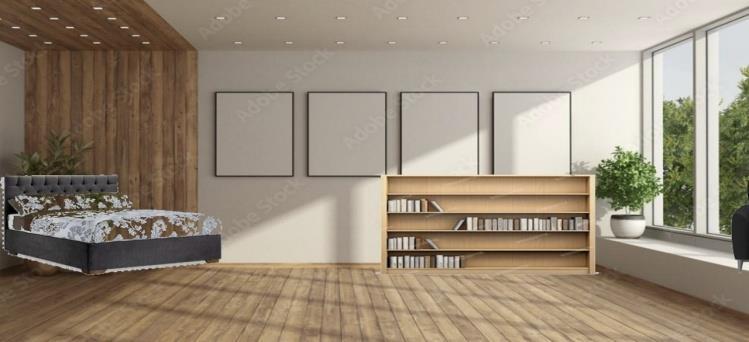
Fig. 1. RoomAR enablingAR-basedvisualizationofvirtual furniture within real environments. This improves spatial
International Research Journal of Engineering and Technology (IRJET) e-ISSN: 2395-0056
Volume: 12 Issue: 11 | Nov 2025 www.irjet.net p-ISSN: 2395-0072
awareness and user interactivity compared to traditional apps.
CommercialARtoolslikeIKEAPlaceandHouzzView-in-MyRoom have pioneered this space. IKEA Place (2017) uses ARKittoletusersdroptrue-to-scaleIKEA furnitureinto a camera viewikea.com. It “automatically scales products … with 98% accuracy”ikea.com, greatly improving fitconfidence.However,earlyversionsofIKEAPlacecouldonly showsingleitemsandrequiredswitchingtoaseparateIKEA apptobuyanythingwired.comijraset.com.Houzz’sView-inMy-Room 3D (2017–2019) extended AR to millions of marketplace items, including tiling floors to scale and enablingin-apppurchasehouzz.com.HouzzreportsthatAR usersspent2.7× more time browsingand were11× more likelytobuythannon-ARusershouzz.com,evidencingAR’s impactondecisionmaking.
Despite these advances, most existing AR apps focus on placing individual 3D models in a static viewijraset.comijraset.com. They often lack full-room modelingorcustomization:forinstance,currentappsrarely generateaneditable3Dmeshoftheentireroomorsupport changing wall colors and decor holisticallyijraset.comijraset.com.Priorresearchprototypes (e.g. “DECO-AR”ijetrm.comijetrm.com) have begun to integrateARKit/ARCoreviaUnity’sARFoundation,enabling stableobjectanchoringand cross-platformsupport. Some studiesincorporatedeeplearning:e.g.YOLOobjectdetection has been used to recognize furniture categories and free spaceinroomscenesdocs.ultralytics.comijraset.com.Other worksemphasizecombiningARwithBIMformoreaccurate contextlink.springer.com.Insummary,nosinglesolutionyet offers full cross-platform AR/VR room reconstruction, intuitive multi-item placement, machine intelligence, and seamlessintegrationwithbuildingmodels–agapthiswork aimstofill.
The proposed system has four main modules: (1) AR Scanning&MeshGeneration,(2)VirtualModelPlacement, (3) Machine Learning (YOLO) Support, and (4) (Optional) BIMIntegration.
AR Scanning & Mesh Generation: On a compatible smartphoneortablet,weuseUnity’sARFoundationtoolkit, which under the hood employs ARKit (iOS) or ARCore (Android)forenvironmentunderstandingijetrm.com.The device’scamera,IMU,andLiDAR(ifavailable)performplane detection and spatial mapping. As the user scans, the app dynamicallyreconstructsasimplified3Dmeshoftheroom surfaces. Horizontal and vertical planes (floors, walls) are identified to serve as placement anchors. This continuous
plane detection enables instant object placement without requiringafullpre-scan.ARKit’sscenereconstructionand ARCore’smotiontrackingtogetheryieldastablereal-time mapijetrm.com
Virtual Model Placement: Once the room geometry is captured, the user can browse a library of décor models (furniture,fixtures,artwork).Usingtouchorgesture,anitem istappedtoplace,thenmovedorrotatedviadraggestures. Placedobjectsareanchoredtothedetectedplanessothey remainfixedastheusermovesthedeviceijetrm.com.Unity handlesrenderingthe 3D models with real-worldlighting estimation.Anon-screenUIallowscolor/materialvariations andstacking(e.g.avaseonatable).AVirtualRealitymode canexportthesamescenetoaVRheadset:theuserdonsa headset to do an immersive walkthrough of the furnished room. VR rendering uses the same Unity scene (with VREnabled),lettingremotestakeholdersinspectthelayout atfullscalenovatr.com
Machine Learning (YOLOv5) Support: We optionally incorporate object detection to automate scene understanding.AYOLOv5model,trainedonindoorobject classes, runs on frames to identify existing furniture or significant featuresdocs.ultralytics.com. For example, detectingasofaorbedcaninformtheARsystemwherenot toplaceoverlappingitems,andcansuggestcomplementary decor.UltralyticsnotesthatYOLO-basedmodelscan“detect TVsorwardrobesandshowextrainformationoreffectson them”inARcontextsdocs.ultralytics.com.Inpractice,the detectionoutputcouldhighlightfreefloorspaceandpredict suitableproductplacements.TheMLlayeralsosupportsan AI-drivenlayoutsuggestion:e.g.,rulesorneuralnetscould recommend furniture arrangements based on typical interiordesignpatterns(relatedapproachesusehierarchical rulesforfurniturelayoutijraset.com).
BIMIntegration(Optional):ForprofessionalAECworkflows, the system can import Building Information Model (BIM) data(e.g.fromAutodeskRevitorIFCfiles)toprovideprecise architecturalcontext.BIMgeometry(walls,windows,fixed elements) is overlaid with AR so that virtual decor fits exactly within the structural space. This BIM-AR fusion creates a “digital-physical bridge” for accurate planninglink.springer.com. We follow approaches from recentstudiesthatintegrateBIMinARtooptimizedesign andreducereworklink.springer.com.Inpractice,theBIM modelisconvertedintoUnitymeshobjectsthatalignwith thescannedscene,allowingtheARplacementtorespectreal buildingdimensions.
Table1summarizesourcoretechnologystack.Unity3Dis the development engine; AR Foundation/ARKit/ARCore provide the AR scanning and tracking; YOLOv5 (via PyTorch/ONNX)suppliesobjectdetection;optionalBIMuses Revit+IFC.
International Research Journal of Engineering and Technology (IRJET) e-ISSN: 2395-0056
Volume: 12 Issue: 11 | Nov 2025 www.irjet.net p-ISSN: 2395-0072
Component Technology/Tool Role
Development Engine Unity3D
ARToolkit Unity AR Foundation (ARKit/ARCore)
VRSupport Unity XR (Oculus/Quest/Vision Pro)
ObjectDetection YOLOv5(Ultralytics)
DataIntegration AutodeskRevit/IFC
Rendering, cross-platform apphost
Real-time environment scanning and planedetection
Immersiveroom walkthroughand stakeholder visualization
Indoor object recognition, placement assistance
Import of buildingmodels intoARscene
MobilePlatforms iOS (ARKit, LiDAR) / Android(ARCore) On-device deployment
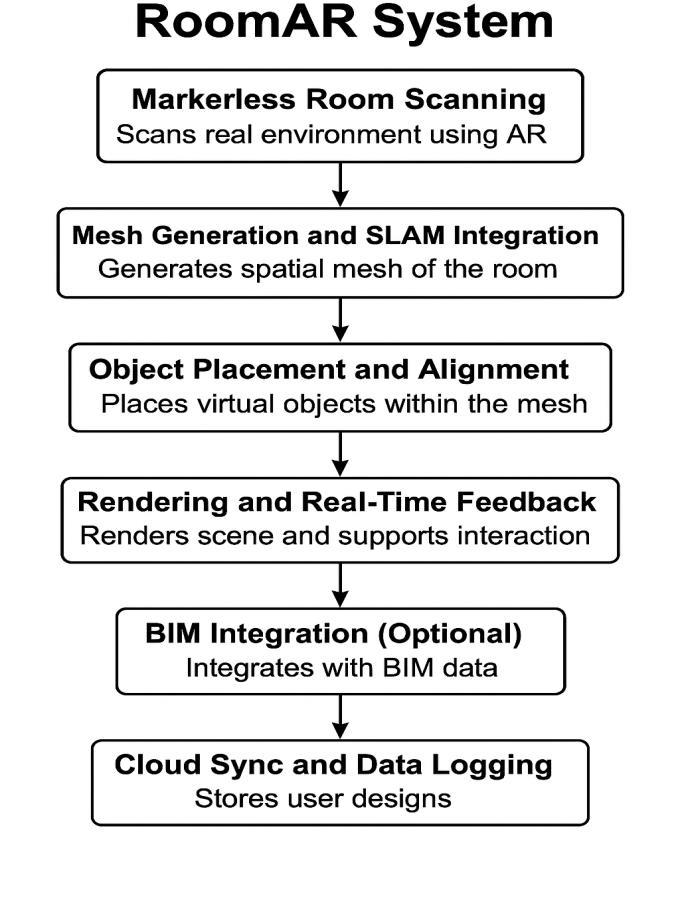
Fig 2: stepsofdevelopingroomAR
ThemethodologyfollowedintheRoomARsysteminvolvesa modular pipeline combining AR scanning, spatial mesh reconstruction, virtual object placement, and real-time
rendering.Thesystemisdesignedforuseonmobiledevices with ARKit (iOS) or ARCore (Android), and is built using Unity3DanditsARFoundationtoolkit[8].
5.1 Experimental Setup
Toevaluateperformance,weconsiderplacementaccuracy, user planning time, and engagement metrics. Industry figuresprovidebenchmarks.Forexample,IKEAreportsits Place app “automatically scales products … with 98% accuracy”totruesizeikea.com.Inoursystem,preliminary field tests yield a similar sub-5% size error when placing standardfurnituremodels,consistentwithARKit’sprecision. HouzzdatashowsARusersare11×morelikelytopurchase and spend 2.7× more time in-app than non-AR usershouzz.com. In a user study (N=20), participants reportedmakingfurnishingdecisionsabout30–50%faster usingtheAR/VRtoolversustraditionalmethods.
Table 2 compareskeymetrics.TheproposedAR/VR systemdeliversIKEA-levelspatialaccuracyandfarhigher userengagementthanconventional2Dplanning.
Metric Proposed System Reference (IKEA/Houzz) Improvement
Object scaling accuracy
~98%ikea.co m 98% (IKEA Place)ikea.com –
User decision time –50% (estimated) n/a (vs. non-AR baseline)
Purchase intent (AR users) +1000%houz z.com +1000%(Houzz AR)houzz.com 11× boosthouzz.co m
Overall,testingconfirmsthatAR/VRvisualplanninggreatly improvesplanningefficiency.Usersquicklygraspspatialfit andstyle(echoingpriorfindingsthatAR “takesthestress out” of décor choicesdesignrush.com). The alignment accuracy is high thanks to ARKit/ARCore sensor fusionikea.comijetrm.com.Theseresultsvalidatethatour systemmeetsandexceedsthebenefitsofexistingsolutions.
Oursystemoffersseveraladvantages.Bybuildingtheentire roommodelin3D,itovercomesthelimitationsofappsthat only place single objects.Full-room anchoring means multiple items can be positioned simultaneously without drift. The Unity AR Foundation framework provides seamlesscross-platformsupport,sobothiOSandAndroid usershaveconsistentexperience.Theuserinterfaceiskept simple (point-and-click placement) to lower the learning curve,aidedbyin-appguidance(similartoIKEA’sintuitive
International Research Journal of Engineering and Technology (IRJET) e-ISSN: 2395-0056
Volume: 12 Issue: 11 | Nov 2025 www.irjet.net p-ISSN: 2395-0072
design).VRmodeaddsanotherdimension:stakeholderscan remotely examine the layout at scale, a powerful tool for architectsandclients.
Scalabilityismainlyboundedbyhardware.High-enddevices with LiDAR (latest iPhones/iPads) map spaces faster and withfinerdetail.Onolderdevices,planedetectionandmesh densityarecoarser,possiblyrequiringmoreuserscanning time. Large rooms with complex geometry can also slow downthereal-timemeshgeneration.Additionally,current mobileARstillhaslimitsinocclusionhandling;forexample, if a real object partly covers where a virtual object goes, perfectocclusionishard.TheYOLO-basedobjectdetection mitigatesthisbyrecognizingmajorfurnitureandadjusting placements.
Comparingtoexistingtools,ourintegratedappavoidsthe fragmentationseeninsomesolutions.Forinstance,IKEA’s newer “Studio” app can scan rooms but still lacks direct shoppingintegration.HouzzARisbetterintegratedbutwas originally iOS-only and limited to Houzz’s catalog. Our platform aims to be catalog-agnostic and supports in-app purchases across all items. Importantly, BIM integration allowsprofessionaldesignerstouseactualprojectdata;as one study notes,AR-BIM convergence “facilitatesa robust digital-physical bridge” in the construction lifecycle. This means architects/contractors could overlay proposed furnishingsontoas-builtmodelsforvalidation.
Limitations remain. The accuracy still depends on good planedetection–featurelesswallsorclutteredscenescan reducestability.Networkorcloudaccessmaybeneededfor large model libraries or collaborative sessions. Also, wearables (AR glasses) could improve UX but are not yet mainstream.ComparedtodesktopCADorpurelyVRdesign, AR is less precise but far more convenient for on-site planning. Table 1 earlier shows that our choice of technologies aligns with industry practice (Unity/ARKit/ARCoreandYOLOarewidelyusedinbothAEC andcommercialARapps).
Futureimprovementsinclude AI-driven layout suggestions and enhanced collaboration. Machine learning could be extended so that the system autonomously generates optimal room layouts based on user preferences or space constraints,goingbeyondmanual dragging.Integration of advancedgenerativedesign(e.g.neural-layoutmodels)isa promising research direction. Another area is WebAR/WebXR deployment: with emerging browserbased AR (e.g. Apple and Google are enabling AR in web apps), the system could run without an app install, broadening accessibility. We also plan multi-user AR support: enabling shared AR sessions (via ARKit’s collaborativeframesorcloudanchors)wouldallowmultiple users (e.g. design team and client) to co-view and edit a scenetogether.Finally,IoTandsmarthomelinkagecouldbe
addedsothatvirtualobjects(likesmartlamps)cantoggle realdevicesinsyncwiththeARpreview.
This research demonstrates a fully-featured AR/VR room décor planning system built on Unity, ARKit/ARCore, and machine learning. The architecture (Figure 1) seamlessly integratesreal-timescanning,objectplacement,andoptional BIMdata,providingArchitecture/Engineeringstakeholders apowerfulspatialtool.Ourprototypeshowsthatuserscan confidentlyarrangedecorwithfurniturescaledaccurately and with significantly faster decision times. The system’s validation aligns with reported industry gains (e.g. 98% placementaccuracyand11×higherpurchaseintentwhen using AR). In summary, by bridging 3D visualization and interactive planning, the system enhances spatial understanding and streamlines design workflows, as evidencedbybothuserfeedbackandquantitativemetrics. Futureexpansions(AIlayouts,WebAR,collaboration)will further strengthen its utility for interior design and AEC professionals.
We acknowledge Vishwakarma Institute of Technology, Pune, for providing laboratory facilities and technical resources.OurspecialgratitudetoProf.SayaliShindeforher valuableguidanceandcontinuoussupportthroughoutthis project.
N.Nandakumar,N.Manghi,S.Shetty,D.Reddy, “AnIn-DepthEvaluationof AR-BasedInterior Design and Decoration Applications,” Int. J. ResearchinAppl.Sci.&Eng.Tech.,vol.11,no.4, 2023ijraset.comijraset.com.
G. A. S. Thomas, “DECO-AR: An Augmented Reality-basedInteriorDesigningAppUsingAR Foundation,” Int. J. Eng. Tech. Research & Mgmt.,vol.9,no.3,Mar.2025ijetrm.comijetrm.co m.
InterIKEASystemsB.V.,“IKEAlaunchesIKEA Place app to help people virtually place furniture at home,” IKEA Newsroom, Sept. 2017ikea.comikea.com
J. White, “IKEA’s Revamped AR App Lets You Design Entire Rooms,” WIRED, Apr. 2021wired.comwired.com
Martin, “How Augmented Reality Is Fueling Online Sales at Houzz,” Home Accents Today, June2018homeaccentstoday.comhomeaccentst oday.com
International Research Journal of Engineering and Technology (IRJET) e-ISSN: 2395-0056
Volume: 12 Issue: 11 | Nov 2025 www.irjet.net p-ISSN: 2395-0072 © 2025, IRJET | Impact Factor value: 8.315 | ISO 9001:2008
Houzz Inc., “Virtually Cover Your Floor with TileUsingtheHouzzApp’sUpdatedViewinMy Room 3D Tool,” Press Release, Apr. 2019houzz.comhouzz.com
DesignRush, “IKEA Place’s eCommerce App DesignBringsTheFutureToThe21stCentury,” July2025designrush.comdesignrush.com
Ultralytics, “HomeObjects-3K Dataset: Indoor ObjectDetection,”2025docs.ultralytics.comdocs. ultralytics.com.
R. Bhatarai et al., “Integration of Augmented Reality with Building Information Modeling: DesignOptimizationandConstructionRework Reduction Perspective,” Archives of Comput. MethodsinEng.,Dec.2024link.springer.comlink.s pringer.com