
International Research Journal of Engineering and Technology (IRJET) e-ISSN:2395-0056
Volume: 12 Issue: 08 | Aug 2025 www.irjet.net p-ISSN:2395-0072
International Research Journal of Engineering and Technology (IRJET) e-ISSN:2395-0056
Volume: 12 Issue: 08 | Aug 2025 www.irjet.net p-ISSN:2395-0072
3
1 M. Tech student, Department of Electronic and Telecommunication, CSMSS Chh. Shahu College of Engineering, Chh. Sambhaji Nagar (Aurangabad), Maharashtra, India
2 Professor, Department of Electronic and Telecommunication, CSMSS Chh. Shahu College of Engineering, Chh. Sambhaji Nagar (Aurangabad), Maharashtra, India
Abstract - Thisisareview paperonIOT BasedPreventive Maintenance. IoT-based Preventive Maintenance uses smart sensors, data analysis, and cloud systems to keep track of how industrial machines are doing in real time. These sensors collect information like temperature, vibration, and pressure all the time. This helps the system know when a machine might have a problem before it actually breaks down. By doing this, companies can avoid unexpected stoppages, save money on repairs, and make their machines last longer. Combining IoT with smart prediction tools and sends out timely warnings, helping businesses move from fixing things after they break to fixing them before they do. Thismakesworkmoreefficient,safer,andproductive.
Key Words: Temperature, Vibration, Pressure, Smart Sensors, Data Analysis, Cloud Systems, Industrial Machines.
In today's industries, when machines break down unexpectedly, it causes expensive delays, lower productivity, and higher repair costs. Old ways of fixing machines, like waiting until they break (reactive maintenance) or checking them on fixed schedules (preventive maintenance), aren't very effective. They eitherleadtosuddenstoppagesorunnecessaryrepairs.
The Internet of Things (IoT) provides a better way to handle this. With IoT, machines are constantly watched using sensors and connected tools. These systems gather real-time information like how much the machine is vibrating, its temperature, pressure levels, and how much energyituses.Andthenthisdatawillbesenttothecloud platforms, where smart tools and analysis techniques will spotearlysignsofpossibleproblems.
Using IoT for maintenance can industries know when a machine might fail before it actually does. This helps schedule repairs at the right time, cut down on time lost due to breakdowns,make equipmentlastlongerand save money on operations. This project shows how IoT can change the way maintenance is done, making it smarter, moreefficient,andsaferforindustrialwork.
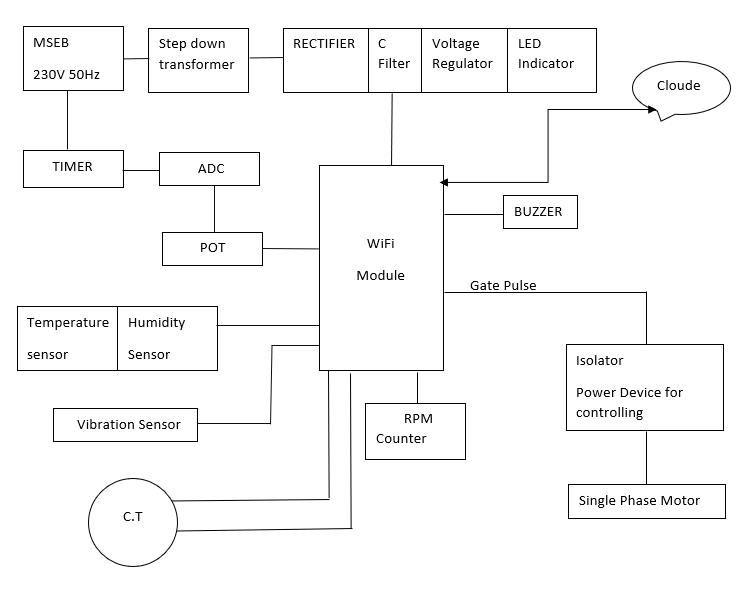
Fig -1:BlockDiagramofIOTBasedPreventive MaintenanceforElectricalMachineandIndustrial Automation
This WiFi Module can set a communication between the sensors and the cloud. WiFi Module will send all the collected data from the machines without wires to the cloud.Itcanhelppeopletolookatit,learnfromit,andset upanalert.Thishelpswithfixingthingsfromfaraway.
ThisCloudSystemservesasacentralplatformforstoring, processing, and analyzing sensor data collected from machines. It enables real-time monitoring, predictive analytics, and remote access through dashboards or mobile applications. By using the cloud, industries can ensure scalability, secure data management, and intelligentdecision-makingforpreventivemaintenance.
International Research Journal of Engineering and Technology (IRJET) e-ISSN:2395-0056
Volume: 12 Issue: 08 | Aug 2025 www.irjet.net p-ISSN:2395-0072
This Temperature Sensor will measure the heat level presentinamachineandenvironmentandconvertitinto an electrical signal. In preventive maintenance, it helps to detectoverheating,abnormalconditions,andensuressafe, efficientequipmentoperation.
This Vibration Sensor can detect changes in the machine movement or imbalance and converts them into signal. It iswidelyusedinpreventivemaintenancetoidentifywear, misalignment, or faults early, ensuring timely corrective action.
ThisHumiditySensormeasuresthemoisturelevelpresent in the surrounding environment of the machine. In preventivemaintenance,ithelpstomonitortheconditions that may cause corrosion, insulation damage, or reduced machineefficiency.
ThisBuzzerisadevicewhichgivesusanalertbyproduces sound when abnormal conditions are detected in the machineorintheenvironment.Inthisproject,thebuzzer provides us an immediate audio warning, ensuring the quickresponsetothepotentialfaults.
Research on IoT-based preventive maintenance shows that industries are moving away from old methods of checking equipment on a fixed schedule to smarter, datadriven approaches. Studies show that using sensors to track things like vibration, temperature, and pressure, along with IoT platforms, helps to find early problems with equipment and cuts down on time when machines arenotworking.
New surveys stress how machine learning and deep learningareusedtolookatreal-timedatatopredictwhen something might break and how much longer a machine can keep working. Methods like CNNs, LSTMs, and mixed AI models are found to make better predictions about problems.
Some of the researchers also says that edge computing speeds up analysis at the source, while cloud systems handle big data and advanced tools. But there are still issues with dealing with messy data, making different devices work together, scaling up systems, and keeping IoTsystemssafefromcyberthreats.
In general, studies show that IoT-based preventive maintenance makes equipment work better, cuts costs, and supports Industry 4.0 by creating smart, connected, andforward-thinkingmaintenancesystems.
TheIOTBasedPreventiveMaintenanceprojectshowsthat it enables continuous monitoring, early fault detection, and predictive decision-making for industrial systems. It reduces downtime, lowers maintenance costs, and improves equipment reliability. With the support of sensors,connectivity,anddataanalytics.
[1] Lee,J.,Bagheri,B.,&Kao,H.A.(2015). A cyber physical systems architecture for industry 4.0-based manufacturing systems. Manufacturing Letters, 3, 18–23.
[2] Carvalho, T. P., et al. (2019). A systematic literature review of machine learning methods applied to predictive maintenance. Computers & Industrial Engineering,137,106024.
[3] Susto, G. A., Schirru, A., Pampuri, S., McLoone, S., & Beghi, A. (2015). Machine learning for predictive maintenance: A multiple classifier approach. IEEE Transactions on Industrial Informatics, 11(3), 812–820.
[4] Zhang, W., Yang, D., & Wang, H. (2019). Data-driven methods for predictive maintenance of industrial equipment: A survey. IEEE Systems Journal, 13(3), 2213–2227.
[5] Lee, J., Jin, C., & Bagheri, B. (2017). Cyber-physical predictive maintenance. Manufacturing Letters, 14, 31–34.
[6] Mobley, R. K. (2002). An Introduction to Predictive Maintenance.Butterworth-Heinemann.
[7] Sethi, P., & Sarangi, S. R. (2017). Internet of Things: Architectures, protocols, and applications. Journal of ElectricalandComputerEngineering,2017,1–25.