
International Research Journal of Engineering and Technology (IRJET) e-ISSN: 2395-0056
Volume: 13 Issue: 03 | Mar 2026 www.irjet.net p-ISSN: 2395-0072
International Research Journal of Engineering and Technology (IRJET) e-ISSN: 2395-0056
Volume: 13 Issue: 03 | Mar 2026 www.irjet.net p-ISSN: 2395-0072
Parth Trivedi1 , Dr. Hetal Pandya2
1ME CIVIL (Infrastructure Engineering) Civil Engineering Department LDRP – Institute of Technology & Research, Gandhinagar, Gujarat, India
2 Civil Engineering Department LDRP – Institute of Technology & Research, Gandhinagar, Gujarat, India
***
ABSTRACT - Water distribution networks (WDNs) are essential infrastructure systems responsible for supplying potablewatertocommunities,andtheirperformanceishighly dependent on network configuration. This study presents a comparative hydraulic assessment of looped and branched water distribution systems with emphasis on efficiency, pressure regulation, and resilience. Hydraulic simulations wereperformedusingBentleyWaterGEMStoevaluatesystem behavior under normal demand, peak demand, and pipe failure conditions. Key performance parameters, including nodal pressure distribution, pipe flow characteristics, energy consumption, and resilience indices, were analyzed for both configurations. The results show that looped networks maintainmoreuniformpressureandhigherservicereliability due to the availability of multiple flow paths, allowing continued water supply during pipe outages. In contrast, branched networks offer simpler design and lower construction costs but are more vulnerable to pressure losses and service interruptions under failure scenarios. Sensitivity analysesconsideringvariationsindemand,pipediameter,and networktopologyfurtherdemonstratethesuperiorrobustness of looped systems. Overall, the study highlights that while branched networks may be suitable for low-demand or costsensitive applications, looped networks provide enhanced operationalperformanceandresilience.The findingssupport informed decision-making for sustainable and reliable water distribution system planning using advanced hydraulic modeling tools.
Key Words: Water Distribution Network, Looped Network, Branched Network, Hydraulic Analysis, Resilience Index, WaterGEMS
Water distribution networks (WDNs) are a fundamental component of municipal infrastructure, responsible for supplying treated water to residential, commercial, industrial,andpublicconsumers.Theperformanceofthese systems directly affects public health, economic activities, andsustainableurbangrowth.Therefore,efficientplanning, operation,andmaintenanceofWDNsareessentialtoensure reliablesupply,minimizewaterlosses,andoptimizeenergy use.
Based on their layout, WDNs are commonly classified as branched or looped networks. Branched systems follow a
tree‑likestructurewithasingleflowpathtoeachdemand node, making them simple and cost‑effective to construct. However,theirlackofredundancymakesthemvulnerableto serviceinterruptionsduringpipefailures.Incontrast,looped networks consist of interconnected pipes that provide multipleflowpaths,improvingpressurebalance,operational flexibility, and reliability during failures or maintenance, thoughathigherinitialcostandcomplexity.
Rapid urbanization, population increase, and variable demand patterns further challenge WDN operation. Advanced hydraulic modelling tools such as Bentley WaterGEMS enable detailed evaluation of pressure, flow behaviour,energyconsumption,andsystemreliability.This studypresentsacomparativehydraulicanalysisoflooped andbranchedWDNsusingWaterGEMStosupportinformed andsustainablenetworkdesigndecisions.
Reviewing existing research is essential to understand advancementsinwaterdistributionnetwork(WDN)design, particularly in hydraulic performance, resilience, and modeling approaches. Earlier studies mainly emphasized cost‑effectiveandsimplenetworklayouts.Recentresearch, however, focuses on improving reliability, resilience, and energy efficiency due to urban growth, changing demand patterns,andaginginfrastructure.Thisreviewsummarizes previousworkunderfourthemes:networkconfigurations, hydraulicperformance,resilienceandefficiency,andtherole ofsimulationtoolsinWDNanalysis.
WDNsaregenerallyclassifiedasbranchedorloopedsystems. Branchednetworkshaveatree‑likestructurewithasingle flowpath,makingthemsimpleandeconomicaltoconstruct buthighlyvulnerabletofailures.Apipebreakcaninterrupt supply to downstream areas. Looped networks use interconnected pipelines that provide multiple flow paths, improving pressure balance and reliability during failures. Althoughlooped systems require higher initial investment andcomplexdesign,studiesshowtheyaremoresuitablefor urbanareaswithhighreliabilityrequirements.
International Research Journal of Engineering and Technology (IRJET) e-ISSN: 2395-0056
Volume: 13 Issue: 03 | Mar 2026 www.irjet.net p-ISSN: 2395-0072
Hydraulicperformanceanalysisensuresthatwaterdemands aremetundervaryingoperatingconditions.Parameterssuch as nodal pressure, flow velocity, and pipe capacity are commonly evaluated. Modern modelingtoolslike EPANET and WaterGEMS allow simulation of normal and stressed conditions, including peak demand and pipe failures. Literatureindicatesthatloopednetworksgenerallymaintain more uniform pressure and stable flows, while branched systems may experience pressure deficiencies at terminal nodesduringhigh‑demandorfailurescenarios.
Resiliencereferstoanetwork’sabilitytocontinuesupplying water during disruptions such as pipe bursts or demand fluctuations.Variousindicatorsareusedtoassessnetwork robustnessandreliability.Operationalefficiencyfocuseson minimizing energy consumption, pressure losses, and hydraulicinefficiencies.Integratingresilienceandefficiency assessments helps in designing networks that are both reliable and cost‑effective. Recent studies emphasize multi‑objective optimizationto balance system robustness withlong‑termoperationalefficiency.
2.4
SimulationsoftwareplaysavitalroleinmodernWDNdesign andmanagement.ToolssuchasBentleyWaterGEMSenable scenario‑based analysis of demand variations, network layouts, and failure conditions. These platforms provide detailedinsightsintopressuredistribution,energyusage,and system resilience. Studies using WaterGEMS show that loopednetworksmaintainbetterservicecontinuityduring failurescomparedtobranchedsystems.Sensitivityanalysis further helps in understanding the impact of design and operationalchangesonnetworkperformance.
Thisstudyfollowsastructuredmethodologytocomparethe hydraulic performance,resilience, and efficiency oflooped and branched water distribution networks using Bentley WaterGEMS.Theapproachincludesnetworkselectionand data collection, hydraulic modeling, performance metric evaluation, and comparative analysis. Both network configurations are developed using identical demand patternsanddesignparameterstoensureafairandreliable comparison.
3.1
Arepresentativewaterdistributionnetworkisselectedto develop looped and branched configurations with comparable size, pipe length, and demand distribution.
Networkdataareobtainedfrommunicipalrecords,standard datasets,andpublishedcasestudies.Collectedinformation includes pipe dimensions, material properties, roughness coefficients, nodal demands, elevations, and operational parameters such as peak demand factors and minimum pressure requirements. This dataset ensures realistic and consistentsimulationconditions.
ThecollecteddataareincorporatedintoBentleyWaterGEMS todefinethenetworktopology.Junctionsrepresentdemand nodes, while pipes, pumps, and valves form the hydraulic links. Reservoirs and tanks are assigned appropriate elevations and capacities. The models are calibrated using baseline demand and pressure data to ensure accurate representationofreal‑worldoperatingconditions.
Hydraulicsimulationsarecarriedoutunderthreeoperating scenarios: normal demand conditions, peak demand conditions, and pipe failure scenarios. Normal operation establishes baseline performance, peak demand evaluates systemcapacity,andpipefailuresimulationsassessnetwork resilienceandredundancy.Thesescenariosenableevaluation of network behavior under both routine and stressed conditions.
Key hydraulic outputs obtained from WaterGEMS include nodalpressurevalues,pressuredeficits,pipeflowrates,flow velocities,pumpenergyconsumption,andhydraulicgrade line profiles. These parameters are extracted for each simulation scenario to assess network performance, efficiency,andreliability.
Network performance is evaluated using resilience and efficiency indicators. Resilience metrics include pressure deficit analysis, service continuity index, and network redundancyindex.Efficiencyisassessedthroughtotalenergy consumption,hydraulicgradeuniformity,andpipeutilization factor. These indicators provide a quantitative basis for comparingloopedandbranchednetworks.
Results from both network configurations are compared using numerical indices and graphical analysis. Sensitivity studies are conducted by varying pipe diameter, demand levels, and network layout to examine their influence on hydraulic performanceandenergyconsumption.Basedon the analysis, recommendations are developed for optimal
International Research Journal of Engineering and Technology (IRJET) e-ISSN: 2395-0056
Volume: 13 Issue: 03 | Mar 2026 www.irjet.net p-ISSN: 2395-0072
networkconfiguration,pipesizing,andoperationalstrategies toimproveresilienceandefficiency.
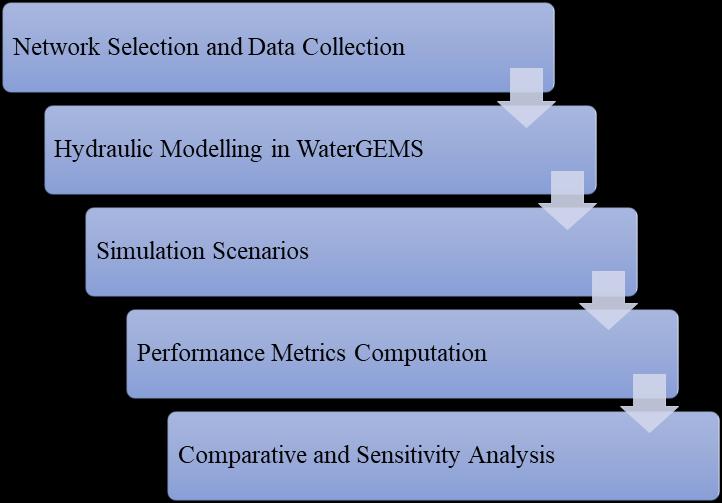
The proposed methodology provides a comprehensive framework for evaluating WDN performance, facilitating informeddecision-makinginboththedesignandoperational phases.
This chapter presents and interprets the results obtained from the hydraulic, resilience, and energy‑efficiency evaluation of looped and branched water distribution network configurations. The analysis combines structural assessment, hydraulic simulation, failure‑based resilience testing,demandvariabilityanalysis,andenergyperformance comparison.Resultsarediscussedtohighlighttheinfluence ofnetwork topologyonhydraulic behavior,reliability,and operationalefficiency,enablingacomprehensivecomparison ofthetwoconfigurations.
The looped network consists of interconnected pipelines formingmultipleclosedcircuits,providingalternativeflow pathsbetweennodes.Thisstructureincreasesredundancy andoperationalflexibility.Incontrast,thebranchednetwork follows a tree‑like layout with a single flow path to each demand node, resulting in lower pipe length and simpler construction. While the branched configuration reduces initial infrastructure requirements, the looped network demonstrates greater structural robustness due to its interconnectedtopology.
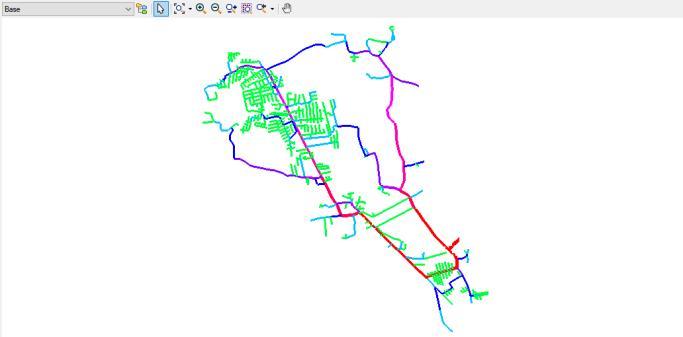
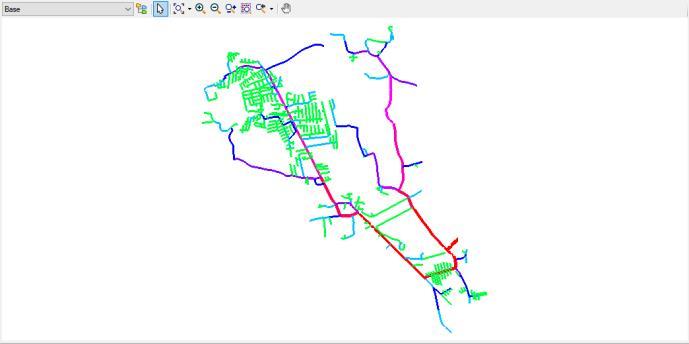
Hydraulicsimulationresultsindicatethattheloopednetwork maintains more uniform pressure distribution across demand nodes under both normal and peak demand conditions. Flow redistribution through alternative paths reducespressurelossesandextremevelocityvariations.The branched network exhibits noticeable pressure drops at terminal nodes, particularly during peak demand. These results confirm that network interconnectivity plays a significantroleinimprovinghydraulicstabilityandservice reliability.
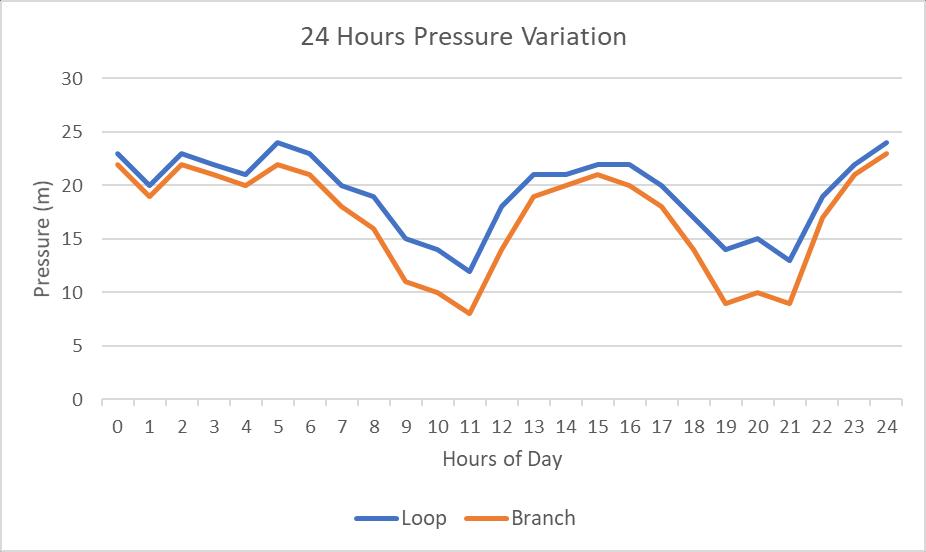
Figure -4: 24HourspressureVariation
International Research Journal of Engineering and Technology (IRJET) e-ISSN: 2395-0056
Volume: 13 Issue: 03 | Mar 2026 www.irjet.net p-ISSN: 2395-0072
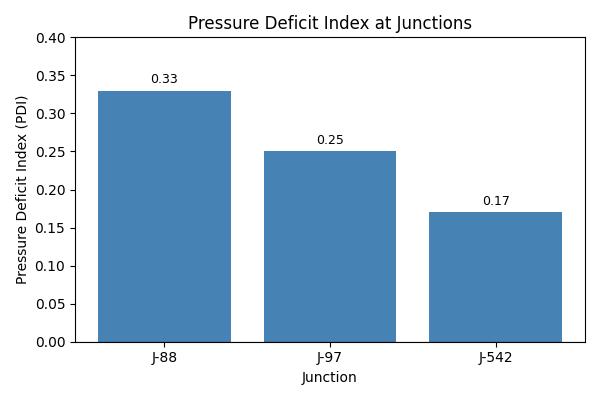
Pipe failure simulations reveal that the looped network sustains water supply to most nodes by rerouting flow throughadjacentlinks.Servicedisruptionremainslocalized, demonstrating high resilience. Conversely, failures in the branchednetworkresultincompletesupplyinterruptionto downstream areas due to the absence of alternate paths. Resilienceindicesclearlyindicatesuperiorperformanceof theloopedconfigurationunderoutagescenarios.
4.4 Discussion
Theresultsestablishastrongrelationshipbetweennetwork topologyandsystemperformance.Loopednetworksprovide enhancedhydraulicstability,higherresilience,andimproved energy efficiency, making them suitable for urban and high-demand applications. Branched networks, while economicalandeasytoimplement,aremoreappropriatefor low-demandorruralsystemswherereliabilityrequirements arelessstringent.
5.1 Conclusion
Thisstudypresentedacomparativeevaluationofbranched and looped water distribution networks using hydraulic simulation,structuralassessment,andresilienceindicators. Although both networks were modeled with identical physicalparameters,theirperformancedifferedsignificantly due to network topology and redundancy. The branched systemexhibitedpressuredeficiencies,higherheadlosses, and limited ability to meet peak demand because of its single‑pathflowanddead‑endnodes.Incontrast,thelooped network demonstrated stable pressure distribution, smoother hydraulic grade lines, and improved flow
redistribution. Resilience indices further confirmed that looped networks possess greater robustness, reduced vulnerability, and superior service reliability, highlighting theimportanceofconnectivityandredundancyinmodern WDNdesign.
Based on the findings, looped, or partially looped configurations are strongly recommended for urban and expandingwaterdistributionsystemsduetotheirenhanced reliability and resilience. Even minor loop closures in branchedareascansignificantlyimprovepressurestability. Criticalpipesandnodesidentifiedasbottlenecksshouldbe prioritized for upgrades. Water utilities are encouraged to adopt hydraulic simulation tools such as WaterGEMS for routine planning, failure assessment, and resilience monitoring.Futureresearchmayintegratereal-timeSCADA data, pump optimization, and energy analysis to further enhance operational efficiency. Additional studies on leak behavior, transient analysis, water quality modeling, and multi-objectiveoptimizationcansupportmoreresilientand sustainableWDNplanning.
With heart-felt gratitude, I would like to acknowledge the great support, help and guidance of God and number of persons,whohelpedmetoreachatthispinnacle. Iconsidermyprivilegetoexpressdeepsenseofgratitude and indebtedness to my guide Dr. Hetal Pandya, for their valuableguidance,inspiration,andconstructivesuggestions throughoutandwholeheartedsupportcontinuously,forthe periodofthisprojectwork.
[1] Todini,E.(2000).Loopedwaterdistributionnetworks designusingaresilienceindexbasedheuristicapproach. UrbanWater,2(2),115-122.
[2] Martínez, J. B. (2010). Costand reliability comparison betweenbranchedandloopedwatersupplynetworks. JournalofHydroinformatics,12(2),150-160.
[3] Assad,A.,Moselhi,O.,&Zayed,T.(2019).ANewMetric forAssessingResilienceofWaterDistributionNetworks. Water,11(8),1701.
[4] Carneiro,J.,Loureiro,D.,Covas,D.(2023).Exploratory AnalysisofSurrogateMetricstoAssesstheResilienceof Water Distribution Networks. Water Resources Research,59(8),e2022WR034289.
[5] Leštáková, M., Logan, K. T., Rehm, I.-S., Pelz, P. F., & Friesen, J. (2023). Do Resilience Metrics of Water
International Research Journal of Engineering and Technology (IRJET) e-ISSN: 2395-0056
Volume: 13 Issue: 03 | Mar 2026 www.irjet.net p-ISSN: 2395-0072
DistributionSystemsReallyAssessResilience?ACritical Review.arXivpreprint.
[6] Ulusoy, A.-J., Stoianov, I., & Chazerain, A. (2018). Hydraulicallyinformedgraphtheoreticmeasureoflink criticality for the resilience analysis of water distributionnetworks.AppliedNetworkScience,3(31).
[7] Huang,Y.,Luo,B.,Wang,Q.,Zhou,Q.,&Zhao,Z.(2024).A Global Resilience Analysis-Based Benchmark Framework for Comparing Reliability Surrogate MeasuresofWaterDistributionSystems.Sustainability, 16(19),8684.
[8] Creaco, E., Franchini, M., & Todini, E. (2014). The combineduseofresilienceandloopdiameteruniformity asagoodindirectmeasureofnetworkreliability.Urban WaterJournal,13(2),167-181.
[9] “ReviewoftheQuantitativeResilienceMethodsinWater DistributionNetworks.”MDPI–Water.
[10] Mohseni,U.,Patidar,N.,Pathan,A.,Agnihotri,P.G.,da Silva Pizzo, H., et al. (2022). Design and Analysis of WaterDistributionNetworkUsingWaterGEMS–ACase StudyofNarangiVillage.LectureNotesinNetworksand Systems,vol.371.
[11] Usman Mohseni, N. Patidar, V. Saran, et al. (2022). AnalyzingandEvaluatingFutureWaterDemandUsing WaterGEMS and Population Forecasting Methods for NarangiVillage.JournalofCivilEngineeringFrontiers, 3(01).
[12] Navin, U. & Dohare, D. (2022). A Critical Review on Design and Analysis of Water Distribution Network UsingWaterGEMSandEPANETSoftwares.SAMRIDDHI: A Journal of Physical Sciences, Engineering and Technology.
[13] Yoo, Do Guen; Lee, Joo Ha; Lee, Bo Yeon. (2019). ComparativeStudyofHydraulicSimulationTechniques forWaterSupplyNetworksunderEarthquakeHazard. Water,11(2),333.
[14] Masuda,N.,&Meng,F.(2019).Dynamical stabilityof waterdistributionnetworks.ProceedingsoftheRoyal SocietyA,475(2220).
[15] “Resilience in Urban Networked Infrastructure: The Case of Water Distribution Systems.” Candelieri, A., Giordani, I., Ponti, A., & Archetti, F. (2020). arXiv preprint.
[16] Piratla,K.R.,&Ariaratnam,S.T.Assessmentofmetrics for resilient design of water distribution networks. (2015).
2026, IRJET | Impact Factor value: 8.315 |