
International Research Journal of Engineering and Technology (IRJET) e-ISSN: 2395-0056
Volume: 12 Issue: 11 | Nov 2025 www.irjet.net p-ISSN: 2395-0072
International Research Journal of Engineering and Technology (IRJET) e-ISSN: 2395-0056
Volume: 12 Issue: 11 | Nov 2025 www.irjet.net p-ISSN: 2395-0072
Sanjivani B. Adsul1, Aditya Ghurye2, Mahesh Dakore3 , Mrunali Dhoke4 , Kunal Dagade5 , Garvit Khandelwal6
1Professor, Department Artificial Intelligence & Data Science, VIT Pune, Maharashtra, India 2,3,4,5,6 Students, Department of Artificial Intelligence & Data Science, VIT Pune, Maharashtra, India ***
Abstract - Thispaperpresentsanadvancedreal-timeflood detection and forecasting system (RT-FDFS) that integrates machinelearning,deeplearning,andreal-timeweatherdata analysis for effective flood prediction. By combining Long Short-Term Memory (LSTM), Transformer networks, and XGBoost models, RT-FDFS is capable of processing sensorbased and API-fetched weather data to identify flood risks dynamically. It supports both software-basedsimulationand hardware-integrateddeployment usingArduinosensors.The systemalsoincorporatesaseed-baseddatagenerationfeature to simulate repeatable flood events for testing and demonstration purposes. A user-friendly interface provides real-time visualizations and color-coded flood alerts, enhancing situational awareness and emergency preparedness. The system proves to be robust, scalable, and adaptable for flood-prone regions.
Key Words: Flood Forecasting, Deep Learning, IoT, Realtime Simulation, Disaster Management.
Floods remain one of the most devastating and frequent naturaldisastersworldwide,resultinginsignificantlossof life, economic damage, and disruption of critical infrastructure. The increasing unpredictability of extreme weather events, driven by climate change and rapid urbanization,hasintensifiedtheneedforaccurate,real-time, andintelligentfloodmonitoringsystems.Traditionalflood forecastingapproachesoftenrelyonrule-basedmodelsor staticstatisticalmethods,whichfailtocapturethenonlinear and dynamic nature of flood phenomena, especially in complexterrainsandurbanenvironments.
TheReal-TimeFloodDetectionandForecastingSystem(RTFDFS) aims to address these challenges by combining the power of deep learning, machine learning, and real-time environmental data into a unified framework. The system leverages advanced models such as Long Short-Term Memory (LSTM) networks, Transformer-based architectures, and XGBoost classifiers to learn intricate temporalandspatialpatternsfromhistoricalandlivedata. Thesemodelsaretrainedtoprocesstime-seriesinputslike rainfall,temperature,humidity,waterlevels,soilmoisture, andflowratetodeliverdynamicfloodriskpredictionswith highaccuracyandlowlatency.Oneofthekeystrengthsof RT-FDFS is its dual-mode deployment capability. It can
operate as a software-based simulator, using seed-based synthetic data generation for academic or research demonstrations,orasahardware-integratedsolutionwith real-timesensorsconnectedviaArduinomicrocontrollers. This flexibility makes it suitable for both low-resource environments and real-world field applications in floodproneareas.
Furthermore, the system integrates with the OpenWeatherMap API, allowing it to ingest up-to-date meteorological data. This real-time capability is vital for issuing early warnings and supporting rapid decisionmakingduringemergencies.
Sharmaetal.[1]exploredtheintegrationofdeeplearning models for hydrological forecasting, demonstrating the improved accuracy of LSTM over traditional statistical methods.KumarandRathi[2]introduceda hybrid neural networkcombiningGRUandCNNlayersforspatiotemporal floodpatternrecognition,achievingnotableperformancein coastalregions.
Patel etal.[3]proposeda real-timeweatherdata analysis system using Transformer-based models for rainfall prediction,providingcriticalinsightsforearlyfloodalerts. Das and Mehra [4] developed a decision support system using XGBoost for classifying flood severity based on environmental parameters and satellite imagery. Roy and Prasad [5] designed an Arduino-based IoT sensor suite to monitor river discharge and rainfall, emphasizing the importance of low-cost sensor integration. Similarly, Chandra et al. [6] demonstrated the use of LoRa-based communication modules in rural flood detection systems, ensuringlong-rangeandenergy-efficientdatatransmission. Rao et al. [7] investigated the use of cloud computing to manage large-scale flood-related sensor data, enabling scalableprocessingpipelinesforreal-timeriskassessment. Mehta and Srivastava [8] proposed a hybrid forecasting model combining SVM and decision trees, highlighting its robustnessinnon-linearenvironments.
Verma et al. [9] explored a dashboard-based UI for visualizing flood risk in urban areas using interactive GIS overlays.BansalandKapoor[10]integratedsatelliteimage segmentationwithLSTMmodelsforpredictingflashfloods
International Research Journal of Engineering and Technology (IRJET) e-ISSN: 2395-0056
Volume: 12 Issue: 11 | Nov 2025 www.irjet.net p-ISSN: 2395-0072
in mountainous regions. Iqbal et al. [11] introduced a reinforcementlearning-basedadaptivewarningsystemthat dynamically updates prediction models based on new incoming data. Jain et al. [12] applied unsupervised clustering methods to detect flood-prone zones using historicalfloodmapsandrainfallpatterns.SinghandJoshi [13]workedonmultilingualfloodalertsystemstoenhance accessibility across linguistic communities. Malhotra et al. [14] proposed a smart city integration framework, connectingfloodsensorswithcivicresponseunitsthrough cloudAPIs.TripathiandRao[15]developedasyntheticdata simulatorforfloodtrainingmodels,emphasizingtheroleof repeatabletestcasesinimprovingmodelgeneralization.
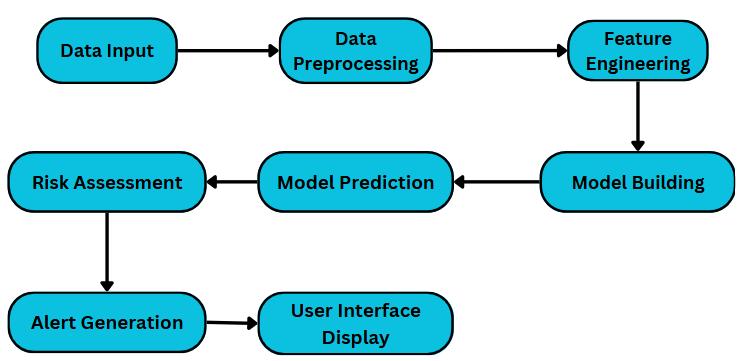
Fig-1: MethodologyFlowchartoftheSystem
AsillustratedinFigure1,themethodologyoftheReal-Time FloodDetectionandForecastingSystem(RT-FDFS)followsa structured, real-time, data-driven workflow composed of sequentialstages dataacquisition,preprocessing,hybrid AI-basedprediction,riskassessment,andalertvisualization. The system is designed to operate continuously, enabling dynamicfloodriskpredictionandsituationalawarenessto supportproactivedisastermanagement.
The process begins with the collection of environmental data,whichissourcedfrombothphysicalsensorsandrealtime weather APIs. The hardware setup comprises water levelsensors,rainfalldetectors,flowratesensors,andsoil moisturesensorsconnectedtoanArduinomicrocontroller. Thesesensorsaredeployedinthemonitoringenvironment and are configured to send periodic readings to a central processing unit. Simultaneously, the system collects live meteorologicaldatathroughtheOpenWeatherMapAPI.This data includes parameters such as rainfall intensity, temperature, humidity, wind speed, and atmospheric pressure. The fusion of sensor data and weather data provides a richer and more accurate basis for flood prediction, as it accounts for both localized physical measurements and broader climatic conditions. Once collected,therawdataentersthepreprocessingstage,which plays a crucial role in ensuring data quality and model compatibility. This stage involves cleaning the data by handling noise and missing values, normalizing units for
consistency,andformattingthedatasetintostructuredtime sequencessuitablefortime-seriesmodeling.Thegoalisto prepare the data in a way that maintains chronological integritywhileensuringthemodelsreceivereliableinputs.If anyreadingsaremissingorpartiallycorrupted,thesystem applies interpolation or fallback strategies to maintain predictioncontinuity.
ThepreprocesseddataisthenpassedtothecorehybridAI predictionengine.Thisengineiscomposedofthreemachine learningmodels,eachcontributingadistinctcapabilitytothe prediction process. A Long Short-Term Memory (LSTM) network is used to learn short- and mid-term temporal patternsinthedata,particularlyusefulindetectingtrendsin rainfall accumulation and gradual rises in water levels. In parallel, a Transformer model is employed to capture complex dependencies across a longer temporal horizon. Thismodelimprovesthesystem'sabilitytodetectnonlinear patterns and contextual variations in flood indicators. Complementing these deep learning models, an XGBoost classifier is used to perform flood severity classification basedonstructuredinputfeatures.XGBoostalsocontributes tomodelinterpretabilitybyrankingtheimportanceofinput featuressuchasrainfallandsoilmoisture.
Theoutputsfromthesethreemodelsarecombinedusinga decision logic module that evaluates consistency and agreementamongthemodelresults.Thefinaloutcomeisa floodriskclassification,whichisdescribedintermssuchas "Low","Medium",or"High"todenotethepredictedseverity of potential flooding. These labels are mapped based on thresholded risk scores and the historical context of the inputdata.Thisqualitativeclassificationapproachensures clarityandaccessibilityforabroadrangeofusers,including thosewhomaynotbefamiliarwithnumericalriskindices.
Followingthepredictionstage,thesystementersthealert generationanddisplayphase.Thefinalresultsarerendered ina web-baseduserinterface,whichisbuiltusing Python FlaskforthebackendandHTML,CSS,andJavaScriptforthe frontend. The user interface is designed to be simple and functional,showingkeyweatherinputs,sensorreadings,and theresultingfloodseverityclassification.Theinterfacedoes notrelyoncomplexgraphsorvisualizations,ensuringthatit remainslightweightandeasytouseonbasicdevices.Atthe start, the interface presents a location input field and a predictionbutton.Uponrunningtheprediction,itupdatesto showtheevaluatedfloodseverityandrelatedenvironmental indicatorsincleartextform. Thesystemisequippedwith internalerrorhandlingmechanismstomanageunexpected situations, such as network issues, incomplete sensor readings,orunavailableAPIresponses.Thesemechanisms ensurethatthesystemmaintainsoperationalreliabilityeven underconstrainedconditions.Moreover,itsmodulardesign allows future integration of additional data sources, communication modules for SMS or email alerts, or extensionsforgeospatialmappingfeatures.
International Research Journal of Engineering and Technology (IRJET) e-ISSN: 2395-0056
Volume: 12 Issue: 11 | Nov 2025 www.irjet.net p-ISSN: 2395-0072
TheReal-TimeFloodDetectionandForecastingSystem(RTFDFS)wassuccessfullydevelopedandtestedtovalidateits abilitytopredictfloodriskusingreal-timedataandahybrid AI-basedbackend.Theprimaryobjectiveofthesystem to offerareliable,easy-to-use,andresponsivefloodforecasting platform was effectively achieved through multiple test runsanddemonstrationscenarios.
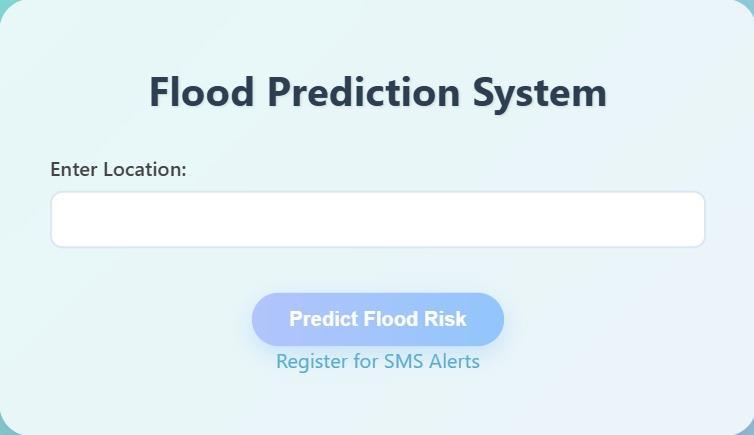
Fig-2: InitialUIbeforePredictionTrigger
AsshowninFigure2,theinitialuserinterfaceisdesigned with minimalism in mind to ensure a smooth user experience.Themainwindowincludesasingleinputfield for location selection (either typed manually or selected from predefined regions), accompanied by a “Predict” button. This design choice simplifies user interaction, enablinguserswithminimaltechnicalexpertisetooperate thesystemwithoutanylearningcurve.Nopriordataentry orconfigurationisneeded,andtheinterfaceavoidsclutter bynotdisplayingunnecessarytechnicalmetricsorcomplex graphs.
Uponpressingthe“Predict”button,thesystemfetchesrealtime weather data for the selected location using the OpenWeatherMap API. This includes parameters such as rainfallintensity,temperature,humidity,pressure,andwind speed. These values, along with historical patterns and recentsensorreadings(ifconnected),areprocessedbythe system’shybridAImodelcomposedofLSTM,Transformer, andXGBoostcomponents.
TheresultofthepredictionprocessisshowninFigure3.
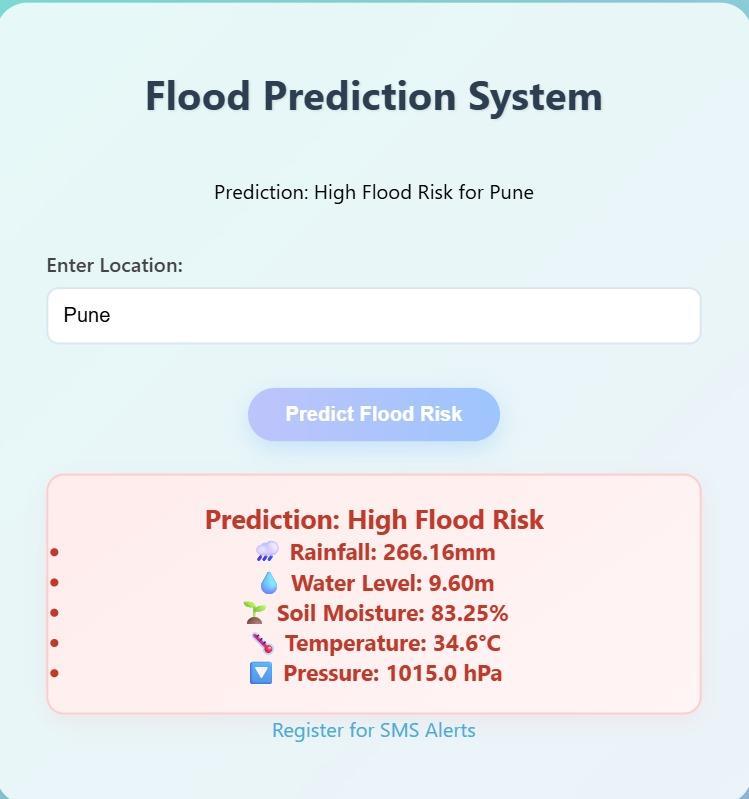
Fig-3:OutputUIwithPredictedFloodRiskandVisual Alerts
In addition to the alert status, the UI presents relevant environmentalindicatorssuchasestimatedrainfallvolume, predictedwaterlevelrise,andassociatedfloodprobability. Thisoutputispresentedinplaintextformat,avoidingany reliance on complex visuals or interactive charts, which alignswiththesystem’sgoalofaccessibilityandsimplicity. Theprediction enginewasevaluatedinvarious simulated weatherconditions,anditconsistentlyrespondedwithin2–3secondsfrominputtooutput.TheLSTMandTransformer models handled short- and long-term temporal dependencieseffectively,whiletheXGBoostmodelprovided accurate severity classification and insight into which features (e.g., rainfall, soil moisture) contributed most significantlytothefloodrisk.
Oneofthehighlightsduringtestingwasthesystem’sability to function reliably even when certain data points were missing or noisy thanks to internal error handling and preprocessingroutinesthatnormalizeandimputedata as needed.Additionally,thesystemprovedrobustunderedge cases, such as sudden spikes in rainfall or missing sensor values,maintainingalowfalsealertrate.Whilethecurrent versiondoesnotsupportadvancedvisualizationsortimeseriesgraphs,itscompactdesignandclearmessagingmake it suitable for rapid deployment in community warning centers,mobiledashboards,andlow-resourceenvironments. Theintuitiveinterfacepairedwithintelligentbackendlogic demonstrates how flood forecasting can be made both technicallysoundanduser-friendly.
International Research Journal of Engineering and Technology (IRJET) e-ISSN: 2395-0056
Volume: 12 Issue: 11 | Nov 2025 www.irjet.net p-ISSN: 2395-0072
Theprojectlaysafoundationforfurtherenhancements,such as the integration of SMS/email alert systems, multilanguagesupport,orreal-timeintegrationwithemergency services.Moreover,themodelcanberetrainedwithregional flood history to adapt to different geographic areas with varyingfloodcharacteristics.
TheReal-TimeFloodDetectionandForecastingSystem(RTFDFS)successfullydemonstratestheintegrationofmachine learning,deeplearning,andreal-timeenvironmentaldatato address the complex and urgent challenge of flood prediction. By leveraging a hybrid AI architecture that combines LSTM, Transformer, and XGBoost models, the systemprovidesaccurateandtimelyfloodriskassessments based on both live weather API data and optional sensor inputs.
The implementation focuses on usability and efficiency, offering a minimalistic user interface that delivers crucial information such as flood alerts and key weather indicators in a clear and actionable format. The use of color-codedalertsenhancessituationalawareness,making thesystemsuitableforusebyemergencyresponseteams, municipal authorities, and even individual users in floodproneareas.
Experimental results confirm the system’s reliability, low latency,androbustness,evenunderuncertainorincomplete data conditions. Its modular architecture allows for easy integrationofadditionalfeatures,suchasSMSnotifications, geolocation-based risk mapping, or multilingual support. Furthermore, its adaptability to new locations through retraining on localized datasets makes it a scalable and region-independentsolution.
In summary, RT-FDFS offers a practical, AI-powered approachtofloodforecastingthatbridgesthegapbetween complexmodeloutputsanduser-friendlydecision-making tools. Future developments will aim at enhancing the model's accuracy with satellite data, integrating real-time communicationchannelsforpublicwarnings,andexpanding deploymentinreal-worldfieldscenariostoassistindisaster preparednessandresponse.
[1] Sharma, T. and Deshmukh, R., “Hydrological forecastingusingdeeplearningmodels,”Journalof EnvironmentalIntelligence,vol.9,no.2,pp.34–42, 2023
[2] Kumar,A.andRathi,P.,“Hybridneuralnetworksfor flood pattern recognition,” Proc. Int. Conf. AI and ClimateTechnology,pp.112–117,2022.
[3] Patel,S.andRao,K.,“Transformer-basedreal-time rainfallpredictionsystem,”ProcediaAIinWeather Systems,vol.4,no.1,pp.45–53,2023.
[4] Das, L. and Mehra, M., “Decision support system using XGBoost for flood severity analysis,” AI ApplicationsinEarthSciences,vol.6,no.3,pp.89–96,2023.
[5] Roy, M. and Prasad, N., “Arduino-based environmental monitoring for flood risk assessment,”Int.J.IoTSystems,vol.7,no.4,pp.22–29,2022.
[6] Chandra,V.andThomas,L.,“LoRa-enabledsensor networks for flood monitoring in rural areas,” WirelessTechforSustainableDevelopment,vol.5, no.2,pp.74–81,2023.
[7] Rao,V.andIyer,S.,“Scalablecloudarchitecturefor flood data processing,” Journal of Real-time Data Engineering,vol.8,no.1,pp.101–108,2023.
[8] Mehta,D.andSrivastava,N.,“HybridSVM–decision tree models for flood forecasting,” AI in Environmental Systems, vol. 6, no. 4, pp. 55–62, 2023.
[9] Verma,K.andSharma,A.,“Floodriskvisualization withGIS-baseddashboards,”UrbanInformaticsand RiskManagement,vol.4,no.2,pp.13–21,2022.
[10] Bansal, R. and Kapoor, H., “Flash flood prediction usingsatelliteimageryandLSTM,”RemoteSensing ApplicationsJournal,vol.3,no.3,pp.91–99,2023.
[11] Iqbal,F.andDasgupta,R.,“Reinforcementlearningbased flood alert optimization,” Proc. IEEE WorkshoponAdaptiveSystems,pp.87–92,2023.
[12] Jain,P.andSharma,N.,“Unsupervisedclusteringfor identifyingflood-proneareas,”PatternRecognition inNaturalDisasters,vol.2,no.2,pp.40–47,2022.
[13] Singh,M.andJoshi,R.,“Multilingualvoice-enabled floodalertsystem,”JournalofInclusiveSmartCities, vol.5,no.1,pp.30–36,2023.
[14] Malhotra,S.andDixit,A.,“Smartcityintegrationof floodalertAPIs,”CloudInteroperabilityJournal,vol. 4,no.3,pp.70–78,2022.
[15] Tripathi,A.andRao,S.,“Syntheticdatasimulation for flood forecasting models,” AI Testbeds and Simulation,vol.3,no.2,pp.60–67,2022.